Introduction
This paper reports on a research study investigating the identity of secondary classroom music teachers in England and how far these teachers consider themselves as ‘musicians who teach’ or ‘teachers who teach music’. This study builds on research carried out into the biography of secondary music teachers (Dalladay, Reference DALLADAY2014). DeNora (Reference DENORA2000) suggests that biography is the ‘historical counterpart’ to identity and that identity is shaped, in part at least, by our life histories. The author of this paper has considered that it is appropriate to investigate the identities of English secondary school music teachers further (i.e. not including instrumental and peripatetic teachers) in order to more fully understand the how, why and what we teach in the classroom in attempting to develop musicianship in our students. In defining a musician, one might pay regard to Zhang et al. (Reference ZHANG, SUSINO, MCPHERSON and SCHUBERT2020), who discusses that being a musician involves three compenents: Skill (years of music training), Identity (‘I consider myself a musician’), and Predisposition (‘I can identify a given note’) (p. 390). However, this current paper’s author has taken the somewhat simplified definition of anyone who is activitely engaged with musical sound, though it is recognised that this will also involve some level of practice and training in securing progress (Dalladay, Reference DALLADAY2022; also Mills, Reference MILLS2005). Such musicians might include performers (making music with instruments, voices, technology), composing, directing and perhaps, arguably, even active listening when one is fully focused and engaged with the sound.
Developing identities as music teachers
Identity is a constantly shifting concept (Brewer, Reference BREWER2009; Shin, Reference SHIN2024) but, though defining it fully can be complex, it is generally accepted that it is to do with our sense of ‘being’: how we (and others) see ourselves and the characterisitcs of our personality (Tatum, Reference TATUM and Adams2000). In the case of music teacher identity, Shin (Reference SHIN2024) suggests that it is ‘constructed at the intersection between musician and teacher’ (abstract). In considering the identity of music teachers, as musicians and teachers, this study explores the relationship between three strands of identity that they possess: (1) our self-image, (2) that of being a musician, and (3) being a teacher (drawing from Roberts, Reference ROBERTS1991; Saunders, Reference SAUNDERS2008; Wagoner, Reference WAGONER2011; Hallam, Reference HALLAM, Hallam, Cross and Thaut2009; Reference HALLAM, MacDonald, Hargreaves and Miell2017). Other writers would extend this brief list to include, for instance, the four ‘facets’ of our ethical self, self efficacy, self-concept, and our possible selves (Chua & Welch, Reference CHUA and WELCH2020); or one’s conception of self as a range of factors, including ‘musician-teacher comprehensiveness (i.e. the broadness or narrowness with which one sees one’s self as a musician and as a teacher’ (Wagoner, Reference WAGONER2012, p. 13). For the purposes of this present research paper, the author has used the terms ‘personal identity’ to refer to one’s individual character traits that form identity, and ‘professional identity’ to refer to one’s identity as a musician (whether as a professional or not) and a music teacher.
The theoretical basis for the study is underpinned by Activity Theory, developed by Lev Vygotsky (Vygotsky, Reference VYGOTSKY and Cole1978; Leontiev, Reference LEONTIEV1978; Engeström, Reference ENGESTRÖM2001), itself based on his Socio-Cultural Theory developed in the 1920s (Vygotsky, Reference VYGOTSKY and Cole1978). In this, Social Learning Theory has its origins in the belief that a child’s parents and carers, peers, and culture contribute strongly to higher order thinking; that learning is both an individual and social function (Yusof, Reference YUSOF2021). This theory also influenced the work of Bronfenbrenner, whose ‘ecological model’ also emphasises the influence of social and cultural backgrounds in the development of children (Bronfenbrenner, Reference BRONFENBRENNER1979). The importance of this is particularly pertinent to the present author as, being a classroom music teacher for over forty years, he has been reserved in defining himself as a musician due, in large part, to an un-musical background and a late-developing music education. To this extent, the research can be said to be ethnographic and arises out of the author’s personal experiences and philosophies and a consideration of how these issues have impacted the effectivess of his teaching over the years (Dalladay, Reference DALLADAY2022). The theoretical underpinnings have led to the development of two models of music teacher identity, created by the author previously (Figures 1 and 2) (Dalladay, Reference DALLADAY2014).
A model of the developing music teacher identity (Dalladay, Reference DALLADAY2014).

A model of the musician-teacher identity (Dalladay, Reference DALLADAY2014; 2022 with some development).

The first model (Figure 1), ‘a model for the developing music teacher identity’, considers the three identity strands highlighted earlier: the identities of self, musician and teacher. This demonstrates the notion that the characteristics of self-image (or self-identity) impact upon the development of the identity as a musician, such as in the shaping of personality by the environment in which we grow and which interacts with the musician’s developing musical expertise, interests, education and role (e.g. as performer or composer) (McPherson et al., Reference MCPHERSON, DAVIDSON and FAULKNER2012; Hallam, Reference HALLAM, MacDonald, Hargreaves and Miell2017). Self-identity and identity as a musician then both influence, and are influenced by, a developing interest in passing expertise and knowledge on to others, i.e. taking on a teaching role, embarking on teacher training, subsequent entry to the teaching profession, and the values and beliefs which shape what is presented to their students in the classroom (Isbell, Reference ISBELL2008; Thornton & Bergee, Reference THORNTON and BERGEE2008 in Rickels et al., Reference RICKELS, COUNCILL, FREDRICKSON, HAIRSTON, PORTER and SCHMIDT2010; Teachout & McKoy, Reference TEACHOUT and MCKOY2010). Emerging from this ‘mixing bowl’ of developing teacher identity, external forces also have a role to play including, inevitably, potential tensions and conflicts: local and national policy, curriculum, school values, tutors and colleagues, the pupils themselves (Hadfield & Atherton, Reference HADFIELD and ATHERTON2008; Chua, Reference CHUA2018).
In preparing for the second model (Figure 2), ‘a model of the musician-teacher identity’, one which complements and develops on from the first, several aspects played a part. In particular, identity was explored through the lens of the aforementioned Activity Theory (Vygotsky, Reference VYGOTSKY and Cole1978) where the subject was taken as a trainee music teacher. It was Activity Theory that demanded a consideration of the influences and forces acting upon the development of the subject, viz.:
-
• mediating artefacts – aspects of one’s personality and experience (e.g. education, background);
-
• rules that impact upon the subject’s development as a teacher – such as the regulations for qualifying as a teacher, local and national policy, examination specifications, etc.;
-
• the impact from within the community of practice (Wenger, Reference WENGER1998) – models, pupils, peers, colleagues;
-
• the division of labour – training institutions, schools, government direction, self-motivation.
These four aspects form the first part of the model of the ‘musician-teacher’ identity (Figure 2).
This current study makes use of the model at Figure 2 as part of the research through discussion on the validity and reliability of it in the participants’ experience. The research has, also, sought to explore the veracity of the assertion that it is not uncommon for the musician-teacher to consider themselves first as musicians and second as teachers (Saunders, Reference SAUNDERS2008), and that these identities operating at the same time in a music teacher’s career can both complement each other and cause conflict (Ballantyne & Zhukov, Reference BALLANTYNE and ZHUKOV2017; Shin, Reference SHIN2024, Ramsey et al., Reference RAMSEY, GRAHAM, DRAVES and BROOKS2024); that interviewees in Ballantyne’s research (Reference BALLANTYNE2005, p. 5) ‘tended to categorise themselves as a musician who happens to be teaching, a music teacher [or] a teacher who teaches music’ (also 2017). Townshend (Reference TOWNSHEND2024) goes a little further by suggesting that these positions, as being primarily musician or teacher first, have a tendency to shift (also, Bernard, Reference BERNARD2005); and Ramsey et al. (Reference RAMSEY, GRAHAM, DRAVES and BROOKS2024, pp. 396–397), comments that these two roles of musician and teacher can either complement or conflict with each other ‘in the development of one’s music teacher identity’ (echoed also in Shin, Reference SHIN2024).
Participants and methodology
There have been two methods of data collection in the study this paper reports on: (1) an online questionnaire and (2) online interviews with a selection of those who participated in the questionnaire. In both cases, the sampling strategy deployed has been of ‘voluntary sampling’ within the ‘non-probability’ strategy (Blaxter et al., Reference BLAXTER, HUGHES and TIGHT2008). Participants volunteered to take part in the online questionnaire through invitation via professional associations – Music Mark (The National Association for Music Education) and The Music Teachers’ Association (MTA) – or, in a few cases, through direct contact by the author with past associates (seven in total). The invitations were targeted at current secondary (11–18) music teachers or those who have been in the recent past. Of those who were not currently teaching (n = 6), they include the recently retired and those who are still involved in music education in other capacities, including some teaching. It was deemed that these had sufficient and recent knowledge of music teaching to be included in the data set. It is possible that the full participant cohort is not particularly representative of the secondary music teacher population as a whole, but the significantly random nature of the vast majority of the invitations to those who were, largely, unknown to the researcher has, hopefully, ensured some generalisation.
In the case of the interviews, all those who provided contact data in the questionnaire were subsequently invited to interview (69% of the cohort) except one ‘late entry’. Fourteen accepted the invitation and were interviewed.
Questionnaire
Forty-eight responses have been received in total. Participants are referred to by alphabetic code from A1 through Z1, and continuing with A2 through V2. Those who were subsequently interviewed were, additionally, given pseudonyms (see below). The respondents were given the opportunity to participate anonymously, though they were asked to provide a name and email address if they were willing to participate in the subsequent interview. Ethical considerations were outlined to the participants through the introductory page of the questionnaire and, as the researcher is independent of any educational institution, he followed the guidance laid out in the ethics guidance from BERA (The British Educational Research Association), published on their website, fifth edition, 2024 (https://www.bera.ac.uk).
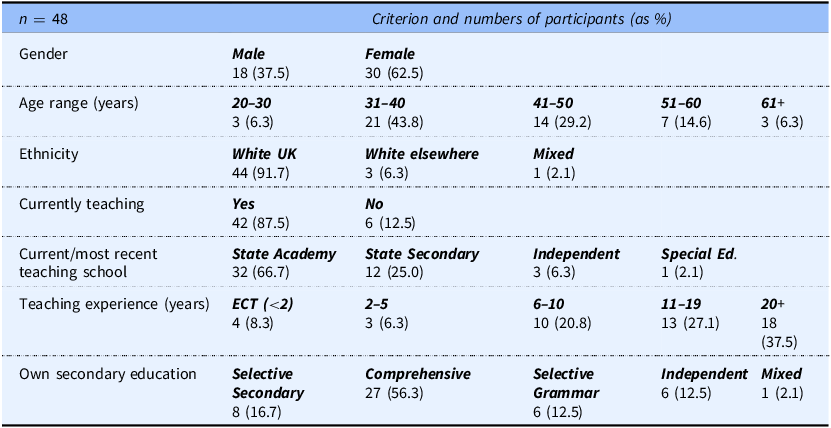
A selection of the most salient contextual data regarding the questionnaire participants can be found in Table 1 (n = 48; data presented as numbers and (in brackets) percentages):
Contextual data drawn from the online questionnaire (n = 48)

Table 1 Long description
The table presents contextual data from an online questionnaire with 48 participants. It has 8 rows and 6 columns, including headers. The columns are Gender, Age range, Ethnicity, Currently teaching, Current/most recent teaching school, Teaching experience, and Own secondary education. Each row provides the number and percentage of participants fitting specific criteria. For example, 18 males (37.5 percent) and 30 females (62.5 percent) participated. Age ranges are divided into 20-30, 31-40, 41-50, 51-60, and 61+, with respective participant counts and percentages. Ethnicity is categorized into White UK, White elsewhere, and Mixed. Teaching status is divided into Yes and No. Current/most recent teaching school types include State Academy, State Secondary, Independent, and Special Education. Teaching experience is grouped into ECT (<2 years), 2-5 years, 6-10 years, 11-19 years, and 20+ years. Own secondary education types are Selective Secondary, Comprehensive, Selective Grammar, Independent, and Mixed.
It is to be noted, the apparent imbalance resulting from the responding participants in reference to ethnicity in particular, where, apart from one respondent of mixed race origin, all are white British or elsewhere. The author has had no control over those who responded to the invitation to take part in this research but acknowledges a potential for skewed data as a result.
Online interviews
Fourteen participants agreed to take part in an online interview of about one hour. These interviews were semi-structured with a range of common questions presented to each but, also, with some individual ‘tweaks’ depending on their responses to certain questionnaire questions and the development of the conversation.
Interviews were recorded as audio files. In analysing these data, listening back to the recordings has enabled the identification of common factors and trends, such as: the participants’ views on their identity, the values which underpin their musicianship and teaching, and driving/restricting forces which impact on the development of their musicianship and teaching.
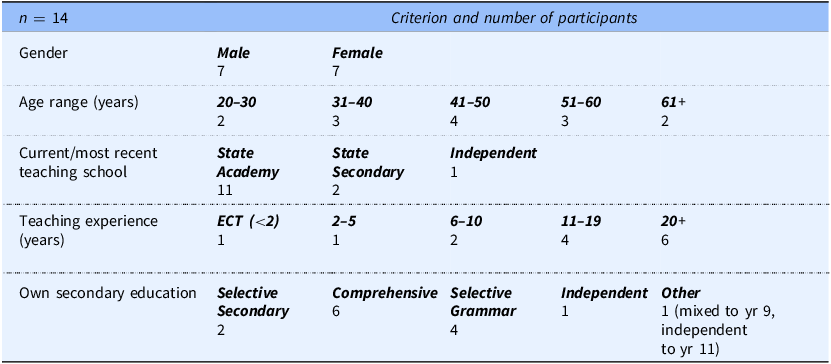
The fourteen participants have been assigned pseudonyms (in addition to the alphabetic code detailed above): Kate (A1), Susan (D1), Phyllis (J1), Laura (K1), Mary (R1), John (W1), Peter (C2), Catherine (H2), Arthur (L2), George (M2), Alice (O2), Daniel (Q2), Thomas (S2) and James (T2). Of these, their contextual data includes (see Table 2):
Contextual data relating to the research interviewees (n = 14)

Table 2 Long description
The table presents contextual data for 14 research interviewees, organized into five categories: Gender, Age range, Current/most recent teaching school, Teaching experience, and Own secondary education. The table has 5 rows and 4 columns. Row 1: Gender, Male 7, Female 7. Row 2: Age range (years), 20-30 2, 31-40 3, 41-50 4, 51-60 3, 61+ 2. Row 3: Current/most recent teaching school, State Academy 11, State Secondary 1, Independent 1. Row 4: Teaching experience (years), ECT (<2) 1, 2-5 1, 6-10 2, 11-19 4, 20+ 6. Row 5: Own secondary education, Selective Secondary 2, Comprehensive 6, Selective Grammar 4, Independent 1, Other 1 (mixed to yr 9, independent to yr 11).
Findings and discussion
Three principle research questions are explored in this section:
-
(1) How far do the participants consider themselves to be principally musician and/or teacher?
-
(2) Is there any correlation between aspects of identity and character traits (such as introversion/extroversion)?
-
(3) Would participants wish to recommend developments to the model of musician-teacher identity (Figure 2)?
How far do music teachers consider themselves to be musicians or teachers first?
One of the principle considerations for investigation is the veracity of the assertion that it is not uncommon for music teachers to think of themselves as musicians before teachers (Saunders, Reference SAUNDERS2008) and that these identities have long been considered to complement or conflict each other (Shin, Reference SHIN2024; Ramsey et al., Reference RAMSEY, GRAHAM, DRAVES and BROOKS2024). It is the contention that differences in how the musician-teacher see themselves may have some part to play in what and how they teach. Where teachers see themselves primarily as a musician first (MF), they will quite possibly seek a musical life beyond the school, often performing in professional and amateur music-making activities (Durrant & Laurence, Reference DURRANT, LAURENCE, Hallam and Creech2010; Welch et al., Reference WELCH, PURVES, HARGREAVES and MARSHALL2011) and in the development of musicianship in their charges (Laing, Reference LAING2013). Alternatively, for those who see themselves primarily as teacher first (TF), their focus may be more likely on the techniques of knowledge and skill transmission, and the ‘life’ of in-school music (Dalladay, Reference DALLADAY2014). This dichotomy may partly lie in what Ballantyne & Zhukov (Reference BALLANTYNE and ZHUKOV2017) term ‘praxis shock’, where the ‘expectations of teaching life do not match up with the realities of teaching’ (p. 241), and that one of the contributors to praxis shock is ‘the nexus between their perceptions of themselves as musicians and as educators’ (p. 242). It is possible, however, that those who are TF are more committed to their role of developing the musicianship of their students than those who are MF, as the latter may be teaching in extremis when not in receipt of professional engagements at the time, and be less invested in the development of their students (Reference VAN ELSLANDEVan Elslande, n.d.). Additionally, there is the notion of what it is to be a musician that has already been alluded to in the introduction to this paper. More recently, this notion seems to have shifted from, almost exclusively, being in the realm of a performer or composer (mainly the former) (Zhang et al., Reference ZHANG, SUSINO, MCPHERSON and SCHUBERT2020) to now including those who create and recreate music using digital technology, or they direct ensembles, arrange pre-exisiting music, or can even be active listeners (Hallam, Reference HALLAM, MacDonald, Hargreaves and Miell2017; Zhang et al., Reference ZHANG, SUSINO, MCPHERSON and SCHUBERT2020). Teaching, itself, has also shifted over time, from teachers being a ‘master’, to ‘tutor, to ‘learning facilitator’ (Concina, Reference CONCINA2023). All the participants in this research, without exception, listed more ‘traditional’ Western instruments in terms of what they performed with only one reference to music technology being part of their degree studies.
Questionnaire participants were requested to indicate on a continuum (see below) where they considered their identity, ranging from completely musician (M5) to completely teacher (T5), where ‘0’ indicated that they felt both of these identities on an equal basis.
Please indicate where you feel your own musician-teacher identity currently lies from fully musician to fully teacher.
M5
M4
M3
M2
M1
0
T1
T2
T3
T4
T5
Musician-Teacher Continuum
__
__
__
__
__
__
__
__
__
__
__
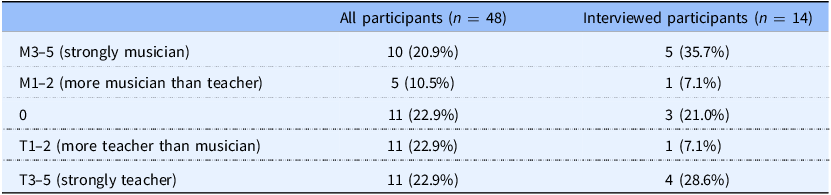
The results from this task can be summarised as shown in Table 3 (n = 48):
How do music teachers view themselves: musician first or teacher first? (n = 48) results from plotting views of the musician-teacher identity along a continuum from M5 through 0 to T5

Table 3 Long description
A table comparing how music teachers view themselves as musicians or teachers. The table has two columns: All participants (n = 48) and Interviewed participants (n = 14). It has five rows labeled M3-5 (strongly musician), M1-2 (more musician than teacher), 0, T1-2 (more teacher than musician), and T3-5 (strongly teacher). Row 1: M3-5 (strongly musician), All participants 10 (20.9 percent), Interviewed participants 5 (35.7 percent). Row 2: M1-2 (more musician than teacher), All participants 5 (10.5 percent), Interviewed participants 1 (7.1 percent). Row 3: 0, All participants 11 (22.9 percent), Interviewed participants 3 (21.0 percent). Row 4: T1-2 (more teacher than musician), All participants 11 (22.9 percent), Interviewed participants 1 (7.1 percent). Row 5: T3-5 (strongly teacher), All participants 11 (22.9 percent), Interviewed participants 4 (28.6 percent).
These data clearly seem to contradict Saunders’s assertion (above), as there are several who view themselves as TF rather than MF, though the data is not particularly conclusive, especially within the interviewed group (all participants: 15 as MF and 22 as TF; interviewed group: 6 as MF and 5 as TF). This exploration of musician and teacher roles and their changing importance has been consistently a part of academic discussion for a long time (Ramsey et al., Reference RAMSEY, GRAHAM, DRAVES and BROOKS2024), and the nature of the curriculum and teacher role has ‘shifted’ from the ‘transmission of traditional praxis to an approach that is more focused on the overall development and personal growth of pupils’ (Concina, Reference CONCINA2023, p. 2).
Participants were also invited to comment on the ‘score’ that they had entered on the continuum. Laura (participant K1), who judged herself as ‘M4’ on the continuum, stated that she always maintained her ‘own performing life despite teaching for 34 years’; and Peter (C2) (scoring as ‘M5’) said that if he ‘did not continue to be a musician outside of the secondary school environment, [he did] not believe that [he] would enjoy [his] current role’ as much as he does. On the other hand, Catherine (H2) at the other end of the musician-teacher continuum (‘T5’) comments that she ‘was told during [her] PGCE that you are one or the other. It is near impossible to be both due to the amount of time teaching takes out of your life and education in general’; and Kate (A1) (‘T4’) has been a little more equivocal by suggesting that she considers her identity at work to be that of ‘teacher’, ‘but I bring my musician identity into my role, and my expectation of myself is as a musician’. In the central position, at ‘0’ on the continuum, Alice (O2) says that ‘teaching takes up much of my time and doesn’t leave much time for rehearsing but I feel that my musician identity is also being built by what I do in the classroom’; and Arthur (L2), rather even-handedly, states that he performs ‘professionally in different situations on at least a weekly basis… When performing I often notice opportunities to develop the skills of other performers. When I teach I am able to bring the air of a musical performance into the classroom’.
It would seem apparent from the data that most participants who completed the questionnaire believe that, in order to preserve any identity as a musician, one needs to be performing in out-of-school contexts, at least occasionally. This point was put to George (participant M2, a brass player) in his interview. He was asked: if one is not currently performing (for example, in an orchestra, band or choir), then could one still define oneself as a musician? He responded, ‘I think to a large level, that’s true. I think it really is important as a music teacher, that I keep my own musical skills and interests going outside of the classroom, and I play in a couple of ensembles’. Such a view also does not seem to change with age or experience. George has been a teacher in excess of twenty years but Alice (O2, a woodwind player), who had only taught for between two and five years, has similar views when she comments that someone with an identity as a musician is a ‘practising musician… actively doing music and engaging’ with it. This view concurs with that of Shin (Reference SHIN2024), who argues that ‘while playing their instruments outside the classroom, several music teachers understood the importance of music in their lives, which was essential in constructing music teacher identities’ (p. 254, abstract). However, these views do seem to contradict that made in this study’s earlier pilot when one participant (an Early Career Teacher (ECT)): one who has been teaching for less than two years) stated his position that he was ‘simply on a journey as a musician, and that this part currently lies in education’; and another participant (also an ECT) made the eminently striking observation that ‘when I first began teaching I was a teacher because I was a musician. Now, I am a musician because I am a teacher’ (Dalladay, Reference DALLADAY2023). The latter considers that she has developed as a musician through music teaching. However, all those in the current study have admitted to performing and presenting practical exemplars to their students in the classroom, i.e. that they are being a practising musician with their pupils.
One additional point of interest in these data concerns those who declared themselves as having an ‘operating genre’ (defined as the principle music genre one is educated in) of ‘classical’ and those who did not, or who had mixed operating genres (for the purposes of this paper, these will be termed ‘other than classical’):
‘Other than classical’ music teachers seem to be more polarised in the way that they see themselves in Table 4, with significantly more who see themselves as both MF and TF than the ‘classical’ music teachers, and with far fewer identifying themselves as equally both. There has been no data, thus far, that has shed light on the reasons for the results in this table.
The manner in which those with different ‘operating genres’ view themselves – as musician first or teacher first results from plotting views of the musician-teacher identity along a continuum from M5 through 0 to T5

Table 4 Long description
A table comparing how musicians and teachers view themselves across different genres. The table has 2 rows and 3 columns. The columns are labeled Operating genre, M1-5, and T1-5. The rows are labeled Classical and Other than classical. For Classical (n = 26), the values are: M1-5: 7 (26.9 percent), 0: 10 (38.5 percent), T1-5: 9 (34.6 percent). For Other than classical (n = 22), the values are: M1-5: 8 (36.4 percent), 0: 1 (4.5 percent), T1-5: 13 (59.1 percent).
According to the data, music teachers who think of themselves as MF do not outweigh those who think of themselves as TF. One possible reason might be that many of the participants in this study have implied, through the data, that teaching is rather all-consuming; that this can mitigate against opportunities to perform and make music out-of-school. When this happens, their comments further suggest that they think of themselves less as musicians. Views such as this can be exemplified in statements such as this, from respondent P1:
‘Despite my childhood being filled with performing and being competent on a number of instruments I rarely play any more except for examples in the classroom. I don’t have time as teaching is all-consuming. I really miss playing in orchestras and hope once I retire to be able to join a local orchestra. I am definitely more a teacher now than a musician, something that in my early 20s I wouldn’t have believed’.
Further, another questionnaire participant (Q1) makes the point that ‘for the last two years I worked solely as a teacher but am now working as a musician in two bands’; and another: ‘I don’t have time to be a musician’ (X1). Amongst those who were interviewed, Catherine (H2), as already reported, was told that she could not be both a musician and a teacher, and Thomas (S2) states that he is ‘a full time music teacher but [does] sometimes go and play with professional music groups/orchestras’. Several of the research participants seem to interpret the term ‘musician’ a someone who actively and currently takes the role of performer, and that one has to continue to be a regular performer (beyond school) in order to retain identity as a musician. This raises a significant question: can one lose one’s identity once it has been established (e.g. as a musician), if such identity is no longer reinforced later in one’s development? This data suggests an answer of ‘yes’ and this is reflected in Hallam (Reference HALLAM, MacDonald, Hargreaves and Miell2017) who argues that if music teachers ‘actively engage in making and creating music they can describe themselves as a musician’ (p. 2). If a musician-teacher loses their sense of being a musician due to the pressures of their teacher role, one can only wonder (and this study has no answer as yet to this quandary) whether this is disadvantageous to seeking to develop the next generation of musicians. This question will form a future phase of research for this current author.
Finally, in this section, it is interesting to note that the apparent conflict of musician- and teacher-roles reported in the data by some respondents takes scant regard of the argument that ‘making music outside the classroom help[s] music teachers feel refreshed and revitalised, making them better able to respond to students’ needs’ (Shin, Reference SHIN2024, p. 255) and that ‘music teachers are also good musicians’ (Concina, Reference CONCINA2023, p. 17).
Some of the character traits of the musician-teacher
Kemp (Reference KEMP1996) argues that, in general, musicians have a tendency towards introversion, though there are differences between different ‘types’ of musician: for example, brass players tend to be more extrovert than string players, and jazz musicians more extrovert than ‘classical’ musicians. Teachers, however, are thought of as most effective if they are more extrovert (ibid.). Therefore, it is appropriate that the current study includes some questions that relate to character traits, such as extro/introversion. Participants were provided with seven statements to which they were asked to respond with one of five responses: ‘not applicable’, ‘not usually’, ‘sometimes’, ‘usually’, and ‘very much true’ for them. These statements were:
-
1. I would generally describe myself as introverted;
-
2. I would generally describe myself as extroverted;
-
3. I find that performing/composing with other musicians is vital to my own identity;
-
4. I like to perform on my own;
-
5. I like to compose on my own;
-
6. My pupils view me mainly as a musician;
-
7. My pupils view me mainly as a teacher.
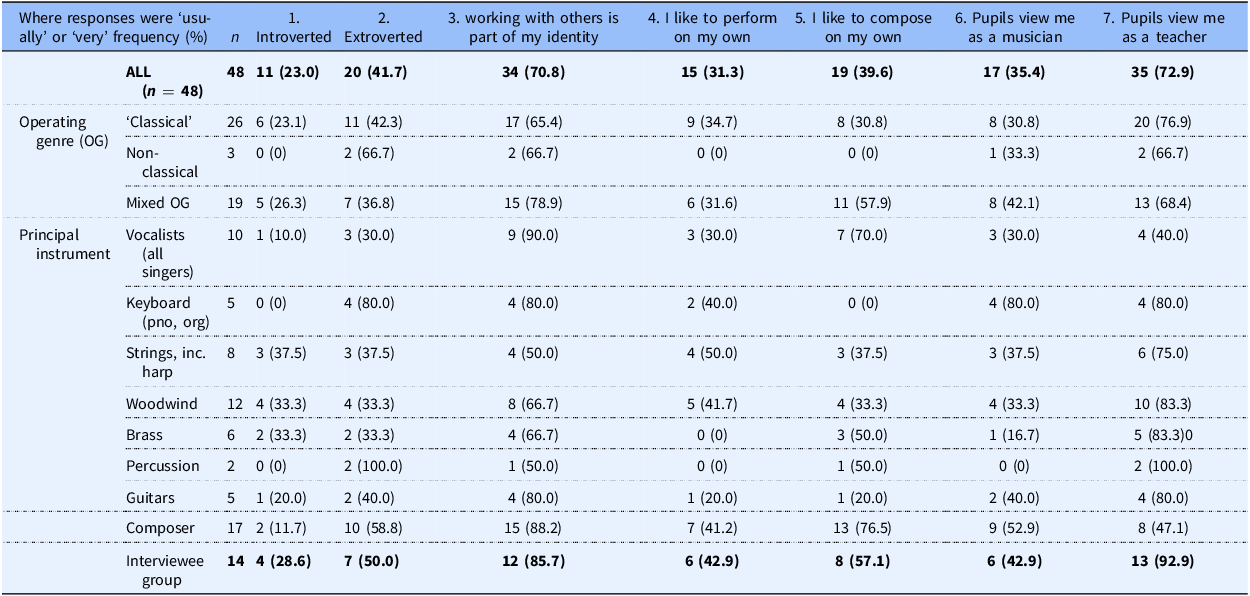
The results from the questions, where participants indicated ‘usually’ or ‘very much’ as their responses, can be found in Table 5:
Results of questions related to how the research participants view their own character traits where responses were ‘usually’ or ‘very’ in agreement. (In each cell, the frequency of responses has been recorded together with the percentage of ‘n’ in brackets.)

Table 5 Long description
A table comparing how research participants view their character traits. The table has 48 rows and 7 columns. Column headers are: Where responses were 'usually' or 'very' frequency (percent), n, Introverted, Extroverted, Working with others is part of my identity, I like to perform on my own, I like to compose on my own, Pupils view me as a musician, Pupils view me as a teacher. Row labels include Operating genre (OG) and Principal instrument. Each cell contains the frequency of responses and the percentage of n in brackets. Notable trends include high percentages for 'Working with others is part of my identity' and 'Pupils view me as a teacher'.
Table 5 highlights that a significant majority of participants self-declared themselves as extrovert rather than introvert, even those with a background in Western ‘classical’ genres, by a ratio of nearly 2:1. Yet, within these data, differences can be discerned: for example, composers (often a solitary activity in Western ‘classical’ music genres) seem to rate themselves as being five times more extrovert than introvert; and, even within instrimentalists, there seem to be more or, in some cases, the same. However, it must be acknowledged that the respondents are all teachers and, seemingly, music teachers are often more extrovert than musicians in all fields (Kemp, Reference KEMP1996). Those who admitted in interviews to being introvert also acknowledge that, when teaching, their role was rather akin to that of being an actor: that they appear to be more extrovert in front of the pupils than they actually felt.
We can see a similar pattern in Table 5 in the ‘sociability’ of the respondents; that is those who enjoy performing and/or composing with others rather than solitarily. Across the entire participant cohort, again, the result is around double for those who enjoy making music with others than those who do so less. Music, by and large, is a social activity (Coates, Reference COATES2023) and it is possible to witness music-making in ensembles of a range of different sizes wherever music is seen and heard.
What is potentially more surprising in these data (Table 5) is that only about one-third (35%) of the participant cohort believe that their pupils view their teachers as musicians whilst around 73% believe that their pupils view them as teachers. The interviewed participants said that they did perform, though, and provide compositional exemplars, to their students in the course of their learning and approximately 43% of these teachers’ students are thought to view them as musicians. However, the data suggest that these students represent only a third of all those who recognise their music teachers as practising musicians (6 students out of 17).
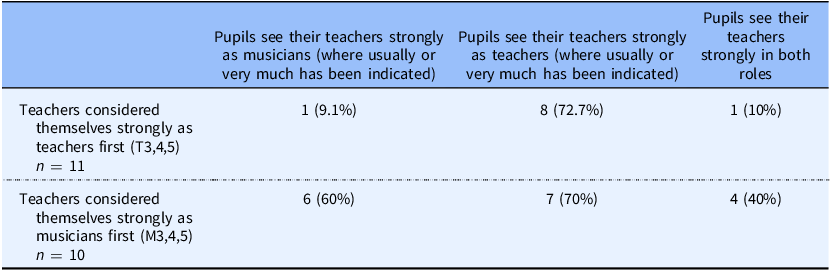
Catherine, for example, a teacher who admits to demonstrating music-making activities in most lessons including, at times, performing alongside her students, states that ‘I do all of that alongside them and the reason why I’m saying they would see [me] more as a teacher is because every time I do that, they kind of go ‘oh, I forgot you could do that‘.’ So, despite the fact that she is a teacher, every time she plays with the students she thinks that they always consider that it’s part of her role of being a teacher rather than that of being a musician. Peter, on the other hand, a music teacher who is also musically highly active in the community, is very clear that his students view him as a musician; that, on occasion, they will even attend public events in which he performs, and that he has a vibrant social media presence which is known by his students, colleagues and the school’s senior management. The majority of the interviewed participants in this study align themselves more with the position of Catherine rather than Peter. It is interesting to note, though, that on the continuum of the musician-teacher identity, Catherine placed herself at T5 and Peter, M5: fully music teacher and fully musician respectively so, possibly, the way in which the teacher views their own identity is reflected in the way their students also view them. Indeed, on closer examination of the data, there does seem to be some correlation: of those teachers that placed themselves on the continuum as T3-5 (strongly viewing themselves as TF; n = 11), 73% judged that their students also saw them strongly as music teachers (‘usually’ and ‘very much’); whereas, of those who placed themselves as M3-5 (strongly viewing themselves as MF; n = 10), 60% judged that their students also saw them strongly as musicians (‘usually’ and ‘very much’), though there were 70% who also saw them strongly as teachers, with 40% seeing them strongly in both roles (see Table 6).
The correlation between the research participants’ identity and the way their students viewed them (according to the same participants)

Table 6 Long description
A table with two rows and four columns. The columns are labeled as follows: Pupils see their teachers strongly as musicians, Pupils see their teachers strongly as teachers, Pupils see their teachers strongly in both roles. The row labels are: Teachers considered themselves strongly as teachers first (T3,4,5) n = 11 and Teachers considered themselves strongly as musicians first (M3,4,5) n = 10. Row 1: Teachers considered themselves strongly as teachers first (T3,4,5) n = 11. Pupils see their teachers strongly as musicians: 1 (9.1 percent). Pupils see their teachers strongly as teachers: 8 (72.7 percent). Pupils see their teachers strongly in both roles: 1 (10 percent). Row 2: Teachers considered themselves strongly as musicians first (M3,4,5) n = 10. Pupils see their teachers strongly as musicians: 6 (60 percent). Pupils see their teachers strongly as teachers: 7 (70 percent). Pupils see their teachers strongly in both roles: 4 (40 percent).
Having explored data on identity and character traits of the research participants, let us next consider the model of musician-teacher identity illustrated at Figure 2, discussed with interviewees as part of the research described in this paper.
The model of the musician-teacher identity
Interviewed participants were asked to consider the model of the musician-teacher identity (Figure 2), sent to them prior to the interviews. Participants were asked to consider four questions (not necessarily presented in the exact same wording, as it depended on the context of the ‘conversation’ of each individual at that point):
-
a) How far do you consider this model to be an accurate representation of the musician-teacher identity?
-
b) Are there any aspects which you feel could be further developed or edited?
-
c) Are there any aspects of this model that have provided you with any ‘food for thought’ in your own work/practice?
-
d) On an examination of the final (right-hand) ‘box’ containing the three teacher ‘typologies’ suggested by Hogg (Reference HOGG1994), what type of teacher do you consider yourself to be and which would you aspire to?
In answer to the first two questions above, all fourteen interviewees considered that this was an accurate ‘picture’ of their identity as a musician-teacher. Few suggestions relating to edits, aspects to add/delete, or further developments of the model were made. Those that were suggested could be thought of as reasonably minor and cosmetic (e.g. that a teacher supports students in composing when one is not necessarily a ‘good’ composer oneself, which might need some further representation within the model (Kate)). Some of the participants (e.g. John) also mentioned the compromises that have to be made between musician and teacher identities where school and personal educational philosophies clash.
In response to the third question posed above, several participants commented that the model had provided some ‘food for thought’ but few made deeper observations than a ‘yes’, though they appreciated the value of a graphical representation of the thoughts they had already considered. The fourth question above, though, prompted some insightful and important points for consideration. Most particularly, the respondents felt that, whilst all three typologies were going to be simultaneous traits of many music teachers, they largely recognised the roles of the first two in themselves (a teacher of ‘music as knowledge’ and as ‘an accomplishment’), but that they would like to think that they were also teachers of ‘music as an empowering agent’ (Hogg, Reference HOGG1994). Catherine made the comment, however, that, in her view, music is not always taught in the classroom as if it is an empowering agent.
Susan made the observation that ‘the more one learns [that is, the pupil], it is possible to become less empowered rather than more’. She elucidated that, when the students become more knowledgeable and more skilled as musicians, they also begin to realise how far they fall short of their ‘ambition’ (the author’s word, not Susan’s); that they feel they can never live up to what they listen to, and subsequently they may become de-motivated.
Implications, recommendations and conclusion
The research and its associated data described in this paper clearly has its limitations, largely for two reasons:
-
(1) it is a small study, just 48 participants. Therefore, it is possible that generalisations for all secondary classroom music teachers can not be made. The sample is large and random enough, though, that it can identify some trends within musician-teacher identity and suggest outcomes that might be applied to others;
-
(2) as a retired independent researcher, the author has limited access to schools and classrooms in order to observe teaching and learning; to see for himself how the teachers’ identity ‘translates’ into practice in lessons. He has had to rely, somewhat, on the reliability of the participants’ own judgements. Again, suggesting generalisations for teachers across the sector may be viewed as problematic.
Despite these two potential limitations, it is possible for some significant observations to be made as a result of the data which may highlight trends and recommendations for the population as a whole.
One of the most significant observations that these data infer is that those who view themselves as musicians above their role as teacher, may also likely teach their students as if they are educating the next generation of musicians and make some strides in attempting to develop musicianship in the students rather than simply provide a range of ‘taster’ sessions as part of their curriculum (Dalladay, Reference DALLADAY2017). The latter might interest students and develop some skill and knowledge, but may not put over the nature of music as an ‘empowering agent’ (Hogg, Reference HOGG1994) in their students’ lives.
It can also be argued that in a subject such as music, teachers place importance on their identity as musicians; that this is central to their lives and forms part of the rationale for entering the teaching profession in the first place – to pass that passion on to others. Future research might explore how far this is also true in other curriculum subjects. It can be argued, for instance, that, whilst music, drama, art and sports teachers may consider themselves as active musicians, actors, artists and sportsmen/women, there is is the possibility that not many science teachers (for example) will also identify themselves as active scientists (Roberts, Reference ROBERTS1991).
Two potential conflicts in the development of the musician-teacher identity that have been identified by many of the participants in this research have included that (1) teaching is a time consuming job that leaves little time for teachers to develop further their own musicianship; that this can only be detrimental to the development of their students; and (2) they feel disenfranchised and restricted in the planning and delivery of the curriculum they would most like to cover in school because of curriculum constraints, differences in educational philosophy between school management and themselves, and from the perception of many music teachers that their subject is not always considered important by their school. As Mary has highlighted:
‘I am more and more considering leaving my position to take on work in any other line of work. Even in supportive schools it seems to be hard to be trusted as a professional…’
Mary’s point here would seem to corroborate the research of Shin (Reference SHIN2024) who, whilst referencing other writers to support his argument, makes the point that:
‘Many researchers and educators consider there to be tension in the combined role of musician and teacher, especially when new music teachers do not feel that schools support musician identity’.
and he goes further by adding,
‘However, other researchers in recent studies have focused on the balance between musician and teacher identities, indicating the importance of both musicial and teaching skills and knowledge in constructing music teacher identity’. (p. 254)
The implications and recommendations that spring from this research can be summarised:
-
• Music teachers should be considered as professionals in their sphere as well as teachers, and that increased freedom over curriculum and approaches adopted in individual schools and classes should be facilitated. Hadfield & Atherton (Reference HADFIELD and ATHERTON2008) argue that education has increasingly adopted the practice that we are a ‘culture of compliance’ and that this is restrictive to teachers (and, perhaps, their students);
-
• If a music teacher recognises the ‘musician’ within themselves, the more likely their students will also see themselves as musicians;
-
• If the previous statement has any validity (as this current research would suggest that it does), musical activities and lessons will more likely focus on musicianship and the development of practising musicians (not only as professionals, but also as amateurs);
-
• It can be advantageous if music teachers could understand their identity as a musician-teacher and be given the opportunity to reflect on this and the implications for their teaching (e.g. through CPD);
-
• Schools and government would do well to recognise that music teachers will have professional identity founded on their expertise as a musician, and not solely as a teacher; that such a recognition could be beneficial in aiding and develop the students’ own musician identity.
Finally, a question that has particularly arisen during this current research and should now form part of the future research is whether, if a music teacher thinks of themselves as a musician first, they will teach their students, also, with the vision that they are/will be musicians as well and not simply pupils who will experience a selection of musical activities.