You have to protect yourself from the masses. They are the calamity of the day and the genuine obstacle to being really human. They are arrogant troublemakers, and more than anything they are indestructible despots and absolutists. Whether they openly call themselves emperor or secretively, the public or the collective, do not let yourself be fooled. They all have the same thing in mind; they want to swallow you up.
Alfred Döblin (1932)Footnote 1By the late 1920s – having witnessed political turmoil, financial crisis, inflation and hyperinflation, high unemployment, and deeply embedded polarizations (employers versus workers, traditional versus modern, etc.) – the Weimar Republic was beginning its descent towards Nazi dictatorship. The economic instability that followed the market crash in 1929, coupled with the failure of the SPD (Social Democratic Party) to bring unity to a politically fragmented society, meant that the end of the Republic was as troubled as its beginning.Footnote 2 By this time it had become all too clear to some that one of the inevitable results of an all-encompassing mass culture was a perception of the demise of individuality. At the heart of this demise lay the complex moral issue of freedom – more specifically, the freedom of the individual. For Alfred Döblin, as is evident from the opening quotation, the individual was in danger of losing the freedom to ‘be’, and if individuality ceases to exist, humanity dies with it. Similarly Ludwig Bauer (also writing in 1932) warned against the ‘disappearance of the I’, describing how ‘[t]he meaning of existence is no longer the happiness and freedom of the individual but a massing together in race, class, and state’.Footnote 3 A prevailing political fragmentation and economic instability created a compensatory desire for unity in order to address these problems, and it was this mobilization of mass culture that enabled the success of the Nazi Party in 1933, a political development that, as is known all too well, would finally succeed in obliterating the notion of the individual in favour of the quantitative strength of an imposing and dehumanized ‘national being’. Given these developments, freedom was arguably the most important ethical issue for many Weimar thinkers, whether or not they acknowledged it as such. In retrospect, Weimar debates relating to freedom – and in particular those that show a contempt for ‘the masses’ – can be viewed as a symptomatic and ominous expression of the drift towards a culture in which it would indeed become possible to view certain individuals no longer as human beings. But the knowledge afforded us by hindsight of the Weimar Republic's ultimate political direction should not prevent us from treating these discussions of freedom as indicators of ethically potent contemporary concerns, as the powerful cultural expressions of an unstable environment that embodied myriad tensions and contradictions. From a musical perspective, the era was endowed with works that dealt in a variety of ways with tensions between subject and object, the individual and the collective: from Berg's Wozzeck (1925), through Hindemith's Neues vom Tage (1929), to Weill's Aufstieg und Fall der Stadt Mahagonny (1930) and Die Bürgschaft (1932), many works expressed an underlying concern with freedom and thereby, wittingly or unwittingly, bridged the conceptual gap between ethics and aesthetics.Footnote 4
This article explores Ernst Krenek's 1927 opera Jonny spielt auf (Jonny Strikes Up), a work which, as the first true Zeitoper (opera for the time), tends to be readily identified with the aesthetic of Neue Sachlichkeit. For Krenek, however, the opera was concerned first and foremost with ‘the problem of freedom’.Footnote 5 In what follows, I shall explore the ways in which it grappled with this problem. First I shall investigate Krenek's musical understanding of ‘the collective’, via his conception of gesellschaftsbildende Macht (‘society-shaping power’, an adaptation of Paul Bekker's conception of gesellschaftsbildende Kraft),Footnote 6 as well as his views of individual freedom, informed by Karl Kraus. I shall then situate the concept of freedom in the broader context of German Idealism and subsequent philosophical developments. Finally, I shall offer a reconsideration of Jonny by way of a musical analysis that focuses on voice as self-expression, as a signifier of subjectivity. As is well known, the opera is constructed around seemingly straightforward dichotomies: old/new, life/death, spiritual/worldly, popular music (jazz)/serious music (classical), artist/society, freedom/non-freedom, nature/culture, intellectual/sensual, and individual/community. These dichotomies find symbolic expression in the opera's main characters, each of whom (apart from Yvonne) is a creative or performing artist.Footnote 7 Although it could be argued that the plot of Jonny – which in general operates on the level of crude symbolism – is more straightforward than its musical construction, it is interesting to note the extent to which the narrative inconsistencies that do exist are corroborated musically. On the one hand, the score includes abundant reminiscences of previous situations and characters, and on the surface supports plot and action in a relatively simple way, as the composer intended. On the other hand, as I shall argue, the music at times subverts the often banal events and instead betrays an ambiguity that presents the listener with alternative narratives. I show that by neglecting a strong expression of subjectivity, the opera was caught between two different ethical directions: one concerned with the freedom of the individual, the other concerned with a utopia tied to the collective. While such a reading enhances our historical knowledge of the relationship between ethics and aesthetics in the Weimar Republic, it also shows how Jonny spielt auf contributed to the wider discourse that led many Weimar intellectuals in the late 1920s and early 1930s to warn against the power of mass culture.
Ethical underpinnings: the collective, and the ‘freedom of the individual’
In her investigation of the opera's reception, Eva Diettrich emphasizes that as early as 1931 Krenek regarded Jonny spielt auf as a failure on account of its having appealed, contrary to his intentions, to the masses rather than to the intellectually engaged. As she puts it, ‘[Krenek's] message of utopian individual freedom […] reached only those for whom “freedom” meant a timely release from the monotonous work day, namely the point at which they got off work.’Footnote 8 And later, in 1948, Krenek was to lament that the opera was sometimes perceived as comic, despite his intention for it to be taken entirely seriously.Footnote 9 Notwithstanding its misapprehension by audiences, the theme of freedom was not only at the very core of Krenek's writings and ethical stance but also vital to the opera's content and construction.
With Jonny spielt auf Krenek wanted to make a point about how ‘to live’, suggesting an ethical perspective that can be connected to ‘the problem of freedom’ via the work of two thinkers, Paul Bekker and Karl Kraus – the former in terms of his concept of the collective and the latter in terms of his ideas on individuality.Footnote 10 Given Krenek's familiarity with Bekker and his writings, it is not surprising that he found inspiration in one of Bekker's key sociological formulations. Within a year of Jonny's completion, Krenek explored (in the article ‘“Materialbestimmtheit” der Oper’) the nature and purpose of opera, making reference to Bekker and employing a number of his concepts.Footnote 11 The most striking of these is gesellschaftsbildende Macht, an adaptation of Bekker's 1918 term gesellschaftbildende Kraft.Footnote 12 Discussing music's ability to support and underline the dramatic action, he argues that rhythm is the element of music with the greatest potential impact on expressiveness.Footnote 13 In particular, a focus on dance rhythms would enable contemporary composers to move away from the less rhythmic and more emotionally overwrought music of the nineteenth century and instead create ‘socially forming’ music.Footnote 14
It is very clear that this emphasis on danceability will lead the composer – when he wishes to realise the given possibilities of the stage through contemporary conventional life – to modern dance forms. Nobody will deny their socially forming power that we experience day after day. It is based on its deeply exciting and irresistible, purely animalistic effectiveness on our nerves.Footnote 15
‘Society-shaping power’ (gesellschaftsbildende Macht) is here linked to the rhythms of dance music: it is by being exposed to the dance rhythms of popular music that people experience a sense of belonging to a unified collective. Like Bekker, although coming from a different angle, Krenek realized music's potential to unite people and give individuals a sense of belonging to a larger group.Footnote 16 The relevance of this to 1920s Weimar is clear: in the Weimar Republic bodies were more healthy, on display, and sexually liberated than ever, and dance had become a manifestation of freedom and modern life in a thriving mass culture. In Eric Weitz's words: ‘bodies were organized and liberated in that curious mixture that characterized so much of the Weimar experience. Germans danced as never before.’Footnote 17
The other ethical aspect of Jonny is related to the notion of the individual. While numerous commentators have pointed out that the opera is based on the theme of freedom,Footnote 18 few have mentioned the extent to which Krenek's employment of that theme stems from his familiarity with the work of the Austrian writer and critic Karl Kraus (1874–1936). Although Krenek did not engage systematically with Kraus until after the composition of Jonny, he had been influenced by his writings since becoming acquainted with Die Fackel in 1918; by 1930, after more than a decade of familiarity with his work, Krenek considered Kraus to be the figure who had had the greatest impact on him, greater than that of anyone from the world of music.Footnote 19 With regard to ethics, Kraus influenced Krenek in two areas in particular: his ideas about the tension between the individual and the masses or the community, and his meticulous and controlled approach to language. While the area of language has a connection with Krenek's later serial compositions, the first area found particular expression in the notion of the ‘freedom of the individual’, a view that is highly relevant to the present investigation of Jonny.Footnote 20
Jonny deals not so much with freedom in general as with its relationship to the tension between individual and community. Kraus insisted on the ‘complete freedom of the individual’.Footnote 21 Inspired by both Wilde and Nietzsche, he took the idea of individual freedom to its limits, exploring how human beings could avoid living merely in accordance with rules imposed by society and could instead realize their own potential and personality.Footnote 22 As Merete Forster has discussed, Kraus and Krenek – both Austrians with close links to Germany – had similar sociopolitical interests that deepened their shared concern of individual freedom.Footnote 23 Although their common idea of freedom admits potentially of a rather broad interpretation, it should be understood in two particular senses. First, there is the notion of the individual's freedom from society/the masses/the community. As Forster writes: ‘Following Kraus, Krenek demanded the eternal independence of the individual from any kind of hero worship, party programmes, or from anything that collectively grows out of the modern Zeitgeist.’Footnote 24 Second, as Forster shows in her investigation of Jonny spielt auf and Reisebuch aus den österreichischen Alpen, Op. 62 (1929), Krenek's and Kraus's freedom ideal goes beyond practical sociopolitical concerns to embrace a spiritual freedom. There are, on the one hand, representations in Jonny of the tension between individual and community; for example, as manifested by the lonely, serious composer Max and his spontaneous and sociable counterpart Jonny. On the other hand, Krenek represents, in his references to nature, a spiritual side that is epitomized by the glacier – a symbol of individual spiritual freedom to which he would return in his portrayal of the Alps in Reisebuch. As a representation of individual spiritual autonomy, the glacier is contrasted, especially in Scene 7, with the mass consumer attitudes displayed by the hotel guests. To the extent that Krenek saw the collective as posing a threat to the individual Geist, the glacier, as a symbol of individuality, became in effect a manifestation of social critique.Footnote 25
If the ethical foundations of Jonny lie in Krenek's involvement with the work of the contemporary critics Bekker and Kraus, it is the broader context of German Idealism in the Weimar Republic that will add further nuances to the picture and demonstrate the pertinence of Jonny's multifaceted engagement with the issue of freedom in this period.
Freedom and ethics in the context of German Idealism
Establishing what a free subject might be was, as Andrew Bowie has put it, ‘one of the key tasks of aesthetic theory from Kant onwards’.Footnote 26 The complex ramifications of the concept of ‘freedom’ cannot be escaped in a period that has its roots in German Idealism (from Kant through to Fichte, Schelling, and Hegel), and continues through discussions of rationality, Self, spirit, Will, and subjectivity in the nineteenth century (Schopenhauer and Nietzsche), to the beginnings of existentialism in early Heidegger. If for Kant and Hegel freedom related to self-determination in accordance with social or intersubjective norms, Schelling emphasized freedom's resistance to definition, considering it to be less about rules and more to do with authentic self-determination, feeling, and intentionality. Freedom for Schopenhauer ultimately related to the transcendence of the temporary, physical individual in a spiritual Nirvana, namely death.Footnote 27 Just as the complexity of the issue of freedom cannot be avoided, neither can it be ignored that freedom-related discussions about music in Weimar – whether directly about ‘the problem of freedom’ (Krenek) or indirectly about individuality and ‘voice’ (for example in Bekker)Footnote 28 – served to a great extent as manifestations of an ethical, and musically ethical, impetus at this point in history, hence shedding light on the intersection of ethics and aesthetics in general.
What happened to individual freedom in the Weimar Republic? A striking example of the general sense of the subordination of the individual can be found in Heidegger's seminal 1927 work Being and Time, in which ‘the notion of the self is always central, if obscured’.Footnote 29 Heidegger's thought, and his concept of Dasein in particular,Footnote 30 involves the problematizing of subjectivity and the subject–object distinction. In his aim to abolish the gap between subject and object, Heidegger partook in an essential feature of the German Idealist project, namely the reconciling of the individual with the collective. However, in his attempt to do so, he subsumed the individual within the collective; for Heidegger, the everyday individual Dasein is always and necessarily lost in the ‘they’ (das Man):
Dasein, as everyday Being-with-one-another, stands in subjection to Others. It itself is not; its Being has been taken away by the Others. Dasein's everyday possibilities of Being are for the Others to dispose of as they please. These Others, moreover, are not definite others. On the contrary, any Other can represent them. […] One belongs to the Others oneself and enhances their power. ‘The Others’ whom one thus designates in order to cover up the fact of one's belonging to them essentially oneself, are those who proximally and for the most part ‘are there’ in everyday Being-with-one-another. The ‘who’ is not this one, not that one, not oneself, not some people, and not the sum of them all. The ‘who’ is the neuter, the ‘they’.Footnote 31
Dasein therefore appears to rule out any kind of authentic individuality. As Stephen Mulhall points out, this description is an attempt to depict how human beings would typically relate to each other, and the ‘Others’ mentioned here thus cannot be any different, or any less vulnerable, from everyday individual Dasein. Therefore, the ‘they’ becomes not a group of individual human beings but ‘a free-floating, impersonal construct, a sort of consensual hallucination to which each of us gives up the capacity for genuine self-relation and the leading of an authentically individual life’.Footnote 32 To this extent, the individual remains un-free because its being is necessarily conditioned by – indeed, is indefinable apart from – its surrounding context.
In Being and Time, as well as his 1930 lectures The Essence of Human Freedom, Heidegger maintained that his interests were ‘purely ontological’ – to which one might add metaphysical and phenomenological – rather than being concerned with ethics.Footnote 33 But moving these considerations into the realm of political or sociological ethics, and viewing Being and Time against the backdrop of historical and political circumstances, provides insight into the tensions that existed in the Weimar Republic in connection with the concept of freedom. It would be hard to deny the ethical relevance of a work that is essentially about the Self and Being-in-the-world. And the idea of an individual determined by circumstances has obvious dangers in the context of a stagnant mass culture such as that of the Weimar Republic, where the more the individual became part of the collective, the more oppressive this collective seemed.Footnote 34
Indeed, one might go further in order to argue that the perceived lack of individual freedom in the Weimar Republic was in part a function of an increasingly unstable and impoverished society, one in which it would have been difficult for many individuals to achieve a sense of free self-determination. And in a society where social norms are themselves dubious, so too does the (Hegelian) notion of freedom as self-determination via socially agreed norms become questionable. The loss of freedom then becomes a real and present danger.Footnote 35
In his essay ‘German Idealism's Contested Heritage’, Bowie asks: ‘why does modern history so often destroy or pervert self-determination?’Footnote 36 Since creativity represents a kind of self-determination, Bowie uses art as a means of demonstrating the points at which such destruction occurs. And here the Weimar era reveals its debt to German Idealism most clearly. In the aftermath of Nietzsche and the First World War, the loss of God, coupled with the wish to rebuild a shattered and humiliated society, put additional emphasis on the importance and necessity of the human imagination.Footnote 37 But if individual creativity is subject to social pressures and thereby becomes ideological (as it did for many artists in Weimar Germany), the question is raised of whether the power of the individual imagination can still be maintained and protected. This question is central to the analysis of Jonny below, in which the ‘demise of individuality’ finds expression in musical terms – for example, as Max struggles to recapture and maintain his own compositional voice faced with the (musically) collective spirit of his counterpart Jonny. Echoing the quotation that opened this article, and linking creativity to self-determination, Jonny implies that for music in the Republic individuality and individual freedom become important prerequisites. And for some, the threat to individual freedom becomes a threat to creativity, as Adorno also contended.Footnote 38 In a positive sense, then, we are dealing with the freedom to create, and in a negative sense we are dealing with freedom from the society that hinders this creativity.
In terms of an ethical narrative of freedom and subjectivity in the Weimar era, a recent comment made by Julian Johnson puts the individual–collective tension into further perspective. After analysing subjectivity and lyricism in Berg's Wozzeck and Lulu, Johnson concludes with an ethical criticism of Neue Sachlichkeit:
Berg's operas propose the idea of a complex subjectivity, shaped by complex social interactions. […] In opposition to the modernity of the Neue Sachlichkeit, Berg insists on a category of subjectivity over and against that of social objectivity. By doing so in operas whose drama is conspicuously political, he insists that the subject is a vehicle of political resistance, a critical opposition. By implication, these works suggest that a music that loses sight of such a category risks capitulating to a social identity that would represent the opposite of the enlightenment ideal of freedom.Footnote 39
This statement can be regarded as an ethical challenge to Jonny spielt auf. With a focus on voice and self-determination, the remainder of this article will explore the extent to which the theme of the ‘freedom of the individual’ in Jonny is able to withstand the social objectivity of utopian mass culture.
Jonny: a free individual without a musical self
The plot of the opera is constructed around the actions of Jonny and unfolds according to his various choices, which have an impact on everybody else (including his alter ego Max, although the two never properly meet). He is an African-American jazz violinist (he also plays the banjo, the saxophone, and the trombone) and a Triebmensch, free of inhibitions, who celebrates and lives life to the full.Footnote 40 His freedom also entails freedom from personal relationships. Throughout the opera, Jonny is attracted and attached only to Daniello's Amati violin, never seriously to another human being. He has fleeting relationships with women, is solely concerned with his own happiness, and when he is faced with the choice of whether or not to rescue Max from prison, the only incentive he can see for doing so is that by rescuing Max he also gets the violin.
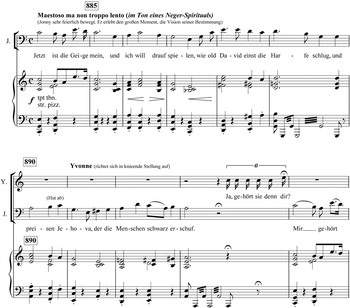
Musically Jonny is portrayed as a leader of the community as well as a favourite with audiences. He is the one who ‘strikes up’ the band to dance, and performs in many numbers throughout the opera. Despite the obvious social engagement of his music, his musical motivation is not grounded in concern for the community (apart from a desire to entertain): he is autonomous, self-contained, and carefree. His music, therefore, embodies a contradiction: although, by virtue of being dance music, it is gesellschaftsbildend in Krenek's definition of the term (in other words, it is music with the power to form society), the music's source (namely Jonny himself) is without altruistic intentions. The contradiction extends to the fact that it is only via his music that Jonny has any deeper engagement with other people; as an individual he is fundamentally distanced from society. The disparity between Jonny and his ‘socially forming’ music reveals an important point: although he is an individual with a high degree of independence, he has in fact no music of his ‘own’. He is accompanied by music saturated with dance idioms, fitting for the band he leads and performs in (and for his portrayal as a popular artist), but when his music is meant to be most revealing of his personality, it is linked with essentialized traits associated with his race and nationality and is thereby robbed of any potential individuality. For example, Jonny's first solo song (which Krenek specified should be performed ‘im Ton eines Niggerliedes’Footnote 41) is a simple E minor melody with banjo accompaniment that seems to imitate popular minstrel songs. It appears as a lullaby for the newly stolen violin at the end of Scene 3, and returns again in Jonny's vocal line as he departs from the hotel along with the other characters towards the end of Scene 4.Footnote 42 Another example is Krenek's employment of the well-known Stephen Foster minstrel song ‘Old Folks at Home’ (also known as ‘Swanee River’), which is used as Jonny's music in two places: rhythmically at the beginning of his Triumphlied, ‘Jetzt ist die Geige mein’ (‘Now the violin is mine’), at the end of Scene 6 (bars 884–5) (Example 1), and then again at the beginning of Scene 8 (bars 1636–42) when he sings of his home in Alabama and mentions the Swanee River (here accompanied by the actual Foster melody).Footnote 43
Ernst Krenek, Jonny spielt auf, Scene 6, bars 884–94.

Further to Jonny's lack of individual musical characterization, it is worth noting that he does not have a thematic identity either. Although we hear the violin as a ‘leit-instrument’ that prompts our memory now and then, he does not have a recurring signature theme that reminds the audience of his character. The fact that we do not get a leitmotif accompanying Jonny might seem appropriate if we adopt what has become the standard reading of this opera: as a narrative based on an aesthetic opposition between the classical tradition (Max) and popular music drawing on dance and jazz idioms (Jonny).Footnote 44 Then we could argue that since musically Jonny does not belong to the classical tradition, there is no need either for him to be portrayed according to its rules or for him to possess any kind of individual musical autonomy. Assigning leitmotifs to particular characters remains, however, a simple tool by which the composer can aid the dramatic narrative and tell the story more clearly and convincingly, Krenek's stated aim. Had Jonny instead been assigned a particular theme or themes, he would to a greater extent have been in line with his strong-willed persona in the plot, and Krenek's point about ‘individual fulfilment’ could have been extended to the music. Although the composer did employ leitmotifs in this opera (for other characters), the method is limited, and at times even crude (perhaps intentionally so, as a form of anti-Wagnerian satire).
The most important (and frequently recurring) musical number associated with Jonny is that which became the most popular song of the opera, ‘Leb wohl mein Schatz’ (‘Farewell my dear’), based on a descending fourth motif that permeates much of the music. It is, furthermore, a song that helps to communicate the narrative theme of freedom. The same descending fourth occurs at the opening of the opera, this interval being linked from the start with the glacier (whether present on the scene or invoked in its absence) as an integral component of its music. It can be argued that ‘Leb wohl’ in effect becomes symptomatic of perhaps the greatest contradiction inherent in the opera, and one that may have led to the confusion, so lamented by Krenek, between its more serious and lighter sides. For at the same time that ‘Leb wohl’ carries a level of seriousness through its musical association with the glacier, it is this song that corresponds to the most superficial moments within the story, and indeed aids the impression of insincerity. The first time it is heard in full is in Scene 3, when Jonny and Yvonne split up after admitting attraction to Anita and Daniello respectively. The break-up between the two characters is as light-hearted as the melodic and harmonic construction of the song: they sing about how they will get on well without each other, and then an offstage chorus continues the song as they dance a few steps and leave the stage.
It is also this song that initiates and accompanies the grand goodbye in the final scene: as soon as Max has caught the train, the orchestra plays vivace molto the descending fourths divided by ascending scales, accompanied by an oom-pah bass line. As the audience is faced with Jonny standing on the top of the globe, the chorus sings the melody set to a different text (‘Die Stunde schlägt’) that describes the beginning of a new era and the journey to freedom. The potential irony of having what was fundamentally an insincere song carry a profound message is clear, but if it were indeed an ironic message, the audience did not grasp it as such; instead, the light-heartedness dominated the reception. More importantly, by being heard at various turning points in the opera, this song became much more a signifier of ‘the collective’ than of Jonny's individuality. Krenek's deployment of the theme seems not so much ironic as simply inconsistent. As the opera's most familiar and most jolly tune, its use as the basis of the finale was perhaps inevitable.
The tension between ‘the individual’ and ‘the collective’ can be clarified by looking at the other song sung by the chorus at the very end, this one based on the second most popular song of the opera, Jonny's Triumphlied, which he first sings at the end of Scene 6 as he obtains the violin. From its text we get a good impression of Jonny's hedonism as an individual and the particular idea of freedom that he represents – one that is not ‘individual freedom’ as such but an ideal of freedom closely connected to the collective. Jonny represents change, ‘the new’, and a utopian future for all.Footnote 45 First, the Triumphlied in Scene 6 links Jonny with his own tradition and racial history, thereby stripping the message of any content that would be particular to himself as a character: he rejoices that the violin is his, and he vows to play it ‘just as old David once plucked his harp, and [to] praise Jehovah, who made men black’.Footnote 46 Second, having been linked with tradition and history, Jonny's role as a symbol of novelty and the future – significantly, via dance music, which is gesellschaftsbildende Musik (in Krenek's sense) – is accentuated in the sung text as follows:
All that is good in the world belongs to me. / The old world created it / but no longer knows what to do with it. / Now the new world comes in glory / across the sea / and takes possession of Europe through dance.Footnote 47
It is this freedom ideal that is projected directly onto the mass triumph depicted at the end of the opera, and the choir appropriately begins the song with ‘Thus Jonny played for us to dance’. That ‘Jetzt ist die Geige mein’ becomes the basis of the opera's conclusion emphasizes that it is Jonny's version of freedom that has triumphed. Since both these songs are grounded in the jazz-music tradition that Jonny represents, the music that surrounds him links him firmly with the collective, despite his own socially irresponsible behaviour. The fact that they are sung at the end of the opera by the choir emphasizes the point that they are not Jonny's: the masses have taken over and use the songs as their own.
Jonny's musical characterization can be summed up as follows. The jazz-inspired music in the opera does, on a certain level, give an impression of Jonny's freedom and his detached, carefree nature. But, despite this, he becomes a symbol of something that is primarily collective rather than independent or individual. When we do get more personal moments in his solo songs, they express either his material attachment (to the violin)Footnote 48 or his victoriously hedonistic, free nature (‘Leb wohl’). Furthermore, thematically and in terms of narrative content, Jonny's music is never his own, but that of his nationality and race. Musically, therefore, he becomes an emblematic manifestation rather than an individual, the carrier of a message about potential freedom for the individual (as part of the masses), a symbolic presence of an ideal state. In terms of plot, he is as free a character as he could possibly be: free from responsibility, from relationships to other human beings, and from feelings of worry and guilt. Musically, however, he becomes an expression of the collective: he is bound to his nature, his tradition, and to other people's songs.
Anita and Max: individual freedom exposed
The opera provides an alternative to the freedom suggested by Jonny. His counterpart, Max, has been depicted in scholarship typically in stark opposition to him, and mostly in negative terms: a lonely, isolated composer who finds it difficult to engage with the world. However, this reading ignores ambiguities that the opera consistently presents. After all, this opera is about the problem of freedom (as Krenek put it), not necessarily its solution. I shall now show how the other side to the story of freedom, namely the theme of ‘individual freedom’, is represented in the plot as well as in the music of Jonny spielt auf. However, it will become clear that the way in which this theme is treated musically assists in negating the serious message that Krenek had intended – and negating it in such a way that Krenek's idea of gesellschaftsbildende Macht becomes bound up with a collective, utopian ideal of freedom.
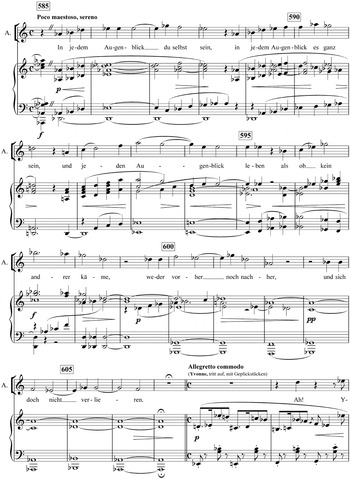
In accounts of Jonny, Anita is known as ‘an emotional opera singer who falls in love with Max and tempts him off his glacier’, simply as ‘an opera singer’, or as ‘a singer who has lost her way back to her resort’.Footnote 49 Considering the relevance of her character for the issue of freedom, she has probably not been given due attention: it is through Anita that Krenek communicates ideas about individual freedom most clearly and directly. She is portrayed as a shallow and self-interested diva who is nevertheless self-aware, knowledgeable, and often quite rational, and offers Max insight into the means to achieve freedom.Footnote 50 Except for Anita's encounter with Daniello (a classical violinist and narcissistic charmer) in Scene 3, where we first become aware that she is searching for her ‘self’, there are two passages that are key for the expression of Anita's ‘voice of reason’ (although somewhat paradoxically her new awareness has mysterious, intuitive origins, and is based in experience of ‘real life’). Both of these occur in Scene 6 after Anita's return to Max, the first between bars 492 and 511 (‘Weil du den Sinn deines Lebens außer dir suchst’), and the second between bars 572 and 608 (reproduced in Examples 2 and 3). Both passages are short yet self-contained ariettas, set apart melodically and harmonically from what surrounds them, and in tripartite forms. The second arietta includes a brief recitativo introduction (‘Ich hab' auf dieser Reise mancherlei erlebt’ preceding ‘In jedem Augenblick du selbst sein’, bars 572–84).
Krenek, Jonny spielt auf, Scene 6, bars 492–511.
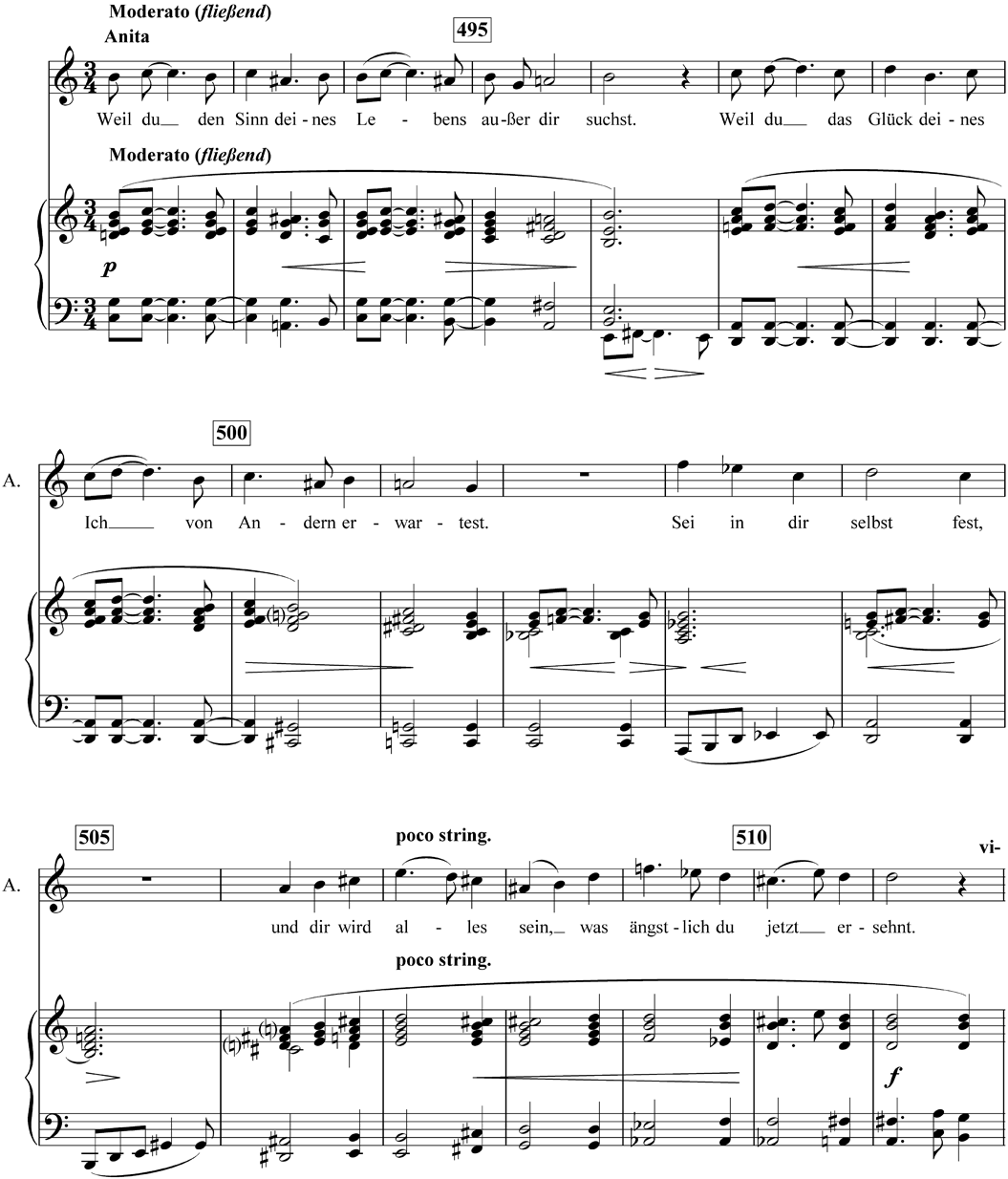
Krenek, Jonny spielt auf, Scene 6, bars 585–609.

The two ariettas are not related thematically, but stylistically they both fit a late Romantic mode (à la Rosenkavalier) to which Max's signature piece ‘Als ich damals’ also belongs. The style is suitable for Anita's operatic persona: as an actual singer, it is only natural that she is given arias to perform. Furthermore, the ariettas are both examples of what Max calls Anita's ‘newfound wisdom’ (related to her knowledge of selfhood), and spring from the experience she gained through her brief encounter with Daniello. Musically the link between the question Max asks immediately before the ‘recitativo’ in bars 568–70 (‘Dies Wissen woher?’) and the beginning of ‘In jedem Augenblick’, which continues after the recitativo, is established by the melodic (pentatonic) connection: Max's collection C–D–F–G–A is complemented by Anita's A♭–B♭–Db♭–E♭–G♭, which thus answers his question. By applying this pentatonic sense to the melodic structure at what Peter Tregear calls ‘perhaps the most crucial moment in Jonny spielt auf’,Footnote 51 Krenek seems to be attempting to establish a connection between Anita's musings on individual freedom and the music of the glacier, based heavily on perfect fifths.
By presenting the songs as independent numbers that Anita sings on her own (in a scene that is packed with duets), Krenek achieves a clear communication of what was undoubtedly an important message. Consider the following extracts from the two passages. The first, from the first arioso, is in reply to Max's question about why it always goes wrong when he tries to please Anita. She replies:
Because you seek the meaning of your life outside yourself. Because you look to others to provide happiness for your true self. Be strong within yourself, and you will achieve everything you anxiously long for.Footnote 52
The same message about the freedom of the individual from his or her surroundings and the striving for selfhood is elaborated in the second extract (from the recitativo and second arioso), in which Anita reflects on what she has learnt on her trip, and explains this ‘newfound wisdom’ to Max:
To be yourself in life, that is everything! To be yourself in every moment, to live life to the full in every moment, to live each moment as though it were the only one, with nothing before or after it, but still not to lose yourself.Footnote 53
Both these passages exemplify Krenek's central message about individual freedom while setting themselves apart from the kind of freedom represented by Jonny, who is completely bound up with his social surroundings and, musically, is not portrayed as an individual at all. In the environment of popular culture that he inhabits, it is all too easy to ‘lose oneself’.
Although the passages are central for this important theme, there are many ways in which this message about individual freedom is simply not pursued in the opera. This is seen first in the fact that, although the ariettas are self-contained entities, the first is interrupted by Max, and the second passage discussed above is immediately interrupted by Yvonne, who enters the stage in an oom-pah dance-like manner. This intrusion leaves little or no time for reflection for either Max or the audience. The second illustration of the negation of this message lies with the glacier and Max, to whom we now turn.
Max: the individual who lost his voice
As mentioned, there are late Romantic stylistic links between Anita's two ariettas and ‘Als ich damals’, as well as an important allusion (by means of pentatonicism) to the glacier's fifth-based musical representation. Stewart calls the glacier the opera's central object, representing ‘dehumanized, life-denying, excessive intellectualism’. He views it as explicating the notion of freedom, albeit in negative terms: the glacier represents the un-freedom of loneliness and death, as opposed to the liberation promised by Jonny and indeed the train in the final scene.Footnote 54 However, I would add that it operates as a symbolic representation of the metaphysical, which for Nietzsche – as well as, presumably, Kraus and Krenek – would have been closely linked to a form of freedom, in contrast to the life of society. It also has a national relevance, linked to pan-German culture and the great summits of its artistic and intellectual traditions, austere yet sublime, now rejected by a philistine crowd. I would argue that the glacier is representative not of a lack of the freedom that Jonny represents, but rather of the different kind of freedom – autonomous rather than social, individual rather than collective – discussed at the beginning of this article in respect of the Kraus/Krenek ideals. Unless this distinction is made, the ambiguities involved in the ‘problem of freedom’ cannot be addressed.
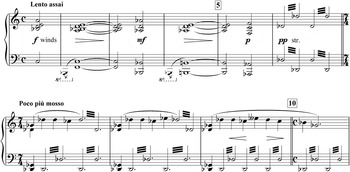
The glacier is represented by two themes in particular: the first, which is heard at the opening of the opera, begins with the descending fourth in the upper voice over a dominant thirteenth chord (see Example 4, bars 1–6); the second is the melody that follows the opening chord progression (see Example 4, bars 7–10). The connection between these two themes and the glacier is at its strongest when we first hear it ‘speak’ in Scene 7 (beginning at bar 1113). Its voice sounds like a combination of a Bach chorale and the Grail music from Parsifal, becoming more Brucknerian during the discussion with Max – a kind of conglomeration of German sacred music. Although these two themes are representative of the glacier, they are also linked with the popular music of the opera: the musical idea of descending fourths relates, as we have seen, to the most popular tune, ‘Leb wohl, mein Schatz’, and the first time we are presented with a longer passage of dance music in the opera, it is the second glacier theme turned Più mosso and adapted to include a ‘blues third’, in a section with changing time signatures at the end of Scene 1. Regardless of this connection with ‘the popular’ however, there can be little doubt that the seriousness with which the glacier is presented at the beginning of the opera accompanies its musical references throughout.
Krenek, Jonny spielt auf, opening, bars 1–11.

It is in its association with Max that the glacier is strongest as a symbol of individual freedom and artistic autonomy. Max is a classical composer, and his passion, strength, and identity are closely connected with the glacier. This is clear from the very beginning of the opera, and the metaphor returns constantly in discussions between the characters. For example, in Scene 4, in the dialogue between Daniello and Anita, Max is directly identified with ‘ice’, and on the morning after, when Anita mentions ‘the composer’ as her reason for leaving Daniello, he comments ‘I thought as much – the glacier!’ Max, in short, is a Gletschermensch, linked to the symbol of the Romantic sublime, the lofty heights of German culture, and its permanence, immobility, and grandeur. The sound of the interval of the fifth resonates in this context as a kind of generic marker of ‘mountain’, of vast space, strong foundations, and so on. Max's ‘musical voice’ is first expressed as part of the second glacier theme: his initial melodic lines grow out of the theme and complement them as it accompanies him, and he also sings the theme in literal imitation (for example, bars 47–8). Yet aside from his association with the glacier, Max is, from a musical point of view at least, the character who, more than any other, is portrayed as an individual. Whereas both Anita and Daniello are artists who perform other people's music, and Jonny is portrayed musically as a ‘product’ of his nature and his past, Max, as a creative artist, has his own compositional voice, his own music. His vocal lines spring from the Western classical tradition and include both consonant and dissonant idioms. His character is represented in completely unironic terms, and he often appears alone on stage: he is the only one endowed with a lyricism that affords genuine insight into his subjectivity.
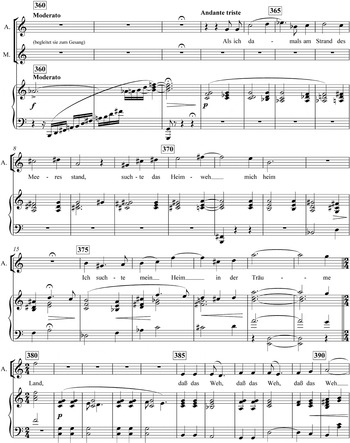
Though Max's glacier-like self is represented by way of copious references to the two glacier themes (especially when he sings about the glacier), the musical ‘signature’ of his individuality is his own composition ‘Als ich damals’. We are first introduced to it at full length towards the end of Scene 2, not long before the separation of Max and Anita. She is going away to perform in his new opera and wants to rehearse this particular song.Footnote 55 This Andante triste aria adopts a musical language reminiscent of late Romanticism, and (as Cook also notesFootnote 56) at times incorporates highly chromatic writing (see Example 5, bars 363–438). The structure of the song does not fit a conventional pattern, but could be described as ABCB’. The shifts between the 3/4 and 2/4 time signatures, and the movement from Andante triste to Agitato and back, add further to the song's aura of Romantic sentimentality. The vocal line includes effusive melodic arabesques that fit awkwardly with the text – a comic effect that could almost be a parody of a parody, an allusion to Beckmesser's singing in Meistersinger. The text of this song is about longing, homesickness,Footnote 57 and a yearning for a happy existence that the solipsistic escape into a dream world has thus far been unable to provide (‘Traüme Land’ can of course mean not only what is experienced in sleeping and dreaming, but also a utopian fantasy). Despite its parodic elements ‘Als ich damals’ is a central aria for Max's character, and functions as a genuine expression of his individuality, consistent with his portrayal throughout the opera as a sensitive, worrying, self-doubting composer with a tendency towards depression.Footnote 58
Krenek, Jonny spielt auf, Scene 2, bars 360–438.

Continued

Apart from being an expression of Max's subjectivity, the song – his own creation – is also a symbol of his creativity. The relationship between creation and creativity inherent in this aria is especially evident in Scene 5, when Max waits for Anita and sits down by the piano to compose, in an attempt to distract himself from his agony. According to Krenek's directions, Max begins to write on an empty page of music paper, suggesting that he is creating new material. However, the music presents us with material derived from ‘Als ich damals’ (as well as material from the second glacier theme), hence not a new composition after all (see Example 6, bars 270–86).Footnote 59 So, at the same time that it reminds us of those personal traits from which he may or may not be able to escape, the aria becomes a symbol of creativity – or, in this case, of stunted creativity – and re-emphasizes its function as Max's own signature (i.e. an expression of his character per se), rather than merely an example of his creative work. When viewed as an act of self-determination, this creativity becomes a decisive measure of individual freedom.
Krenek, Jonny spielt auf, Scene 5, bars 270–86.

While it functions as an expression of Max's character, the aria also comes to represent individuality and individual freedom in general, with its appearance at various crucial stages in the opera. As well as presenting us with an example of Max's personal and creative voice, the aria becomes associated with the notion of voice more broadly. It is Anita's voice that is at the centre here, and as we saw above, she is undoubtedly the opera's (declared, outspoken) authority on individual freedom. We become acquainted with ‘Als ich damals’ (and hence Max) when Anita first sings it in Scene 2. In Scene 3, as Anita reflects on the success of the opera in which she has just performed and begins to ponder her ‘self’ and her longings for her ‘distant beloved’ (ferner Geliebter) Max, she quotes directly from ‘Als ich damals’ (albeit harmonically altered and rhythmically augmented) as she sings ‘I was assailed by homesickness’ (bars 811–14). In this situation, the musical quotation fits all three of these narrative themes (Max's opera, the issue of selfhood, and the yearning for happiness and feeling of homesickness). This marks an important point in the opera: Anita is just about to meet Jonny for the first time and then succumb for the night to the charms of Daniello, through which experience she acquires the knowledge about ‘selfhood’ that she later shares with Max in her two ariettas.
Another example is provided by the use of the aria in Scene 7: once the glacier has thwarted Max's attempt at suicide, it is Anita's voice over the loudspeaker, singing ‘Als ich damals’, that brings Max ‘back to life’. Certainly, there is a message here about love: Max ponders how ‘nothing lives in the high mountains, yet love does not die’, and at the end of the song, when he has regained confidence, he states ‘I must return to life, to her, to her, to her!’ Whether the aria is to be interpreted as Max hearing his own ‘voice’ through Anita (his first question when he hears the song is ‘whose voice is this?’) or Max listening to Anita as she performs his composition and recognizing that she is calling him back (he states: ‘What is calling me back to life? She is singing my song just as she did, before she left’), the focus on individuality and its relationship with ‘voice’ in this scene cannot be ignored. In various ways ‘Als ich damals’ becomes the bearer of a message about individual freedom: it liberates Max from death, and shows him a direction to follow, one that (given the nature and content of the aria) is ultimately about his ‘Self’. In connection with Anita's advice it may be more appropriate to talk about authenticity as essential to the attainment of freedom; if one is always oneself and resists the influence of the mob and its ideology (its party politics, its unions, etc.), then one can be free, even in the midst of modern urban life. This freedom is noticeably different from the liberation promised by Jonny and the train at the end of the opera, for there are no allusions in ‘Als ich damals’ to Jonny's jazz-inspired collective freedom, which is on one level superficial, foreign, and (thus) inauthentic, yet at the same time remains more fresh and exciting than what we see and hear from Max. The tension between the two types of freedom may have been the ‘problem’ to which Krenek referred.
Jonny spielt auf: a deconstructive journey
If the theme of individual freedom is central to Scene 7, the same scene makes apparent a few of the opera's many ambiguities. And it could be argued that it is partly due to these ambiguities (which remain unresolved throughout the work) that Krenek could not maintain the seriousness of his theme of individual freedom. For example, given the focus on Max's despair and attempt at suicide (though even this ‘suicide’ is ambiguous, and might also represent a wish to return to an isolated life of contemplation), this scene carries with it a sombre message. However, this gravity is neither sustained for long nor developed further; while ‘Als ich damals’ is being heard over the loudspeakers, hotel guests provide comic relief by commenting on the beautiful voice but lamenting the modern music. And, like Anita's own aria in Scene 5, this aria is concluded abruptly and replaced with dance music (announced and broadcast over the loudspeaker), again leaving no time for reflection. In addition, the interference of the hotel guests is another example that could be used to support the emphasis of the standard reading of the opera on a popular–classical split, in which the guests represent the popular. But this would be to ignore Anita's earlier comment (in Scene 3) that Max's opera was a ‘huge success’. While this does not make his music ‘popular’ in the wider, demotic sense (it may have been well received by an élite audience), it creates a further ambiguity that counteracts any interpretation of the opera's stylistic characterizations based on straightforward oppositions. The opera seems to defy any kind of simplistic reading, much as it might appear to be tempting us towards one.
Much of the narrative in Scene 7 becomes ambiguous simply because it is left unexplained. We are not, for example, given any information about Anita's intentions for singing ‘Als ich damals’, although we can guess from her exclamations in Scene 6 that she is concerned about Max. And the familiar reading of this opera as a struggle between a classical composer and a popular musician – in which the popular eventually triumphs and liberates all – is not supported by the fact that this aria is sung at this vital point in the opera. If Anita's intention is to bring Max ‘back to life’, and if ‘life’ is that which is promised by Jonny and social urban living (as is commonly argued in scholarship on the operaFootnote 60), then why sing this introspective aria? Why would this music bring about a change for the better, if all that represents life and hope belongs to the sphere of the popular? Max's aria represents his survival as an individual (and the survival of his creative individuality) rather than the promise of a future as part of a community (though that is what he appears to join after leaving the glacier). It calls him back because he recognizes it as his own creation. The modern composer, perhaps, is no longer able to maintain the old illusions. Does he perceive the possibility that his identity as composer can survive in a new social context, once he has accepted the necessity of addressing a contemporary audience and even the new role of technology? Is Max discovering that creation means communication, and engagement with society? Instead of supplying us with an easy ‘solution’ to the problem of freedom, the opera continually subverts these deceptively simple dichotomies and, in spite of its heavy-handed symbolism, leaves us with basic questions as to the symbols' meaning and significance.
The narrative and musical negation of individual freedom
In place of the reading that sees the opera as favouring the performer Jonny and ‘the popular’ over the composer Max and ‘the classical’ – and hence privileging society above the individual – Claire Taylor-Jay has suggested that Max undergoes a ‘transformation’ and ‘converts’ to society after the fateful Scene 7.Footnote 61 The dichotomy constructed by her reading is the familiar one between the ‘lonely’ intellectual (whose spiritual dwelling is manifested by the glacier and by nature) and the ‘lively’ and social habitat provided by civilization (as represented by Jonny, the hotel, the city, the train, and the utopian ideal of America). Accordingly, Taylor-Jay states that ‘[w]hile the opera clearly portrays an underlying conflict between Max and Jonny, Krenek resolves this tension during the course of the work’.Footnote 62 But although the opera is arguably based around such a conflict, it would be reductive to suggest that it clearly exhibits such a preference regarding the respective worlds of Max and Jonny, let alone resolves the clash between them. Indeed, we might suggest that its refusal to take sides, its inability to marginalize, emphasizes instead the work's deconstructive strength: it presents problems, not solutions. The idea that Max's ‘transformation’ is complete, or even that such a transformation occurs at all, lacks sufficient narrative support. We are told little about what actually happens to Max after Scene 7, the kind of life to which he returns, and whether he is truly happy with the outcome of his choice to leave the glacier (and all that it encompasses) behind. Indeed, if happiness is equivalent to what Anita has suggested in Scene 6 (‘to be oneself in the midst of things’), then it is questionable that ‘losing himself’ in Jonny's world would contribute to Max's happiness.Footnote 63
Furthermore, the idea that Max would prefer to ‘join society’ rests on the assumption that the glacier should be understood predominantly in negative terms. But, as we saw above, the conception of individual freedom that Krenek developed under Kraus's influence was related to the idea of nature, in particular as represented by mountains, and possessed a spiritual aspect. For that reason it is hard to view the glacier in Jonny spielt auf in purely negative terms, when it is so obviously a potent symbol of spiritual autonomy. On the contrary, in light of that idea of individual freedom, perhaps it is what happens in the opera after Scene 7 that should be viewed negatively. From Scene 7 onwards, Krenek makes a compositional choice that results in what is perhaps the most powerful ambiguity in the opera: the musical negation of individual freedom.
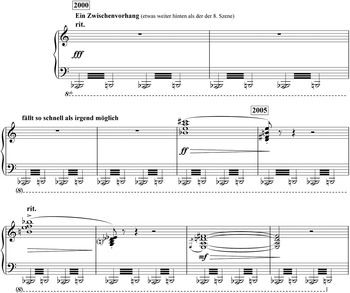
The music of the glacier and ‘Als ich damals’ serve as pivots around which important events occur.Footnote 64 They help to connect and develop both musical and narrative occurrences related to the theme of individual freedom. Noteworthy from a musical point of view is therefore that neither the glacier themes nor Max's aria continue to perform these tasks. Where the glacier is concerned, the point at which it appears to sever all connection with its earlier signification is in Daniello's death in Scene 9 (see Example 7), which is accompanied by the three chords that began the opera, albeit in a more dissonant and open-ended construction reminiscent of Scene 1 (just before Anita enters the stage in bars 52–4). If this represents simply a confirmation of the association of the glacier with death, it would throw into doubt the connection between the glacier and individual and spiritual autonomy (apart from, perhaps, in a Schopenhauerian sense).
Krenek, Jonny spielt auf, Scene 9, bars 2000–9.

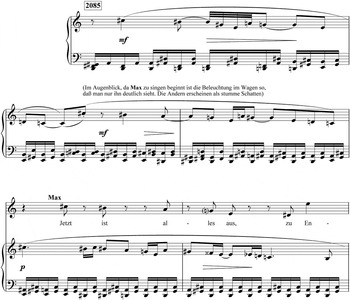
As we have seen, in a way that recalls the abrupt endings of Anita's arias, Max's suicide scenario is also interrupted by jazz rhythms (bar 1410); this choice of a sudden change in musical expression leaves no time for audience reflection. Crucially, after Scene 7, Max has ‘lost’ the individual voice that was given to him via his music: his vocal lines are now constrained by Jonny's jazz world, and he frequently quotes from Jonny's songs. For example, in Scene 9 (the first time we have heard him since Scene 7) Max quotes from ‘Leb wohl’ as he searches for Anita, having just made a brief reference to ‘Jetzt ist die Geige mein’ (bars 1735 and 1729 respectively). The fact that Max's character is no longer supported by his music – whether his aria or the music of the object most symbolic (in both music and narrative) of his autonomy, the glacier – appears to compromise his individuality. A potent example is the pivotal point in Scene 10 at which Max makes the decision to catch the train – the point, namely, at which he ought to be portrayed as a strong individual.Footnote 65 Rather than drawing on the musical material provided by the glacier or Max's aria – both of which would have helped substantiate a musical ‘turning point’ – a strange, quasi-oriental vocal line (material we have not encountered before) is intertwined with some of the opera's familiar syncopated rhythms and jazz harmonies (bar 2088 onwards, Example 8); it strongly conveys the sense of alienation that Max experiences in his new surroundings, in the noisy presence of the mass crowd and modern forms of transportation (the car, the train).
Krenek, Jonny spielt auf, scene 10, bars 2085–9.

Although it could be argued that there is a very slight hint of ‘Als ich damals’ in bars 2125–6, this ‘quotation’ remains so weak that it emphasizes if anything that by this stage Max's individual voice is being drowned out by jazz phrases. In arguing for Max's transformation, Taylor-Jay calls his monologue a ‘moment of conversion’ and describes the music as predominantly ‘atonal’ (i.e. music that would be representative of Max), before it succumbs to the tonality that the jazz music offers.Footnote 66 However, what is striking in the music, beginning with the solo oboe line in bar 2085 (Example 8), is not atonality but hints of an ‘exotic’ idiom: the oboe's two-bar descending phrase, which Max takes up as he begins his vocal line in bar 2088, contains a telltale augmented second. In other words, these bars introduce an element that is distinctly uncharacteristic of his music up to this point. An alternative reading might suggest that this ‘oriental’ music is an expression of what seems to inform Max's rather hasty decision, namely a confused state of mind, an experience of ‘otherness’ – or, rather, of being ‘other’ – that results from his distance from the ‘home’ for which he is truly longing. His homesickness is bound to persist, and the home that he seeks will remain a utopia. If he is no longer represented by his own music, this signifies that he has indeed ‘lost himself’ and hence failed to be authentically himself in the midst of life (as Anita had advised him to be). Regardless of which interpretation one would choose in order to explain this new musical material, Krenek chooses neither to pursue the consequences of the material nor to resolve its ambiguities: from Scene 8 onwards it is Jonny's world of ‘the collective’ that dominates, and any musical reference to individual freedom – as previously represented by the glacier music and Max's ‘voice’ – is smothered, no longer audible. Max has discovered that his creativity and authenticity are in jeopardy in the midst of life. But that, as we know, is because he lacks strength, unlike Jonny. It becomes a question of will, rather than authenticity or integrity. Realpolitik and the mass market have displaced idealism.
Conclusion
Jonny spielt auf presents a variety of revealing and enlightening interactions between ethics and aesthetics. From Scene 8 onwards the dance rhythms of the opera's catchy tunes dominate the stage. In light of Krenek's ideas concerning gesellschaftbildende Macht, it is appropriate that dance music supports the idea of the collective, and to this extent it succeeds in being ‘socially forming’. As for ‘the problem of freedom’, the opera does not solve this problem as much as it emphasizes it. Indeed, the society-building exercise of the dance music and the muting of individual voices obliterate any prospect of a focus on individual freedom.
With regard to freedom as self-determination, the opera offers a musical manifestation of how the threat to individual freedom can be considered a threat to creativity. It was suggested earlier that the arietta composed by Max, ‘Als ich damals’, is also a symbol of his creativity: hence when the song (his creation) is no longer present, Max loses not only his individuality but also his creativity. And here one of Paul Bekker's main points about individual freedom and the human singing voice in the contemporary climate of Weimar Germany springs to mind: for him, art is never the collective product of a group or community, and its existence is possible only where the existence of man as such is possible.Footnote 67 Accordingly, in his 1932 critique of Krenek and Jonny spielt auf, he advised the ‘real life’ Max – Krenek – to work in isolation and focus on the music rather than being concerned with the world. Finally, it seems that it was not only Max who was muted: if Krenek sought with Jonny to make a statement about individual freedom, this message was not heard by the audience.
Given the points made here, one could argue that Jonny spielt auf has a disturbing side to it. This is not because of what is represented or expressed: given the dominance of the jazz-inspired numbers and an overwhelming theatrical spectacle, audiences would have left the theatre in high spirits, humming the tunes that were easy on the ear. The opera might be considered disturbing because of what was not expressed, what was stifled. Beyond Scene 7 any reference to individuality is no longer musically audible. In Abbatean terms the strongest individual in the opera, Max, is undone by plot, and his voice is not triumphant. Indeed no one at the end has an individual voice. The crowd praise a new hero, as the old world and its aesthetic values (symbolized by Daniello) are finished off by a new world of industry and technology and the heroic role assumed by the jazz musician. Jonny now appears solo, without his band, and has instead the adoration of the whole crowd as his accompaniment. He emerges as a modern pied piper, leading his enchanted followers – to what? If the opera aims at a moral conclusion, it appears to be one that is pessimistic about modern life and about the future for those, like Max, who aspire to higher ideals. The problem of freedom may be that, unlike Max, the selfish and frivolous Jonny can operate as authentic in modern life. This not only affirms Hegel's view that freedom as self-determination via socially agreed norms becomes implausible in a society where social norms are questionable, but it also recalls an ethical problem going back to Aristotle: the good life cannot be lived outside of proper social circumstances. And modern life, as the opera seems to show, does not provide such circumstances for the contemporary composer.
On the one hand, then, there is a ring of truth in Johnson's warning that manifestations of Neue Sachlichkeit risk capitulating to a particular kind of social identity that neglects the category of subjectivity. Individuality struggles against utopian mass culture in Jonny, and the opera can be seen to lose sight of the Enlightenment ideal of freedom. On the other hand, the fact that it becomes a musical manifestation of a philosophical issue is significant in itself, regardless of whether and how it may be deemed to succeed or fail in providing ‘serious’ (Krenek) critical opposition to the contemporary political and aesthetic climate. Jonny spielt auf is a musical contribution to an important ethical discussion about freedom at this moment in German history. And it is in its refusal to present a solution to ‘the problem of freedom’ that the strength of the opera lies: in doing so, it bridges the conceptual gap between ethics and aesthetics while heightening our understanding of music's involvement with philosophy at this crucial time in the history of German opera.