Introduction
One of the main issues of recent bilingualism research concerns how the two language systems interact with and influence each other. Although some studies have failed to find evidence for cross-linguistic influence (e.g., Meisel, Reference Meisel1994; Paradis & Genesee, Reference Paradis and Genesee1996), others point to the prevalence of systematic influence from one language to another in various domains of language, including phonology (e.g., Paradis, Reference Paradis2001) and morphology (e.g., Nicoladis, Reference Nicoladis2002). Another domain widely known for a high incidence of cross-linguistic influence is syntax; a number of studies have probed the nature and direction of this influence. An important proposal regarding these issues was put forth by Hulk and Müller (Reference Hulk and Müller2000), and has been supported by subsequent studies (e.g., Hacohen & Schaeffer, Reference Hacohen and Schaeffer2007; Haznedar, Reference Haznedar2010; Müller & Hulk, Reference Müller and Hulk2001). In their proposal, Hulk and Müller (Reference Hulk and Müller2000) predict that cross-linguistic influence would occur if the affected construction involves (i) syntax–pragmatics interface, and (ii) a surface overlap between the two target languages. However, their study, along with other supporting research, explicitly rules out language dominance as a factor involved in cross-linguistic influence.
Hulk and Müller (Reference Hulk and Müller2000) cite several reasons for excluding language dominance as an explanation for cross-linguistic influence. In some of their earlier studies (e.g., Hulk, Reference Hulk and Döpke2000; Müller, Hulk & Jakubowicz, Reference Müller, Hulk, Jakubowicz, Greenhill, Littlefield and Tano1999), they observed that for the syntactic phenomena studied (i.e., object drop and object preposing), a Germanic language influences a Romance language but not vice versa. Based on this observation, they assume language-external factors such as dominance are not at work. Two factors support their assertion. First, if language dominance were a factor, the Germanic language should always be the dominant language. However, the children's Mean Length of Utterance (MLU) values of both languages did not always support the claim. Second, if the Romance language were dominant, it would be expected to influence the Germanic language. However, this prediction was not borne out by the data. Therefore, Hulk and Müller have turned their gaze to language-internal factors, and have ruled out language dominance as a variable in cross-linguistic influence.
This paper aims to critically examine the conditions on cross-linguistic influence proposed by Hulk and Müller (Reference Hulk and Müller2000), providing support for their overlap and interface conditions but adding dominance as a causal factor. More specifically, this study argues against the claim that language dominance plays no role in determining cross-linguistic influence in bilingual development. Experimental data from a Korean–English bilingual boy show his English null-subject use. The participant, Sammy, had returned to Korea after a two-year stay in the U.S. and quickly become Korean-dominant. His English null-subject use involved a syntax–pragmatics interface and a surface overlap between English and Korean. However, comparing his use of subjects in English to that of other bilingual children who were English-dominant, demonstrates that the null-subject parameter of Korean triggered his English subject drop when his dominant language changed from English to Korean.
It must be noted that the data used for the current study differ from those of Hulk and Müller's. While they collected bilingual acquisition data, the critical data of the current research are products of language attrition. Thus, it may seem inappropriate to argue against a proposal made for bilingual language development using language attrition data, as it is not clear whether the effects seen in the present study are the result of a dominant language influencing a weaker language or a different phenomenon involving attrition. However, based on the argument that there is no fundamental distinction between attrition and a weaker language in development (e.g., Francis, Reference Francis2011), the discrepancy between the type of data in this paper and Hulk and Müller (Reference Hulk and Müller2000) can be considered trivial.
The next section provides background for this study, including a detailed discussion of Hulk and Müller's (Reference Hulk and Müller2000) proposal and a review of previous studies that test their hypothesis with subject realization. Theories of subject realization in Korean and English are then presented. In subsequent sections, methods used in the study are described and results shown. The Discussion section provides an analysis of the data, proposals for a revised model of Hulk and Müller (Reference Hulk and Müller2000), and an examination of the role of language dominance in cross-linguistic influence. Finally, conclusions and suggestions for further research are provided.
Background
Hulk and Müller (Reference Hulk and Müller2000)
Hulk and Müller (Reference Hulk and Müller2000) (henceforth H&M) propose that the type of syntactic phenomena that are likely to be under cross-linguistic influence can be predicted. In particular, they claim that the following two conditions must be met in order for cross-linguistic influence to occur.
1. Cross-linguistic influence occurs at the interface between two modules of grammar: syntax and pragmatics in the so-called C-domain.
2. Syntactic cross-linguistic influence occurs only if language A has a syntactic construction that may seem to allow more than one syntactic analysis and, at the same time, language B contains evidence for one of these two possible analyses. In other words, there has to be a certain overlap of the two systems at the surface level.
In order to demonstrate these points, H&M compared early speech data from a Dutch–French bilingual child and a German–Italian bilingual child to the development of monolingual children. The investigators probed these children's use of object drop and root infinitives because object drop satisfies both of the above conditions, while root infinitives do not satisfy the second condition.Footnote 1
C-domain in the first condition refers to the Complementizer Phrase (CP), whose role is to link the information present at Inflectional Phrase (IP) to the discourse (Rizzi, Reference Rizzi and Haegeman1997). Platzack (Reference Platzack1999) demonstrated the vulnerability of the C-domain in the Swedish and German of very early first language (L1) learners, language-impaired L1 learners, second language (L2) learners, and patients with Broca's aphasia, even though these speakers produced target-like syntax in lower structural levels such as IP. Because the C-domain constitutes an interface level, linking syntax to other domains such as pragmatics and other cognitive systems, it is not surprising to find this high functional level posing problems. In this sense, object drop is within the C-domain, as it is mostly licensed by discourse-related conditions such as the presence of a prior discourse referent. This satisfies the first condition.
As for the second condition, object drop in the early speech data of the Dutch–French and the German–Italian bilingual children show some overlap in the analyses of H&M. Germanic topic-drop languages (Dutch and German) omit clause-initial object topics under certain contextual conditions (e.g., the presence of a discourse referent) as in the German example in (1), presenting young learners with evidence for the validity of a (universal) discourse licensing strategy for empty objects. On the other hand, French and Italian generally do not license object drop although there are some cases of null objects. The canonical postverbal object position can be empty after a small class of verbs including savoir “know” as in the French example in (2). However, these Romance languages mostly allow the canonical object position to be empty when a preverbal object clitic is present as in the French example in (3).
(1)


(2)
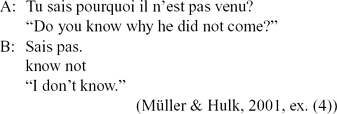
(3)
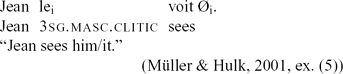
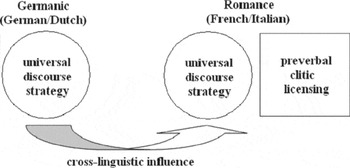
Thus, while German and Dutch license object drop via the universal discourse strategy, French and Italian empty objects are licensed by a preverbal object clitic in most cases. However, examples such as (2) might incorrectly give French and Italian learners the idea that the canonical object position may be empty due to the universal discourse strategy (which also licenses Germanic object drop). H&M argue that the lone option (universal discourse strategy) in Germanic object drop, which is only one of two possible analyses (universal discourse strategy and preverbal clitic licensing) in Romance languages, influences the same option and causes the speaker to incorrectly prefer that option in Romance languages.
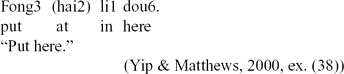
Figure 1 summarizes the point. Due to cross-linguistic influence from Germanic topic-drop languages to Romance languages, young bilingual speakers prefer to apply the universal discourse strategy even for Romance languages, which results in target-deviant object omission. Thus, H&M argue that the influence is unidirectional, as in Figure 1, ruling out language dominance as a factor involved in the process. This claim is in contrast to other studies, which propose a major role for language dominance in syntactic transfer. For example, Yip and Matthews (Reference Yip and Matthews2000) raise the possibility of Cantonese dominance influencing their bilingual child's English in several constructions, including the deviant use of English null objects. They report that the dominance of Cantonese (a pro-drop language) in their young bilingual subject was reflected in his MLUw (MLU in words) and language preference, and that the directionality of transfer, the child's higher range of ungrammatical English object drop compared to that of young English monolinguals, appears to be due to dominance.
(4)

(5)
The H&M model of cross-linguistic influence in object drop.

Example (4) demonstrates a case of the English null object used by the child in Yip and Matthews’ (Reference Yip and Matthews2000) study. The authors observe that this non-target-like structure, whereby the verb put is directly followed by a locative phrase, resembles the corresponding Cantonese structure without a direct object, as in (5). By comparing the child's use of verbs such as put in English and Cantonese, they suggest that the child's dominance in Cantonese affected his object drop in English.Footnote 2
Further research on cross-linguistic influence of subject realization
This section introduces three studies that have probed the direction of cross-linguistic influence. All three studies investigated subject realization in null- and overt-subject languages. The case of the referential subject is ideal for investigating cross-linguistic influence based on the H&M model. The realization of subjects takes place at the syntax–pragmatics interface, so using an overt subject in a null-subject language may have pragmatic implications such as focus and emphasis. Moreover, there is a certain overlap in the way subjects are realized in the two types of languages (e.g., the overt subject is not only the option in overt-subject languages, but is also used in null-subject languages). While Tsimpli, Sorace, Heycock and Filiaci's (Reference Tsimpli, Sorace, Heycock and Filiaci2004) work is an attrition study, the other two similar studies, by Hacohen and Schaeffer (Reference Hacohen and Schaeffer2007) and Serratrice, Sorace and Paoli (Reference Serratrice, Sorace and Paoli2004)d, are directly related to H&M. However, the latter two studies adopt the second condition of H&M's proposal in slightly different ways, and this change indicates the need for a revision of that proposal.
Serratrice et al. (Reference Serratrice, Sorace and Paoli2004) examined subject arguments in data from a child bilingual in English (an overt-subject language) and Italian (a null-subject language). They analyzed English as a language that allows both overt and null subjects, where subjects are typically obligatory although some ambiguous input with the empty subject position is also available in a restricted number of contexts: imperatives as in (6), coordinate clauses as in (7), progressive participle constructions as in (8), questions with an implied second person subject as in (9), and “diary drop”, usually with an implied first person subject as in (10).Footnote 3
(6) (You) Be quiet!
(7) Bill went to the park and (he) had a good time.
(8) A: What are you doing?
B: Eating.
(9) Want to go for a walk?
(10)

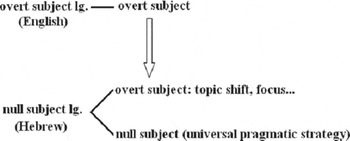
Therefore, Serratrice et al. (Reference Serratrice, Sorace and Paoli2004) state that when H&M's model is applied, the result of cross-linguistic influence from null subjects in Italian should be the ungrammatical overuse of null subjects in English (represented by the dotted-line arrow in Figure 2). This claim is based on the idea that the lone option in Italian (the null subject) would bolster the use of English null subjects, which is one of two options (overt and null subjects) in English. However, Serratrice et al. report that from their data of the English–Italian bilingual child, at development points between the ages of 1;5 and 3;6, the opposite direction of cross-linguistic influence was observed. The bilingual child used overt Italian subjects more frequently than did monolingual Italian speakers at a similar language developmental stage. However, his use of overt English subjects was comparable to the usage of young monolingual English speakers. Serratrice et al. argue that this is one of the limitations of H&M's model, as the literature lacks reports of such a direction of influence.Footnote 4 They further claim that even after the C-domain is in place and learners figure out the language-specific requirements, pragmatic errors are still likely to occur (represented by the solid-line arrow in Figure 2). Based on their findings, they argue that the direction of cross-linguistic influence is one-way from the language with fewer pragmatic constraints in the distribution of overt subjects (English) to the language where overt subjects are licensed by pragmatically complex constraints such as topic shift and focus (Italian).
Applying the H&M model in Serratrice et al. (Reference Serratrice, Sorace and Paoli2004).

The second study related to H&M is by Hacohen and Schaeffer (Reference Hacohen and Schaeffer2007), who examined subject use in the speech of a Hebrew–English bilingual child. The child's data between the ages 2;10 and 3;4 show use of overt Hebrew subjects in inappropriate contexts more frequently than in monolingual Hebrew children's data (23% vs. 7%). However, Hacohen and Schaeffer's application of H&M's model is different from that of Serratrice et al.'s (Reference Serratrice, Sorace and Paoli2004). In Serratrice et al., English is seen to have two possible analyses (overt and null subject), while the null-subject language, Italian, has only one (null subject, Figure 2). In Hacohen and Schaeffer (Reference Hacohen and Schaeffer2007), English is taken to have only one option (overt subject), while the null-subject language, Hebrew, has two (null and overt subject, Figure 3).Footnote 5 Although Hebrew is a null-subject language, subjects are realized when emphasis and/or contrast is given to the subject as in (11).Footnote 6
(11)

Applying the H&M model in Hachohen and Schaeffer (Reference Hacohen and Schaeffer2007).

Although the two studies apply H&M's proposal in different ways, their results coincide; both observe pragmatically deviant overuse of overt subjects in the null-subject languages (Italian and Hebrew) due to the influence of English. Therefore, the current paper suggests a model that can better accommodate the cross-linguistic influence of null subjects reported in both of these studies.
Another study, by Tsimpli et al. (Reference Tsimpli, Sorace, Heycock and Filiaci2004), examined bilinguals’ use of subjects in null-subject languages (Greek and Italian) and an overt-subject language (English). Their research differs from Hacohen and Schaeffer (Reference Hacohen and Schaeffer2007) and Serratrice et al. (Reference Serratrice, Sorace and Paoli2004) in three major aspects. First, the participants in Tsimpli et al. (Reference Tsimpli, Sorace, Heycock and Filiaci2004) were not children, but adult native speakers of Greek or Italian living in Britain. Second, rather than analyzing spontaneous speech, the researchers looked at experimental data. Participants in their study performed a production task by completing a given sentence with several phrases scattered on a computer screen, and a comprehension task in which they selected from among three choices a picture that correctly depicted a sentence they had heard. Finally, Tsimpli et al. studied cases of L1 (Greek/Italian) attrition, rather than acquisition. Despite these differences, however, the findings on the direction of influence were in line with the other two studies. The most significant finding is that Greek/Italian near-native speakers of English who were living in the U.K. showed attrition effects in their use of L1 overt subjects, but not null subjects. While monolingual speakers of Greek and Italian associated overt subjects with new referents, attriters were willing to allow them to be interpreted as continued topics, which is inappropriate in their L1s. This suggests that overt subject use in English affected the interpretation of overt subjects in their null-subject L1s.
In all three studies that probed subject realization in null- and overt-subject languages, English was the overt-subject language. Although Hacohen and Schaeffer (Reference Hacohen and Schaeffer2007) and Serratrice et al. (Reference Serratrice, Sorace and Paoli2004) analyzed English subject realization using spontaneous speech data while Tsimpli et al. (Reference Tsimpli, Sorace, Heycock and Filiaci2004) used experimental data, the findings of all three studies were the same: the overt subject in English triggered overuse of overt subjects in the null-subject languages (Italian, Hebrew, and Greek), resulting in pragmatic errors, though the utterances were syntactically correct.
Subject realization in English and Korean
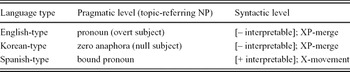
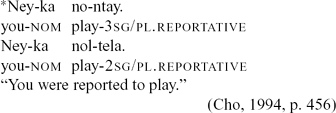
This section discusses the grammatical construction at the center of this research: subject realization in English (an overt-subject language) and Korean (a null-subject language). Park (Reference Park2004) describes subject licensing conditions in the two languages based on a minimalist approach. She points out two types of pro-drop languages: Spanish-type, with rich agreement, and Korean-type, with weak agreement.Footnote 7 Although Korean is sometimes thought of as a language without any agreement features, it does have some, such as mood agreement, which agrees with the subject (Cho, Reference Cho and Kim-Renaud1994), as is shown in (12). That is, Korean is a language with weak agreement, like English.Footnote 8 This suggests that both Korean and English syntactically license subjects in the same way (Table 1).Footnote 9
(12)
Licensing conditions on null subjects (Park, Reference Park2004).

The reason why Korean allows null subjects while English does not is due to licensing conditions on the NP at the pragmatic level. Empty categories in discourse-oriented languages like Korean are identified by a null sentence topic linked to a discourse topic, while sentence-oriented languages like English do not allow the null topic (Huang, Reference Huang1984). Park (Reference Park2004) argues that the topic chains in different languages are simply realized in different ways, resulting in null or overt subjects. Following Givón's (Reference Givón and Givón1983) scale, reproduced in (13), Park states that Korean-type languages choose zero anaphora to refer to the topic, whereas English-type languages usually select independent pronouns to encode a topic-referring NP.Footnote 10 Thus, topic chains in all languages are formed at the pragmatic level; the only difference between languages is the type of NP they prefer to code as the topic.
(13)

In summary, the divergence in the way subjects are realized in English and Korean (overt vs. null) is whether the languages prefer full NPs or zero anaphora to code topic-referring NPs. This will be relevant in the Discussion section, where constraints of subject realization are discussed.
Methods
Participants
The participants of this study are three children who participated in my dissertation project (Kang, Reference Kang2011). Their language was studied when they returned to Korea at ages 11;10, 6;9, and 4;11, after a two-year sojourn in the U.S. The oldest child, Sammy, is the main focus of the current study. At our first meeting, a day after his return to Korea from Michigan, Sammy reported that he was more comfortable with English than Korean. Still, he was able to understand and express himself in fluent Korean. Considering that he had been raised in Korea for almost ten years before he went to Michigan, it was not surprising to witness his fluent use of L1 Korean after two years in the U.S. Like most of his peers in Seoul, Korea, Sammy attended an English class at his middle school and private English institutions every day. Some of his classes were taught by a native English speaker. Although his mother, whose L1 is Korean, tried to speak English with him at home as much as possible, Korean was the dominant language of the family.Footnote 11
The other two participants, Hera and Rita, are sisters who returned to Korea from Hawai'i. At the time they returned to Korea, Hera (6;9) and Rita (4;11) spoke only English and were able to understand only elementary Korean. Even after their return to Korea, the sisters continued to use English at home, where, after a few hours at school and kindergarten every day, they spent most of their time under the supervision of a monolingual Korean babysitter until their parents came home from work. Near the end of the two-year project, both girls were speaking Korean to their parents, but Hera reported that her interaction with her little sister was still English-dominant because she thought Rita was not fully proficient in Korean.
The language dominance of the participants can only be speculated upon; as the original focus of my research was English attrition, Korean data were never collected. However, I am fairly confident that English was the dominant language of Hera and Rita as their Korean was still English-accented even after two years in Korea. On the other hand, Korean seemed to become the dominant language for Sammy quite quickly. He once reported, about eight months after his return to Korea, that he felt as though his English was slipping away and he was much more confident in Korean.
Materials
While most of the null-subject research analyzes participants’ spontaneous speech data, this study reports results from two production tasks. The tasks were originally designed to elicit children's use of English irregular past tense verbs and passives, not their use of null subjects, because I did not foresee that the English subject drop would appear in my data. These two tasks were used because both tasks elicited responses in complete sentences.
The main reason for analysis of the production task results rather than of naturalistic speech data is because my work with Sammy, the only child who frequently omitted subjects, focused primarily on the experiments. Unlike Hera and Rita, who did not hesitate to break away from the experiment materials and freely talk about other topics, Sammy concentrated on the experiments and thus his recordings lacked spontaneous data. As a result, there is a considerable amount of spontaneous speech data from the sisters, but not from Sammy, and it is his production task data that are of interest in this investigation.
Irregular past tense production task
In the irregular past tense production task, participants listened to a short story that I had created following the model used by Ullman, Pancheva, Love, Yee, Swinney and Hickok (Reference Ullman, Pancheva, Love, Yee, Swinney and Hickok2005). Usually, the story contained three or four short sentences. In the story, the target irregular verb was presented in its uninflected form. At the end of each story, I asked a short comprehension question aimed at eliciting an irregular past tense form of that verb. An example of a test item is given in (14).
(14) Sample test item
Yesterday, John went to the beach to swim.
But before swimming, he decided to build a sand castle.
After the sand castle was done, he enjoyed swimming.
Q: What did John do at the beach yesterday before swimming?
Target A: He built a sand castle.
Passive production task
The passive elicitation stimuli from Crain and Fodor (Reference Crain, Fodor and Dromi1993) were slightly modified for this passive production task. Crain and Fodor had children ask a puppet a question that contained a passive whereas in the current experiment, the participant was asked to answer two comprehension questions following a short story that accompanied two pictures. The first question was likely to be answered in the active voice while the second question was intended to elicit a passive with a by-phrase.
There were three characters in each picture. In the first picture, the character in the middle was always a human performing an action affecting the other two characters. The other two characters were sets of animates (e.g., a tiger and a mouse) or inanimates (a fork and a knife). I provided a short description such as Look! The tall girl brings a tiger and a mouse while the child looked at the first picture (see Figure 4).
A sample test item for passive production task.

The second picture also contained three characters. The human character in the middle contrasted with the human in the first picture with respect to a feature such as size (tall vs. short) or sex (male vs. female). The other two characters from the first picture remained unchanged. In the second picture, one of the remaining characters performed an action on the new human character. Again, I provided a short description such as Look over here! The tiger brushes the short girl. Then, I added another sentence like So the tiger, but not the mouse, brushes one of the girls, to make sure that the participants understood that there were two potential agents in the second picture. This sentence was added to satisfy the “felicity condition” (Crain & Fodor, Reference Crain, Fodor and Dromi1993; O'Brien, Grolla & Lillo-Martin, Reference O'Brien, Grolla, Lillo-Martin, Bamman, Magnitskaia and Zaller2006): the presence of an additional potential agent encourages the child to use a long passive (with a by-phrase).
I then showed the participant the first picture again and asked a comprehension question such as What did the tall girl do? After the participant answered, most likely in an active voice sentence, I showed the second picture to the child again and asked a second comprehension question, such as What happened to the short girl? The second question was intended to elicit an answer that contained a passive sentence like She was brushed by the tiger.
Procedure
There were nine sets of irregular past tense production tasks and five sets of passive production tasks, which were used in the longitudinal study of Kang (Reference Kang2011). Each set in the irregular past tense production task contained 10–15 test items, while each passive production task set had eight items. Because two questions were asked in the passive production task, participants produced 16 responses.
The two tasks were conducted on different days, approximately every two weeks, along with other experiments not reported here. However, since the children were not able to regularly participate every two weeks, Sammy ended up participating only 15 times over a one-year period before he returned to the U.S., while Hera and Rita participated 27 times over a two-year period. As there were only five sets for the passive production task and nine sets for the irregular past tense production task, the same materials were used in the same order as in the previous experiment. It usually took approximately four months for the passive production task and about eight months for the irregular past tense production task before the children were tested on the exact same test set. They did not show any familiarity with the irregular past tense task items though they did recognize some pictures in the passive production task items. Still, Kang (Reference Kang2011) showed that repeated measures of the same test materials every four to eight months do not influence the outcome of task performance.
The three participants’ recorded data were transcribed before analyses. Their use (or non-use) of the English subject was quite clear; there was no instance of uncertainty concerning the presence or absence of subjects.
Results
Interestingly, neither Hera nor Rita ever produced a single instance of a null subject throughout the entire 27 sessions. Considering the experiment design, which is similar to the English subject-drop context in (8) above with implied subjects, the participants’ responses could have in principle contained null subjects. Because the likely subjects of Hera and Rita's answers were already given in my questions, their data provided opportunities to observe how they would respond to a continued topic in English. The fact that they never dropped the English subjects even in contexts where subject omission would be allowed clearly demonstrates their native-like proficiency at least in terms of subject realization. It should be noted that the English null subject followed by an inflected verb as in (15) is considered ungrammatical although a null-subject response with a non-finite verb as in Throw a cup and a book may be deemed grammatical.
(15) I: What did the woman wearing a skirt do?
Sammy: Ø threw a cup and a book.
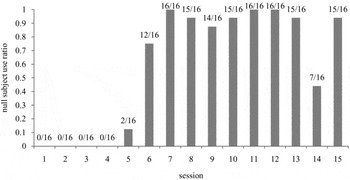
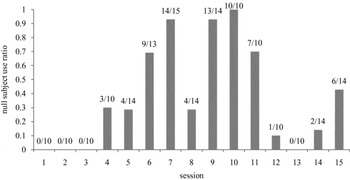
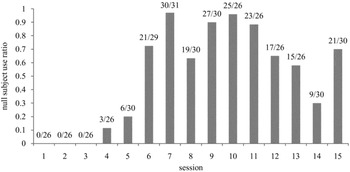
On the other hand, Sammy's result shows a different pattern. Just like the sisters, Sammy also did not omit subjects in the early sessions. However, after the first three sessions, he started producing null subjects as in (15). Figure 6 shows that null subjects began appearing in Session 4. After Session 7, in which Sammy responded without a subject (Figure 7) to all but one question in both tasks, he consistently dropped the subject more than half the time except in Session 14.Footnote 12
Sammy's use of null subjects in the passive elicitation task (null/total).

Sammy's use of null subjects in the irregular past tense elicitation task (null/total).

Sammy's aggregate use of null subjects in two tasks (null/total).

It is important to note that null subjects were never observed in the speech of Hera and Rita, who were proficient English speakers and were unable to speak any Korean when they returned to Korea. In contrast, although Sammy was an excellent English speaker at the time of his return, he was also a native speaker of Korean. It is also necessary to note that Sammy was at least a native-like English speaker who had already acquired the overt-subject parameter of English, as evidenced by his correct subject realization in the first three sessions. It seems that Sammy's Korean quickly gained dominance in the first two months after his return to Korea, and he transferred the Korean null-subject parameter setting to English. In the case of Hera and Rita, two years of exposure to Korean were apparently not sufficient for such a transfer to occur.
Discussion
Serratrice et al. (Reference Serratrice, Sorace and Paoli2004, p. 187) state that “none of the few studies that have addressed the issue of subject realization . . . have reported the kind of cross-linguistic influence . . . [that involves] a higher number of null subjects in the overt-subject language when compared to monolingual controls”. The data presented in this study, however, do suggest precisely this kind of cross-linguistic influence. According to H&M's model, Sammy's increased use of English null subjects should not have occurred. As a language with both overt- and null-subject options, Korean should have been influenced by the English lone option: the overt subject. However, the results of this study demonstrate that in fact, null-subject use in an overt-subject language (English) can be influenced by a null-subject language (Korean).
Revised model of cross-linguistic influence
Based on my data, I present revisions to the H&M model, with a particular look at the second condition. This model incorporates not only my data but also the findings from previous studies. The second condition in the original H&M model proposes that the lone option in language A influences the same option in language B, which is only one of two possible options in language B. This has created confusion because Serratrice et al. (Reference Serratrice, Sorace and Paoli2004) analyze the overt-subject language (English) as language B while Hacohen and Schaeffer (Reference Hacohen and Schaeffer2007) posit English as language A.
However, if both languages are acknowledged to have the same two options (as in the overt-subject language analysis of Serratrice et al. and the null-subject language analysis of Hacohen and Schaeffer), the confusion can be resolved. In fact, such an analysis seems more plausible because an overt subject is more appropriate in certain contexts of null-subject languages and subjects can be dropped in overt-subject languages, as demonstrated in the Background section above.
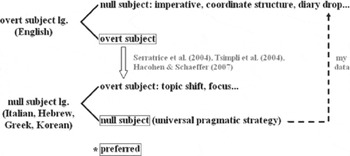
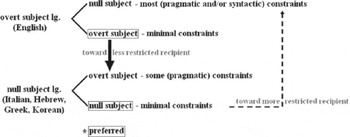
Applying this revised model results in Figure 8. Both overt- and null-subject languages can realize subjects with two options, with the bottom option in each language being the preferred option. Preferred option here refers to the subject realization option that a certain language selects in a canonical sentence that does not carry focus or emphasis. Thus, for example, even though English allows both overt- and null-subject options, the overt subject is the preferred option. When cross-linguistic influence occurs, it only happens between the same options; for example, the overt-subject option in overt-subject languages may influence overt-subject use in null-subject languages but not the null option in null-subject languages.
Applying the revised H&M model to the cross-linguistic influence of subject realization.

I argue that the direction of influence is from the preferred option of one language to the non-preferred option of the other language, but not vice versa. For example, the overt-subject pattern (preferred) in an overt-subject language can influence overt-subject use (non-preferred) in a null-subject language, as the three studies (Hacohen & Schaeffer, Reference Hacohen and Schaeffer2007; Serratrice et al., Reference Serratrice, Sorace and Paoli2004; Tsimpli et al., Reference Tsimpli, Sorace, Heycock and Filiaci2004) reviewed earlier demonstrate. My data show that the null-subject pattern (preferred) in a null-subject language can also influence null-subject use (non-preferred) in an overt-subject language (presented by the dotted-line arrow in Figure 8), which was considered unlikely by Serratrice et al. (Reference Serratrice, Sorace and Paoli2004) due to a lack of literature reporting such a direction of influence.
It is improbable, however, that the non-preferred option of one language could influence the preferred option of the other; the preferred option would not require reinforcement from the non-preferred option of another language. Even if such an influence were present, it would be difficult to demonstrate unless, for example, one could show that an English–Italian bilingual's use of an English overt subject (preferred), strengthened by the Italian non-preferred overt-subject option, were significantly more frequent than monolingual English speakers’ use.
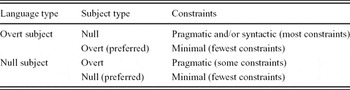
In conclusion, there are two potential directions of bilingual cross-linguistic influence: (i) from language A's preferred option to language B's non-preferred option, and (ii) from language B's preferred option to language A's non-preferred option. I propose that there is a hierarchy determining the direction of cross-linguistic influence between the two choices. Borrowing Serratrice et al.'s (Reference Serratrice, Sorace and Paoli2004) proposal that the direction of transfer is from the language with fewer (pragmatic) constraints to the language with (pragmatically) more complex constraints, I list the constraints imposed on each subject option (Table 2).
Constraints of subject realization in null- and overt-subject languages.

Overt subjects in overt-subject languages and null subjects in null-subject languages have the fewest constraints because they are the preferred options in their respective language types. Moreover, there are pragmatic constraints applied to licensing overt subjects in null-subject languages. Usually, subjects are realized in null-subject languages when emphasis and/or contrast are given to the subject, as in the Hebrew example in (11) above. Therefore, overt subjects in null-subject languages are restricted by pragmatic factors. However, there are more constraints involved in licensing null subjects in overt-subject languages. In the example of English, subjects could be dropped in (10) above due to a pragmatic reason (implicit first person subject). On the other hand, null subjects in coordinate structures as in (7) above are licensed by syntax; in this case, the licensing comes from ellipsis. Therefore, null subjects in overt-subject languages involve not only pragmatics but also syntax, thereby increasing the number and type of constraints.
In summary, there are two potential directions of cross-linguistic influence in subject realization: first, overt subjects in overt-subject languages can influence overt-subject use in null-subject languages and second, null subjects in null-subject languages can influence null-subject use in overt-subject languages. Also important are the number and type of constraints involved in each subject type: (i) fewest constraints for the overt subject in overt-subject languages and null subject in the null-subject languages, (ii) some constraints for the overt option in null-subject languages, and (iii) the most constraints for the null option in overt-subject languages.
Between the two potential directions of cross-linguistic influence, I acknowledge that the first, involving overt subjects (represented by the solid-line arrow in Figure 9), is more likely to occur than the second, concerning null subjects (represented by the dotted-line arrow in Figure 9), as shown in several previous studies. The main factor determining the direction involves the constraints imposed on the recipient of the influence. Both the overt subject in overt-subject languages and the null subject in null-subject languages are sources of influence, and have minimal constraints because they are the preferred options for subject realization in their respective languages. However, the receiving ends of the two transfer directions have different degrees of constraints. Overt subjects in null-subject languages are licensed only by pragmatic factors, whereas null subjects in overt-subject languages are subject to pragmatic and/or syntactic constraints. I suggest that the transfer is more likely to occur in the direction of the less restricted recipient because the fewer constraints there are at the receiving end, the easier it is for the source to influence it. This explains why every previous study has observed cross-linguistic influence in that direction.
Potential directions and constraints of cross-linguistic influence.

However, as my data demonstrate, transfer to the more restricted recipient language can also occur, although it is less likely due to the many constraints on the receiving end. Because language-internal factors (such as the number of constraints) favor transfer toward the less restricted recipient, a language-external factor strong enough to override internal factors must be present in order for the transfer toward the more restricted recipient to occur. I suggest that the strong external factor, in the case of this study, is language dominance.
The role of language dominance in cross-linguistic influence
So far, the direction of influence appears to depend on the restrictions on the receiving end. However, when language dominance is factored in, it can change the status of one of the sources. Without language dominance, the sources (preferred options) in each of two language types both have the fewest constraints and are thus equal in status, but if the null-subject language is the dominant language it can strengthen the null-subject option. If dominance strengthens the null-subject source in the null-subject language to the extent that it can overcome the large number of constraints imposed on this option in an overt-subject language, cross-linguistic influence in that direction will occur. This directionality was seen in Sammy's case.Footnote 13
In the case of balanced bilinguals such as the participants of Hacohen and Schaeffer (Reference Hacohen and Schaeffer2007) and Serratrice et al. (Reference Serratrice, Sorace and Paoli2004) studies, the direction of transfer will be determined by language-internal considerations (constraints involved in subject realization), resulting in overuse of overt subjects in null-subject languages. Even if the null-subject language is more dominant to a certain degree, the direction of transfer will remain until the dominance grows strong enough to override the existence of the greater number of constraints imposed on null subjects in overt-subject languages. I believe that this revised model can be applied to account for the behavior of the participants in Tsimpli et al. (Reference Tsimpli, Sorace, Heycock and Filiaci2004). The participants were native speakers of null-subject languages (Italian and Greek) but had lived in the U.K. for a considerable amount of time, reaching English near-nativeness. Therefore, even if their native languages could be considered more dominant, the dominance did not reach a level that could change the direction of transfer.
The same principle applies to the participants in my study. Hera and Rita never produced English null subjects. Even though their Korean was constantly gaining dominance, it did not become strong enough within the two years of the study period. In contrast, because Sammy was already a proficient Korean speaker when he returned to Korea, he only needed a short period for his Korean to gain the strength to ignite an English subject drop due to influence from Korean.
Conclusion
In this study, I have presented a revised model for the direction of cross-linguistic influence. Based on English null-subject data from a Korean–English bilingual child, I have argued that there are two potential directions of cross-linguistic influence. The direction with fewer constraints on the recipient is more likely to occur than the one with more constraints at the receiving end. The other direction of transfer can occur when the source language becomes dominant enough to override the number of constraints imposed on the recipient. Thus, contrary to the claims of Hacohen and Schaeffer (Reference Hacohen and Schaeffer2007), Hulk and Müller (Reference Hulk and Müller2000), and Serratrice et al. (Reference Serratrice, Sorace and Paoli2004), language dominance can play a significant role in cross-linguistic syntactic influence.
A number of differences distinguish participants of this study from those of other studies covered in the literature review. For example, while most participants in other studies were very young children acquiring two languages, the participants in my study were older and were undergoing an attrition process in one language. Questions may therefore arise concerning the predicted pattern, direction, and rate of cross-linguistic influence when considering different factors such as the children's age, length of exposure to the language(s), and linguistic environment. The issue of bilingual acquisition versus the attrition of one language while acquiring another is another difference to consider. However, an investigation of these questions is beyond the scope of this relatively restricted study. Further research in this area is required in order to provide insights into such interesting areas of inquiry.