Introduction
A common feature of Alzheimer's disease (AD) is lack of awareness about deficits or the illness itself, termed anosognosia in this context because of the largely but not exclusive neurobiological basis (Morris & Hannesdottir, Reference Morris and Hannesdottir2004). Anosognosia is a cause of caregiver distress and has substantial implications for clinical care, impacting on capacity issues, such as treatment compliance, and the person's ability to deal appropriately with potentially risk situations (Starkstein, Jorge, Mizrahi, Adrian, & Robinson, Reference Starkstein, Jorge, Mizrahi, Adrian and Robinson2007). There is variability in the presentation and severity of anosognosia, with some people with AD largely oblivious to deficits and the diagnosis, while others experience milder effects such as acknowledging the presence of impairments, but minimizing them or attributing them to normal aging.
One important aspect of anosognosia in AD is the relation with mood state. This relationship is explored here in two senses. First, there is the direct association between the extent of anosognosia and variations in ongoing mood, with special attention paid to depression and apathy. Here the issue is whether low mood or high apathy is causally related to awareness of symptoms and deficit, vice-versa or simply co-occurring. Second, and the main focus of this short review, there is the issue of whether immediate emotional reactivity in response to experiences of illness or deficit is dissociated from anosognosia, that is, if there are implicit emotional reactions despite a person showing no overt awareness or understanding of their condition. Finally, in a concluding section, we explore the clinical and theoretical implications of the reviewed findings.
Relationship between Mood State and Anosognosia
A common occurrence in people with AD is depressed mood, typically accompanied by changes in the level of behavioral activity, with impact on everyday cognitive functioning over and above the effects of dementia (for a review, see Lyketsos & Olin, Reference Lyketsos and Olin2002). The etiology of depression in dementia is complex; family and previous personal history of depression are risk factors, suggesting a genetic basis, but it has also been argued that depression may be a psychological reaction to the changes associated with the illness (Lyketsos & Olin, Reference Lyketsos and Olin2002) or have a common neurobiological base with AD pathology (Caraci, Copani, Nicoletti, & Drago, Reference Caraci, Copani, Nicoletti and Drago2010).
The relationship between depression and anosognosia has been explored through correlational analyses. Many studies indicate that people with AD who are more depressed show more apparent awareness (e.g., Clare et al., Reference Clare, Nelis, Martyr, Roberts, Whitaker, Markova and Morris2011; Harwood, Sultzer, & Wheatley, Reference Harwood, Sultzer and Wheatley2000). Mirroring that, mania and pathological laughing has been found to be associated with less anosognosia (e.g., Migliorelli et al., Reference Migliorelli, Teson, Sabe, Petracca, Petracchi, Leiquarda and Starkstein1995). A key issue is whether there is a causal link between such entities and, if so, in which direction? A prominent theory is that depression produces only apparently less anosognosia because of a negative bias when reporting problems, a form of depressive realism but applied to the self and symptoms. This depressive realism goes against the normal positive or optimistic bias that is associated with euthymic mood state. A converse theory is that increased awareness of difficulties might lead to higher depression (i.e., reactive depression). The latter position is sometimes linked to a psychological account of unawareness, suggesting a protective role for unawareness. It is worth noting that, in the context of dementia, prospective studies indicate that higher awareness predicts depressive mood at follow-up (Aalten et al., Reference Aalten, Van Valen, de Vugt, Lousberg, Jolles and Verhey2006; Derouesne et al., Reference Derouesne, Thibault, Lagha-Pierucci, Baudouin-Madec, Ancri and Lacomblez1999).
Despite most studies suggesting a link between awareness and depression in AD, a few have not confirmed this relationship (e.g., Lopez, Becker, Somsak, Dew, & DeKosky, Reference Lopez, Becker, Somsak, Dew and DeKosky1994). This may reflect use of different constructs (e.g., major depression or dysthymic mood) in the assessment of depression (Aalten, Van Valen, Clare, Kenny, & Verhey, Reference Aalten, Van Valen, Clare, Kenny and Verhey2005), with studies which measure major depression typically not finding a relationship (e.g., Lopez et al., Reference Lopez, Becker, Somsak, Dew and DeKosky1994; Reed, Jagust, & Coulter, Reference Reed, Jagust and Coulter1993). Others reasons for the discrepancy are differences in sample size, larger samples usually indicating a relationship (e.g., Aalten et al., Reference Aalten, Van Valen, Clare, Kenny and Verhey2005), and the fact that most studies have relied on participants recruited from clinical sites, which may contribute to differential sampling biases. Regarding this latter possibility, findings from the largest community-based study (n = 897) of awareness in dementia, also conducted in developing countries, suggested that depression, as diagnosed by the Geriatric Mental State Examination using ICD criteria, was associated with less awareness of memory impairment (Mograbi, Ferri, et al., Reference Mograbi, Ferri, Sosa, Stewart, Laks, Brown and Morris2012).
It should always be kept in mind that anosognosia is not a unitary concept, and associations with mood may depend on the specific domain being measured. In this regard, Starkstein, Sabe, Chemerinski, Jason, and Leiguarda (Reference Starkstein, Sabe, Chemerinski, Jason and Leiguarda1996) indicated that only awareness of cognitive difficulties, as opposed to behavioral symptoms, is associated with depression. Similarly, depression has different dimensions and facets, with the possibility that the relationship with awareness is mediated by the specific factors involved. This has not been explored extensively, but a study by Troisi and colleagues (Reference Troisi, Pasini, Gori, Sorbi, Baroni and Ciani1996) has suggested that awareness in dementia is associated with increased depression in psychological symptoms only (e.g., mood, ideation, anxiety), but no relationship for somatic symptoms (e.g., fatigue, slowness). Nevertheless, interpretation here is limited by the lack of a more structured assessment of awareness. Less frequently, unawareness in dementia has also been shown to be associated with symptoms such as anxiety (Derouesne et al., Reference Derouesne, Thibault, Lagha-Pierucci, Baudouin-Madec, Ancri and Lacomblez1999; Harwood et al., Reference Harwood, Sultzer and Wheatley2000), irritability (Seltzer, Vasterling, Hale, & Khurana, Reference Seltzer, Vasterling, Hale and Khurana1995), and overall distress (Claire et al., 2011), which may confound the relationship with mood disorder.
Apathy, Error Monitoring, and Anosognosia
In AD, apathy is also found as an accompanying feature, being clinically distinguished from depression. In essence, apathy in AD may present as a motivational disorder characterized by loss of initiative and participation in goal directed activity and lack of emotional reactivity. Apathy is seen as an independent syndrome if such loss of motivation is not due to a secondary factor such as emotional distress or intellectual impairment (Marin, Biedrzycki, & Firinciogullari, Reference Marin, Biedrzycki and Firinciogullari1991). However, depression and apathy can be co-morbid, with some dementia patients showing signs of both (Starkstein, Petracca, Chemerisnki, & Kremer, Reference Starkstein, Petracca, Chemerisnki and Kremer2001).
Apathy has been consistently associated with unawareness in AD, but unlike depression, more apathy is accompanied by less awareness (e.g., Derouesne et al., Reference Derouesne, Thibault, Lagha-Pierucci, Baudouin-Madec, Ancri and Lacomblez1999; Starkstein, Petracca, Chemerisnki, & Kremer, Reference Starkstein, Petracca, Chemerisnki and Kremer2001). There is some evidence that apathy is more tightly related to unawareness of cognitive symptoms than behavioral disturbance (Starkstein et al., Reference Starkstein, Sabe, Chemerinski, Jason and Leiguarda1996). Although the theme has not been explored extensively, a study by Spalletta, Girardi, Caltagirone, and Orfei (Reference Spalletta, Girardi, Caltagirone and Orfei2012) has found that apathy is related to anosognosia in mild AD, but not in mild cognitive impairment (MCI). Considering that MCI can be seen in many patients as a prodromal stage of dementia, this finding may reflect the fact that apathy becomes more prevalent at later stages of the neurodegenerative process (Starkstein, Ingram, Garau, & Mizrahi, Reference Starkstein, Ingram, Garau and Mizrahi2005). In terms of suggested causality, results from a longitudinal study indicated that anosognosia at baseline predicts apathy at follow-up (Starkstein, Brockman, Bruce, & Petracca, Reference Starkstein, Brockman, Bruce and Petracca2010).
Ott, Noto, and Fogel (Reference Ott, Noto and Fogel1996) indicate a common neuroanatomical correlate for apathy and unawareness in AD. The literature also points to an association between frontal lobe dysfunction and anosognosia in AD, for instance as indicated by neuropsychological tests of executive functions (e.g., Mangone, Hier, Gorelick, & Ganellen, Reference Mangone, Hier, Gorelick and Ganellen1991; Michon et al., Reference Michon, Deweer, Pillon and Agid1994) and neuroimaging studies (e.g., fMRI, Amanzio et al., Reference Amanzio, Torta, Sacco, Cauda, D'Agata, Duca and Geminiani2011; PET, Harwood et al., Reference Harwood, Sultzer, Feil, Monserratt, Freedman and Mandelkern2005; SPECT, Reed et al., Reference Reed, Jagust and Coulter1993). In addition, converging evidence from neuroimaging and neuropathological studies indicate that apathy in AD is associated with alterations in the anterior cingulate (Apostolova et al., Reference Apostolova, Akopyan, Partiali, Steiner, Dutton, Hayashi and Thompson2007; Marshall, Fairbanks, Tekin, Vinters, & Cummings, Reference Marshall, Fairbanks, Tekin, Vinters and Cummings2006), including structural connectivity changes around this region (Hahn et al., Reference Hahn, Lim, Won, Ahn, Jung and Lee2013; Kim et al., Reference Kim, Lee, Choo, Seo, Kim, Park and Woo2011; Ota, Sato, Nakata, Arima, & Uno, Reference Ota, Sato, Nakata, Arima and Uno2012). The anterior cingulate is the main candidate area for event-related potentials (ERPs) associated with error monitoring, such as the error-related negativity (ERN) and error-related positivity (Pe). Hence, it is possible that in AD apathy is closely related to impairment of processes such as error monitoring. It is also possible, however, that the association between apathy and frontal lobe dysfunction is not the same across all stages of the illness, since it has been found that apathy is related to changes in connectivity in the temporal lobes and between the temporal and frontal lobes in MCI (Cacciari et al., Reference Cacciari, Moraschi, Di Paola, Cherubini, Orfei, Giove and Spalletta2010).
Emotional Reactivity to Illness Despite Unawareness
Clinical observation indicates that lack of awareness can be accompanied by implicit signs of understanding or representation of deficit. Such knowledge is suggested by or inferred from actions or statements of the person with neurological disorder more generally. For example, a person lacking awareness may be indifferent to their impairments, but show strong emotional reactions when hearing about related themes (Kaplan-Solms & Solms, Reference Kaplan-Solms and Solms2000). A few studies have suggested that people with AD may show emotional reactivity to illness related material or the experience of failure in cognitive tasks despite limited awareness of condition or performance.
Martyr and colleagues (Reference Martyr, Clare, Nelis, Roberts, Robinson, Roth and Morris2011) explored unawareness of memory deficit in a group of people with dementia (including AD) and their caregivers. A modified emotional Stroop Test was used, in which the time taken to name the print color of words was measured for neutral words and memory-deficit related words (e.g., forgetful, lapse). Here, attentional bias in relation to deficit associated words is predicted to slow naming of the color by the participants. The dementia group showed a similar increase in response times as the caregiver group to memory-related relative to neutral words, suggesting that both groups have a heightened susceptibility to deficit words. It is important to note that the interference effect was not correlated with explicit awareness (measured by clinician ratings) in the dementia group. Additional data have shown a weaker effect in non-carer controls. Future research should expand the use of this technique to emotional words unrelated to deficit, testing also the extent to which the attentional bias is self-relevant and not merely related to recent exposure.
A recent study by Mograbi, Brown, Salas, and Morris (Reference Mograbi, Brown, Salas and Morris2012) investigated emotional reactivity to the experience of task failure in people with AD and age-matched controls using a series of computer tasks testing memory and reaction time. The study firstly ascertained individual performance levels and then titrated difficulty levels of each participant to either ensure success or failure. This success/failure manipulation effectively produced matching error rates between groups, necessary to explore emotional reaction given the same degree of failure (for a full description, see Mograbi, Brown, Salas, et al., Reference Mograbi, Brown, Salas and Morris2012). Half of the tasks were set to be below participants’ ability level (success tasks), while the other half was above (failure tasks). The results indicated that even though the AD group had less awareness of failure relative to controls, emotional reactivity was similar both in terms of self-report and filmed facial expressions, with increased reactivity to failure compared with success. In all tasks, emotional reactivity to failure was not correlated with awareness of performance. Although it is possible that factors such as lack of memory for performance affecting accuracy judgments might contribute for the observed results, the dissociation between awareness and emotional reactivity is suggestive of implicit awareness and that emotional reaction to task failure is robust at least in early AD.
Finally, another recent study also provided potential evidence of implicit reactivity despite unawareness of dementia (Mograbi, Brown, & Morris, Reference Mograbi, Brown and Morris2012). Reactivity was induced using emotional film clips (neutral; negative using one film depicting a person coping with cancer and another about dealing with dementia; and positive) comparing people with early AD versus normal controls. While emotional reactivity was slightly decreased in the AD group compared to the control group, more awareness in the AD group was accompanied by lower frequency of negative facial expressions to the dementia illness-related film. It is possible that people with AD with more preserved awareness might try to suppress their emotional responses to dementia-related material as a conscious coping mechanism to avoid stress responses; in those with less awareness this process might not take place leading to a stronger emotional reaction. As an alternative explanation, the findings may suggest “leakage” of involuntary expressions where there is unawareness, leading to reactivity which bypasses volitional control or active suppression.
Theoretical Implications
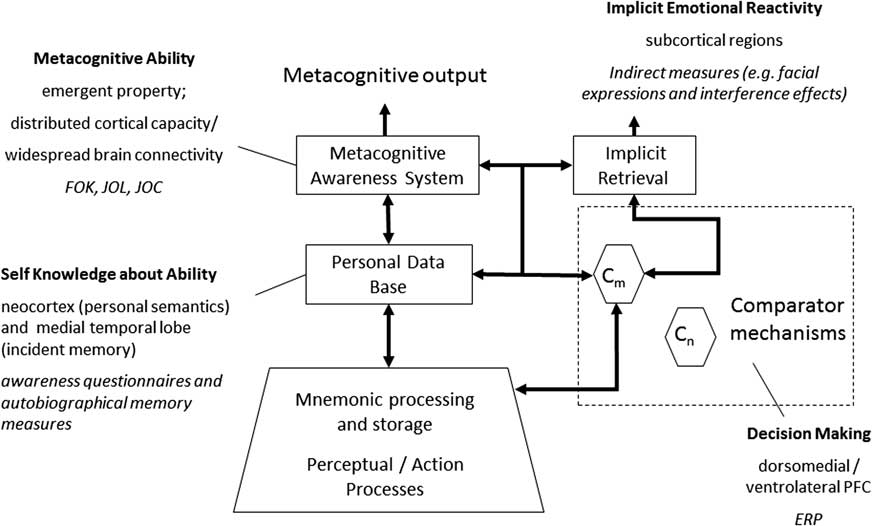
The studies reviewed in the previous section indicate a potential dissociation between emotional reactivity and overt expression of awareness. This idea has been explored in the context of the Cognitive Awareness Model (for a simplified version, see Figure 1A; a more complete description can be found in Morris & Mograbi, Reference Morris and Mograbi2013). According to this model, if comparator mechanisms are sufficiently preserved (i.e., if the anosognosia is not caused by executive dysfunction), information about performance can lead to implicit reactivity through a parallel route bypassing consciousness. This mirrors theoretical models (e.g., LeDoux, Reference LeDoux1996), which suggest a dual route for processing of emotional information, one linked to awareness and more elaborate in nature, and another quicker and less detailed, based on subcortical structures. Although the exact mechanism for implicit emotional reactivity in dementia remains unknown, initial evidence for subcortical involvement in implicit awareness has been found in the case of hemiplegia (Moro, Pernigo, Zapparoli, Cordioli, & Aglioti, Reference Moro, Pernigo, Zapparoli, Cordioli and Aglioti2011).
A simplified version of the new CAM model (for the full model, see Morris & Mograbi, Reference Morris and Mograbi2013). Concepts are presented in bold with their potential underlying neural systems and assessment methods (in italics).

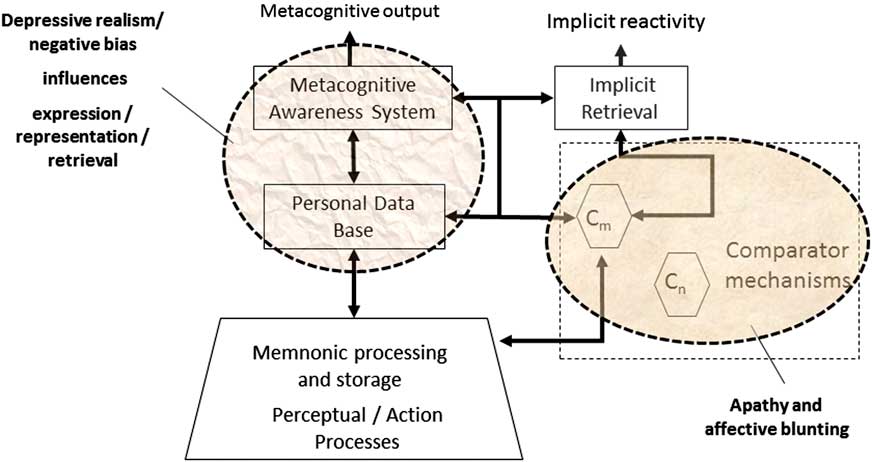
Figure 1B exemplifies how depression and apathy may impact metacognitive ability and implicit emotional reactivity. In cases where apathy is present and there is affective blunting, experience is deprived of its emotional coloring and fails to receive attention. Errors and their consequences are ignored or normalized because they do not convey an affective signature, or, rather, apathy produces “numbness” and inability to feel them. Apathy is also characterized by loss of motivation and participation in goal directed activity, a context in which monitoring of errors becomes less relevant [for similar views, see Vuilleumier (Reference Vuilleumier2004) and Rosen (Reference Rosen2011)]. By its turn, depressed mood may lead to depressive realism or a negative bias, impacting self-appraisal, for example influencing metacognitive judgment or biasing representation and retrieval of mnemonic material about self-efficacy.
Depressive mood may lead to negative bias or depressive realism when evaluating self-ability, acting both at the level of self appraisals (Metacognitive Awareness system) or biased recall of personal information (personal data base). Apathy may cause affective blunting, hindering monitoring of performance by depriving errors of their affective signature.

Mild Cognitive Impairment
Although few studies have investigated anosognosia in MCI, there is growing evidence for awareness impairments in this group (Orfei et al., Reference Orfei, Varsi, Blundo, Celia, Casini, Caltagirone and Spalletta2010). This has significant clinical impact, considering that self-report of memory problems has been used in the past as a diagnostic criterion for the diagnosis of MCI. At this stage, however, there is limited evidence for an association between depression/apathy and anosognosia in MCI. For example, Spalletta and colleagues (Reference Spalletta, Girardi, Caltagirone and Orfei2012) found an association of anosognosia and apathy in AD but not in MCI. Regarding implicit emotional reactivity, although a similar pattern of responses is predicted in people with MCI, this has not been yet explored empirically. It is possible that psychosocial factors play a greater role in the expression of awareness in this group relative to people with diagnosed dementia, and this may also impact implicit reactivity and the association of anosognosia with apathy and depression.
Conclusion
To summarize, various studies have explored the relation between mood state and unawareness. Despite some variation in study features, such as assessment tools (e.g., self-report or clinician ratings), depression construct (e.g., major depression or dysthymic mood) and sample sizes, most studies point to a correlation between more depression and lower anosognosia (i.e., more awareness). Conversely, apathy seems to increase with anosognosia, interpretations being that this reflects shared networks between these phenomena or the importance of emotional processing in error monitoring. To date, only three experimental studies have been conducted exploring implicit emotional reactivity and anosognosia in people with dementia. The evidence produced so far seems to suggest that there may be normal emotional reaction to the experience of illness or deficit, despite unawareness of task deficit.
Future research can help to disentangle in which conditions depression is associated with awareness. For example, the use of complementary approaches, including self-report, informant, and observational/clinician measures, may indicate which constructs and facets of these two phenomena, both heterogeneous and diverse, are related. Another topic which could be further explored is the relationship between apathy and awareness, in particular the putative framework suggested here linking error monitoring impairment with emotional blunting. Neuroimaging techniques, including EEG and fMRI, and physiological measures of emotion may be particularly helpful in this regard. In addition, it would be important to investigate whether implicit processing of information leads to more lasting negative mood, although this may be experimentally hard to explore.
In addition to theoretical conclusions, the findings reviewed here may have important clinical implications. If there is a causative association between awareness and depression and also if there is normal emotional reaction to failure even with lack of awareness then this might lead to the following suggestions:
-
1. Exposing people with dementia to failure should be handled with caution, taking into account the potential risk of causing negative mood. In the past, certain approaches, such as basic reality orientation (RO), which inadvertently involved confronting people with their impairments, did indeed produced negative mood changes in some people with dementia (e.g., Dietch, Hewett, & Jones, Reference Dietch, Hewett and Jones1989). More recent adaptions of such approaches have been more affirmative, focusing on successful activity. In this sense, techniques such errorless learning as applied to people with dementia (Clare, Wilson, Breen, & Rogers, Reference Clare, Wilson, Breen and Hodges1999) may have the benefit of improving function whilst helping to keeping mood stable. Further research is needed to analyze the interaction between awareness, mood and task efficacy in such interventions;
-
2. The importance of tailoring neuropsychological assessment procedures to reduce the amount of experienced failure should be carefully considered, even if the person does not declare awareness of their neuropsychological deficits. The range of specially developed assessment techniques for different severities of dementia can be applied sensitively to detect and diagnose disability but reduce the amount of failure exposure (Morris & Brookes, Reference Morris and Brookes2012);
-
3. Finally, the issue raised by the reviewed research has implications for understanding patients’ experience of failure or success in everyday life; there may be substantial negative feelings that are not necessarily appreciated by caregivers. Future research should be orientated to exploring these factors from the perspective of the person with dementia.
Acknowledgments
Daniel Mograbi receives funding support from CAPES and FAPERJ. Robin Morris receives financial support from the Wellcome Trust, the Stroke Association, the Economic and Social Research Council and P1Vital Limited. The authors declare that there are no conflicts of interest.