


Following immediately upon Iraq’s 1990 invasion of Kuwait, the United States National Security Council met to discuss the US response. At this meeting, then Secretary of Defense Richard Cheney made a forceful case for the US military intervention that would eventually follow, arguing that:
[Saddam Hussein] has clearly done what he has to do to dominate OPEC, the Gulf and the Arab World. He is 40 kilometers from Saudi Arabia, and its oil production is only a couple of hundred kilometers away. If he doesn’t take it physically, with his new wealth he will still have an impact and will be able to acquire new weapons, including nuclear weapons. The problem will get worse, not better (National Security Council 1990, 3–4).
Cheney is clearly making a case for preventive war against Iraq. What he argues the United States should be preventing is somewhat subtle. It is not that Iraq’s invasion of Kuwait will result in a hegemonic transition. Neither the United States nor the international system it dominated was immediately threatened by Iraq’s actions. Nor was it simply to prevent a large and rapid shift in power that would result if Iraq was to go on to attack Saudi Arabia. Although there certainly existed incomplete information over what Hussein intended to do, this does not factor much into Cheney’s reasoning. Instead, Cheney is arguing that Hussein has effected a change that will, without intervention, result in the long-term acquisition of greater economic, military, and political power in the hands of the Iraqi government. It is this potential for a long-term erosion of bargaining power vis-à-vis Iraq that Cheney hopes to prevent.Footnote 1
Fearon (Reference Fearon1995) introduced the logic that states may initiate war in order to prevent the loss of future bargaining power. He even provides an intuitive argument as to why this logic applies to the case of US intervention following the Iraqi invasion of Kuwait (Fearon Reference Fearon1995, 406). However, international relations still lacks a formal theory of long-term power shifts that can adequately formalize Fearon’s intuition and address Cheney’s reasoning. Although there exist models of long-run shifts in the formal theory literature (Powell Reference Powell1999; Powell Reference Powell2004b; Powell Reference Powell2012), past models have focused on one period conditions for war that have the effect of emphasizing large and rapid shifts in power. Yet, a theory that fully addresses the implications of slower, long-term shifts is critical for understanding both the currently rising tensions between the United States and China, as well as the circumstances behind many important historical wars. This paper builds a model of long-term shifts in power and uses it to demonstrate two substantively important results.
First, preventive wars are triggered by commitment problems under a broader set of circumstances than previously demonstrated in the literature. Previous work has demonstrated that preventive war can be caused by large power shifts over a short period of time such as those that might be caused by the acquisition of nuclear weapons (Powell Reference Powell2004b; Powell Reference Powell2006). This paper demonstrates that preventive war is not only caused by these types of power shifts, but also by relatively slow, but persistent shifts in the distribution of power such as those caused by sustained differences in economic growth rates.
Second, preventive wars may be initiated after a shift in power has already begun. Powell’s analysis implies that war will begin before a large and rapid shift in power occurs. However, historical preventive wars typically involve a period of tension where a status quo power is made nervous by a rising power before initiating war. This dynamic is present in this model since the power shift that ultimately causes war can progress for several periods before the status quo power attacks.
These substantive results follow from a novel technical contribution that builds on the work of Robert Powell. Powell demonstrates that war occurs when the sum of one state’s current war value and the expectation of a competing state’s war value in the next period exceeds the total surplus available. This paper demonstrates that war occurs when the sum of one state’s current war value and the expectation of a competing state’s maximum discounted war value at any point in the future exceeds the total surplus available. This turns out to have the large substantive consequences discussed above.
The paper proceeds as follows: first, a brief discussion of how this paper’s results relate to the previous literature is presented. The next section then builds a simplification of the model in Powell (Reference Powell2004b, 235–7).Footnote 2 Following this, the main results are presented. Results are presented for the general case, the case of constant multiplicative shifts in power, and constant additive shifts in power, which allows for an easy comparison with the models in Powell (Reference Powell1999) and Powell (Reference Powell2006). Final section concludes. All proofs are located in the Appendix.
Related Literature
By emphasizing persistent shifts in power, the new sufficient condition for war in this paper focuses attention on long-term shifts in power. As Thucydides’ famous quote that the Peloponnesian War was caused by “the growth of Athenian power and the fear which this caused in Sparta” (Thucydides 1954, 1.23), there have been many thinkers who have argued that long-term shifts in power cause war. Most recently, Power Transition Theory has argued that shifts in power owing to long-term economic changes lead to hegemonic challenges of the currently dominant state (Organski Reference Organski1968; Organski and Kugler Reference Organski and Kugler1980; Gilpin Reference Gilpin1981). What is missing from this literature is a clear causal mechanism for war that holds up to formal theoretical analysis.
The hypothesis in Power Transition Theory that a rising challenger disrupts the place of the currently dominant state is not the causal mechanism explored in this paper.Footnote 3 Although the potential displacement of a dominant state may occur incidentally with a shift in the distribution of power, in this paper’s analysis there is nothing special about shifts in power that result in the most powerful state losing its position. Although the causal mechanism for war is different, the intuition gained from Power Transition Theory about the importance of long-term shifts in power is very relevant to the analysis of this paper.
Both Powell’s sufficient condition for war and the new one in this paper rely on the logic of commitment problems. Fearon (Reference Fearon1995, 401–9) elucidates the nature of the commitment problem as a cause of war. Commitment problems arise when anticipated shifts in the distribution of power cause adversely impacted states to go to war in order to prevent future declines in their bargaining power. The rising state may prefer to avoid war by committing to not exercise its future bargaining power with a contract. However, as there does not exist a world government to enforce contracts between states, there is no means by which a rising state can commit to honor this contract in the future.
Powell subsequently demonstrated that a common mechanism underlies the various types of commitment problems outlined by Fearon (Powell Reference Powell2004b; Powell Reference Powell2006)—namely, the large and rapid shifts in the distribution of power discussed above. Powell’s condition results from demonstrating how an adverse power shift occurring within a single period can bound the maximum size of a declining power’s peace value in the current period as future bargaining power will have eroded. However, if this shift takes place far in the future, it is also possible to extend this same logic backwards. Each period’s maximum peace value is limited both by the power shift taking place in that period, but also by the degree to which the next period’s peace value is limited by shifts in future periods. I use this approach to prove a much tighter bound on peace values than results from Powell’s approach.
This difference in approach highlights that the principal problem in applying Powell’s condition is the “rapid” part of the formulation. Shifts may occur over time that satisfy the size requirement in Powell’s condition, but it is typically unrealistic to expect them to occur all at once. Moreover, it is difficult to justify preventive war when bargain periods need only be long enough to accommodate an exchange of offers or a flow of benefits, but, in the same time frame, allow for large changes in the underlying state of the world. Discrete changes, such as a state acquiring nuclear weapons, are needed to make the mechanism natural in an empirical setting.
Empirically, Powell’s mechanism seems to be most applicable when looking at the causes of war that are the result of actions taken by policy makers. Large and rapid shifts in the distribution of power on the scale implied by Powell’s model are, in fact, quite dramatic changes. Examples of such a shift might be the acquisition of nuclear weapons or a sudden change in the alliance structure of the international system. Both are highly relevant events in the study of war. However, saying that such actions are the root cause of an inefficient preventive war immediately raises the question, why did the state choose to acquire the nuclear weapons or change the alliance structure in the first place?
Debs and Monteiro (Reference Debs and Monteiro2014) argues that incomplete information is necessary to generate such actions when using the Powell’s sufficient condition for war. In their model, a state may only receive an imperfect signal of whether or not a rival has chosen to invest in militarization. Given this, a state may risk preventive war by militarizing as the other state will only initiate war if it receives a strong enough signal that an investment in militarization has occurred. Although Debs and Monteiro (Reference Debs and Monteiro2014) emphasizes incomplete information as the root cause of war in order to get around the problems of justifying large and rapid shifts, the results of this paper show that incomplete information is not necessary to cause war using the logic of commitment problems.Footnote 4
Another case where Powell’s large and rapid mechanism applies is the case of first strike advantages. As highlighted in several papers (Fearon Reference Fearon1995; Powell Reference Powell2006; Leventoglu and Slantchev Reference Leventoglu and Slantchev2007), first strike advantages lead to rapid and potentially large shifts in the distribution of power as one player gives up the advantage of striking first, it immediately swings to the other player. Although it is true that many wars have indeed begun with one state taking advantage of a first strike, it is difficult to imagine that such advantages are the fundamental cause of a war unless they had just come into existence, again, through some exogenous technological shock or change to the international structure. Otherwise, one must ask: what has changed that made these first strike advantages critical at the instance war began?
A case where the large and rapid mechanism does not provide a compelling theoretical justification for war is when the shift in question is of an economic nature. This point is made in both Powell (Reference Powell1999) and Powell (Reference Powell2004b). Powell argues that shifts owing to differential rates of economic growth large enough to cause war through the commitment problem mechanism “posit rates of change in the distribution of power or costs of fighting that seem empirically implausible” (Powell Reference Powell1999, 133). Powell justifies this claim by noting that, according to his analysis of the Correlates of War data from 1816–1990, the largest one period shift in the distribution of power between two Great Powers occurred between Great Britain and Russia in the years 1925–1926. The size of this shift was only 6.8 percent. Furthermore, Powell’s analysis concludes that only 0.73 percent of non-warring, Great Power dyads had an annual change >5 percent. Under the large and rapid mechanism, shifts of such small sizes are unlikely to cause war.
This demonstrates the large and rapid mechanism’s core antagonism with Power Transition Theory, which has long argued that economic shifts are causal for wars. The problem with economic shifts, when confronted with Powell’s mechanism, is that they typically occur over long periods of time. However, the generalization of Powell’s condition presented here can potentially serve as a causal mechanism for war as a result of long-term economic shifts. In fact, the more persistent an economic shock is expected to be, the more likely it is to cause preventive war. Shocks to the trend of economic growth are therefore far more likely to cause preventive war than transitory business cycle shocks.
This is not to suggest that a multi-period sufficient condition for preventive war is only useful for the case of economic shifts. For instance, Powell (Reference Powell2012) considers shifts in power owing to state consolidation that may take place over many periods. Furthermore, while modeling endogenous militarization decisions over many periods in a stochastic game setting can be quite complex, given that a militarization decision has already been made, they can be treated as exogenous so that the condition in this paper is then useful for thinking through the effects. McDonald (Reference McDonald2011) looks at how Russia’s militarization decisions before World War I may have induced a preventive war motive in Germany through Powell’s large and rapid mechanism. However, it is much more convenient to quantify and test the effects of this multi-year militarization plan with a multi-period sufficient condition. In the case of building nuclear weapons, as demonstrated by the Iranian nuclear program, it can take many years to build the necessary facilities, enrich the necessary amount of uranium, and build an effective delivery system. Each step along the way may contribute bargaining power to the builder, whereas preventive war may be initiated at any time during this process. Therefore, even in this case, a sufficient condition that applies to long-term shifts is useful.
In this vein, the wide applicability of the new sufficient condition for war in this paper has the potential to motivate new theoretical insights from the large literature that utilizes Powell’s condition (Leventoglu and Slantchev Reference Leventoglu and Slantchev2007; Schwarz and Sonin Reference Schwarz and Sonin2008; Wolford, Reiter and Carrubba Reference Wolford, Reiter and Carrubba2011; Powell Reference Powell2012; Debs and Monteiro Reference Debs and Monteiro2014; Chapman, McDonald and Moser Reference Chapman, McDonald and Moser2015). Furthermore, the condition in this paper is more easily utilized in applied work than Powell’s condition for two reasons. First, empirically observed shifts in power may occur over widely different lengths of time. This is significantly more natural to analyze with a multi-period sufficient condition than a single period one. Second, as the sufficient condition for war in this paper applies to much smaller shifts in power than Powell’s sufficient condition, the new condition is satisfied for shift sizes that are more empirically plausible.
The Model
Consider a simplification of the stochastic game in Powell (Reference Powell2004b), which I label Γ. There are two states, labeled R and S. These states bargain to split a pie of size 1 in every period t∈{0, 1, 2, …}. If the states agree on a bargain x∈[0, 1], then state S receives a payoff of x for that period and R receives a payoff of 1−x. Both states discount the future at the same constant rate δ∈(0,1). The total present value of the current and future flows of this pie is then
 $$B=\mathop{\sum}\limits_{t\,=\,0}^\infty {\delta ^{t} } ={1 \over {1{\minus}\delta }}.$$
In general bargaining problems, the players often have an outside option that they can revert to if they do not like the bargaining outcome. As the players always have this option, it can be thought of as a lower bound on their minmax value, as there is no way the other player can force them to take less than this value. In war models, one thinks of this as being the war value for a state. A simple way of modeling war is as a game-ending costly lottery.Footnote 5 This value in a given period will then serve as a state’s minmax value for that period, M i,t . The lottery is costly as the essential motivating principle behind bargaining models of war is that war is an inefficient way of dividing a pie.
Let p t ∈(0, 1) be the probability that R wins a war at time t, whereas 1−p t is S’s probability of victory. If a state wins the war, it receives the entire value of the pie from that period forward and nothing if it loses. However, when states resort to war, some of the pie is lost owing to the inefficiency of war represented by the value d∈(0, 1), where, for reference, a value of d=0 means no inefficiency to war and a value of d=1 implies that the entire pie is lost in a war.Footnote 6 This gives minmax values at t of
 $$M_{{R,t}} ={{p_{{t}}(1{\minus}d)} \over {1{\minus}\delta }}$$
and
 $$M_{{S,t}} ={{(1{\minus}p_{{t}})(1{\minus}d)} \over {1{\minus}\delta }}$$.
I assume that R is rising in power relative to S for a number of periods T≥1 beginning in period τ. This rise in power is modeled as a deterministic transition function, q t , which, in the absence of war, maps R’s probability of winning at time t into its probability of winning a war at time t+1. Hence, p t+1=q t (p t ). The assumption that R is rising relative to S for T periods starting in period τ can be written as the assumption that q t (p t )>p t for all t∈{τ, τ+1, … , τ+T−1}. Once period τ+T is reached, the shift in power is assumed to end. Thereafter, q t (p t )=p t for all t≥τ+T. Of course, q t must be constrained so that p τ+T ≤1. Although q t represents exogenous shifts in power, most interesting underlying shifts that induce shifts in power, such as changes in military spending and even economic shifts, are endogenous from the viewpoint of a sufficiently sophisticated model. The exogeneity of q t is a simplification and can be thought to model endogenous changes in a reduced form manner. Finally, note that q t is also exogenous to the bargain struck. This is in contrast to papers in the tradition of Fearon (Reference Fearon1996) that consider bargains that endogenously impact future bargaining power.
I will pay special attention to two functional forms for q t . The first, which I call the θ shift case, has the form p t+1=θp t , where θ>1 when τ≤t≤τ+T−1. Otherwise, θ=1. This case is interesting for two reasons. First, it is the simplest to analyze. Second, θ can be clearly interpreted empirically as one plus the percentage shift in the probability of victory from one period to the next. In the case of multiplicative shifts, in order to ensure that p τ+T ≤1, it must be the case that T≤−log(p τ )/log(θ). When discussing the case of multiplicative shifts, I will refer to the game as Γ(θ).
The second specific functional form I focus on is the constant additive shift case. In this case, p t+1=p t +Δ, where Δ>0 when t≤τ+T−1. Otherwise, Δ=0. This case is primarily interesting as a comparison with Powell (Reference Powell1999) and Powell (Reference Powell2006). Powell (Reference Powell2006) demonstrates a sufficient condition for war for one period additive shifts, whereas Powell (Reference Powell1999) examines the case where additive shifts may accumulate over many periods. As the conclusions of this paper are very different than Powell (Reference Powell1999), it is worth examining this case in detail. In the case of additive shifts, in order to ensure that p τ+T ≤1, it must be the case that T≤(1−p τ )/Δ. When discussing the game with additive shifts, I will refer to it as Γ(Δ).
What is so powerful and convincing about Powell’s sufficient condition for war is that it holds for all possible bargaining protocols that states may employ to avoid war. In general, the results in the next section hold for any bargaining protocol as well. An example of a popular bargaining protocol, which I call
 $${\Bbb S}$$
, is the protocol where the bargain is determined by S making a take-it-or-leave-it offer in each period. Formally, under bargaining protocol
 $${\Bbb S}$$
, S makes a take-it-or-leave-it offer of keeping x∈[0, 1] such that if neither state declares war, then S receives x and R receives 1−x.
Regardless of bargaining protocol, in every period, after a bargain, x, is determined, states S and R play actions A i ∈{a,w} in a random order.Footnote 7 If a is chosen, then that state accepts the bargain. If both states play a, then the bargain is accepted and no war occurs this period. If either state plays w, then the states do not receive the bargain value and a game-ending war with values as described previously occurs.Footnote 8
Results
General Case
Proposition 1 restates the inefficiency condition in Powell (Reference Powell2004b) within this simplified framework as a sufficient condition for war.
Proposition 1: War must occur in any subgame perfect equilibrium (SPE) of the game Γ at some time t≤τ if there exists a time τ such that
 $$M_{{S,\tau }}\,\gt \,B\,{\minus}\,\delta M_{{R,\tau {\plus}1}} .$$
The main result of this paper is to weaken condition (1) in Proposition 1 considerably.
Proposition 2: War must occur in any SPE of the game Γ at some time t<τ+T if there exists a time τ such that
 $$M_{{S,\tau }}\,\gt\,B\,{\minus}\,\mathop{{{\rm max}}}\limits_{{\hat{T}\in \{ 0, \cdots ,T\} }} \left\{ {\delta ^{{\hat{T}}} M_{{R,\tau {\plus}\hat{T}}} } \right\}.$$
Intuitively, Proposition 2 follows as S’s outside option of war at time τ dominates any peaceful equilibrium. S receives a payoff of at least M S,τ by initiating war at time τ. As q t is increasing from t∈{τ, τ+T−1} followed by no further increases, the maximum discounted value for M R,t must be achieved within this interval. The max function is necessary because it is possible for q t to specify shifts that are faster in the beginning, but then slow down.
The best S can do in a peaceful equilibrium is to receive the entire pie in all periods τ until
 $$\tau {\plus}\hat{T}{\minus}1$$
and then all the flow of benefits from time
 $\tau {\plus}\hat{T}$
on less
 $$M_{{R,\tau {\plus}\hat{T}}} $$
, which R can secure for itself by fighting. This is
 $$\delta ^{\tau } (1\,{\minus}\,\delta ^{{\hat{T}}} )B{\plus}\delta ^{{\tau {\plus}\hat{T}}} (B\,{\minus}\,M_{{R,\tau {\plus}\hat{T}}} )=\delta ^{\tau } B\,{\minus}\,\delta ^{{\tau {\plus}\hat{T}}} M_{{R,\tau {\plus}\hat{T}}} $$
. If
 $$\delta ^{\tau } M_{{S,\tau }}\,\gt\,\delta ^{\tau } \left( {B\,{\minus}\,\delta ^{{\hat{T}}} M_{{R,\tau {\plus}\hat{T}}} } \right)$$
or, canceling the δ
τ
,
 $$M_{{S,\tau }}\,\gt\,B\,{\minus}\,\delta ^{{\hat{T}}} M_{{R,\tau {\plus}\hat{T}}} $$
, S prefers to initiate war and no peaceful equilibrium exists.
When comparing these two propositions, two interesting consequences are immediately apparent. First, in this model, war may occur after a shift in power has already begun. Second, although any shift that satisfies Proposition 1 must satisfy Proposition 2, the reverse is not the case. This means that although any war predicted by Proposition 1 is also predicted by Proposition 2, there are cases where Proposition 1 fails to predict a war predicted by Proposition 2. This is formalized as Corollary 1.
Corollary 1: If there exists a time τ such that (1) holds, (2) also holds at τ. If there exists a time τ such that (2) holds, there need not exist any time τ′ such that (1) holds.
The first statement in Corollary 1 is immediately obvious as
 $$\mathop{{{\rm max}}}\limits_{{\hat{T}\in \{ 0,\,\ldots\,,T\} }} \left\{ {\delta ^{{\hat{T}}} M_{{R,\tau {\plus}\hat{T}}} } \right\}\geq \delta M_{{R,\tau {\plus}1}} ,$$
because 1 is included in the set over which
 $$\hat{T}$$
is maximized. The second statement is more subtle. It states that not only may war occur at a time where Powell’s sufficient condition for war is not satisfied, but Proposition 2 may predict war even when there is no time period where Powell’s sufficient condition holds. The next two subsections provide a more intuitive look at this result using more specific functional forms. In particular, these functional forms help demonstrate cases where Powell’s condition fails to hold, but Proposition 2 would predict war. Using the θ shift case, I also attempt to anticipate some possible confusions over the implications of Proposition 2.
θ Shifts
In this subsection, I assume that the transition function is of the constant multiplicative form discussed in the model section. Under this assumption, war conditions can be stated as conditions on the size of a shift θ. As war can be delayed past the start of a shift, it is particularly interesting to pin down the timing of war in the case of θ shifts.
The analogy to Proposition 1 is then:
Proposition 3: War must occur in any SPE of the game Γ(θ) at time t=τ, if
 $$\theta\,\gt\,{1 \over \delta }{\plus}{d \over {\delta p_{\tau } (1{\minus}d)}}.$$
To be concrete, consider a t that represents one year. The economics literature suggests that a reasonable δ is then 0.96. Arbitrarily, let d=0.2 or a 20 percent inefficiency of war. Finally, let p
0=1/3 so that S starts off twice as likely to win a war as R. This means that
 $$\theta \,{\gsim}\, 1.82$$
, or an 82 percent increase in R’s probability of winning.
The analogy to Proposition 2 is as follows:
Proposition 4: War must occur in any SPE of the game Γ(θ) at time t=τ, if
 $$\theta\,\gt\,{1 \over \delta }\left( {1{\plus}{d \over {p_{\tau } \left( {1{\minus}d} \right)}}} \right)^{{{1 \over T}}} $$
and
 $$\theta\,\gt\,{1 \over \delta }{\plus}{1 \over {p_{\tau } }}\left[ {{{d\left( {1{\minus}\delta } \right)} \over {\delta \left( {1{\minus}d} \right)}}} \right].$$
Intuitively, these two conditions capture two disparate aspects of preventive war. (4) is derived directly from Proposition 2. It is satisfied when a shift in power θ of length T is significant enough to cause the sum of S’s current minmax value and the maximum discounted minmax value of R at any point in the future to exceed the total surplus available. If (4) is satisfied, war must occur at some time τ′, where τ≤τ′<T.
Although war must eventually occur because (4) is satisfied, (5) pins the timing down. If (4) is satisfied, implying war is inevitable, S will only delay war if R is able to offer a bargain in the current period that exceeds the war power lost to S by delaying. Interestingly, although the environment that creates the air of inevitable war is caused by the long-term nature of the shift in power, it may appear most immediately to S that war is caused because of the short-term shift in strength (5) represents. The logic would be that a war today prevents a worse war in the future. Yet, a worse war in the future is only inevitable because the long-term loss of peaceful bargaining power is sufficient to satisfy (4).
Interestingly, Powell (Reference Powell2012) also provides a simple intuition for condition (5). In that model, rebels may fight a government in order to prevent the government consolidating its power (power is potentially shifting up for the government). Meanwhile, the government makes all of the offers. Call this protocol
 $${\Bbb R}$$
, with the rising state R (the government in Powell (Reference Powell2012)) making a take-it-or-leave-it offer of keeping 1−x each period so that S receives x. Though R has all of the bargaining power, this worsens the commitment problem, resulting in a greater range of θ shifts which cause war. In the spirit of Schelling (Reference Schelling1960), this seeming bargaining strength turns into a weakness as it may cause a war that R might have avoided if S had all the bargaining power. The result is formalized in Proposition 5 below.
Proposition 5:
Under bargaining protocol
 $${\Bbb R}$$
, war must occur in any SPE of the game Γ(θ) at time t=τ if inequality (5) holds.
The intuition behind Proposition 5 is that as R has all of the bargaining power, R cannot commit to extracting all but S’s war value at any given time. Therefore, from S’s perspective, it is as if war is inevitable, which is normally a result of condition (4). Therefore, in this case, only condition (5) needs to be satisfied. As Proposition 5 holds whenever (5) is satisfied, but it need not satisfy (4), wars occur under a broader set of conditions under the specific protocol
 $${\Bbb R}$$
than for general bargaining protocols as in Proposition 4.
It is also interesting to note that there is no need to include the equivalent of a max function in describing conditions (4) and (5). With θ shifts, R’s discounted war value is always increasing if θ>1/δ. However, it turns out that there are always some peaceful bargains whenever θ≤1/δ. Hence, these cases never imply war for all bargaining protocols and need not be considered.
At first glance, the fact that there are two inequalities, (4) and (5), that must be satisfied in Proposition 4, would seem to make this proposition harder to satisfy than the single inequality, (3), in Proposition 3. This is not the case as Corollary 2 demonstrates.
Corollary 2: If inequality (3) holds, (4) and (5) hold as well. The converse is not true.
Using the parameterizations above, it is easy to illustrate this concretely. Under these parameters, (5) is satisfied when
 $$\theta\,{\gsim}\,1.07$$
. When (4) is satisfied depends on the persistence of the shift, T. Table 1 presents these values approximately.
Inequality (4): p 0=1/3, δ=0.96, d=0.2

Hence, when T=1, (4) corresponds to (3) exactly. For higher levels of persistence, (4) becomes easier to satisfy. At T=12,
 $$\theta\,{\gsim}\,1.09$$
or a 9 percent increase is sufficient to satisfy (4). Any θ that satisfies (4) at T=12 also satisfies (5), as (5) only requires that
 $$\theta\,{\gsim}\,1.07$$
. In this case, any θ and T that satisfies (4) also satisfies (5).
This need not be the case. When p
0 is small, (5) can be quite large. For instance, under parameters (p
0=0.02, δ=0.96, d=0.2), a shift of
 $$\theta\,{\gsim}\,1.56$$
is required to satisfy (5). Meanwhile, a shift of length T=14 only requires that
 $$\theta\,{\gsim}\,1.31$$
. In this case, if the actual shift in power was θ=1.32, there would be a delay where S and R peacefully bargain despite inevitable war until time t=2, at which point war will occur.
At this point there are two concerns that can arise when first trying to understand the implications of Proposition 4 and Corollary 2. I will try to anticipate these issues.
The first issue might be the (incorrect) hypothesis that Powell’s condition must hold at some point whenever the conditions in Proposition 4 are satisfied. This worry might stem from correctly recognizing that the right hand side (RHS) of (5) is decreasing in t as p
t
is increasing over time. Therefore, if (5) holds for any t, then it must hold for t′>t. In particular, it must hold at τ+T−1 if war is to occur. Therefore, one might wonder how it is that this is an improvement on Powell since a one period shift must satisfy (5) if there is to be war. Table 1 suggests the answer. Consider a shift of size θ′=1.4 that lasts T=2 periods. Clearly, war is predicted at time t=0 as θ′>1.38. Powell’s condition does not hold at t=0, but does it hold at t=1? The answer is “No.” After a period of shifting, at t=1, p
1≈0.47. At that point, Powell’s condition would be satisfied if
 $$\theta\,{\gsim}\,1.60$$
, but this is not the case. It is true that (5) is satisfied at both t=0 and t=1. However, (4) is only satisfied at t=0. This is then a case where Powell’s condition fails to ever hold, yet war occurs. More generally, it is possible that a θ′ which satisfies (5) at t=τ+T−1, will not satisfy (3). Subtracting the RHS of (5) from (3) gives λ
t
where λ
t
≡d/p
t
(1−d)>0. Hence, there exists a range of values for θ′ that will satisfy (5), but fail to satisfy the large and rapid condition.
A second issue revolves around the following (incorrect) hypotheses: a one period shift in power large enough to satisfy Powell’s condition can always be divided into a shift of any number of periods that also causes war. The reverse also may by hypothesized, so that there is nothing lost from condensing a multi-period shift into a single period shift. Hence, the new condition in the paper is trivial. However, both of these hypotheses are incorrect. This is once again easy to see from the example in Table 1. A one period shift that satisfies Powell’s condition here is θ′=1.85. This means that p t moves from p 0=1/3 to p 1≈0.62. Now consider a shift that causes the same change in p t , but occurs over ten periods. Call this θ"=1.851/10≈1.06. However, θ" satisfies neither (4) nor (5) and therefore this type of shift does not generally cause war. Hence, shifts of different length are not directly convertible. In this case, if a modeler condensed a ten period shift, like one of magnitude θ"≈1.06, into a one period shift of magnitude θ′=1.85, war would be falsely predicted. In the other direction, if a modeler expanded a one period shift of magnitude θ′=1.85 into a ten period shift of size θ"≈1.06, the model would fail to predict a war that would indeed occur.
This second source of confusion suggests another reason why a multi-period condition is an important contribution. One reason why δ (patience) may be very close to 1 is that the period length is very short. This makes sense when the amount of time it takes to make offers and receive benefits is very quick. At the extreme, δ→1. In this case, Powell’s condition becomes θ>1+d/p τ (1−d). Using the previous parameters for p τ and d, this condition becomes θ>1.75. In terms of the absolute value of the shift, increasing patience, weakens Powell’s condition, but not dramatically. However, in some ways the condition becomes more unreasonable in that this shift would have to essentially occur within an instant. This is because there is no means of keeping track of the shortening period length in a one period condition. However, as the period length is arbitrary in this paper’s condition, it is possible to scale the number of periods along with the length of the period. So, for instance, a shift that takes place over three years would have T=3 when the period length is a year. However, if the period length was better modeled as a month, then δ would have to be adjusted appropriately and the length of the shift would become T=36.
Beyond establishing the fundamental differences between Powell’s sufficient condition for war and the one in Proposition 4, it is also interesting to note how the conditions relate to comparative statics on d. In the example used throughout this section, d was assumed to be 0.2, which implied the cost of war was 20 percent of the total surplus. The size of d is an empirical question beyond the scope of this paper. However, the RHS s of (3), (4), and (5) have similar properties with relation to d. First, they are increasing in d. Second, they all converge to 1/δ as d→0. Third, they all become unbounded as d→1. Fourth, and of particular importance, is that while at larger levels of d the difference between (3) and (4)/(5) can be very large, the differences when d is very close to 0 is less dramatic. For instance, when d=0.01 and p
0=1/3, (3) becomes
 $$\theta\,{\gsim}\,1.064$$
. However, for T=14, (4) becomes
 $$\theta\,{\gsim}\,1.052$$
, which is larger than (5) for these parameters. Still, in terms of percentage increase, (3) still requires a percentage shift that is approximately 6.4−5.2/5.2≈23 percent larger than (4) at d=0.01 and p
0=1/3.
A final point of interest involves a practical consideration in the timing of war for empirical cases. This subsection has shown that delay may occur even in the face of inevitable war for time periods, where (4) is satisfied but (5) is not. However, it is important to recognize that the timing predictions in this model rely on modeling states as unitary actors as well as other simplifying assumptions.
In reality, there are many possible reasons why a decision maker’s interests may not correspond exactly with the public’s interest.Footnote 9 If the state’s decision maker is constrained by public opinion, or the differing opinions of another group of elites, the timing of war may be more complex. Many historical wars involve a major incident, such as the assassination of Franz Ferdinand, that shifts public or elite opinion in support of aggressive action. This support may quickly fade if action is not forthcoming. If this happens in the context of long-term shifts in power, the decision maker may choose to initiate war before it is optimal, so as to take advantage of this temporary public support. Conversely, if (4) and (5) are satisfied, the decision maker has a large incentive to manufacture an incident or elevate a relatively minor incident to a point of national honor before power continues to adversely shift.
Δ Shifts
In this subsection, I assume that the transition function is of the constant additive form discussed in the model section. Under this assumption, war conditions can be stated as conditions on the size of a shift Δ. Here, Powell’s sufficient condition for war is as in Powell (Reference Powell2006).
Proposition 6: War must occur in any SPE of the game Γ(Δ) at some time t≤τ, if
 $${\rm \Delta }\gt {{1{\minus}\delta } \over \delta }p_{\tau } {\plus}{d \over {\delta (1{\minus}d)}}.$$
As Powell points out, as δ→1, this becomes Δ>d/(1−d). The analogous new sufficient condition is
Proposition 7: War must occur in any SPE of the game Γ(Δ) at some time t<τ+T if there exists a time τ such that
 $${\rm \Delta }\gt \mathop{{{\rm min}}}\limits_{{\hat{T}\in \{ 0,\,\ldots\,,T\} }} \left\{ {{{(1{\minus}\delta ^{{\hat{T}}} )} \over {\hat{T}\delta ^{{\hat{T}}} }}p_{\tau } {\plus}{d \over {\hat{T}\delta ^{{\hat{T}}} (1{\minus}d)}}} \right\}.$$
Intuitively, Proposition 7 follows because additive shifts may cause the discounted value of M R,t to increase for a time. However, the size of this increase is declining in percentage terms. The min function is therefore necessary in the same way the max function is necessary in the more general Proposition 2. Taking the minimum of the bracketed value ensures that the maximum discounted value of M R,t is considered. There are a few things to note here in comparing Proposition 6 with Proposition 7. First, once again the new condition predicts war whenever Powell’s condition predicts war, but there exist cases where the new conditions predict war and the Powell condition fails. This is formalized in Corollary 3.
Corollary 3: If inequality (6) holds, then inequality (7) holds. The converse is not true.
As with Powell’s condition, it is also interesting to consider the case where δ→1. In this case, T always minimizes the RHS in (7) and the condition becomes
 $${\rm \Delta }\gt {d \over {T(1{\minus}d)}}.$$
Clearly, this is a significant weakening of Powell’s condition when δ→1 and T is large. However, one must be careful when applying this to only consider shifts such that p τ +TΔ≤1 in order to ensure a valid probability.
It is also illustrative to compare a concrete example. I assume the following parameters p
0=1/3, δ=0.85, and d=0.05. I have altered the parameters from the previous subsection so as to illustrate the necessity of the min function in (7).Footnote
10
In this case, (6) implies that
 $${\rm \Delta }\,{\gsim}\,0.121$$
. Table 2 presents the approximate conditions for inequality (7) and different shift lengths T.
Inequality (7): p 0=1/3, δ=0.85, d=0.05

When shifts are of T∈{1, 2, 3} length, the minimum Δ that causes war is falling. However, for T∈{4, 5, 6}, the added length of shift does not cause the minimum Δ to fall. Again, this is because the percentage change induced in p t by the additive shift Δ tamps down over time. It is then possible, as is the case here, that increased discounting overwhelms the effect of longer shifts. In this period of time, the minimum Δ is actually found at T=3. Furthermore, for T≥7, any Δ shift that was large enough to cause war would produce an invalid probability.
The model in this section is quite similar to the model in Powell (Reference Powell1999). One modeling difference is that Powell (Reference Powell1999, 123–33) considers different costs for the rising state, r>0, and for the declining state, d′>0. This paper follows Powell (Reference Powell2006) and only uses a single cost variable, d∈(0,1), which represents all of the inefficiency lost owing to war. It is possible to compare the current model’s conclusions to those in Powell (Reference Powell1999) by letting d=d′+r. Powell (Reference Powell1999) also differs from the current model in that it assumes that states bargain over adjusting a status quo, whereas in this paper, as in Powell (Reference Powell2004b) and Powell (Reference Powell2006), states are free to strike any bargain. Furthermore, the analysis in Powell (Reference Powell1999, 123–33) focuses on how a declining state would have to adjust the status quo in order to appease a rising state.
The conclusion reached in Powell (Reference Powell1999, 132) that war does not occur unless Δ>d′+r=d does not hold in the current setting. For instance, as δ→1, the RHS of (8) is less than d whenever T(1−d)>1. When the patience parameter δ is fixed below 1, it still not necessary for war that Δ>d. Consider the following parameters, (p
0=1/3, δ=0.96, d=0.05). For these parameters and a shift of persistence T=9, (7) implies that a shift of magnitude
 ${\rm \Delta }\,{\gsim}\,0.025$
will induce war even though 0.025<d. As this logic applies in many reasonable cases, it is far more likely that empirically plausible shifts in power will satisfy the sufficient condition in this paper than the condition in Powell (Reference Powell1999).
Conclusion
From the sufficient condition proved in this paper comes the insight that preventive war may occur under a broader set of circumstances than just large and rapid shifts in the distribution of power. Namely, relatively small, slow, and persistent shifts in the distribution of power can cause preventive war. This means that war may often be caused not by the anticipation of an adverse shift in the distribution of power in the immediate future but by changes in expectations today about future events, even if these events are quite distant.
Extending this paper’s basic insight on persistent shifts in power to more sophisticated settings has the potential to impact many strands of the international relations literature. The vast recent literature of the security implications of the rise of China (Friedberg Reference Friedberg2005; Mearsheimer Reference Mearsheimer2006; Tammen and Kugler Reference Tammen and Kugler2006; Fravel Reference Fravel2007; Goldstein Reference Goldstein2007; Levy Reference Levy2008; Fravel Reference Fravel2010) involves the story of a persistent power shift modified by the presence of nuclear weapons. The dynamics of the Cold War is an important case study in several strands of international relations theory. These dynamics were characterized by persistent shifts in economic and political power punctuated by more rapid shifts resulting from nuclear power acquisition. Much of the large literature on the origins of the World War I (Fearon Reference Fearon1995; Hermann Reference Hermann1996; Stevenson Reference Stevenson1996; Copeland Reference Copeland2000; Mombauer Reference Mombauer2001; McDonald Reference McDonald2011) has focused on the long-term relative rise of German and Russian power intertwined with the militarization decisions of these states. The very different outcome of the peaceful late 19th century rise of the United States relative to Great Britain may also be addressed by building on the tools of this paper.
In general, by demonstrating that Fearon and Powell’s commitment problem applies to persistent historical trends, the concept is imbued with a great deal more empirical relevance. Moreover, it corrects the false impression that the empiricist must search for large, rapid, and anticipated shifts in the distribution of power when attempting to demonstrate that a war resulted from a commitment problem.
There are several possible theoretical extensions to the model in this paper that could be fruitful in better understanding the broader implications of persistent shifts in power. In many ways, the model presented here is the simplest possible that utilizes the logic of the sufficient condition in this paper. Adding complications to the model such as alliances, international organizations, and a more realistic list of state actions short of war (for instance, economic sanctions) has the potential to cause the outbreak of war in the observed world to deviate from the predictions made by the sufficient condition presented in this paper. However, by isolating the impact of power shifts on war decisions, this condition can serve as a useful benchmark in the construction of more realistic models of war.
Appendix
Before proceeding with the proofs, it is helpful to define an infinite vector
 $P\in {\Bbb P}$
, which assigns all periods t an x∈[0, 1]. Let x
t
(P) be the bargain value assigned at t under P.
 ${\Bbb P}$
is the set of all such assignments. A vector P is called minmax compatible at
 $\tau $
if and only if
 $$\mathop{\sum}\nolimits_\tau ^\infty {x_{t} (P)\geq {\rm M}_{{S,\tau }} } $$
and
 $\mathop{\sum}\nolimits_\tau ^\infty {(1{\minus}x_{t} (P))\geq M_{{R,\tau }} } $
. P is called minmax compatible if it is minmax compatible at
 $\tau $
for all t≥τ. Intuitively, if contracts are allowed and a bargain P′ is minmax compatible at
 $\tau $
, then a game beginning at
 $\tau $
is peaceful under a contract that specifies bargain P′. Notice that as war is inefficient, there always exists a bargain P′ that is minmax compatible at a given
 $\tau $
. Without contracts, war is avoided only if P′ is minmax compatible for all t≥τ if a game begins at
 $\tau $
. Otherwise, at least one state S or R optimally deviates at time t.
Note that any SPE of an arbitrary bargaining game that satisfies our assumption that an x will be proposed within the model period before the war decision is made, will have the property that it assigns x according to some
 $P\in {\Bbb P}$
. The SPE that corresponds to P may be complex in the manner in which it assigns x, but it can always be summarized directly by P.
Proposition 1.
The proof of this is a subcase of the proof in Powell (Reference Powell2004b, 238). It also follows as a subcase of the proof of Proposition 2.
Proof of Proposition 2.
This proof first proceeds by the construction of two lemmas.
Recall that bargaining protocol
 ${\Bbb S}$
is the protocol where S make a take-it-or-leave-it offer each period to keep x and allow R to have 1−x.
Lemma 1: War occurs in any SPE of the game, Γ, under bargaining protocol
 ${\Bbb S}$
before time t
*
such that τ≤t
*
<τ+T if there exists a time
 $\tau $
such that inequality (2) holds.
Proof. Consider the subgame beginning in period
 $\tau {\plus}\hat{T}$
, where
 $\hat{T}$
is the arg max of the max function in (2). The possible actions at
 $\tau {\plus}\hat{T}$
are for S to offer to keep a bargain value
 $x_{{\tau {\plus}\hat{T}}} $
and then for R to play a for accepting the bargain or w for war contingent on
 $x_{{\tau {\plus}\hat{T}}} $
. Consider an
 $x'_{{\tau {\plus}\hat{T}}} $
such that
 $$1{\minus}x'_{{\tau {\plus}\hat{T}}} \geq (1{\minus}\delta )M_{{R,\tau {\plus}\hat{T}}} $$
. This implies a payoff in period
 $\tau {\plus}\hat{T}$
of at least
 $$(1{\minus}\delta )M_{{R,\tau {\plus}\hat{T}}} $$
for R. If R′s strategy is w for
 $x'_{{\tau {\plus}\hat{T}}} $
, then R has a positive deviation to play a this period even when receiving its worst possible value next period of
 $\delta M_{{R,\tau {\plus}\hat{T}{\plus}1}}\,\lt\,M_{{R,\tau {\plus}\hat{T}}} $
by virtue of
 $M_{{R,\tau {\plus}\hat{T}}} $
being the max discounted value achieved and as
 $$1{\minus}x'_{{\tau {\plus}\hat{T}}} {\plus}\delta M_{{R,\tau {\plus}\hat{T}}} \geq M_{{R,\tau {\plus}\hat{T}}} $$
.Footnote
11
Therefore, R must play a for
 $x'_{{\tau {\plus}\hat{T}}} $
. As R must accept all values
 $1{\minus}x_{{\tau {\plus}\hat{T}}} \geq (1{\minus}\delta )M_{{R,\tau {\plus}\hat{T}}} $
, S must not propose
 $1{\minus}x_{{\tau {\plus}\hat{T}}} \gt (1{\minus}\delta )M_{{R,\tau {\plus}\hat{T}}} $
, as any proposal such that
 $1{\minus}x_{{\tau {\plus}\hat{T}}}\,\gt\,(1{\minus}\delta )M_{{R,\tau {\plus}\hat{T}}} $
has a profitable deviation to
 $$1{\minus}x'_{{\tau {\plus}\hat{T}}} =(1{\minus}\delta )M_{{R,\tau {\plus}\hat{T}}} $$
. By this logic,
 $$1{\minus}x_{{t'}} \leq (1{\minus}\delta )M_{{R,\tau {\plus}\hat{T}}} $$
for all
 $t'\geq \tau {\plus}\hat{T}$
. This means the most optimistic R can be of its value for future periods is that
 $1\,{\minus}\,x_{t} =(1{\minus}\delta )M_{{R,\tau {\plus}\hat{T}}} $
for all
 $t'\geq \tau {\plus}\hat{T}$
. This most optimistic assessment implies that R’s valuation of peace starting in
 $t'\geq \tau {\plus}\hat{T}$
cannot be greater than
 $M_{{R,\tau {\plus}\hat{T}}} $
. This means that for
 $1{\minus}x''_{{\tau {\plus}\hat{T}}}^{{}} \lt (1{\minus}\delta )M_{{R,\tau {\plus}\hat{T}}} $
, R has profitable deviation from the action a to w, as
 $M_{{R,\tau {\plus}\hat{T}}}\,\gt\,1{\minus}x''_{{\tau {\plus}\hat{T}}}^{{}} {\plus}\delta M_{{R,\tau {\plus}\hat{T}}} $
. Therefore, in any period
 $t'\geq \tau {\plus}\hat{T}$
, R’s strategy must be w if
 $x_{{t'}} \lt (1{\minus}\delta )M_{{R,\tau {\plus}\hat{T}}} $
. This in turn implies that S must play
 $$(x_{{t'}} ,{\rm }A_{{St'}} )=(x_{{t'}} \geq 1{\minus}(1{\minus}\delta )M_{{R,\tau {\plus}\hat{T}}} ,a)$$
in all peaceful
 $t'\geq \tau {\plus}\hat{T}$
. This implies that S’s peaceful utility value at
 $\tau {\plus}\hat{T}$
is bounded above by
 $B{\minus}M_{{R,\tau {\plus}\hat{T}}} $
.
Therefore, letting U
i,t
represent the total utility received by i starting at t if Γ is peaceful, it must be that
 $U_{{S,\tau {\plus}\hat{T}}} \leq B{\minus}M_{{R,\tau {\plus}\hat{T}}} $
for the game starting in
 $\tau {\plus}\hat{T}$
.
(Sufficiency): Must show that
 $$M_{{S,\tau }}\,\gt\,B\,{\minus}\,\delta ^{{\hat{T}}} M_{{R,\tau {\plus}\hat{T}}} \Rightarrow$$
war occurs in any SPE of the game, Γ, under bargaining protocol
 ${\Bbb S}$
at
 $t\,\lt\,\tau {\plus}\hat{T}$
.
If S receives the entire bargain value in all
 $$\tau\,\lt\,\tau {\plus}\hat{T}$$
, then
 $$U_{{S,\tau }} =\mathop{\sum}\nolimits_{t=\tau }^{\tau {\plus}\hat{T}{\minus}1} {\delta ^{{t{\minus}\tau }} {\plus}\delta ^{{\hat{T}}} \left( {B\,{\minus}\,M_{{R,\tau {\plus}\hat{T}}} } \right)=B\,{\minus}\,\delta ^{{\hat{T}}} M_{{R,\tau {\plus}\hat{T}}} } $$
. Therefore, if
 $$M_{{S,\tau }} \gt B{\minus}\delta ^{{\hat{T}}} M_{{R,\tau {\plus}\hat{T}}} $$
, then war at
 $\tau $
is preferred to any peaceful bargain by S. Therefore, if war does not occur at
 $\tau $
, it must be that war occurs, at the latest, at t′ such that
 $\tau\,\lt\,t'\,\lt\,\tau {\plus}\hat{T}$
, otherwise S has a positive deviation to w at
 $\tau $
. If war occurs at
 $\tau $
, let t
*=τ. Otherwise, let t*=t′. □
Lemma 2 extends the conclusion in Lemma 1 to all possible bargaining protocols.
Lemma 2: Let t
*
be defined as in Lemma 1. If w is played at t in any SPE of Γ for the bargaining protocol
 ${\Bbb S}$
, then w is played at some t
**
such that t
**
≤t
*
in Γ for
all protocols
 $P\in {\Bbb P}$
. The converse also holds.
Proof. First, the converse statement. By definition,
 ${\Bbb S}$
assigns a value x
t
∈[0,1] for all t, therefore ∃
 $P\in {\Bbb P}$
such that
 ${\Bbb S}$
corresponds to P. Therefore, the converse statement holds trivially.
Now, assume to the contrary that w is played at time t* under
 ${\Bbb S}$
, but that ∃
 $P'\in {\Bbb P}$
such that w is not played at some t≤t* in P′. As w was not played at t* or before, it must be that either w is never played or that w is played at t′>t*.
In the first case, this means that
 $\mathop{\sum}\nolimits_{t^{{\rm {\asterisk}}} }^\infty {\delta ^{{t{\minus}t^{{\rm {\asterisk}}} }} x_{t} (P')\geq M_{{S,t^{{\rm {\asterisk}}} }} ^{{}} } $
. However, as w is played at t* under
 ${\Bbb S}$
, there must not be a positive deviation to a under
 ${\Bbb S}$
, so that
 $M_{{S,t^{{\rm {\asterisk}}} }} \gt \mathop{\sum}\nolimits_{t^{{\rm {\asterisk}}} }^\infty {\delta ^{{t{\minus}t^{{\rm {\asterisk}}} }} x_{{t^{{\rm {\asterisk}}} }} ({\Bbb S}')} $
where
 ${\Bbb S}'$
generates the largest peaceful bargain value for S that is credible. This implies that
 $\mathop{\sum}\nolimits_{t^{{\rm {\asterisk}}} }^\infty {\delta ^{{t{\minus}t^{{\rm {\asterisk}}} }} x_{t} (P')\gt \mathop{\sum}\nolimits_{t^{{\rm {\asterisk}}} }^\infty {\delta ^{{t{\minus}t^{{\rm {\asterisk}}} }} x_{t} ({\Bbb S}')} ^{{}} } $
. As S makes the offers of x
t
under
 ${\Bbb S}$
, it must be that P′ is an incredible sequence of offers for S. P′ can be incredible for S only because it is not minmax compatible, in which case there is war at some time t, or because S cannot commit to the sequence P′ because of its offer power. This means that there is a τ′≥t* such that
 $$\mathop{\sum}\nolimits_{\tau '}^\infty {\delta ^{{t{\minus}\tau '}} x_{t} ({\Bbb S}')\gt \mathop{\sum}\nolimits_{\tau '}^\infty {\delta ^{{t{\minus}\tau '}} x_{t} (P')} ^{{}} } $$
. Therefore,
 $\mathop{\sum}\nolimits_{t^{{\rm {\asterisk}}} }^{\tau '{\minus}1} {\delta ^{{t{\minus}t^{{\rm {\asterisk}}} }} x_{t} (P')} \gt \mathop{\sum}\nolimits_{t^{{\rm {\asterisk}}} }^{\tau '{\minus}1} {\delta ^{{t{\minus}t^{{\rm {\asterisk}}} }} x_{t} ({\Bbb S}')} $
otherwise our presumption that
 $\mathop{\sum}\nolimits_{t^{{\rm {\asterisk}}} }^\infty {\delta ^{{t{\minus}t^{{\rm {\asterisk}}} }} x_{t} (P')\gt } \mathop{\sum}\nolimits_{t^{{\rm {\asterisk}}} }^\infty {\delta ^{{t{\minus}t^{{\rm {\asterisk}}} }} x_{t} ({\Bbb S}')} $
would fail. However, as S makes the offers in
 ${\Bbb S}'$
, S can choose {x
t*, … ,x
τ
′}={x
t*(P′), … ,x
τ
′(P′)} unless this is not minmax compatible for R. By definition of q
t
and
 $\hat{T}$
, from the perspective of time t*, M
R,t
is increasing in present value terms from the point t* to
 $\tau {\plus}\hat{T}$
. In this range, R will accept any sequence of bargains as
 $\delta ^{{\hat{T}}} M_{{R,\tau {\plus}\hat{T}}} \geq M_{{R,t^{{\rm {\asterisk}}} }} $
. Therefore, if
 $\tau {\plus}\hat{T}\geq \tau '$
, then {x
t*, … ,x
τ
′}={x
t*(P′), … ,x
τ
′(P′)} is in fact minmax compatible for R and there exists a sequence such that
 $\mathop{\sum}\nolimits_{t^{{\rm {\asterisk}}} }^{\tau '{\minus}1} {\delta ^{{t{\minus}t^{{\rm {\asterisk}}} }} x_{t} ({\Bbb S}')} \geq \mathop{\sum}\nolimits_{t^{{\rm {\asterisk}}} }^{\tau '{\minus}1} {\delta ^{{t{\minus}t^{{\rm {\asterisk}}} }} x_{t} (P')} $
implies
 $\mathop{\sum}\nolimits_{t^{{\rm {\asterisk}}} }^\infty {\delta ^{{t{\minus}t^{{\rm {\asterisk}}} }} x_{t} ({\Bbb S}')} \gt \mathop{\sum}\nolimits_{t^{{\rm {\asterisk}}} }^\infty {\delta ^{{t{\minus}t^{{\rm {\asterisk}}} }} x_{t} (P')} $
a contradiction of the premise. If
 $\tau {\plus}\hat{T}\lt \tau '^{{}} $
, then
 $$\{ x_{{\tau {\plus}\hat{T}}} ,\:\,\ldots\,\:\:,x_{{\tau '}} \} =\{ x_{{\tau {\plus}\hat{T}}} (P'),\:\:\,\ldots\,\:,x_{{\tau '}} (P')\} $$
is incredible under
 ${\Bbb S}$
. As R does not play w at
 $\tau {\plus}\hat{T}$
under P′, but it is minmax incompatible for R under
 ${\Bbb S}$
, it must be that
 $\mathop{\sum}\nolimits_{\tau {\plus}\hat{T}}^\infty {\delta ^{{t{\minus}\left( {\tau {\plus}\hat{T}} \right)}} \left( {1{\minus}x_{t} (P')} \right)} \geq M_{{R,\tau {\plus}\hat{T}}} \gt \mathop{\sum}\nolimits_{\tau {\plus}\hat{T}}^\infty {\delta ^{{t{\minus}\left( {\tau {\plus}\hat{T}} \right)}} \left( {1{\minus}x_{t} ({\Bbb S}')} \right)} $
, which in turn implies that
 $\mathop{\sum}\nolimits_{\tau {\plus}\hat{T}}^\infty {\delta ^{{t{\minus}\tau '}} x_{t} ({\Bbb S}')} \geq \mathop{\sum}\nolimits_{\tau {\plus}\hat{T}}^\infty {\delta ^{{t{\minus}\tau '}} x_{t} (P')} $
, otherwise, there is no incompatibility problem. However, in all periods
 $t\lt \tau {\plus}\hat{T}$
,
 ${\Bbb S}'$
can always at least mimic the P′ offer without causing war, which implies that
 $$\mathop{\sum}\nolimits_{t^{{\rm {\asterisk}}} }^\infty {\delta ^{{t{\minus}t^{{\rm {\asterisk}}} }} x_{t} ({\Bbb S}')} \gt \mathop{\sum}\nolimits_{t^{{\rm {\asterisk}}} }^\infty {\delta ^{{t{\minus}t^{{\rm {\asterisk}}} }} x_{t} (P')} $$
, which contradicts the original premise.
Now assume that w is played at t′>t*. As M
S,t
is necessarily decreasing in present value terms from time t* to time
 $\tau {\plus}\hat{T}$
, this implies that
 $\mathop{\sum}\nolimits_{t^{{\rm {\asterisk}}} }^{t'{\minus}1} {\delta ^{{t{\minus}t^{{\rm {\asterisk}}} }} x_{t} (P')} \gt \mathop{\sum}\nolimits_{t^{{\rm {\asterisk}}} }^{t'{\minus}1} {\delta ^{{t{\minus}t^{{\rm {\asterisk}}} }} x_{t} ({\Bbb S}')} $
. If R prefers this bargain to waiting, then it must be that δ
t'−t*
M
R,t'
≥M
R,t* holds in this range and under
 ${\Bbb S}$
any bargain is possible, therefore
 $$\mathop{\sum}\nolimits_{t^{{\rm {\asterisk}}} }^{t'{\minus}1} {\delta ^{{t{\minus}t^{{\rm {\asterisk}}} }} x_{t} ({\Bbb S}')} \geq \mathop{\sum}\nolimits_{t^{{\rm {\asterisk}}} }^{t'{\minus}1} {\delta ^{{t{\minus}t^{{\rm {\asterisk}}} }} x_{t} (P')} $$
a contradiction. Otherwise, R prefers war at some t"<t′. However, by the same logic, if R prefers war at t'' to war at t*, then any bargain is possible under
 ${\Bbb S}$
in that range, therefore it must be that if t">t* then
 $$\mathop{\sum}\nolimits_{t^{{\rm {\asterisk}}} }^{t''{\minus}1} {\delta ^{{t{\minus}t^{{\rm {\asterisk}}} }} x_{t} ({\Bbb S}'} )\geq \mathop{\sum}\nolimits_{t^{{\rm {\asterisk}}} }^{t''{\minus}1} {\delta ^{{t{\minus}t^{{\rm {\asterisk}}} }} x_{t} (P'} )$$
, which again contradicts the premise that P′ can delay war when
 ${\Bbb S}'$
does not. If t"<t*, then war may occur earlier under P′, but not later, again contradicting that w is played at some t′>t*. This exhausts all cases.
When w is played at t*, set t **=t*. Otherwise, set t **=t"<t*. □
Now, by Lemma 1, if (2) holds, then w is played at or before some time t* where
 $t^{{\rm {\asterisk}}} \lt \tau {\plus}\hat{T}$
. By Lemma 2, w is then played at some t
** such that t
**≤t* in Γ for all protocols
 $P\in {\Bbb P}$
. Let t=t
**. QED.
Proof of Corollary 1.
That (2) holds whenever (1) follows, as max
 $$_{{\hat{T}\in \{ 0,\:\,\ldots\,\:,T\} }} \left\{ {\delta ^{{\hat{T}}} M_{{R,\tau {\plus}\hat{T}}} } \right\}\geq \delta M_{{R,\tau {\plus}1}} $$
. Therefore,
 $B{\minus}{\rm max}_{{\hat{T}\in \{ 0,\,\ldots\,,T\} }} \left\{ {\delta ^{{\hat{T}}} M_{{R,\tau {\plus}\hat{T}}} } \right\}\leq B{\minus}\delta M_{{R,\tau {\plus}1}} $
. Hence, if M
S,τ
>B−δM
R,τ+1, then it is also the case that
 $M_{{S,\tau }} \gt \,B{\minus}{\rm max}\,_{{\hat{T}\in \{ 0,\:\,\ldots\,\:,T\} }} \left\{ {\delta ^{{\hat{T}}} M_{{R,\tau {\plus}\hat{T}}} } \right\}$
.
That the converse does not hold strictly follows from the counterfactuals in the results section. For instance, the θ shift case where θ′=1.4 and (p 0=1/3, δ=0.96, d=0.2). QED.
Proposition 3 follows as a subcase of Proposition 4 where T=1.
Proof of Proposition 4.
Proposition 2 demonstrates that war must occur at some time t<T (WLOG,
 $\tau $
is taken to be 0 here) if (2) is satisfied. Ignoring the max function and plugging in for inequality (2) gives
 $$\eqalign{ & {{\left( {1{\minus}p_{0} } \right)\left( {1{\minus}d} \right)} \over {1{\minus}\delta }}\gt {1 \over {1{\minus}\delta }}{\minus}{{\left( {\delta \theta } \right)^{T} p_{0} \left( {1{\minus}d} \right)} \over {1{\minus}\delta }} \cr& \left( {1{\minus}p_{0} } \right)\left( {1{\minus}d} \right)\gt 1{\minus}\left( {\delta \theta } \right)^{T} p_{0} \left( {1{\minus}d} \right) \cr& \theta ^{T} \gt {{1{\minus}\left( {1{\minus}p_{0} } \right)\left( {1{\minus}d} \right)} \over {\delta ^{T} p_{0} \left( {1{\minus}d} \right)}} \cr&\theta\,\gt\,{1 \over \delta }\left( {1{\plus}{d \over {p_{0} \left( {1{\minus}d} \right)}}} \right)^{{{1 \over T}}} . $$
The terms within the parenthesis add to be >1. Therefore, the RHS is decreasing in T. Therefore, if the inequality holds for T=1, then it holds for all T≥1. Thus, ignoring the max function is immaterial. This inequality is exactly (4).
Now assume that period t is reached and that (5) is satisfied. Assume the contrary and that S waits until some t<t′<T to play w. First, assume that t′=t+1. For this to be a positive deviation it must be that
 $$\eqalign{1&{\plus}\delta {{\left( {1{\minus}\theta p_{t} } \right)\left( {1{\minus}d} \right)} \over {1{\minus}\delta }}\geq {{\left( {1{\minus}p_{t} } \right)\left( {1{\minus}d} \right)} \over {1{\minus}\delta }} \cr& {{1{\minus}\delta } \over {\left( {1{\minus}d} \right)}}{\plus}\delta\,{\minus}\,\delta \theta p_{t} \geq 1{\minus}p_{t} \cr& \delta \theta p_{t} \leq {{1{\minus}\delta } \over {\left( {1{\minus}d} \right)}}{\plus}\delta {\plus}p_{t} {\minus}1 \cr\theta \leq {1 \over \delta }{\plus}{1 \over {p_{t} }}{\plus}{1 \over {\delta p_{t} }}\left[ {{{1{\minus}\delta } \over {1{\minus}d}}{\minus}1} \right] \cr&\theta \leq {1 \over \delta }{\plus}{1 \over {\delta p_{t} }}\left[ {{{\delta {\minus}1{\minus}\delta d{\plus}d} \over {1{\minus}d}}{\plus}{{1{\minus}\delta } \over {1{\minus}d}}} \right] \cr& \theta \leq {1 \over \delta }{\plus}{1 \over {p_{t} }}\left[ {{{d(1{\minus}\delta )} \over {\delta (1{\minus}d)}}} \right]. $$
However, this contradicts (5) exactly. Now consider t′>t+1. Define s=t′−1. As θ>1,
 $${1 \over \delta }{\plus}{1 \over {p_{{t^{{\rm '}} }} }}\left[ {{{d(1{\minus}\delta )} \over {\delta (1{\minus}d)}}} \right]\gt {1 \over \delta }{\plus}{1 \over {p_{s} }}\left[ {{{d(1{\minus}\delta )} \over {\delta (1{\minus}d)}}} \right].$$
Therefore, war is preferred by S at s to war at t′. As this is true for all t′>t, war must occur at t. Let t=0. QED.
Proof of Proposition 5.
Let (5) hold at t=τ. R offers at most
 $$x_{t} =(1{\minus}\delta )M_{{S,\tau {\plus}\hat{T}}} $$
in all periods
 $t\geq \tau {\plus}\hat{T}$
. The most R can offer in periods
 $t\,\lt\,\tau {\plus}\hat{T}$
is x
t
=1. Let period
 $\tau {\plus}\hat{T}{\minus}1$
be reached. The most that S can get by playing a and
 $x_{{\tau {\plus}\hat{T}{\minus}1}} =1$
today is
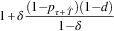 $$1{\plus}\delta {{(1{\minus}p_{{\tau {\plus}\hat{T}}} )(1{\minus}d)} \over {1{\minus}\delta }}$$
compared with the war value of
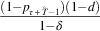 ${{(1{\minus}p_{{\tau {\plus}\hat{T}{\minus}1}} )(1{\minus}d)} \over {1{\minus}\delta }}$
when w is chosen. By the proof of Proposition 4, w is optimal at
 $\tau {\plus}\hat{T}{\minus}1$
as (5) holds for all
 $t'\in \{ \tau ,\:\:\,\ldots\,\:,\tau {\plus}\hat{T}{\minus}1)$
when it holds for t=τ. This means that if
 $\tau {\plus}\hat{T}{\minus}2$
is reached, w is optimal at
 $\tau {\plus}\hat{T}{\minus}2$
as S will get its war value at
 $\tau {\plus}\hat{T}{\minus}1$
again by the logic in Proposition 4. This logic extends back through backward induction implying w is optimal for S at t=τ. QED.
Proof of Corollary 2.
When (3) holds, (4) immediately follows from the fact that when T=1 in (3) and (4) are identical. When T>1, the RHS of (4) is decreasing, so if θ satisfies (3), it satisfies (4) for T≥1.
(3) implies (5) if the RHS of (5) is less than the RHS of (3). This means that any θ that satisfies (3), it also satisfies (5). That is, one needs to check that
 $$\eqalignno{ & {1 \over \delta }{\plus}{d \over {\delta p_{0} \left( {1{\minus}d} \right)}}\gt {1 \over \delta }{\plus}{1 \over {p_{0} }}\left[ {{{d(1{\minus}\delta )} \over {\delta (1{\minus}d)}}} \right] \cr & {d \over {\delta p_{0} \left( {1{\minus}d} \right)}}\gt {1 \over {p_{0} }}\left[ {{{d(1{\minus}\delta )} \over {\delta (1{\minus}d)}}} \right] \cr & 1\gt 1{\minus}\delta \cr & \delta\,\gt\,0, $$
which holds by the assumption that δ ∈(0,1).
That the converse does not hold strictly follows from the same counterfactual used to demonstrate Corollary 1. QED.
Proposition 6 follows as a subcase of Proposition 7 where T=1.
Proof of Proposition 7.
Proposition 2 demonstrates that war must occur at some time t<τ+T if (2) is satisfied. Ignoring the max function and plugging in for inequality (2) for a given
 $\hat{T}$
gives
 $$\eqalignno{ & {{\left( {1{\minus}p_{\tau } } \right)\left( {1{\minus}d} \right)} \over {1{\minus}\delta }}\gt {1 \over {1{\minus}\delta }}{\minus}{{\delta ^{{\hat{T}}} \left( {p_{\tau } {\plus}{\rm \Delta }\hat{T}} \right)(1{\minus}d)} \over {1{\minus}\delta }} \cr & \left( {1{\minus}p_{\tau } } \right)\left( {1{\minus}d} \right)\gt 1{\minus}\delta ^{{\hat{T}}} \left( {p_{\tau } {\plus}{\rm \Delta }\hat{T}} \right)(1{\minus}d) \cr & 1{\minus}p_{\tau } \gt {1 \over {1{\minus}d}}{\minus}\delta ^{{\hat{T}}} p_{\tau } {\minus}\delta ^{{\hat{T}}} {\rm \Delta }\hat{T} \cr & {\rm \Delta }\gt {d \over {\hat{T}\delta ^{{\hat{T}}} (1{\minus}d)}}{\plus}{{(1{\minus}\delta ^{{\hat{T}}} )} \over {\hat{T}\delta ^{{\hat{T}}} }}p_{\tau } . $$
The RHS is not decreasing in T for all δ and T. Therefore, the max function is necessary. For the initial RHS, taking the max of
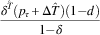 $${{\delta ^{{\hat{T}}} (p_{\tau } {\plus}{\rm \Delta }\hat{T})(1{\minus}d)} \over {1{\minus}\delta }}$$
over the
 $$\hat{T}$$
argument is equivalent to taking the min of
 ${1 \over {1{\minus}\delta }}{\minus}{{\delta ^{{\hat{T}}} (p_{\tau } {\plus}{\rm \Delta }\hat{T})(1{\minus}d)} \over {1{\minus}\delta }}$
over the
 $$\hat{T}$$
argument. Minimizing the RHS with respect to
 $$\hat{T}$$
minimizes the size of Δ needed for the inequality to hold.
 $\hat{T}\in \{ 0,\:\:\,\ldots\,\:,T\} $
, therefore the min function must be taken over this range. Hence, the condition becomes
 $${\rm \Delta }\gt \mathop{{{\rm min}}}\limits_{{\hat{T}\in \{ 0,\:\:\,\ldots\,\:,T\} }} \left\{ {{{(1{\minus}\delta ^{{\hat{T}}} )} \over {\hat{T}\delta ^{{\hat{T}}} }}p_{\tau } {\plus}{d \over {\hat{T}\delta ^{{\hat{T}}} (1{\minus}d)}}} \right\},$$
which is exactly (7). QED.
Proof of Corollary 3.
When (6) holds, (7) immediately follows from considering
 $\hat{T}=1$
in (7). That the converse does not hold strictly can be seen by the counterfactual presented in the Δ shift section with parameters (p
0=1/3, δ=0.85, d=0.05) and T∈{2, … ,6}. QED.



