Introduction
Numerous species of the genus Verrucaria Schrad. are confined to calcareous rocks in Europe. Only a minority of the described species are widely accepted although during the past decade many names have been resurrected based on morphological studies (e.g. Reference BreussBreuss Reference Breuss2007, 2008 Reference Breussa ; Reference BreussBreuss & Berger Reference Breuss and Berger2010; Pykälä Reference Pykälä2011, Reference Pykälä2013; Pykälä & Reference BreussBreuss Reference Pykälä and Breuss2011). In addition, new species of Verrucaria have been described from calcareous and siliceous rocks (Reference BreussBreuss & Berger Reference Breuss and Berger2012; Orange Reference Orange2013, Reference Orange2014; Thüs et al. Reference Thüs, Orange, Gueidan, Pykälä, Ruberti, Lo Schiavo and Nascimbene2015) suggesting that many undescribed species still occur among Verrucaria. Some of these species are morphologically well defined, while others are semi-cryptic species which can be reliably identified only with molecular data.
Previously nine species of Verrucaria (three of them as Dermatocarpon) have been described as new from calcareous mountains in Fennoscandia, all from Sweden (Magnusson Reference Magnusson1946, Reference Magnusson1952; Servít Reference Servít1952). Most of these species were for a long time known only from their type localities, but recently several have been found in Finland (Pykälä 2010 Reference Pykäläa , Reference Pykäläb , 2011; Pykälä & Reference BreussBreuss Reference Pykälä and Breuss2011). Nevertheless, the identity of many Finnish Verrucaria specimens has remained unsolved, suggesting that they might represent undescribed species. In this paper we describe four morphologically and genetically distinct new Verrucaria species from calcareous rocks in Finland, from the Staurothele group sensu Gueidan et al. (Reference Gueidan, Savić, Thüs, Roux, Keller, Tibell, Prieto, Heiðmarsson, Breuss and Orange2009): V. lapponica, V. othmarbreussii, V. sublapponica and V. saanaensis. Verrucaria othmarbreussii occurs in southern Finland while the remaining three species are restricted to calcareous mountains in northern Finland.
Material and Methods
This study is based on material collected by the first author during a lichen inventory of calcareous rocks and limestone quarries in Finland in 2003–2011. The sampling, including over 7000 Verrucaria specimens, was most extensive in southern Finland (over 50% of all calcareous rocks and lime quarries studied), but only one of the new species described below was found here (V. othmarbreussii). The remaining three species were found during field trips to the calcareous mountains in the NW part of Finland which belong to the northern Scandes mountain range, located in the municipality of Enontekiö in the biogeographical province Enontekiön Lappi (EnL).
Type material of putatively related Verrucaria species from herbaria B, G, H, H-NYL, M, PRM, S, UPS, VER and W was studied for comparison.
Morphology
Perithecia and thalli were hand-sectioned with razor blades. The sections were examined and measured on material mounted in water. Asci and ascospores were also studied in squash preparations of perithecia mounted in water. Sections and squash preparations of old herbarium specimens were mounted in potassium hydroxide (KOH) solution. Additionally, involucrellum characters and exciple colour and diameter were examined by cutting perithecia into two pieces and studying the pieces using a binocular microscope.
The range of spore size is indicated as arithmetic mean and standard deviation. Minimum and maximum values are given in parentheses. The size of the perithecia is given in surface view. The colour of the wall of the exciple was assessed from the basal parts.
DNA extraction and sequencing
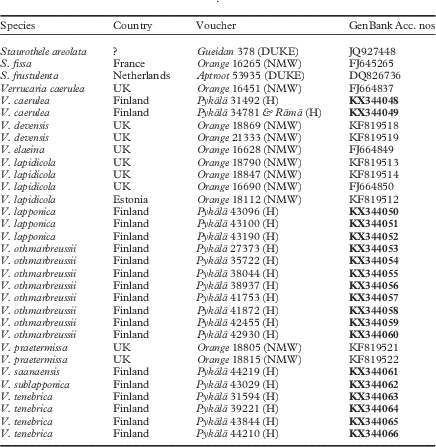
Total genomic DNA was extracted from perithecia (1–3) of two to six year-old specimens. All but four samples (Pykälä 27373, 31492, 34871, 42930; see below) were placed in 96-well microplates and sent to the Canadian Centre for DNA Barcoding (CCDB). CCDB’s standard protocols (documentation available at http://ccdb.ca/resources.php) were used for extraction, PCR and sequencing. Primers ITS1-LM (Myllys et al. Reference Myllys, Lohtander, Källersjö and Tehler1999) and ITS4 (White et al. Reference White, Bruns, Lee and Taylor1990) were used both for PCR and sequencing of the nuclear ribosomal ITS region. The barcode sequences and their trace files, along with all relevant collection data and photographs of the voucher specimens, were uploaded to the Barcode of Life Data Systems (BOLD, http://www.boldsystems.org) database. The sequences were deposited in GenBank (see Table 1 for accession numbers).
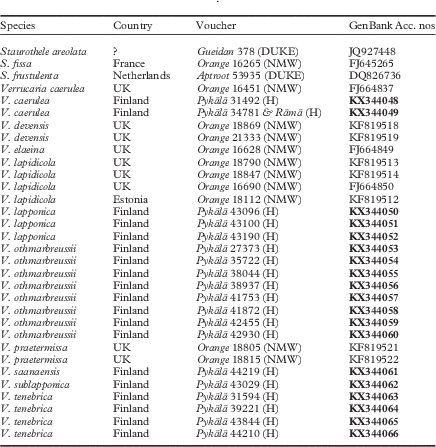
Specimens used in the phylogenetic analyses of Verrucaria from Finland. Staurothele species were used as outgroup. New sequences are in bold
DNA of specimens 27373, 31492, 34871 and 42930 was extracted using the DNeasy® Blood & Tissue Kit by Qiagen, following the protocol described in Myllys et al. (Reference Myllys, Velmala, Holien, Halonen, Wang and Goward2011). PCR reactions were prepared using PuReTaq Ready-To-Go PCR beads (GE Healthcare). The 25 µl reaction volume contained 19 µl dH2O, 0·4 µM of each primer and 4 µl of extracted DNA. PCR was run under the following conditions: initial denaturation for 5 min at 95 °C followed by five cycles of 30 s at 95 °C (denaturation), 30 s at 58°C (annealing), and 1 min at 72 °C (extension); in the remaining 35 cycles the annealing temperature was decreased to 56°C; the PCR schedule ended with a final extension for 7 min at 72°C. PCR products were cleaned and sequenced by Macrogen Inc., South Korea (www.macrogen.fi). Primers ITS1F (Gardes & Bruns Reference Gardes and Bruns1993) and ITS4 (White et al. Reference White, Bruns, Lee and Taylor1990) were used both for PCR amplification and sequencing of the ITS regions.
Phylogenetic analyses
We searched for the closest relatives of the new Verrucaria species by using the BLAST search facility in GenBank (http://blast.ncbi.nlm.nih.gov/Blast.cgi). Based on this search, 13 ITS sequences obtained from the four new species were supplemented by four ITS sequences of V. tenebrica H. Magn. and nine ITS sequences of V. praetermissa (Trevis.) Anzi and related species (see Orange Reference Orange2014; Thüs et al. Reference Thüs, Orange, Gueidan, Pykälä, Ruberti, Lo Schiavo and Nascimbene2015), to reconstruct a putative phylogeny of the species (Table 1). Three Staurothele species were used as outgroup based on the studies of Gueidan et al. (Reference Gueidan, Roux and Lutzoni2007), Savíc et al. (Reference Savíc, Tibell, Gueidan and Lutzoni2008), and Thüs et al. (Reference Thüs, Orange, Gueidan, Pykälä, Ruberti, Lo Schiavo and Nascimbene2015).
A total of 32 ITS sequences were aligned with MUSCLE v.3.8.31 (Edgar Reference Edgar2004) using EMBL-EBI’s freely available webservice (http://www.ebi.ac.uk/Tools/msa/muscle/). The aligned data set was subjected to maximum parsimony analysis as implemented in TNT v.1.1 (Goloboff et al. Reference Goloboff, Farris and Nixon2008). The analysis was performed using Traditional search with random addition of sequences, with 100 replicates and TBR branch-swapping algorithm. Ten trees were saved for each replicate and gaps were treated as missing data. Node support was estimated using the bootstrapping method (Felsenstein Reference Felsenstein1985) with 1000 replicates. Bootstrap values≥75% are considered significant.
Results
This study generated 19 new sequences. In addition to the 13 sequences obtained from the new species, we produced two sequences of V. caerulea DC. and four of V. tenebrica (Table 1).
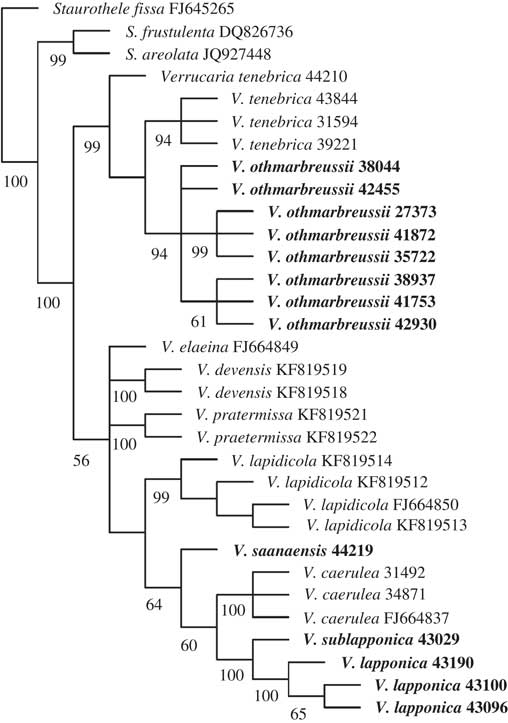
In the ITS phylogeny two main groups were observed (Fig. 1): the first strongly supported clade consisted of V. tenebrica and the newly described V. othmarbreussii. Comparison of ITS sequences revealed high sequence similarity between the two species (98–99%), but in the phylogeny V. othmarbreussii is clearly separated from V. tenebrica. The two taxa also differ in their morphology, distribution and ecology (see Taxonomy section below). It should be noted here that V. tenebrica appears as a paraphyletic group, because one sequence (Pykälä 44210) is basal to V. othmarbreussii and to three sequences of V. tenebrica. Clearly the taxonomic status of V. tenebrica needs to be examined with more material as we did not observe any morphological difference between the two groups of V. tenebrica.
Phylogenetic relationships among Verrucaria species from Finland. Staurothele species were used as outgroup. Strict consensus based on ITS data set with bootstrap values (>50%) at nodes. New species described in this study are indicated in bold.
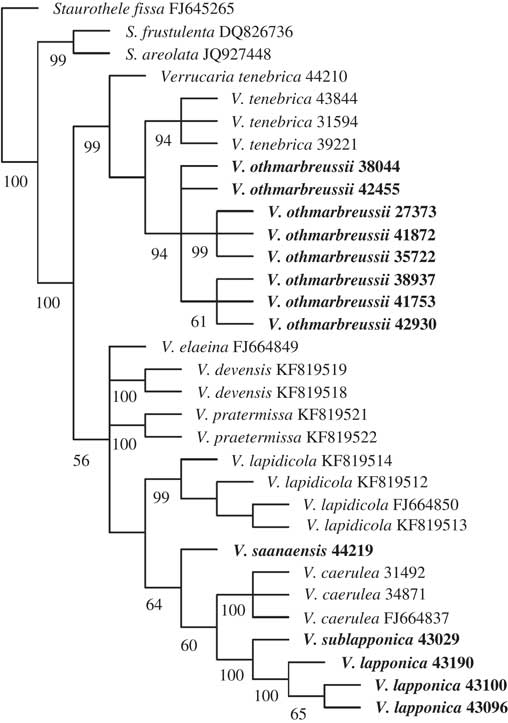
In the second clade, the newly described species V. saanaensis, V. sublapponica and V. lapponica cluster together in a weakly supported clade (64%) with V. elaeina Borrer, V. devensis (G. Salisbury) Orange, V. praetermissa, V. lapidicola Orange and V. caerulea. Verrucaria saanaensis, represented by only one sequence, is basal to V. caerulea, V. sublapponica and V. lapponica. A single sequence of V. sublapponica forms a strongly supported monophyletic group with the three sequences representing V. lapponica.
Discussion
The new species most probably belong to the Staurothele group in the sense of Gueidan et al. (Reference Gueidan, Savić, Thüs, Roux, Keller, Tibell, Prieto, Heiðmarsson, Breuss and Orange2009) and are not closely related to Verrucaria rupestris, the type species of the genus. Recent molecular phylogenies have shown that Verrucaria is highly polyphyletic (Gueidan et al. Reference Gueidan, Roux and Lutzoni2007, Reference Gueidan, Savić, Thüs, Roux, Keller, Tibell, Prieto, Heiðmarsson, Breuss and Orange2009; Thüs et al. Reference Thüs, Orange, Gueidan, Pykälä, Ruberti, Lo Schiavo and Nascimbene2015) and is clearly in need of taxonomic revision. Meanwhile, before any new genera are proposed, we will describe our new species as Verrucaria.
The Staurothele group is somewhat variable morphologically. Verrucaria lapponica and V. sublapponica have an endolithic thallus whereas most species in the Staurothele group have an epilithic areolate thallus. Verrucaria othmarbreussii may be superficially rather similar to V. caerulea, but that species has prothalline lines commonly present and a paler thallus.
The discovery of undescribed species is not surprising as the crustose lichen flora of calcareous rocks in the mountains of northern Finland has been rather poorly studied (Pykälä 2010 Reference Pykäläb ). Lichens in calcareous mountains of Sweden and Norway are also poorly collected (Magnusson Reference Magnusson1952). It remains to be seen whether our new species occur more widely in the Scandes mountain range and other northern mountains.
It is possible that the three new Verrucaria species from northern mountains are globally rare and they might be threatened due to climate change. In Finland they are restricted to the very few calcareous sites above the tree line, suggesting that the species may be sensitive to shading by trees. Verrucaria lapponica and V. sublapponica seem to be restricted to dolomite pebbles above the tree line. These dolomite pebbles may occur on gentle slopes around small rocks or alpine grassland, or on steeper slopes on dolomite scree. Such a microhabitat on gentle slopes might be highly vulnerable to the invasion of trees caused by climate warming. Dolomite screes may potentially be less sensitive to the invasion of trees. At present, the tree line in the Kilpisjärvi area is at c. 600–650 m a.s.l. (Oksanen & Virtanen Reference Oksanen and Virtanen1995), which is c. 60–200 m lower than the populations of the new species. The expected climate warming within this century might cause an elevational tree line advance of several hundred metres (Grace et al. Reference Grace, Berninger and Nagy2002; Kullman & Öberg Reference Kullman and Öberg2009). Furthermore, an increase in temperature might cause a drastic decrease in earth-surface processes (cryoturbation, solifluction and nivation) (Aalto et al. Reference Aalto, Venäläinen, Heikkinen and Luoto2014), which may have a large impact on northern species.
It has been suggested that mammalian grazing may buffer the effects of climate warming, for example by decreasing the invasion of plants including trees and shrubs (Virtanen et al. Reference Virtanen, Luoto, Rämä, Mikkola, Hjort, Grytnes and Birks2010; Speed et al. Reference Speed, Austrheim, Hester and Mysterud2012). For V. lapponica and V. sublapponica such management may, however, have risks. An increase in reindeer grazing (the sites are extensively grazed) may increase the movement of pebbles on the ground due to excessive trampling, which may be detrimental to lichens growing on pebbles. The effect may depend on grazing intensity as a moderate level of grazing could be beneficial for pioneer lichens invading the newly exposed surfaces of pebbles. However, it is not known whether V. lapponica and V. sublapponica are pioneer lichens or dependent on pebbles with a longer continuity of suitable microhabitat. Almost all calcareous mountains in Finland (even the most protected sites) are utilized by reindeer herding but the effects of reindeer grazing on calcicolous epilithic lichens is an unexplored issue.
The Species
Verrucaria lapponica Pykälä sp. nov.
MycoBank No.: MB 817199
Thallus white or grey, endolithic; perithecia leaving shallow to deep pits; involucrellum usually extending to the exciple base level, 50–100 μm thick; spores (15–)16–20(–24)×6–7 (–8) μm.
Type: Finland, Enontekiön Lappi, Enontekiö, Porojärvet, Toskalharji, Toskaljärvi N, fell, dolomite scree, gentle SE-slope, on dolomite pebbles, 710 m, 69°12'N, 21°26'E, 2 August 2011, J. Pykälä 43190 (H—holotype). GenBank accession number: KX344052 (ITS).
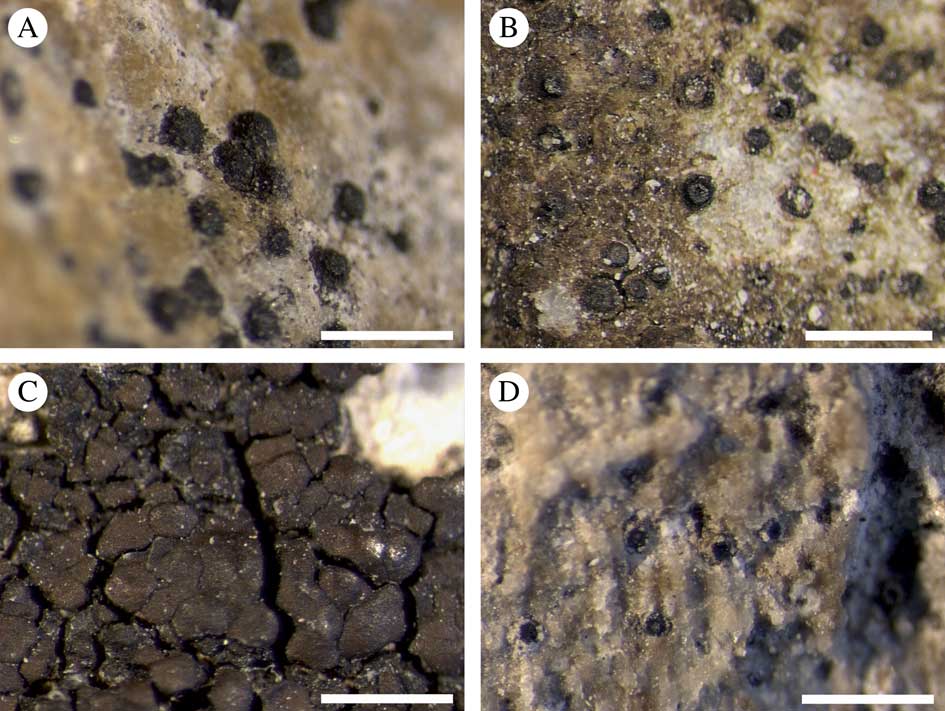
New species of Verrucaria. A, Verrucaria lapponica (holotype); B, V. othmarbreussii (holotype); C, V. saanaensis (holotype); D, V. sublapponica (holotype). Scales: A–C=1 mm; D=2 mm. In colour online.

Sections of perithecia of the new Verrucaria species. A, V. lapponica (holotype); B, V. othmarbreussii (holotype); C, V. saanaensis (holotype); D, V. sublapponica (holotype). Scales: A–D=0·1 mm. In colour online.

Prothallus not visible. Thallus white or pale brownish grey, inconspicuous or endolithic, algal cells sparse, c. 5–7 μm.
Perithecia 0·18–0·33 mm diam., 50–75% immersed, leaving shallow to deep pits, often surrounded by thallus collar, otherwise without thalline cover; c. 160–260 perithecia cm–2. Ostiole dark, depressed, 20–40 μm wide, ostiolar depression up to 70 μm wide. Involucrellum exceeding half of the exciple or usually extending to the exciple base level, 50–100 μm thick, sometimes increasing in thickness towards the base, appressed to the exciple or slightly diverging from it, often 2–3 involucrella fused. Exciple 0·16–0·25 mm, wall pale, pale brown, medium brown or dark brown (usually brown), c. 17–21 μm thick. Periphysoids c. 25–45×1·0–1·5 μm, branching. Asci c. 54–62×16–22 μm, 8-spored. Ascospores 0-septate, (15·2–)16·3–18·2–20·2(–24·3)×(5·5–)6·1–6·6–7·1(–7·9) μm (n=72).
Pycnidia not seen.
Etymology. The specific epithet refers to Lapland (Lapponia), to which the species is confined.
Habitat and distribution. All collections are from dolomite pebbles on calcareous mountains in the Toskalharji area which is the largest area of calcareous rocks in Finland.
Notes. Verrucaria lapponica is related to V. sublapponica which differs in having clearly larger spores. We have found six previously described species of Verrucaria (V. cincta Hepp, nom illeg. non Ramond 1825, V. corcontica Servít, V. dinarica Zahlbr., V. endolithea Zschacke, V. pararupestris Servít and V. subcincta Nyl.) that morphologically resemble V. lapponica in having a rather similar spore size, an involucrellum reaching the exciple base level, similar thickness of involucrellum and a thin pale thallus. There are no sequences available of these rare or rarely recorded species which seem to be absent from Finland.
Based on five syntypes of V. cincta (UPS-L-069708!, G-00295024!, G-00295025!, G-00295026!, G-00295027!), several small morphological differences were found between V. cincta and V. lapponica. Verrucaria cincta has larger perithecia, 0·25–0·44 mm in diameter; a slightly thicker involucrellum, 70–120 μm thick; thicker periphysoids c. 20–40×2·0(–2·5) μm; and all exciple bases seen were medium brown or dark brown.
The syntype of V. corcontica (PRM-765225!) has 25–50% immersed perithecia not leaving pits or leaving shallow pits, c. 60–80 μm thick involucrellum (protologue 40–80 μm thick; Servít Reference Servít1950), more sparsely occurring perithecia (c. 80–90 perithecia cm–2), and slightly larger spores 16–21×7–8 μm (protologue 16–20(–24)×7–9 μm; Servít Reference Servít1950).
The holotype? of V. dinarica (W-4269!) differs from V. lapponica by smaller perithecia (0·20–0·25 mm diam.) and an endolithic thallus with frequent tiny brown flecks. Spores are also shorter, 14–17×6–8 μm (see also Reference BreussBreuss 2008b).
The holotype? of V. endolithea (B-600072061!) has clearly shorter spores, 11–15×7–8 μm, and a somewhat inconspicuous thallus.
The syntypes of V. pararupestris (UPS-L-177208!, PRM-858415!) have perithecia not leaving pits or leaving shallow pits, a thallus surrounded by a dark prothalline line, shorter spores (13–18×6–8 μm) and short and thick periphysoids.
The studied syntypes of V. subcincta (H-NYL 3095!, M-0123976!) have perithecia with a thin thalline cover, and the perithecia do not leave pits or only shallow pits. In the syntype H-NYL 3095 the involucrellum predominantly covers only half of the exciple, while in the syntype M-0123976 the involucrellum reaches the exciple base level or even envelopes the exciple in several perithecia. We conclude that the syntype material of V. subcincta may be heterogenous.
Additional specimens investigated. Finland: Enontekiön Lappi: Enontekiö, Porojärvet, Toskalharji, Toskalpahta, fell, SW-slope, scree, on dolomite pebbles, 790 m, 69°11''N, 21°29'E, 2011, Pykälä 43096 (H); Enontekiö, Porojärvet, Toskalharji, Toskalpahta, fell, SW-slope, scree, on dolomite pebbles, 795 m, 69°11'N, 21°29'E, 2011, Pykälä 43100 (H); Enontekiö, Porojärvet, Toskalharji, Toskaljärvi N, fell, dolomite rock, on dolomite pebbles, 735 m, 69°12'N, 21°26'E, 2011, Pykälä 43245 (H), not sequenced; Enontekiö, Porojärvet, Toskalharji, Toskaljärvi N, fell, dolomite rock, gentle SE-slope, on dolomite pebbles, 730 m, 69°12'N, 21°26'E, 2011, Pykälä 43333 (H), not sequenced.
Verrucaria othmarbreussii Pykälä & Myllys sp. nov.
MycoBank No.: MB 817200
Differs from V. tenebrica by the paler brown and thinner thallus which is usually not distinctly areolate.
Type: Finland, Varsinais-Suomi, Parainen (Korppoo), Åfvensår, Ronudden, calcareous rock on shore of the Baltic Sea, small abandoned lime quarry, under overhanging NW-facing wall, on flat rock, 2 m, 60°17'N, 21°32'E, 15 July 2011, J. Pykälä 38937 (H—holotype; UPS—isotype). GenBank accession number: KX344056 (ITS).
Prothallus absent or pale greenish brown, medium brown or dark brown, fleck-like or fimbriate (fimbriate prothallus seen only in one specimen in few places). Thallus pale greenish grey, medium brownish green, medium greenish brown, medium brown or dark greenish brown, in one specimen grey-pruinose; continuous, rimose or more rarely areolate, c. 0·05–0·20 mm thick; sterile areoles 0·1–0·3 mm diam., algal cells (5–)7–10(–12) μm, cortex often not clearly differentiated, c. 5–12 μm thick, cortical cells brown.
Perithecia 0·12–0·23 mm diam., 50–75(100%) immersed in the thallus, usually without thalline cover, lower part rarely with a thin thalline cover; perithecial density c. 120–220 cm–2 . Ostiole inconspicuous, tiny, pale or dark, plane or depressed, c. 20–30 μm wide. Involucrellum extending to the exciple base level, in a few perithecia occasionally not reaching the exciple base level, although extending more than halfway down the exciple, 30–50(–70) μm thick, appressed to the exciple or slightly diverging near base, dark purplish brown in squash. Exciple 0·13–0·20 mm diam., wall pale to dark brown. Periphysoids c. (15–)20–25×(1·5–)2·0–2·5(–3·0) μm, moderately to richly branching. Asci 38–57×14–19 μm, 8-spored. Ascospores 0-septate, (10·4–)12·0–13·3–14·6(–17·1)×(5·2–)5·5–6·1–6·7(–8·1) μm (n=124).
Pycnidia not seen.
Etymology. The species is named in honour of Othmar Reference BreussBreuss for his invaluable contribution to the taxonomy of Verrucariales and for helping the first author in identifying many specimens of Verrucaria.
Habitat and distribution. The species is rare on calcareous rocks and in lime quarries in southern and eastern Finland. A single isolated northern outpost occurs in the north-east of Finland (biogeographical province of Koillismaa). Verrucaria othmarbreussii may prefer half-shady or rather shady calcareous rocks, but occurs also in rather sun-exposed sites. Associate species include Acarospora glaucocarpa (Ach.) Körb., Bagliettoa sp., Scytinium parvum (Degel.) Otálora et al. (Collema parvum Degel.), Lathagrium fuscovirens (With.) Otálora et al. (Collema fuscovirens), Lecidella stigmatea (Ach.) Hertel & Leuckert, Placopyrenium fuscellum (Turner) Gueidan & Cl. Roux, Placynthium nigrum (Huds.) Gray, Polyblastia abscondita (Nyl.) Arnold group, Protoblastenia rupestris (Scop.) J. Steiner, Verrucaria nigrescens Pers. and V. cf. nigroumbrina Servít. Typical populations of V. othmarbreussii are small, and may thus have been overlooked.
Notes. Based on the ITS phylogeny, V. othmarbreussii is closely related to V. tenebrica which differs in the darker and more areolate thallus and in the slightly thicker (40–60(–70) μm) involucrellum. Verrucaria tenebrica (UPS-484009!, syntype) is a northern species found mainly in the calcareous mountains of Fennoscandia, where it may be rather frequent. It is possible that V. tenebrica is rather shade-intolerant, unlike V. othmarbreussii which prefers semi-shaded or shady habitats. A single isolated outpost of V. tenebrica occurs in the Oulanka area in north-east Finland (the biogeographical province Koillismaa (confirmed by ITS)). The northernmost specimen of V. othmarbreussii differs from the other specimens in the grey-pruinose thallus which is also more clearly areolate than in most specimens of V. othmarbreussii.
Verrucaria othmarbreussii may also be confused with V. pinguicula A. Massal. and V. sparsiuscula Nyl. Verrucaria pinguicula frequently has dark prothalline lines and the thallus is usually pale brown. In the syntypes studied (VER!, H-NYL 2677!, H-NYL3096!, M-0163962!; M-0163963!) perithecial density is higher than in V. othmarbreussii (c. 380–480 cm–2). Verrucaria sparsiuscula differs in having broader spores (12–17×(6–)7–9(–10) μm). Based on the ITS sequences, the species is not closely related to V. othmarbreussii (J. Pykälä, L. Myllys & A. Launis, unpublished data).
Additional specimens investigated. Finland: Varsinais-Suomi: Lohja, Hiittinen, NW of Hiidensalmi Bridge, yard of a single-family house, calcareous rock, 40 m, 60°16'N, 24°03'E, 2005, Pykälä 27373 (H); Parainen (Korppoo), Åfvensår, Kirmo, calcareous rock, on top, on flat rock, on pebbles, 30 m, 60°17'N, 21°33'E, 2010, Pykälä 38044 (H); Salo (Kisko), Toija, Karjassuonmäki, calcareous rock, on flat rock, scarce, 45 m, 60°15'N, 23°25'E, 2011, Pykälä 41753 (H). Uusimaa: Helsinki (Vantaa), Västersundom, Vikkulla, 400 m NW, abandoned lime quarry on the shore of the Baltic Sea, on NE-facing wall, scarce, 2 m, 60°13'N, 25°09'E, 2011, Pykälä 41872 (H). Pohjois-Karjala: Juuka, Polvela, Hanhilampi N, W-slope, Picea abies-dominated herb-rich forest, calcareous rock, on W-facing wall, rather scarce, 175 m, 63°10'N, 29°07'E, 2011, Pykälä 42455 (H); Juankoski, Siikajärvi, Huosiaisniemi, nature reserve, dolomite rock on the shore of Lake Ala-Siikajärvi, on W-facing wall, scarce, 97 m, 63°12'N, 28°51'E, 2011, Pykälä 42930 (H). Koillismaa: Kuusamo, Paljakka, E shore of Kuusinkijoki River, Kiukaankorva, dolomite rock, on NW-facing wall, scarce, 214 m, 66°11'N, 29°38'E, 2009, Pykälä 35722 (H).
Verrucaria saanaensis Pykälä sp. nov.
MycoBank No.: MB 817201
Similar to Dermatocarpon nuoljae but having larger spores ((10–)11–13(–14)×6–7(–8) μm), a darker brown thallus and fimbriate prothallus.
Type: Finland, Enontekiön Lappi, Enontekiö, Kilpisjärvi, Saana, Nature Reserve, E-part, fell, steep SW-slope, alpine grassland, on dolomite boulder, scarce, with Physcia subalbinea Nyl., Lecidella stigmatea, Verrucaria tenebrica and Lecanora sp., 730 m, 69°02'N, 20°51'E, 12 August 2011, J. Pykälä 44219 (H—holotype; UPS—isotype). GenBank accession number: KX344061 (ITS).
Prothallus dark brown, fimbriate. Thallus medium brown (blackish brown to the unaided eye), areolate, 0·4–0·8 mm thick, areoles 0·4–2·0 mm, often secondarily subdivided into smaller (0·3–0·6 mm) areoles, squamuliform, often convex, epinecral layer absent or c. 6–12 μm thick, cortex c. 20–32 μm thick, cortical cells 3–5×3–4 μm, thick-walled, cortical pigment brown, present in the uppermost part of the cortex, algal cells c. 5–9 μm, sometimes in vertical rows; medulla rather thick or not clearly differentiated, but then algal cells often sparse in lower part of the thallus.
Perithecia 0·05–0·08 mm, immersed in thallus, seen as tiny dots or totally hidden inside thallus (also hidden perithecia with spores); c. 250–300 perithecia cm–2. Ostiole inconspicuous, tiny, depressed. Involucrellum absent. Exciple 0·14–0·25 mm, wall pale, c. 18–24 μm thick. Periphysoids c. 10–16×1·5–2·0 μm, simple. Asci c. 44–52×15–18 μm, 8-spored. Ascospores 0-septate, (10·1–)11·3–12·2–13·1(–14·1)×(5·6–)6·2–6·6–7·1(–7·7) μm (n=62).
Pycnidia not seen.
Etymology. The species is named after Saana Mountain which is rich in rare lichens. For several species Saana is the only known locality in Finland.
Habitat and distribution. The specimen was collected from a dolomite boulder on a steep SW facing slope of a mountain above the tree line. Verrucaria saanaensis is a morphologically distinct species and it was already obvious in the field that the specimen represents a species new to Finland. It is possible that the Saana Mountain will remain the only locality of V. saanaensis in Finland. However, the species should be searched for further in the few calcareous mountains of the Kilpisjärvi area. It is probable that V. saanaensis is confined to calcareous mountains.
Notes. Verrucaria saanaensis is among the few species of Verrucaria in which the apex of the exciple is pale. Verrucaria saanaensis resembles Dermatocarpon nuoljae H. Magn., a species known only from the type specimen from northern Sweden (Magnusson Reference Magnusson1952). Verrucaria saanaensis differs from D. nuoljae by the longer spores and darker brown thallus. Dermatocarpon nuoljae is in fact not a Dermatocarpon but belongs to Verrucaria (s. lat.), as pointed out by Santesson (Reference Santesson1993). The size of the spores measured from the type specimen of D. nuoljae (UPS-L-134715!) was 8–10×6–7(–8) μm. This agrees with the values given by Magnusson (Reference Magnusson1952): 8·5–10·0×6·5–7·0 μm. A fimbriate prothallus may also be characteristic for V. saanaensis. A weakly developed non-fimbriate prothallus occurs in the type of D. nuoljae, which has a predominantly pale brown thallus. Verrucaria saanaensis also has a superficial morphological similarity to species of Staurothele with an epilithic thallus.
Verrucaria sublapponica Pykälä & Myllys sp. nov.
MycoBank No.: MB 817202
Similar to V. lapponica, but differs in the shorter involucrellum and larger spores.
Type: Finland, Enontekiön Lappi, Enontekiö, Porojärvet, Toskalharji, Toskalpahta, fell, SW-slope, scree, on dolomite pebbles, 770 m, 69°11'N, 21°29'E, 1 August 2011, J. Pykälä 43029 (H—holotype). GenBank accession number: KX 344062 (ITS).
Prothallus not seen. Thallus endolithic, white, algal cells 5–7 μm.
Perithecia 0·18–0·33 mm, 75% immersed, leaving shallow to deep pits, often surrounded by a thalline collar, otherwise without thalline cover; c. 70–100 perithecia cm–2. Ostiole pale brown to dark, depressed, c. 20–30 μm wide, ostiolar depression up to 100 μm wide. Involucrellum covering half of the exciple or occasionally almost to the exciple base, 60–100 μm thick, appressed to the exciple or moderately diverging from it. Exciple 0·17–0·24 mm, wall pale brown to dark brown. Periphysoids c. 30–40×1·5 μm. Asci 54–78×18–22 μm, 8-spored. Ascospores 0-septate, (17·6–)19·0–20·6–22·2(–24·2)×(7·3–)7·7–8·4–9·2(–10·1) μm (n=35).
Pycnidia not seen.
Etymology. The species morphologically resembles and is closely related to V. lapponica.
Habitat and distribution. Based on the one specimen available, V. sublapponica may have a similar ecology to V. lapponica and is confined to dolomite pebbles in the mountains.
Notes. The species is related to V. lapponica based on both morphology and ITS phylogeny. It is, however, easily separated from V. lapponica by its broader spores. Furthermore, the ITS sequence similarity between the two species is only 93%. Thus, we are confident that these two species are distinct, although we have only one sequence available for V. sublapponica. Three species of Verrucaria resemble V. sublapponica morphologically: V. slovaca Servít, V. limitatoides Servít and V. cataractophila Servít.
The syntype of V. slovaca (PRM-765231!) has longer spores (20–27×9–10 μm, protologue 24–30×9–11 μm), a pale exciple, an involucrellum that reaches the exciple base level and thicker periphysoids (c. 2·0–2·5 μm thick).
The holotype of V. limitatoides (M-0193016!) differs from V. sublapponica by the involucrellum predominantly reaching the exciple base level, larger perithecia (0·25–0·44 mm), slightly longer spores (20–25×8–9 μm) and dark prothalline line.
The holotype of V. cataractophila (M-0220013!) has a thick involucrellum (80–120 μm thick) covering half of the exciple, but it differs from V. sublapponica by larger perithecia (0·33–0·44 mm) leaving deep pits, smaller spores (14–17×7–8(–9) μm) and a thinly epilithic and continuous, grey thallus with frequent brown flecks.
The fieldwork was carried out during the research project “Threatened lichens of calcareous rocks” (Grant number YTB059), which belonged to the research programme of deficiently known and threatened forest species (PUTTE) financed by the Ministry of the Environment. The Kone Foundation and Finnish Cultural Foundation are thanked for their financial support through the FinBOL project to the Finnish Museum of Natural History. We are grateful to Diana Weckman and Laura Häkkinen for laboratory work. Anna Palomäki took the photographs in Fig. 2A, C, and D. The curators of the herbaria B, G, S, UPS and W are thanked for loans of specimens. We also would like to thank Andreas Beck, František Bouda, Francesco Di Carlo and Anders Nordin for their hospitality during the visits to M, PRM, VER and UPS, respectively. Herbarium visits were supported by a grant from Societas pro Fauna et Flora Fennica. Teuvo Ahti, Alan Orange and one anonymous referee are thanked for constructive comments on the manuscript.