


In 2011, Wisconsin Governor Scott Walker and his Republican allies in the legislature passed a watershed labor bill that limited collective bargaining rights for public employees. Something similar happened or was attempted in a number of other Republican-controlled states, including Ohio, Idaho, and Tennessee. In all cases, the official purpose was a policy purpose: to enhance effective government. But opponents saw a political purpose at work too, and so did many observers. As congressional scholar Norman Ornstein put it, “a lot of the efforts we've seen in undercutting unions have been strongly focused on undercutting the Democratic Party's political base” (Gurciullo Reference Gurciullo2015).
Direct evidence for such claims is hard to come by. If politicians use policy to undercut the other party, they are not going to say so publicly. Yet they do have opportunities to engage in such partisan behavior—and to benefit from it. Labor policy, moreover, is not unique in these respects. Consider immigration. Most agree that major immigration reform is much needed. But if policy were to include a “path to citizenship”—which the Democrats favor—it would also create millions of new voters, most of them voting Democratic. To say that this political consequence is unrelated to the Democrats’ approach to immigration reform would strain credibility, just as it would strain credibility to say that Scott Walker did not consider the benefits for Republicans when he weakened Wisconsin's unions.
Labor law and immigration reform are just two examples of how policies make their own politics. This phenomenon was first recognized by Schattschneider (Reference Schattschneider1935) in his classic study of the Smoot-Hawley tariff, and it has since been confirmed by research in American political development, public policy, and comparative politics (Hacker and Pierson Reference Hacker and Pierson2014). When a new program is created, so are new constituencies—and new politics—and this dynamic plays a key role, via policy feedback, in explaining how policies affect their own politics (e.g., Mettler and Soss Reference Mettler and Soss2004; Pierson Reference Pierson1993). The adoption of Social Security, for example, created a constituency of senior citizens that strongly supported the program and protected it from change (Campbell Reference Campbell2003).
Yet a key dimension of inquiry has gone unexplored. For if policies make their own politics, strategic politicians would want to use policy to shape politics to their own benefit. They would not be limited, moreover, to crafting policies with an eye toward boosting future political support for those same policies. Their opportunities are broader and more potent than that. As Scott Walker seems to have recognized, some policies have political consequences for the partisan balance of power.
The introduction of agency, then, opens up a new realm of important issues. How common is it—and what are the incentives—for politicians to pursue these broader politics-shaping opportunities as they make policy decisions? What can this tell us about why policies get adopted and why they get designed as they do? So far, this line of inquiry has barely been explored. But it needs to be if the payoffs from Schattschneider's original insight are to be fully realized (Oberlander and Weaver Reference Oberlander and Weaver2015; Patashnik and Zelizer Reference Patashnik and Zelizer2013).
This article is an early step along the way. We focus on a policy development that is particularly instructive: the adoption of public-sector collective bargaining laws by the states during the 1960s, 1970s, and early 1980s. It is instructive for two reasons. First, these laws have had important consequences for American politics, fueling the emergence of organizations—public-sector unions—that have shaped the party and interest group systems to the advantage of Democrats and the disadvantage of Republicans (DiSalvo Reference DiSalvo2015; Flavin and Hartney Reference Flavin and Hartney2015; Moe Reference Moe2011). This is a clear example of policies shaping politics, and its partisan effects are asymmetric. If politicians do make policies with their parties’ future prospects in mind, then it seems likely they would do it here, with Democrats pushing for these new labor laws and Republicans opposing them.
The second reason this policy development is so instructive is that, despite the importance of public-sector unions to American politics, political scientists have paid little attention to them. The literatures on parties and interest groups virtually ignore them.Footnote 1 Precisely because Schattschneider was right—policies do shape politics—the laws that gave rise to public-sector unions need to be studied as important determinants of the structure of American politics.
Our analysis unfolds in three parts. In the first, we examine whether Democrats were indeed the champions of public-sector labor laws and Republicans their opponents. Using state-level data, we show that the Democratic expectation is well borne out, but that Republicans actually played pivotal roles in supporting these laws—and thus in igniting the growth of unions that would oppose the Republican Party. Why would Republicans do that? In the second part of the article, we offer an explanation. We develop a theoretical argument about what can be expected from strategic political actors—in any realm of policy—as they think about using policies to shape the future structure of politics. The heart of the argument is that collective action problems limit the conditions under which they will actually engage in such behavior—leading to outcomes that, in the aggregate, may look strange or irrational. In the third part of the article, we carry out an empirical analysis of individual-level voting by state legislators on public-sector labor laws, testing the implications of this theoretical perspective and showing that it is supported by the evidence.
BACKGROUND
During the first half of the 20th century, collective bargaining by public workers was largely illegal throughout the country, and few government employees belonged to unions. Unions fared much better in the private sector, where the membership and political involvement of unions grew dramatically following the adoption in 1935 of the National Labor Relations Act (NLRA): a hallmark of the Democratic New Deal. By the late 1940s, the labor-Democrat alliance stood at the center of the American party system, with the Democrats benefiting from a newly empowered constituency they had played a key role in creating. Public-sector workers were on the sidelines. They were not included in the NLRA, and they remained unorganized and politically unimportant (Slater Reference Slater2004; Walker Reference Walker2014).
Change, however, was just around the corner. In 1959, Wisconsin became the first state to adopt a collective bargaining law for public-sector workers. In 1962, President Kennedy issued an executive order authorizing collective bargaining at the federal level. And soon the nation experienced a wave of new labor legislation—modeled after the NLRA—that quickly brought collective bargaining to virtually all states outside the South. Along with it came a surge in union organizing that increased membership tenfold between 1960 and 1976 (Goldfield Reference Goldfield1989–90; also DiSalvo Reference DiSalvo2015; Freeman Reference Freeman1986; Moe Reference Moe2011).
By the early 1980s, union density had risen to 37 percent of the public workforce (and much higher in many states and cities), where it stabilized. Meantime, private-sector unions—beset by rising competition, globalization, and structural change in the economy—fell into decline. Today, less than 7 percent of private-sector workers are unionized, and public-sector unions are the leaders of the union movement.
These developments have had large impacts on American politics. Public-sector unions enroll more than eight million members, are top contributors to political campaigns, field vast numbers of campaign workers, and marshal many other political resources—almost all of them in support of Democrats and in opposition to Republicans (DiSalvo Reference DiSalvo2015). They are core members of the Democratic Party coalition. They are also interest groups whose resources, electoral activity, and lobbying organization put them in the top tier of all groups that seek political influence. Their rise has been consequential at the national level, but they have been especially consequential at the state and local levels—where most of the nation's public employees work and most public money is spent.
The states’ adoption of public-sector labor laws is a prime example of policies making their own politics. The winners and losers, moreover, are clear: these developments were good for the Democratic Party and bad for the Republican Party. So were Democrats the driving force behind these laws, and did Republicans try to stop them?
Scholars have barely explored these matters. Political scientists have paid little attention to public-sector unions, and even less to the policy changes that fueled their growth. The same is true for historians (as noted by McCartin Reference McCartin2006; Shaffer Reference Shaffer2002). There is a literature on labor history, but it focuses on private-sector unions as the embodiment of the union movement, and a common theme is that the movement is in decline. In those rare cases when political scientists have written about unions, they too have focused on private-sector unions, particularly the relationship between those unions and the Democrats; and they too have highlighted the political consequences of union decline (e.g., Dark Reference Dark1999; Schlozman, Verba, and Brady Reference Schlozman, Verba and Brady2012).
Although the questions concerning us here have yet to be studied, there are well-known lines of evidence that point in a common direction. Pre-1960 collective bargaining breakthroughs in New York City and Philadelphia were due to supportive Democratic mayors. The Wisconsin breakthrough in 1959 came about under the leadership of Gaylord Nelson, the state's first Democratic governor in more than 20 years. Efforts to organize federal workers expanded when Kennedy's executive order signaled a more union-friendly era in government (e.g., McCartin Reference McCartin2006; Slater Reference Slater2004). The importance of Democratic control also shines through in case studies of labor law adoption in particular states (e.g., Saltzman Reference Saltzman, Richard and Ichniowski1988).
These accounts have given rise to a conventional wisdom that seems to make good sense. As Joseph A. McCartin (Reference McCartin2006, 79) expresses it, “the success of public sector unions was almost always dependent upon an alliance between those unions and Democratic politicians. . . . The record could not be clearer on this point: without the close collaboration that emerged between public sector trade unionists and Democratic leaders at all levels of government, the public sector movement would not have grown as quickly as it did” (see also Walker Reference Walker2014, 190). Quantitative analysis affirms these conclusions. Notably, Saltzman's (Reference Saltzman1985) study of state labor laws for teachers shows that their adoption was more likely when Democrats had more political control.Footnote 2
But empirical support for this conventional wisdom is thin. Even Saltzman's (Reference Saltzman1985) study—the most comprehensive to date—only scratches the surface. His model measures Democratic strength as the number of state government institutions controlled by Democrats, which assumes that all unit increases in Democratic strength have the same effect on adoption. But if the conventional wisdom is correct, what should really matter is whether Republicans are in a position to block—which holds under both divided government and unified Republican control. Marginal cases aside, these laws should only pass under Democratic unified government.
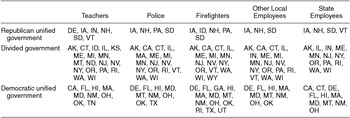
Is that the case? To answer this question, we assembled data on when the states enacted collective bargaining for five categories of government workers: teachers, firefighters, police, other local government workers, and state government workers.Footnote 3 We then grouped the states by party control at the time of enactment.
The results, shown in Table 1, are revealing: most states that adopted these bargaining laws did so under divided government, not Democratic unified government. Equally important, several bargaining laws were actually adopted under Republican unified government. This pattern is hard to reconcile with conventional wisdom—as well as with the Schattschneider-based expectation that Republicans, with so much at stake for their party's political future, would have opposed these new laws. It may well be that Democrats were the strongest supporters of state collective bargaining laws, but it is not true that Republicans strongly opposed them. Far from it, for most bargaining laws were actually adopted in political contexts where Republicans could have blocked their enactment—but didn't.
Party Control of State Government at the Time of Collective Bargaining Adoption

THEORY
If policies make their own politics, then it seems straightforward that politicians would want to use policy to shape politics to their advantage. But we need to look more closely at their actual incentives for doing that.
Consider first the policy feedback effects highlighted in the literature, where the focus is on how policies can change politics—by providing benefits to mass constituencies, for example—in ways that bolster their own political support. Feedback effects occur whether they are intended or not, but they will differ depending on how the policies are designed. Would their advocates have incentives, then, to favor designs that make the feedback effects as politically potent as possible (Patashnik Reference Patashnik2008; Patashnik and Zelizer Reference Patashnik and Zelizer2013)?
There is good reason to think the answer is yes. Politicians are concerned with pleasing the constituencies and interest groups that can get them reelected; and if a politician supports a policy to benefit those interests, she could easily have incentives—in furthering the same interests—to favor designs that best promote the policy's future political support. There are qualifications, however. Politicians may be unaware in any instance that they can use policy to shape politics, or of what the consequences might be; they are also notoriously myopic, thinking mostly of their next election rather than the long-term effects of policy (Arnold Reference Arnold1990); and as Mayhew (Reference Mayhew1974) reminds us, their embrace of policy may be due to position-taking or credit-claiming, not to genuine concern for the policy's success. All these factors can weaken the strategic use of policy for politics. Even granting these qualifications, though, the saving grace is that there may be interest groups that are aware, do look ahead, and are genuinely concerned about the policy—and that pressure politicians to “make politics” in ways that bolster the policy's durability.
All things considered, then, it is reasonable to suggest that politicians will often have incentives to take politics-shaping actions that are policy specific. This does not mean that they will get the outcomes they desire—for as policy scholars have argued (Pierson Reference Pierson2004) and as Oberlander and Weaver (Reference Oberlander and Weaver2015) have recently shown with application to the Affordable Care Act (ACA), policies and their environments can be complex and their feedback effects difficult to anticipate, leading to outcomes that depart from the designers’ intentions (see also Howard Reference Howard1997). Our point here, however, is that they will often have the incentives to try—which held true, we should note, even in the case of the complex ACA.
But will they have similar incentives when it comes to using policy to shape the larger structure of partisan politics? Here the situation is different. Public-sector labor laws, for example, have far-reaching effects that favor Democrats and disfavor Republicans—and these effects are collective goods (or bads). If the Democratic Party were a unitary actor (and sufficiently aware and forward-looking), it would support these laws, and if the Republican Party were a comparable unitary actor, it would oppose them. But they are not unitary actors. The decision-makers are individual politicians; and each of them, concerned about reelection and constituency, has incentives to do what is best for herself—not what is best for the party.
This collective action problem is fundamental to the theoretical perspective on parties that, over the last two decades, has been most central to the field of American politics, particularly when the focus has been on legislators. The theory argues that legislators within the same party carry a common brand and recognize their shared electoral fate, and to achieve mutual gains they delegate authority to party leaders—who have incentives to promote the larger interests of the party by orchestrating member votes and controlling the agenda (Cox and McCubbins Reference Cox and McCubbins1993, Reference Cox and McCubbins2005; Jenkins and Monroe Reference Jenkins and Monroe2012). This solution to the collective action problem, however, is only partial at best, and is most effective—with members supporting stronger party constraints on their behavior—when they are already in substantial agreement on policy (Aldrich and Rohde Reference Aldrich, Rohde, Lawrence and Oppenheimer2001; Rohde Reference Rohde1991). The more diverse the members are, the weaker the enforced constraints of party, and the more members can follow their individual incentives.Footnote 4
One implication is that, to the extent parties are internally homogeneous, they are better able to promote the parties’ interests. The modern era of polarization, then, is a best-case setting for politicians to use policy to shape the structure of partisan politics. In earlier decades, however, these conditions did not prevail (Mayhew Reference Mayhew1974; Rohde Reference Rohde1991). The parties were more internally diverse and thus, theory would suggest, less capable of getting their members to shape politics to the parties’ advantage. The labor laws we are concerned with here, of course, were enacted during this earlier era. So our expectation is that, while the Democratic Party stood to be advantaged by these laws and the Republican Party disadvantaged, the legislators in each party would not weigh this heavily in deciding how to vote. They would be mainly motivated by their own individual-level concerns, not by what was best for the party.
What would this mean, more concretely, for how legislators would vote? Here, the mainstream theory needs elaboration. As recent critics have pointed out, the theory arises out of a Downsian framework of politicians and voters, and pays no direct attention to the specifics of policies, the constituencies and interest groups associated with them, and the latter's influence on what politicians do (Hacker and Pierson Reference Hacker and Pierson2014). Indeed, it has recently been challenged by an alternative perspective, which argues that parties should be treated as coalitions of interest groups, with groups as the key decision-makers (Bawn et al. Reference Bawn, Cohen, Karol, Masket, Noel and Zaller2012; Cohen et al. Reference Cohen, Karol, Noel and Zaller2008). We cannot, of course, adjudicate this debate here. What we can do is extend the theory we have already developed, taking account of the specific nature of the policies, constituencies, and interest groups of relevance to legislators’ votes.
For Democrats, all of these factors worked to their advantage. Outside the South, they were the party of labor, allied with unions—interest groups at the core of the party—and for virtually all nonsouthern Democrats, there were constituency and ideology-based reasons, at the individual level, for supporting these new laws. In following their own personal incentives as politicians, then, individual Democrats would automatically be making politics to the party's larger advantage—even though, theory suggests, that was not what motivated them.
The Republican Party was less fortunate. While today's party can accurately be characterized as antiunion and homogeneously conservative, in earlier decades it had an appreciable number of moderates (anchored in politically moderate constituencies)—and they were more favorable to labor than conservatives were (Shafer Reference Shafer2003). Thus, there was a contingent of potential defectors—moderates—who had constituency and ideology-based incentives to vote in favor of these labor laws despite their future impacts on the party.
A second problem deepened the party's troubles. During these earlier times, Republican conservatives were known as antilabor because they and their business allies were often opposed to the private-sector unions that dominated the union movement—and those private-sector unions (often in manufacturing) were not a forceful presence in conservative constituencies. But the workers now demanding bargaining rights were the employees of governments, not business. Business groups therefore had less incentive to oppose public-sector labor laws, freeing many Republicans from group pressure to vote “no.” Workers in the public sector, moreover, were present in every district, including conservative districts. Even for conservative Republicans, then, a vote for public-sector labor laws may often have been the smart thing to do politically—regardless of its impact on the party.
These problems for the Republican Party were compounded by a third political force, this one arising from public-sector strikes. During the decades when these laws were being considered, the nation was swept by strikes as government workers and their nascent unions sought to bring pressure on policymakers. These new developments were quite troubling to the public, which feared a loss of government services, and many policymakers felt a pressing need to deal with the immediate problem (or impending threat). Collective bargaining was presented by academics, labor-law experts, and union advocates as a solution: a way to substitute negotiation for conflict, and thus to bring “labor peace” (McCartin Reference McCartin2008; Shaffer Reference Shaffer2002). This, then, was yet another force potentially pushing Republicans to support new labor laws—for if they did not, and if they stood in the way of collective bargaining, they risked being blamed by voters for future disruption of government services. There is good reason to think, therefore, that if collective bargaining was viewed as a way to bring labor peace (a contingency we will revisit in our analysis), strikes were likely to succeed in getting Republicans to support it.
In sum, while the collective action problem was relevant to both parties, the individual-level incentives of Democrats (outside the South) on these labor laws lined up with what was best for their party's political future—but the opposite was true for Republicans. Our theory suggests that Republican moderates were especially likely to defect, but also that many conservatives had political grounds for defecting too—and that, for both, the incentives for doing so were heightened by the political pressures arising from strikes. For Republicans, the individual incentives of politicians were simply not aligned with promoting the party's collective good—and what they would get, as a result, was a collective bad.
PARTISAN SUPPORT FOR COLLECTIVE BARGAINING LAWS
To explore these matters, we compiled a new dataset. For each duty-to-bargain law passed between 1959 and 1990, we collected the final votes of as many state legislators as possible.Footnote 5 The completed dataset includes 5,439 votes on 42 bills in 31 states, as well as the party and district number of each legislator.
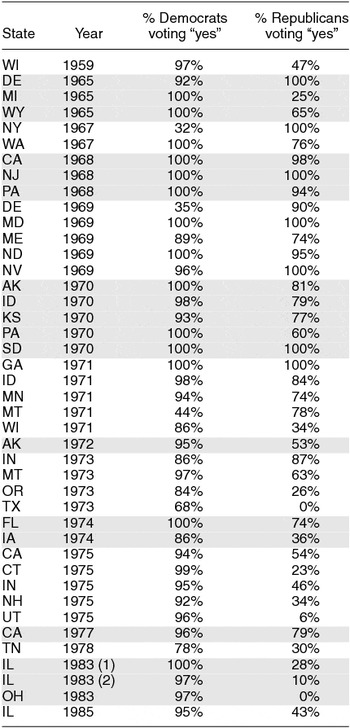
We begin with two simple questions: Were Democrats unified, or nearly unified, in support of collective bargaining? And was Republican support limited to a few crossover votes, or was it substantial? To answer these questions, we display in Table 2 the percentages of Democrats and Republicans who voted for each bill, sorted by year.
Party Support for Collective Bargaining Laws

As expected, Democratic support was extremely high in almost all states. In three quarters of the bills, more than 90% of Democrats voted in favor, and in many their support was unanimous. We find five exceptional cases of Democratic support below 80%, but two were in the South (where Democrats were overwhelmingly conservative), and the remaining three were passed under unusual political circumstances—with some Democrats voting “no” because the bills were not sufficiently prounion. Aside from these unusual cases, the clear pattern among Democrats is near-universal support for public-sector bargaining laws.
For Republicans, our findings are especially instructive. Earlier, we showed that Republicans failed to block collective bargaining laws when they could have done so. Here we see, in exploring the votes, that the percentage of Republicans supporting enactment was actually quite large. In some states, such as Pennsylvania in 1968, almost all Republicans voted “yes.” In others, such as South Dakota, Republican support was unanimous. There was substantial variation in Republican support across states, however. In some, such as Iowa, these laws passed with smaller percentages of Republican votes; and in a few, such as Ohio, not a single Republican voted “yes.” But what is most striking about the findings in Table 2 is that so many Republicans voted to grant bargaining rights to government employees: in our dataset, 63% of the Republican votes are “yes” votes. Such extensive support is hard to square with the idea that they were using policy to promote the best interests of their party.
Why did so many Republicans support collective bargaining? Our first expectation is that, if Republicans were acting on their individual-level incentives, moderates would be more likely to vote “yes” than conservatives. To test this expectation, we constructed a measure of legislative district ideology using county data on Democratic presidential vote share. Because this vote share can vary greatly across elections, we chose two elections in which the national popular vote was closely divided between Republicans and Democrats: 1960 and 1976. Then, for all years between 1960 and 1976, as well as years before and after, we linearly interpolated the Democratic vote within each county. Next, we used historical maps and descriptions of district boundaries for relevant years to identify the county or counties contained in each district, and by computing a weighted average of the Democratic presidential vote across these counties, we arrived at our measure of each district's ideology.
We also expect that Republicans with high concentrations of government employees in their districts should be more likely to vote “yes” than Republicans with low concentrations. To test this, we again turned to county data—this time U.S. Census data on government employment in 1970 and 1980. As before, we linearly interpolated the percentage of workers in each county who were employed by government, and we matched those counties to state legislative districts using the same procedure as before. (See the Online Appendix for more detail.)
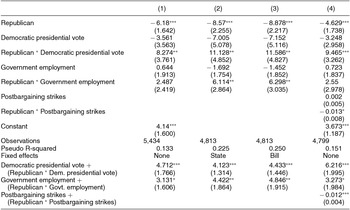
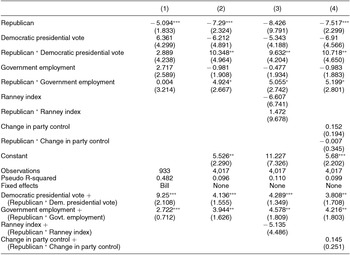
We begin the analysis by using logistic regression to estimate the effects of district ideology and government employment on state legislators’ votes (“yes” = 1, “no” = 0). Because we expect these variables to matter little for Democrats but a great deal for Republicans, we also include legislators’ party (Republican = 1, Democrat = 0) and its interaction with ideology and government employment. We cluster the standard errors by state.
The results are set out in the first column of Table 3. As expected, the coefficient on Democratic presidential vote is insignificant, suggesting that the ideology of Democrats’ districts had no significant relationship to their votes on collective bargaining. However, we find that district ideology did matter for Republicans. At the bottom of column 1, we show that the sum of Democratic presidential vote and its interaction with Republican is positive and significant at the 1% level. Republicans were more likely to favor collective bargaining, then, the more moderate their constituencies.
State Legislators’ Collective Bargaining Votes

Notes: Standard errors clustered by state in parentheses. *p < 0.10; **p < 0.05; ***p < 0.01.
Similarly, we find that Democrats’ votes did not vary with the amount of government employment in their districts, but Republicans’ votes did. As we show at the bottom of column 1, the sum of Government employment and its interaction with Republican is positive and statistically significant. This finding aligns nicely with our expectations: the greater the concentration of government employment in the district, the greater the likelihood that a Republican voted “yes” on public-sector collective bargaining.
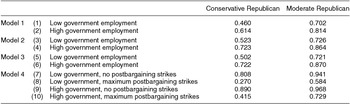
Table 4 presents some key predicted probabilities from this model that convey the magnitudes of these effects. We predict the probability of a “yes” vote for two types of Republicans: “Conservative Republicans” are those from districts where 34% of the presidential vote went to the Democratic candidate (the 5th percentile) and “Moderate Republicans” are those from districts where 55% of the presidential vote went to the Democratic candidate (the 95th percentile). We start by examining the probabilities for these two types of Republicans in districts with low government employment—which we define as those where 10% of workers are employed by government (the 5th percentile). In row 1 of Table 4, we find that the predicted probability of a “yes” vote was 46% among conservative Republicans. By contrast it was 70% for moderate Republicans—a 24 point difference. Clearly, then, in districts with low government employment, moderate Republicans felt greater pressure to support collective bargaining than conservative Republicans.
Predicted Probabilities

In row 2 of Table 4, we calculate the same probabilities but for Republicans in districts where 29% of workers were employed by government (the 95th percentile). Here, too, we find a marked difference in labor law support between conservative and moderate Republicans (20 percentage points). But we also see, by comparing rows 1 and 2, a large effect of government employment on Republicans’ votes. For conservatives, the predicted probability of a “yes” vote was 61% in districts with high government employment, but only 46% in districts with low government employment. Moderate Republicans from districts with high government employment voted “yes” on collective bargaining 81% of the time—11 points more often than moderates in districts with low government employment. The evidence indicates, then, that many Republicans—conservatives and moderates alike—supported collective bargaining because government employees were important local constituencies for them.
Next we add state fixed effects to account for the possibility that state characteristics—such as private-sector union strength and the professionalization of the legislature—affected Republican support. This modeling strategy allows us to ask whether within states, and thus controlling for time-invariant state characteristics, the basic relationships we found in the original model continue to hold up.Footnote 6
The answer is yes. As column 2 of Table 3 indicates, moderate Republicans were significantly more likely to vote for duty-to-bargain laws than conservative Republicans in the same state, and Republicans from districts with high government employment were more supportive than those from districts with low government employment. In rows 3 and 4 of Table 4, we present predicted probabilities from this model.Footnote 7 Moderate Republicans were 14 to 20 percentage points more likely to vote “yes” than conservative Republicans. And for Republicans with high concentrations of government employees in their districts, the probability of support was 14 to 20 points higher than for Republicans with low concentrations.Footnote 8
It is important to emphasize that all bills in our dataset are the same at their core: they all established formal collective bargaining rights for government workers, modeled after the NLRA. Yet there are some differences between them at the margins—for example, in how they deal with strike penalties or what occupations they target. To partial out the effects of these bill characteristics on votes, we add bill fixed effects to the model in column 3 of Table 3. Our results are substantively unchanged. Again, at the bottom of Table 3, we find that the effects of district ideology and government employment are positive and statistically significant for Republicans. (See Table 4 for the magnitudes.)
In the final column of Table 3, we test our expectations about how strikes influenced Republican votes. As we discussed earlier, the sudden upsurge in strikes by public workers was a political concern in the 1960s, and many experts argued that granting them collective bargaining would bring labor peace. Until the late 1960s and early 1970s, there was little direct evidence to counter that claim, and Republicans had good reason to bank on it—and embrace collective bargaining as a way of slowing government strikes.
As time went on, however, more and more states had actual experiences with collective bargaining, and legislators could look to them for evidence. If it appeared that strike activity declined after states adopted duty-to-bargain laws, we would expect Republicans to continue their support. But if strike activity stayed the same or increased after adoption, we would expect their support to decline.
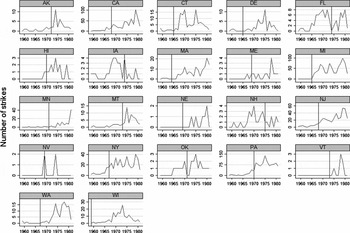
What, then, would state legislators have observed had they looked to the experiences of other states? In Figure 1, we plot government strikes over time for 22 states—the states that enacted duty-to-bargain laws for three out of the five categories of government employees at the same time. (We exclude states that extended bargaining rights to only one or two categories of workers, because strikes may have continued on behalf of the excluded workers.) The vertical line in each graph depicts the year that the state adopted its law.
Strikes by state and local government employees

The trend immediately apparent in Figure 1 is that, in almost all states, strike activity tended to increase after they adopted duty-to-bargain laws. In some, the increase was dramatic. In Michigan, which adopted a comprehensive law in 1965, there were only two public strikes in the years leading up to adoption, but four years after adoption there were 70 strikes. Ten years later, there were nearly 100 strikes. The pattern was similar in many other states. Given this experience, it seems likely that state legislators would question the earlier claim that collective bargaining brought labor peace—and we would expect Republican support for collective bargaining to decline as a result.
To test for this, we created a measure of how Republicans might have thought about the relationship between collective bargaining and strikes at the time of their votes. For each state in Figure 1, we calculated the average number of strikes during the three years prior to the law's adoption. Then, for all years after adoption, we subtracted this prebargaining baseline from the number of strikes in that particular year. We then summed these differences across all 22 states, by year. This aggregate measure, which we call Postbargaining strikes, captures the extent to which strike activity changed after the adoption of duty-to-bargain laws. We link this measure to the votes in our dataset using a one-year lag.
In column 4 of Table 3, we include this variable and its interaction with party. As expected, we find that as legislators could witness more and more strikes in states that already had collective bargaining, Republican support declined. We can see this from the hypothesis test at the bottom of column 4: when we add the coefficients of Postbargaining strikes and its interaction with Republican, we estimate a negative effect, significant at the 1% level.Footnote 9
The predicted probabilities from this model (see Table 4) show that the effect of Postbargaining strikes was quite large. For conservative Republicans in districts with low government employment, shifting from an environment of no strikes in bargaining states (and therefore no reason to doubt that collective bargaining would reduce strikes) to an environment of 206 strikes per year in bargaining states (the maximum in our dataset) reduced the probability of voting “yes” from 81% to 27%. For moderate Republicans, the effect was a change from 94% support to 58%. We see a similar pattern in districts with high government employment, where Republican support tended to be higher across the board. Specifically, our model predicts that the vast majority of these Republicans—moderates and conservatives—voted “yes” on collective bargaining when postbargaining strike incidence was zero (89% for conservatives and 97% for moderates). At the maximum level of Postbargaining strikes, however, conservative support dropped to 42%, and moderate support decreased to 73%. These results support our theoretical expectation: Republicans’ support dropped as they observed what was happening in states that had already adopted collective bargaining.
Taken together, our findings show that, on the key policy issue of collective bargaining, most Republicans did not act in the interest of their party. Although they were usually in a position to block, nearly two-thirds of the Republicans in our dataset voted “yes.” Those “yes” votes were disproportionately likely to come from moderate Republicans, Republicans from districts with high concentrations of government employees, and Republicans who thought they could prevent government strikes. Thus, an outcome that appears collectively irrational—Republicans supporting prounion labor laws—is sensible in terms of the self-interest of individual legislators. By thinking about their own districts and constituencies, Republicans played a pivotal role in enacting legislation that disadvantaged their party.
Alternative Explanations
Next we consider whether there are alternative explanations that could account for the patterns in our data. A potential concern is that we have only analyzed votes on enacted legislation. One might argue that, if we looked at nonenacted bills, we would find low levels of Republican support. Indeed, perhaps Republicans often did come together to block collective bargaining in the early going, and only jumped on the bandwagon when it became clear that a bill was going to pass.
The problem with this reasoning is that Republicans were usually pivotal to the legislation that eventually passed. If many had voted “no” on prior, nonenacted bills, they could have continued to vote “no” —and thus prevented collective bargaining from being adopted. But they didn't do that. They were in a position to block by voting “no,” but they voted “yes” instead. And without their support, there was no bandwagon to jump on.
Even so, it is worth finding out more about nonenacted bills. To do that, we searched the historical legislative records of three states: California, Iowa, and Utah.Footnote 10 For each, we compiled a list of all unsuccessful collective bargaining bills between 1960 and 1979. Of the 57 nonenacted bills we identified, only 15 received floor votes. We therefore collected individual roll-call votes on these 15 nonenacted bills.
The picture that emerges is not one of unified Republican opposition. In California, 47% of the Republican votes on these nonenacted bills were “yes” votes. In Iowa, 67% were. And while fewer Utah Republicans voted “yes”—only 11%—that low percentage is consistent with our theory, because Utah Republicans were uniformly conservative. What is more, when we model the individual votes on these nonenacted bills, using bill fixed effects to account for differences across bills, we find the same general patterns as in Table 3. See column 1 of Table 5. There, we find that moderate Republicans and Republicans from districts with high government employment were more likely to vote “yes.” This suggests that our key conclusions would not be different if we could somehow analyze votes on all nonenacted bills.
Testing Alternative Explanations

Notes: Standard errors clustered by state in parentheses. Column 1 is a model of all votes on nonenacted bills in CA, IA, and UT. Columns 2–4 are models of votes on enacted bills in all states, excluding Democratic unified governments. *p < 0.10; **p < 0.05; ***p < 0.01.
But what of the states that never adopted collective bargaining, and therefore are not in our dataset? Did they fail to pass collective bargaining because Republicans banded together to block? The answer is no. Almost all of these states are in the South, and during the 1960s and 1970s, their governments were overwhelmingly controlled by Democrats who were conservative and antilabor. Even so, as we show in the Online Appendix, we do find evidence consistent with our expectation that legislators were motivated by their individual-level incentives: on nonenacted bills in Kentucky, urban Democrats and Democrats from districts with high female labor force participation (both of which we expect to be more moderate) were the most likely to support collective bargaining. Although this is interesting, it is not clear whether we should view these labor laws as a collective good or bad for the Southern wing of the Democratic Party; and for that reason, the South is not a good test bed for our theory. What is most important is that Republicans were not the reason collective bargaining failed in the South.
Turning back to our analysis of enacted legislation, are there any other explanations for the patterns we have found? One possible story is that perhaps only conservative Republicans saw these labor laws and the rise of public-sector unions as bad for the Republican Party, while moderate Republicans believed the new unions might become supporters of the kind of big-tent Republican Party that moderates hoped (but failed) to create. Perhaps conservatives and moderates were both motivated to do what was best for their party, then—but were acting on different visions of what their party should be.
But this explanation doesn't hold up. Our data show that while moderates were indeed more likely to support these laws than conservatives were, the level of conservative support was actually very high. Of the most conservative Republicans (the top 10%), 57% voted “yes.” This is critical evidence. Conservatives surely believed that these laws would have negative impacts on their party, yet they voted “yes” in large numbers. This is consistent with our expectation that they were voting without reference to the impact on their party.
Yet another conjecture is that perhaps Republicans only voted “yes” when they were not pivotal and could not block collective bargaining anyway—and that when it counted, Republicans came together and voted “no.” But our data do not support that. First of all, Republicans were pivotal in passing collective bargaining in most of the states (Table 1); and in those cases—of divided government or Republican unified government—they voted “yes” 66% of the time. Moreover, when we limit our basic model to those cases (see column 2 of Table 5), our findings are essentially the same as in Table 3.
Still another possibility to consider is that, precisely because Republicans were so often pivotal, they were—as a party—trying to lock in their own conservative version of collective bargaining, perhaps because they anticipated that Democrats would soon regain control of state government, and they wanted to prevent more liberal bills in the future. Such a scenario may seem plausible, but it does not square with the facts.
Collective bargaining bills did differ at the margins (for example, in the presence or absence of strike provisions), but at the core they were all the same and modeled after the NLRA: they gave unions the electoral machinery to organize, endowed them with exclusive representation rights, obligated public employers to negotiate in good faith, and made labor contracts legally binding. Every one of these bills institutionalized collective bargaining. There were indeed “conservative” versions of labor bills, but they were not collective bargaining bills. Rather, they called for “meet and confer” arrangements, or they gave employees the right to “present proposals”—and these kinds of weaker bills are not in our dataset.
We can, however, carry out an interesting test by addressing the following question: in states where Republicans were pivotal, were they more inclined to vote “yes” when they had reason to fear that Democrats would soon make gains in state government? We explore this in two ways: First—see column 3 of Table 5—we interact Republican with the four-year average of the Ranney index, which ranges from 0.5 (least competitive) to 1 (most competitive).Footnote 11 Second, in column 4, we replace the Ranney index with a measure of how many state institutions—the lower chamber, the upper chamber, and the governor—changed party hands from two years prior to two years after the adoption of collective bargaining.Footnote 12 In both models, we find that interparty competition had no significant impact on Republicans’ votes. There is no evidence here that the votes of individual Republicans depended on whether Republican Party control was threatened.
Another alternative is that Republicans did not know collective bargaining would give rise to public-sector unions aligned with the Democratic Party. While there is no direct evidence on this score—scholars have barely studied these developments, state and local newspapers provide scant political detail, and national publications focused on union growth and strikes—politicians were surrounded by evidence about what the partisan consequences would be, and it is hard to believe that all this evidence escaped them.
By the 1960s, it was well known that the 1935 NLRA had fueled the growth of private-sector unions and that these unions, led by the AFL-CIO, were firmly allied with the Democratic Party (Alexander Reference Alexander1971; Dark Reference Dark1999; Greenstone Reference Greenstone1969; Heard Reference Heard1960). As Wilson (Reference Wilson1979, 39) summarized it, “Everywhere, the unions looked to and worked with the Democrats to the disadvantage of the Republicans.” State labor laws for government workers were therefore expected to propel a similar upsurge in public-sector unionization—which they did—and there was abundant evidence that their expansion would advantage the Democratic Party, just as the expansion of private-sector unions had (DiSalvo Reference DiSalvo2015; Freeman Reference Freeman1986; Slater Reference Slater2004; Walker Reference Walker2014).
Well before state duty-to-bargain laws gained traction, the key public-sector unions—AFSCME, the AFT, and the SEIU (the NEA was not yet a union)—were already inside the AFL-CIO and strongly supporting the labor-Democratic alliance. Indeed, they were affiliated with Walter Reuther's Industrial Unions Department, the most socially progressive component of the AFL-CIO and the most fervently involved in Democratic politics (Battista Reference Battista2008; Mackenzie and Weisbrot Reference MacKenzie and Weisbrot2008). Thus, the early public-sector unions weren't just core allies of the Democrats—they were on the left of the party. And there were good reasons for that, as they organized many blue-collar as well as white-collar workers, had large female and black memberships, supported policies expanding the public sector, and were “vigorous advocates for racial and gender equality” (Battista Reference Battista2008, 12).
With Reuther's death in 1970, AFSCME president Jerry Wurf assumed leadership of the AFL-CIO's progressive wing. Wurf was a prominent and passionate player in Democratic politics, and he argued publicly that electing Democrats—and defeating Republicans—was crucial to AFSCME and the public-sector labor movement generally. AFSCME “led the surge” in propelling that movement (Zieger Reference Zieger1986, 163). But action of great consequence was also occurring in public education, where the NEA and the AFT were competing to organize millions of teachers—and by the end of the 1960s, they “had become two of the most powerful political forces in the country” (Mackenzie and Weisbrot Reference MacKenzie and Weisbrot2008, 19). Both were allies of the Democrats and active supporters of progressive causes (Murphy Reference Murphy1990).
A much larger body of evidence points in the same direction (see the Online Appendix). Although more research is needed, we think there is little doubt that, to most observers at the time, the pronounced Democratic tilt of the public-sector union movement was apparent as the new laws were being adopted, and that most Republicans were likely to know that the long-term consequences for their party would not be good.
Party Support for Collective Bargaining in the Modern Era
Our conclusion, then, is that during this critical time period for public-sector labor law adoption, Republicans did not use policy to engineer favorable political consequences for their party. And the theoretical logic we have developed helps to explain why. The heterogeneous Republican Party of the 1960s and 1970s faced a collective action problem, and in the end, individual Republicans largely voted according to their own, locally based interests.
The Republican Party of today, of course, is more homogeneously conservative. And the same theoretical logic that predicts extensive Republican support for collective bargaining in the 1960s and 1970s suggests that the modern period may well be different. A Republican Party with fewer moderates has fewer members with district-level incentives to defect from the party-enhancing position. Moreover, the theory of conditional party government suggests that as parties become more internally homogeneous, their members delegate greater authority to party leaders to constrain members’ votes (Aldrich and Rohde Reference Aldrich, Rohde, Lawrence and Oppenheimer2001)—further promoting party discipline. The implication, then, is that today's Republicans should be much better positioned to “make politics” to their collective advantage.
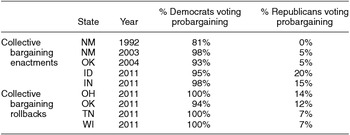
While there are only two states that adopted duty-to-bargain laws after the 1980s—New Mexico and Oklahoma—a look at Republicans’ votes in those states reveals that they were, in fact, more uniformly opposed than they were during the earlier period. Table 6 shows that when New Mexico enacted a duty-to-bargain law in 1992, not a single Republican voted for it. That initial law was unusual in that it contained a sunset provision, but when New Mexico passed another law in 2003 (to replace the expired law), only two Republicans were supportive. Republican voting in Oklahoma in 2004 was similarly opposed: of 64 Republicans voting on its duty-to-bargain law, only three voted “yes.”
Party Support for Collective Bargaining, Recent Laws

We need not limit our analysis, however, to the two states that passed duty-to-bargain laws in recent years. In 2011, Republicans pushed through rollbacks of collective bargaining rights in six states: Indiana, Idaho, Ohio, Oklahoma, Tennessee, and Wisconsin. In these states, did Republicans come together and collectively reject policies that benefit the Democratic Party?
Table 6 shows the percentages of Democrats and Republicans who took the probargaining position (i.e., voted “no”) on these six retrenchment bills. As in the earlier period, nearly all Democrats took the probargaining position and voted against collective bargaining retrenchment. But in contrast to the earlier period, very few Republicans defected from the position favorable to their party. In all but one state, Republican opposition to retrenchment was limited to 15% of state legislators or less. In Wisconsin, only 7% voted against the rollback. The highest percentage of Republican “no” votes was in Idaho (20%), but even that number is very low compared to the 63% average Republican support during the 1960s, 1970s, and 1980s. It does appear, then, that today's politicians are better positioned to use policy to make politics favorable to their party. Republicans in 2011 largely voted together—and pushed for limits to collective bargaining laws that weakened public-sector unions.
Even today, however, a non-negligible number of Republicans have taken the probargaining position on critical votes. The explanation, we suspect, is largely the same as before. While strike incidence has slowed since 1980, and while the Republican Party has shed most of its moderate wing, there are still Republicans who are relatively moderate, and Republicans still have government employees in their districts. Thus, while the political forces pushing Republicans to defect from the party-enhancing position are weaker than they were during the 1960s and 1970s, they have not disappeared—and if our logic is correct, they should help to explain why a few Republicans still support collective bargaining.
To test this idea, we carry out an analysis similar to the earlier one, regressing individual legislators’ votes on measures of government employment and ideology. For the modern period, we have access to better measures of state legislator ideology: here we use the Shor and McCarty (Reference Shor and McCarty2011) ideology scores created from state legislators’ roll-call votes. (We take the inverse of the measure so that higher values indicate more liberal legislators.) Government employment is measured as before, based on the U.S. Census (from 2010). Our models include votes on all bills enacted since 2000, coded so that 1 denotes a vote in favor of collective bargaining. We drop the 1992 New Mexico votes because the ideology measures are not available for that year. Finally, because the dependent variable equals 0 for only 12 Democrats in this dataset, we limit our analysis to Republicans.
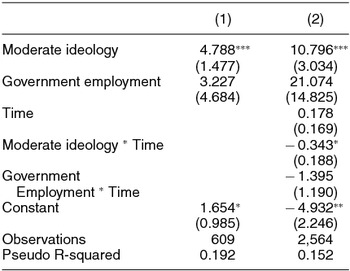
The logit estimates are presented in column 1 of Table 7. The coefficient on government employment is positive but statistically insignificant. However, the coefficient on district ideology is positive and significant, showing that moderate Republicans are more likely to vote in favor of collective bargaining—even today. As we show in the Online Appendix, a Republican at the 5th percentile of the distribution of the Shor-McCarty scores—a conservative—is predicted to have a 1% chance of voting the probargaining position. By contrast, the predicted probability for a moderate—one at the 95th percentile—is 35%. Even in today's polarized climate, then, the influence of local forces on Republicans’ votes has not disappeared entirely.
Republicans’ Collective Bargaining Votes in the Modern Era

Notes: Standard errors clustered by state in parentheses. Column 1 is a model of Republicans’ votes in the modern period (2003–2011); the dependent variable equals 1 if the state legislator cast a probargaining vote. Column 2 is a model of Republicans’ votes in the earlier period (1959–1985). In column 1, Moderate ideology is the legislators’ Shor-McCarty ideology scores; in column 2, it is approximate Democratic presidential vote (as earlier). * p < 0.1; **p < 0.05; ***p < 0.01.
Our main takeaway, however, is that today's parties are better positioned to use policy to shape politics in their party's favor. There are fewer moderates, and therefore fewer members with incentives to defect. And if party leaders gain more authority to constrain members’ votes as the parties become more homogeneous (Aldrich and Rohde Reference Aldrich, Rohde, Lawrence and Oppenheimer2001), then the few moderates who remain should be less inclined to buck the party in favor of their local interests.
Because our dataset from the modern period uses different ideology measures than the dataset from the earlier period, we cannot directly test whether district forces have a weaker effect on Republicans’ votes today than in the 1960s and 1970s. But our dataset from the earlier period does span 27 years, and we know that the Republicans were starting to become more homogeneously conservative by the end of that period. In a final test, therefore, we return to our original dataset (which ends in 1985), focusing on Republicans’ votes, to ask whether the effects of ideology and government employment grew weaker over time. In column 2 of Table 7, we model legislators’ votes with district ideology and government employment, this time interacting both with a linear time trend. On the one hand, we do not find that the effect of government employment weakened over time. But we do estimate a significant negative coefficient on the interaction of district ideology and the time trend, suggesting that the effect of ideology did, in fact, get weaker as time went on. In 1965, the probability of a moderate Republican voting “yes” was 94%, whereas for conservatives it was 71%—a 23 point difference. By 1980, the gap between moderates and conservatives had shrunk to 16 points. Thus, even by the 1980s, district considerations weighed less heavily on Republicans’ votes. It was the dawn of a new era—one in which Republicans were better equipped to use policy to shape their party's future.
CONCLUSION
Schattschneider's insight that policies make politics has played an influential role in the modern study of political institutions and public policy. When this notion has taken center stage, the focus has mainly been on how policies give rise to new interests and constituencies that, via policy feedback, shape the future politics of those policies. Important as this line of analysis is, there is also an important strategic aspect that arises from Schattschneider's original insight. For if policies do indeed make politics, rational politicians have opportunities to use policies to create a future structure of politics more to their advantage.
This strategic dimension has gone almost entirely unexplored, and even the most basic questions have gone unstudied. Do politicians actually use policies to make politics? Under what conditions and with what consequences? To what extent has the structure of American politics been shaped through the strategic design of policy? As these questions begin to suggest, there is an untapped research agenda that flows naturally from Schattschneider's work, and that stands to shed new light on our understanding of politics and policy.
This article is an early effort to move that agenda forward. We develop a theoretical argument that highlights certain basics that we think are essential for understanding how rational politicians do—or don't—use policies to make politics. One of these is that politicians may often have incentives to “make politics” when the political consequences are policy specific. Another is that, when the consequences involve the larger balance of power between the parties, the incentives of politicians are diluted by collective action problems. As a result, politicians may not act on what seem like obvious opportunities, and indeed, may act in ways that are disadvantageous to their own parties. These problems may be (partially) overcome when parties are internally homogeneous. But when parties are more diverse, politicians can be expected to take actions that are good for themselves even if bad for their parties.
Our empirical analysis brings data to bear on a case that is especially instructive: the adoption of public-sector collective bargaining laws—a development of great political consequence that favored Democrats over Republicans. We show that Republicans played pivotal roles in passing these laws, and thus in shaping the structure of politics to their own disadvantage. They behaved rationally as individuals, responding to district and constituency concerns—and not to the collective goods (or bads) that were being generated for their party. In this case, the collective action problem was indeed disabling.
The modern period, however, is different. There are still some Republicans who vote in favor of collective bargaining—defecting from the party-enhancing position—but they are far fewer in number than during the 1960s and 1970s. Indeed, today's more homogeneously conservative Republican Party appears much better equipped to make policy in its own favor.
As we look ahead, various implications offer promising avenues for advancing this Schattschneider-based agenda. One begins with our argument that, while it is precisely when the political stakes are broadly consequential for the parties that politicians have weak incentives to “make politics,” the flip side is that they are likely to have stronger incentives when the consequences are policy specific. The opportunities for such policy-specific decisions are omnipresent across policy realms and time, making them central to an understanding of political dynamics and attractive targets for political research.
Among other things, research along these lines should explore the qualifications we mentioned earlier, and how problematic they are in the policymaking process. Are politicians aware that they can use the design of policy to shape its future politics? Does their myopia prevent them from taking steps to enhance the long-term durability of the policies they support? Does the attractiveness of position-taking and credit-claiming mean that their support for a policy implies no genuine commitment to its ultimate success, and no incentive to create favorable future politics?
Perhaps most important, research on these qualifying conditions needs to be combined with new research on interest groups—for interest groups likely have incentives to care about the durability of policy, and to pressure politicians to “make politics” in ways that promote it. So far, this is a dimension of interest group behavior that has not been systematically studied. And we would expect new work along these lines to show that interest groups can play key roles in overcoming the incentive-weaknesses of politicians, activating them to do what they might not otherwise do on their own.
Another line of inquiry has to do with those policies, like labor laws, that are broadly consequential for the parties. Here research should center on the collective action problems that weaken the incentives of politicians to “make politics”—but it also needs to recognize that these problems are not always disabling, and that there is much to explore about when these problems are disabling and when they are not. Here too, research should shed light on the role of interest groups, and specifically on whether at least some types of groups may play roles that go beyond specific policy realms in pressuring politicians to do what is best for their parties.
That said, the top priority is research on the parties themselves, and their capacity to get members to cooperate in “making politics” to their collective advantage. As we have shown, today's strong parties are better positioned to do this than parties were in past decades. This is a basic claim that, in itself, calls out for historical research on how parties have differentially acted through time to “make politics.” Along the way, research should determine whether the potential impact of policies on the partisan balance of power does indeed have greater incentive value in recent decades—and thus helps explain the dynamics behind some of the salient, politics-making issues of our time: from immigration reform to Obamacare to union “card check” legislation to voter ID laws.
The argument we have developed in this article is just a start. It points to the limits on the incentives of politicians to “make politics” through the design of policy, and the roles of interest groups and parties in (potentially) overcoming those limits. This argument will surely need refinement and elaboration as new evidence and theoretical thinking are brought to bear. We hope that it will help to encourage just such research—and that, in the years ahead, this work will add significantly to Schattschneider's already considerable contribution to political science.
Supplementary Materials
To view supplementary material for this article, please visit http://dx.doi.org/10.1017/S0003055416000484




Comments
No Comments have been published for this article.