Deciding when to begin teaching children to read, and what conditions should be met before that point, are fundamental questions in the field of Education (Cuban, Reference Cuban1992). Dowing (Reference Dowing1963) coined the term “readiness”, that is, the preparedness or disposition needed to learn a new competency. Gallego (Reference Gallego2006) used the term “reading prerequisites” to refer to the set of skills and processes a person has to master before effectively learning to read. This term implies there is an optimal point in development at which children possess the cognitive and neurological resources needed to successfully learn to read.
Analysis of reading precursors has attracted significant attention, especially in recent years (Adams, Reference Adams1990; Oakhill & Cain, Reference Oakhill and Cain2012; Vellutino, Tunmer, Jaccard, & Chen, Reference Vellutino, Tunmer, Jaccard and Chen2007; Warmington & Hulme, Reference Warmington and Hulme2012). Several basic processes have been proposed to account for reading development. Catts, Fey, Zhang, and Tomblin (Reference Catts, Fey, Zhang and Tomblin2001) conducted a longitudinal study of 604 children (51% boys, 49% girls) in first grade and examined predictors of future reading performance. They administered a battery of language tests, including early reading measures as well as non-verbal, cognitive measures. Measures of reading performance were taken in second grade. Their results showed that five variables predicted second graders’ reading ability: letter identification, sentence imitation, phonological awareness (PA), rapid automatized naming (RAN), and mother’s education. Schatschneider, Fletcher, Francis, Carlson, and Foorman (Reference Schatschneider, Fletcher, Francis, Carlson and Foorman2004) reduced that number to only three variables: PA, letter knowledge, and RAN. Apparently those three have yielded the most robust effects as reading precursors. However, there is disagreement among researchers about what role each of these skills plays in reading development, which point in reading development is most crucial, whether different skills influence each other reciprocally, and whether some skills are precursors to others (Caravolas et al., Reference Caravolas, Lervåg, Mousikou, Efrim, Litavsky, Onochie-Quintanilla and Hulme2012). The debate is distinct, and all the more complex, when it comes to reading acquisition and development in languages with transparent orthographies, like Spanish.
PA refers to an individual’s awareness of the phonological structure, or sound structure, of words. It involves detecting and manipulating sound at three structural levels: (1) syllables, (2) onset and rimes, and (3) phonemes. There has been disagreement within the literature, with some studies arguing that PA is a precursor (Suárez-Coalla, García de Castro, & Cuetos, Reference Suárez-Coalla, García-de-Castro and Cuetos2013) and others maintaining that its role is less important in languages with transparent orthographies (e.g., de Jong & van der Leij, Reference de Jong and van der Leij1999; Wimmer, Mayringer, & Landerl, Reference Wimmer, Mayringer and Landerl2000). Recent large-scale cross-linguistic studies have suggested that once reading instruction begins, cognitive correlates of reading speed and accuracy are relatively similar in orthographies that range in consistency (Caravolas, Lervåg, Defior, Málková, & Hulme, Reference Caravolas, Lervåg, Defior, Málková and Hulme2013; Vaessen et al., Reference Vaessen, Bertrand, Tóth, Csépe, Faisca, Reis and Blomert2010; Ziegler et al., Reference Ziegler, Bertrand, Tóth, Csépe, Reis, Faísca and Blomert2010).
In the English literature on reading, variability in children’s RAN time strongly predicts their later ability to read, and is independent of other precursors like PA, word recognition, and reading comprehension. In transparent orthographies like Spanish, RAN is slower and less consistent than in English (Araújo, Reis, Petersson, & Faísca, Reference Araújo, Reis, Petersson and Faísca2015). Given its association with aspects of attention, it could be an especially important predictor of learning difficulty in preliterate children (see Rosselli, Matute, & Ardila, Reference Rosselli, Mature and Ardila2006).
PA is typically considered the variable that best predicts reading acquisition (Carrillo, Reference Carrillo1994; de Jong & van der Leij, Reference de Jong and van der Leij1999; Goswami, Reference Goswami, Kamil, Mosenthal, Pearson and Barr2000; Stanovich, Reference Stanovich2000; Stanovich & Siegel, Reference Stanovich and Siegel1994; Vellutino & Scanlon, Reference Vellutino, Scanlon, Neuman and Dickinson2002). There is consensus on the close relationship between PA and word-reading development (for a review, see Dickinson, McCabe, Anastasopoulous, Peisner-Feinberg, & Poe, Reference Dickinson, McCabe, Anastasopoulos, Peisner-Feinberg and Poe2003). It has been demonstrated that the pre-reading children who can best identify and isolate phonemes have the best cognitive foundation for associating sounds with their respective letters (Adams, Reference Adams1990; Bravo, Villalón, & Orellana, Reference Bravo, Villalón and Orellana2001; Bryant & Bradley, Reference Bryant and Bradley1985; Goswami, Reference Goswami, Neuman and Dickinson2002; Wagner & Torgensen, Reference Wagner and Torgeson1987). Results to that effect have been found in various languages, including English and Spanish (Carrillo & Marín, Reference Carrillo and Marín1996; Domínguez & Cuetos, Reference Domínguez and Cuetos1992; Guardia, Reference Guardia2003; Jiménez Glez & Rodrigo, Reference Jiménez Glez and Rodrigo López1994).
Some research groups have argued that PA emerges around 4 or 5 years of age (Ball & Blachman, Reference Ball and Blachman1991; Lundberg, Frost, & Petersen, Reference Lundberg, Frost and Petersen1988; Rayner, Foorman, Perfetti, Pesetsky, & Seidenberg, Reference Rayner, Foorman, Perfetti, Pesetsky and Seidenberg2002). Moreover, PA training only seems to be effective from age 5 onward (Bradley & Bryant, Reference Bradley and Bryant1983; Bryne & Fielding-Barnsley, Reference Bryne and Fielding-Barnsley1991; Cunningham, Reference Cunningham1990; Lundberg et al., Reference Lundberg, Frost and Petersen1988). Meanwhile, the phonological skill of learning to read is considered even more decisive in Spanish – with its regular, consistent orthography – than in English, whose orthography is irregular (Alegría, Reference Alegría2006; Defior & Tudela, Reference Defior and Tudela1994). A distinct characteristic of Spanish is that preliterate children can complete syllable segmentation tasks at a high level; thus PA’s contribution to literacy in Spanish may be developmentally limited (see Caravolas et al., Reference Caravolas, Lervåg, Defior, Málková and Hulme2013; Parrila, Kirby, & McQuarrie, Reference Parrila, Kirby and McQuarrie2004; Stanovich, Reference Stanovich1986). At five years of age, children have already demonstrated PA of syllable structure, though not on all types of tasks (Carrillo & Marín, Reference Carrillo and Marín1996; Domínguez, Reference Domínguez1996; Herrera & Defior, Reference Herrera and Defior2005; Kim & Pallante, Reference Kim and Pallante2012).
Additionally, reading requires that words be identified or recognized visually. For example, most good readers recognize familiar words with no more than a glance (globally). This procedure is known as visual word reading, or lexical reading (Rayner et al., Reference Rayner, Foorman, Perfetti, Pesetsky and Seidenberg2002). Visual memory plays a key role in automatizing reading (Ehri, Reference Ehri, Gough, Ehri and Treiman1992). Defior, Cary, and Martos (Reference Defior, Cary and Martos2002) showed that Spanish-speaking children in first through fourth grade, when learning to read familiar words, tended to use visual images of the words stored in memory.
Specialized reading at the level of comprehension requires, at the very least, accurate, fluent word recognition, and language comprehension (Gough & Tunmer, Reference Gough and Tunmer1986). Both skills are necessary, but neither is sufficient per se to read successfully (Hoover & Gough, Reference Hoover and Gough1990).
Another variable relevant to reading comprehension is vocabulary size. Vocabulary volume increases comprehension and facilitates the reading acquisition process (Hirsch Jr, Reference Hirsch2003). Reciprocally, reading comprehension enhances vocabulary in both quantity and quality (Eldredge, Quinn, & Butterfield, Reference Eldredge, Quinn and Butterfield1990). High lexical quality facilitates reading comprehension in various ways: it avoids word confusion, improves meaning retrieval, reduces working memory load, and makes it easier to integrate words into the overall representation in the text (Perfetti, Reference Perfetti2007). Working memory, too, is important for reading comprehension (Jorm, Reference Jorm1983). Children with specific learning difficulties in reading have been found to exhibit diminished working memory (Miles & Ellis, Reference Miles, Ellis, Pavlidis and Miles1981). By the same token, as a child’s working memory expands, his or her reading comprehension automatically improves (García-Madruga, Reference García-Madruga2006). Consequently, to assess reading comprehension in Spanish, tests must be designed that take into consideration word recognition, language comprehension and vocabulary, as the present study set out to do.
Evidently, several variables have the potential to affect the reading acquisition process. However, the particular significance of each one in different languages is, as of yet, not sufficiently clear.
Suggate (Reference Suggate2010) published a meta-analytic review of 85 reading interventions in which grade in school was considered an estimate of developmental and educational level. He concluded that phonology training is effective until first grade, while comprehension-based interventions grow more effective over the course of development, especially beginning in first grade.
The current study’s purpose was to analyze different variables’ potential ability to predict reading acquisition in Spanish-speaking children. Specifically, we analyzed the significance of three abilities (word recognition, phonological skills, and reading comprehension). Our research objective was to determine as precisely as possible at what age children develop and master several basic skills for reading acquisition in Spanish. The process of recognizing written words and their constituent elements is analyzed, for example, lexical access following the word’s visual form and meaning stored in memory. Second, we explore the importance of PA, and its relationship to mastery of the rules of grapheme-phoneme conversion. Children with adequate PA are able to explicitly manipulate phonological speech segments. Third, we examine reading comprehension of sentences and short texts after word recognition. Even in its earliest stages, comprehension involves more complex activities: sentence building, putting the text’s ideas in order, extracting overall meaning, and interrelating ideas.
Method
Participants
The sample included 245 Spanish-monolingual children (120 boys, 125 girls) from Madrid (Spain) between the last year of preschool and third grade in primary school. Participants ranged from 4 years and 9 months of age, to 9 years and 7 months of age (M = 7.57; SD = 1.17).
This study was conducted in a school located in an upper middle class residential area. The school receives psychopedagogical guidance services, which were put to use in this study in the process of selecting students with age/grade-appropriate school achievement. Twelve children were excluded from participating and were not evaluated because they exhibited some developmental delay (cognitive or psychomotor) or were older than their grade in school would normally indicate.
Participants were distributed into classes with 15 students at most. Each one had a senior teacher and an assistant teacher to provide individual attention while the tasks were carried out. Prior to data collection, we sought authorization from school principals and the children’s parents. The children all participated voluntarily in this assessment, and their parents signed informed consent forms to that effect.
Instruments
To construct a test of basic reading processes that would suit our experimental purposes, the following procedure was used: 9 classic reading assessment tasks were created and then grouped according to three basic reading skills (recognition, PA, and comprehension); they were combined to form an assessment battery named PROBALES (Procesos Básicos de Lectura [Basic Reading Processes]):
Recognition skills
Three tasks were designed to assess children’s recognition and identification skills, using as points of reference the Word Identification subtests of the Wide Range Achievement Test (Wilkinson, Reference Wilkinson1993) and the Woodcock Reading Mastery Test (Woodcock, Reference Woodcock1987).
Symbol identification
A simple visual stimulus is presented, and participants must correctly identify it within a set of similar stimuli. To complete this task, children must cognitively engage by visually discriminating what makes two or more symbols or letters the same or different. Their difference may lie in some distinctive feature, or in orientation or position in space. To recognize a word and access its meaning in the mental lexicon requires that visual symbols be processed.
Word identification
A word written on a card is presented for approximately 20 seconds and then taken away. Participants must identify the word that matches the card from a set of four options (for example: choosing ama [Spanish for “lady” or “mistress”] from among ana, asa, ama, ata). This cognitive activity taps visual memory of words as well as visual recognition of the stimulus presented beforehand, now from among four options. To successfully complete the task, the participants must store the word’s imprint in mental lexicon. Symbol identification is part of a series of activities that prepare us to recognize words and access the meaning of letters and words stored in the mental lexicon.
Word recognition
A written list of words is presented visually and participants must correctly rewrite them from memory. The stimulus words are nouns of variable length, frequency of use, and structural difficulty (for example: mesa [Spanish for “table”], sombra [Spanish for “shadow”], and cuaderno [Spanish for “notebook”]). The task is to recognize each written word by its visual characteristics, its letters, or the overall shape of the word, and then rewrite it clearly. Like the Word Identification task, this requires participants to activate the word’s imprint, hold it in visual memory, and then write it down. In Spain, children in their final year of preschool have received instruction in reproducing and copying simple words.
Phonological skills
Three scales were designed to measure phonological processes. For reference, we turned to earlier tests of sound identification and phonological processing (e.g., Lovett et al., Reference Lovett, Borden, DeLuca, Lacerenza, Benson and Brackstone1994; Torgeson & Wagner, Reference Torgeson and Wagner1999).
Letter sound identification
The experimenter pronounces aloud the phoneme corresponding to a letter, and participants must select that letter of the alphabet by circling it. To complete this task, children must recognize the phonological features of phonemes, and the visual features of letters or graphemes.
Rhyme identification
This entails identifying the word with the same rhyme as another word, which is presented in writing and read aloud (for example, the word that sounds the same as banco [Spanish for “bank”] is “lago”, “manco”, “pato”). Participants answer either yes or no to a set of three words. This kind of task requires the activation of auditory memory, where basic letter-sound associations are stored.
Listen and write
Letters and words are read aloud and participants are asked to immediately write down the same letter or word. To carry out this task, children must integrate successive phoneme sounds into a meaningful phonemic unit. This requires, in addition to auditory discrimination of phonemes, that children store their pronunciation in the working memory system, and then immediately write them down.
Comprehension skills
Reading comprehension is a complex ability requiring a certain mastery of more basic skills like word recognition and PA. Three tasks were designed that require comprehension to be completed successfully. To do so, we referenced reading comprehension assessments such as the Passage Comprehension subtest of the Woodcock Reading Mastery Test (Woodcock, Reference Woodcock1987).
Word completion
A word or phrase is presented with certain vowels or consonants missing, and participants must fill in the blank so it makes sense. For example, to complete the phrase luce el s_l (Spanish for “the s_n shines”), participants must choose the vowel “o” (sol) from among several options. Adding to this example’s difficulty is the fact that in Spanish, common words like sal would not be correct in the context of this sentence.
Vocabulary (identify the correct word)
This is a task of vocabulary breadth in which participants choose the word with the correct spelling among four very similar options. In this case, the other alternatives are pseudowords, or variations produced by slightly altering the position of a component letter of the word. For example, if these four stimuli are presented: gallta, gaella, golleta, galleta, the child must recognize that the spelling corresponding to a real Spanish word is galleta (Spanish for “cookie”).
Phrase completion
Participants select the word from a list that completes the sentence. This task resembles the passage comprehension subtest, where participants read a segment of prose with a missing word and are asked to provide an appropriate substitute for the missing word. For example, when the phrase María … las velas de su cumpleaños (“Maria … her birthday candles”) is presented, participants should fill in the blank with the correct word, sopló (Spanish for “blew out”).
Procedure
We designed the PROBALES reading battery to be administered to participants as a group, except for the PA tasks, which were done individually. All testing materials were placed on students’ desks, which were otherwise clear. The children were not permitted to erase anything. The tasks were given no time limit, but completion time was recorded.
Two sessions were held. In the first, the tasks were administered collectively, and always in the same order: Symbol Identification, Word Completion, Word Identification, Vocabulary, Phrase Completion, and Word Recognition. This took 25 minutes on average. In the second session, phonological assessments were administered individually (letter sound identification, rhyme, and listen-and-write-the-word), which took approximately 10 minutes.
Statistical analysis
To assess the reading measures’ construct validity, confirmatory factor analysis (CFA) was carried out in Lisrel 8.80 (Jöreskog & Sörbom, Reference Jöreskog and Sörbom2006). Stepwise linear regression (IBM, 2010; SPSS 19) was employed to ascertain which of the reading tasks best explain reading performance as a function of approximate development or grade in school (see Suggate, Reference Suggate2010).
Results
Measurement Models: Recognition, Phonological, and Comprehension
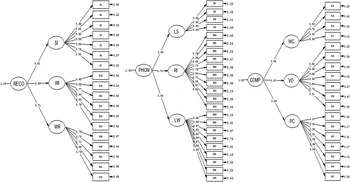
CFA models were performed using tetrachoric correlation and robust unweighted least square (RULS) estimation (see Figure 1). To determine the model’s goodness of fit to the data, the following indices were utilized: the Satorra-Bentler Scaled Chi-square S-B (χ2), Root Mean-Square Error of Approximation (RMSEA) and Comparative Fit Index (CFI).
CFA Models of Recognition, Phonological, and Comprehension Skills in Reading.
Note: RECO = Recognition Skills; SI = Symbol Identification; WI = Word Identification; WR = Word Recognition; PHON = Phonological Skills; LS = Letter-sound Identification; RI = Rhyme Identification; LW = Listen and Write; COMP = Comprehension Skills; WC = Word Completion; VO = Vocabulary; PC = Phrase Completion.

The criteria and cut-off points we applied to the various goodness of fit indices here are widely used, and can be consulted in, for example, the review by Schreiber, Nora, Stage, Barlow, and King (Reference Schreiber, Nora, Stage, Barlow and King2006). In the case of chi-squared, a model is considered to have goodness of fit to the data if the result is non-significant, or when the χ2/df ratio is less than two. RMSEA should fall below .06 for categorical data and the CFI index should exceed .95.
According to the criteria listed above, the three CFA models showed overall goodness of fit, as well as very high factor loadings for all items but number three, which we decided to eliminate. The phonological model yielded the best solution, with all indices falling within the accepted margins; χ2(227) = 237.06, p = .31, χ2/df = 1.04, RMSEA = .01, CFI = 1.0. The other two likewise displayed goodness of fit, except according to χ2, so we can conclude that the tasks designed to tap each skill–recognition and comprehension, respectively – were part of the same construct. Recognition model: χ2(132) = 162.93, p = .04, χ2/df = 1.23, RMSEA = .03, CFI = 1.0. Comprehension model: χ2(132) = 215.13, p = .01, χ2/df = 1.63, RMSEA = .05, CFI = .99.
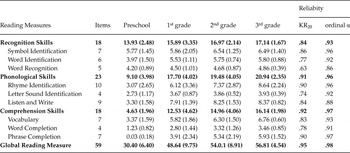
As for the relationship between the three reading skills, we observed a high correlation between them, indicating progressive, gradual, and joint development of various reading skills: the correlation between recognition and phonological skills was .61 (p < .001), between recognition and comprehension skills was .63 (p < .001), and between phonological and comprehension skills was .72 (p < .001). Finally, we evaluated the measures’ quality in terms of reliability using Kuder-Richardson formula number 20 (KR20) (especial case of Cronbach’α for dichotomous or binary data) and ordinal alpha (standardized Cronbach’α using tetrachoric/polichoric correlations, see Zumbo, Gadermann, & Zeisser, Reference Zumbo, Gadermann and Zeisser2007). The reliability was KR20 = .84 on the measure of recognition skills KR20 = .92 for phonological skills and KR20 = .92 for comprehension skills. The overall test’s reliability, according to KR20 was .95. Reliability coefficients estimated by ordinal alfa are slightly higher on all measures (see Table 1).
Means and standard deviations (in parenthesis) on the Reading Measures, by Grade in School. Reliability estimated by Kuder-Richardson formula number 20 (KR20) and standardized Cronbach’α using tetrachoric correlations (ordinal α)

Table 1 presents the means and standard deviations (in parentheses) for the nine reading tasks, by grade in school. On all tasks, scores clearly, continuously improved between the first and fourth groups, but the magnitude of that improvement depended on the specific task. Mastery of all three skills progressively increased with grade in school. Recognition skills are taught during the final years of preschool, and were found to be strong by first or second grade. Nevertheless, phonological and comprehension skills are acquired later on. That was reflected in their pattern of acquisition, which spiked considerably between the last year of preschool and the first grade.
Analyses of variance (ANOVA) were carried out to determine whether or not there were statistically significant differences between average scores on each ability as a function of grade in school. ANOVAs revealed a significant main effect of grade in school on all three measures: (a) recognition skills, F(3, 241) = 15.48, p < .001, partial η2 = .16; (b) phonological skills, F(3, 241) = 81.80, p < .001, partial η2 = .51; and (c) comprehension skills, F(3, 241) = 75.02, p < .001, partial η2 = .48. Post hoc least significant difference (LSD) analyses revealed that all pairwise comparisons, except for the second grade/third grade comparison, turned out to be statistically significant on all three measures (p ≤ .01).
Global Reading Model: Differences by Grade
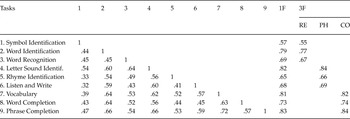
The high correlation between the three reading measures (around .85) suggests an essential unidimensional reading measure. To test this possibility, CFAs were carried out at the task level using RULS estimation, the results of which are displayed in Tables 2 and 3.
Test statistics for CFA models

Note: CFI = Comparative fit index; RMSEA = Root mean square error of approximation [90% confidence interval].
Correlation Matrix and factor loading for the one factor model (1F) and three factors (3F) correlated model (RE = Recognition, PH = Phonological, CO = Comprehension)

The three-factor model obtained better goodness of fit than the one-factor model, but that improvement was not significant. Therefore we can assume that the nine tasks contribute to a global measure of reading.
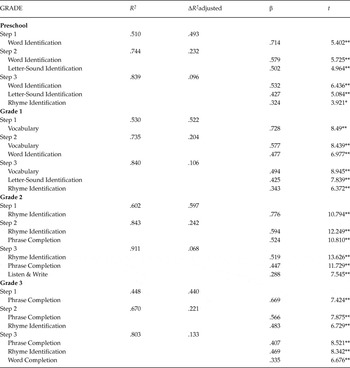
To determine which tasks contributed the most explained variance in global reading scores, a stepwise regression analysis was carried out introducing the nine task in each grade as possible predictive variables. The criterion for including new predictors was that their inclusion would increase the explained variance by at least 10%. This value is identified with a small effect size (see Cohen, Reference Cohen1968) and the application of this rule resulted in four models (one per grade) showing a similar goodness of fit (R 2 = .84 in the first three grades, and R 2 = .80 in 3rd year of primary), identifying in each case (see Table 4) the variable with a large effect size (first step), medium effect size (second step) and small effect size (third step).
Stepwise regression for each grade

*p < .05; **p < .001.
Discussion
The present study’s purpose was to analyse reading skills in Spanish-speaking children aged four years and nine months, through nine years and seven months. First, nine tasks were administered, tapping three basic skills of reading ability acquisition: word recognition, PA, and reading comprehension. The nine tasks evaluate reading ability, but the sensitivity of each one varied as a function of development, in this case grade. Later we confirmed that they could be broken down into three basic reading skills. We observed that recognition skills had already been established at the earliest stages, while PA, and reading comprehension skills in particular, develop later, and seem to be closely related. In other words, the jump to PA is associated with the start of reading comprehension.
Word recognition was the first skill in the proposed model of reading acquisition. It has been suggested that various mechanisms are involved in word recognition and depend on how familiar the word is. Phonological mediation is essential to recognizing relatively unfamiliar words. Another important mechanism involved in recognition is when a reader knows a word and can recognize it visually without decoding its phonology (Share & Stanovich, Reference Share and Stanovich1995).
The letter and word recognition tasks employed in this study were easy for 5-year-old children. Letter knowledge was found to be a good predictor of reading and writing in Spanish, as shown in earlier research conducted primarily in English-speaking preschool children (Catts et al., Reference Catts, Fey, Zhang and Tomblin2001; Schatschneider et al., Reference Schatschneider, Fletcher, Francis, Carlson and Foorman2004). Similarly, we demonstrated that alphabet knowledge promotes the development of phonological skills by establishing a causal relationship between knowing letter names and learning their sounds (Share, Reference Share2004). Our results speak to the importance of the combined effect of letter knowledge and phonetic knowledge in reading acquisition (Sprugevica & Høien, Reference Sprugevica and Høien2003).
Among children in the preschool group, the more relevant tasks in reading included word identification in the first step of regression; as in other studies, this was a key predictor (e.g., Jiménez & Ortiz, Reference Jiménez and Ortiz1995). Knowing how to identify words and their meaning is a basic reading process. We found letter sound identification was associated with this task, from the second step of regression. They are closely related in that the identification process is built on pronunciation (Byrne, Reference Byrne1998; Goswami, Reference Goswami, Kamil, Mosenthal, Pearson and Barr2000; Reference Goswami, Neuman and Dickinson2002; Lervåg & Hulme, Reference Lervåg and Hulme2009).
The simplicity of grapheme-phoneme relationships in transparent orthographies makes it easier for word recognition skills to develop, which explains why high rates of precise word recognition can be attained during the first year of formal reading instruction in transparent languages (Seymour, Aro, & Erskine, Reference Seymour, Aro and Erskine2003). Quickly developing word recognition skills may, furthermore, entail that word reading does not limit children’s early reading capacity in transparent orthographies in the same way it does in English. While studies of transparent orthographies have been few and inconclusive, evidence from studies of highly transparent orthographies like Turkish and Finnish has supported that idea (e.g., Babayiğit & Stainthorp, Reference Babayiğit and Stainthorp2014; Müller & Brady, Reference Müller and Brady2001). The present Spanish-language research is part of that same line of evidence.
Skilled reading demands at least two abilities: accurate and fluent word recognition (single word reading) and linguistic comprehension. Both skills are necessary and neither of them is sufficient per se for reading success, as stated in Hoover and Gough (Reference Hoover and Gough1990). To learn to decode single words, phonological processing skills are prerequisite.
PA is the second reading skill in the proposed model. Regression analysis showed that the letter sound identification task was a second predictor in preschool, with rhyme identification in third place. These two phonological tasks remain important predictors in first grade, and by second grade, rhyme identification is the primary predictor of reading level. At age 6 and below, syllable and rhyme seem to be the most effective measures of PA, but ultimately, recognition becomes the most effective. For preliterate children under 6-years-old, however, at the time the instrument was administered, the phoneme remained a highly abstract unit. Casillas and Goikoetxea (Reference Casillas and Goikoetxea2007) reported similar findings. Awareness of phonological speech structures, particularly phonemic units, seems to lay the groundwork for related skills that are causally linked to reading acquisition.
This type of study always shows a relationship between reading and PA. Some researchers believe they influence one another reciprocally, and they become more highly correlated as reading mastery progresses (Herrera & Defior, Reference Herrera and Defior2005). Nevertheless, some studies have suggested that PA does not reliably predict reading skills beyond Early Childhood Education in languages with transparent orthographies, like Norwegian and Swedish (Furnes & Samuelsson, Reference Furnes and Samuelsson2011). PA seems to be more closely related to decoding skills, and is a precursor to the early stages of reading acquisition. In Spanish, PA and knowledge of letter names is for some an essential requirement for early literacy skills, including studies of orthographically transparent languages like Spanish (Defior & Tudela, Reference Defior and Tudela1994; Kim & Pallante, Reference Kim and Pallante2012; Serrano, Defior, & Jiménez, Reference Serrano, Defior and Jiménez2005).
What are the precursors to reading comprehension? Word recognition is an obvious candidate. However, though it correlates substantially with reading comprehension, the relation between them is not one-to-one. Even learners reading comprehend text in a familiar domain quite well. On the other hand, some studies have clearly shown that there exist children who fail despite good word recognition skills. In children for whom the reading process is not yet fully automated, another precursor to reading comprehension is phonological memory. It can serve as backup storage in situations when higher-level interpretation and analysis of linguistically complex structures proceed “off-line”. In fact, phonological memory has been shown to correlate significantly with listening comprehension and reading comprehension (Dufva, Niemi, & Voeten, Reference Dufva, Niemi and Voeten2001).
The model’s last skill involved sentence comprehension skills. According to regression analysis, the Vocabulary task was already an important precursor during first grade, while other comprehension tasks like word completion, and especially Phrase Completion, explained the most variance in reading level in second and third grade.
Vocabulary quality and quantity, along with a solid knowledge base, are among the strongest reading comprehension precursors. That has been extensively researched and was confirmed in an array of longitudinal studies (National Reading Panel, 2000). Snow, Burns, and Griffin (Reference Snow, Burns and Griffin1998) suggested a link between vocabulary size and phonemic representation. By second grade, and especially by third, it is assumed that children can decode isolated words rather automatically (Alegría, Reference Alegría2006; de Jong & van der Leij, Reference de Jong and van der Leij2002). Therefore, we assume they are prepared for a considerable qualitative leap in reading ability. Now they are able to string words together into short sentences, extract meaning from sentences, and communicate more complex messages. Reading comprehension tasks become important for written communication (Sánchez, García, & Bustos, Reference Sánchez, García, Bustos, Carrillo and Domínguez2010). The child begins to discover that sentences have syntactic logic and are more than the sum of arbitrarily constructed words (Defior, Justicia, & Martos, Reference Defior, Justicia and Martos1998).
The present study has several limitations. First of all, the sample’s geographic location and socioeconomic status were narrow, which may restrict the generalisability of results to children belonging to the Spanish upper-middle class. Future research should broaden the sample’s geographic and socioeconomic range. A second limitation concerns the tasks included in the study. Several skills and variables were left out that eventually become significant in reading acquisition, such as attention, executive functions, and spatial abilities. In addition, the measures employed in the present study by no means cover all the possible tasks of each skill. For example, other recent studies have illustrated the importance of suprasegmental PA as a reading precursor, which is related to the ability to discern certain prosodic features, such as: accent, tone, melody, intonation, pause, rhythm, speaking rate, and vocal timbre (Calet, Gutiérrez-Palma, & Defior, 2013; Gutiérrez-Palma, Raya-García, & Palma-Reyes, Reference Gutierrez-Palma, Raya-García and Palma-Reyes2009; Holliman, Wood, & Sheehy, Reference Holliman, Wood and Sheehy2010; Reference Holliman, Wood and Sheehy2012). Future research should test the predictive validity of the processes and tasks selected here, and should use independent measures of reading achievement to do so.
Educational practice holds that reading acquisition requires certain conditions to be met that are tied to age and neurological maturity. Based on experience and the research to date, we recommend introducing formal reading education during the last year of preschool. Nevertheless, training in the foundational skills of reading should begin earlier: visual perception, auditory discrimination, aural comprehension, memory for linguistic stimuli, visual-motor coordination for writing, and attention.
We aimed to elucidate the normal developmental sequence followed in reading acquisition. By determining that sequence, we were able to identify children who, for whatever reason, showed differential developmental patterns and needed early intervention to prevent reading difficulties later on. Beyond a doubt, it is much easier and more humane to prevent reading difficulties than it is to correct them after they take root. In addition to providing diagnostic information, understanding these precursors is crucial to the development of treatment programs in cases of reading delay or other alteration, such as dyslexia.
It is relatively easy for professionals to recognize reading-related developmental difficulties when they are accompanied by severe language problems, low intellectual capacity, or attention deficit. However, that task is more complicated when it comes to identifying developmental reading issues in children who seem to follow the normal course of development, and who exhibit no severe sensory or cognitive deficit. Given that the PROBALES can predict a person’s stage in the development of recognition, phonological, and comprehension skills, it could be a useful tool for assessment and diagnosis during the early stages of reading acquisition.