Introduction
The main aim of this paper is to provide an outline reconstruction of some aspects of Copernicus's life and work that have previously been unrepresented or poorly represented in the literature, by referring to rarely referenced sources and existing work concerning the social and political context. Some aspects of Copernicus's likely reaction to astrological prognostication are then re-examined. The first part of this introduction focuses on recent Copernicus scholarship and some lacunae that can be addressed.
Much admirable scholarly detective work into Copernicus's development has been undertaken despite the very sparse documentation from his early life. As has been frequently rehearsed, all that is possible in such circumstances are “plausible reconstructions – although . . . some are more plausible than others” (Westman Reference Westman2013, 104; cf. Goddu Reference Goddu2010, xxiii). Opponents of some reconstructions have demanded documentary proof; however this is not attainable, and a strict interpretation of such a demand would reduce our view of Copernicus's first thirty-nine years to the contents of fifty short documents (Biskup Reference Biskup1973a). Operating in these conditions, scholars have made advances, for example in reconstructing the stages of his likely thought processes leading up to the first expression of his theory in the Commentariolus, the books and education that influenced him, and the turning point in his scientific and personal development in around 1510. However, given that the little existing evidence when considered from different initial assumptions can lead to radically different reconstructions, introducing additional evidence should be helpful. It has recently been a widespread view that we have not yet gone far enough in extending the range of historical sources that are considered, nor in considering these in relation to their culture. One instance is that the existing Copernicus literature has tended to focus only on his later activities as a relatively low-ranking ecclesiastical administrator and to ignore sources and existing work which are relevant to his earlier political experience.
Consequently while scholars have recently emphasized that what is now called astrology and its practitioners were linked to social and political arrangements, including direct employment by princes (Grafton Reference Grafton1997, 134; Westman Reference Westman2013, 115), views on Copernicus's reaction to astrology have taken little account of Copernicus's likely political experience. The reconstruction in this paper includes attention to “interstitial” periods in Copernicus's life – the three years before he started at Kraków university in 1491, the period between his presence at Kraków and Bologna universities in 1495–6, and his visit to Royal Prussia in 1501. In these periods and the years 1503–10 he had experience of political activity due to or alongside his uncle Lucas Watzenrode the prince-bishop of Warmia. This experience is likely to have informed aspects of his reactions to lectures in astrology at Kraków and to his activities as assistant to Domenico Maria di Novara.
The main biographical studies of Copernicus pre-date the emphasis on contextual studies of scientists’ work, and largely ignore significant parts of his early political context. In the still-unsuperseded magnum opus on Copernicus by Prowe (Reference Prowe1883) some political context was given for 1488–92 and 1503–10, but while Prowe cited the work of Thiel (Reference Thiel1859) on the relations between Watzenrode and the Teutonic Knights he reported little of it, and consequently did not include significant contextual material from three of the periods during which Copernicus was most affected by Watzenrode. The main basis of Thiel's work was the Memoriale for Watzenrode, written progressively during his lifetime by his assistants but first published after Prowe's book (Deusterwald et al. Reference Deusterwald, Prange, Reich, Stockfisch and Woelky1889). The Memoriale was also a main basis for Górski's (Reference Górski1973b) book on the politics of Watzenrode, whom Górski seemed to find both fascinating and rather repellent, which seems reasonable given that many of Watzenrode's contemporaries invoked the devil when referring to him.Footnote 1 However, Górski's (Reference Górski1973a) biography of Copernicus, in which he introduced Lucas after dealing with Copernicus's education, included very little for 1495–6 and 1501, and gave hardly any exploration of the possible influence of Lucas on Copernicus until the latter was thirty. Marian Biskup had a panoramic and detailed view of the political context,Footnote 2 but his work on Copernicus stuck relatively closely to sources which specifically mentioned Copernicus, and his main interpretative work on Copernicus (Biskup Reference Biskup1972) was restricted to what the mature Copernicus did other than astronomy and thus gave a partial view of him as a minor provincial administrator and devoted citizen. Works in English on Copernicus have tended to follow this view by Biskup and to ignore the remaining political context.
Concerning reconstructions of the development of Copernicus's heliocentric theory, the modern historiography starts with Swerdlow's (Reference Swerdlow1973) paper, which remains the most detailed presentation of Copernicus's mathematical astronomy in the Commentariolus. Swerdlow speculated that the heliocentric theory originated with consideration of the problems with the realistic construal of celestial spheres and this theory proved fertile for many years; the realistic construal of celestial spheres has recently been re-visited by Barker (Reference Barker and J. Boner2011 and Reference Barker2013). However, Goldstein (Reference Goldstein2002) produced a well-regarded alternative proposal for the origin of the heliocentric theory. Goddu (Reference Goddu2006) then provided a more detailed reconstruction, correlating steps in the thought process with time-periods. The argument has been amended in Goddu's book (Reference Goddu2010), which also gives much useful information including the context of Copernicus's education.
During the above progression of articles, no connection was made between the heliocentric theory and what is now called astrology, the obvious reason being that there is no direct mention of astrology in the Commentariolus and in the final version of De Revolutionibus. There is also little indirect evidence to connect Copernicus to astrology, of which the main elements are Rheticus's short astrological section in the Narratio Prima (Rosen Reference Rosen1971, 121–122), Bernard Wapowski's letter of 1535 concerning a lost almanac by Copernicus, the knowledge that at the time Copernicus attended Kraków university it was at the height of its international reputation for astrology and astronomy (A. Birkenmajer Reference Birkenmajer and Birkenmajer1936a, Reference Birkenmajer and Birkenmajer1937, and Reference Birkenmajer and Birkenmajer1956) and that while all the books that Copernicus acquired at Kraków were partly, and one was wholly, to do with astrology, Copernicus did not annotate the astrological texts in books that he owned.Footnote 3 There is also the question of whether and to what extent some statements in the discarded introduction to section 1 of De revolutionibus referred to astrology.
By putting different stresses and interpretations on the above elements, scholars have arrived at a wide range of views on Copernicus's reaction to astrology. Aleksander Birkenmajer ([Reference Birkenmajer and Birkenmajer1936b] 1972, 597) stated “we possess proof . . . that Copernicus became familiar with astrology during his time at Kraków” but concluded that “this contact . . . did not go beyond his early years. Copernicus was never an astrologer, contrary to most of the astronomers of his times.” Thorndike (Reference Thorndike1941, 414) stated that “the Copernican system was first publicly announced . . . to an astrological accompaniment,” but he judged that “De revolutionibus stands out all the more impressively as a work of science, when viewed against this background” (Thorndike Reference Thorndike1941, 420). Kuhn (Reference Kuhn1957, 143) stated that “it was the reform of mathematical astronomy alone that compelled him to move the earth” and claimed that it was with Copernicus that the stranglehold of astrology on the human imagination began to relax. Rosen (Reference Rosen1984, 111) declared that it was an extraordinary aspect of Copernicus's mentality that, contrary to the majority of people at the time who believed in astrology, he did not. Lerner (Reference Lerner2012, 237) has noted that the most plausible candidate for the impetus behind the heliocentric theory was Copernicus's worry, expressed in the preface to De revolutionibus, that “the movements of the world-machine . . . were not understood with greater certainty by the philosophers.”
Dreyer claimed that Rheticus would have obtained his argument from Copernicus, but Lerner has rightly countered that Luther and Melanchthon collaborated closely without this being affected by their completely different views on astrology, with the implication that the same was likely to have been the case with Copernicus and Rheticus (ibid.). Histories of astrology have tended not to mention Copernicus (Holden Reference Holden1997; von Stuckrad Reference Von Stuckrad2003) or to treat the Copernican theory as producing possible problems for astrology (Tester Reference Tester1987). Swerdlow (Reference Swerdlow2012) has suggested that nothing much can be derived from Copernicus's silence and that all astronomers of the times were involved with astrology, but he considers that astrology had nothing to do with Copernicus's development of his heliocentric theory. By contrast Campion leaped from part of a quote from Plato concerning “solemnities and sacrifices” in the original introduction to Book I of De revolutionibus to the claim that “Copernicus's astronomy was subservient to astrology and astrology served political priorities” (Campion Reference Campion2009, 109); he has also leaped from part of a passage apparently paraphrasing Ficino in Book I:X of De Revolutionibus to the claim that “Copernicus was convinced by the Hermetic notion that a ‘spiritual’ sun was the heart of the cosmos . . . and concluded that it made sense for the [physical sun] to occupy the same space as the [spiritual sun]” (ibid., 110).
Westman's Reference Westman2011 book investigated the study of the visible heavens in relation to the celestial practitioner's prognosticatory activities during the “long sixteenth century.” Westman's suggestion that Copernicus took seriously the questions posed by Pico's Disputationes seems clearly reasonable with regard to astronomy itself. However, Westman claimed that Goldstein's (Reference Goldstein2002) points were insufficient to explain Copernicus's motivation (Westman Reference Westman2011), and also claimed “Copernicus's initial turn to the heliocentric planetary arrangement occurred in the context of a late fifteenth century political controversy about the credibility of astrology” (Westman Reference Westman2013, point (2)) and “in the face of Pico's critique there were different kinds of effort to improve astrological prognostication during the sixteenth century and Copernicus's proposal to reform theoretical astronomy was but one of them” (Westman Reference Westman2013, point (4)).
For Westman to maintain his stance, he needed to explain away some of the evidence. He has attempted to explain Copernicus's silence concerning prognostication in De revolutionibus on grounds of disciplinary identity and of an ambivalent attitude to astrology within the Papacy. However, Westman has not dealt with Copernicus's silence concerning prognostication in the Commentariolus to which these arguments would not apply, and the Commentariolus contains nothing useful for improving tables for prognosticators (Lerner Reference Lerner2012, 236–7). Further reservations concerning these claims have been lodged by other reviewers. This paper will differ from Westman's quoted claims in the light of additional information concerning the political context.
Concerning the turning point in Copernicus's career, Rosen (Reference Rosen1971) proposed that this occurred between late 1508 and late 1510. On 29 November 1508 Copernicus received permission from Pope Julius II to receive additional benefices, the tacit aim of which was to accumulate the money needed for a bid to be successor to his uncle, Lucas Watzenrode, as Prince-Bishop of Warmia (Biskup Reference Biskup1973a, doc. 56). However, late in 1510 Copernicus left his post as secretary and personal medical attendant to his uncle and therefore effectively terminated that possibility.Footnote 4
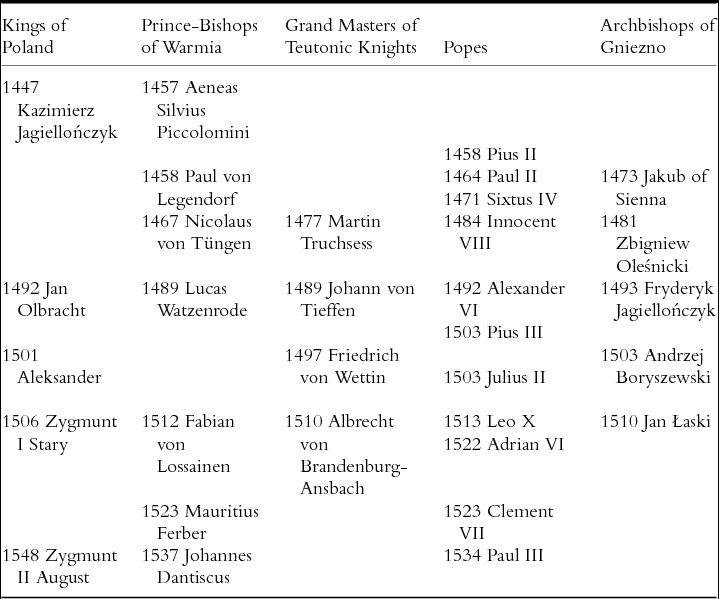
Rosen (Reference Rosen1971, 334–5) reconstructed some of the issues that Lucas might have raised during a discussion on the issue of Copernicus leaving. Lucas had provided for Copernicus's education, repaid his Italian bank-loan, obtained for him benefices at Frauenburg and Wroclaw, given him good quarters at Heilsberg, and given him vital experience in administration and foreign policy. “Was the Bishopric to be allowed to slip out of the family's grasp?” Rosen inferred that Copernicus had not realized until early 1509 that he could not become Prince-Bishop, and that Copernicus's development of his heliocentric theory occurred at that point and that this caused Copernicus to leave Heilsberg (Lidzbark Warminski)Footnote 5 “reluctantly and with a heavy heart.” This analysis has subsequently been widely accepted. Swerdlow and Neugebauer (Reference Swerdlow and Neugebauer1984, 3–7) noted the possibility of fixing the date of the Commentariolus around 1510.Footnote 6 Swerdlow rightly noted that Watzenrode “had a profound influence on his nephew's future and perhaps on his character,” and agreed that it would take something of great importance to break Copernicus's ties to his stern uncle and that it was hard to think of anything more important than the heliocentric theory. This reconstruction from contextual information suggested a sharper focus concerning the dating for the Commentariolus than had previously been achieved. The work had previously been accepted to be not later than 1 May 1514, the date such a manuscript was recorded as being in the library of Maciej of Miechów,Footnote 7 and to be not earlier than 15 July 1502, due to the reference to Hispalensis, the author of a work published then (Ludwik Birkenmajer Reference Birkenmajer1924, 353).Footnote 8 The current reconstruction proposes that Copernicus's departure from Heilsberg was linked not only with the Commentariolus but also with Lucas's political setbacks during the years 1507–10, and with the only book Copernicus personally published, i.e., his translation of the Letters of Theophylactus Simocatta. For clarity, Table 1 has been provided to show some of the major characters and the periods during which they held their offices.
Time lines of major characters (giving date of inception of reign or office). For a very brief outline of Copernicus's likely experience concerning diplomacy with the Papacy, see Blumenthal Reference Blumenthal2013.

Copernicus during 1489–91, and his study in Kraków during 1491–5
The effect on Copernicus of the loss of his father in 1483 when he was ten years old (Biskup Reference Biskup1973a, doc 19) was partly offset by the support of his family by his maternal uncle, Lucas Watzenrode (Schmauch Reference Schmauch, Papritz and Schmauch1943a, 101). Lucas was a high official in the service of Zbigniew Oleśnicki the younger (Górski Reference Górski1973b, 9), who had been raised from the Bishopric of Kujavia to the Archbishopric of Gniezno by Kazimierz Jagiellończyk, the Polish king, after having supported Kazimierz against the rebellious Prince-Bishop of Warmia in 1478–9 (Górski Reference Górski1976, 93). In this post, Lucas had accumulated five additional church benefices: to his canonry at Kulm (Chelmno) he added more canonries at Wloclawek in 1478, at Frauenburg (Frombork) in 1479, and at Gniezno in 1485; he also became archdeacon at Kalisz in 1482 and scholasticus at Leçzyce in 1485 (Schmauch Reference Schmauch, Papritz and Schmauch1943a, reg. 19, 26, 30, 47, 82 and 90; Górski Reference Górski1973b, 11). His support for the Copernicus family will therefore have seemed relatively secure.
However during July 1488 Lucas left his position and went to Rome (Schmauch Reference Schmauch1933b, 69; Górski Reference Górski1973b, 12); Copernicus and his family may have heard nothing more about him directly until around a year later. However, they had a source of indirect news in Copernicus's uncle-by-marriage, Tilman von Allen, who was a town councillor in Thorn (Toruń). Lucas was elected as Prince-Bishop of Warmia in his absence and against the wishes of Kazimierz on 19 February 1489 (Hirsch Reference Hirsch1870, 689; Caro 1888, 553). Not long afterwards, a contingent of 2600 troops arrived in Royal Prussia, sent by Kazimierz (Górski and Biskup Reference Górski and Biskup1957, 57–61), officially to protect the area against a possible incursion by troops of Matthias Corvinus, but potentially to apprehend the returning Bishop of Warmia (Schmauch Reference Schmauch1933b, 76–8). In July 1489 the Thorn town councillors received a message from Kazimierz forbidding them to receive Lucas into the town (Górski and Biskup Reference Górski and Biskup1957, 85). On 21 July 1489, envoys from Royal Prussia including Thorn who had gone to Kraków for talks with Kazimierz, requested him to remove the troops since the threat from Corvinus had receded, but he refused, citing his concerns about Warmia (ibid., 85–6 and 108–13). Lucas avoided likely attempts by Kazimierz to bar his route by travelling back from Rome disguised as a bookseller through Germany to the monastery at Oliva from where he arranged a passage by boat from Danzig (Gdansk) to Frauenburg,Footnote 9 where he arrived on 22 July 1489 (Schmauch Reference Schmauch1933b, 78). It is likely that the news of Lucas's safe journey only reached Copernicus and his family in late July or early August.
There had been two precedents for Lucas's action: the first occurred in 1460, when before the death of Bishop Strzempiński of Kraków, he had resigned his post in favor of Jakub of Sienna, a nephew of the late Cardinal Zbigniew Oleśnicki the elder, who had then rushed to Rome and returned with a Papal bull of confirmation, thus foiling Kazimierz's wishes (Nowakowska Reference Nowakowska2007, 27; Boswell Reference Boswell, Reddaway, Penson, Halecki and Dyboski1950, 246). While in that case, Kazimierz had within two years in effect forced Jakub's resignation, he had later forgiven Jakub who had received in 1464 the Bishopric of Wroclaw and in 1474 the Archbishopric of Gniezno. Lucas presumably learned about this matter from Oleśnicki's other nephew, Zbigniew the younger, who was Jakub's successor to the Archbishopric. The second was in 1466, when the previous Prince-Bishop of Warmia, Nicolaus von Tüngen, was elected despite Kazimierz's wishes (Prowe Reference Prowe1883, 1:1:164–5). In this case it had taken Kazimierz a dozen years to collect an army and invade, but following von Tüngen's submission he was left in his post (Thunert Reference Thunert1896, 537). Lucas could therefore estimate that it would be likely to take Kazimierz a long time to assemble sufficient force to bring Lucas to submission, and even if he did, the results might not be crucial. In addition to these precedents, Lucas was relying on some diplomatic support from Royal Prussia and Zbigniew Oleśnicki, and initially also on some support from Teutonic PrussiaFootnote 10 and from Matthias Corvinus,Footnote 11 none of whose interests would have been served by the election of Kazimierz's candidate for the Prince-Bishopric, his sixth son Fyderyk.
Kazimierz was and remained furious, but his actions were constrained by many factors. He was firstly busy with the Turks (Prowe Reference Prowe1883, 1:1:165) and then with the conflict between his first son Wladyslaw and his third son Jan Olbracht over the throne of Hungary, after which he went to Lithuania (Górski and Biskup Reference Górski and Biskup1957, 357). His main strategic interests were elsewhere and his ability to act diplomatically against Lucas was limited by his need to raise a tax from Royal Prussia – the estates and especially Danzig refused to pay a tax (ibid., 268) on the basis of doubt that Kazimierz might use the money against Royal Prussia including Warmia, until at the Royal Prussian estates at Christburg on 17–20 April 1491, it was reported that Kazimierz had (apparently) softened his attitude concerning Warmia (ibid., 317–8), after which collection of the tax began.
This context is likely to have affected the date on which Copernicus commenced at university, at the relatively late age of eighteen, whereas Prowe (Reference Prowe1883, 1:1:116) pointed out that Lucas had gone to university aged sixteen while Tiedemann Giese started at Leipzig university aged twelve. The scholarly argument that has become traditional concerning this period has focused on where Copernicus went to school after the age of sixteen.Footnote 12 However, it is also important why he went to university so late. Górski (Reference Górski1973b, 38) suggested that Lucas held back the Copernicus brothers from going to Kraków under the nose of the Polish King until matters were more clear. Concerning the choice of university, Prowe (Reference Prowe1883, 1:1:121) pointed out that in the fifteenth century the first university of choice for Prussian students was that of Leipzig; he suggested that there were familial reasons for the choice of Kraków for Copernicus. However, Hartmann Schedel noted in 1493 about Kraków University that “the study of astronomy stands highest there. In all Germany there is no university more renowned than this” (ibid., 1:1:137). It may be that Copernicus was already drawn to astronomy and thus to studying at Kraków.
After Copernicus had gone to the University of Kraków, and following collection of the tax, in early 1492 a delegation from Royal Prussia including Tilman von Allen (ibid., 1:1:163; Górski Reference Górski1973b, 39) went to meet Kazimierz who was in Lithuania, principally to try to confirm Lucas's status (Górski and Biskup Reference Górski and Biskup1957, 400–1). Kazimierz angrily indicated that the Royal Prussians should be supporting him against Lucas and went into a remarkable rant which included the claim that if they would not “there were the Turks and the Tatars who would certainly help him.”Footnote 13 He also repeatedly used the words “sword” and “war.” The negotiations had been a disaster (Górski Reference Górski1973b, 40). In early May Lucas was “most highly shocked” (Schmauch Reference Schmauch1933b, 94) by the news that Kazimierz planned to attend the parliament in Radom in late May and then come to Prussia with his third son Jan Olbracht and a military force (Lewicki Reference Lewicki1891 nr. 378). However, Kazimierz did not leave Grodno where on 7 June 1492 he died of dysentery. Górski (Reference Górski1973b, 42) commented that for Lucas that was in effect “a victory won when all seemed lost.” Kazimierz was brought to Kraków for burial,Footnote 14 so Copernicus will therefore at least have known about his death, and may have heard about the preceding negotiations via Royal Prussian representatives at the funeral.
In terms of Copernicus's personal development, Swerdlow's suggestion that Watzenrode and his actions may have had a profound effect on his nephew's character seems amply justified. Evidence from the next twenty years suggests that Copernicus remained deeply grateful to Lucas for supporting the whole family. However, Copernicus's main political experience at this point had been of aspects of the four-year “cold war” between Kazimierz and Lucas (Prowe Reference Prowe1883, 1:1:164). Although Lucas's political gamble had been based on sophisticated political knowledge, and the final outcome had shown that the likely “risk-analysis” involved had been reasonable, the outcome had actually been uncertain until the last weeks of Kazimierz's life. The result was probably an introduction for Copernicus to the high levels of insecurity which Carey (Reference Carey1992, 18) has suggested were usual conditions of life for those at (or dependent on) Courts during this period.Footnote 15
It was in this context that Copernicus entered another part of the “entire web of social and political arrangements” of which the science of the stars and its practitioners were parts, and “almost certainly” attended the lectures on Ptolemy's Tetrabiblos at Kraków University, given by Wojciech Krypa of Szamotuly in 1494 (A. Birkenmajer Reference Birkenmajer and Birkenmajer1953a, 565; Goddu Reference Goddu2010, 32 and 160–1). The most valuable matters that astrology could supply to a Court or to the dependent of a prince were the times and manners of rulers’ deaths (Carey Reference Carey1992, 24; Azzolini Reference Azzolini2010), although predictions concerning countries would also be interesting if reasonably specific. Copernicus would therefore have included usefulness and credibility for political purposes among the matters with regard to which he assessed astrology. However, he would then have had a particular interest in the following sections of the Tetrabiblos: section 1–1 and section 1–2 which proposes “that knowledge by astrological means is attainable and how far,” and the particular sections 3–10 on length of life, 3–12 on injuries and diseases, 4–9 on quality of death, and 2–4 to 2–8 on predictions about countries.
In section 1–1, Ptolemy distinguished what is now called astronomy, which he stated “is first both in order and effectiveness . . . which has its own science, desirable in itself” from (the rest of) astrology, which suffered from the “weaknesses and unpredictability of material qualities found in individual things.” Section 1–2 clarified that Ptolemy's methods of prediction focused on time of birth, but that those born at the same time nevertheless differed much due to differences between individual seeds and between place of birth, rearing, and customs. Ptolemy (Reference Ptolemy and Robbins1940, 17–19) claimed that the influence of the planets was the greatest, but noted that the remaining factors would cause much difficulty for those who believed that everything could be understood. Section 3–12 only considered clusters of diseases; when on a chart Saturn was in the ascendant as an evening star relative to the sun, that would predict a “proneness” to dysentery among other diseases. However, even though Kazimierz died from dysentery it could have been claimed that he had not been “prone” to dysentery. Equally, section 3–10 which gave a method for determining length of life was still subject to variation due to customs, etc. Additionally, sections 2–4 to 2–8 on predictions about countries left the detailed determination of proper outcomes to “the enterprise and ingenuity of the mathematician” (Ptolemy Reference Ptolemy and Robbins1940, 189).
Grafton (Reference Grafton1999, 10–11) has pithily characterized some of the relatively usual features and problems of astrological practice: “The astrologer insisted . . . that astrology had only a limited ability to predict the future . . . [but] proved willing in practice, when powerful clients demanded it, to predict individual outcomes anyhow. . . . [G]enerally . . . the events did not match the prediction . . . the astrologer became the butt of universal criticism – and still proved indispensable.” While Copernicus was fascinated by the models and methods of astronomy, his reaction to astrology is likely to have been tempered by a developing understanding that astrology, even as sympathetically and systematically presented by Ptolemy, could not provide the kind of predictive accuracy that would be reliably useful in practical political circumstances and would lead to continuing political credibility.
Copernicus is also likely to have been highly interested that the political credibility of astrology was currently being tested via the Court career of the most famous astronomer/astrologer of Kraków University, Albert (Wojciech) of Brudzewo (Broźek Reference Broźek and Gierowski1973, 72). Just before or at Easter 1494,Footnote 16 which is just before Copernicus may have taken the astrology course, Albert was head-hunted into the service of Aleksander Jagiellończyk,Footnote 17 being given a year's leave for the purpose, with the assurance that he would regain his University position afterwards (Pakulski Reference Pakulski1973, 677). Albert's claim in his Commentariolum of unqualified certainty that the heavens exert causal influences on earth (Barker Reference Barker2013, 136), may have been a factor in his selection, and his additional expertise in theology may have been another. Aleksander was “the least gifted of the sons of Kazimierz” (Górski Reference Górski1973b, 59). The two years since Aleksander's accession as Grand Duke of Lithuania had not been propitious: the nobles had compelled him to make his father's council permanent (Stone Reference Stone2001, 33), his ability to raise money even to defend the realm was severely limited, and Lithuania had been invaded both by Ivan III of Muscovy (Stone Reference Stone2001, 33) and by the Tatars (Jasienica Reference Jasienica1978, 251). Albert's stay in Lithuania coincided with the sending of a Lithuanian embassy to Moscow requesting the hand of Ivan's daughter Helen for Aleksander, and the marriage on 15 February 1495 (Papée Reference Papée1949, 15). Aleksander intended that the marriage should consolidate peace with Muscovy, whereas Ivan intended the entourage of his daughter to act as spies, giving him information that would help him in conquering more of Ruthenia from Lithuanian control (Jasienica Reference Jasienica1978, 252). Albert's job was nominally as secretary, and presumably involved diplomatic duties, which may have included negotiations concerning the difficulties posed by Ivan's requirement that Helen was to remain in the Orthodox faith. However, it is likely that Aleksander and his advisers hoped that Albert would provide prognostications of successful outcomes. Given that it would have been relatively clear to an astrologer exercising his “enterprise and ingenuity” that a prognostication concerning Aleksander would either make unpleasant reading or be likely to be proved wrong within a relatively short time,Footnote 18 this was a difficult position. As Grafton (Reference Grafton1999, 123) has remarked, “the astrologer faced a political dilemma that no level of technical expertise could solve” in that under some circumstances he could not tell a client the truth; additionally in critical situations an incorrect prognostication could be dangerous for the astrologer. If Albert managed to avoid prognostication in Vilnius, as he did in his ephemerides (Broźek Reference Broźek and Gierowski1973, 65), he is likely to have been considered unhelpful by the Court. It may be significant that there are no records of Albert's activity during his year in Vilnius, whereas there are considerable records concerning Aleksander's dealings with influential figures such as the Bishop of Vilnius, Wojciech Tabor (Papée Reference Papée1949). Staff and students at Kraków University are likely to have remained interested in Albert's new high-level position, but Albert died in spring 1495,Footnote 19 so it is possible that before Copernicus left the University the salutary news may have filtered back that Albert's Court career had been difficult as well as short.
By contrast, Copernicus probably agreed that astronomy was “its own science, desirable in itself” (Ptolemy Reference Ptolemy and Robbins1940, 3). Aleksander Birkenmajer (Reference Birkenmajer and Birkenmajer1953a, 568–9) suggested that it was during the period in Kraków that Copernicus accepted the axiom about the uniform circular motions of celestial bodies, and rejected Ptolemy's equant model as a violation of this axiom. Goddu (Reference Goddu2010, 161) concluded that by the end of this period, Copernicus was well aware of: differences among astronomers and philosophers on the reality of models, some of the problems with Ptolemy's lunar as well as his equant model, the problems related to the accuracy of tables, the calendar problem, and differences about the order of the spheres of Mercury and Venus. While Rosen suggested that there was “a certain dichotomy” between Copernicus's astronomical work and his experience due to Lucas's activities from 1503, it is reasonable to suggest that some divergence was already evident in the previous decade, and that a dichotomy also developed between Copernicus's reactions to astrology and astronomy.
Copernicus in Heilsberg, 1495–6, and his study in Bologna during 1496–1500
The first substantial period during which Copernicus had direct experience of politics alongside Lucas was probably during 1495–6. The known dates are that Copernicus became the successor to a canon of Warmia who died on 26 August 1495; he was late with a payment for vestments before 8 November 1495; he signed a document of 22 February 1496 authorizing Lucas's chancellor to negotiate on Lucas's behalf; and he was registered into the German College in Bologna from late 1496 (Biskup Reference Biskup1973a, docs. 23–25, 27). Most historians have concluded that Copernicus's return from Kraków to Warmia occurred in summer 1495,Footnote 20 and there has been an obvious hypothesis for the date of his departure – that he travelled to Italy with the group accompanying Lucas's chancellor (Górski Reference Górski1973a, 74) starting on 18 March 1496 (Górski Reference Górski1973b, 56). While many historians have been vague concerning the intervening period, not least because of conflicting information from Copernicus's early biographer Starowolski,Footnote 21 it is clear from the document of 22 February 1496 that he was involved at the central point in Lucas's politics during this period, and from this and later evidence of his involvement in political matters alongside Lucas it is reasonable to conclude that he was aware of most of Lucas's political activity.
To set the additional context needed for this period, it is necessary to start from the aftermath of Kazimierz's death in 1492. Just a week afterwards, a letter arrived from Jan Olbracht, Kazimierz's third son, requesting the vote and support of his “friend”Footnote 22 Bishop Watzenrode (Papée Reference Papée and Papée1907, 221) in the election for the new monarch. Lucas was delighted to comply (Górski Reference Górski1976, 94), bringing with him the votes of the Royal Prussian estates, who however in exchange wanted a charter of increased rights for themselves (given in Górski and Biskup Reference Górski and Biskup1963a, 31–3).Footnote 23 Lucas tried to obtain the insertion of a clause concerning Prussian rights in Jan Olbracht's coronation address, even during the ceremony.Footnote 24 After this Jan Olbracht indicated that Lucas was once more in disfavor (Deusterwald et al. Reference Deusterwald, Prange, Reich, Stockfisch and Woelky1889, 34; Górski and Biskup Reference Górski and Biskup1963a, 128). Given that the coronation took place in the Wawel cathedral in Kraków, Copernicus may have heard about the incident not long afterwards. Following this, Lucas made a major change in his political policy, the centerpiece of which was a strategy involving transferring the Teutonic Knights, who had been set up to fight for Christianity against the heathen but were now hemmed in by Christian Poland and Lithuania, to Podolia which bordered Turkish territory.Footnote 25 The plan was linked with a vision of an enlarged coherent block of European territory controlled by the sons of Kazimierz.Footnote 26 In late 1493, Lucas began diplomacy with the Knights leading up to the plan (Deusterwald et al. Reference Deusterwald, Prange, Reich, Stockfisch and Woelky1889, 25–99). All this was a major factor in Lucas's return back into Jan Olbracht's favor at the end of October 1494. Lucas was invited to accompany Jan Olbracht during most of the latter's tour of Royal Prussia until May 1495 (Górski and Biskup Reference Górski and Biskup1963a, 152).
As Prowe (Reference Prowe1883, 1:1:169) noted, it was only after this that Lucas's position became sufficiently certain that Copernicus's future career could be decided. It is likely that Lucas brought Copernicus back from Kraków in summer 1495,Footnote 27 not least to present him in person to the Chapter for the next vacant post of Warmian canon. Copernicus could now catch up on the most important aspects of the diplomacy with the Knights by reading the Memoriale (Deusterwald et al. Reference Deusterwald, Prange, Reich, Stockfisch and Woelky1889, 25–42) and is likely to have been told the underlying political strategy, together with associated political ideas such as Callimachus's plan for Jan Olbracht to lead a crusade. He experienced the stand-off between Lucas and the Chapter over his own appointment as canon. While there were relatively few matters in the struggle with the Knights during 1495 (ibid., 42–3), in February 1496 the Grand Master inflicted a considerable set-back on Lucas (ibid., 43–5), which resulted in the embassy to Italy starting in March 1496.
During this period, on the one hand Copernicus clearly remained grateful for Lucas's previous and ongoing financial provision, and may have found Lucas's wide overall vision inspirational. However, on the other hand, Lucas's actual political activity tended to be mostly small-scale and was not only risky but also resulted in tenacious opposition that produced set-backs for Lucas.
Copernicus's overt reactions deserve remark. Where there is evidence of his manner to influential superiors, as in his later letters to Dantiscus, he was overtly submissive and non-confrontational, while also attempting to win some compromise towards his own choices. In effect, this manner involved silence about his own opinions when that was expedient. A consequent possibility would be that Copernicus had already developed the idea that he did not wish to succeed Lucas as Bishop, but that he did not express this. It also seems possible that he became adept at identifying propitious moments to obtain Lucas's agreement: a pattern may be proposed to have started at this period, involving Lucas summoning Copernicus to Heilsberg when Lucas felt he was being successful, and Copernicus obtaining leave of absence at a point when Lucas had had a significant political setback.
When Copernicus went to Bologna, lodging with and working as an assistant to the astronomer/astrologer Domenico Maria Novara, he therefore had an unusual level of political knowledge with which to judge his new experiences. In addition, while it seems clear that he had the point of view of an assistant to a ruler, he might also have evaluated a possible life as an astrologer/astronomer as an alternative for himself. Novara's position carried the duty to prepare annual prognostications for Bologna. Part of this task had become more difficult since 1494, with the invasion of Italy by Charles VIII of France.Footnote 28 Giovanni Bentivoglio, the ruler of Bologna, was linked by marriage to the Sforza family who ruled Milan. Ludovico Sforza was originally allied with Charles VIII, but then effectively organized the League of Venice against the French in 1495, and humiliated the King's cousin Louis d’Orléans at Novara (Baumgartner Reference Baumgartner1994, 105). Bologna emerged from the campaign of 1494–5 almost unscathed (Ady Reference Ady1936, 115). Charles retreated to France where he stayed. The Holy Roman Emperor Maximilian I wished to re-assert Imperial authority, but it has been rightly said of his 1496 expedition into Italy that “high-sounding claims to authority as emperor, backed by inadequate forces and compromised by lack of funds, were what Italians had come to expect of Imperial intervention in Italy, to which Maximilian added his characteristic touch of sudden and unexplained withdrawal” (Mallett and Shaw Reference Mallett and Shaw2012, 40). Charles VIII died at Amboise in 1498 (Labande-Mailfert Reference Labande-Mailfert1986, 453; Baumgartner Reference Baumgartner1994, 51; le Fur Reference Le Fur2006, 395) and was succeeded by his cousin as Louis XII. Ludovico Sforza had little option other than to continue his alliance with Maximilian, but new principal alliances were formed by Louis with the Papacy and with Venice, and subsidiary ones with several other states, all this being essentially settled during 1498, even though these alliances were not made public until 1499 (Pélissier Reference Pélissier1896, 1:3). Giovanni Bentivoglio in 1498/9 (ibid., 1:235) did not pursue a rapprochement with Louis with tenacity, and Bologna became virtually alone in supporting Ludovico (Ady Reference Ady1936, 120; Baumgartner Reference Baumgartner1994, 108) and in a newly precarious political position. It gave some fruitless support for Ludovico in both 1499 and early 1500, and on the latter occasion had to pay 40,000 ducats, supposedly to regain Louis's goodwill (Mallett and Shaw Reference Mallett and Shaw2012, 55). Meanwhile Cesare Borgia was in the process of conquering Imola and Forli, south-east of Bologna on the Via Aemilia (Ady Reference Ady1936, 123; Mallett and Shaw Reference Mallett and Shaw2012, 57). From 1499 Bologna's continued independence was maintained only via the favor of the French King (Ady Reference Ady1936, 123), and when that was withdrawn Bologna was only saved, temporarily, in 1502 by a rebellion of Cesare Borgia's captains (ibid., 126) and in 1503 by the death of Alexander VI.
Bologna's position in early 1499 will have reminded Copernicus of Warmia, in that both were small states with one or more nearby larger states and one or more much larger though more distant nation states, and both relied primarily on diplomacy to avert threats and maintain the status quo. The accession of Louis XII was reminiscent of that of Jan Olbracht in that a more vigorous monarch posed a new threat and a new diplomatic challenge. Lucas had supported Royal Prussia against Jan Olbracht, but had seen his mistake and had made a major change to his diplomatic strategy. Giovanni Bentivoglio did not make such a change, and therefore took an obvious major risk given that it was relatively clear that Louis was preparing to invade while recent experience had shown Maximilian to be ineffective, and most of the other small Italian states were avoiding this risk by allying themselves with Louis. Domenico Maria faced largely the same generic political issue that Albert of Brudzewo had faced in Lithuania, that it could be dangerous for the astrologer either to state unpleasant truths or to make incorrect predictions.
As has been identified by Westman, Domenico Maria's prognostication for 1499 criticized those “ignorant” authors who denounced the “science of the stars” as misleading and denied its social utility. He then made the “conjectural enquiry” that “the French were naturally inclined to make war on the Italians.”
Several aspects of Domenico Maria's “conjectural enquiry” seem striking. Astrology was usually practiced by “making predictions of the future by inspecting representations of the visible heavens” (vanden Broecke Reference Vanden Broecke2013, 153), but in order to avoid blame, prognostications tended to be “filled with near-platitudes, equivocation, and the artful hedging of bets” (Barnes Reference Barnes, Guggisberg and Krodel1993, 442). Domenico Maria's “conjectural enquiry” arguably took the latter policy to an extreme, avoiding anything specific, and providing for the possibility of attack by Louis while diplomatically avoiding mention of the specific problem. In doing the latter, it did not represent Louis's actual position – Louis was targeting Ludovico Sforza together with Ludovico's allies and with Naples, not Italians in general, and Louis was allied with many Italian states. The nature of the “conjectural enquiry” was solely due to the “enterprise and ingenuity of the mathematician.” Furthermore, Domenico Maria's enterprise and ingenuity had effectively been expended on attempting to keep himself out of trouble, and because the “conjectural enquiry” was specifically misleading it would have been worse than useless to Giovanni Bentivoglio and his associates.
The much more detailed study of Domenico Maria's prognostications that will be forthcoming from Italian editors will presumably introduce more factors into the discussion of Copernicus's potential reaction to astrology and astronomy in Bologna. Additional factors may emerge from a detailed study of the whole set of Domenico Maria's prognostications in the light of the Italian political context. However, this paper is responding to Westman's existing proposals.
Westman (Reference Westman2011) has suggested that Domenico Maria wished to defend astrology against Pico's attack and that Copernicus's primary effort was to improve astrological prognostication by clarifying the planetary order of Mercury and Venus.
There seems to be no reason to question that Pico's criticisms of astronomical weaknesses were an influence on both Novara and Copernicus, and it is clear from the original introduction to book 1 of De revolutionibus that Copernicus agreed with Novara in terms of the “social utility” of the science of the stars, at least where the length of the solar year was concerned. However, it was probably now clear to Copernicus that when a prognostication would be important or crucial politically, the enterprise and ingenuity of the practitioner was likely to dominate or even to swamp any matters supposedly relating to celestial influences. Ptolemy's claim that planetary influences dominated other factors in astrology was at least over-optimistic if not wrong for current practical purposes. Whether or not it was correct that celestial occurrences influenced human destinies, astrological prognostication had no current significant likelihood of achieving and retaining continuing political credibility. Among other subordinate issues, the order of Mercury and Venus was a minor issue among the problems of astrological prognostication.
However, there were good reasons for a celestial practitioner who wished to avoid the problems of astrological prognostication to be silent both by not issuing prognostications and by not voicing criticism. The widespread interest in astrology led to some financial support for astronomy and also ensured an avid audience for new astronomical ideas and methods. Pico had already criticized astrology, and there was no need to repeat that criticism. Silence on astrology would also prevent Copernicus's study of the heavens “which contain all beautiful things,” a study which gave “unbelievable pleasure of mind,” from becoming sullied by the deserved criticism directed at the manifest defects of astrological prognostication.
By contrast, for those at universities with less political understanding than Copernicus, an obvious first strategy concerning a discipline with “the best mathematical techniques available” (Newman and Grafton Reference Newman, Grafton, Newman and Grafton2006, 13) but problems with predictive outcomes, would be to try to improve the existing discipline (cf. vanden Broecke Reference Vanden Broecke2003). Astrological practitioners would also tend to opt for advocating a program of reform. Non-astrologers who craved some form of reassurance about the future had little alternative, in the event of incorrect prognostications, other than to search for potentially more skillful astrologers.
Copernicus's post as canon of Warmia which was definitely confirmed in 1497, together with his experience both of politics and “celestial practice,” enabled him in later life to make exceptional choices. He avoided the conventional roles and places for the astronomer (Westman Reference Westman1980; Jardine Reference Jardine1998) with their prognosticatory communities and duties, and concentrated on astronomy (Lemay Reference Lemay, Hilfstein, Czartoryski and Grande1978, 354) while being silent about astrology in his extant published works.
Some authors have imagined Copernicus reluctantly bidding farewell to Italy, but it was in fact perfectly possible for a Warmian canon to remain in Italy for periods of many years, as for example Bernard Sculteti did for roughly twenty years and Andreas Copernicus did for much of a twenty-year period; also what might seem a surprising number of the sixteen Warmian canons tended to be in Rome – for example in 1512 there were five (Górski Reference Górski1973a, 131) and in 1520 there were three or four (Kolberg Reference Kolberg1903, 290). However, Copernicus's personal experience of conditions in Italy plus his experience of the life of Domenico Maria, and his probable experience in the Curia for several months from May 1500, probably convinced him that conditions of life in Italy were potentially worse for him than life in Warmia.
In terms of astronomy, through Novara he probably became quickly aware of several publications of 1494–6, including the printed issue of Albert of Brudzewo's Commentary, Simon Bevilacqua's commentary on Peurbach, and Regiomontanus's Epitome (Westman Reference Westman2011, 96; cf. Lerner Reference Lerner2012, 235). While Copernicus had probably already begun to question Ptolemy (Goddu Reference Goddu2010, 161), Novara's criticisms of aspects of Ptolemy's theory probably reinforced Copernicus's development in this respect (Rosen Reference Rosen1971, 323). Lerner (Reference Lerner2012, 236) has added that the quality of Novara's observations would explain Copernicus's later continued respect for Novara.
Copernicus in Royal Prussia during 1501, and his second Italian period
Copernicus's period in Royal Prussia during 1501, despite its likely importance, is one of the relatively blank areas in the literature on him. Only one document survives from 1501 which mentions Copernicus, the Chapter's permission dated July 28 for him and Andreas to return to Italy for more study, and this is also virtually the only matter given in the biographies concerning Copernicus's visit (Prowe Reference Prowe1883, 1:1:290–4; Górski Reference Górski1973a, 78).
However, useful additional clues can be obtained from the movements of the Warmian Dean Bernard Sculteti. He was in contact with the Copernicus brothers in Rome in 1499 where he undertook Lucas's business with the Curia,Footnote 29 was not in Warmia in October 1500 (Eichhorn Reference Eichhorn1866, 357; Prowe Reference Prowe1883, 1:1:287), was in Prussia for a meeting on Lucas's behalf with the Grand Master in January 1501 and for more meetings in March and on 23 July 1501 (Thiel Reference Thiel1859, 420), and was given permission to return to Italy on 3 August 1501 (Biskup Reference Biskup1973a, doc. 39) probably accompanying the Copernicus brothers, and thereafter stayed in Italy (Eichhorn Reference Eichhorn1866, 357). From this and from additional background material given below, it seems clear that during this period, the center of Lucas's diplomatic activity was in Prussia, to such an extent as to eclipse the importance of his diplomacy in Rome. Ludwik Birkenmajer (Reference Birkenmajer, Dobrzycki and Gingerich1900, 213) proposed that in winter “only those who were in some way forced to leave Italy for the North did this,” and there was no such emergency for the Copernicus brothers; but in fact there was a compelling reason for Bernard Sculteti to travel north, so one possibility is that the Copernicus brothers might have gone with him.Footnote 30
To clarify the significance of this period for Copernicus, it is necessary to start some years earlier. Jan Olbracht's crusade had ended in failure (Nowakowska Reference Nowakowska and Housley2004, 141–2; Górski Reference Górski1973b, 58), following which Jan Olbracht had fallen “into alternate states of debauchery and prostration” (Górski Reference Górski1976, 69). During the war, the Grand Master and most of the Knights who took part in the expedition obeying their duty as vassals to the Polish King, had died (Deusterwald et al. Reference Deusterwald, Prange, Reich, Stockfisch and Woelky1889, 53–4). Johann von Tieffen had seen that it was essential that future Grand Masters did not swear fealty to the Polish King (Boockmann Reference Boockmann1981, 215), in which case it was necessary to strengthen the Knights’ ties with the Emperor. Accordingly, in 1498 the Knights elected as their thirty-sixth Grand Master, Friedrich von Wettin, of the ruling house of Saxony (Forstreuter Reference Forstreuter1951), who was thus an Imperial prince (Biskup Reference Biskup1983, 89), but was also connected to the Polish royal family – his elder brother Georg had married a sister of Jan Olbracht (Górski and Biskup Reference Górski and Biskup1963b, 20). Given that Jan Olbracht's current inactivity had left Warmia somewhat exposed, and given the Knights’ overwhelming need to avoid swearing fealty, there was potential mutual advantage in some co-operation between them. On 27 November 1500 there was a meeting between Friedrich's chancellor, Paul Watt, and Lucas at Heilsberg which apparently resulted in an unwritten and secret agreement (Deusterwald Reference Deusterwald, Prange, Reich, Stockfisch and Woelky1889, 126; Thiel Reference Thiel1859, 418; Górski Reference Górski1973b, 59; Biskup Reference Biskup1983, 90). This process probably led to Lucas urgently requesting Bernard Sculteti's presence in Prussia. It no doubt seemed clear to Lucas that major diplomatic events that would apparently be favorable to himself would commence in the spring of 1501, so if the Copernicus brothers did not travel with Bernard Sculteti, they may now have been summoned by Lucas to arrive by May.
Friedrich refused to give homage to his sister-in-law's brother, in response to which on 7 May 1501 Jan Olbracht arrived in Thorn for negotiations, accompanied by an army of mercenaries with cannon (Biskup Reference Biskup1983, 121). It has been proposed that Copernicus would have met Jan Olbracht (Adamczewski Reference Adamczewski1972, 90). Negotiations started, but Jan Olbracht fell ill during the first days of June, suddenly became paralyzed and lost his speech on 14 June 1501, and died three days later (Górski Reference Górski1973b, 59). This was overwhelmingly to the advantage of the Grand Master and his Saxon allies (Biskup Reference Biskup1983, 125) and to the disadvantage of Lucas. Nevertheless Lucas on 23 July sent Bernard Sculteti on a further mission with demands to the Grand Master, who understandably did not answer favorably.
The King's death in this unexpected fashion and at this unexpected time, with its major impact on a complex diplomatic situation, coupled with what Copernicus now knew about astrological practice, may have provided further confirmation to Copernicus that astrological prognostication was unlikely to ever attain considerable reliability for matters with so many contributory factors.
Early in his visit Copernicus is likely to have heard that Lucas had negotiated with Sweden about the possibility of Zygmunt becoming King there (Górski and Biskup Reference Górski and Biskup1963a, 301–3), and had proposed to undertake an embassy from Poland to France concerning an alliance against the Empire (Górski and Biskup Reference Górski and Biskup1963b, 147–8); he will thus have had more experience of Lucas's breadth of vision. However, in practical terms the diplomatic set-back that Lucas experienced this time was worse than that in 1496. Again it seems that Copernicus had travelled to be alongside Lucas at a politically important time, and after Lucas's political setback Copernicus was allowed to take further study leave.
Copernicus received permission from the Frauenburg Chapter to study medicine in Italy, explicitly in order that he should become medical adviser to Lucas and the Chapter. It seems clear that it had been the intention that Copernicus should return to Italy anyway – the evidence being that he had not taken a degree – but the original intention might have been for him to concentrate on legal studies together with practical experience in the Curia. However, while the Memoriale recorded that the rumors that Jan Olbracht had been poisoned were incorrect, it also noted that no medical help was available in Thorn and Jan Olbracht had died miserably (Deusterwald et al. Reference Deusterwald, Prange, Reich, Stockfisch and Woelky1889, 135) – and Copernicus might have suggested medical studies as a result. This would supply an explanation for the overwhelmingly practical nature of Copernicus's medical concerns (Berg Reference Berg, Papritz and Schmauch1943; Rosenberg Reference Rosenberg, Kaulbach, Bargenda and Blühdorn1973; Goddu Reference Goddu2010, 198–203). All of Copernicus's medical annotations of any length in books he owned were (potential) prescriptionsFootnote 31 (Czartoryski Reference Czartoryski, Hilfstein, Czartoryski and Grande1978, 368–371; Goddu Reference Goddu2010, 202). It is interesting that the only one of these that almost certainly dates from his time in Padua was for treating dysentery. The evidence from Copernicus's later years includes several letters from Bishops Ferber and Dantiscus,Footnote 32 who Copernicus treated, often in joint consultation with other medical practitioners including the Duke of Prussia's medical adviser. These letters are unanimously thankful for Copernicus's medical talents, and note his prescriptions and his caring and calm bedside manner. In no case in these letters is Copernicus's advice reported as significantly different from that of his fellow medical consultees,Footnote 33 and in no case is astrology mentioned.Footnote 34
As with the period of study in Bologna, it seems that in Padua, Copernicus studied both the official subject of study and astronomy. Swerdlow (Reference Swerdlow1973, 469) noted the similarity between Tūsī's couple and other devices developed by astronomers of the Marāgha school and equivalents used by Copernicus, and proposed that he heard of these during this period in Padua. Objections to this by Di Bono (Reference Di Bono1995) and Goddu (Reference Goddu2010, 476–86) have been criticized by Barker (Reference Barker2013), but in any case Padua seems the likely location at which Copernicus became aware of these devices.
Copernicus in Warmia, 1503–10, and the composition of the Commentariolus
When Copernicus returned from Italy in 1503,Footnote 35 he now potentially had the means to determine his future since in addition to his post as Warmian canon, in January 1503 Lucas had procured for him another benefice as scholasticus at the Holy Cross church in Wrocław. However, he probably did not have the ingratitude nor the disloyalty that would have been necessary for him to have unilaterally decided on a move away from Lucas. He would maintain astronomical observation, especially of the “particularly spectacular celestial show” (Gingerich Reference Gingerich1993, 168–71) put on by the planets between October 1503 and the end of May 1504, and he would advance his astronomical thinking in whatever spare time he had available. The political activity between which such activities needed to be fitted is sparsely covered in the Copernicus literature.Footnote 36
The new King, Aleksander, toured Royal Prussia obtaining homage from early April 1504 to the end of June, and it is documented that Copernicus was present alongside Watzenrode at previous meetings of the Royal Prussian estates and during part of this time (Biskup Reference Biskup1973a, docs. 45–7). In the two years since Jan Olbracht's death, Lucas and the Knights had resumed their supposedly secret negotiations, which continued at relatively high frequency until 1506 (Deusterwald et al. Reference Deusterwald, Prange, Reich, Stockfisch and Woelky1889, 74–98; Thiel Reference Thiel1859). It appears that the Court was not warned (Papée Reference Papée1927, 464; Biskup and Górski Reference Biskup and Górski1967, 201); Aleksander held Lucas in favor, and in early 1506 supported the plan for Lucas to be raised to the status of Archbishop (Papée Reference Papée1927, 520–1). At this point, Lucas was still clearly very busy and apparently reasonably successful, although the scope of his political vision had now contracted. However Aleksander died in 1506, during a conference which was intended to sort out the relations between the Prussias and Poland. The death of a Polish monarch at a crucial moment for Lucas's politics was now routine news for Copernicus, this being the third time that it had happened.
Aleksander's successor was Kazimierz's fifth son, Zygmunt I Stary. On the advice of Jan Łaski the chancellor (Górski Reference Górski1976, 95), one of Zygmunt's first actions was to order Lucas to impel the Grand Master to take the oath of allegiance (Górski Reference Górski1973b, 64). This effectively broke up the fragile form of partial cooperation between Lucas and the Grand Master: deprived of the diplomatic shield that Lucas had previously potentially afforded, in 1507 Friedrich went back to the safety of the Empire.Footnote 37 The general opposition to Lucas of the majority of the Knights was now unchecked, and the Knights began once again to tacitly support robber incursions into Warmia (Voigt Reference Voigt1839, 354; Biskup Reference Biskup1973c, 104). The Knights now argued vigorously against the idea of Lucas becoming an Archbishop, and the Pope quashed the idea.Footnote 38 After Friedrich's departure, Lucas's diplomatic activity underwent a major reduction.
It was in the aftermath of this setback that the question “was the Bishopric to be allowed to slip out of the family's grasp?” arose, rather than two years later as Rosen proposed (1971, 334–5). Whereas since at least 1495 Lucas had favored Copernicus over his older brother Andreas, it was now that the possibility of Andreas becoming Bishop was considered (Górski Reference Górski1973a, 106–7) – he arrived back from Rome on 18 April 1507. However, on the grounds that Andreas had contracted a long-term progressive disease, this possibility was discarded, and Andreas left again for Rome following permission from the Chapter on 8 January 1508. If this was a venereal disease, other considerations must have been in play, since the current Pope, Julius II, and next bishop of Warmia, Fabian von Lossainen, each had a venereal disease. Following Andreas's departure, Copernicus's lack of money to make a bid for the Bishopric must have been considered, leading to diplomacy which resulted in permission from Julius II for Copernicus to be given more benefices.
The need to rebut the overall charge of Lucas's argument with Copernicus (as reconstructed by Rosen) – that of ingratitude, may explain the only work published by Copernicus himself during his lifetime – his translation of the Letters of Theophylactus Simocatta, with a fulsome dedicatory poem by Laurentius Corvinus describing Copernicus as being like an Achates to the Aeneas represented by Lucas, and a second fulsome dedication by Copernicus to Lucas. Rosen proposed that Copernicus had copied the Letters in around 1499 for use as a translation exercise to improve his Greek, but without a new need for a work to which to attach a published dedication it is not particularly easy to understand why Copernicus would single out this work as his only personally-undertaken publication. The timing of the publication process is interesting not only concerning the impetus to publish the Letters themselves, but also because there are possible implications for the date of the Commentariolus.
Corvinus wrote his poem while travelling from Thorn to Wrocław in the late spring of 1508, and the bulk of the poem reports that journey. Rosen (Reference Rosen1971, 337) inferred that Corvinus took the manuscript with him, and that he arranged for printing; however, Corvinus's poem shows no signs of close acquaintance with the Letters. Other authors have followed Deusterwald (Reference Deusterwald, Prange, Reich, Stockfisch and Woelky1889) in indicating that Copernicus went on from the Piotrków parliament in March-April 1509 to Kraków, personally taking the manuscript to the printer Haller (Biskup Reference Biskup1973a, doc. 58). Concerning Copernicus's observation of the eclipse of the moon on the Kraków meridian on 2 June 1509, Rosen (Reference Rosen1971, 334) thought he was “probably” in Frombork and Biskup (Reference Biskup1973a, doc 59) that he was “certainly” in Kraków. Rosen considered that the presence of many errors in the printing proved that Copernicus was not present, but if the main function of the Letters was as the vehicle for complimentary dedications, Copernicus might have been in Kraków but relatively inattentive to the main text being printed.
Long-running differences of opinion have taken place concerning the implications of the dates of the Letters for those of the Commentariolus. One such difference has concerned references by Corvinus, firstly to Copernicus's view on the “brother” of the moon, which was assumed by Rosen to be the sun and translated as having “alternating movements,”Footnote 39 and secondly to Copernicus having “based his work on remarkable principles” and having known “how to find the secret causes of events.” For Ludwik Birkenmajer and for Dobrzycki, the latter quotations implied that Corvinus was aware of Copernicus's heliocentric theory which would imply that at any rate the principles of the theory pre-dated summer 1508. However for Rosen (Reference Rosen1971, 339), the former quote implied that Corvinus was not aware of the heliocentric theory which would imply that the theory post-dated summer 1508. However, it is reasonable to suggest that all this may well be putting too much trust in a poetic phrase by an author whose knowledge of Copernicus's work seems to have been imprecise. Ludwik Birkenmajer's view was supplemented by the hypothesis of Aleksander Birkenmajer (Reference Birkenmajer and Birkenmajer1953b, 587) that the manuscript of the Commentariolus might have arrived with Maciej of Miechów during Copernicus's 1509 visit to Kraków, during which time he also visited his university friend Bernard Wapowski, who lived in the same building as Maciej.
Copernicus would have had additional time to work on both the Letters and the Commentariolus after the fall-off in diplomatic workload following the set-back to Lucas in 1506–7, and more impetus to do such work as a relief from stress. The final stages in Copernicus putting together his heliocentric theory probably took place now (Goddu Reference Goddu2006, 46), possibly including the conclusion that the variation in distances between the planets and the Earth could hardly be due to the motions of the planets alone but must in part be due to the earth's orbital motion about the sun, the conclusion that the larger variations in the distance of Mars must indicate that the earth's orbit must be closer to Mars than to the other superior planets, and the conclusion that since Venus's retrograde arc is larger than Mercury's, the Earth's must be between the orbits of Mars and Venus. The remaining stages, including the calculation of the sidereal periods of Venus and Mercury, the realization that Earth's orbit could compensate for the large epicycles in Ptolemy's models, and the much-discussed calculations in the Uppsala notebook, would then probably have happened during this period. The uncertain timing and political pressures could provide an explanation for any “hasty” aspects of the Commentariolus, which were proposed by Swerdlow (Reference Swerdlow1973, 429).
It is noteworthy that the Commentariolus does not contain any reference to astrology. Westman's proposed explanations for the absence of such reference in De revolutionibus, which have to do with disciplinary identity and an ambivalent attitude to astrology in the Curia, would not apply in this case. Additionally as has already been quoted, Lerner (Reference Lerner2012, 236–7) pointed out that nothing in the Commentariolus “offers anything useful for improving tables for the prognosticators.” The initial interest that Copernicus is likely to have had in astrological prognostication had disappeared well before this stage.
In view of the indications given previously of a date in 1507 for the first occurrence of at least one of Rosen's “turning-point” questions, it may be reasonable to re-interpret a matter at the beginning of 1507 – the curious episode of the voting of additional payment by the Chapter to Copernicus on the condition that he would stay by Lucas as his medical attendant. Rosen (Reference Rosen1971, 331) ascribed this simply to Lucas having been ill. However, other scholars have recognized this as an anomalous occurrence at this date, and this led to Prowe inventing an additional stay by Copernicus in Padua until 1506. It may be reasonable to stress in this, not the ostensible medical reason, but the condition that Copernicus had to stay with Lucas. It seems possible that in the light of the ongoing political setback, Copernicus had broached the subject of himself possibly moving to Frauenburg, which Lucas countered by enlisting the support of the Chapter for Copernicus staying alongside Lucas.
A further set-back to Lucas that led to a further fall-off in diplomatic workload occurred at the end of 1508. Despite the newly adverse political situation concerning Poland and Teutonic Prussia, Lucas continued to press for more authority in Royal Prussia, and naturally encountered resistance from the highly competent governor, Ambrozy Pampowski. In 1508, Zygmunt promoted both men, Pampowski to Capitaneus Generalis Prussiae,Footnote 40 and Lucas to supreme judge in Prussia (Górski Reference Górski1976, 103). Late in 1508, Lucas transgressed his official duty to keep an impartial attitude as guardian of justice and not to initiate disputes with other members of the council, by initiating proceedings against Danzig for taking part of the Vistula Spit and excommunicating Elbing (Elbląg) for seizure of church property; the result was a “sharp explosion” of opposition to him and a series of diplomatic defeats and humiliations for Lucas from Royal Prussia (ibid., 104), including at the Piotrków parliament in 1509, at which he was probably attended by Copernicus. The administrator of Pomerania, Niclas Wolkow, stated that Lucas had made the estates run after him like hens (Biskup Reference Biskup1974, 40–50). In 1509 Lucas requested that he no longer be obliged to attend the meetings of the Royal Prussian estates, and the office of supreme judge in Prussia was added to the functions of Pampowski, the news being brought by Johannes Dantiscus (Biskup Reference Biskup1974, 189–200). In 1510, Copernicus accompanied Lucas to the Poznań conference on the relations between the Knights and Poland, during which occurred further indications of Lucas's fall from influence. During the conference Fabian von Lossainen, a canon of Warmia, spied on Lucas and Copernicus on behalf of the Knights (Forstreuter Reference Forstreuter, Papritz and Schmauch1943, 223). For the first time in Lucas's career, he now had terrible diplomatic relations with both Prussias as well as lukewarm relations with Poland, and an increasing number of specific opponents. It was clear that when Lucas eventually were to die, his successor as Prince-Bishop would have a major task to repair relations with Warmia's stronger neighbors.
Conditions were now favorable for Copernicus to leave. The Bishopric was now considerably likely to pass out of the family irrespective of the family's wishes. It seems likely that Lucas would not have enjoyed his nephew seeing Lucas take so long and continuing a series of defeats. The translation of the Simocatta Letters had been printed and provided an obvious demonstration of loyalty and gratitude by Copernicus to Lucas. The Commentariolus is likely to have now been in existence, providing a demonstration of Copernicus's fruitful alternative course of action that was potentially more important than looking after Lucas's health. In addition, it seems clear that Copernicus's reference to “the mathematical demonstrations intended for my larger work” could also have served the purpose of showing that the Commentariolus was not a one-off but the germ of something much more substantial. Whether or not there was any explicit linkage between such matters and Lucas permitting Copernicus to depart, such matters might well have been implicit elements contributing to such a permission.
Swerdlow's note that “something of great importance” was necessary to break Copernicus's ties with his uncle (Swerdlow and Neugebauer Reference Swerdlow and Neugebauer1984, 7) could be seen as amply supported by these considerations, although it may be that while the heliocentric theory was an important factor for Copernicus, a factor that was at least equally important was the unprecedented series of political defeats for Lucas. With all these matters in place, contrary to Górski's indication, there was no need for a quarrel between Copernicus and Lucas. That the departure of the former was reasonably amicable appears to be confirmed by the well-known fact that Copernicus was with Lucas at a meeting with representatives from Danzig on 19 January 1512 (Biskup Reference Biskup1973a, doc. 70).
On Copernicus's exceptionality
The tendency in relatively recent history and philosophy of science “to move beyond ‘great man’ history, to consider the work of lesser figures, to consider genres that found no place in the older grand narrative of the scientific revolution and in general to place the history of astronomy and cosmology in its cultural context” (Barker Reference Barker and J. Boner2011, 8) has produced some exemplary work (cf. Granada and Tessicini Reference Granada and Tessicini2005; Shank Reference Shank2009).
This kind of work can be a useful antidote to overly presentist accounts which lose sight of contemporary context and which can overstress exceptional achievements, among which it now seems reasonable to count Kuhn's view that it was with Copernicus that the stranglehold of astrology on the human imagination began to relax its grip. However, the more recent approach has the potential to lose sight of exceptional achievements, potentially resulting in “throwing out the baby with the bath water” (Gingerich Reference Gingerich1996). Arguably one example of the loss of view of an exceptional achievement is Westman's claim that Copernicus's proposal to reform theoretical astronomy was but one of several different kinds of effort to improve astrological prognostication during the sixteenth century. One of Westman's central examples is Domenico Maria's prognostication involving his “conjectural enquiry” that “the French were naturally inclined to make war on the Italians.” However, in the context of a political controversy concerning the credibility of astrology, this conjectural enquiry which had little or nothing to do with the supposed basis of astrology in inspecting representations of the visible heavens but was due to the “enterprise and ingenuity of the mathematician” and which was specifically misleading concerning the difficult political situation, would have provided evidence against the political credibility of astrology.
It is clear that Copernicus had an early interest in astrology and significant experience of how others practiced it, and that he avoided criticizing astrology. However, among the benefits of understanding a lot more about Copernicus's political context and experience is the consequent understanding that he had an unusual advantage in terms of understanding the defects of astrological prognostication. While research is continuing in several parts of the field, and conclusions should therefore be seen as interim, the existing evidence supports the view that Copernicus was exceptional for his time in managing to almost completely disentangle his thinking and his astronomical efforts from the widespread astrological context.
Acknowledgments
The author is grateful to James Ladyman, Andrew Pyle, and the reviewers for this journal for helpful comments.