I. INTRODUCTION
The world is facing a very serious problem of water shortages. Reference Mekonnen and Hoekstra1 With the growth of population and the expansion of industrialization, more frequently, agricultural activities and environmental pollution result in more urgent problem of water purification. Reference Shannon, Bohn, Elimelech, Georgiadis, Mariñas and Mayes2 Various technological solutions have been developed to meet the increasing demand for fresh water, Reference La Riviere3 among which desalination and water reuse are developed to obtain freshwater. Reference Elimelech and Phillip4–Reference Gude, Nirmalakhandan and Deng6 However, these methods result from high cost, low efficiency, and complicated process.
Solar steam generation is an efficient and green technology for desalination systems and drinking water purification. Earlier solar thermal conversion techniques basically depend on highly absorbing materials and optical concentration to heat bulk liquid, Reference Lenert and Wang7 such as charcoal, Reference Naim and El Kawi8 black cloth, Reference Murugavel and Srithar9 and solar still. Reference Al-Hayeka and Badran10,Reference Ansari, Asbik, Bah, Arbaoui and Khmou11 Even if these materials have excellent absorption properties, their photothermal conversion efficiency is still at a very low level, Reference Lewis12 and it unavoidably results in unnecessary heat loss due to the energy transfer to the nonevaporative portion of bulk water. The conventional bulk heating of water is not a rational choice for water evaporation, and thus there is a need for a solar energy acquisition system with low optical concentration and high conversion efficiency.
However, solar steam technology can directly convert liquid water into vapor through surface plasmon resonance effects without heating bulk water. Reference Baffou and Quidant13–Reference Neumann, Urban, Day, Lal, Nordlander and Halas16 Many plasmonic nanoparticles have been studied to generate solar steam, such as Au nanoparticles, Reference Zhang, Chen, Du and Wen17,Reference Zhou, Tan, Ji, Zhu, Zhang, Xu, Gan, Yu and Zhu18 3D self-assembly of Al nanoparticles, Reference Zhou, Tan, Wang, Xu, Yuan, Cai, Zhu and Zhu19 Ag polyhedron nanoparticles, Reference Wang, Miao and Tanemura20 graphene, Reference Ni, Miljkovic, Ghasemi, Huang, Boriskina, Lin, Wang, Xu, Rahman and Zhang21 and black gold membranes with ultrabroadband plasmonic. Reference Bae, Kang, Cho, Park, Kim and Padilla22 Although the photothermal conversion efficiency is improved to a great extent, the dispersed particles are easily aggregated and deposited at high temperature, and the price of Au is high, so that it is not practical for large-scale production.
To solve the problems of earlier solar thermal conversion systems and plasmonic systems, a new concept of air–water interface solar heating has been used for absorbing the solar irradiance and converting it to solar steam at the water–air interface. Reference Zhang, Tang, Wu, Li and Wang23,Reference Hu, Xu, Zhou, Tan, Wang, Zhu and Zhu24 In these platforms, the floating substrate not only served as a support but also effectively reduced the heat transfer between the water surface and the bulk liquid. The use of porous matrix material could obtain a steady source of water by a capillary force on the interface. It was reported that the double-layer structure, consisting of a carbon foam layer supporting an exfoliated graphite layer, yielded a solar thermal conversion efficiency of 85% at 10 kW/m2. Reference Ghasemi, Ni, Marconnet, Loomis, Yerci, Miljkovic and Chen25 The foldable GO film with a confined 2D water path obtained solar thermal conversion efficiency of 80% under one sun illumination. Reference Li, Xu, Tang, Zhou, Zhu, Zhu and Zhu26 Carbonized mushrooms could achieve about 78% efficiency under one sun illumination. Reference Xu, Hu, Xu, Li, Zhou, Zhu and Zhu27 To enable efficient solar steam generation, it is necessary to explore new material system and excellent structural design.
Titania nanomaterials have been extensively studied as environmental pollution treatment and photocatalytic hydrogen generation. Reference Li, Lu, Zhou, Ye, Xiong, Yang, Pan, Chen, Wu, Li, Chen, Wang and Xia28–Reference Xia, Zhang, Oyler and Chen32 However, its optical absorption is limited due to the wide band gap. Reference Xia, Zhang, Oyler and Chen33–Reference Xu, Mo, Tian, Wang, Yu and Yu35 Black titania was discovered to show high solar absorption, Reference Chen, Liu and Huang36–Reference Liu and Chen41 and it is expected to exhibit excellent solar steam performance. Reference Zhu, Xu, Zhao and Huang42,Reference Ye, Jia, Wu, Qian, Chen, O’Brien, Sun, Dong and Ozin43 In addition, the photothermal conversion properties of carbon-based nanomaterials and floating structure materials not only improved the efficiency of solar steam generation but also effectively reduced heat loss. However, it is still unclear whether the composites of black titania and carbon materials have a synergistic effect for solar steam generation. It is necessary to study the photothermal conversion performance of the nanocomposite. Here, we report a high light absorbing and efficient solar steam generation system based on a black titania (500 °C)/GO nanocomposite membrane affixed to airlaid paper wrapped over the surface of expandable polyethylene (EPE) foam. The nanocomposite membrane possesses hydrophilic surface and porous structure, which not only drives water to the hot spot by capillary forces but also contributes to vapor flowing. The airlaid paper, as a two-dimensional water path, provides efficient water supply and reduces heat loss. The EPE foam, as a thermal insulator (thermal conductivity of ∼0.04 W/mK), physically separates the nanocomposite membrane from bulk water to ensure suppressed heat loss. Remarkably, we realized a solar thermal conversion efficiency of 69.1% under illumination of 1 kW/m2 with no solar concentration. Furthermore, the nanocomposite film delivered remarkable cycle stability.
II. EXPERIMENTAL SECTION
A. Materials
Titania nanoparticles with a primary size of 60 nm (Anatase, 99.8%) and Polyethyleneimine (PEI) (Mw 70,000, 50% aqueous solution) were obtained from Shanghai McLean Biochemical Technology Co., Ltd. (Shanghai, China). GO was purchased from Suzhou carbon fried graphene Technology Co., Ltd. (Suzhou, China). Ethanol (99.7%) was purchased from Tianjin Fuyu Fine Chemical Co., Ltd. (Tianjin, China). Sodium borohydride (NaBH4, 96%) was supplied from Sinopharm Chemical Reagent Co., Ltd. (Beijing, China). The MCE membrane was provided from Shanghai Xingya purification materials plant (Shanghai, China). Airlaid paper was purchased from Dongguan Filexair Cleanroom Products Co., Ltd. (Guangdong, China). EPE foam (1.4-cm-thick) was obtained from Langfang City Rui Rui Packing Products Co., Ltd. (Langfang, China). All Chemicals were used as received without any further purification. Deionized water was used for all experiments.
B. Preparation of black titania with different colors
The black titania nanoparticles were prepared by a facile NaBH4-assisted method, and 0.7987 g of anatase TiO2 nanoparticles were mixed with 0.3783 g of NaBH4 powder (the molar ratio between TiO2 and NaBH4 is 1:1), then the mixed powder was homogenized by grinding. Afterward, the powder mixture was transferred into tube furnace and purged with argon for 20 min. After that, the mixtures were calcined at 400, 450, 500, 550, and 600 °C under an Ar atmosphere for 4 h. Finally, the black titania was washed with ethanol and distilled water three times, respectively.
C. Preparation of the black titania/GO nanocomposite membrane
First, 10 mg of GO was dissolved in 10 mL deionized water with ultrasound dispersion for 2 h at room temperature. Second, 1, 5, 7, 10, 12, and 15 mg of the black titania (500 °C) were added into the ultrasound solution, then sonicated for 1 h and stirred for 1 h to make sure that the black titania was fully doped into GO. Third, 250 mg of PEI was added into the above mixed solution and stirred for 2 h. Finally, the hybrids were filtered under vacuum on the MCE membrane with a pore size of around 0.22 μm, and the product was dried at room temperature.
D. Materials characterization
The crystalline structure of the black titania nanoparticles with different colors was evaluated by X-ray diffraction (XRD) analyses on a Bruker D8 Phaser X-ray diffractometer (Bruker Corp., Kalsruhe, Germany) operating with Cu Kα radiation. UV-visible absorption spectra were measured from 200 to 2500 nm using a Shimadzu UV-3600 spectrometer (Shimadzu Corp., Tokyo, Japan, measured using an integrating sphere). X-ray photoelectron spectroscopy (XPS) was carried out on a Thermo Fisher Scientific Escalab 250Xi (Thermo Fisher Scientific Inc., Waltham, Massachusetts). Raman spectra were performed on a thermal dispersive spectrometer using a laser with an excitation wave length of 532 nm at a laser power of 120 mW. The transmission electron microscopy (TEM) images were obtained on JEOL JEM 2100F (JEOL Ltd., Tokyo, Japan) operated at 200 kV. For TEM measurements, the black titania was suspended in ethanol. After ultrasonic treatment, a drop of the suspension was then dripped onto a microgrid with a carbon thin film. Scanning electron microscopy (SEM) was conducted on a JEOL JSM 7100F (JEOL Ltd., Tokyo, Japan) worked at 15 kV. The nitrogen gas adsorption–desorption experiments were conducted at 77 K (Micromeritics ASAP 2020 HD88, Autosorb-iQ, Norcross, Georgia). Fourier transform infrared (FT-IR) spectroscopy was carried out on a Thermo Scientific Nicolet iS50 (Thermo Fischer Scientific Inc., Waltham, Massachusetts). Electron paramagnetic resonance (EPR) was conducted at room temperature (Bruker A200, 9.8 GHz, 17 mW, Bruker Corp., Karlsruhe, Germany). The real-time temperatures of samples were measured by using an IR thermograph. The simulated natural sun light was generated by a xenon lamp of 300 W.
E. Solar steam generation
To systematically investigate the photothermal conversion properties of black titania/GO nanocomposite films, we utilized a solar simulator xenon lamp with a light intensity of 1 kW/m2 (one sun) to simulate solar illumination, and the samples were irradiated for 30 min. We used EPE foam to wrap the beaker to reduce heat loss during solar irradiation, and the mass change of water in a beaker was recorded by using an electronic balance. Various contrast tests were conducted, including pure water, GO film, anatase/GO nanocomposite film, and black titania/GO nanocomposite film, and to explore the optimum doping amount of black titania, different content tests were performed. To determine the performance stability of the system, cycle tests on the nanocomposite film were carried out under the same conditions 14 times. After each cycle test, the composite film was completely dried before it could be tested again.
III. RESULTS AND DISCUSSION
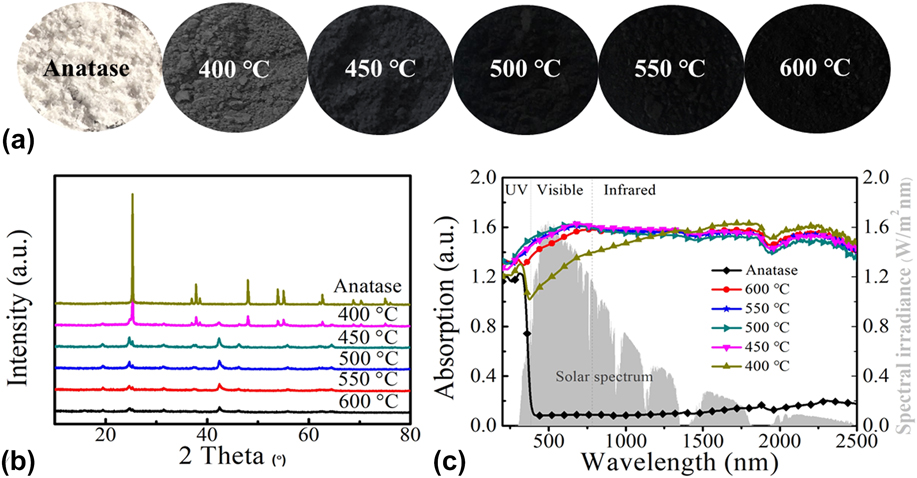
Black titania nanoparticles with different colors were successfully synthesized using sodium borohydride (NaBH4) reduction reaction. As shown in Fig. 1(a), the anatase powder were converted into the gray, blue-gray, black, light black, and dark black TiO2 after being reacted at 400, 450, 500, 550, and 600 °C, respectively. XRD was used to investigate the crystal structure and possible phase changes of the prepared samples. The diffraction peaks of the colored titania synthesized at 400 °C are well matched with the anatase phase TiO2 (21-1272, JCPDS). Compared with the diffraction patterns of anatase, a series of new diffraction peaks appear at 19.3°, 24.7°, 31.4°, 42.2°, 46.2°, 55.7°, and 64.6° for colored titania synthesized at 400 °C are observed, and these characteristic peaks belong to the brookite phase TiO2 (75-1582, JCPDS). It can be seen from Fig. 1(b) that colored titania synthesized at different temperatures is both anatase phase and brookite phase TiO2. As the temperature increases, the intensity of the diffraction peak decreases gradually, indicating that the effective reduction of the colored titania and the gradually weaken and widened peaks of colored titania are related to the amorphous phase after reduction process.
(a) Digital photographs of initial anatase nanoparticles, colored titania synthesized at 400, 450, 500, 550, and 600 °C; (b) X-ray diffraction patterns of anatase and colored titania; (c) solar spectrum and UV-Vis-NIR absorption spectra of initial anatase and colored titania synthesized at different temperatures.

From the Ultraviolet-visible-near infrared (UV-Vis-NIR) absorption spectra [Fig. 1(c)], it can be seen that the all the colored titania from gray to dark black exhibit excellent light absorption ability. For all samples, the initial anatase or colored titania, there is high light absorption in the wavelength of less than 400 nm, and it is due to the inherent bandgap absorption. Moreover, compared with initial anatase, the optical response range of the colored titania synthesized by the NaBH4 reduction process is expanded from the ultraviolet region to the visible and near infrared regions. In particularly, black titania, which was reduced at 500 °C, has an optimum light absorption in the visible region, and it is expected to exhibit excellent solar steam performance. The high visible light absorption capability of black titania is mainly due to the effective reduction process reducing Ti4+ to Ti3+ by introducing oxygen vacancies. Reference Ren, Wen, Cui, Hou, Guo and Chen44
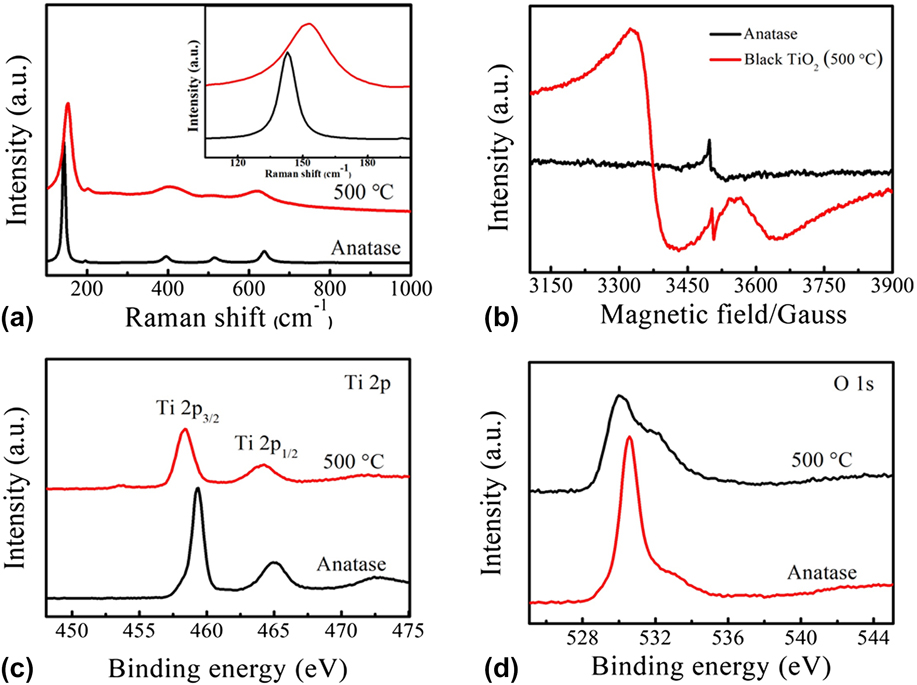
The structural changes of black titania (500 °C) were analyzed by Raman spectra techniques. As shown in Fig. 2(a), there are five Raman vibration peaks, locating at 144, 196, 397, 515, and 637 cm−1, assigned as E g, E g, B 1g, A 1g (B 1g), and E g characteristic Raman active modes of anatase, respectively. Compared with initial anatase nanoparticles, it can be observed that the E g peak centered at 144 cm−1 of the black titania nanoparticles (500 °C) occurs broadening and a blue shift. It is well known that the blue shift and broadening of the E g peak are either due to the nanosized grains (<10 nm) or the shortening of the correlation length because of the presence of defects. Reference Gupta, Desai, Jha, Sahoo and Kirin45 In this case, the finite-size effects were ruled out and indicate that the crystallography geometry of black titania lattice is changed because of the amorphous layers with oxygen vacancies. Reference Wang, Yang, Lin, Yin, Chen, Wan, Xu, Huang, Lin, Xie and Jiang46 This result is consistent with the conclusion drawn from the EPR and TEM investigations.
(a) Raman spectra of initial anatase nanoparticles and black titania synthesized at 500 °C; (b) EPR spectra of initial anatase and black titania (500 °C) under room temperature; (c) and (d) XPS spectra of initial anatase nanoparticles and black titania (500 °C).

EPR was conducted to characterize the existence of Ti3+ and oxygen vacancies in the black titania (500 °C). As shown in Fig. 2(b), black titania (500 °C) presents two peaks at g = 2.003 and 2.001 corresponding to oxygen vacancies and Ti3+, according to the previous report. Reference Nakamura, Negishi, Kutsuna, Ihara, Sugihara and Takeuchi47 As we know, the surface of Ti3+ is easily oxidized by oxygen under solar illumination in water or air. However, black titania doesn’t present an EPR peak at g = 2.02 corresponding to superoxide anions, which demonstrates that Ti3+ present in the bulk of TiO2 rather than on the surface. Hence, Ti3+ possesses the high stability under illumination.
To further explore the electronic structure and chemical states of initial anatase and black titania (500 °C), XPS was conducted. As shown in Fig. 2(c), the spectra of Ti 2p are displayed ranging from 448.08 to 475.08 eV for anatase and black titania (500 °C), and the symmetric Ti 2p 3/2 and Ti 2p 1/2 XPS peaks of initial anatase centered at binding energies of 459.27 and 465.02 eV are typical for Ti4+-O bonds, the Ti 2p 3/2 XPS peak shifts from 459.27 eV of initial anatase to 458.3 eV for black titania (500 °C) accompanying with negative shift of the Ti 2p 1/2 XPS peak from 465.02 to 464.13 eV. For the black titania (500 °C), compared with the Ti 3d spectrum of initial anatase, a negative shifting indicating lesser electron density around the Ti atom is clearly observed, and it can be concluded that the reduction reaction has occurred. Figure 2(d) shows the O 1s XPS spectra of initial anatase and black titania (500 °C), and the Ti–O XPS peak shifts from 530.55 eV of initial anatase to 530.04 eV for black titania (500 °C). In addition, the broader O 1s peak located at 532.15 eV is attributed to Ti–OH bonds, confirming that the hydroxyl group is presented on the surface of the black titania (500 °C) after the reduction reaction. Reference Wang, Wang, Ling, Tang, Yang, Fitzmorris, Wang, Zhang and Li48
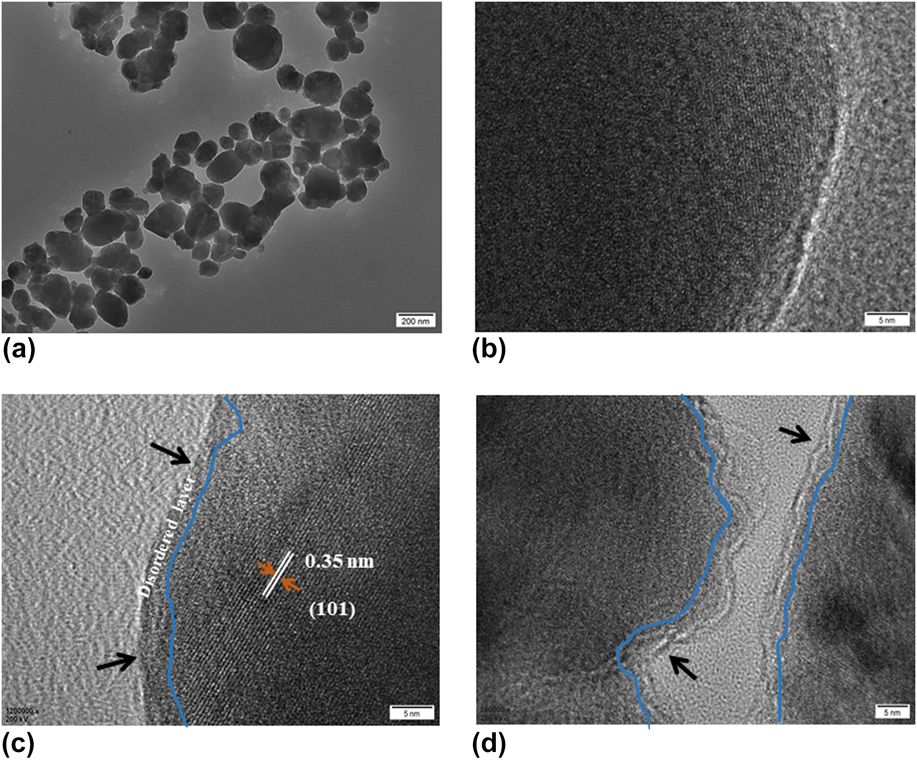
The morphology and crystal structure of the black titania (500 °C) were observed by using a TEM. As shown in Fig. 3, we can observe that the average particle size of black titania (500 °C) is approximately 100 nm [Fig. 3(a)], while the average particle size of the initial anatase is about 60 nm. The sizes and morphologies of black titania were slightly changed due to reunion. The initial anatase nanocrystals are highly crystallized, shown in its well-resolved lattice features of Fig. 3(b), while the black titania displays a unique structure with an amorphous layer surrounding a crystalline core [shown by the black arrows, Figs. 3(c) and 3(d)], and the average thickness of the disordered surface layer is approximately 5 nm, which is mainly attributed to the NaBH4 reduction reaction.
TEM images of the morphology of (a) black titania (500 °C) and (b) initial anatase with well-resolved lattice feature; (c) and (d) TEM images of black titania synthesized at 500 °C.

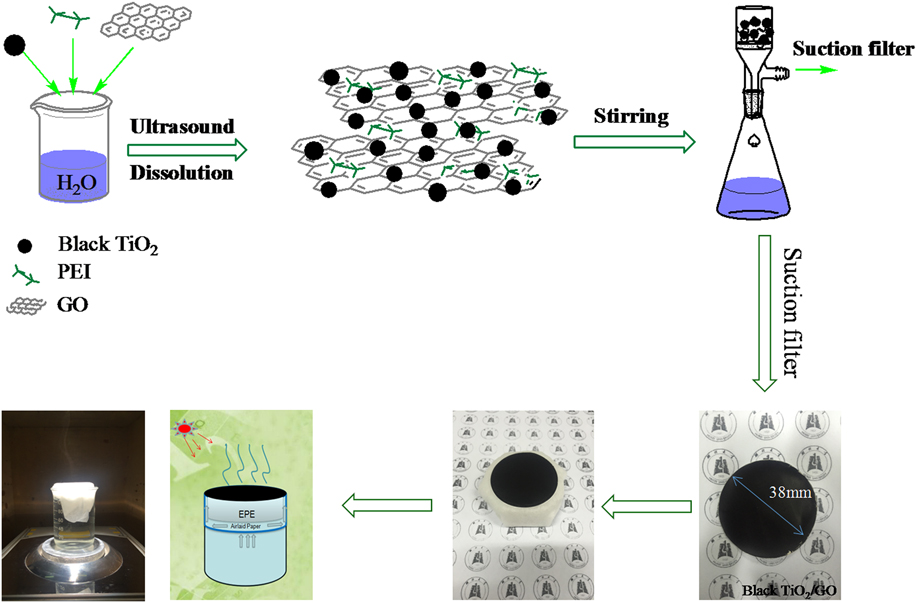
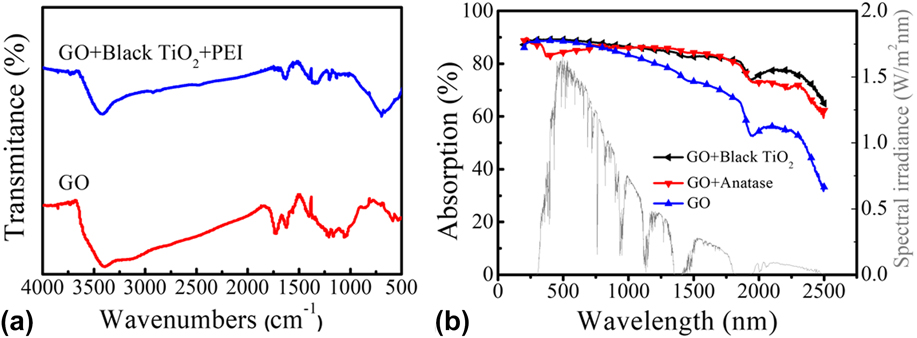
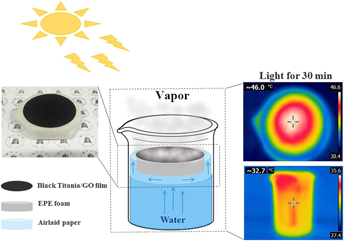
For the application of solar water evaporation, a black titania (500 °C)/GO nanocomposite film affixed to airlaid paper wrapped over the surface of EPE foam was prepared for efficient solar steam generation. The preparation process of the black titania/GO nanocomposite film is shown in Scheme 1. GO is one of the most important derivatives of graphene, which has various functional groups and good light absorption performance. Reference Chen, Feng and Li49–Reference Yin, Zhao, Hu, Ye and Wang53 Moreover, the porous structure of the GO film provides water supply and steam flow paths for the solar steam generation process. Reference Li, Xu, Tang, Zhou, Zhu, Zhu and Zhu26,Reference Boukhvalov, Katsnelson and Son54 PEI is a water-soluble polymer used to form amide bond through the carboxyl and amino groups to further functionalized GO, to achieve the connection between GO sheets. Reference Yan, Chang, Zhao, Gu, Liu, Tian, Zhou, Ren, Jin and Yin55–Reference Lai, Wang, Zeng, Liu, Huang, Zhang, Wang, Xu, Cheng, Huang, Wu and Qin58 To obtain excellent mechanical properties of the nanocomposite film, according to our previous work, the optimum ratio of GO and PEI is 1:25. Reference Wang, Fu, Ma, Pi, Liu and Wang59 As shown in Fig. 4(a), the FT-IR spectra of the functionalized GO show the stretching vibration of the amide bond at 1630 cm−1, which indicate that the effective connection between GO was achieved using PEI.
Schematic illustrating the preparation and solar steam generation process of the black titania/GO nanocomposite film.

(a) FT-IR spectra of GO and GO-black titania-PEI; (b) the absorption spectra of the black titania/GO, anatase/GO, and GO nanocomposite films in the wave length range of 250–2500 nm.

The UV-Vis-NIR absorption spectra of three different films are shown in Fig. 4(b). In the ultraviolet and visible regions, both the black titania/GO nanocomposite film and GO film have nearly 90% absorbance. The anatase/GO nanocomposite film has good light absorption in the ultraviolet region due to the absorption of the inherent band gap of titania, while in the visible region, titania and GO did not show a good synergistic effect and thus have only 85% of the absorbance. With the increase in wave length, the GO film shows sharp decrease in absorbance, while the black titania/GO and anatase/GO nanocomposite films still have a good absorbance. Whether in the ultraviolet, visible, or near infrared light, compared with the anatase/GO nanocomposite film and GO film, the black titania/GO nanocomposite film possesses the best optical absorption capacity.
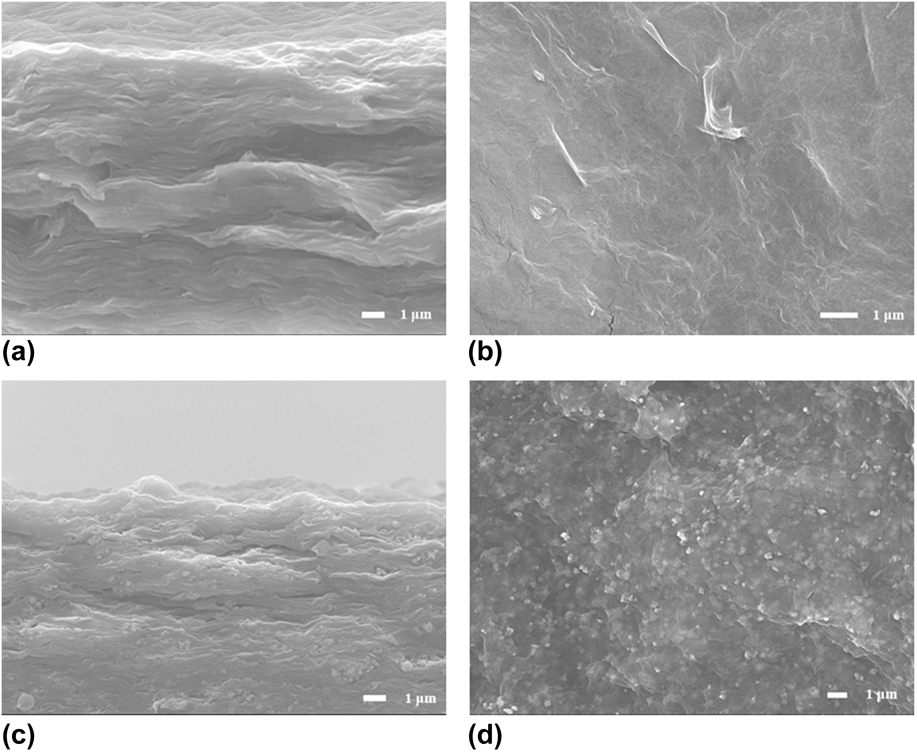
To further explore the surface and structure of the black titania/GO nanocomposite film after vacuum filtration, SEM analysis was carried out, and the results are shown in Fig. 5. The GO membrane has a smooth surface and multilayer structure [Figs. 5(a) and 5(b)], after the deposition of black titania nanoparticles, and the black titania/GO nanocomposite membrane with rough surface structure can be clearly seen from Figs. 5(c) and 5(d). The black titania nanoparticles are not only uniformly distributed on the surface of the nanocomposite film but also doped between the GO layers. Uniform distribution can better promote the solar steam generation.
The cross-sectional (a) and surface (b) images of the GO film; the cross-sectional (c) and surface (d) images of the black titania/GO nanocomposite film.

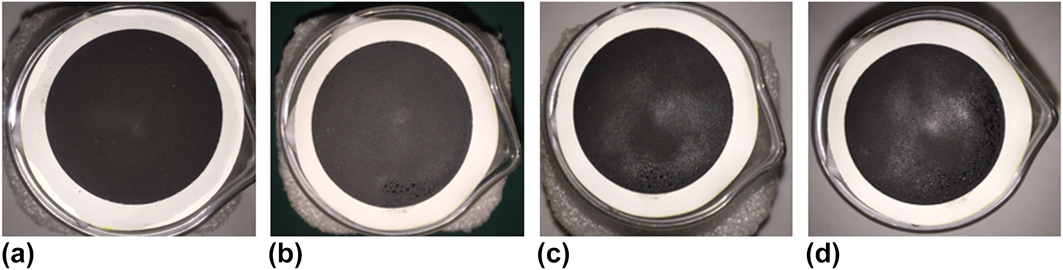
The N2 adsorption–desorption isotherm and pore size distribution curve of black titania/GO nanocomposite films are shown in Figs. S1 and S2. The nanocomposite film has a BET surface area of around 3.5 m2/g, and it shows an average pore size of 15.6 nm. This mesoporous structure not only enhances the absorption of light but also facilitates the transport of water and steam, thereby increasing the efficiency of solar steam. As mentioned above, the nanocomposite membrane is placed on the upper surface of the airlaid paper wrapped over EPE foam, and the airlaid paper provides a 2D water path to ensure the supply of water. The EPE foam not only ensures that the nanocomposite film floats on the surface of the water but also can be insulated. The wetting processes of the nanocomposite membrane are shown in Figs. 6(a)–6(d). The nanocomposite film begins to wet near the side of the sidewall due to the 2D water path on the sidewall [Fig. 6(a)], and the nanocomposite film utilizes capillary forces to continuously obtain water supply [Fig. 6(b)]. The wetted area is gradually diffused toward the central location of the nanocomposite film until the nanocomposite film is completely wetted [Figs. 6(c) and 6(d)]. Therefore, it can be seen that the composite film can have a steady water supply without direct contact with bulk water.
The water supply process of the black titania/GO nanocomposite film, starting from the first contact between the black titania/GO nanocomposite film and wetted airlaid paper, wetted area spread from edge positions (a) and (b) to central locations (c) and (d) over time.

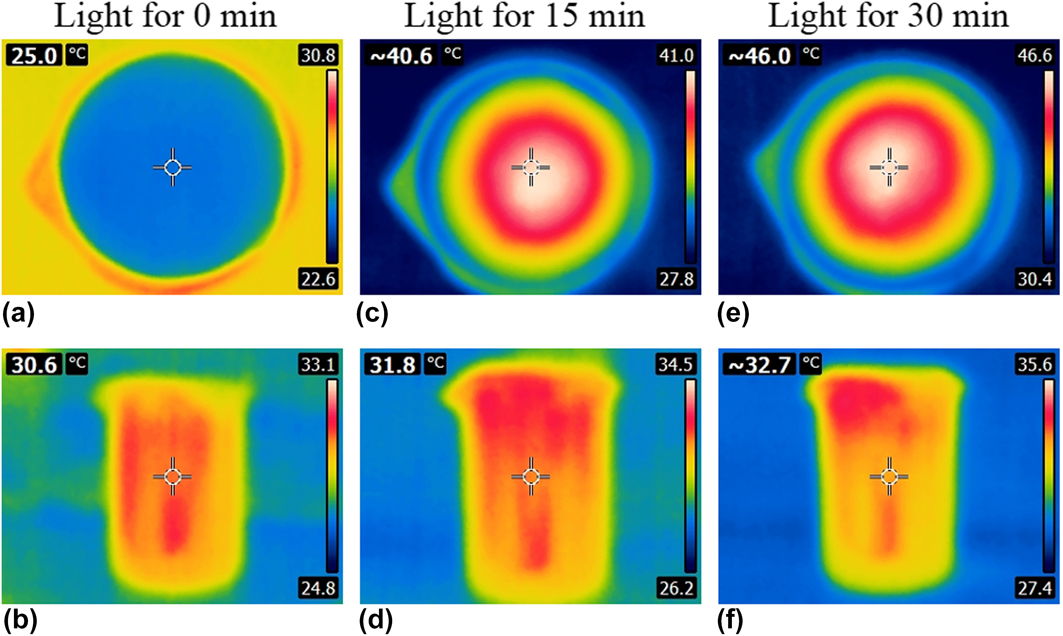
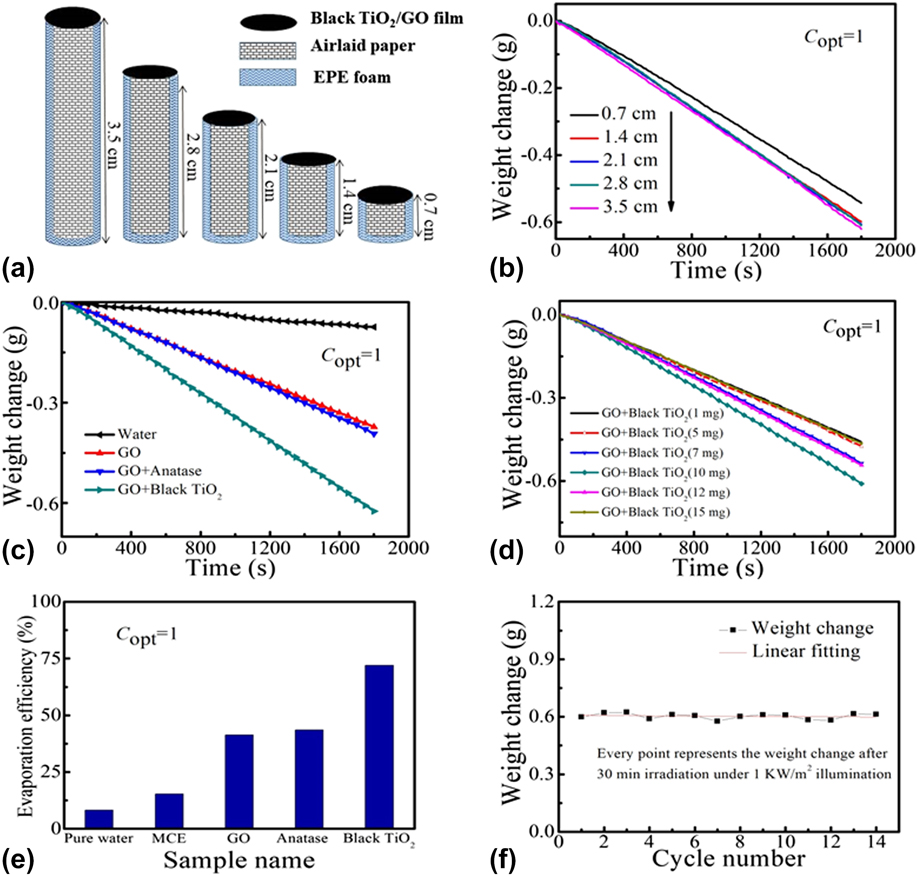
The two-dimensional water channel provides a sufficient water supply for the nanocomposite film without direct contacting with bulk water, and the EPE foam effectively reduces heat loss as a thermal insulator. Figures 7(a)–7(f) show that the surface temperatures of the black titania/GO nanocomposite film and the bulk water temperature distribute over time under normal solar illumination (1 kW/m2). Before irradiation, the surface temperatures of the nanocomposite film and the bulk water temperature were 25.0 and 30.6 °C [Figs. 7(a) and 7(b)], respectively. After solar irradiation for 15 min, the surface temperatures of nanocomposite film increased from 25.0 to 40.6 °C quickly [Fig. 7(c)], while the bulk water temperature was only 31.8 °C [Fig. 7(d)]. With the increase of the irradiation time, the surface temperatures of the nanocomposite film were getting higher and higher, and the final temperature stabilized at about 46 °C, while the bulk water temperature did not change significantly. Optical images show that the two-dimensional water channel and EPE foam effectively obstruct the heat loss, and the thermal energy is concentrated in the nanocomposite film. To explore the optimum thickness of EPE foam on solar steam generation, different thickness tests were performed [Figs. 8(a) and 8(b)]. The accumulated mass loss became significantly larger when the thickness of EPE foam increased from 0.7 to 1.4 cm. However, the accumulated mass loss did not change significantly when increasing from 1.4 to 3.5 cm. When the thickness of the EPE foam is 0.7 cm, the nanocomposite film was in direct contact with water due to the quality of the device. When the thickness of the EPE foam is 1.4 cm, the nanocomposite film was not in direct contact with water and effectively functions as an insulator.
The surface temperature distribution of the black titania/GO nanocomposite film and the whole water temperature were monitored by using an IR camera after 0 min (a) and (b), 15 min (c) and (d), and 30 min (e) and (f) solar illumination.

(a) Schematics of a solar steam generator with the same diameter but different thickness of EPE foam; (b) mass change over time with different thickness of EPE foam; (c) and (d) the accumulated mass loss as a function of the irradiation time; (e) the evaporation efficiency of different samples under one solar irradiation; (f) cycle performance of the black titania/GO nanocomposite film.

To systematically evaluate the photothermal efficiency of the solar steam generation system we designed, the experiments on solar steam generation were measured by recording the weight loss over time under one solar illumination (1 kW/m2). As shown in Fig. 8(c), for the black titania/GO nanocomposite film, the accumulated mass loss was 0.624 g after solar illumination for half an hour, which is 8.4 times that of pure water, 1.6 times that of GO film, and 1.5 times that of the anatase/GO nanocomposite film (black titania was consistent with the amount of anatase added). Comparing with the solar steam generation capability of four materials, the addition of black titania greatly improves the efficiency of the solar steam of GO. To further improve the solar steam efficiency of the black titania/GO nanocomposite film, the optimum doping amount was investigated by adding different amounts of black titania [Fig. 8(d)]. With the increase of doping amount of black titania, the accumulated mass loss also increased, and when the doping amount of black titania was 10 mg, the accumulated mass loss reached the maximum value. When the doping amount was more than 10 mg, the accumulated mass loss decreased, and the nanocomposite film was cracked.
Figure 8(e) shows the solar steam efficiency (η) of five materials, and they were calculated by the following formula for the steam efficiency:
 $$\eta = {{{m_{{\rm{flu}}}} \cdot {h_{{\rm{vap}}}}} \over {{Q_{\rm{s}}}}} \times 100\% \quad ,$$
where m flu is the vaporization rate, h vap denotes the total enthalpy of liquid–steam phase change (sensible heat + phase-change enthalpy), and Q s is the intensity of the incident light (1 kW/m2). According to the steam efficiency diagram [Fig. 8(e)], it can be seen that the efficiency of heating bulk water is relatively low, while the steam efficiency of the black titania/GO nanocomposite film is as high as 69.1%, which is 8.4 times that of pure water, 4.5 times that of cellulose film, 1.6 times that of GO film, and 1.5 times that of anatase/GO nanocomposite film. These data can completely indicate that the black titania/GO nanocomposite film greatly improves the efficiency of solar steam generation. As shown in Fig. 8(f), we performed cycle tests on the performance stability of the composite film 14 times. After each cycle test, the nanocomposite film was completely dried before it could be tested again. After several cycles of experiments, the accumulated mass loss still maintained at a stable level, and the morphology of the nanocomposite film did not change in the cycle experiment, showing that the composite film has not only high steam efficiency but also excellent stability.
IV. CONCLUSION
In summary, we have successfully synthesized black titania with unique “core–shell” structure using NaBH4 reduction process at different temperatures, and the introduction of Ti3+ states and oxygen vacancies result in excellent light-absorbing properties. Our results have demonstrated that the black titania (500 °C)/GO nanocomposite membrane can enable highly efficient solar steam generation. The nanocomposite film, fabricated by the vacuum filtration process, serves as high-efficiency solar absorbers (about 90% across 200–1000 nm). The combination of the nanocomposite film and two-dimensional water channels improve the photothermal conversion efficiency to 69.1% under solar illumination of 1 kW/m2 with no solar concentration, what’s more, the system possesses excellent cycle stability.
Supplementary Material
To view supplementary material for this article, please visit https://doi.org/10.1557/jmr.2018.25.
ACKNOWLEDGMENTS
This work is financially supported by National Key R&D Program of China (Grant: 2016YFA0200200) and National Natural Science Foundation of China (Grants 51272071, 51203045, and 21401049).