The reports on the excavations of the legionary fortress at Carpow bring together the evidence from a number of excavations which took place between 1961 and 1970.Footnote 1 The fortress is situated midway between Abernethy and Newburgh, a few miles south of the Tay, approximately 25 miles north of the nearest section of the Antonine Wall; as such it is isolated from the densely patterned military landscapes associated with the frontier schemes of both the Antonine and Hadrian’s Walls. The fortress is stone walled with masonry internal buildings, which include a headquarters and a commanding-officer’s residence. Smaller, at 12 hectares, than the other well-defined legionary fortresses elsewhere in the province (Caerleon 20.6 ha; Chester 24.3 ha; Lincoln 16.4 ha; Inchtuthil 20 ha), Carpow may have been intended to house a half legion rather than a full complement.
The conclusion of the reports is that the construction of the fortress was the work of Septimius Severus (or Caracalla and Geta) following the Caledonian campaigns of a.d. 208–211. The report accepts as the framework for its chronology the story of events in northern Britain in the Severan period as related by Herodian and Cassius Dio. Herodian states:
… the governor of Britain informed Severus by despatches that the barbarians there were in revolt and overrunning the country, looting and destroying virtually everything on the island. He told Severus that he needed either a stronger army for defence of the province or the presence of the emperor … Footnote 2
The governor, possibly to his distress, got a full imperial expedition complete with the imperial family and its entourage, the Praetorian Guard, possibly Legion II Parthica (Alban legion), normally stationed outside Rome to curb the king-making ambitions of the Praetorians, and probably the usual baggage of senators who could not be trusted at home.
Dio, however, asserts that the forces in Britain were already winning the war and that the emperor’s descent on Britain was an arbitrary, rather than strategic, decision.
Severus, informed of these various occurrences (i.e. widespread banditry in Italy) was angry at the thought that though he was winning the wars in Britain through others, yet he himself had proved no match for a robber in Italy. Footnote 3
According to Dio, the primary motive for the expedition was not military but largely a parental attempt to curb the increasingly disturbing behaviour of his sons Caracalla and Geta, who were already negotiating their relative positions in anticipation of the death of Severus.Footnote 4 Herodian concurs with this view: ‘… he wished to win victories over the Britons … But he wished even more to take his sons away from Rome’. Footnote 5
In contrast with the traditional view, this note will argue that far from Severus building Carpow, he actually abandoned a pre-existing fortification and in so doing abandoned a system of frontier control that had been established by Commodus. Thus was laid the foundation for the troubles in northern Britain which culminated in the imperial campaign mounted in a.d. 208.
There are a number of strands of evidence: ceramic, epigraphic, numismatic and historical. The first can be dealt with at once since nothing in the published reports of the pottery can be dated more closely than as being from the last quarter of the second to the first quarter of the third century. Effectively the detailed ceramic analysis establishes that the pottery is characteristic of the late Antonine and early Severan periods and, thus, does not prove or disprove a pre-Severan date for the establishment of the fortress. Further, since pottery and small finds, with the exception of the coins, are reliant on orthodox chronologies dependent on a Severan date they are, de facto, mutable.
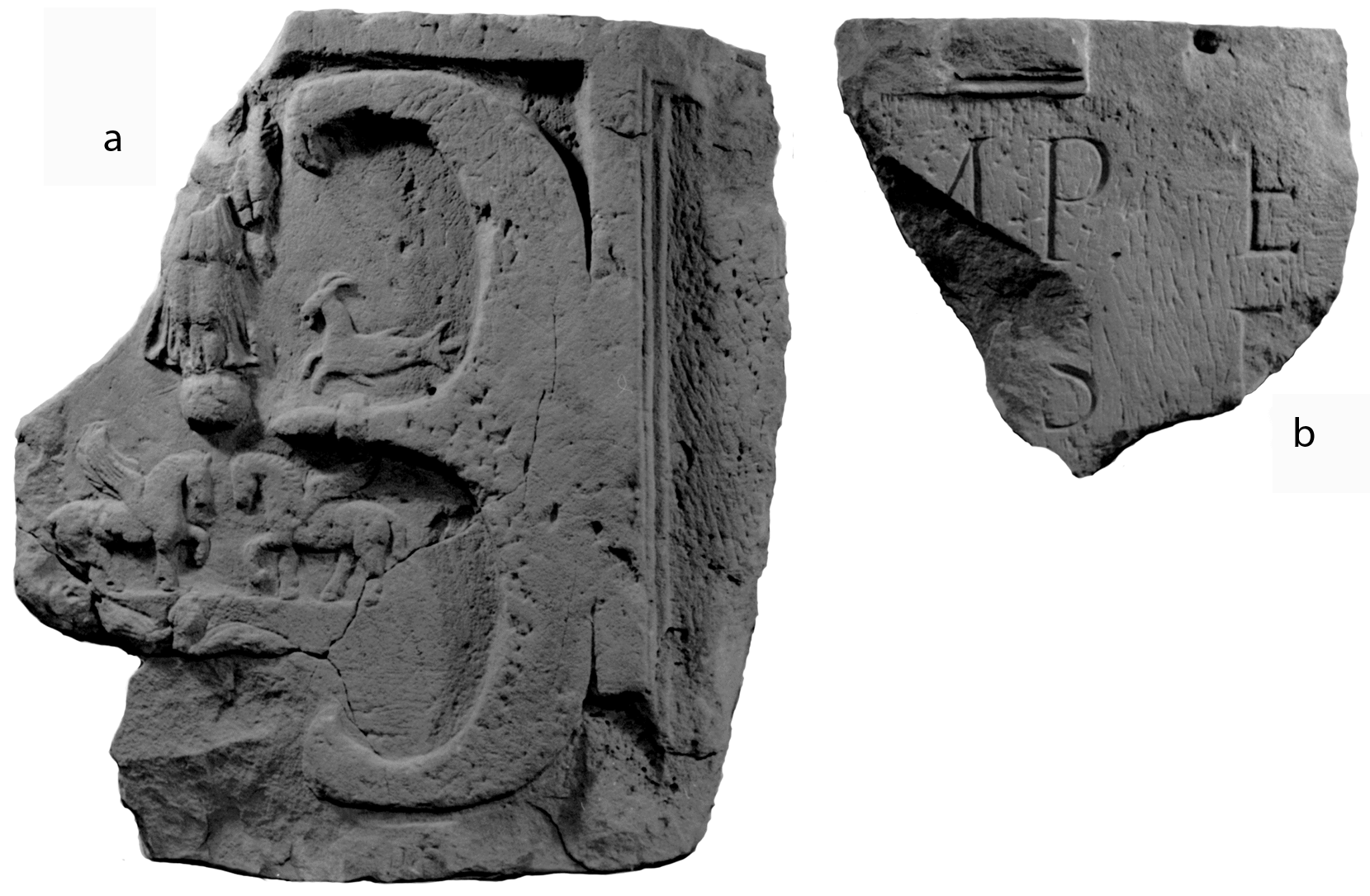
Next, the epigraphic evidence. This consists of two fragments of an inscription found outside the east gate at CarpowFootnote 6 and supplementary material in the form of stamped tiles. Further sculptured fragments were also recovered, but none add to the burden of the text. The largest and most enigmatic fragment consists of the upper left-hand corner of a monumental slab comprising two lines of lettering (fig. 1b). The other fragment, a heavily decorated peltaic relief, comprised the left-hand side of the monumental inscription itself (fig. 1a). Reconstruction of this inscription has been based upon the assumption that it is of Severan date, an attribution which raises a number of epigraphic problems — the main problem being that the inscription is a dedication using the title IMP(erator), indicative of a single emperor. To fulfil the requirements of a Severan inscription dating to the joint reign of Septimius Severus and Caracalla (a.d. 197–211), or of Severus, Caracalla and Geta (a.d. 209–210), or of Caracalla and Geta (a.d. 210–212), the title should indicate a plurality of rulers by the formula IMPP (imperatores) in which the final letter is duplicated. Three solutions have been offered. Firstly and secondly, that the inscription is one of a complementary pair individually dedicated to Severus and Caracalla or to Caracalla and Geta. Thirdly, that the inscription is from a single monument which must be for Caracalla during his sole reign following the death of Geta. The latter supposes that Severan building at Carpow continued into the sole reign of Caracalla and, thus, that Severan occupation of Scotland continued for an unknown period after the cessation of hostilities on the death of Severus. With this view in mind the text has been reconstructed to read:
Fragments from a building inscription from Carpow, RIB III, 3512. (a) Left-hand side decorated with pelta and associated figures; (b) Top with five letters from lines 1 and 2. (Photos: courtesy of Dundee Museums and Art Galleries)

The chronology of events following Severus’ death does not support this. The emperor died in York, where he had met or was expecting to meet an embassy from Persia,Footnote 7 on 4 February 211, in the middle of the northern winter and three months before the opening of the sailing season in May — the earliest that the expeditionary force, as a whole, could be re-embarked for its return to the Continent. This does not preclude the possibility, even probability, that the brothers made for Rome at the earliest opportunity accompanied by the minimum force necessary for their mutual protection in this period of three months. A number of events are recorded, none of a military nature. Severus was cremated at York and his ashes reserved for formal funeral in Rome. Caracalla tried, unsuccessfully, to buy the loyalty of the commanders of the army in Britain in an attempt to dispose of his brother. The murder of key members of the former emperor’s inner circle was undertaken, including his physicians, the imperial tutors, and Caracalla’s exiled ex-wife Plautilla. The date at which the brothers got back to Rome is uncertain, but Caracalla seems to have had a plan, unexecuted, to despatch Geta during the celebration, in Rome, of the Saturnalia in December. In the event the death of Geta was postponed until February 212.
Significantly, the commemorative coins needed for distribution at the imperial adventus, the formal ceremonies attached to the return of the emperor to the capital, were prepared and issued by the Rome mint in a.d. 211. These included coins for the dead Severus whose presence in the issue represents the ambivalent position occupied by a dead emperor before the completion of the elaborate obsequies detailed by HerodianFootnote 8 had been completed. In this context may be cited the ceremony of Trajan’s Parthian triumph in which the dead emperor was represented by an imperial dummy in the triumphal chariot, the event being recorded by a coin of Hadrian issued in the name of Trajan. Footnote 9
None of this suggests an extended stay in Britain by Caracalla and Geta, but does not prove that a policy of occupation in Scotland was not pursued. We may ask, however, whether the coinage found at Carpow and elsewhere in Scotland supports an extended occupation. Emphatically it does not.
Severus is said to have taken ‘an immense, vast sum of money’ on his expedition.Footnote 10 The sum cannot be quantified, but the output of the Rome mint appears to expand between a.d. 209 and 211. Direct numerical evidence is lacking, but the number of individual coin types increased in these years, suggesting an expansion of officinae, or workshops, in the mint.Footnote 11 What is remarkable about the Severan coins from Scotland is that there are none struck later than a.d. 205, and that the coins of that year are found in mint condition at Carpow and Cramond.Footnote 12 Explanation for this phenomenon can be advanced if it is proposed that the coins were issued from stock long after their production as part of the funds taken in a.d. 208 as reported by Dio. But this expedient merely seeks to reconcile a model for the later Severan construction of Carpow with a numismatic observation which would normally defy archaeological logic elsewhere and is subverted by the epigraphic evidence from Hadrian’s Wall.
What, then, might have happened? The coins at Carpow and Cramond cease, suggesting the end of occupation in, or about, a.d. 205.Footnote 13 At the same time the forts of Hadrian’s Wall produce an abundance of epigraphic evidence for the activity of the governor Alfenus Senecio who took office in Britain in a.d. 205 or a little earlier. Inscriptions are known from Risingham, High Rochester, Vindolanda, Chesters, Birdoswald, Corbridge, Housesteads, Benwell, and the quarries at Brampton near Carlisle. On the basis of this evidence, it appears inevitable that a withdrawal from Scotland was part of a programme involving the restoration and reoccupation of Hadrian’s Wall. That this restoration was extensive is attested archaeologically and by the fact that three out of the four ancient sources that mention the Wall attribute its construction to Septimius Severus. The reasons for a decision to withdraw are not clear. One might suggest that Severus intended to continue the long-term occupation of Scotland following the policy of Commodus, but that he was forced to give this up. Sometime in the governorship of Virius Lupus, the exact dates of which are uncertain but probably extended to a.d. 202, a rapprochement which had been negotiated with the Caledonians collapsed.
In as much as the Caledonians did not abide by their promises and had made ready to aid the Maeatae, and in view of the fact that Severus at the time was devoting himself to the neighbouring war, Lupus was compelled to purchase peace from the Maeatae for a large sum; and he received a few captives. Footnote 14
The location of these tribes is ambiguous. The Maeatae are described as being next to the ‘cross-wall which cuts the island in half’. The Caledonians ‘are beyond them’.Footnote 15 Opinion is divided as to which wall is involved: the Antonine Wall, apparently abandoned as early as a.d. 160,Footnote 16 or Hadrian’s Wall largely decommissioned, by this account, by Commodus? Since Dio wrote his history in a period when Hadrian’s Wall once again ‘cuts the island in half’ and the Antonine Wall had been in long desuetude, economy of hypothesis points to Hadrian’s Wall as being the southern boundary of the Maeatae. This being so, the promises made by the Caledonians would have partaken of the normal Roman practice of buying the loyalty of the tribe beyond a troublesome neighbour by which hostility by the near-neighbour would be met by intervention by the friendly tribe beyond their border. This practice is exemplified at its most effective in the Later Eastern Empire where the Crimean Pechenegs offered a very effective countervailing force to the Bulgars.
That subsidies were being paid to the Caledonians as early as the reign of Commodus may be evidenced by a series of denarius hoards dating to his reign from Rumbling Bridge (Kinross), Pitcullo (Perths.), Shotts (Lanarks.), Strathaven (Lanarks.), and Muthill (Perths.).Footnote 17 That these subventions continued early into the reign of Severus is attested by two hoards from Birnie in Morayshire, part of which appears to have been in Roman money bags when buried. Footnote 18
Who then, in the first place, abandoned Hadrian’s Wall and for what reason? The answer to these questions resides in the reign of Commodus (a.d. 180–192). During his joint and sole reign a number of notable military campaigns were undertaken. For the German campaigns, conducted under his father, he celebrated a triumph in a.d. 180; for a further German war in a.d. 182 he adopted the title Germanicus Maximus; and in a.d. 184 he took that of Britannicus. He is also credited with campaigns ‘with the barbarians beyond the Dacians’, in which both Severus and Clodius Albinus served, probably as legionary commanders. Of all these campaigns that in Britain was the most important — ‘the greatest struggle was the one with the Britons’.Footnote 19 The war was precipitated when:
the tribes in that island, crossing the wall that separated them from the Roman legions (Ῥωμαιων στρατοπεδα in the Byzantine usage of Xiphilinus), proceeded to do much mischief and cut down a general (στρατηγος, or even the governor of a military province in Byzantine Greek Footnote 20) together with his troops. Footnote 21
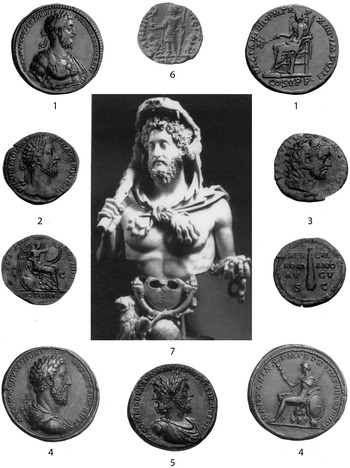
The wall crossed was certainly Hadrian’s Wall and the general probably the legate of Legion VI stationed at York. It cannot be coincidental that the legion was awarded the title Britannica, presumably for its part in the subsequent, retributive campaign rather than in any Severan campaigns more than a decade later. Tiles bearing this title are present at Carpow.Footnote 22 Material evidence for this invasion is slight. However, attention may be drawn to the need for the restoration in a.d. 191, by a beneficiarius consularis, of a monument at Catterick dedicated to ‘the god who devised roads and pathways’, erected originally by a member of the governor’s escort.Footnote 23 Ulpius Marcellus, already governor in the joint reign of Marcus and Commodus, ‘ruthlessly put down the barbarians of Britain’.Footnote 24 Marcellus’ victory was celebrated by the emperor assuming the title Britannicus; coins with this title, and the record of a seventh imperatorial proclamation, appear in a.d. 184 (fig. 2.2). The victory was also celebrated by the issue of coins and of a series of non-monetary medallions, probably for distribution at celebrations in Rome (fig. 2.4). So important was the event that the mint of Alexandria in Egypt issued celebratory coins specifically referring to events in Britain by name (fig. 2.6). Footnote 25
(1) Medallion a.d. 188–9, M COMMODVS ANTONINVS PIVS FELIX AVG BRIT/PACI AETER P M TR P XIIII IMP VIII COS V P P (Toynbee Reference Hill1944, pl. 42, 8); (2) Sestertius a.d. 184–5, M COMMODVS ANTON AVG PIVS BRIT/P M TR P X IMP VII COS IIII P P VICT BRIT – S C (RIC 452); (3) Sestertius a.d. 192, L AEL AVREL COMM AVG P FEL/HERCVL ROMANO AVGV – S C (RIC 637); (4) Medallion a.d. 184–5, M COMMODVS ANTONINVS AVG PIVS BRIT/BRITANNIA P M TR P X IMP VII COS IIII P P (Grueber 1874, pl. 29, fig. 2); (5) Medallion a.d. 186–7, M COMMODVS ANTONINVS PIVS FELIX AVG BRIT/P M TR P XII IMP VIII P P/TELLVS STABIL – Janiform bust of Hercules and Commodus; (6) Billon tetradrachm (Alexandria) a.d. 184, BPETTANI – Commodus with captives, holding figure of Victory (Dattari Reference Dattari1901, no. 3842); (7) Marble bust of Commodus as Hercules (Fittschen and Zanker Reference Fittschen and Zanker1985, Taf. 91, no. 78).

The date of the start of the war may be deduced from the cumulative titles taken by Commodus. His campaigns in Germany were celebrated with a triumph in a.d. 180 and salutation as ‘imperator’ for the fourth time; the adoption of the title Germanicus Maximus is first recorded in a.d. 182. Further imperatorial acclamations follow in a.d. 182 (IMP V), 183 (IMP VI), and 184 (IMP VII). The latest signifies the end of the war and the acquisition of the title Britannicus. No further acclamations are recorded until a.d. 186 and the end of the Sarmatian war. On this evidence it looks as though events in Britain were already bringing victories in a.d. 182 and 183 and that the campaign culminated in victory in 184. By any reckoning this chronology would be compatible with Dio’s claim that ‘the greatest struggle was the one with the Britons’.
There follows a period of confusion during which the army in Britain attempted to promote its own emperor and the junior officers are said to have despatched a force of 1,500 infantry to Italy. This is in effect a body equivalent to three auxiliary cohorts. It is claimed that their arrival in the vicinity of Rome helped precipitate the downfall and death of Perennis, the Praetorian Prefect. A new governor, P. Helvius Pertinax, then in retirement in Italy, took command in Britain and restored order. Appointed by Commodus following the death of Perennis, that is after early summer a.d. 185, he would have reached Britain at latest by the autumn of that year and served until 187. During his short, but tumultuous, tenure he suppressed an army mutiny, resisted an attempt by the military to proclaim him emperor, and was nearly lynched in a legionary riot, possibly all in a single episode or incident. He resigned his post; his successor is unknown.
The participation of British troops in Italy is ignored by Herodian: instead he relates the presence near Rome of a rather different military force. This was led by a soldier named Maternus ‘who had committed many frightful crimes. He deserted from the army, persuading others to flee with him, and soon collected a huge mob of desperados’.Footnote 26 Success increased his force and attacks were mounted on towns in Gaul and Spain. Commodus ordered military force against Maternus, whose following was now so enlarged that it ‘no longer appeared to be brigands but rather enemy troops’. Eluding imperial intervention, he infiltrated his followers into Italy ‘by a quick but difficult route’. Realising that his force was not powerful enough to mount a putsch, he planned to assassinate Commodus by infiltrating killers into the imperial presence at the festival of Cybele celebrated in March. The plotters dressed in the parade uniforms of the Praetorian Guard, but were betrayed and Maternus and his revolt brought to a bloody end. That the conspirators had access to uniforms and equipment of the élite imperial guard and proximity to the emperor suggests a more widespread and structured plot than Herodian’s account.
It is not impossible that both of these military episodes were aspects of the same event, especially since any consideration of the logistics of sending three cohorts to Rome would involve cross-Channel transport, a march across Gaul, possibly transport down the Rhône, either transfer by sea to the Italian mainland or another march from Marseilles eastwards around the coast to Italy, not to mention provisions, secure accommodation and the co-operation, or coercion, of the civil and military authorities of Gaul. Possibly they were sent from Britain in pursuit of the elusive Maternus. The absence of this episode in Dio may be explained by the fact that his text survives only as a Byzantine epitome. Again the chronology is confused, Perennis was overthrown in a.d. 185, probably in April or May; the Italian episode of the ‘Bellum Desertorum’ of Maternus seems to have occurred between a.d. 186 and 187. Given the location of Maternus’ activities it may be possible that he and the core of his followers were deserters from Britain itself. But bearing in mind the unrest in the British army from the Hadrianic period onwards, sending British soldiers in pursuit of mutinous comrades might be too high a risk.
If the coins from Carpow pose a problem as regards a later Severan inception for the site, the fragmentary inscription can be reconstructed in a manner which supports an earlier date. R.P. Wright discussing the inscription, which was recovered at the east gate (porta praetoria) of the fortress, draws attention to the stylistic features of the stone which he notes to be characteristic of the Antonine period.Footnote 27 Noting the presence of pegasii and a Capricorn, devices normally associated with inscriptions of Legion II Augusta, he attributes the inscription to that legion (fig. 1a). The monumentality of the stone is attested by the height of the surviving letters, which are 14.5 cm high; the calculated length is 4.2 m, though this represents the calculated length of a Severan inscription. Wright’s reconstruction of the text is derived from the survival of four letters [I]MP E[ – ] in the top left-hand corner of the upper register and [ – ]S F[ – ] immediately below them. Swayed by the interpretation of the coin evidence, which the excavator insisted must be evidence of the Severan campaigns, Wright reluctantly abandoned an Antonine date and concurred with a later Severan one, though he was unable to find further examples of this style attributable to the Severan era. As we have noted, this dating forced the conclusion that since a single emperor was the subject of the dedication, it must be Caracalla during his sole reign. Such a conclusion inevitably led to the belief in an occupation of Caledonia extending for an uncertain period beyond a.d. 212, which saw the death of Geta and the end of co-sovereignty.
The case for restoring the Carpow inscription as Commodan must be considered in the light of developments in the titulature of the emperor and his increasingly disturbed behaviour towards the end of his reign. This behaviour centred upon the emperor’s identification of himself with Hercules.
First he discarded his family name and issued orders that he was not to be called Commodus, son of Marcus, but Hercules, son of Zeus. Abandoning the Roman and imperial mode of dress, he donned the lion-skin, and carried the club of Hercules … He assigned new names to the months of the year; abolishing the old ones, he called the months after his own list of names and titles, most of which actually referred to Hercules … Footnote 28
The height of this imperial self-deification as the Roman Hercules came in the last two years of his reign.
Dio’s account of these years, of which he was an eye-witness, gives detailed instances of the emperor’s behaviour, which is reflected in the coinage, where Commodus appears as Hercules (fig. 2.3). In addresses to the Senate he styled himself the Roman Hercules. In his absence the imperial seat in the theatre was occupied by the lion-skin and club of the deity. Hercules/Commodus statues abounded in the City (fig. 2.7).Footnote 29 He was recognised as a god, ‘for he was even given this name, too’. The months were renamed to reflect attributes of Hercules and for the emperor himself. Footnote 30
The imperial cult of Hercules took particularly strong root in the recently mutinous army in BritainFootnote 31 and this devotion is probably reflected in the inscription from Carlisle celebrating successful action beyond the Wall by the ala Augusta;Footnote 32 such devotion is also found among British troops abroad. For instance an inscription from Volubilis for the health and safety of Commodus/Hercules records the piety of a centurion of a vex(illationis) Britt(onum) who paid for the monument. It reads: Footnote 33
In the light of these factors we may return to the Carpow inscription combining the titles used in addresses to the Senate in his last years as recorded by Dio.Footnote 34 Bearing in mind the recognition of the divine nature of the emperor, we may suggest the following reconstruction of the Carpow inscription:
The wording of the inscription is capable of two interpretations. To the unsophisticated it might be read as a claim that Commodus is the god to whom the dedication is made; to the constitutionally-minded Roman it reads as attributed to Commodus and Hercules jointly. It is unlikely that the garrison of Britain included many of the latter among its number. The use of the divine title for the emperor is not unknown in Roman epigraphy: the coinage of Probus bears the title IMP DEO ET DOMINO (RIC 841), whilst Carus is DEO ET DOMINO (RIC 96). Both instances are from the mint of Siscia, the first probably inspired by Probus’ triumph in a.d. 281, the latter by Carus’ defeat of the Sarmatians in the Balkans. Significantly, both instances are associated with outstanding military success. Reconstruction of the inscription in this form must date it to the last years of Commodus’ reign. This observation does not undermine the contention that the fort was built following the successful conclusion of the campaigns of a.d. 182–184 since Roman building inscriptions were erected on completion and were not foundation stones.
Reattribution of the foundation of Carpow to Commodus affects the status of Cramond, a site also claimed as Severan. Here the coin list exactly matches that of Carpow, as does the pottery. As at Carpow the coin list contains a tail of post-Commodan issues. None come from the site itself; all form a part of the normal list of imported exotica promiscuously recorded by an earlier generation of archaeologists. This phenomenon has been dealt with in detail elsewhere. Footnote 35
Anomalous features which have been observed in respect to events and structures on or in the region of Hadrian’s Wall may be reviewed in the light of a changed chronology. At Castlecary, on the Antonine Wall, an inscription which has proved contentious in the past can be consigned to a Commodan context, suggesting that some installations on the Antonine Wall were incorporated, possibly as hinterland forts, in the new frontier system. The dedication to Mercury by soldiers of legio VI Victrix cives Italici et Norici Footnote 36 is best interpreted as showing that Legion VI Victrix had been reinforced by drafts of legionaries from II Italica, stationed in Noricum.Footnote 37 As the legion nearest to Hadrian’s Wall VI Victrix was the most likely to have suffered heavy casualties in the events of a.d. 181, possibly including the loss of its commander. Events on the Danube combine to preclude troop transfers before a.d. 180.
The new fort constructed at South Shields (Tyne and Wear) in the mid to late Antonine period, later adapted as a supply base for the Severan campaigns in Scotland, may owe its origins to events leading to Commodus’ campaigns. Studies of the finds from what is plausibly interpreted as a shipwreck on the Herd Sands at the mouth of the Tyne include military items owned by soldiers of Legion VIII Augusta. Associated coins point to a late Antonine date, while numismatic finds in the area of the river mouth and from the vicus of South Shields itself are of early Commodan date.Footnote 38 Detachments of Legion VIII, based at Mainz, are known to have been sent to Britain in the reigns of Hadrian and Antoninus Pius, during critical periods of military activity. It appears from the associated coin evidence and inscribed equipment that similar detachments arrived in Britain to support Commodus’ three years of campaigning in the North.
Further evidence for Commodan reinforcement may be sought in the inscription from an uncertain location in Scotland which records the presence of a vexillation of Legion XXII Primigenia.Footnote 39 A previous detachment of this legion had seen action in Britain early in the reign of Hadrian. The same legion is found in a joint dedication with Legion VIII Augusta at Birrens, which is possibly indicative of legionary vexillations replacing a normal auxiliary garrison in the Commodan period. Footnote 40
Evidence for the infrastructure of the Commodan occupation of Scotland is exiguous. A detachment from the regiment of Raeti Gaesati, normally to be found at Risingham, is attested by an inscription attributed to Cappuck. The authors of Roman Inscriptions in Britain, unable to find an Antonine context for this occupation, suggest ‘that this indicates that some outpost north of the Cheviots was maintained in Severan times’. A similar problem arises in regard to an inscription of cohors I Fida Vardullorum also attributed to Cappuck. During this unit’s long career in Britain it saw duty at various times in the later second century at Vindolanda, Corbridge, probably on the Wall, at Castlecary on the Antonine Wall, at Lanchester, and, finally, at High Rochester. Attention may be drawn, also, to the wide variety of marching camps to be found in Lowland Scotland which are variously attributed to the campaigns of Agricola and Severus. It is inconceivable that three years campaigning by Commodus would not have left traces of troop movements as evidenced by temporary fortification.
There were strong political correlations between the campaigns of Commodus and the intervention by Severus in Britain. The familial relationship between the Severi and the Antonines was non-existent, but in order to legitimise the new dynasty a fictitious connection was forged by Septimius. Though his opinion of Commodus was that it would have been better for Rome if Marcus Aurelius had himself killed his son, the need to attach the new regime to Marcus, the ideal emperor, depended upon the rehabilitation of Commodus.Footnote 41 The act of damnatio memoriae imposed by the Senate in a.d. 193 was rescinded and in a.d. 195 Severus deified Commodus who was now officially recognised as Divus Commodus Frater Imp Caes L. Septimi Severi.Footnote 42 The success of Commodus in Britain, the length and severity of the campaigns, and the conferment of the title Britannicus clearly influenced the policy of his self-appointed brother when the abandonment of the Commodan settlement of Britain was signalled by the Severan withdrawal to Hadrian’s Wall. We may see the personal intervention of Severus, albeit ascribed to the behaviour of his sons, as an attempt to reinforce the fictitious Antonine-Severan relationship through a repetition of one of the former dynasty’s greatest military successes. It may be significant that once again the Egyptian mint issued coins to celebrate the emperor’s victory.
ACKNOWLEDGEMENTS
Thanks are due to the following: the late Dr Vivien Swan for guidance on ceramics; the late Professor John Mann for early discussions of this study; Dr S. Ireland (Warwick University) for guidance on epigraphic problems; Paul Bidwell (Tyne and Wear Museums) for discussion on recent developments in northern frontier studies.