


Introduction
Ruminative thinking in its broadest sense refers to repetitive thinking characterized by limited controllability (Martin and Tesser, Reference Martin, Tesser and Wyer1996). In the clinical context, rumination is often conceptualized as repetitive thinking in response to negative affect or negative emotion (Nolen-Hoeksema and Morrow, Reference Nolen-Hoeksema and Morrow1993). Although rumination may also be a functional form of cognitive processing depending, for example, on the mode of processing and the perspective that is taken (Watkins, Reference Watkins2008), most models stress its dysfunctional nature (Thomsen, Reference Thomsen2006) and its role in the development and maintenance of disorders: Ruminative thinking is a salient feature not only of depression as evidenced by the notion of depressive rumination (Nolen-Hoeksema, Wisco and Lyubomirsky, Reference Nolen-Hoeksema, Wisco and Lyubomirsky2008), but is also prominent in posttraumatic stress disorder (Ehring, Fuchs and Kläsener, Reference Ehring, Fuchs and Kläsener2009) or – as worry – in generalized anxiety disorder (Roemer, Orsillo and Barlow, Reference Roemer, Orsillo, Barlow and Barlow2004). Ehring and Watkins (Reference Ehring and Watkins2008) argue that rumination may even be a transdiagnostic feature of numerous Axis I disorders.
A comprehensive theoretical framework that allows for dedicated modelling the role of cognitive processes in the development of emotional disorders is the self-regulatory executive function theory of emotional disorders (Wells and Matthews, Reference Wells and Matthews1994, Reference Wells and Matthews1996). This theory conceptualizes cognitive processes at different levels, with a particular focus on the role of metacognitions. Specifically, in the case of depression, the role of beliefs about rumination are stressed: positive beliefs about rumination, that is beliefs that ruminative thinking is functional (for instance to solve a problematic situation), are thought to increase the odds for engaging into ruminative thinking. Given that rumination turns out to be unsuccessful, this has detrimental effects on affect, and negative beliefs about rumination are built up that contribute to the subsequent development of depression (Papageorgiou and Wells, Reference Papageorgiou and Wells2003).
Until now a substantial body of evidence has accumulated, corroborating the metacognitive model (Wells, Reference Wells2008, for an overview), which has then been extended to other emotional disorders, particularly anxiety disorders (e.g. Bennett and Wells, Reference Bennett and Wells2010) and posttraumatic stress disorder (Wells et al., Reference Wells, Welford, King, Papageorgiou, Wisely and Mendel2010). However, most evidence supporting the model and the role of positive and negative beliefs about rumination stems from cross-sectional surveys where key variables were generally assessed with retrospective questionnaires (Papageorgiou and Wells, Reference Papageorgiou and Wells2003; Wells and Carter, Reference Wells and Carter2001). Longitudinal trials are scarce; however, some longitudinal data indeed support the notion of metacognitions preceding depression and anxiety (Yılmaz, Gençöz and Wells, Reference Yılmaz, Gençöz and Wells2011). Trials on the effectiveness of metacognitive therapy provide further ex juvantibus evidence for the model's validity (van der Heiden, Muris and van der Molen, Reference van der Heiden, Muris and van der Molen2012; Bennett and Wells, Reference Bennett and Wells2010; Roelofs et al., Reference Roelofs, Papageorgiou, Gerber, Huibers, Peeters and Arntz2007; Wells and Papageorgiou, Reference Wells, Papageorgiou, Papageorgiou and Wells2004).
While the latter studies provide only indirect evidence for the model, the former studies may be afflicted by substantial biases in terms of the retrospective nature of the self-reports (Schwarz, Reference Schwarz, Stone, Shiffman, Atienza and Nebeling2007). Moreover, retrospective self-reports may differ from momentary experience and processes as they unfold in daily life and tap different kind of “experiences” (Conner and Barrett, Reference Conner and Barrett2012). Studies that focus on cognitive processes as they occur in daily life are needed to close this gap and to test the predictions of the self-regulatory executive function theory: are trait positive beliefs about rumination related not only to retrospective self-reports about rumination but also to momentary ruminative thinking?
The aim of the present study was to examine ruminative thinking in daily life with an diary-based Ecological Momentary Assessment (EMA) approach (Stone, Shiffman and Atienza, Reference Stone, Shiffman and Atienza2007). Specifically, we examined if trait positive beliefs about rumination (1) were associated with ruminative thinking in daily life and if (2) a potential association with momentary affect was mediated by rumination.
Material and method
In a 4-week EMA study a non-clinical sample was equipped with electronic diaries.Footnote 1 Data were obtained on ruminative thinking in response towards negative emotions and momentary affect in daily life. Trait positive beliefs about rumination were assessed via retrospective self-reports at the beginning of the study.
Participants
A non-clinical sample of 93 undergraduate students (non-psychology; 64.5% women; mean age 23.4 years, SD = 2.9) at the University of Greifswald, Germany, was studied. The study's protocol was in accordance with the Declaration of Helsinki and informed consent was obtained from all participants.
Procedure
EMA protocol
Participants were equipped with electronic diaries (iPaq 11 series hand-held computers, Hewlett–Packard Corporation, Palo Alto, CA, USA) for 28 consecutive days. The EMA procedure was implemented with mQuest data entry software (cluetec GmbH, Karlsruhe, Germany, see Kubiak and Krog, Reference Kubiak, Krog, Mehl and Conner2012) and followed a signal-contingent sampling scheme. The participants were prompted acoustically four times per day to complete the questionnaire (random time frames of ± 30 min around 9 am, 1 pm, 5 pm and 9 pm). The participants completed the following EMA measures:
-
1. Emotions: In each trial, the participants were prompted to complete questions on the experience of emotions since the last trial. Participants were asked to report the possible experience of six emotions in a yes/no manner: anger, fear, sadness, joy, pride and enthusiasm. In cases in which more than one emotion was present, the participants were instructed to check the predominant emotion. To address our hypotheses only responses towards negative emotions (anger, fear, sadness) were of interest and only these episodes were subjected to further analyses. Note that we did not differentiate between the negative emotions (anger, fear, sadness) for the subsequent analyses, as the trait measure of positive beliefs about rumination that we used was not emotion-specific.
-
2. Rumination: Participants were then asked if they ruminated in response to the emotion (“I cannot forget the situation and keep thinking about it”, rated on a 9-point Likert scale from 1 = totally disagree to 9 = totally agree). We examined this one item scale with regard to its psychometrics according to the suggestions made by Nezlek and Gable (Reference Nezlek and Gable2001) and by Shrout and Lane (Reference Shrout, Lane, Mehl and Conner2012). We found good reliabilities: following Shrout and Lane's (Reference Shrout, Lane, Mehl and Conner2012) notation, the between-person reliability amounted to RKRN = 0.89. The within-person reliability amounted to RCN = 0.88.
-
3. Affect: As a measure of momentary affect we used two bipolar items (content – discontent; well – unwell) adapted from the valence scale of the Mehrdimensionaler Befindlichkeitsfragebogen (MDBF; Multidimensional Mood Questionnaire; Steyer, Schwenkmezger, Notz and Eid, Reference Steyer, Schwenkmezger, Notz and Eid1997). The version we used was adapted for daily process studies and has been validated previously (Wilhelm and Schoebi, Reference Wilhelm and Schoebi2007). Reliabilities of the scale were RKRN = 0.94 and RCN = 0.86 in the present study. A sum score was computed with higher values reflecting more positive affect.
Positive beliefs about rumination
To assess positive beliefs about rumination we used the Positive Beliefs about Rumination Scale (PBRS; Papageorgiou and Wells, Reference Papageorgiou and Wells2001; Wells and Papageorgiou, Reference Wells and Papageorgiou2003) which the participants completed among other questionnaires in a pre-monitoring session. The PBRS comprises nine items (4-point Likert scale from 1 = do not agree to 4 = agree very much; Cronbach's α = .86). Sum scores were computed with higher scores indicating more pronounced positive beliefs in the functionality of ruminative thinking.
Statistical analysis
As our data were of a hierarchical structure, that is measurements (Level 1) nested within individuals (Level 2), we used multilevel analyses (Snijders and Bosker, Reference Snijders and Bosker1999). Neglecting this multilevel structure would lead to invalid results. There was substantial within and between persons variability that justified the multilevel approach further (ruminative thinking: variance Level 2 -between = .53, SE 0.35 = ; variance Level 1 - within = 6.44, SE = 0.36; affect: variance Level 2 -between = 0.19, SE 0.04 = ; variance Level 1 - within = 0.76, SE = 0.04).
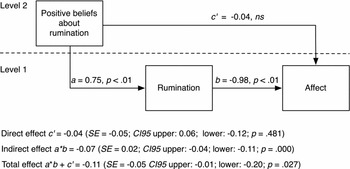
To investigate our hypotheses, a cross-level mediation model was examined (Krull and MacKinnon, Reference Krull and MacKinnon2001). In Krull and MacKinnon's (Reference Krull and MacKinnon2001) terminology a 2 → 1 → 1 mediation model was appropriate to test our hypotheses, that is a person level (level 2) effect on a within person (level 1) variable mediated by a within person (level 1) effect. In our study positive beliefs about rumination (Level 2) were modelled to predict average momentary positive affect (Level 1) either directly or indirectly via ruminative thinking (Level 1) in response to a negative emotion (see Figure 1). We used Stata statistical software (version 12.1, Stata Corporation, College Station, TX, USA) and the xtmixed command and ml_mediation package (Ender, Reference Ender2012; UCLA Academic Technology Services Statistical Consulting Group, 2012) to model random intercept multilevel mediation according to Krull and MacKinnon (Reference Krull and MacKinnon2001). The indirect effect was computed by multiplying the a and b paths in the mediation model (see Figure 1). We tested the significance of the indirect, direct, and total effect with an n = 500 bootstrap.
Multilevel mediation model, predicting momentary positive affect.
Notes.
Unstandardized coefficients.
CI95 = 95% confidence interval.
Confidence intervals based on an n = 500 bootstrap.

Results
The participants complied well with the 4-week protocol: on average 68.4 (SD = 14.72), out of a possible 84 signals were answered and completed. To examine whether compliance declined over the course oft he study, we computed a mixed logit regression to predict compliance by time, with the latter variable modelled as an endogenous parameter. The mixed logit regression model turned out to be non-significant with b = 0.18, SE = 0.25, p = .70. This indicates that protocol compliance did not deteriorate significantly during the course of the 4-week monitoring. Similarly, the degree of rumination did not change significantly over time, b = −0.02, SE = 0.03, p = .96.
The participants experienced on average 3.6 episodes of anger (SD = 2.6, range 0 – 11), 2.7 episodes of sadness (SD = 2.3, range 0 – 8) and 2.7 episodes of fear (SD = 2.3, range 0 – 12). While the rather low rates of fear are surprising the findings on sadness and anger are largely in line with previous evidence from non-clinical populations (Scherer, Wranik, Sangsue, Tran and Scherer, Reference Scherer, Wranik, Sangsue, Tran and Scherer2004). To rule our competing explanations, we tested if positive beliefs about rumination were associated with the occurrence of negative emotions. Mixed logit regression results showed that there was no significant association, with b = −.049 SE = 0.10, p = .626.
Effect estimates and 95% percentile confidence intervals, based on bootstrapping (N = 500) are shown in Figure 1. We found a significant indirect effect, that is the positive beliefs’ effect on momentary positive affect was significantly mediated by momentary ruminative thinking. The direct effect of positive beliefs about rumination was non-significant, whereas the total effect was significant.
Discussion
We set out to examine whether positive beliefs about rumination were associated with the occurrence of ruminative thinking in daily life as predicted by the metacognitive model of depression and the self-regulatory executive function theory of emotional disorders (Wells and Matthews, Reference Wells and Matthews1994). In line with our predictions we found that trait positive beliefs about rumination are associated with ruminative thinking as it occurs in daily life. Moreover, metacognitions were significantly associated with momentary affect, this effect, however, being almost completely mediated by momentary ruminative thinking as evidenced by the total, direct, and indirect effects of the multilevel mediation model. Taken together, our findings add to the evidence supporting the metacognitive model; in line with the model, recent longitudinal evidence on metacognitions (Yılmaz et al., Reference Yılmaz, Gençöz and Wells2011) demonstrate that positive beliefs about rumination are indeed associated with ruminative thinking in daily life. The mediation mechanism that we found further corroborated the model's assumptions in terms of processes underlying the metacognition–negative affect link.
However, the total effect of metacognition is merely modest in terms of its effect size. One explanation may lie in the nature of rumination which, as pointed out by Watkins (Reference Watkins2008), is not necessarily only dysfunctional. Different (dys)functional modes of ruminative thinking seem to exist that could be considered an appropriate mode of cognitive processing under specific circumstances: These pertain to different content and perspectives of ruminations (Ayduk and Kross, Reference Ayduk and Kross2009; Kross, Ayduk and Mischel, Reference Kross, Ayduk and Mischel2005; Maria, Reichert, Hummel and Ehring, Reference Maria, Reichert, Hummel and Ehring2012) or the identification of emotion-specific facets or further moderating factors (Siewert, Kubiak, Jonas and Weber, Reference Siewert, Kubiak, Jonas and Weber2011). For instance, in a recent EMA study, Huffziger, Ebner-Priemer, Koudela, Reinhard and Kuehner (Reference Huffziger, Ebner-Priemer, Koudela, Reinhard and Kuehner2012) examined the effect of experimentally induced modes of rumination on momentary affect and found that particularly self-focused as opposed to distanced rumination led to a sustained decrease of positive affect. Distanced rumination may even be helpful as shown by Kross et al. (Reference Kross, Ayduk and Mischel2005). On the same reasoning, positive beliefs about rumination may not only have a dysfunctional basis but could reflect positive experience with ruminative thinking in the past, that is solving problems or even effectively regulating emotions by ruminating. Trait metacognitions as assessed in our study may tap into both types of metacognitions, functional and dysfunctional possibly leading to low effect sizes of the metacognition paths. Future research should try to address this possible issue by differentiating between modes of ruminative thinking and possibly functional and dysfunctional metacognitions.
One prominent limitation of the study is its correlational nature that prevents us from drawing causal inferences pertaining to a directional effect of positive beliefs about rumination on ruminative thinking in daily life. However, from a conceptual perspective a trait like set of metacognitions, as assessed in the current study at baseline, precedes actual behaviour and experiences that could be with caution taken as a hint for a directional relationship. Moreover, we only examined rumination in response to negative affect and our findings may not generalize on ruminative thinking that occurs without a triggering episode of affect. The latter may also play a prominent role within the metacognitive model and warrants further study.
We acknowledge further limitations of our study. First, although we observed good compliance with the sampling protocol and no evidence in terms of reactivity, EMA studies are generally prone to reactivity effects (Barta, Tennen and Litt, Reference Barta, Tennen, Litt, Mehl and Conner2012.). A further methodological point concerns the sampling frequency, with four scheduled measurements per day implying (modest) recall periods for the diary self-reports and not “true” real-time assessment. We opted deliberately for this sampling frequency as we expected compliance and acceptance to deteriorate considerably were the frequency increased, particularly in light of the long monitoring duration of 4 weeks.
Second, only a non-clinical sample was studied and our findings call for replication in samples of people with depression and other emotional disorders. In addition, we neither assessed depression nor depressive symptomatology in a strict sense. Thus, from a conceptual angle we were only able to test the positive beliefs about rumination –rumination link of the metacognitive model. An EMA study pertaining to the hypothesized negative beliefs about depression–depression link remains to be conducted.
Conclusions
Our results confirmed our hypotheses and provide evidence of high ecological validity in support of the metacognitive model of depression that had so far been missing, as most studies relied on retrospective, questionnaire-based self-report. From a therapeutic perspective, our results also support the key role of metacognitions as a promising target for interventions, as in metacognitive therapy. Incorporating EMA-based patient reported outcomes in intervention research on metacognitive therapy would be a worthwhile endeavour. Based on the modest effect size of metacognitions that we found we argue that future research should differentiate between functional and dysfunctional modes of ruminative thinking as well as (dys)functional metacognitions.
Acknowledgements
This research was funded by the German Research Foundation (DFG KU 2465/1-1).



Comments
No Comments have been published for this article.