




Crossref Citations

This article has been cited by the following publications. This list is generated based on data provided by Crossref.
HINDRIKS, FRANK
and
GUALA, FRANCESCO
2015.
Understanding institutions: replies to Aoki, Binmore, Hodgson, Searle, Smith, and Sugden.
Journal of Institutional Economics,
Vol. 11,
Issue. 3,
p.
515.
Herrmann-Pillath, Carsten
2016.
Institutional Naturalism: Reflections on Masahiko Aoki's Contribution to Institutional Economics.
SSRN Electronic Journal,
CRESPO, RICARDO F.
2016.
Aristotle on agency, habits and institutions.
Journal of Institutional Economics,
Vol. 12,
Issue. 4,
p.
867.
Dequech, David
2017.
The Concept of Development Conventions: Some Suggestions for a Research Agenda.
Journal of Economic Issues,
Vol. 51,
Issue. 2,
p.
285.
Markey-Towler, Brendan
2019.
Rules, perception and emotion: When do institutions determine behaviour?.
Journal of Institutional Economics,
Vol. 15,
Issue. 3,
p.
381.
Lana Berasain, José Miguel
2021.
Reglas, actores, potestades y equilibrios. ¿De qué hablamos cuando abordamos la propiedad como institución?.
Iberian Journal of the History of Economic Thought,
Vol. 8,
Issue. 1,
p.
23.
Rosenbaum, Eckehard
2021.
Mental models and institutional inertia.
Journal of Institutional Economics,
p.
1.
Degli Antoni, Giacomo
Faillo, Marco
Francés-Gómez, Pedro
and
Sacconi, Lorenzo
2022.
Liberal egalitarian justice in the distribution of a common output. Experimental evidence and implications for effective institution design.
Journal of Institutional Economics,
Vol. 18,
Issue. 6,
p.
901.
Isogai, Akinori
2024.
Present and Future of Evolutionary Economics.
Vol. 31,
Issue. ,
p.
41.
Taniguchi, Kazuhiro S.
2025.
Understanding Masahiko Aoki’s comparative institutional analysis.
Journal of Institutional Economics,
Vol. 21,
Issue. ,
Hindriks, Frank
2025.
The Structure of the Open Society.
Hingl, Kurtis
and
Shera, Marcus
2025.
Ideas, institutions, and incompleteness.
Journal of Institutional Economics,
Vol. 21,
Issue. ,
Hindriks, Frank
2026.
The Oxford Handbook of Social Ontology.
p.
255.
For me the article by Hindriks and Guala (Reference Hindriks and Guala2014) is a welcome addition to the literature on institutions: it nicely lays the debate between so-called institutions-as-rules view versus institutions-as-equilibrium to a rest. Contrasting these two views as if they are not incompatible often leads to a superficial straw man such as ‘equilibrium market prices are not institutions’. Certainly, rules that are socially enforceable in one way or other, or the regulative rules in Searle's terminology, could be regarded as (at least as elements of) institutions. But for social sciences it is imperative to inquire and understand why and how rules emerge, and become collectively accepted, enforceable, and evolving. The mere dictum: ‘institutions are the rules of social games’ is not much far from a tautology. According to Williams (Reference Williams1983: 168–9) the English word ‘institution’ is ultimately traceable to the Latin word ‘stature’ (‘to establish’), which is related to the Latin word ‘status’ implying something established or stable. Thus original meaning of institutions is deeply rooted in the notion of equilibrium.
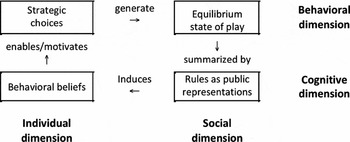
Then, how are the notion of equilibrium and that of rules interrelated? For this, I basically agree with the argument by Hindriks and Guala who generously refer to my past works. Let me dare to reproduce, however, the Figure 1 used in (Aoki, Reference Aoki2001; Reference Aoki2011) with some modifications to clarify the shortcomings of both the so-called rule view and the classical equilibrium view in the simplest way. As known, the classical game theory starts out with the lower-left box with the premise of complete knowledge of the structure of the game among agents and common knowledge about behavioral belief of each agent derived therefrom. It then ends with the upper-right box, which is then identified as an institution (e.g. Schotter, Reference Schotter1981). But this classical theory is incomplete in that it does not explain how such common knowledge becomes possible if multiplicity of equilibrium is a possibility. As a seminal work by Lewis (Reference Lewis1969: 56) argued, some ‘public proposition’, as represented by the lower-right box, is necessary such that everyone can derive common behavioral inference therefrom. On the other hand, the rule of the game view à la North starts with the lower-right box (the rules) and ends with the upper-left box (constrained behaviors of agents). It does not explain where those rules come from (except for the government) and why they are followed by agents. For the rules to be followed, they must be regarded as legitimate, enforceable, reasonable, agreeable, or else by all the agents. It would become so when the rules are endorsed and confirmed by repeated stable plays of the game.
Institutions as integrated processes involving rules (modified from Aoki (Reference Aoki2001, Reference Aoki2011)).
In the primitive equilibrium view, the link from the lower-right box to the lower left box is missing, while in the rule view the link from the upper-right to lower-right box is missing. In order to have a complete picture of institutions as a stable process, we need to take both linkages into consideration. Having said this, I do not object to singling out the lower-right box as the substantive form of institution that generates shared beliefs, or dispositions, among the agents in the lower-left box. Using rigorous set-theoretic notions, Aoki (Reference Aoki2001: 197–202, Reference Aoki2010b: 124–128) derived the concept of institutions as summary representations of equilibria (not equilibria as such as often misunderstood) common to everyone that is invariant under agents’ reaction to a modicum of environmental variations. As such, it essentially corresponds to the pioneering Hayekian concept of cognition by classification (Hayek, Reference Hayek1952), applied to a decomposition of possible events in a strategic space. It thus requires a linguistic/symbolic representation such as laws, norms, organizational names, money, rituals, and even folklore and mythology. Equilibrium and idea/sign are not opposing notions but they are complementary. I hope Figure shows succinctly that equilibrium is part of the ontological nature of institutions, while its substantive forms mediate between stable states of societal play and individual-cum-collective intentionality.Footnote 1
I also basically agree with the Hindriks and Guala's argument on Searle. Searle prominently argues that by applying the status function (X counts as Y in context C) successively, higher institutional realities could be constituted. By this way the important role of linguistic representation in institutional evolution is highlighted and elucidated. This is fine. However, to complete the theory, Hindriks and Guala raise a legitimate question of ‘what does Y refer to, exactly?’ (p.13) For example, what does Y refer to when it is money? Searle admitted in his recent book 2010 there could be ‘a free standing Y that is made up by a simple Declaration.’(2010: 101) I would rather argue that money evolves first of all by mutual agreements in practice and cognitions among market participating agents that a certain good is exchangeable for anything.
Related to this issue, although Hindriks and Guala do not explicitly discuss it, is Searle's proposition that ‘deontological values/power’ precedes ‘desire-based’ behavior and the deontological power initially arises in ‘brute facts’ (Reference Searle2005). Thus in spite of his insistence on the ‘collective acceptance’ of deontological values based on individual intentionality, his theory seems to be bent on the Kantian-like exogenous view. I would rather subscribe to the Hegelian-like view of social values as arising from mutual recognitions among agents (Herrmann-Pillath and Bordoyev, Reference Herrmann-Pillath and Boldyrev2014). In modern game-theoretic terms norms and deontological values may be regarded as emergent through repeated social-exchanges among agents who are strategically concerned with developing own emotional payoffs if not materially desired payoffs (Aoki, Reference Aoki, Lin and Pleskovic2010a). From this perspective, I regard the authors’ argument that Y-term in Searle's original constitutive rule should be unpacked as ‘if Y, then Z’, which specifies ‘mutually agreed’ (‘equilibrium’!) actions Z under the condition Y. Indeed, Aoki (Reference Aoki2011: 201) listed six examples of linguistic public representations related to property rights, community norm, employment contract, money, and political state as an evolutionary/subgame-perfect equilibrium of a respectively relevant game, and all of them essentially take a form of either regulative rule (if Y, then Z) or constitutive rule (X counts as Y).
Further a merit of equilibrium notion of institutions is its ability to understand possible interdependencies and mutual reinforcements among particular forms of institutions in a society such as social embededness and institutional complementarities. It becomes possible through game-theoretic analysis of strategic complementarities and linkages across societal games in different domains (Aoki, Reference Aoki2001; Gagliardi, Reference Gagliardi2013). It is important to grasp and understand institutions as integral processes and ideas of the societal order rather than just as a collection of discretionary rules.