Hematopoietic syndrome (HS) is a clinical diagnosis assigned to individuals who present with ≥1 new-onset cytopenias in the setting of whole-body or significant partial-body acute radiation exposure. The severity of lymphopenia and thrombocytopenia correlate in general with cumulative radiation dose and dose rate.Reference Fliedner, Friesecke and Beyrer1 The rate of decline in absolute lymphocyte count correlates closely with dose and dose rate, and has been used as a surrogate marker for whole-body dose.Reference Goans, Holloway, Berger and Ricks2Reference Parker and Parker3 The primary causes of HS are radiation-induced suppression of mitosis in hematopoietic stem/progenitor cells and their progeny, resulting in hypocellularity and aplasia of the bone marrow and apoptosis in lymphocytes and other hematopoietic cells.
Although guidelines have been proposed to aid clinicians in the evaluation, triage, and/or medical management of victims of acute radiation injury,Reference Waselenko, MacVittie and Blakely4Reference Gorin, Fliedner and Gourmelon5 the level of evidence supporting the current recommendations has not been evaluated. The World Health Organization (WHO) convened a panel of experts in Geneva, Switzerland, from March 16 to 18, 2009, to develop a harmonized approach to the medical management of acute radiation exposure. Among their considerations was the evidence supporting the clinical management of HS.Reference Mettler and Upton6Reference Dainiak, Waselenko, Armitage, MacVittie and Farese7 Using the Grading of Recommendations Assessment Development and Evaluation (GRADE) system for evaluating evidence supporting clinical guidelines,Reference Schünemann, Oxman and Brozek8 the consultation group weighted the available evidence supporting the use of cytokines, hematopoietic stem cell transplantation, or both in the management of HS.
METHODS
Participants in the consultancy were selected based upon their established expertise in the field. They were asked to consider and respond to a virtual scenario in which 100 to 200 victims required hospitalization. English language references were identified by each consultant before the meeting. All of the references were provided to the WHO and were made available to conferees. At the time of the meeting, additional English-language articles were identified in MEDLINE and PubMed from inception to the time of the consultancy. Search terms included radiation or radiation toxicity or ionizing radiation and therapy or treatment or cytokines or transplantation or hematopoietic system. Publications included case series, individual case reports of humans who were accidentally exposed to ionizing radiation, randomized control trials and cohort studies of humans who received therapeutic radiation or who may not have been exposed to radiation but who received the indicated treatment, reports of experimental studies in irradiated animals, and prior publications of recommendations of other consensus groups. Reference lists and references were distributed periodically throughout the meeting, as specific topics were raised for discussion.
Questions on the clinical management of HS were framed in the PICO format (patient problem, intervention, comparison, and outcome).Reference Richardson, Wilson, Nishikawa and Hayward9 To assess the quality of the evidence objectively, drafts of GRADE evidence profiles were prepared, according to WHO recommendations for guideline development.Reference Schünemann, Oxman and Brozek8 Letter assignments (A, B, C, and D) were made based upon the level of certainty that the magnitudes of benefits and harms of an intervention are known (Table 1 of the accompanying article by the same authors). Ranking the evidence with this tool was discussed and clarified by an expert (H.S.) on the GRADE approach.Reference Guyatt, Oxman and Kunz10Reference Guyatt, Oxman and Vist11 Criteria included study design, study limitations, consistency rate across studies, directness or generalizability of study results, bias, dose-response gradient, and confounding variables. A single individual (R.N.G.) entered all of the data, and the subsequent findings were reviewed for accuracy by a subgroup of conferees (N.D., Z.C., R.S., J.A., and V.M.) in advance of consideration by the entire consultation group. All of the consultants were asked to make final comments before scoring the strength of each recommendation. A final consensus ranking of recommendations was made by e-mail to all of the conferees.
Strong or weak recommendations for the use of hematopoietic cytokines/growth factors or stem cell transplantation were made based upon the balance between desirable and undesirable consequences of alternative treatment strategies, the quality of the evidence, uncertainty about or variability in values and preferences, and impact on resource utilization. A numerical score was used to gauge the strength of recommendations (see the accompanying article by the same authors). These recommendations included one favoring a practice having a high certainty of substantial net benefit (1a) or a practice having a moderate certainty of moderate net benefit (1b). A recommendation against a practice was made when the practice was believed to have a moderate or high certainty of no net benefit (2a) or to have a moderate or high certainty of a small net benefit (2b).
RESULTS
Rationale for Cytokine Administration
Hematopoietic cytokines such as granulocyte colony-stimulating factor (G-CSF) and granulocyte macrophage colony-stimulating factor (GM-CSF) have been used since the 1980s to treat radiation-associated cytopenias.Reference Butturini, De Souza and Gale12 Although their use in radiation accident victims has been recommended by 2 expert groups,Reference Waselenko, MacVittie and Blakely4Reference Gorin, Fliedner and Gourmelon5 the quality of the evidence supporting this recommendation is highly variable.
Clinical trial data supporting the use of cytokine efficacy in the treatment of humans with accidental radiation-induced hematopoietic stem/progenitor cell injury is not robust; additional evidence comes from studies in experimental animals. The administration of G-CSF, GM-CSF, erythropoiesis-stimulating agents (ESAs), and/or thrombopoietin-receptor agonists after exposure to ionizing radiation appears to significantly increase circulating blood counts in humans or nonhuman primatesReference Butturini, De Souza and Gale12Reference Neelis, Dubbelman, Qingliang, Thomas, Eaton and Wagemaker13Reference Asano14Reference Liu, Jiang and Jiang15; however, the lack of a human control group (eg, patients not receiving cytokine treatment) limits interpretation of these results.Reference Dainiak16 Spontaneous recovery of blood counts occurred several weeks after the appearance of severe cytopenias in humans with HS, even in the absence of cytokine therapy.Reference Baranov, Guskova, Nadejina and Nugis17
In an effort to justify the use and efficacy of cytokines in treating HS, researchers have used animal models. Based on the scientific literature suggesting a beneficial effect in the treatment of HS and the evidence of efficacy of cytokines in chemotherapy, a consensus has emerged that it is not ethically justifiable to conduct a placebo-controlled trial of cytokines in human victims of radiation sickness. In light of this lack of clinical equipoise, the best-available scientific evidence comes (and may continue to come) from animal-based experiments. Survival benefits observed in irradiated rhesus macaques and canines receiving G-CSF, GM-CSF, pegylated G-CSF thrombopoietinReference Neelis, Dubbelman, Qingliang, Thomas, Eaton and Wagemaker13Reference Patchen, MacVittie, Solberg and Souza18Reference Neelis, Hartong, Egeland, Thomas, Eaton and Wagemaker19 support continued use of cytokines in humans exposed to high-dose ionizing radiation.
Analysis of Cytokine Effects Using GRADE
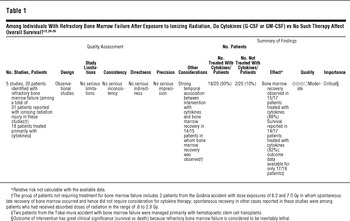
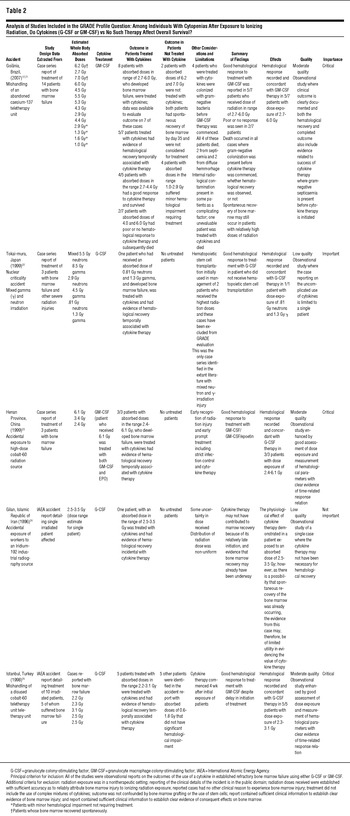
In reviewing the evidence of hematological system injury, we found 5 reported accidents (Goiãnia, Brazil; Tokai-mura, Japan; Henan Province, China; Istanbul, Turkey; and Gilan, Iran), that enabled the establishment of bone marrow failure, the documentation of cytokine use, and the demonstration of effect on the hematological system. Table 1 provides a summary of an analysis of the evidence. Table 2 is a complete GRADE analysis of the effects of cytokines on overall survival among individuals with cytopenias after exposure to ionizing radiation. Among these accidents, 18 cases of cytokine use were reported.Reference Butturini, De Souza and Gale12Reference Brandao-Mello, Oliveira, Valverde, Farina and Cordeiro2021Reference Hirama, Tanosaki and Kandatsu222324 Eight patients received G-CSF and 10 received GM-CSF (Table 1).
Among Individuals With Refractory Bone Marrow Failure After Exposure to Ionizing Radiation, Do Cytokines (G-CSF or GM-CSF) vs No Such Therapy Affect Overall Survival?Reference Butturini, De Souza and Gale12Reference Brandao-Mello, Oliveira, Valverde, Farina and Cordeiro2021Reference Hirama, Tanosaki and Kandatsu222324Reference Grimes and Schulz25Reference Grimes and Schulz26

Analysis of Studies Included in the GRADE Profile Question: Among Individuals With Cytopenias After Exposure to Ionizing Radiation, Do Cytokines (G-CSF or GM-CSF) vs No Such Therapy Affect Overall Survival?

Among the data reported from the Goiãnia accident, 2 patients experienced spontaneous reversal of leukopenia by 35 days postexposure to 6.2 or 7.1 Gy, and 8 individuals demonstrated persistent leukopenia for 24 to 47 days, and GM-CSF therapy was initiated at this time. Four of the individuals treated with cytokines (radiation doses of 2.5-4.4 Gy) survived and recovered from leukopenias. Four of the treated individuals (doses of 4.0-6.0 Gy received) died of Gram-negative sepsis and/or hemorrhagic complications, 3 of whom experienced minimal increase in their white blood cell count (Table 2). Four of the 6 patients from the Tokai-mura accident (1 patient) and the Henan Province accident (3 patients) were evaluable by GRADE, and all of them demonstrated improvement in absolute neutrophil count (Table 2).
In the 5 nuclear accidents, among the patients whose exposure dose was >5 Gy, 1 of 3 patients treated with cytokines survived. At exposures <5 Gy, 14 of 15 patients survived. The consultation group interpreted this observational finding as suggesting a possible benefit to myelopoiesis used in patients with exposure doses <5 Gy, when the only likely organ-critical failure is the hematopoietic system.
In assessing the effectiveness of cytokines, the GRADE analysis was severely restricted by our failure to identify any true control or comparator groups. Descriptive studies like these that do not have an appropriate, contemporaneous comparison group allow assessment of hypotheses for possible associations but not robust assessments of causality.Reference Grimes and Schulz25 Randomized, appropriately designed, and powered studies are much more useful in studying causality.Reference Grimes and Schulz25 In this case, a temporal association of cytokine administration followed by myeloid recovery should not be inferred as strong evidence of causality.Reference Grimes and Schulz26
Rationale for Stem Cell Transplantation
Hematopoietic stem/progenitor cells of the bone marrow undergo mitotic death after exposure to ionizing radiation, with a Do (the radiation dose that reduces survival to e−1 or 0.37 of its previous value on the exponential portion of the survival curve) for human marrow colony-forming units granulocyte-macrophage of 1.02 ± 0.05 at a dose rate of 2 Gy/minReference FitzGerald, McKenna, Rothstein, Daugherty, Kase and Greenberger27 and for human peripheral blood total colony-forming cells of 1.18 ± 0.24 at a dose rate of 0.8 Gy/min.Reference Oriya, Takahashi and Inanami28 This particular in vitro measure of sensitivity to radiation correlates with the appearance of the HS that occurs in individuals whose partial-body or whole-body radiation exposure exceeds approximately 1 Gy.Reference Dainiak, Waselenko, Armitage, MacVittie and Farese729 The clinical correlate of this laboratory observation is the significantly diminished capacity of hematopoietic stem/progenitor cells to proliferate in vivo after a whole-body dose exceeding 2 to 3 Gy.
Depending on the dose, dose rate, and radiation quality factor, various degrees of pancytopenia develop over several weeks after whole-body or significant partial-body exposure.Reference Waselenko, MacVittie and Blakely4Reference Mettler and Upton6Reference Alexander, Swartz and Amundson30 Hypocellularity and aplasia of the bone marrow may occur at doses >3 Gy.Reference Waselenko, MacVittie and Blakely4Reference Mettler and Upton6Reference Alexander, Swartz and Amundson30Reference Fliedner, Meineke, Akashi, Dainiak and Gourmelon31 Factors that may exacerbate the effects of radiation include a patient's age, underlying state of health, and overall nutritional status.
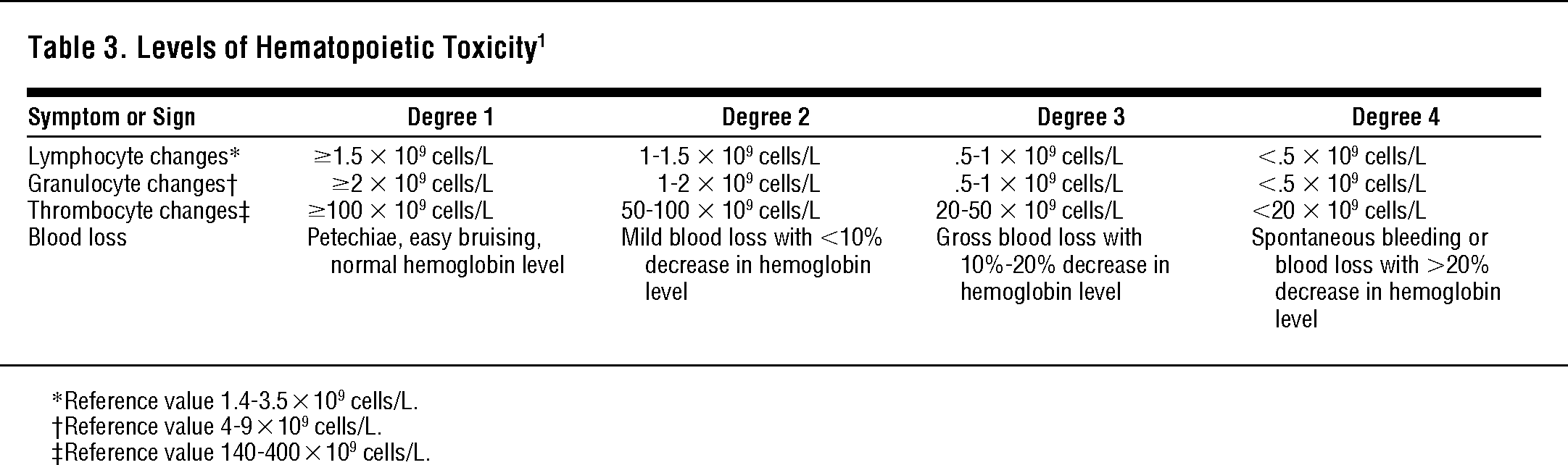
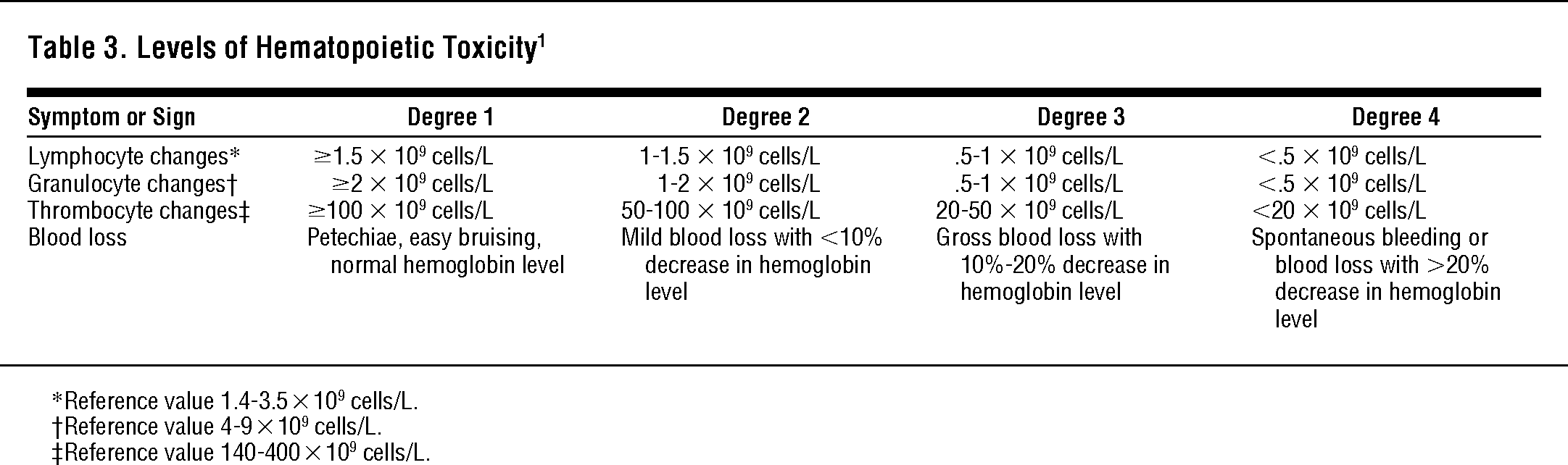
Hematopoietic stem/progenitor cell therapy has been recommended for patients with complete aplasia of the bone marrow, as assessed by bone marrow biopsies taken from 2 noncontiguous sites.Reference Waselenko, MacVittie and Blakely4Reference Gorin, Fliedner and Gourmelon5 Such individuals would be expected to have third- or fourth-degree hematopoietic toxicity (Table 3).
Levels of Hematopoietic ToxicityReference Fliedner, Friesecke and Beyrer1
Analysis of the Effects of Bone Marrow Transplantation Using GRADE
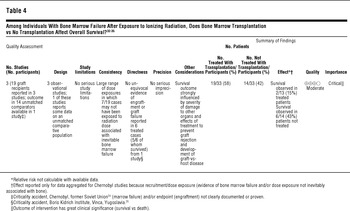
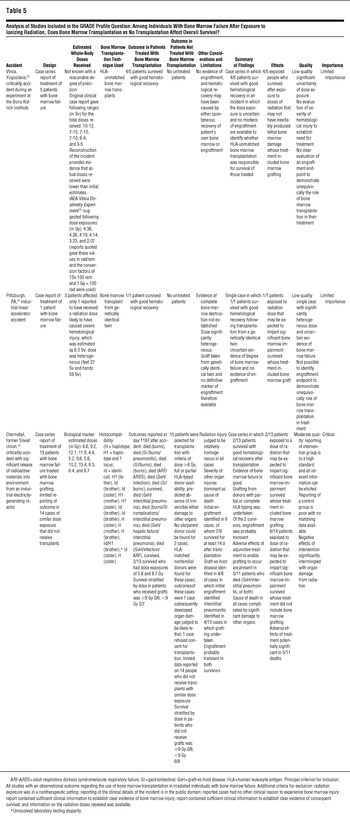
A crude meta-analysis of 3 reported incidents in which bone marrow transplantation was used to treat radiation-induced marrow failure was performed. Table 4 provides a summary of this analysis. Table 5 presents a complete GRADE analysis of the question of the impact of bone marrow transplantation on overall survival among individuals with bone marrow failure after exposure to ionizing radiation. In these reports,Reference Jammet, Mathe and Pendic32Reference Baranov, Gale and Guskova3334Reference Gilbert35 some of which predate the use of cytokines, survival appeared not to rely on transplantation, and may have been affected adversely by transplantation.
Among Individuals With Bone Marrow Failure After Exposure to Ionizing Radiation, Does Bone Marrow Transplantation vs No Transplantation Affect Overall Survival?Reference Jammet, Mathe and Pendic32Reference Baranov, Gale and Guskova3334Reference Gilbert35

Analysis of Studies Included in the GRADE Profile Question: Among Individuals With Bone Marrow Failure After Exposure to Ionizing Radiation, Does Bone Marrow Transplantation vs No Transplantation Affect Overall Survival?

Stratification of the results from the Chernobyl studyReference Baranov, Gale and Guskova33 suggests that survival is more likely among individuals receiving <9 Gy and no bone marrow transplant. Nevertheless, the data are too restrictive to allow definitive statistical analysis. Survival in 2 additional patients (one receiving a peripheral blood transplant and the other receiving a cord blood transplant) from the Tokai-mura accident was possibly longer than predicted by the estimated whole-body radiation dose.Reference Maekawa36 These individuals also received concurrent cytokine therapy, and comparators were not available. Data are insufficient to determine the impact of genetically identical bone marrow transplantation on outcomes.
In summary, the data available from these reports strongly suggest that the effect of hematopoietic stem/progenitor cell transplantation is unproven as initial therapy for HS after irradiation.
RECOMMENDATIONS
The consultation group strongly considered the GRADE evidence profiles for cytokine administration and bone marrow transplantation in developing recommendations for the management of HS. The group also derived recommendations in part from results of these therapies in controlled animal trials. During the deliberation process, guidelines provided by expert consensus groups and by national and international societies also were considered, reviewed, and discussed.
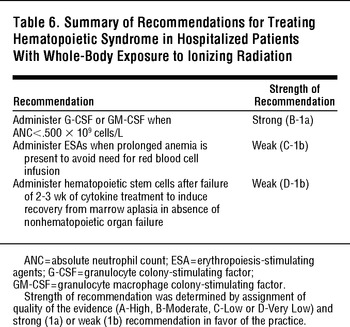
Although the evidence for cytokine administration from radiation incident reports alone is weak, results are remarkably consistent from controlled animal trialsReference Neelis, Dubbelman, Qingliang, Thomas, Eaton and Wagemaker13Reference Patchen, MacVittie, Solberg and Souza18Reference Drouet, Mourcin and Grenier37Reference Hérodin, Grenier and Drouet38 and reports recommending the use of CSF in nonirradiated (eg, chemotherapy treated) patients with malignancy, as recommended by the American Society of Clinical Oncology,Reference Smith, Khatcheressian and Lyman39 by the European Society of Medical Oncology,Reference Greil, Thödtman and Roila40 and by consensus groups.Reference Waselenko, MacVittie and Blakely4Reference Gorin, Fliedner and Gourmelon529 The consistency of the observation that cytokines successfully treat hematological injury in animal models and in humans with hematological deficits of nonradiation origin, together with the relatively limited drug-related toxicity reported for certain cytokines, leads to a strong recommendation that these cytokines should be used in the management of radiation-induced hematotopoietic system injury (Table 6).
Summary of Recommendations for Treating Hematopoietic Syndrome in Hospitalized Patients With Whole-Body Exposure to Ionizing Radiation

Health care providers should consider initiating cytokine therapy for exposures of ≥2 Gy and/or a significant decrease in the absolute lymphocyte count, or when it is anticipated that neutropenia of <.5 × 109 cells per liter will persist for ≥7 days. It is recommended that cytokine therapy with G-CSF or GM-CSF be initiated within 24 hours of exposure. Pegylated G-CSF may be used as an alternative to G-CSF. Patients should continue to receive treatment until their absolute neutrophil count reaches and maintains a level >1.0 × 10⁹ cells per liter in the absence of active infection. Those with infection should be treated with cytokines, according to the guidelines published by infectious disease societies, including the Infectious Diseases Society of America.Reference Hughes, Armstrong and Bodey41
Individuals with prolonged anemia, a significant decline in hemoglobin concentration, or both may be candidates for treatment with erythropoietin. In contrast to the relatively short life span of myeloid cells and platelets (<10 days), the life span of erythrocytes is approximately 120 days. Experiencing a response to erythropoietin will take weeks rather than days. Consideration should be given to the administration of oral iron supplementation in individuals receiving ESAs. ESAs may be considered in the lowest dosage that induces a sufficiently high hemoglobin level to render blood transfusion unnecessary (ie, 9-10 g/dL), although a higher level of hemoglobin may be reasonably targeted on a case-by-case basis. Strong caveats recommending specific indications for the use of ESAs are incorporated in a “black box” warning by the US Food and Drug Administration (FDA).42 The initial dose of ESAs should follow the recommendations of the FDA, the the European Medicines Agency, or other relevant regulatory authorities, as provided in the manufacturer's labeling. Dosing is based on a patient's hemoglobin level at the initiation of therapy, his or her target hemoglobin level, the observed rate of increase in hemoglobin level, and individual clinical circumstances. Finding few published reports in humans with nonimmunological thrombocytopenia or exposure to radiation, the consultancy group makes no recommendation regarding the use of second-generation thrombopoietic growth factors.
Because patients with severe hematopoietic injury may recover, either spontaneously or after G-CSF treatment alone, clinicians considering bone marrow transplantation are advised to adopt a wait-and-see approach with careful surveillance. Stem/progenitor cell replacement therapy should not be administered until there is a documented lack of spontaneous recovery and/or lack of response following 2 to 3 weeks of cytokine treatment. Survival outcomes have been poor among patients who have received transplants who also have radiation burns, gastrointestinal syndrome, infection, adult respiratory distress syndrome, and/or renal insufficiencyReference Jammet, Mathe and Pendic32Reference Baranov, Gale and Guskova3334Reference Gilbert35Reference Maekawa36; therefore, it has been recommended that hematopoietic stem/progenitor cell therapy not be used for patients with aplasia and significant injury to another organ system.Reference Waselenko, MacVittie and Blakely4Reference Dainiak, Waselenko, Armitage, MacVittie and Farese729Reference Dainiak and Ricks43Reference Densow, Kindler, Baranov, Tibken, Hofer and Fliedner44 With these caveats in mind, the consulting group makes a weak recommendation for the administration of allogeneic hematopoietic stem/progenitor cells from the bone marrow, peripheral blood, or cord blood of patients who are unresponsive to cytokine therapy and in whom there is no significant injury to a nonhemopoietic organ system (Table 6).
CONCLUSIONS
The WHO panel of experts used the GRADE tool to extract and analyze data from reports of cytokine administration and/or bone marrow transplantation in individuals with HS after exposure to ionizing radiation. The lack of comparator groups in humans restricts these analyses. Nevertheless, together with results of controlled trials in large animals and clinical trials in nonirradiated humans, these analyses support the strong recommendation for G-CSF or GM-CSF administration and the weak recommendation for ESA or hematopoietic stem cell administration in humans with HS.
Disclaimer: The opinions or assertions contained herein are the private views of the authors and are not necessarily those of the World Health Organization, the International Atomic Energy Agency, the Centers for Disease Control and Prevention, the Bundeswehr Institute of Radiobiology, the Health Protection Agency, the National Institutes of Health, the Department of Health and Human Services, the US Army, or the US Department of Defense. The mention of specific commercial equipment or therapeutic agents does not constitute endorsement by the Bundeswehr Institute of Radiobiology, the Health Protection Agency, the US Department of Defense, or the Centers for Disease Control and Prevention. Trade names are used only for the purpose of clarification.
Author Disclosures: Dr Weinstock has been a consultant to Genzyme and Novartis.
The other authors report no conflicts of interest.
Acknowledgments: Owing to their seminal contributions in the field of radiation biology and their pioneering approaches to treatment of victims of radiation injury, this consultancy report is dedicated to Theodor M. Fliedner and Angelina Guskova. The authors thank Makoto Akashi, Axel Bottger, Thierry de Revel, Patrick Gourmelon, Richard Hatchett, Mikhail Konchalovski, Ying Liu, Maria Julia Marinissen, Hilary Walker, Helmut Walerius, and Wei Zhang for participating in the consultancy and contributing to consensus building. The authors are grateful to the National Institute of Allergy and Infectious Diseases for providing financial support for this consultancy.