




No CrossRef data available.
Article contents
Specific systemic IgG1, IgG2 and IgM responses in pigs immunized with infective eggs or selected antigens of Ascaris suum
Published online by Cambridge University Press: 09 October 2003
Abstract
A total of 35 pigs aged 15 weeks old, and 21 pigs aged 8 weeks old were divided into 7 groups. Groups 1 and 2 were uninfected and challenge control groups, respectively. Groups 3 and 4 were infected weekly with 6 increasing doses of Ascaris suum eggs, and group 4 was additionally treated with pyrantel. Groups 5, 6, and 7 were immunized weekly with the 14, 42, or 97 kDa fractions from adult worms, respectively. Animals of groups 2–7 were challenged with 10 000 A. suum eggs 7 days after the last infection/immunization. Serum was sampled weekly and specific IgG1, IgG2, and IgM responses were measured. Pigs of groups 5, 6, and 7 showed high IgG1 and IgG2 responses especially against adult worms antigens, while infected groups had high IgG1 and IgM responses, especially against larva. The IgG1 responses were negatively correlated to the numbers of larvae in the lungs, and positively associated with the liver white spot numbers. There was a positive correlation between IgG2 and the numbers of white spots and lung larvae, while IgM was negatively correlated with these parasitological measures. These findings are discussed and it is suggested that acquired resistance against A. suum larvae is correlated with the induction of IgG1 and IgM, and not with IgG2, and that future vaccination protocols may focus on inducing the Th2 activity.
Information
- Type
- Research Article
- Information
- Copyright
- © 2003 Cambridge University Press
INTRODUCTION
Protective immunity to A. suum has been demonstrated in pigs using multiple immunizing doses of infective eggs (Urban & Tromba, 1982; Lunney, Urban & Johnson, 1986; Urban, Alizadeh & Romanowski, 1988; Helwigh & Nansen, 1999; Jungersen et al. 1999 a) or parasite antigens (Urban & Romanowski, 1985; Hill et al. 1994). In immune pigs, a pre-hepatic barrier to migrating larvae has been correlated with a reduction in the numbers of characteristic white spots in the liver after a challenge infection, and with the number of larvae in the lungs (Urban et al. 1988; Eriksen et al. 1992 a, b). With the gradual acquisition of resistance to reinfection there is an increase in titres of specific antibodies in the serum (Lind et al. 1993).
Some reports have indicated a moderate age-dependent resistance to A. suum in helminth-naïve pigs (Eriksen et al. 1992 a), which was correlated with the level of serum antibodies reacting with A. suum antigens in sows, growers and finishers, suggesting a non-specific resistance to A. suum developed with age. Other authors have not been able to show any significant correlation between specific antibody levels and intestinal worm burdens, although significant positive correlations have been found between the number of milk spots and the antibody titres (Lind et al. 1993; Bøgh et al. 1994).
The characterization of the major A. suum antigens and the swine immune responses is incomplete, including the possible role of the various antibody isotypes in the resistance to A. suum. Investigation of the isotypes profiles in mice infected with A. suum showed that serum IgG1 and IgM increased during the first weeks of infection, but no consistent changes in IgG2 and IgA were observed (Crandall & Crandall, 1971). The aim of this study was to investigate the specific antibody class (IgG1, IgG2 and IgM) responses in pigs receiving multiple infections with infective A. suum eggs and in pigs immunized with parasite antigens in order to improve the knowledge of each isotype antibody in the resistance against A. suum in the natural host.
MATERIALS AND METHODS
Animals
Thirty-five Iberian pigs (15 weeks old) were obtained from an intensively managed swine herd. According to coprological analyses, the pigs had been naturally exposed to Oesophagostomum sp. and Trichuris suis infections. Twenty-one young Iberian pigs (8 weeks old) were born in helminth-free pens at the Veterinary Faculty of the University of Extremadura. Weekly faecal examinations were carried out on all animals to check for patent A. suum infections.
Experimental design
All pigs were allocated in 7 groups, each composed of 5 old and 3 young pigs. Groups 1 and 2 were uninfected and challenge controls, respectively. The pigs of groups 3 and 4 all received weekly increasing doses of 500, 1000, 2000, 5000, 10000, and 20000 infective A. suum eggs. Medicated feed (96 mg/kg pyrantel pamoate) was offered from 2 days before until 2 days after each pre-challenge inoculation to group 4. Groups 5, 6, and 7 were immunized with 6 weekly doses of 1 μg/kg body weight of the 14 kDa and 42 kDa fractions of body fluid (BF) and 97 kDa of body wall (BW), respectively. On day 42 of the experiment (7 days after the last pre-challenge and 7 days before necropsy), groups 2 to 7 were challenged with 10000 infective eggs and the number of liver white spots and the larvae in the lung were counted 7 days later.
Antigens
Adult A. suum collected from naturally infected pigs were dissected to obtain the BF and the BW antigens by ultrasonic vibration as described previously by Serrano et al. (2001). Somatic (SL) and excretory/secretory (ES) antigens from artificially hatched 3rd-stage larvae (L3) were produced as described by Urban & Romanowski (1985). The 14 kDa and 42 kDa fractions from the BF and the 97 kDa fraction from the BW were obtained by SDS–PAGE (Laemmli, 1970) of the BF and BW soluble extracts and consecutively electroelution of the fraction bands as described by Serrano et al. (2001). The 14 kDa fraction was selected because it contains a major component of the BF and well-know allergen (ABA-1), although there are no previous studies on the protection of this fractions in pigs. The 42 kDa and 97 kDa fractions were selected among most clearly recognized fractions by A. suum naturally infected pigs (unpublished observations).
Necropsy procedure
Gross hepatic lesions corresponding to a recent larvae migration (mesh white spots) were counted on the liver surface (Serrano et al. 2001). The number of L3 was evaluated by artificial digestion as previously described by Serrano et al. (2001).
Measurement of specific isotype responses
Detection of specific antibodies was performed by an indirect ELISA. Briefly, polystyrene plates (Costar, 3590) were coated with 1 of 7 different antigens (BF, BW, SL, ES, 14 kDa, 42 kDa or 97 kDa fractions) in phosphate-buffered saline (PBS) at concentrations determined by checkerboard titration. Serum samples were diluted at 1[ratio ]600 (IgG1 and IgG2) or 1[ratio ]800 (IgM) and incubated for 30 min at 37 °C. After washing, secondary antibodies specific for pig IgG1 and IgG2 (mouse monoclonal anti-IgG1 pig CTS6135 and anti-IgG2 pig CTS6136, LABGEN®, respectively) and for pig IgM (rabbit polyclonal anti-IgM pig 643901, ICN®) were incubated for 1 h at 37 °C at 1[ratio ]500 dilution. A peroxidase-conjugated rabbit anti-mouse IgG (A-9044, Sigma®) diluted 1[ratio ]10000 and 1[ratio ]20000, was incubated for 30 min at 37 °C for the detection of anti-IgG1 and anti-IgG2, respectively. For IgM detection, a peroxidase-conjugated goat anti-rabbit IgG (1[ratio ]10000) was incubated for 30 min at 37 °C. After washing, 100 μl of substrate (1·8 μg orthophenylenediamine and 3 μl of hydrogen peroxide in 1 ml of 0·1 M sodium citrate buffer, pH 5·0) were added per well. The reaction time and the absorbances were as follows: IgG1 (30 min, 450 nm), IgG2 (45 min, 490 nm, after sulphuric acid was added) and IgM (45 min, 490 nm, after sulphuric acid was added). Negative and positive control sera were added to all plates and the optical density values (OD) were corrected for plate-to-plate variation according to the following calculation: (sample mean OD)−(control positive mean OD for all plates/control positive mean OD in each plate).
Statistical analysis
Differences between groups were analysed by analysis of variance (ANOVA) and post hoc comparisons of pairs of groups was estimated by the Ryan-Einot-Gabriel-Welsch multiple range test (Day & Quinn, 1989). Pearson correlation coefficients were calculated between number of white spots or larvae in lungs and the IgG1, IgG2, IgM OD values. All analysis were carried out using the SPSS 10.0 software package.
RESULTS
White spots and larval burden
The level of protection due to the infection/immunization protocols has been presented in detail elsewhere (Serrano et al. 2001). The numbers of mesh white spots in the livers and the lung larvae and the percentage reduction of these parameters are represented in Table 1.

IgG1 responses
At the start of the experiment (day 0), the OD values of IgG1 were generally higher but not statistically significant in the old than in the young pigs. In contrast, at the day of challenge, the young animals of groups 3 and 4 had significantly higher ODs than old animals when using the BW (Fig. 1A,B), ES (Fig. 1C,D) and the 97 kDa fraction as antigens, while no significant differences were observed in groups 5 and 6. The young pigs of group 7 only had significantly higher ODs than old pigs against the SL and the BW (Fig. 1A,B). Both the age (8-week-old and 15-week-old) and the infection/immunization protocols (groups) influenced the development of the specific serum IgG1 responses. Thus, the specific serum IgG1 response to all A. suum antigens increased from week 1 in the old pigs (Fig. 1A,C) and from weeks 2–3 in the young pigs (Fig. 1B,D). The uninfected controls (group 1) and the challenge controls (group 2) did not have any increase in the antibody levels during the experiment. At the day of challenge, moderate IgG1 responses were observed in the egg-inoculated pigs of groups 3 and 4, reaching the highest ODs after using the 97 kDa, BW (Fig. 1A,B) and especially the 2 larval antigens (Fig. 1C,D) and starting a little earlier in group 3 than in group 4. The animals of group 5 had the highest IgG1 responses against the BF and the homologous fraction (14 kDa). Group 6 showed the highest ODs for all antigens in the old pigs (except against the 14 kDa and the BF), while group 7 only had the highest IgG1 responses against the 97 kDa and the BW (Fig. 1A,B) antigens in the young animals.

Fig. 1. Development of swine specific serum IgG1 against the body wall (A, B) and the excretory secretory larval (C, D) antigens during the experimental infection. Group 1 (□), control; group 2 (○), challenge control; group 3 ([utri ]), weekly egg-infected; group 4 ([loz ]), weekly egg-infected and treated with pyrantel; group 5 ([squf ]), weekly immunized with 14 kDa fraction; group 6 ([bull ]), weekly immunized with 42 kDa fraction; group 7 ([utrif ]), weekly immunized with 97 kDa fraction. Each point represents the mean of 5 older pigs (A, C) and 3 younger pigs (B, D).
At the day of challenge, positive but not significant correlations were obtained between the numbers of mesh white spots in the livers and the IgG1 ODs in the old and the young pigs. In contrast, the correlations with the numbers of larvae in lungs were negative for all antigens in young and old animals, being significant for ES (r=−0·52; P=0·01) and the 42 kDa (r=−0·44; P=0·04) antigens in the young pigs.
IgG2 responses
On day 0, the old pigs had significantly higher specific IgG2 ODs than the young animals when using the 2 larval products as antigens. However, there were no significant differences in the specific IgG2 ODs between the two age groups within the experimental groups at the day of challenge, except for group 5 against the BF (Fig. 2A,B) and the 14 kDa and for group 6 against the BW and the 42 kDa antigens. Neither the uninfected controls (group 1) nor the egg-inoculated pigs (groups 3 and 4) had any significant increases in specific serum IgG2 during the experiment (see Fig. 2). The young pigs of group 5 pigs developed a very high IgG2 response (comparable high responses in all 3 pigs) against the BF (Fig. 2D) and the 14 kDa antigens, while almost undetectable responses were obtained in the old pigs (Fig. 2A–C). In contrast, the group 7 showed higher IgG2 ODs in the old pigs (Fig. 2A,C) than in the young animals (Fig. 2B,D). The specific IgG2 immune responses showed moderate positive correlations with the comparable IgG1 responses (between r=0·79 and r=0·43 for the 42 kDa and the ES antigens, respectively) or low positive correlations with the IgM responses (between r=0·56 and r=0·20 for the 14 kDa and the BW antigens, respectively). Correlations between the mesh white spots in livers with IgG2 at the day of challenge was always positive in young and old pigs, being statistically significant against SL (r=0·56; P=0·008), BW (r=0·58; P=0·005) and the 97 kDa (r=0·46; P=0·05) antigens in the young animals. Similarly, positive although non-significant correlations were obtained between the IgG2 responses at challenge and the number of the lung larvae in old pigs. Only when using the ES, BF and the 14 kDa as antigens was the correlation negative, but not significant with the number of lung larvae in the young pigs.

Fig. 2. Development of swine specific serum IgG2 against the body fluid (A, B) and the 97 kDa (C, D) antigens during the experimental infection. Group 1 (□), control; group 2 (○), challenge control; group 3 ([utri ]), weekly egg-infected; group 4 ([loz ]), weekly egg-infected and treated with pyrantel; group 5 ([squf ]), weekly immunized with 14 kDa fraction; group 6 ([bull ]), weekly immunized with 42 kDa fraction; group 7 ([utrif ]), weekly immunized with 97 kDa fraction. Each point represents the mean of 5 older pigs (A, C) and 3 younger pigs (B, D).
IgM responses
The time-course of IgM was different compared to the IgG subclasses. On day 0 older pigs had significantly higher levels of IgM than younger animals when using all antigens (see Fig. 3). The uninfected control pigs (group 1) and the challenge control pigs (group 2) did not have any increase in the IgM levels during the experiment. The egg-inoculated young animals of groups 3 and 4 showed a significant increase in IgM responses at weeks 2 and 3 p.i. respectively against all antigens except the 14 kDa, later followed by a gradual decline (Fig. 3A,B). The IgM responses in the old pigs of group 4 increased significantly from weeks 4 until the end of the experiment against all antigens (Fig. 3A,C). The antigen-immunized pigs of group 5 had a transitory rise in the IgM OD at weeks 3–4 when using the homologous antigens (Fig. 3C,D), while the young pigs of group 6 showed 2 increases of IgM OD at week 3 and week 7 against all antigens, except the 14 kDa antigen (see Fig. 3). There were no significant increases of IgM responses in the old animals of group 7, except against the 2 larval antigens. Between challenge and necropsy, the young pigs of the antigen-immunized groups had remarkably increased IgM ODs.

Fig. 3. Development of swine specific serum IgM against the 42 kDa (A, B) and the 14 kDa (C, D) antigens during the experimental infection. Group 1 (□), control; group 2 (○), challenge control; group 3 ([utri ]), weekly egg-infected; group 4 ([loz ]), weekly egg-infected and treated with pyrantel; group 5 ([squf ]), weekly immunized with 14 kDa fraction; group 6 ([bull ]), weekly immunized with 42 kDa fraction; group 7 ([utrif ]), weekly immunized with 97 kDa fraction. Each point represents the mean of 5 older pigs (A, C) and 3 younger pigs (B, D).
At challenge, the specific IgM responses was negatively correlated (although not significantly) with the number of mesh white spots, except when using the SL and 14 kDa antigens in younger pigs and the SL, ES and BW in the old animals. Correlations between IgM ODs and the number of lung larvae were negative, being significant when using the BF (r=−0·58; P=0·005) and the 97 kDa (r=−0·45; P=0·03) as antigens in the young pigs.
DISCUSSION
In this work, the specific antibody isotype responses to A. suum were investigated in 2 age groups of pigs. At the start of the experiment i.e. before initiating the immunization with infective A. suum eggs or the vaccination by means of selected antigens, the older pigs had higher specific antibody ODs than the young pigs, regarding both IgG1, IgG2 and IgM. This fact suggested that the old pigs have had uncontrolled contact with A. suum before the start of the experiment, which was corroborated by the presence of a few regressive white spot lesions in liver in the uninfected group (group 1) and a few adult A. suum in the old challenge control pigs of group 2 (Serrano et al. 2001). On the other hand, the elevated antibody ODs in the old pigs at the start of the experiment, may at least partly be explained by cross-reacting antibodies, originally raised against Oesophagostomum sp. (Lind et al. 1993; Helwigh et al. 1999) and perhaps T. suis. In addition, previous studies have suggested some degree of age-dependent, non-specific resistance to A. suum (Kelley & Nayak, 1964; Eriksen et al. 1992 a). In the present study, it is possible that the initially elevated antibody figures were due to both causes; previously sensitization and age-dependent resistance.
Some authors (Stankiewic, Jonas & Froe, 1992; Stankiewic & Froe, 1995), suggested that repeated pyrantel treatments in egg-inoculated pigs can produce a higher protection level against A. suum than unabbreviated infections. However, Serrano et al. (2001) obtained the same protection level in the treated and non-treated animals of groups 4 and 3, respectively. In the present study, both groups reached similar IgG1 and IgM ODs, but the immune response started a little earlier in group 3 than in group 4. Therefore, the continuous pyrantel dosing treatment may not increase resistance against migrating larvae A. suum.
The specific IgG1 response developed very similarly to the total-IgG response (unpublished observations) suggesting that IgG1 is the main component of the specific IgG. Results of the egg-inoculated animals of groups 3 and 4 show that the specific IgG1 mainly reacted with the larval antigens but there was also a IgG1 reaction against the 42 and the 97 kDa fractions, indicating the presence of these antigens in the migrating larvae. Similarly, pigs immunized with the 3 fractions (groups 5, 6 and 7) developed IgG1 against the homologous and the heterologous antigens, suggesting the cross-reaction of different epitopes among different Ascaris antigens.
The relationship between the level of IgG1 and the numbers of larvae in the lungs showed a negative correlation for all antigens, being significant for ES and the 42 kDa antigens, suggesting that this specific isotype response may have a protective effect at the pre-lung level in the host. However, IgG1 was positively correlated with the number of white spots in livers. This may indicate that the IgG1 there was no pre-hepatic effect in the resistance against A. suum, although it may also reflect the fact that moderately sensitized pigs have stronger immunological reactions against migrating larvae and excreted antigens and thus more numerous and severe liver lesions, than Ascaris-naive pigs (Helwigh & Nansen, 1999; Jungersen et al. 1999 b). Hill et al. (1994) found a low level of protection in pigs immunized with cuticle fractions from L2, L3 and adults, despite a marked IgG response (subclass not investigated). Thus, it is possible that the specific IgG1 response may have moderate protective effects against the migrating A. suum.
The positive correlation between the IgG2 response and the parasitological results, i.e. numbers of white spots and lung larvae, may indicate the absence of a protective role of this immunoglobulin subclass against the migrating larvae and that instead of a protective effect, this immunoglobulin is associated with the susceptibility to A. suum larval migration, while the negative correlations between serum IgM and both liver white spots and lung larvae may suggest a positive role of this Ig class in the resistance against the migrating A. suum larvae.
There are a few reports on a specific immunoglobulin class and subclass responses in serum to ascaridid infections. In trickle inoculated pigs, Lind et al. (1993) found rapidly increasing IgG and IgA titres which stabilized at a high concentration by weeks 4 and 10 after the initial infection when given high and low inoculation doses, respectively. In contrast, IgM had only a transitory peak titre after 2–4 weeks in the high dose pigs, while this isotype could not be detected in the low dose pigs. Crandall & Crandall (1971) analysed the IgG1, IgG2, IgM, and IgA serum profiles in mice infected with A. suum, and found that serum IgG1 and IgM increased during the first 4 weeks of infection, while no consistent changes in IgG2 and IgA were observed. In the present study, repeatedly egg-infected pigs of groups 3 and 4 also showed high levels of IgG1 and IgM but almost undetectable IgG2 responses.
Different cytokines have been shown to promote the secretion of certain immunoglobulin isotypes while inhibiting others (Abbas, Lichtman & Pober, 1995). Interestingly, cytokines typically derived from CD4+ T-helper 2 (Th2) such as IL-4, IL-5 and IL-10 have been shown to enhance the levels of IgG1, IgA and IgE in the mouse (Mosmann & Coffman, 1989), while IFN-γ and IL-12 (Th1) are inhibitory for these isotypes (Coffman & Carty, 1986; Snapper, Peschel & Paul, 1988). Functional attributes of pig Ig isotypes have not been well described. In pigs, the ratio of IgG1[ratio ]IgG2-associated antibody was increased as a correlate of resistance against Actinobacillus pleuropneumoniae, suggesting that IgG1 is hypothetically a type 2 isotype and IgG2 a type 1 isotype (Furesz et al. 1998). Recent studies based on Ig secretion into culture medium of swine CD21+ B-cells (Crawley, Raymond & Wilkie, 2003) showed that type 1 cytokines (IFN-γ and IL-12) induced a bias towards IgG2 production. One possible explanation for the immunoglobulin profiles observed in the egg-inoculated groups 3 and 4 pigs is that the A. suum larval antigens stimulated a priming of T cells of the Th2 phenotype. Whether the IgG1 and IgM antibodies are directly involved in a protective immune response at a pre-pulmonary level, or are the by-product of a successful priming of cells mediating a delayed-type hypersensitivity reaction in the gut, or both, remains to be determined. In contrast, the pigs immunized with some fractions from the adult worms produced significant IgG2 responses compared to pigs of the egg-infected and control groups. It is possible that this different pattern of response in the vaccinated pigs indicates a fundamental difference in the generation of immunity after vaccination. The presence of both IgG1 and IgG2 isotypes in the antigen-immunized pigs may suggest that both Th1 and Th2 cells are active, although probably with a dominating Th1-response, particularly in pigs immunized with the 42 and 97 kDa fractions, and the two latter vaccination protocols were actually those conferring least protection against a challenge infection (Serrano et al. 2001).
In summary, the results indicate that while repeated doses of A. suum eggs stimulate high IgG1 and IgM responses (the latter only in helminth naive young pigs), parenteral vaccination with selected antigens stimulated both IgG1 and IgG2 responses and little IgM responses. The acquired resistance against the migrating A. suum larvae was correlated with the generation of antibodies of the IgG1 and IgM isotypes but not with the IgG2 isotype, and thus future vaccination protocols may better try to stimulate the Th2 rather than the Th1 activity.
This work was supported by a grant of the Spanish Comisión Interministerial de Ciencia y Tecnología (Research Project AGF96-0557). The pigs used in this experiment were treated in accordance with the animal ethics law of Spain.
References
REFERENCES
ABBAS, A. K.,
LICHTMAN, A. H. &
POBER, J. S.
(1995).
Inmunología Celular y Molecular, 4th Edn.
Interamericana, McGraw-Hill, New York.
BØGH, H. O.,
ERIKSEN, L.,
LAWSON, L. G. &
LIND, P.
(1994).
Evaluation of an enzyme-linked immunosorbent assay and a histamine release test system for the detection of pigs naturally infected with Ascaris suum. Preventive Veterinary Medicine
21, 201–214.CrossRefGoogle Scholar
COFFMAN, R. L. &
CARTY, J.
(1986).
A T cell activity that enhances polyclonal IgE production and its inhibition by interferon-gamma. Journal of Immunology
136, 949–954.Google Scholar
CRANDALL, C. A. &
CRANDALL, R. B. (1971).
Ascaris suum: immunoglobulin responses in mice.
Experimental Parasitology
30, 126–137.CrossRefGoogle Scholar
CRAWLEY, A.,
RAYMOND, C. &
WILKIE, B. N.
(2003).
Control of immunoglobulin isotype production by porcine B-cells cultured with cytokines. Veterinary Immunology and Immunopathology
91, 141–154.CrossRefGoogle Scholar
DAY, R. W. &
QUINN, G. P. (1989).
Comparisons of treatments after analysis of variance in ecology. Ecological Monographs
59, 433–463.CrossRefGoogle Scholar
ERIKSEN, L.,
LIND, P.,
NANSEN, P.,
ROEPSTORFF, A. &
URBAN, J.
(1992 a).
Resistance to Ascaris suum in parasite naive and naturally exposed growers, finishers and sows. Veterinary Parasitology
41, 137–149.Google Scholar
ERIKSEN, L.,
NANSEN, P.,
ROEPSTORFF, A.,
LIND, P. &
NILSSON, O.
(1992 b).
Response to repeated inoculations with Ascaris suum eggs in pigs during the fattening period. I. Studies on worm population kinetics. Parasitology Research
78, 241–246.Google Scholar
FURESZ, S. E.,
WILKIE, B. N.,
MALLARD, B. A.,
ROSENDAL, S. &
MACINNES, J. I.
(1998).
Anti-haemolysin IgG1 to IgG2 ratios correlates with haemolysin neutralization titres and lung lesion scores in Actinobacillus pleuropneumoniae infected pigs.
Vaccine
16, 1971–1975.CrossRefGoogle Scholar
HELWIGH, A. B.,
CHRISTENSEN, C. M.,
ROEPSTORFF, A. &
NANSEN, P.
(1999).
Concurrent Ascaris suum and Oesophagostomum dentatum infections in pigs.
Veterinary Parasitology
82, 221–234.CrossRefGoogle Scholar
HELWIGH, A. B. &
NANSEN, P.
(1999).
Establishment of Ascaris suum in the pig: Development of immunity following a single primary infection.
Acta Veterinaria Scandinavica
40, 121–132.Google Scholar
HILL, D. E.,
FETTERER, R. H.,
ROMANOWSKI, R. D. &
URBAN, J. F.
(1994).
The effect of immunisation of pigs with Ascaris suum cuticle components on the development of resistance to parenteral migration during a challenge infection. Veterinary Immunology and Immunopathology
42, 161–169.CrossRefGoogle Scholar
JUNGERSEN, G.,
FAGERHOLM, H. P.,
NANSEN, P. &
ERIKSEN, L.
(1999 a).
Development of patent Ascaris suum infections in pigs after intravenous administration of larvae hatched in vitro.
Parasitology
119, 503–508.Google Scholar
JUNGERSEN, G.,
ERIKSEN, L.,
ROEPSTORFF, A.,
LIND, P.,
MEEUSEN, E. N. T. &
NANSEN, P.
(1999 b).
Experimental Ascaris suum infections in the pig: protective memory response after three immunisations and effect to intestinal worm population.
Parasite Immunology
21, 619–630.Google Scholar
KELLEY, G. W. &
NAYAK, D. P. (1964).
Acquired immunity to migrating larvae of Ascaris suum induced in pigs by repeated oral inoculations of infective eggs. Journal of Parasitology
50, 499–503.CrossRefGoogle Scholar
LAEMMLI, U. K.
(1970).
Cleavage of structural proteins during the assembly of the head of bacteriophage T4. Nature, London
277, 680–685.CrossRefGoogle Scholar
LIND, P.,
ERIKSEN, L.,
NANSEN, P.,
NILSSON, O. &
ROEPSTORFF, A.
(1993).
Response to repeated inoculations with Ascaris suum eggs in pigs during the fattening period. II. Specific IgA, IgG, and IgM antibodies determined by enzyme-linked immunosorbent assay.
Parasitology Research
79, 240–244.Google Scholar
LUNNEY, J. K.,
URBAN, J. F. &
JOHNSON, L. A. (1986).
Protective immunity to Ascaris suum: analysis of swine peripheral blood subsets using monoclonal antibodies and flow cytometry. Veterinary Parasitology
20, 117–131.CrossRefGoogle Scholar
MOSMANN, T. R. &
COFMANN, R. L. (1989).
Heterogeneity of cytokine secretion patterns and functions of helper T cells.
Advances in Immunology
46, 111–147.CrossRefGoogle Scholar
SERRANO, F. J.,
REINA, D.,
FRONTERA, E.,
NAVARRETE, I. &
ROEPSTORFF, A.
(2001).
Resistance against migrating Ascaris suum larvae in pigs immunised with adult worm antigens.
Parasitology
105, 111–115.Google Scholar
SNAPPER, C. M.,
PESCHEL, C. &
PAUL, W. E.
(1988).
Interferon-γ stimulates IgG2a secretion by murine B-cells stimulated with bacterial lipopolysaccharide. Journal of Immunology
140, 2121–2127.Google Scholar
STANKIEWICZ, M.,
JONAS, W. &
FROE, D. L.
(1992).
Patent infections of Ascaris suum in pigs: effect of previous exposure to multiple, high doses of eggs and various treatment regimes. International Journal for Parasitology
22, 597–601.CrossRefGoogle Scholar
STANKIEWICZ, M. &
FROE, D. L.
(1995).
Unabbreviated Ascaris suum immunising infections of piglets lead to immunosupression and increased numbers of intestinal parasites. Acta Parasitologica
40, 152–155.Google Scholar
URBAN, J. F.,
ALIZADEH, H. &
ROMANOWSKI, R. D.
(1988).
Ascaris suum: Development of intestinal immunity to infective second-stage larvae in swine. Experimental Parasitology
66, 66–77.CrossRefGoogle Scholar
URBAN, J. F. &
ROMANOWSKI, R. D. (1985).
Ascaris suum: protective immunity in pigs immunised with products from eggs and larvae. Experimental Parasitology
60, 245–254.CrossRefGoogle Scholar
URBAN, J. F. &
TROMBA, F. G. (1982).
Development of immune responsiveness to Ascaris suum antigens in pigs vaccinated with ultraviolet-attenuated eggs. Veterinary Immunology and Immunopathology
3, 399–409.CrossRefGoogle Scholar

Table 1. Numbers (mean±S.D.) of liver mesh white spots and larvae recovered in the lungs in all groups, and percentage reduction of these parasitological parameters with respect to the challenge control 7 days post-challenge in the younger (8-week-old) and older animals (15-week-old)
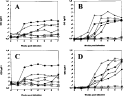
Fig. 1. Development of swine specific serum IgG1 against the body wall (A, B) and the excretory secretory larval (C, D) antigens during the experimental infection. Group 1 (□), control; group 2 (○), challenge control; group 3 ([utri ]), weekly egg-infected; group 4 ([loz ]), weekly egg-infected and treated with pyrantel; group 5 ([squf ]), weekly immunized with 14 kDa fraction; group 6 ([bull ]), weekly immunized with 42 kDa fraction; group 7 ([utrif ]), weekly immunized with 97 kDa fraction. Each point represents the mean of 5 older pigs (A, C) and 3 younger pigs (B, D).
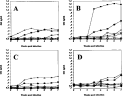
Fig. 2. Development of swine specific serum IgG2 against the body fluid (A, B) and the 97 kDa (C, D) antigens during the experimental infection. Group 1 (□), control; group 2 (○), challenge control; group 3 ([utri ]), weekly egg-infected; group 4 ([loz ]), weekly egg-infected and treated with pyrantel; group 5 ([squf ]), weekly immunized with 14 kDa fraction; group 6 ([bull ]), weekly immunized with 42 kDa fraction; group 7 ([utrif ]), weekly immunized with 97 kDa fraction. Each point represents the mean of 5 older pigs (A, C) and 3 younger pigs (B, D).
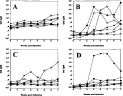
Fig. 3. Development of swine specific serum IgM against the 42 kDa (A, B) and the 14 kDa (C, D) antigens during the experimental infection. Group 1 (□), control; group 2 (○), challenge control; group 3 ([utri ]), weekly egg-infected; group 4 ([loz ]), weekly egg-infected and treated with pyrantel; group 5 ([squf ]), weekly immunized with 14 kDa fraction; group 6 ([bull ]), weekly immunized with 42 kDa fraction; group 7 ([utrif ]), weekly immunized with 97 kDa fraction. Each point represents the mean of 5 older pigs (A, C) and 3 younger pigs (B, D).
 You have
Access
- 14
- Cited by