Introduction
Head and neck cancer is now the sixth commonest malignancy worldwide.Reference Jemal, Siegel, Ward, Hao, Xu and Murray1 Despite increasing molecular and genetic profiling of head and neck cancers over the last two decades, and trials of molecular markers and targeted therapies aimed at improving diagnostic and therapeutic options, the overall survival of head and neck cancer patients remains poor.
There is now an increasing body of literature allowing us a better understanding of the various molecular factors that impact on tumourigenesis and metastatic spread. The more well researched markers (e.g. tumour suppressor proteins p53 and p16, and the oncogene epidermal growth factor receptor) are now used in clinical practice. Oropharyngeal tumours positive for tumour suppressor protein p16 are now known to have a better prognosis, whilst epidermal growth factor receptor is used as the target receptor for cetuximab, enabling improved locoregional control.Reference Bonner, Harari, Giralt, Azarnia, Shin and Cohen2
Recently, microRNAs (also known as ‘miRNAs’) have emerged as important regulators of gene function.Reference Babu, Prathibha, Jijith, Hariharan and Pillai3 MicroRNAs are a group of endogenous ribonucleic acids which participate in the regulation of gene expression. The pathological involvement of microRNAs and their potential as prognostic biomarkers are being increasingly appreciated. This paper introduces microRNAs and their significance in head and neck cancer.
Micro-ribonucleic acids are small (18–22 nucleotide), non-coding RNAs which are vital for regulation of host genome expression at the post-transcriptional level.Reference Calin4 Their role in normal cellular function occurs at various points on the pathway from gene to protein. Micro-ribonucleic acids do not directly code for proteins. Instead, they regulate protein expression by binding to complementary nucleotide sequences present in target messenger RNA (mRNA) molecules, thereby blocking the translation of mRNA into protein.Reference Kim and Nam5 A single microRNA can regulate the expression of hundreds of different mRNAs. Furthermore, a single mRNA can contain binding sites for several microRNAs, typically within the 3′ untranslated region. It is now apparent that microRNAs are key modulators of biological processes including cellular proliferation, apoptosis, cell-to-cell communication and inflammation.Reference Kim6, Reference Kim, Han and Siomi7 Micro-ribonucleic acids essentially ‘fine-tune’ the regulatory networks that control these processes, and as such are central to maintaining homeostasis.Reference Gantier, Sadler and Williams8 Dysregulated microRNA patterns have now been demonstrated in many disease processes, including autoimmune disorders and other inflammatory conditions, as well as in carcinogenesis.Reference Xiao and Rajewsky9, Reference O'Connell, Rao, Chaudhuri and Baltimore10
Micro-ribonucleic acids have potential as biomarkers assisting early diagnosis, prognosis, decision-making and ongoing surveillance within the whole field of oncology. They may prove to have high specificity and sensitivity, and could possibly enable monitoring using easily accessible bodily fluids such as saliva and/or plasma.Reference Ramdas, Giri, Ashorn, Coombes, El-Naggar and Ang11 Such innovations are yet to be introduced into clinical practice.
Discovery of microRNA
The nematode Caenorhabditis elegans has been widely used as a model organism for molecular and developmental biology research, and was first characterised at the genetic level in the early 1970s.Reference Sulston and Brenner12, Reference Brenner13 In 1993, research was conducted on two genes which controlled larval development events in a range of cell types.Reference Lee, Feinbaum and Ambros14 This research demonstrated that one of these genes, lin-4, actually encoded two small RNAs (61 and 22 nucleotides) with antisense complementarity to sequences in an untranslated region of the second gene, lin-14. Further study demonstrated that RNA–RNA binding at this site actually blocked the protein expression of the second gene (lin-14).Reference Wightman, Ha and Ruvkun15 These two small RNAs from lin-4 were the founding members of the family of small regulatory RNAs that were eventually termed microRNAs.
Further research into microRNAs has continued exponentially, and there are now over a thousand (1587) different human microRNAs listed in the central miRBase database.16
MicroRNA biogenesis
Micro-ribonucleic acid biogenesis is complex and involves multiple processes. The key steps are as follows.
First, many microRNA genes are present in the intron region of each longer RNA transcript.Reference Kim and Nam5, Reference Rodriguez, Griffiths-Jones, Ashurst and Bradley17 These RNA strands are transcribed from DNA by RNA polymerase II (Figures 1a to 2a).
Diagram showing DNA to RNA transcription by RNA polymerase II: (a) commencement of RNA strand transcription; (b) longer RNA transcript formation; and (c) release of RNA strand.

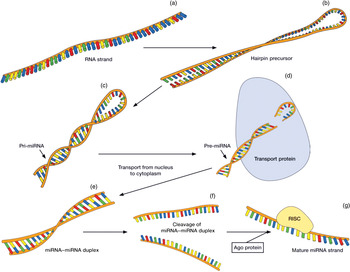
Diagram showing biogenesis of microRNA (miRNA): (a) RNA strand; (b) hairpin precursor; (c) & (d) primary microRNA (pri-miRNA) cleaved to produce precursor microRNA (pre-miRNA) and transported from nucleus to cytoplasm by transport protein; (e) microRNA–microRNA duplex; (f) cleavage of microRNA–microRNA duplex; (g) mature microRNA strand together with Argonaute (Ago) protein generates RNA-induced silencing complex (RISC).

Second, microRNA genes are transcribed by RNA polymerase II into primary microRNA transcripts (also termed ‘pri-miRNAs’) which are usually hundreds or thousands of nucleotides long and contain one or several hairpin loop structures (Figure 2b).Reference Kim6, Reference Kim, Han and Siomi7
Third, the primary microRNAs are cleaved in the nucleus by enzymes to produce precursor microRNAs (also termed ‘pre-miRNAs’) (Figure 2c and 2d).Reference Gregory, Yan, Amuthan, Chendrimada, Doratotaj and Cooch18
Fourth, a shuttle protein exports the precursor microRNA from the nucleus to the cytoplasm, at which point the precursor microRNA is processed by the Dicer RNAIII enzyme to yield imperfectly matched microRNA–microRNA* duplexes (Figure 2e, 2f and 2g).Reference Kim, Han and Siomi7
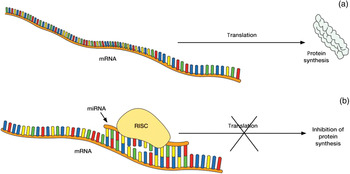
Last, the duplex is then separated into individual strands with the guide strand of the duplex being loaded into the Argonaute (Ago) protein to generate an RNA-induced silencing complex. This RNA-induced silencing complex interacts with the 3′ untranslated region of its target mRNA to regulate gene expression (Figure 3a and 3b).Reference Carthew and Sontheimer19
Diagram showing (a) usual translational stage, with messenger RNA (mRNA) producing protein structures, and (b) interaction of mRNA with RNA-induced silencing complex (RISC) at translational stage, inhibiting protein synthesis.

MicroRNA and cancer
Micro-ribonucleic acid expression has a significant biological impact, disruption of which can contribute to the development and progression of cancer. A microRNA that specifically binds to an mRNA which encodes for a protein with growth-suppressing roles can act as an ‘onco-microRNA’, because its expression can result in a bias towards growth-promoting processes associated with cancer development. Conversely, a microRNA that specifically binds to an mRNA with growth-promoting roles can act as a ‘tumour suppressor microRNA’ because its expression can result in a bias towards growth suppression and anti-neoplastic processes.Reference Babu, Prathibha, Jijith, Hariharan and Pillai3, Reference Gomes and Gomez20
The expression profiles of microRNA are certainly not the same in all cancers.Reference Lu, Getz, Miska, Alvarez-Saavedra, Lamb and Peck21, Reference Chen, Chen, Chen, Liao, Liu and Chang22 In 2002, studies on B-cell chronic lymphocytic lymphoma showed down-regulation of two key microRNAs (miR-15 and miR-16) in over 60 per cent of tumour samples.Reference Calin, Dumitru, Shimizu, Bichi, Zupo and Noch23 In 2005, further work demonstrated that most microRNAs had lower expression in tumours compared with normal tissue, and that using expression profiles of microRNA could predict poorly differentiated tumour.Reference Lu, Getz, Miska, Alvarez-Saavedra, Lamb and Peck21
MicroRNAs in head and neck cancer
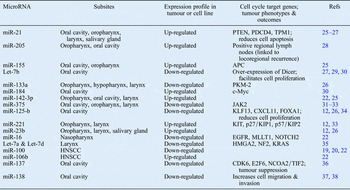
The first work on microRNA in head and neck cancer was published in 2005.Reference Jiang, Lee, Gusev and Schmittgen24 A summary of microRNAs thought to be involved in head and neck cancer is shown in Table I. There is no doubt that, in head and neck tumours, dysregulation of microRNA is associated with tumourigenesis.Reference Chen, Chen, Chen, Liao, Liu and Chang22, Reference Chang, Jiang, Smith, Poeta, Begum and Glazer25, Reference Jakymiw, Patel, Deming, Bhattacharyya, Shah and Lamont29 However, the relevant studies do not always show the same trends in microRNA dysregulation; more detailed studies in this area are needed in order to determine the exact role of microRNA dysfunction at each particular site and subsite.
Micro-rnas involved in head and neck cancer

PTEN = phosphatase and tensin homologue; PDCD4 = programmed cell death 4 (neoplastic transformation inhibitor); TPM1 = tropomyosin 1 (alpha); APC = adenomatous polyposis coli; PKM-2 = pyruvate kinase, muscle; c-Myc = v-myc myelocytomatosis viral oncogene homologue (avian); JAK2 = janus kinase 2; KLF13 = Kruppel-like factor 13; CXCL11 = chemokine (C-X-C motif) ligand 11; FOXA1 = Forkhead box protein A1; KIT = v-kit Hardy-Zuckerman 4 feline sarcoma viral oncogene homologue; KIP = cyclin-dependent kinase inhibitor 1B (p27, Kip1); EGFR = epidermal growth factor receptor; MLLT1 = myeloid/lymphoid or mixed-lineage leukaemia (trithorax homologue, drosophila), translocated to 1; NOTCH2 = neurogenic locus notch homologue protein 2; HMGA2 = high mobility group AT-hook 2; NF2 = neurofibromin 2 (merlin); KRAS = v-Ki-ras2 Kirsten rat sarcoma viral oncogene homologue; HNSCC = head and neck squamous cell carcinoma; CDK6 = cyclin-dependent kinase 6; E2F6 = E2F transcription factor 6; NCOA2 = nuclear receptor coactivator 2; TIF2 = translational intermediary factor 2
MicroRNA expression differs in normal and malignant head and neck tissue, a finding reported consistently by several authors.Reference Ramdas, Giri, Ashorn, Coombes, El-Naggar and Ang11, Reference Lu, Getz, Miska, Alvarez-Saavedra, Lamb and Peck21 At present, there is no published research assessing specific microRNA function in normal versus dysplastic tissue, and in successfully treated disease versus persistent disease.
The largest study of microRNA in head and neck cancer to date, published in 2009, studied samples from 104 head and neck cancer patients undergoing treatment with curative intent.Reference Childs, Fazzari, Kung, Kawachi, Brandwein-Gensler and McLemore26 This study aimed to investigate the microRNA expression profile with respect to prognosis. It demonstrated that 43 microRNAs were expressed at lower levels than in normal tissues, while only 6 microRNAs were expressed at higher levels.
Further studies have demonstrated that microRNAs are involved in the specific molecular and biological processes that drive initial tumourigenesis, then subsequent invasion and eventual metastasis.Reference Hurst, Edmonds and Welch39
Consistent down-regulation of the miR-21 microRNA has been found in several separate head and neck studies; miR-21 has also been found to be associated with tumourigenesis in a variety of non-head and neck cancers.Reference Chang, Jiang, Smith, Poeta, Begum and Glazer25–Reference Tran, McLean, Zhang, Zhao, Thomson and O'Brien27 This microRNA is now known to alter tumour suppressor genes, resulting in reduced cell apoptosis.
Another microRNA of interest is miR-451, which has been shown to be down-regulated in head and neck patients with recurrent disease when compared with patients with an effective cure. Although further work is required, this molecular change may have a clinical role as a prognostic marker.Reference Chen, Chen, Chen, Liao, Liu and Chang22
Clinical relevance of microRNAs in otolaryngology and head and neck surgery
In spite of greater understanding of the molecular biology involved in head and neck cancer, 5-year survival has remained essentially unchanged, at approximately 50 per cent.Reference Jemal, Siegel, Ward, Hao, Xu and Murray1 The changes occurring in the cell cycle that lead to tumourigenesis, invasion and metastasis are now better understood, and the success of translational research on markers such as p16 is now evident in clinical practice. The link between microRNA and the well-known tumour suppressors and proto-oncogenes that lead to cell cycle changes has been established in recent studies.Reference Babu, Prathibha, Jijith, Hariharan and Pillai3 A classification system has been proposed for the microRNAs linked with head and neck cancers, which categorises them as causal, non-causal or ‘not enough information’.Reference Babu, Prathibha, Jijith, Hariharan and Pillai3, 40 Under this classification system, five microRNAs are currently considered to be causal in head and neck cancer: miR-21, miR-100, miR-106b, miR-125b and miR-137. Understanding microRNAs and their significant contribution to cancer development may allow the development of clinical applications for determining diagnosis and prognosis, and for targeting therapeutics.
The potential role of microRNAs as diagnostic tools arises from the possibility of detecting differences in microRNA expression profiles between subsites of diseased and normal tissue, thus enabling early recognition of tumour. The presence of microRNAs linked to a subsite-specific cancer may determine the likelihood of occult nodal metastasis, or enable identification of primary sites in cases of unknown metastases. For example, miR-205, a specific marker for squamous epithelium, may be able to identify the presence of cervical lymph node metastasis with high specificity and sensitivity.Reference Gomes and Gomez20 Some microRNA expression profiles are maintained between tissues: one study of squamous cell carcinoma from the tonsil, base of tongue, post-nasal space and nodal metastases found that all sites showed the same molecular changes.Reference Barker, Cervigne, Reis, Goswami, Xu and Weinreb36 It is possible that, once specific microRNA expression profiles are determined for primary head and neck cancer subsites, the location of an unknown primary tumour could be determined by molecular means.
The potential role of microRNAs as prognostic tools has also been studied. High levels of miR-21 expression in head and neck cancer have been found to be associated with decreased five-year survival.Reference Avissar, McClean, Kelsey and Marsit31 Down-regulation of the microRNAs let-7d and miR-205 has also been found to correlate with shorter survival.Reference Childs, Fazzari, Kung, Kawachi, Brandwein-Gensler and McLemore26
In contrast to those molecular markers the clinical application of which requires tissue biopsies (e.g. for immunohistochemical analysis), microRNAs can be detected in circulating blood and saliva, facilitating easy sampling and inexpensive diagnosis.Reference Park, Zhou, Elashoff, Henson, Kastratovic and Abemayor41–Reference Wong, Ho, Chan, Ng and Wei43 Two studies of oral cavity squamous cell carcinoma detected reduced plasma microRNA levels following tumour resection.Reference Liu, Kao, Tu, Tsai, Chang and Lin42, Reference Bader, Brown and Winkler44 This facility may enable specific microRNAs to play a role in the surveillance of head and neck tumours.
Another possible application of microRNAs is targeted therapy for tumours in which microRNAs promote oncogenes or tumour suppressor genes. This possibility has been explored for many different cancers. In head and neck cancer, epidermal growth factor receptor is blocked by cetuximab, a drug now widely utilised in the clinical setting. It is possible to up-regulate the expression of tumour suppressive microRNAs and to inhibit the over-expression of oncogenic microRNAs; thus, in future it may be possible to target therapy at the molecular level. For example, it may be possible to introduce synthetically designed microRNAs into cells to promote the expression of tumour-suppressive microRNAs.Reference Bader, Brown and Winkler44 The ‘antago-miRs’ or ‘microRNA sponges’ are synthetic microRNAs used as inhibitors, which act by binding to oncogenic microRNA and blocking its function.Reference Krutzfeldt, Rajewsky, Braich, Rajeev, Tuschi and Manoharan45, Reference Ebert, Neilson and Sharp46 Further research on microRNA in head and neck cancer may enable the development of microRNA-based therapy and/or microRNA-linked therapeutic agents.Reference MacDiarmid, Madrid-Weiss, Amaro-Mugridge, Phillips and Brahmbhatt47
Conclusion
Micro-ribonucleic acids are important regulatory molecules in carcinogenesis. However, in head and neck cancer their expression profiling is still at a relatively early stage, compared with other areas of oncology. Discoveries thus far seem promising, and further molecular work in this field may enable the development of clinically applicable tools for head and neck cancer diagnosis, prognosis and therapy.
Acknowledgements
We thank David Heinrich (Graphic Artist, Medical Illustration and Media Unit, Flinders Medical Centre) for the illustrations. We also acknowledge Priya Ghosal (Research Assistant) for her contribution to the literature search on microRNAs in head and neck cancer.