The inauguration of New Delhi in February 1931 had far reaching consequences for the British Empire. From the city's earliest beginnings in 1911, the capital was destined to be much more than a place to do the work of imperial government. It was meant to be a crowning achievement in colonial architecture and colonial town planning, a capital worthy of the British Empire. Built on what Edwin Montagu, under-secretary of state for India, called ‘virgin soil’,Footnote 1 New Delhi's precise location, its structures, its design, its rigorously controlled road grid, its monuments commemorating important imperial persons and events were artfully combined to make the capital a new temple of empire, the quintessential statement of what British imperial rule had meant and continued to mean for Britain and for India. The spatial layout of New Delhi's town plan and the architectural styles employed by its two primary architects – Edwin Lutyens and Herbert Baker – physically rendered the colonial social order through the colonial built environment.Footnote 2
The decision to build New Delhi did not occur in a vacuum.Footnote 3 As a response to specific historical conditions in India in the first decade of the twentieth century, the transfer of the capital from Calcutta to Delhi was designed to be ‘a bold stroke of statesmanship’ that reversed Lord Curzon's (viceroy 1899–1905) disastrous partition of Bengal in 1905.Footnote 4 Partition divided Bengal's Hindu majority between East and West Bengal, simultaneously weakening Hindu political power while strengthening that of Bengali Muslims in the new Eastern province.Footnote 5 Curzon claimed that partition was an administrative expedient, but there were much deeper reasons for pursuing such an aggressive imperial strategy. Quoting Curzon's home secretary, Sugata Bose and Ayesha Jalal write, ‘Bengal united is a power; Bengal divided would pull in different ways.’Footnote 6 The policy was met with anger by many Bengalis who rightly saw it as a direct threat to their political aspirations. Lord Hardinge (viceroy 1910–16), the man most responsible for the decision to build New Delhi, hoped that the transfer of capitals would create the appropriate political conditions to reverse Curzon's resented partition without looking as if the British were surrendering to Bengali demands.Footnote 7
Hardinge's spokesperson was none other than George V who announced at the end of his royal durbar, in 1911, his royal desire not only to transfer the seat of government to Delhi but to compensate Bengal for its loss of imperial prestige by ending partition.Footnote 8 The announcement was made grander by the fact that George V's durbar represented the first time a reigning British monarch had travelled to India to receive homage directly from his Indian subjects and to bestow gifts upon them. Two earlier durbars for Queen Victoria, in 1877, and Edward II, in 1903, had been staged without the monarchs actually present. All three imperial durbars were held at Delhi because of the area's connection to previous Indo-Muslim empires. The surprise nature of the proclamation, which was kept a closely guarded secret, further obfuscated the real reason behind the transfer. Except for a handful of close officials to the viceroy and the king, most people in Britain and India were unprepared for such a momentous decision.Footnote 9 With remarkably subtle legerdemain, Hardinge's government rescinded partition but claimed that Bengal's re-unification was simply an ancillary component of the larger colonial policy regarding the transfer of the capital. Somewhat fanciful, perhaps, but certainly an elegant idea, New Delhi would serve as the answer to India's growing anti-colonialism.Footnote 10
This article examines the last days of the colonial building project when the new capital was officially inaugurated in February 1931. It argues that the ceremony represented a complex vision of the late colonial state where liberal political reforms intended to pacify Indians simultaneously bound them more closely to the British Empire.Footnote 11 The inauguration provides a discrete example of Bose and Jalal's claim that Britain's passage of constitutional reforms was ‘not paved with good intentions’.Footnote 12 For these conciliatory reforms focused Indian attention on provincial local self-government while ‘the centre was kept firmly in British hands’.Footnote 13 As the pre-eminent symbol of this imperial centre, New Delhi crucially disseminated this double narrative of promised liberation and continued colonial dependency. The new capital may have projected imperial power and permanence, as many scholars have noted, but it also symbolized the underlying strands that connected British political reform with the reinforcement and re-affirmation of continued British rule.
New Delhi's inauguration also represented the precise point where colonial policies that politically empowered Indians intersected long-held British racial and cultural assumptions about Indians and indeed about themselves. While British officials worked hard to resolve British–Indian antagonisms, their deeply ingrained ideas about India's difference continually fractured the very vision they worked so hard to create. As a strategy of colonial control, New Delhi ultimately failed, for many Indian nationalists realized that the traditional social and racial hierarchies that sustained the British Empire remained intact underneath this imperial rhetoric of liberty. Rather than misunderstanding the inauguration's promise of political reform, as many colonial officials assumed, many Indian nationalist leaders understood the message all too well.
Urban historians and historical geographers have shown that cities are ‘communicative devices that encode and transmit information’.Footnote 14 A city is ‘one of the central elements in a cultural system’, according to James S. Duncan, ‘for as an ordered assemblage of objects, a text, it acts as a signifying system through which a social system is communicated, reproduced, experienced, and explored’.Footnote 15 For Duncan, city builders, past and present, commonly use such linguistic strategies as allegory (morally charged stories), synecdoche (a part stands for the whole and vice versa), metonymy (a word or icon stands for something else) and narrative repetition when encoding their cities with meaning.Footnote 16 Hence, cities are sites where power is manifested as Anthony King shows in his rigorous study of urbanization at Delhi. For King, colonial capitals are perhaps the best illustrations of the textual nature of cities because their languages of control and their concretization of colonial power relations are so persistently employed and performed. New Delhi, as King's case study makes clear, is a compelling example of how specific colonial discourses are materialized in the colonial setting.Footnote 17
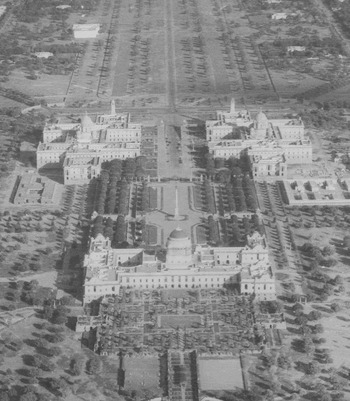
The primary government buildings of Edwin Lutyens and Herbert Baker's original conception for New Delhi. Lutyens' Viceroy's House lies in the foreground and Baker's Secretariats are just behind straddling the Kingsway, the ceremonial parade route used during the inauguration. It is still used for India's Republic Day Parade (courtesy The Centre of South Asian Studies, Cambridge, file no. Medd A2:28).

Much of the scholarship on New Delhi has focused on architects and architecture.Footnote 18 Robert Grant Irving and Thomas Metcalf, in this regard, have provided some of the most intriguing studies.Footnote 19 Irving focuses on New Delhi's primary architects – Herbert Baker and Edwin Lutyens – arguing that the design of their city reflected Britain's unification of an extremely diverse South Asian continent. ‘The architects sought to express in permanent and unmistakable form’, according to Irving, ‘the order and unity that were central to the meaning of the Indian Empire.’Footnote 20 Metcalf's intellectual history of British architecture in India, on the other hand, convincingly shows that New Delhi represented the culmination of a long history of experimentation in colonial architecture. For Metcalf, the building of New Delhi offered an opportunity to create a new form of colonial architecture that portrayed the power and permanence of the British Empire.
Yet a focus on architecture seems to limit our understanding of the meaning of New Delhi as a colonial text. From this perspective, New Delhi can only be seen as one of the great ironies of British rule in India. For Britain's Indian Empire seemed to unravel even as it erected this remarkable spectacle of its colonial authority. If ‘New Delhi was an anomaly’, as Jan Morris writes, ‘too late for arrogance, too soon for regrets’ then the city's failure as a colonial text seems to lie solely within Britain itself – with its obscured sense of imperial identity, with its loss of imperial assurance.Footnote 21 In truth, forces beyond Britain's control – primarily the rising power of the Indian nationalist movement – changed the political landscape in India, and New Delhi's meaning changed with it. Specific elements of New Delhi's built environment, therefore, can be better understood when juxtaposed against political transformations taking place in India.
The cultural-politics of liberation and dependency in colonial India
Sugata Bose and Ayesha Jalal have shown that by the end of the nineteenth century a vast array of Indian nationalists from across the socio-economic spectrum and informed by multiple linguistic cultural identities used both secular and religious language to exert tremendous pressure on the British in India.Footnote 22 Although the colonial state always had the threat of violence at its disposal, it also responded to this nationalist pressure by placing greater emphasis on encouraging Indian consent to British rule. As Antonio Gramsci long ago argued, hegemony is a powerful system of socio-political control in that it effectively encourages people's consent to the state's coercive measures. Britain itself exemplified how hegemony, when properly employed, encouraged average citizens to accept the status quo because the benefits of belonging outweighed Britain's coercive tendencies. But political conditions in India, according to Ranajit Guha, were markedly different.Footnote 23 Though Guha perhaps under-estimates the number of Indians who benefited from working with and for the British in India, his focus on the relationship of hegemony to empire sheds light on the coercive nature of Britain's colonial state in the nineteenth century. But as Indian resistance to British rule became greater in the twentieth century, older colonial methods of domination and control grew increasingly less effective in dealing with the strategies employed by Indian nationalists. British police officials could stop a demonstration, for example, but how could they stop a boycott of British textiles made in Lancashire?
Britain's response to the changes in the political landscape brought on by Indian nationalism was characteristically ambiguous.Footnote 24 According to Thomas Metcalf, the very notion of imperialism posed significant problems for the British who prided themselves on their own historical pursuit of liberty.Footnote 25 How could a nation that valued freedom, asks Metcalf, justify its domination of others? This troubling contradiction could be somewhat resolved if Britain's colonial policies brought positive results for colonial subjects either by resurrecting their history through the translation of Indo-Muslim texts or by materially advancing them through progressive reforms. Both visions led to important conclusions that shaped British colonial assumptions about India and its history forming what Metcalf calls the ‘creation of difference’.Footnote 26 It was clear that Britain and India shared a deep past with each other, as Sanskrit scholars such as William Jones had shown, but the two cultures had markedly diverged over time. British civilization, according to Henry Maine, a late nineteenth-century colonial official, showed clear signs of advancement, but Indian civilization had been arrested early in its development.Footnote 27
The British perception of India as a culture in stagnation shaped Britain's constitutional reforms in the first three decades of the twentieth century. While these reforms concomitantly encouraged greater Indian consent to British rule through liberal reform, they also re-affirmed the existing colonial order and colonial power structure.Footnote 28 What resolved this seeming contradiction was the very nature of liberal reform in India, as Barry Hindess and Uday Mehta have shown. Both Hindess and Mehta argue that liberalism has an authoritative side in the colonial context. Before colonial subjects could be given greater liberty, according to Hindess, they needed to undergo ‘the imposition of . . . extended periods of discipline’ because, as British officials believed, they lacked the ‘capacities required for autonomous conduct’ due to their long history of autocratic rule.Footnote 29 Similarly, Mehta writes that ‘the normative valuations that liberals make, that is those who are deemed to be “backward” and those who are not, are expressed as historical facts that can be redressed only through the instrument of political intervention and in the register of future time’.Footnote 30 Coterminous with political reform in India, then, was an element of instruction built into the reforms themselves. The Government of India Act of 1919, for example, served as a tutorial in responsible government where elected Indian officials handled less critical legislation in the provinces, while British officials remained in control of all-India government responsibilities such as defence and foreign affairsFootnote 31 – the latter being what Bose and Jalal call the ‘vital aspects of sovereignty’.Footnote 32 Provincial governors retained ‘extraordinary powers’ to ‘override’ any legislation passed by Indian representatives if the legislation threatened imperial interests.Footnote 33 Every ten years, according to the act, parliament was obligated to send a statutory commission to India to measure India's progress toward responsible government.Footnote 34 This allowed the British to control the speed at which Indians were given constitutional reforms while at the same time reconciling imperialism and liberty.
New Delhi lay at the centre of these political changes as a colonial symbol that metonymically and allegorically promoted Britain's new imperial vision. If anyone failed to understand the architectural symbolism, a placard was posted prominently on Baker's Secretariats, which housed the various departments of the government of India. It read, ‘Liberty does not descend to a people. A people must raise themselves to liberty. It is a blessing that must be earned before it can be enjoyed.’Footnote 35 Based on Britain's particular interpretation of liberalism in the colonial context, the placard was meant to be a poignant reminder to Indians that liberty could not simply be demanded or, perhaps more importantly, be freely given. It must be earned.
Still, relations between Britain and India continued to deteriorate in the 1920s. While there were many reasons for strained colonial relations,Footnote 36 M.K. Gandhi's rise to power in the Indian National Congress, one of India's most powerful nationalist organizations, and the particular anti-colonial strategies which he brought to bear against British rule were particularly important. According to Bose and Jalal, Gandhi combined ‘the negative value of ahimsa (non-violence) with the positive value of satyagraha (a quest for truth through mass political activity) as an all-India strategy to resist colonial rule’.Footnote 37 The boycotting of British goods, revenues and other imperial policies both damaged the colonial administration's political economy in India and expressed India's ‘sense of alienation from the Raj’.Footnote 38
Due to the tremendous pressure caused by civil disobedience, the British were forced to appoint a statutory commission, authorized under the Government of India Act of 1919, with instructions to draft a report recommending further constitutional reforms for India.Footnote 39 This statutory commission (commonly called the Simon Commission after its chairman, John Simon) met well-planned demonstrations and boycotts on each of its visits in 1928 and 1929.Footnote 40 This anger and frustration stemmed from parliament's appointment of an all-white statutory commission.Footnote 41 Believing that little progress toward real independence would come from this commission, the Indian National Congress decided to boycott the proceedings of the commission altogether.Footnote 42
The political chaos caused by the Simon Commission ultimately led to Britain's decision to create a series of Round Table Conferences culminating in the Government of India Act of 1935.Footnote 43 Ironically, the constitutional reforms recommended by the Simon Commission and the constitution eventually drafted by members of the Round Table Conferences were remarkably similar. Both called for a system of federalization where Indians would have more political power over domestic policies, particularly in the provinces, while Britain would control foreign policy, the military and the police thus retaining ultimate authority at the centre in New Delhi. The inclusion of Indian princes under the Government of India Act of 1935 would serve as a counterweight to elected Indian officials, making the constitutional reforms in India more palatable to incredulous British officials.Footnote 44 Ultimately, as Bose and Jalal have argued, ‘the 1935 act sought to safeguard British rule in India, not weaken it’,Footnote 45 for ‘the centre was equipped with all the authority necessary to curb powers in the provinces’.Footnote 46 But on two points the Simon Commission and the Round Table Conferences differed significantly. First, while the Simon Commission strongly resisted adding Indians to their commission – and only did so belatedly in a failed attempt to end the demonstrations and boycotts that threatened their work – the Round Table Conference began and ended with a large, albeit selective, Indian representation. Second, the first Round Table Conference asserted that the purpose of continued British rule in India was to move the colony toward dominion status. This elevation in colonial status would make it the newest member of an exclusive imperial club consisting of Australia, Canada, New Zealand and South Africa. Yet as Bose and Jalal argue, ‘the constitutional reforms were both concessionary and pre-emptive in nature’ in that they redirected attention away from the centre ‘to provincial pastures where the policy of pitting Indian against Indian could ensure the stability of the colonial state’.Footnote 47
The cultural-politics of liberation and dependency in the colonial built environment
New Delhi was one of the most important imperial symbols of the late colonial state in India, and its inauguration provided the perfect opportunity to introduce and disseminate Britain's new imperial vision for India, dominion status. Imperial pageantry, imperial ritual and imperial precedence were much on display at the inauguration. There were gun salutes for the viceroy, massed military parades, formal inspections, pennant-draped avenues and highly formalized seating arrangements for specially invited guest and British officials. Yet compared to the all-India scope of previous imperial ceremonies, such as George V's durbar in 1911, the inaugural ceremonies were subdued. A variety of minor events were held including a field hockey match held near the Mori Gate in old Delhi, a ‘Hog Hunters Ball’ at the Imperial Delhi Gymkhana Club, banquets, garden parties, evening soirees, a polo tournament and air displays by the Royal Air Force.Footnote 48 But these were relatively superfluous activities designed to connect the three major events: the unveiling of four Dominion Columns, the People's Fete and the commemoration of the All-India War Memorial.
Interestingly, the most important government structures such as Lutyens' Viceroy's House or Baker's Secretariats received little direct attention. Instead, inaugural planners chose key monuments in new and old Delhi to stage the ceremonies, using Lutyens' and primarily Baker's government buildings as imperial backdrops. Perhaps this was due to the controversy surrounding the cost of the structures, especially the Viceroy's House, which for many seemed overly extravagant and expensive in the context of the current economic difficulties faced by the empire.Footnote 49 On the other hand, Britain's new vision for its Indian Empire required carefully balancing the constitutional reforms being debated in London with a re-affirmation of its continued presence and importance in the national life of India. To have focused specifically on the large government structures, which represented British absolute power, would have defeated the purpose of the inauguration, the introduction of a new vision of the colonial state. Furthermore, the large government structure's use as backdrops made the proposed constitutional changes seem less threatening to those who feared Indian nationalism. Indeed, the inauguration allowed colonial officials to proclaim that these constitutional reforms were not only encouraged but made possible by the British Empire, which was still strong and confident enough to adapt to a changing colonial world. Thus, while political transformation was occurring in India, there was still remarkable imperial continuity. Consequently, many of the speeches made by British officials at the various ceremonies portrayed a spirit of continued sacrifice and loyalty, which was in the best interest of both Britain and India.
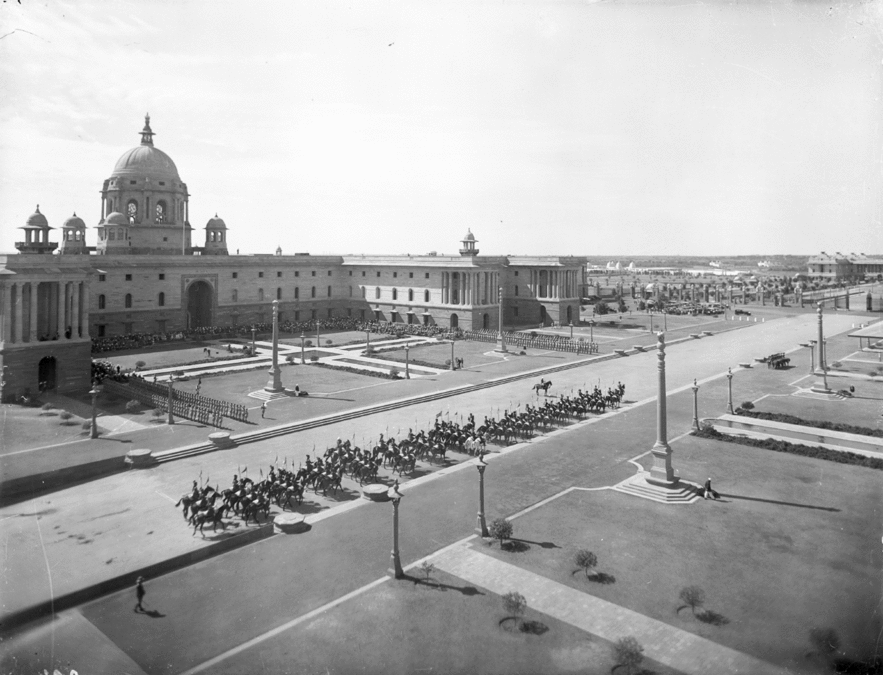
Appropriately, the inaugural planners used the unveiling of four Dominion Columns to set the stage for the inauguration. The columns were positioned between Baker's north and south Secretariats, which sat on either side of the Kingsway, the main processional route in New Delhi. This broad avenue – lined with expansive grass parks and shallow canals – connected two of the capital's most important axial points, the Viceroy's House and the All-India War Memorial. The Dominion Columns were exceedingly important for expressing Britain's particular conception of constitutional reform in India. While the unveiling ceremony did not elevate India to dominion status, it directly alluded to the Round Table Conference's discussions to do so in the future.
Herbert Baker, the columns' designer, was an architect of acute political understanding, a trait which he repeatedly manifested during the building project. Influenced and encouraged by Cecil Rhodes, his most important client in South Africa, he believed that colonial architecture should evince core imperial values. When debate arose in London over the style of architecture to be used at New Delhi, Baker quickly contributed his views on colonial architecture in a letter to The Times in October 1912. ‘The capital’, he wrote, ‘must be the sculptural monument of the good government and unity which India, for the first time in its history, has enjoyed under British rule.’Footnote 50 Thus, while he claimed that New Delhi should represent a ‘civilization in growth, a blend of the best elements of east and west’, his overriding concern was with symbols of British law and order. An Indian presence should be felt, particularly in regard to climate, but it was the spirit of British rule that must be ‘imprisoned in stone and bronze’.Footnote 51 Robert Grant Irving writes that ‘He discerned a welter of races, local laws, and provincial governmental systems within the empire, but all given coherence by supreme laws and common ideals of which the crown stood as a symbol.’Footnote 52
Unveiling of the Dominion Columns during New Delhi's inaugural ceremonies in February 1931. Conceived by Herbert Baker, the four columns represent Canada, Australia, New Zealand, and South Africa, the great dominions of the British Empire (courtesy Country Life).

Baker approached Lord Chelmsford (viceroy of India, 1916–21) in March 1920, with the idea of building Dominion Columns between his Secretariats.Footnote 53 The columns were not originally meant to represent India's passage into dominion status but to express, instead, ‘the great historic fact that the four dominions and India fought shoulder to shoulder in the Great War’.Footnote 54 Baker modelled the Dominion Columns after the pillars of Asoka, a Buddhist Mauryan emperor, who inscribed his laws on stone columns throughout South Asia in the third century BC.Footnote 55 Later imperial rulers would often move the pillars to different locations. There are two in Delhi, one placed in Kotla Firoz Shah just south of the Red Fort and the other on the ridge above the civil lines near the Mutiny Memorial. The pillar at Kotla Firoz Shah is still standing and, according to Percival Spear, was originally erected near Ambala, a city north of Delhi, in 250 BC. It was moved to Delhi by the Tughlak emperor Firoz Shah in the fourteenth century.Footnote 56
Baker's columns were made of a similar red stone material as the government structures and stood 41.5ft from base to tip. The base of each column carried the coat of arms of its contributing dominion and an inscription: ‘Canada to India, 1930’, ‘Australia to India, 1930’, etc.Footnote 57 On top of each column rested a white stone globe with a bronze ship atop heading eastward under full sail. Allegorically, the bronze ship, an East India Merchant Man, signified the centrality of India to Britain's maritime empire. The columns themselves linked the British colonial government with Asoka's reign, which was recognized as a golden era of law-giving. By the time of the inauguration, the columns had gone from memorials of wartime sacrifices to allegorical statements writ in stone concerning the social, political and economic benefits for India if it remained under the aegis of the British Empire as a dominion.
Yet for all the rhetoric about dominion status, the imperial ritual surrounding the unveiling ceremony fell far short of the promise and served simply to remind most Indians of their continued colonial status. Seating arrangements were limited to two distinguished blocs: one for British high-ranking civil and military officers and the other for distinguished guests (a handful of Indian princes or their heirs-apparent and the heads of state for Nepal, Japan, Persia and Afghanistan). The vast majority of Indians who wanted to see the inauguration were confined to the roofs of Baker's Secretariats.Footnote 58 A heavy police cordon secured the processional way and the government forum between the two Secretariats.
In general, the unveiling ceremonies tended to emphasize India's difference. For many British officials, India's particular history – steeped in autocracy and caste – had created social and political conditions that made it far different than the other great dominions. Britain's ‘interpretive strategies for knowing India’, according to Bernard Cohn, created lasting impressions of India as ‘the land of oriental despotism, with its cycles of strong but lawless rules, whose inability to create political order based on anything but unbridled power led inevitably to its own destruction’.Footnote 59 This reading of India as a land of despots and arbitrary rule made Indians ‘a people . . . thoroughly fitted by habit for a foreign yoke’.Footnote 60 If the British were characterized by a deep-seated belief in the rule of law, India was characterized by its absence, for in India law was simply the will of the despot. In contrast, as Arthur Balfour claimed in June 1910 while comparing colonial subjects to the freeborn Englishmen, ‘Western nations as soon as they emerge into history show the beginnings of those capacities for self-government.’Footnote 61 The white settler colonies of Canada, Australia, New Zealand and South Africa had become prosperous, self-governing nations because of hard-working, industrious settlers whose core identities were shaped by the pursuit of liberty and individual freedom, both of which were maintained by the rule of law. India, lacking such a history, had reached a seminal point in its history, as speech writers at the unveiling made clear. Its political advances toward self-government could easily evaporate or be squandered by premature independence. Unlike the other dominions, India still required British tutelage in responsible government. As Sir John Monash of Australia carefully stated, ‘While on the one hand, the people of India can be assured of our sympathy for a measure of self-government, my fellow citizens in Australia are equally concerned that nothing may happen to loosen the bonds which bind all subjects of the King Emperor in a common loyalty and that integrity of our great Commonwealth of nations may be preserved inviolate’ (my italics).Footnote 62
Several months before the inauguration in a published talk, John Simon had made a similar argument concerning the obstacles to India's natural growth toward self-government. Simon metaphorically fused architecture with constitutional reform while simultaneously re-affirming Britain's pedagogical role in India: ‘[A constitution] is a work of architecture, like a great cathedral, which must stand on solid earth, and be designed to resist all the strains and stresses that will assail it, and to give room and protection not to one section but to all manner of people.’Footnote 63 Continued British administration, then, was essential in providing a sound political foundation upon which a self-governing state, which protected the liberties of all its citizens through the rule of law, could be built in India. For Simon, self-government in India – like a plant needing appropriate soil and nutrients – required further tending by the British.
India's difference from the other dominions immediately appeared in the press. ‘The function was deliberately designed to show the whiteman's superiority’, reported the Lahore Tribune, ‘and to emphasize the fact that India could do well to remain within the British Empire and not to talk of independence.’Footnote 64 The same paper continued, ‘General opinion expressed that it was too much official and a whiteman's show and that those in charge of arrangements had failed to catch the imagination of the people . . . altogether the first ceremony proved to be very cold and frigid from the popular point of view.’Footnote 65 And this difference was apparent in England as well. When describing the unveiling ceremonies, The Times reported, ‘It would be idle to pretend that the ceremony had any popular support. The attendance was confined entirely to those admitted by invitation. All the approaches were plastered with armed police, and little encouragement was given to anyone who desired to offer a demonstration, friendly or otherwise.’Footnote 66
Clearly, as the press in India and Britain pointed out, inaugural planners had missed a tremendous opportunity to shift the political momentum in India. While the Dominion Columns represented a narrative about the promise of dominion status, Britain had still not resolved what Noel Buxton, liberal parliament member for North Norfolk (1910–18), called ‘the great test of the future’. Speaking in front of the House of Commons in 1913, Buxton claimed that this test was none other than ‘the reconciliation of democracy with imperialism’.Footnote 67 Although British officials had seemed to move in this direction, even calling for it in their speeches, their offer of liberal reform simultaneously re-affirmed the very colonial assumptions that forever marked Indians as culturally, politically and socially different. What India required was further British tutelage in responsible government rather than independence. Thus, the columns were a reminder not only of India's difference but its colonial domination. If the unveiling of the Dominion Columns portended India's future as an integral part of the British Empire, the next major event reminded people of India's past.
While the unveiling ceremonies had been a predominately closed affair, the People's Fete was specifically designed to be a public event. The fete was held the following afternoon in front of the Red Fort, a seventeenth-century Mughal palace located in Shajahanabad, the older Indian capital that lay immediately next to the new capital. Knowing that this event would be the only one attended by the average Indian, British planners used the occasion to send a series of messages to Indians. While it is impossible to know the exact number of Indian onlookers, the fact that the fete was held near one of the most densely populated areas of the old Indian city and that attendance was open to all (and not by invitation as with the other main events) suggests that Indians were present. To dispel any assumption in the minds of Indians that the elevation to dominion status meant independence, inaugural planners used the People's Fete to remind Indians of their colonial past and their continued colonial status. Not too subtly, the fete was a reminder of Britain's legitimate claim to India by right of conquest.
The fete was advertised as a panorama of Indian history, but it was, in reality, a history of British imperial rule presented through a martial filter of military drill and regimental music. Fete activities included wrestling matches, tent pegging competitions, vaulting displays by the Royal Deccan Horse, bagpipe music by the 42nd Black Watch and an aerial night performance by the Royal Air Force. The fete closed with a grand finale of fireworks and the singing of ‘God Save the King’, reminding attendees, once again, that they belonged to the British Empire.
While at the most immediate level the fete reminded Indians of Britain's monopoly of force in India, it also pointed to India's long colonial history under the Mughals and later the British. The fete's military drills were performed in front of the Red Fort, once an opulent palace built by the Mughal emperor Shah Jahan. Still majestic and powerful, no other structure in the Delhi area better symbolized the end of the Mughal and the beginning of the British Empire. It was here that General Lake, after defeating the Maratha army on the east bank of the Yamuna River, was received by the Mughal emperor Shah Alam in September 1803.Footnote 68 Bose and Jalal have referred to the capture of Delhi as the ‘highpoint in British imperialist expansion’.Footnote 69 Half a century later the Red Fort once again loomed large in British imperial history when the British recaptured the palace at the end of the Indian uprising in September 1858.Footnote 70 William Dalrymple has recently traced the brutality of this imperial episode in a colourful history of the last Mughal emperor, Bahadur Shah II.Footnote 71 On 20 September 1858, the Red Fort fell to the British and that night General Wilson, the British commanding officer, set up his headquarters in the Diwan i-Khas, the emperor's private meeting hall.Footnote 72 Bahadar Shah's ‘willing or unwilling involvement in the conflict ended the Mughal Empire in India’.Footnote 73
The British put their imperial stamp on the Red Fort by building barracks and garrisoning British troops within its confines. Before the uprising the British resided in the city of Delhi at the will of the emperor. Afterward, ‘the monopoly of government by the incoming [British] culture was now based . . . on the presence of military force’; therefore, it was imperative to ‘accommodate’ this military presence ‘in the most strategic, visible and hitherto most prestigious sector’ of Delhi, the Red Fort.Footnote 74 Within its walls, the palace held a self-contained town, most of which was demolished or occupied by soldiers after 1858, according to Anthony King. Four-storey barracks were later built to house European soldiers. The Red Fort symbolized Britain's imperial legitimacy in India, earned and maintained by force of arms.
The People's Fete carried an additional message which was directly related to India's material progress under British rule. The fete's meaning and style encouraged Indians to ask questions about their colonial past and indeed about themselves by juxtaposing India's last two imperial rulers, the Mughals and the British. If Indians were seemingly destined to be dominated by foreign empires, as the past 600 years seemed to suggest, then would it not be wiser to support the empire that had brought the greatest benefits? Whereas the Mughals had expanded India's artistic and architectural sensibilities through court poetry and monumental architecture, Britain claimed that it had advanced India through economic development. The latter was made explicit by what seems an anomaly amongst the fete's military drill: a parade of decorated cars celebrating the progress made in modern transportation in India. While the Mughals had built magnificent mausoleums, such as Shah Jahan's Taj Mahal, the British had busied themselves building steeled roads, modern ports and telegraph lines.Footnote 75 By 1900, more than 5,000 miles of railway track had been laid in India.Footnote 76 For inaugural planners, then, British colonial officials may have lacked the artistic temperament of the Mughals, but their reasoned materialism and engineering skills made possible the integration and unification of an extremely diverse subcontinent. This material rather than aesthetic British temperament ensured good government, good business and in the end good rule. This particular rendering of the colonial past created a specific kind of colonial knowledge. ‘Its function’, as Ranajit Guha writes, ‘was to erect that past as a pedestal on which the triumphs and glories of the colonizers and their instrument, the colonial state, could be displayed to best advantage’.Footnote 77 Yet who actually benefited from Britain's material development of India is a matter of debate. When discussing Britain's political economy in India, Bose and Jalal argue that ‘the famous Indian railways, often cited as the great modernizing achievement of colonialism, were planned and constructed to serve the strategic and economic needs of the metropolis’.Footnote 78 If the seven anna third-class fare allowed long-distance travel for millions of Indians, ‘joining friends and uniting the anxious’, as Niall Ferguson writes,Footnote 79 the same trains ‘facilitated the movement of troops, the dispersal of British manufactured goods and the extraction of raw materials from the hinterlands to the port cities’ where they were shipped to manufacturers in Britain.Footnote 80 Rather than materially helping Indians, according to Bose and Jalal, Britain's celebrated Indian railways simply allowed British colonial capitalists more effectively to reorder India's economy for their economic advantage.
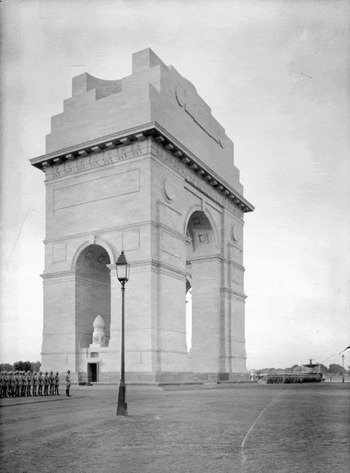
If the first two major inaugural ceremonies represented the benefits of British rule, the last major event, the dedication of the All-India War Memorial, symbolized Britain and India's inseparability. The memorial, a large archway designed by Edwin Lutyens, commemorated Indians who had died in World War I and the Afghan Wars.Footnote 81 The archway spanned the same processional route that passed between Herbert Baker's Secretariats and his Dominion Columns. The memorial's importance is evidenced by its placement as the eastern axial point in the new capital. Lutyens' arch, according to David Crellin, was a ‘creative reworking of the Arc de Triomphe’.Footnote 82 Lutyens reduced the ornamentation on his memorial arch and made his ‘proportions slimmer and more elegant’ by making the height of the opening two and half times its width.Footnote 83 The names of 13,617 Indian soldiers were inscribed into the memorial.Footnote 84 The arch was part of the work of the Imperial War Graves Commission, which received its Royal Charter in 1917, to aid in the erection of headstones and memorials for soldiers who had died in World War I without commemoration.Footnote 85 The names of fallen Indian soldiers were on more than 150 memorials from the Middle East to East Africa, and from Gallipoli to the large memorials at Neuve Chapelle in France and the Menin Gate in Belgium.Footnote 86
Lutyens had tremendous influence over the planning of New Delhi as an original member of the town planning committee – also known as the ‘Delhi experts’ – which went to India to select a building site for the new capital. His importance to the city became greater when he was given the contract to design and build the Viceroy's House. Jane Ridley notes that Captain George Swinton, the chairman of the committee, wrote to the king's secretary during the capital's planning phase explaining that ‘if Lutyens is to be responsible for Government House (Viceroy's House) I feel . . . that we must defer to his views as to the management of sites’.Footnote 87 For Anthony King, Lutyens masterfully blended three important building variables in India: colonialism, culture and technology.Footnote 88 The power structure of colonialism and its culture determined the spatial and symbolic relationship of objects within the capital and of the capital itself to the neighbouring Indian city of Shajahanabad.Footnote 89 Colonial power structures also shaped residential requirements in the new capital with blocs segregated by race and Indian Civil Service rank. Highest-ranking positions were located nearer to the Viceroy's House with members of the Viceroy's Executive Council receiving large structures and compounds that ornamented and accented the Kingsway.Footnote 90 Residential blocs for Indian clerks and government peons were placed farthest from the colonial seat of power, the Viceroy's House and nearest to the older Indian city. Technologically, New Delhi's large size, especially when one includes the military cantonment, was made possible by modern motorized transport and electronic communications.Footnote 91
Commemoration of Edwin Lutyens' All-India War Memorial during New Delhi's inaugural ceremonies, February 1931 (courtesy Country Life).

Yet Lutyens was more than an architect and city planner. He was also one of England's most important war memorial designers. Here, he had strong ideas about how memorials of the Great War should look and what icons should be used.Footnote 92 Receiving commissions to build memorials in Europe during the war, he struggled with finding suitable designs that would symbolize the war's profound loss of life.Footnote 93 Finally, he determined that only sparse, classical, universal designs – what Christopher Hussey called Lutyens' ‘Elemental Mode’ – could adequately convey this message of loss.Footnote 94 He was also well aware of the religious diversity of the allied forces and was one of the most ardent critics of using any sort of religious iconography on memorials. Instead, he believed that a simple stone or bronze ball captured the ‘elemental (universal) responses to the terrible loss of life’ in the Great War, as Jay Winter writes.Footnote 95
While showing a deep open-mindedness concerning the commemoration of fallen soldiers from different religious backgrounds, Lutyens was remarkably traditional about the existing colonial order.Footnote 96 Concerning political reform in India, Lutyens wrote to his wife, Emily, that ‘India, like Africa, makes one very Tory and preTory feudal’.Footnote 97 For Lutyens, the All-India War Memorial symbolized ‘duty, discipline, unity, fraternity, loyalty, service, and sacrifice . . . encouraging continued partnership in the established order, and celebrating the ideal and fact of British rule over India’.Footnote 98 Though building a monument to memorialize Indians who had supposedly died fighting for freedom in France and though certainly in favour of showing religious respect by designing a memorial that approached war time sacrifices in a universal manner, Lutyens continued to ground his memorial in British imperial paternalism.
That paternalism was repeated during the inauguration's dedication ceremony, which was characterized by much of the same imperial ritual as the unveiling of the Dominion Columns. Attendance at the event was by invitation only though the monument was supposed to express the shared sacrifices of both British and Indians in the Great War. After several speeches, the fire of remembrance was lit to the doleful sound of ‘last post’. Wreaths were then placed by the viceroy and other high officials,Footnote 99 a British soldier, a British airman and an Indian soldier chosen by lot from the Indian Army.Footnote 100 The ceremony ended with attendees departing underneath the archway – the entire procession conducted to the sound of ‘A Long Way to Tipperary’ played by British and Indian regimental bands.Footnote 101
The speeches made during the commemoration of the All-India War Memorial completed the inauguration's new vision of empire in India. Major-General Fabian Ware of the Imperial War Graves Commission gave the opening address. He spoke of what he believed was an unbreakable bond between Britain and India, a bond forged long ago but tested and made stronger by the fiery crucible of the Great War. According to Ware, both nations had answered the call when the challenge came: ‘As I stand here today . . . I remember how we looked into their eyes unperturbed by their strange surroundings and said to ourselves, “Thank God the Indians have also come.”’Footnote 102 For Ware, the great threat of World War I was not simply the annihilation of the British Empire but the destruction of the values it stood for. ‘On the day of testing, when the flails of the almighty separated the chaff from the grain’, claimed Ware, ‘India was found standing freely shoulder to shoulder with other nations of the Empire on the side of right and freedom.’Footnote 103
The commemoration re-affirmed what Joseph Chamberlain called in 1902 a ‘community of sacrifice’.Footnote 104 This community empowered, strengthened and, possibly, made the British Empire eternal. But what precisely was this ‘community of sacrifice’? Niall Ferguson describes it as a ‘Greater Britain’ movement sponsored by imperialists such as Joseph Chamberlain who believed the empire's strength derived from the ‘ties between the different branches of the Anglo-Saxon race which form the Empire’.Footnote 105 The empire endured because Anglo-Saxons, who were spread throughout the world, were willing to make sacrifices for the empire and its ideals. At the heart of this imperial thinking was an obdurate belief in England's unique relationship to democratic reform, particularly in regard to liberty.Footnote 106 Hence, whiteness, and especially Englishness, became intimately connected with the didactic process of spreading self-government and political reform to the much more numerous non-Anglo-Saxon races of the empire. Colonial rule, as Thomas Metcalf insists, was made possible by the creation of a difference that privileged Britain. Citing their own political heritage consisting of profoundly important democratic moments such as the Glorious Revolution or the three great reform bills of the nineteenth century, British officials could claim that no other people were better qualified to teach Indians responsible government than themselves.
Here was the crux of the problem with India's elevation to dominion status. Politically, it could become a dominion of the empire – an integral member of that ‘imperial brotherhood’ that officials spoke of during the unveiling of the dominion columns and the commemoration of the war memorial – but how could it possibly be part of Chamberlain's or Ware's ‘community of sacrifice’? Indians, simply, were the wrong race. This inherent, troubling problem both strengthened and weakened Britain's position in India at a critical moment as is made clear by Irwin's speech which followed Ware's.
Where General Ware had narrowed the meaning of the war down to the shared sacrifices made by soldiers of the empire, Irwin used the opportunity to argue that Britain secured the rights of all colonial subjects. Applauding the efforts of Indians in World War I, Irwin stated, ‘We are here to recall the four unforgettable years during which nations and peoples and races . . . became one in a common impulse of loyalty to the throne and one in the defence unto death of the rights they had won under the protection of that sovereign.’Footnote 107 Irwin's speech was a pointed statement directed at the Indian independence movement. Highlighting the tremendous diversity of the British Empire, he drew attention to the unifying power of the British Empire and underscored the tenuousness of the rights and benefits that Indians had gained under British rule. Indeed, warned Irwin, the progress made by India toward independence could be easily lost without Britain's continued help, guidance and imperial protection.
Thus, ironically, Indian independence had become possible only through continued British domination. While on the surface the inauguration disseminated a message of greater Indian liberty brought about by its elevated dominion status, underneath it continued to re-affirm the traditional colonial order. And just as this ambiguous colonial policy of give and take encouraged rather than weakened Indian nationalist sentiment in the early twentieth century, the inauguration's double message of dominion status alongside continued British domination failed to silence many members of the Indian independence movement. Six months before New Delhi's inaugural ceremonies Indian National Congress leaders had stated in a letter to the government, ‘We notice no symptoms of conversion of the English official world view that it is India's men and women who must decide what is best for India.’Footnote 108 The inaugural ceremonies gave these nationalists no reason to change their minds. Indeed, the inauguration's re-affirmation of Britain's paternalism in India underscored the connection between constitutional reform and imperial imposition in the national life of India. As one Indian newspaper claimed while covering the inauguration, ‘India knows New Delhi. India understands New Delhi. India is not in it.’Footnote 109 The imperial vision proposed by New Delhi collapsed under the weight of its own ambiguity and contradictions.
The inauguration of New Delhi serves as an example of the ways in which the British Empire tried to redefine its imperial mission in India in response to a dynamic and remarkably diverse all-India independence movement. This redefinition allowed colonial policy makers to proclaim that Britain's imperial position had not become weakened in India but that its imperial role had merely changed, from one of colonial master to one of liberal educator. Subsequently, it enabled colonial officials to obscure or indefinitely postpone the actual moment of independence since they were the ultimate arbiters of India's growth toward responsible government. This continued use of liberal reform for authoritarian reasons caused New Delhi to fail as a strategy meant to stabilize British-India. The depth of this failure becomes much more striking when New Delhi is recognized as a symbol of a new imperial vision for India based on liberal reforms. It failed as an imperial strategy not simply because it was a bold statement of imperial power that needed to be resisted but because it represented a highly ambivalent space where forms of knowledge and language – ways of seeing and understanding the world – were contained, produced, shaped, consumed and, ultimately, contested. Certainly, New Delhi was a large imperial object filled with smaller tokens of imperial authority but objects laden with so much meaning rarely have a single master.