INTRODUCTION
Lanternbellies (family Acropomatidae) have unique characteristics of a ventral luminous organ comprising a luminous gland, lens and reflector (Haneda, Reference Haneda1950; Okamoto & Ida, Reference Okamoto and Ida2002). The family comprises a total of 31 species in seven genera (Froese & Pauly, Reference Froese and Pauly2011). The genus, Acropoma contains five valid species, which are all distributed in the Indo-Pacific. A single species from this genus Acropoma japonicum Gunther, 1859, has been reported from the Arabian Sea and the west coast of India (Balachandran & Nizar, Reference Balachandran and Nizar1990).
During the study of the icthyofaunal components from the West Bengal coast, east coast of India, Bay of Bengal we came across 30 examples of Acropoma, which after thorough identification and verification were confirmed as Acropoma argentistigma Okamoto & Ida, Reference Okamoto and Ida2002. The species was reported for the first time from the Andaman Sea, off southern Thailand (Okamoto & Ida, Reference Okamoto and Ida2002) and known by the types only. The present paper is the first report of the species from the Indian waters extending the distributional range of the species to the east coast of India.
MATERIALS AND METHODS
Sample collection
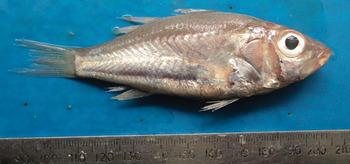
All specimens were collected from the fish landing centre and fish market at Mohana, Digha, West Bengal, India (21°37.843′ N87°32.827′E). The fishing boats of the area never cross the boundary of the Indian territorial water limits. All the specimens were examined fresh and, after taking photographs in fresh condition, preliminary observations of morphometric characters were recorded. The photograph of the fresh specimen is given in Figure 1. The specimens were subsequently preserved in 10% formaldehyde and deposited in the museum of the Marine Aquarium and Regional Centre of Zoological Survey of India, Digha.
Acropoma argentistigma (Okamaoto & Ida, 2002), collected from the Digha coast, West Bengal, India.

Materials examined
Mohana, Digha, Fish market: MARC/F1967, 22 examples (date of collection: 2 November 2011) and MARC/F1968, 8 examples (date of collection: 4 November 2011).
DIAGNOSIS
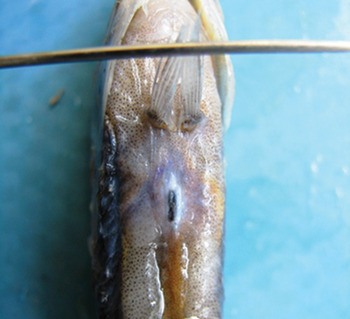
Body moderately elongate, compressed; long head, long upper jaw; anus situated about midway along the depressed pelvic fin; U-shaped luminous gland around the anus (Figure 2). A single row of well-developed conical teeth anteriorly on the upper jaw and entirely on lower jaw. Villiform teeth in bands on the inner part of upper jaw and palatines and a pair of inwardly directed canines near symphyseal region of both jaws. Tongue toothless, round and narrow at the tip. Eyes large and projecting slightly above upper profile of the head. Snout moderately long, nearly equal to the eye diameter. Preoperculum and interoperculum with smooth margins. Operculum with two weak spines. Branchiostegal rays 7. Two separate dorsal fins, the posterior most spine of the 1st dorsal fin lacks any connection with fin membrane. Dorsal fin rays VII–I–I, 10; anal fin rays III, 7, anal spines moderately developed, first spine very small and the third spine is the longest; pectoral fin rays 15, pelvic fin rays I, 5; caudal fin forked; gill rakers on the first arch 5 + 12–13 (26 specimens 5 + 13 and 4 specimens 5 + 12). All the characters described for Acropoma argentistigma by Okamoto & Ida (Reference Okamoto and Ida2002) clearly match the present description which confirms the occurrence of Acropoma argentistigma in Indian waters.
Photograph showing U-shaped luminous organ of Acropoma argentistigma (Okamaoto & Ida, 2002).

COLOUR
The fresh specimens were pinkish red on the upper half and lower half of the body; opercular flap silvery white; ventral muscles transparent.
DISTRIBUTION
The species, to date known by the types only, was reported previously from Phuklet Island (Thailand) in the Andaman Sea (Okamoto & Ida, Reference Okamoto and Ida2002), and has now been reported as a first distributional record from the east coast of India with range extension.
REMARKS
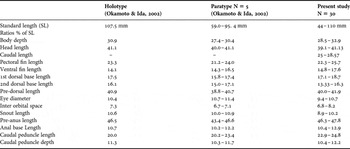
The only species from the genus Acropoma reported previously from Indian waters was A. japonicum and the species described here is different from earlier reported species in having a comparatively shorter luminous gland and fewer gill rakers (16–18 versus 21–24). The spinous dorsal fin matches the description of Okamoto & Ida (Reference Okamoto and Ida2002) in comprising seven spines connected by a fin membrane plus an eighth isolated spine and the fin formula expressed as VII–I–I, 10. All the morphometric characters described for the holotype and paratype by Okamoto & Ida (Reference Okamoto and Ida2002) and the specimens examined in the present study are given in Table 1. The slight variations in the different morphometric ratios may be due to the greater sample size in the present study (N = 30) in comparison to the six specimens described by Okamoto & Ida (Reference Okamoto and Ida2002).
Comparative proportional measurements of Acropoma argentistigma with the holotype and paratypes.

ACKNOWLEDGEMENTS
We thank Dr Venkataramen, Director, Zoological Survey of India (ZSI) for providing necessary facilities for the work and his constant encouragements. D.R. thanks ZSI for a Junior Research Fellowship grant to carry out this work.