INTRODUCTION
This article argues that it is quite possible that two antiquities delivered to Italy in the last decade by an American museum and a private collector, respectively, were each in fact looted from a country other than Italy. I present all available information related to the collecting history of a marble statue of Vibia Sabina, delivered to Italy by the Boston Museum of Fine Arts, and a krater by Euphronios, delivered to Italy by the American collector Shelby White. Since the members of the negotiation teams representing each side of these two cases have signed confidentiality agreements, it is not possible to know the details of the discussions at the time. Still, my argument adds new information from unpublished sources and compares these cases with the case of a marble kore (Greek archaic statue of a woman) that was returned to Greece on the basis of evidence that it was looted from there. Until the Roman statue and the krater likewise prove to have been looted from Italy, we should refer to these antiquities as “given” or “delivered” (by the museum/collector to Italy) rather than as “returned” or “repatriated.” Having demonstrated the lack of proof that it was from Italian soil that these two objects were looted, this article also briefly considers why these two antiquities were nonetheless sent to Italy.
HISTORICAL BACKGROUND
The characters involved in the two cases on which this article focuses, as well as the historical circumstances behind the negotiations and returns in these cases, require some introduction. The first major player is the antiquities dealer Giacomo Medici. In 1995, the Italian authorities obtained information that a sarcophagus, stolen from a medieval tower in Italy, was being consigned for auction at Sotheby’s London branch. Footnote 1 The consigner was Edition Service, one of the companies belonging to Medici. Jointly with their Swiss colleagues, the Italians raided Medici’s warehouses at the Free Port of Geneva on 13 September 1995. Footnote 2 They confiscated, along with hundreds of looted, smuggled, and stolen antiquities, about 4,000 images, most of them Polaroid photographs, depicting thousands of antiquities in a fragmentary condition and covered with soil encrustations. Since its discovery, this extensive group of images, together with documents found with them, have become known as the Medici archive. The Italian state prosecuted Giacomo Medici, and on 12 May 2005, the court found him guilty of illegal export of antiquities, receipt of stolen goods, and conspiracy. Footnote 3 After appealing twice, Medici was finally convicted by Italy’s highest court in December 2011 to an eight-year prison sentence and a €10 million fine. Footnote 4 Medici was never jailed since by the time of the final verdict he was over 70 years of age and, according to the Italian law, unless someone is found guilty for committing a murder, criminals over 70 years old do not serve sentences in jail. Footnote 5
The second important figure in this article is Robert Emmanuel Hecht, Jr, the American illicit antiquities dealer who dominated the international market from the mid-1960s until the mid-1980s. A year before the raid at Medici’s premises, during a raid at a flat belonging to an Italian middleman in Rome, the Carabinieri art squad had already obtained a handwritten diagram depicting the Italian branch of the international illicit antiquities network. Footnote 6 This plan, which became known as the “organigram,” presented Medici as one of the two main suppliers of Hecht, whose name was occupying the highest point of the diagram. Hecht had already been charged in Italy and Turkey of buying illegally excavated antiquities. Footnote 7 On 16 February 2001, the Italian and French authorities jointly raided Hecht’s flat in the center of Paris and discovered dozens of images and a few antiquities in fragmentary condition and covered with soil. However, the most valuable discovery was Hecht’s handwritten memoir, in which he narrated his involvement in some of the most well-known instances of illicit antiquities surfacing in the international market from the early 1960s until the early 1990s. Footnote 8 The memoir focused, in particular, on the famous story of the illicitly excavated and sold Sarpedon krater painted by Euphronios, the most celebrated vase painter of antiquity. Footnote 9 Hecht had sold the krater to the Metropolitan Museum in 1972 for US $1 million, not only setting a new record for the sale price of a single antiquity but also creating the biggest and most long-lasting mystery over any antiquity acquired by a museum. The Italian state prosecuted Hecht, but in January 2012, the case ended without a verdict because the statute of limitations had expired. Footnote 10 Less than three weeks later, Hecht died at the age of 92. Footnote 11
My third focus is on Robin Symes and Christos Michaelides, the dealers that succeeded Hecht in dominating the international antiquities market. In April 2006, on the privately owned peninsula of the Cycladic island of Schinousa in the Aegean Sea, the Greek authorities raided the complex of villas that used to be the property of Symes and Michaelides. The raiding team, in which I participated as a forensic archaeologist, discovered hundreds of antiquities not registered in the catalogues of the Greek Ministry of Culture (which a Greek citizen is obliged to do according to national law) and the invaluable photographic archive of Symes and Michaelides.
Following each of these raids, there was an examination of the archives on which the Italian repatriation claims were based (Greece started to examine the same archives in 2006 to claim repatriation of post-1970 looted antiquities). The Italian public prosecutor, Paolo Giorgio Ferri, had asked Daniela Rizzo and Maurizio Pellegrini, two prominent archaeologists working at the Etruscan Museum of Villa Giulia in Rome, to exercise their forensic skills on the Medici archive. In the course of 10 years, Rizzo and Pellegrini managed to identify hundreds of illicit masterpieces in North American and European state and private collections, by combining research on the confiscated images in the Medici archive with information from the Hecht memoir, the Symes–Michaelides archive, and other archives. Armed with these identifications and using the confiscated images as evidence in trials against looters, middlemen, and dealers, the Italian state contacted some of the most reputable museums and private collections around the world. Negotiations started over specific claims regarding the repatriation of antiquities that were looted and smuggled out of Italy in the post-1970 period (1970 being the cut-off date created in November of that year by the Convention on the Means of Prohibiting and Preventing the Illicit Import, Export and Transfer of Ownership of Cultural Property [UNESCO Convention]). Footnote 12 Among the museums identified as having acquired illicit material were the Boston Museum of Fine Arts and the Metropolitan Museum of Art in New York. Additionally, negotiations over 10 antiquities started with Shelby White, who together with her late husband Leon Levy, were the owners of one of the best private antiquities collections in the world.
Both the defendants (museum officials and private collectors) and claimants (state authorities) presented an image of productive cooperation, but the negotiations proved to be lengthy, lasting several months. Footnote 13 Contrary to the public image, the resulting repatriations of 43 illicit antiquities to Italy from these three collections were definitely not made voluntarily. Footnote 14 In 2006, the Boston Museum of Fine Arts returned 13 antiquities, among which was the over-life-size marble statue of the empress Vibia Sabina, wife of the Roman emperor Hadrian. In January 2008, after 18 months of intense negotiations, White returned 10 antiquities, Footnote 15 among which was another Euphronios krater, depicting Herakles killing Kyknos, son of the god Ares. This Euphronios krater (henceforth the Euphronios’ Kyknos krater), although reconstructed, was missing most of its original pieces. The Metropolitan Museum returned 20 antiquities in the first instance, comprising the Euphronios’ Sarpedon krater bought during Thomas Hoving’s directorship (1967–77) and 19 more masterpieces that became part of the museum’s collection during the period of Philippe de Montebello’s directorship (1977–2008). Several other antiquities were returned from the Met to Italy over the following years. Footnote 16
Ten years after the agreements were made for the return of these 43 masterpieces to Italy, a few issues in the reconstructed collecting history of some of these objects raise doubts as to whether Italy was in fact the country of origin for at least two of these antiquities. The objects in question are the statue of Vibia Sabina, returned by the Boston Museum of Fine Arts (MFA), and the Euphronios’ Kyknos krater, returned by White from her collection.
CASE STUDY 1: MARBLE STATUE OF VIBIA SABINA
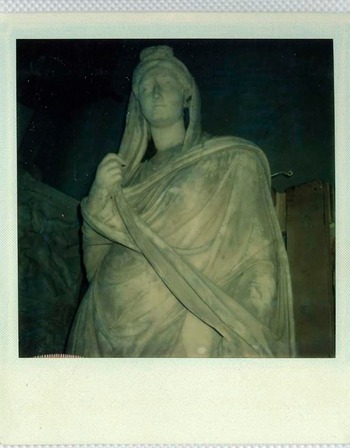
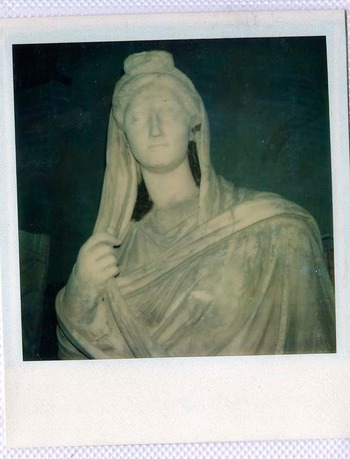
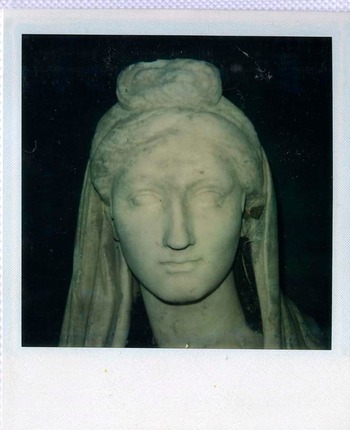
My account of this case is based on a comparison and contrast with another object in a very similar set of circumstances that had a different end result. Circumstantial details about the photographs will be important, along with the reaction of the museums and the action (or lack of action) by the state authorities concerned. Just before the beginning of the 1974 football World Cup hosted by Germany, the Greek, Geneva-based antiquities dealer Nikola Koutoulakis was informed of an impressive haul of antiquities that was about to appear on the market. Footnote 17 Among them was a marble statue of the empress Vibia Sabina, wife of the Roman emperor Hadrian (117–138 ad). The over-life-size statue (204 centimeters in height) was kept in the warehouse of a Turkish dealer in Munich. Koutoulakis asked Giacomo Medici to check the object for him since Medici had already scheduled to be in Munich on 15 June in order to watch the football match between Italy and Haiti. After the match, Medici visited the warehouse and took three Polaroid images, Footnote 18 depicting the statue still covered with soil, on a wooden pallet on the floor, near other antiquities (figs. 1–3). Footnote 19 Medici kept the Polaroid images in his archive and reported back to Koutoulakis on the condition of the statue.
The first Polaroid image from the confiscated Medici archive depicting the Vibia Sabina statue unconserved and lying on a wooden pallet. © Italian Ministry of Justice.

The second Polaroid image from the confiscated Medici archive depicting the Vibia Sabina statue unconserved and lying on a wooden pallet. © Italian Ministry of Justice.

The third Polaroid image from the confiscated Medici archive depicting the Vibia Sabina statue unconserved and lying on a wooden pallet. © Italian Ministry of Justice.

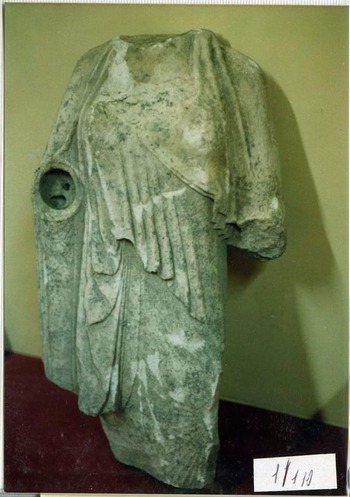
However, it seems that Robert Hecht, the dealer who dominated the international illicit antiquities market at the time, found out that the statue of Vibia Sabina was on offer. Apparently, acting quicker than Koutoulakis, Hecht bought the statue and sold it to the Boston MFA on 14 November 1979 (Account no. 1979.556), pretending, as often happens, to be the agent of his own conservator Fritz Bürki. Footnote 20 The Boston MFA acquired the Vibia Sabina statue using funds from the Classical Department Exchange Fund. Footnote 21 The museum gave the collecting history of the statue as follows: “Said to have been in an aristocratic family collection in Bavaria.” Footnote 22
After the raid of the Medici warehouses by the Swiss and Italian authorities, the three Polaroid images that were produced by Medici in Munich were discovered in the archive. The Italian archaeologists Maurizio Pellegrini and Daniela Rizzo identified the statue depicted in the three Polaroids as the one on exhibition in the Boston MFA. Footnote 23 Apart from this statue, they also identified 12 more antiquities at the Boston MFA from the confiscated archives. On 28 September 2006, the Boston MFA signed an agreement with the Italian Ministry of Culture for the return of all 13 identified antiquities. Footnote 24
The museum agreed to return the antiquities to Italy after five months of quiet negotiations, without demanding any legal proof that the objects had been looted. Footnote 25 Furthermore, as Jason Felch and Ralph Frammolino note, “[u]nlike the Met, the MFA did not demand loans in exchange for all the returned objects and delivered them as soon as the deal was struck. And unlike the Getty, it did not resist.” Footnote 26 However, at some point between 2006 and 2007, Medici told journalist Sharon Waxman, regarding the Sabina statue: “Boston returned it to Italy, but it came from Turkey. This is absurd; the piece is not Italian. It’s typically Turkish, of smooth marble. Now it’s in the Villa Adriana.” Footnote 27 Moreover, on 5 May 2009, Suzan Mazur, a journalist with a lengthy passion about research on illicit antiquities cases, wrote that the Turkish journalist Ozgen Acar informed her about the possible identity of the Turkish dealer who in 1974 had the statue of Vibia Sabina at his gallery in Munich; the information included his connection with Hecht:
Acar has emailed me from Turkey saying it’s likely it was Fuat Uzulmez of Munich’s Artemis Gallery. Uzulmez is the handsome playboy who escorted me out of the Hecht-McNall Park Lane Hotel auction in November 1990, putting his arm around me and whispering in my ear: “We are going to kill him [Acar].” Hecht’s daughter knew him as “Uncle Fuat.” Footnote 28
The use of photographs in the Medici archive as “evidence” for an Italian claim may now be compared and contrasted with that of a Greek archaic female statue, a kore, likewise depicted in this archive and likewise acquired by a major North American museum, but eventually—rightly—returned to Greece. Kore statues have been found chiefly in Greece and Minor Asia; only a few examples come from Magna Graecia and Cyprus. Footnote 29 In March 1993, the J.P. Getty Museum notified the Greek and Italian authorities about its intention to acquire the kore statue (along with another object, a golden wreath, which could have been Italian but eventually proved to have been looted from Greece). The Greek Ministry of Culture responded that the statue could only be the product of an illicit excavation, but at the time, the Greek authorities had no proof to support that claim. Their rationale, as Peter Watson and Cecilia Todeschini make clear, was that material of such quality, had it been legally excavated, would have been widely published. Footnote 30 Regardless of the Greek reaction, the Getty approved the acquisition of the kore on 14 April 1993 from the dealer Robin Symes for US $3,300,000 Footnote 31 and formally acquired the statue on 10 June 1993. Footnote 32
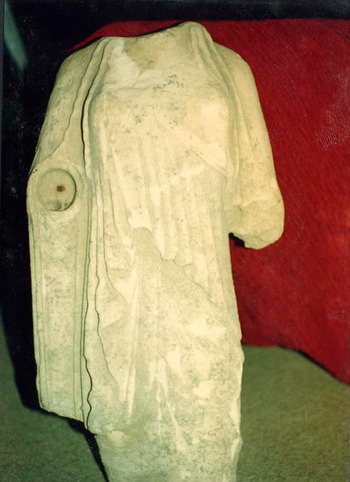
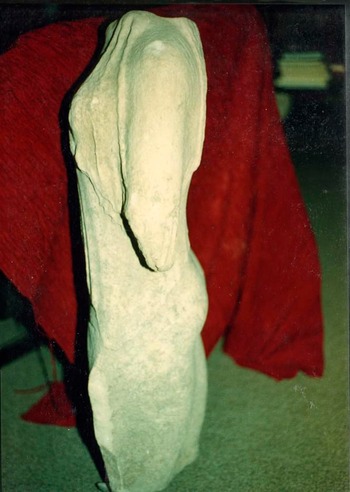
Twenty-one images in the Medici archive depict the kore still covered with soil and bearing fresh marks from tools used for looting the statue, in what appears to be two different warehouses (three of these images are shown as figs. 4–6). While an official Greek claim, lacking the required evidence of supporting documentation, was pending on the kore, the Italian state discovered the images of the kore in the Medici archive. However, before the Italian state pushed forward with their claim of the kore, based solely on the fact that the images were discovered in the confiscated archive of an Italian dealer (Medici), a fruitful cooperation between the Italian and Greek authorities, Footnote 33 in which I participated as an archaeologist for Greece, resulted in the reinforcement of the 14-year-old (by that time) Greek claim and the repatriation of the kore to Greece in March 2007. Footnote 34
The first of 21 images from the confiscated Medici archive depicting the Kore statue unconserved and bearing marks of unprofessional excavation. © Italian Ministry of Justice.

The second of 21 images from the confiscated Medici archive depicting the Kore statue unconserved and bearing marks of unprofessional excavation. © Italian Ministry of Justice.

The third of 21 images from the confiscated Medici archive depicting the Kore statue unconserved and bearing marks of unprofessional excavation. © Italian Ministry of Justice.

Another element contributing to the repatriation of the kore statue to Greece was Robin Symes’ testimony to the Italian public prosecutor Paolo Giorgio Ferri. During his interrogation in Rome on 28 March 2003, Symes stated regarding the kore statue:
Symes: I bought it from Koutoulakis and I sold it to the Getty …
Ferri: To the Getty …
Symes: Many years ago. It’s Greek, completely Greek! It’s even Paros marble … it’s made of. It couldn’t be anything else. Footnote 35
The involvement of the Greek dealer Koutoulakis in the case of the kore statue reinforced the Greek task force’s argument regarding the statue’s Greek origin and aided the repatriation of the statue to Greece.
The Greek dealer’s involvement with the kore connects this case with that of the Vibia Sabina statue, but these two similar cases received differing treatment. The Vibia Sabina was returned to Italy based purely on the fact that three Polaroid images of the statue were discovered in the confiscated archive of an Italian dealer, a fact that does not prove the statue’s Italian origin—the statue is Roman and could theoretically have been looted from any country that in antiquity was part of the Roman Empire. Moreover, in the case of this statue, a statement of the witness (Medici) that it came from Turkey was not taken into account. However, neither this detail, nor the fact that Medici told Silver that he saw the statue at the warehouse of a Turkish dealer in Munich, Footnote 36 are by themselves proof of the statue’s Turkish origin, any more than the images in the Medici archive constitute proof for the statue’s Italian origin. Rightly, then, the discovery of seven times more images of the kore statue (21 in total) than of the Vibia Sabina statue (three) in the same archive of the same Italian dealer should not have been regarded as proof enough for the kore statue to be “returned” to Italy. In neither case was there other evidence in the photos regarding the possible origins of the object, such as there was in the case of two marble griffins depicted in the Medici archive in an Italian newspaper, a fact that helped their repatriation to Italy. Footnote 37
Note that the fact that kore statues of this type (Parian) are exclusively found in Greece was not seen as being sufficient in itself for the repatriation of this kore to Greece, otherwise the statue could have been repatriated there as early as March 1993, when the Greek authorities first became aware of the kore’s existence. Again, the Italian dealer’s statement of the Turkish origin of the Vibia Sabina statue depicted in his archive has not (yet) overturned that statue’s repatriation to Italy, not just because the Turkish authorities have not investigated the matter, or because the Italian authorities, when they were claiming the statue, were unaware of Medici’s view and experience. The statement of the English dealer (Robin Symes) about the kore’s Greek origin was (eventually) made to contribute to the Greek case, but I judge that the Italian authorities were right to be cautious regarding the validity of Symes’ statement in 2003. Both Symes and Medici, during their legal fights with various countries’ authorities, have been found to have lied in several cases, and thus, neither man’s word is proof in itself. Footnote 38
The fact that the Boston MFA gave the Vibia Sabina statue to Italy, relying purely on three images coming from an Italian dealer’s confiscated archive, without asking the Italian authorities to provide any proof that the Vibia Sabina statue was actually looted from Italy, leaves the case open to further research regarding the true origin of this statue. The Italian authorities apparently benefited from the Boston museum’s loose approach (see next paragraph) at the time of the negotiations to the Italian claim of the Vibia Sabina along with other more obviously Italian antiquities. Indeed, there is a telling caveat in the catalogue of the Italians’ celebratory exhibition of the objects in Italy, “Nostoi. Capolavori Ritrovati.” In regard to the origin of this statue, the catalogue entry reads: “La statua proviene forse da villa Adriana a Tivoli [The statue possibly comes from Hadrian’s villa at Tivoli].” Footnote 39 Medici’s own link to the case is circumstantial, as may be inferred from his telling Vernon Silver that Koutoulakis had asked him to inspect the Vibia Sabina statue as a favor since he would be in Munich anyway to watch the football match.
The reason that the Boston MFA did not insist on the Italian authorities’ providing evidence of the statue’s Italian origin seems to be the weight of the evidence presented during the negotiations regarding the 12 other antiquities claimed. Those 12 objects, at any rate, were undoubtedly looted from Italian soil and had been traded by the same illicit antiquities dealers. Although in the case of the Vibia Sabina statue, there were available only the Polaroid images, which did not constitute proof that the statue was looted from Italy, the evidence concerning all of the claimed objects, taken as a whole, probably deterred the museum from requesting evidence of an Italian find-spot for this one object. The alternative for the Boston MFA would have been to take the case to court, trying to resist the release of only this antiquity. However, it is highly probable that the museum’s legal team did a risk assessment and gave the advice not to follow this path since a court case could lead to public disclosure of information currently protected by confidentiality agreements, disclosure that might encourage Italy or other countries to make further claims on the museum’s collection. The lawyers might have warned more generally that a court case might result in long-lasting negative publicity if the institution were to emerge as a guilty and greedy organization trying to hold onto a statue that was probably looted (as the Polaroids implied) and traded by the same dealers who traded antiquities that the museum had just agreed to release. These reasons likely explain why no museum or private collector has ever tried to defend their acquisitions in court regarding any claims made so far on the basis of photographic evidence from the confiscated archives. Footnote 40
At the moment, there is no real proof to support Italy’s claim to the Vibia Sabina statue; any other country that used to be part of the Roman Empire could raise a claim to the statue, if it gathers sufficient evidence. Given that Hecht and Koutoulakis are no longer alive, one way to re-open the case might be to re-examine Medici, Fritz Bürki, and the Turkish dealer (reportedly Fuat Uzulmez). All of the indications so far (although they are not in themselves proof) point not to Italian, but, rather, to Turkish, origin.
CASE STUDY 2: KYKNOS KRATER BY EUPHRONIOS
The collecting history of the Kyknos krater by Euphronios has never been investigated in isolation from the more famous Sarpedon krater that was acquired by the Metropolitan Museum in 1972 and repatriated to Italy in 2008. The Kyknos krater was also repatriated in 2008 to Italy and, like the Sarpedon krater, was traded by Robert Hecht, this time ending up in the collection of Shelby White. After recounting the known collecting history of the Kyknos krater, I will evaluate various points of speculation about its earlier trade, in terms of evidence for its repatriation to Italy.
This fragmentary krater, of which about one quarter survives, depicts Herakles killing the prince Kyknos, while Athena protects Herakles from the god Ares who advances to avenge his son Kyknos. Footnote 41 Euphronios signed this krater and inscribed below Herakles ΛEAΓΡΟΣ ΚΑΛΟΣ (“Leagros is beautiful”). The beauty of this young man was regularly praised on Athenian vases in the late sixth century bc, a detail that helped Dietrich von Bothmer, the then curator of antiquities at the Met, to date the krater to around 510 bc. Footnote 42 The first public appearance of this vase was as an “anonymous loan” to the J.P. Getty Museum on 28 February 1980. The Kyknos krater was exhibited among a group of Euphronios vases and fragments, the biggest accumulation of previously unknown Euphronios vases in hundreds of years. All of these works of Euphronios were published in a single article, without reference to any previous collecting history, by Martin Robertson in 1981, Footnote 43 who was at the time, together with Bothmer, the greatest living authority on Attic vase painting and who “had the good fortune of being a Visiting Scholar at the Getty” when all these Euphronios vases appeared there. Footnote 44 Through this publication and their exhibition at the Getty museum, these previously unprovenanced vases and fragments acquired some kind of collecting history. Soon after, the krater appeared as part of the Nelson Bunker and William Herbert Hunt collection. From June 1983 to June 1984, the collection went on tour to some of the most famous American museums (the Virginia Museum of Fine Arts, the Detroit Institute of Arts, and the Dallas Museum of Art), beginning with the Kimbell Art Museum in Ohio, where the Texan Hunt brothers had been born. The catalogue of the exhibition, entitled Wealth of the Ancient World, included the publication of the Kyknos krater by Bothmer.
When the Hunt brothers went bankrupt, they sold their antiquities collection through an auction organized by Sotheby’s in New York on 19 June 1990. Footnote 45 At the auction, Robin Symes, acting as an agent for the collectors Shelby White and her husband Leon Levy, acquired the Kyknos krater for US $1,760,000. The krater was lent by White and Levy to the Metropolitan Museum in 1999 (Account no. L1999.36.1), where it stayed on exhibition at least until December 2005. Footnote 46 As mentioned previously, in January 2008, White returned 10 antiquities to Italy after 18 months of intense negotiations. Among the returned objects was the Kyknos krater.
In order to examine whether the return of the Kyknos krater to Italy was right, it is important to trace the collecting history of the vase before its acquisition by the Hunt brothers. In the mid-1970s, Hecht had arranged to cooperate with the American dealer Bruce McNall, becoming almost exclusively the sole supplier of McNall’s gallery (named the Summa Gallery and situated on Rodeo Drive in Los Angeles) and splitting the proceeds with him. Footnote 47 In 1979, Hecht, through McNall, sold the Kyknos krater to the Hunt brothers together with a Euphronios cup that depicted Sleep and Death carrying Sarpedon’s body; the price for both was US $2 million. Footnote 48 According to Silver, Footnote 49 Hecht told McNall that he bought the Kyknos krater from Medici for US $800,000–$900,000. It appears that these two vases, before they reached the Hunt brothers who were now their owners, were sent directly to the Getty museum by Bürki, on behalf of Hecht and McNall, for exhibition. For official purposes, these objects were listed by the Getty as being an “anonymous loan.” Footnote 50
Before Hecht’s acquisition of the Kyknos krater, nothing is proven regarding its previous collecting history. According to Thomas Hoving, the former director of the Metropolitan Museum, the Kyknos krater was bought by Hecht from a Lebanese dealer, Dikran Sarrafian. Hecht stated, and Sarrafian confirmed in interviews, that he inherited the fragments of a Euphronios krater from his father, who he said acquired the fragments in London in the 1920s. In Hoving’s opinion, the Euphronios’ Kyknos krater was “a bona fide krater,” whose collecting history Hecht deliberately switched with that of the freshly excavated near-complete Sarpedon krater that Hecht had sold to the Met. Footnote 51 Hecht claimed that he had bought the Sarpedon krater, the highest quality vase surviving from antiquity, signed by Euphronios, from Dikran Sarrafian in August 1971. In fact, as we now know, the Sarpedon krater was not excavated until December 1971. Moreover, Sarrafian always emphasized that his Euphronios krater was not complete. Hoving met Hecht in December 2000 during an exhibition in London, where, Hoving asserted, Hecht admitted that he switched the collecting histories; Hecht later denied that he said this. Footnote 52
However, Hoving’s scenario about the two Euphronios kraters seems to me very possible, as it explains in a convincing way all of the statements and incidents from the time. Footnote 53 This includes the apparently independent testimony from Muriel Silberstein-Newman, who wrote to the Metropolitan Museum, on seeing the controversy about the Sarpedon krater in the papers, to attest that she had seen the fragments of a Euphronios krater in Sarrafian’s flat in Beirut in 1964; however, the fragments were “large—very—and thick and extremely dirty.” Footnote 54 If Hoving’s theory is correct, then the Kyknos krater was used to launder the Sarpedon krater and was not exhibited deliberately until nine years later in order to disassociate it from its Euphronios twin. This would make the Kyknos krater the only legal antiquity that Hecht ever sold, and, according to the Italian law (passed in 1939) and the 1970 UNESCO Convention, the Italian authorities had no grounds on which to claim it.
There is a real question, then, as to why White delivered the most expensive object of her collection to the Italian authorities. The Italians have no proof that the Kyknos krater was looted from Italian soil in the post-1970 period. Equally, though, White had no proof that the Kyknos krater was licit. The absence of proof on both sides does not justify either the removal of the object from the private collection or its repatriation to Italy in particular. Yet, both happened. Later in this article, I offer several possible explanations for why the absence of proof regarding the licit origin of the krater in this case seems to have weighed more than the absence of proof regarding its illicit excavation.
Indeed, the likelihood is slim that the Kyknos krater is licit since everyone connected with the known part of its collecting history is tarnished by association with the trade and/or acquisition of numerous other illicit antiquities. I have already discussed Hecht and his restorer Fritz Bürki. Bruce McNall, after being sentenced for financial fraud, wrote his memoir Fun While It Lasted (2003) while he was in jail, in which he narrates the ways in which he was smuggling antiquities from their countries of origin and trading other illicit objects independently or through his cooperation with Robert Hecht. Bothmer, a close friend of Hecht, Footnote 55 became a customer of Hecht and other illicit antiquities dealers, forming a private collection of vases and fragments that he kept in his office at the Metropolitan Museum—an obvious case of conflict of interest that the museum overlooked. Footnote 56 Several fragments and a near-complete vase from the Bothmer collection have been repatriated to Italy. Footnote 57 Bothmer was instrumental in the acquisition of the Sarpedon krater, which he later published. He also published the Kyknos krater in the Hunt collection volume and several other antiquities in the Shelby White and Leon Levy volume, many of them now proven to be illicit and returned to Italy, while others are still under investigation.
The Hunt brothers very quickly built up a formidable collection of antiquities, acquiring from Hecht and McNall objects originating from illicit antiquities dealers such as Medici. The same stands for the collection of White and her husband Levy, which, even after all of the repatriations, remains the foremost in the world. Part of the Levy and White collection was presented for the first time at an exhibition at the Metropolitan Museum in 1990, Footnote 58 arranged by Philippe de Montebello; in this exhibition 93 percent of the objects lacked a “source,” and 84 percent had no collecting history before 1974. Footnote 59 When Philippe de Montebello retired from being director of the Met in December 2008, he immediately became (in January 2009) the first Fiske Kimball Professor in the History and Culture of Museums at New York University’s (NYU) Institute for the Study of the Ancient World, an establishment created by White, from whom New York University accepted a US $200 million donation for its creation. Footnote 60 The acceptance of this donation caused the resignation of at least one NYU academic from its existing Center for Ancient Studies because of the known activity of White in collecting antiquities largely without any collecting history. Footnote 61 Indeed, White was the declared source of several entries in the 2008 catalogue of the Nostoi exhibition of antiquities repatriated to Italy and Greece, which have now been proven to have been stolen or freshly looted and smuggled. Footnote 62
There is one other consideration to bear in mind. It is not absolutely certain that the Kyknos krater “was a bona fide krater.” Footnote 63 Silver states that Hecht sent images of the Kyknos krater to McNall and from them it was evident that “Bürki hadn’t yet done his handiwork because they thought other fragments might come into the market. There’d be no point gluing it all together if they’d have to take it apart again to stick in extra bits.” Footnote 64 Only after McNall persuaded Bunker Hunt, in 1979, to acquire the krater did Hecht notify Bürki to glue the vase together. Footnote 65 If the origin of the Kyknos krater was indeed from Sarrafian (thus, in London in the 1920s), then the fragments of the Kyknos krater that reached Bürki in August 1971 and were photographed by Widmer in early September, would have been glued immediately, as no other fragments would have been expected to emerge. The fact that the Kyknos krater remained in a fragmentary condition at Bürki’s workshop for eight years after its acquisition by Hecht may indicate that the krater is the result of much more recent looting and that the owners of other fragments belonging to the same vase might have offered them in due course.
As with every antiquity, there are ultimately only two options regarding the Kyknos krater’s collecting history: either it is licit or illicit. If we accept that the Kyknos krater is licit, then we accept Hoving’s theory about Sarrafian being the original holder of the krater. After all, there is no third Euphronios krater—complete or fragmentary—that has surfaced in the market since 1971. In that case, the Kyknos krater should have stayed in the Shelby White collection. On the other hand, if we suppose that the Kyknos krater was looted, we have no other lead but to accept McNall’s statement that Hecht received the fragments of the Kyknos krater from Medici, as happened with the Sarpedon krater fragments. We thereby also distrust the statements of Sarrafian, if Sarrafian was talking about the fragments of the Kyknos krater. However, Sarrafian never explicitly claimed that he owned the Sarpedon or the Kyknos krater. Footnote 66 According to Silberstein-Newman, Sarrafian told her in 1964 that the “extremely dirty fragments” he had were from a Euphronios krater. Silberstein-Newman’s testimony indicated that she could not know if the fragments she saw were those of the Sarpedon krater or the Kyknos krater or even of any krater painted by Euphronios. If the Kyknos krater is illicit, and we accept that Silberstein-Newman is telling the truth, there are two possibilities: either Silberstein-Newman saw fragments of another Euphronios krater that for over half a century has not reached the market (a highly improbable scenario) or she saw fragments of another krater that she was told was by Euphronios when it was not. Footnote 67
If the Kyknos krater was looted, then—if we accept McNall’s statement—it is possible that the krater was looted from Italy. In this case, Medici and Hecht were involved in the trafficking of all three Euphronios vases surfacing in the market since 1971. Several of the objects trafficked by Hecht have been proven to have passed through the hands of Medici after being looted in Italy. Footnote 68 However, in the case of the Kyknos krater, we have no actual proof of this. We may compare the case of the Vibia Sabina statue discussed above, in which the involvement of Medici’s name and three images were enough for the statue to be delivered by the Boston MFA to Italy. However, in the case of the Kyknos krater, there is not even a single image in the Medici archive. Footnote 69
The condition of the Kyknos krater, however, makes an Italian origin less likely. Unlike the Sarpedon krater, which is complete enough to have been found in a tomb, only a quarter of the Kyknos krater survives. Footnote 70 Daniella Rizzo believes that the Kyknos krater could have been discovered in Greece. Its partial survival is a reminder of the few Euphronios vases that were discovered in Greece and that also survive only in part because of their discovery in archaeological contexts other than tombs. In reply, one might point to a fragmentary kylix, also depicting the death of Sarpedon, which (eventually) was judged to have been looted from the same Etruscan tomb as the Sarpedon krater. Footnote 71 This theory, however, seems to be an exception, and the “proof” of its find-spot was not its condition but, rather, the looters’ testimony and other information.
Indeed, the Italians have failed to prove on the basis of fragment matching that the Euphronios kraters were looted from Italy. In 1973, one of the looters who discovered the Sarpedon krater, Armando Cenere, led the Carabinieri art squad to the illicit dig site, and the investigators discovered four fragments from the rim of a vase. Footnote 72 It was later proven that although these fragments did belong to a vase painted by Euphronios, they could not belong to the practically complete Sarpedon krater, Footnote 73 nor did they belong to the Kyknos one. Footnote 74 Fifteen more fragments were found at the site by the Carabinieri in 1973, as Maurizio Fiorilli, the lawyer representing the Italian state in the negotiations with the foreign museums told Silver. Footnote 75 With information that I received from Rizzo and Maurizio Pellegrini, I can report that this appearance was probably to distract the authorities from the investigation of the Sarpedon krater, for the fragments had been left at the entrance of the archaeological site of Cerveteri and were found by the guards who opened the site in the morning. When put together, the fragments formed half the base of a Euphronios krater with a lotus palmette towards the bottom of the krater’s body. During Fiorilli’s negotiations to win back the krater from White, “Italy claimed the fragments definitely comprised the vase’s missing foot.” Footnote 76 However, after the negotiating team got the Kyknos krater from White, Rizzo and Pellegrini realized that these fragments did not fit that krater. Footnote 77 In fact, this should have emerged from close attention to the photographs of the krater in Robertson and Bothmer’s publications. Judging only from the timing of Rizzo and Pellegrini’s discovery (non-disclosure agreements cover the negotiations), it seems most probable that White had not asked experts to check for a match during the negotiations. Such inattention makes her agreement to return the object even more remarkable, and I note several possible scenarios below. The result is that the Italian state does not have a single proof that the Kyknos krater was looted from Italy in recent years.
As in the Vibia Sabina and the archaic kore cases, it is impossible to know the points discussed by the negotiation teams at the time, due to the confidentiality agreements that were signed by all of the participating members. There are two main scenarios. Either White believed that there was a match and so released the object without first checking with an archaeologist, or she did not believe the claim but gave up the object anyway for other reasons (see my discussion below). With respect to the first scenario, she may have been deliberately deceived by the claim that the fragments found at Cerveteri “definitely” belonged to the krater she possessed—Silver’s account leaves open this possibility, although the quotes that he directly attributes to Fiorilli and public prosecutor Ferri, earlier in the account, speak rather of a “hypothesis,” Footnote 78 and by attributing the final claim to “Italy,” Silver elides the origin of the shift from a suspected match to a definite one. It is equally possible, however, that the Italians claimed in genuine (but mistaken) belief that the fragments matched White’s krater and so unintentionally deceived her.
If we follow up the second scenario, there are several possible reasons why White relinquished ownership of the Kyknos krater despite suspecting that the claim was not valid. In my view, these would be exactly the same reasons as (I believe) prevailed previously over the Boston MFA in the case of the Vibia Sabina statue—that is, the weight of the photographic and other evidence relating to the remaining antiquities being claimed, which White accepted were undoubtedly looted from Italy. For an object linked to the most notorious antiquities dealers, as were the remaining nine objects, to pursue the defense of its ownership in the American or Italian courts would have resulted in significant negative publicity for White. Intense negotiations had been underway in private for 18 months and were kept that way after the repatriations due to the non-disclosure agreements. Footnote 79 Moreover, there was the possibility that a public trial would produce more evidence regarding other antiquities in the Levy and White collection, either for Italy’s benefit and/or for attracting the attention of other countries for possible claims. For all of these reasons, the overall risk assessment by White’s advisers must have been against the option of resisting this one, resulting in the delivery of all 10 claimed antiquities to Italy, regardless of the absence of solid proof by the Italian team that the Kyknos krater was looted from Italy.
An alternative possibility may be deduced from an allusive comment concluding an online article by Susan Mazur in 2006. Footnote 80 In her article, Mazur is discussing an exhibition of high-quality Greek vases (with ownership disguised) in the “Phoenix Ancient Art” gallery in New York. She reminds us of the legal problems that the gallery owners, the brothers Ali and Hicham Aboutaam, had with several countries, including Italy and the United States, regarding illicit antiquities. (Indeed, in 2009, the Aboutaams, who were cooperating with Medici, Footnote 81 would return 251 antiquities to Italy.) Footnote 82 Mazur’s article concludes:
The fragmentary Euphronios is now owned by New York collector Shelby White and is on loan to the Met. It was purchased for White’s late husband, Leon Levy, by dealer Robin Symes who paid $1.76 million for it at the time. It rests on a pedestal just down the hall from the Sarpendon [sic] Euphronios krater, whose title of ownership was transferred from the Met to Italy earlier this year.
And the Italians are as interested in the Herakles-Kyknos Euphronios as they were in the Sarpendon [sic] Euphronios.
But surely Dr. C.J.D.’s Swiss provenance is proof enough that the Aboutaams’ Herakles-Kyknos carries no risk for the buyer? Perhaps it’ll turn up in Shelby White’s hoard as insurance against <the?> loss of her Kyknos Euphronios. Footnote 83
Written in 2006 at the start of the negotiations with the Italian authorities, Mazur’s phrase “insurance against loss” is suggestive; it implies that White’s Kyknos krater is linked with the Aboutaams and that they should compensate White for her anticipated loss of the Kyknos krater. In 2006, the Aboutaam brothers were in their thirties, so they themselves could not have trafficked the Euphronios’ Kyknos krater. However, the Aboutaams’ place of origin is Beirut, and their father, Sleiman, was an antiquities dealer and close friend of Robert Hecht. Footnote 84 Mazur’s comment opens the possibility that the Kyknos krater truly came from Beirut, with the involvement not only of Dikran Sarrafian but also of Sleiman Aboutaam. This would be particularly ironic because, as Hoving declares regarding Hecht’s assertion of Beirut as the origin of the Sarpedon krater:
Beirut was the cliché provenance for any smuggled antiquity out of Italy or Turkey. Lebanon was as shopworn an origin as “from an old Swiss private collection.” Beirut was such an obvious laundry that I wondered why Hecht had not chosen the “Gessler collection” from Switzerland. That would have sounded more authentic. Footnote 85
If my guess based on Mazur’s mysterious comment is correct, Hecht mentioned Beirut because it was in fact the provenance of one of the Euphronios kraters. Sarrafian’s initial testimony about his Euphronios (it is now doubted whether this was genuinely Sarrafian or was a testimony (a letter) forged by Hecht) stated that Hecht had seen the krater “with Sarrafian’s friends in Switzerland.” Footnote 86 Such “friends,” with connections to Beirut, Switzerland, and Hecht, would most probably include Sleiman Aboutaam.
Ultimately, no one of these scenarios has any more real proof than another. We do not know whether the Italians intended to deceive White with their citation of fragments that “definitely fitted” the Kyknos krater; we do not know whether White consulted an expert on this before giving back the krater. All we can say for sure is that, in effect, the Italians got the Kyknos krater because White could not prove that it was legally traded and because those who were involved in its trade up to that point were involved in numerous other illicit antiquities cases. These points, by themselves, are not proofs.
Are there any ways leading forward to find out what really happened? Hecht, Hoving, and Sarrafian are now deceased (Sarrafian was killed in a mysterious car accident with his Danish wife in 1977). Footnote 87 We might, however, have a chance to clear up the case by consulting the photograph archive (if it still exists) of Dieter Widmer, the professional photographer of Medici, Hecht, and Symes, based in Basel. In response to the Metropolitan Museum’s searching for evidence of the legal origin of the Euphronios’ Sarpedon krater, Widmer testified that he had received “fragments in an unrestored state” in early September 1971 and was paid for his images in October 1971. Footnote 88 As we now know, the Sarpedon krater was not excavated until December of that year, and so it seems most likely that Widmer was referring to the Kyknos krater, but it remains possible that he photographed the Kyknos krater earlier or later. Sometimes, information on the reverse of a professional photograph depicting looted antiquities yields not only its date but also clues about the client (owner of the object) for whom the images were made. Footnote 89 No one yet has examined the photographer and his archive.
CONCLUSION
While we suspect that many items recently on offer in the international antiquities market are probably looted, or illicit in some way, actual repatriation should require evidence. But for these two objects, the Vibia Sabina statue and the Kyknos krater, questions remain. Both were sold by Hecht, through his “fronts” (Bürki and McNall) in 1979 to the Boston MFA and to the Hunt brothers, respectively. However, we have no clue where these objects came from originally, and the Italian authorities did not have any proof that they were recently looted from Italian soil, although they succeeded in bringing them to Italy.
Several conclusions may be drawn. The first concerns the type of evidence in the repatriation process. In the two cases I have discussed, the Italians claimed a group of objects (13 from the Boston MFA and 10 from the Shelby White and Leon Levy collection). The Italians succeeded in bringing all 23 objects to Italy, despite the fact that they did not offer conclusive evidence for each and every object claimed; as I have shown, two objects may well have been trafficked from other countries. One interpretation for these two doubtful objects being included among those returned to Italy was the cumulative force of the evidence presented for the rest of the antiquities claimed. It seems to be important, therefore, that these two objects were claimed among other antiquities for which there was concrete evidence of Italian origin. That is to say, the Italians, intentionally or not, by grouping those doubtful objects with the others in large-scale claims thereby strengthened by association their claim on the doubtful objects.
A second point, suggested by my analysis of why the Vibia Sabina statue and the Kyknos krater of Euphronios were delivered to Italy despite uncertainty about their origin is that evidence is not always the sole reason for the success of a claim made in the name of repatriation. Since we would expect that the claim on each object would be checked by legal and archaeological experts on behalf of the museums and collectors, the decisions to give the doubtful objects to the Italians seem to have weighed reputational factors above the requirement for strict evidence. Such factors include the odds against winning a court case involving a undoubtedly tainted object (even if that object was not explicitly proved to be trafficked from Italy), the museum and collector’s desire to keep private all that had been discussed in negotiations, the likelihood of negative publicity, and the fear of provoking further claims (by Italy or by other countries) from circumstantial information that would be revealed if the case reached the courts. Apart from other reasons (for example, the financial cost of a long-lasting trial), such concern for reputation surely helps to explain why no museum or private collector has ever tried to defend their acquisitions in court regarding any claims made so far on the basis of photographic evidence from the confiscated archives. In the case of the Vibia Sabina statue, the photographic evidence from the archives did not conclusively point to the object’s Italian origin. In the case involving the Kyknos krater, the absence even of photographic evidence from the archives did not prohibit the success of its claim by the Italian negotiation team. Therefore, the decisive factor in a successful repatriation claim has not always been the evidence.
My third conclusion is that the search for the missing proofs should be ongoing. Although the Vibia Sabina statue and the Kyknos krater by Euphronios seem to be exceptions to the rule regarding the evidential basis for claims on antiquities, they represent the rule in terms of illicit antiquities in the modern market. That is, objects whose country of origin cannot be proven are far more common in the antiquities market than objects for which repatriation claims can be made (on the basis of archival, testimonial, or other evidence). For these two cases, at least, there are now some unfinished lines of enquiry to follow up.
ACKNOWLEDGMENTS:
The author acknowledges support from the European Research Council under the European Union’s Seventh Framework Programme (FP7/2007-2013; ERC Grant Agreement no. 283873).