INTRODUCTION
Estuaries show both high biological activity and high production (Wolff, Reference Wolf and Ketchum1983; Valiela, Reference Valiela1995). In estuarine zones, the animal assemblages are established along a continuum from internal areas to the mouth with more or less overlapping distributions of the species according to the ecocline model proposed by Attrill & Rundle (Reference Attrill and Rundle2002). Like a transition zone between the marine and the freshwater domains, they are preferential sites for the development of several human activities such as industry, transport, fisheries and tourism. These systems are also areas with considerable pollution problems (Dauvin et al., Reference Dauvin, Desroy, Janson, Vallet and Duhamel2006). However, interpretation of the effects of pollution on the estuaries is often difficult since the geological, physical and chemical characteristics can be confounded with the impacts of anthropogenic origin (Warwick, Reference Warwick1988; Weisberg et al., Reference Weisberg, Ranasinghe, Dauer, Schaffner, Diaz and Frithsen1997; Gaston et al., Reference Gaston, Rakocinski, Brown and Cleveland1998; Morrisey et al., Reference Morrisey, Turner, Mills, Williamson and Wise2003).
The Guadiana River, located along the southern border between Spain and Portugal, is recognized as one of the less polluted European estuaries (Vasconcelos et al., Reference Vasconcelos, Reis-Santos, Fonseca, Maia, Ruano, França, Vinagre, Costa and Cabral2007) and as one of the rivers with greater contributions of sediments to the Spanish coasts (Consejería de Medio Ambiente, 1997). This river shows an irregular flow on both seasonal and interannual scales and crosses a wide rural area along the Iberian Pyrite Belt, with intense mining extraction since Phoenician and Roman times, although this activity has ceased in the last decade (Caetano et al., Reference Caetano, Vale and Falcao2006).
The Guadiana River basin is regulated by approximately 100 reservoirs, and since 2001 the Alqueva Dam, the biggest dam in Europe, with a water storage capacity of 4150 hm3, has regulated more than 80% of the freshwater flow (the damned area within the Guadiana River basin has increased by 12% to a total of 89%) (Gonzalez et al., Reference Gonzalez, Araújo, Burdloff, Cachão, Cascalho and Corredeira2007). The alteration of flow regimes is recognized as one of the most serious processes affecting community structure and function in lagoons, estuaries and deltas of the world (Sklar & Browder, Reference Sklar and Browder1998; Bunn & Arthingthon, Reference Bunn and Arthington2002). The Alqueva Dam will reduce the abrupt river discharges to the estuary and may cause an important impact on the quantity and types of sediments and on the biogeochemical cycles of nutrients that might lead to a significant change in the food web structure of both the estuary and the coastal zone (Caetano et al., Reference Caetano, Vale and Falcao2006; Cravo et al., Reference Cravo, Madureira, Felícia, Rita and Bebianno2006; Gonzalez et al., Reference Gonzalez, Araújo, Burdloff, Cachão, Cascalho and Corredeira2007). The possible impact of this dam in the Guadiana estuary and the nearby coastal area has been analysed for fish assemblages (Chícharo et al., Reference Chícharo, Chícharo and Morais2006a; Morais et al., Reference Morais, Chícharo and Chícharo2009) and planktonic assemblages (Chícharo et al., Reference Chícharo, Chícharo and Ben-Hamadou2006b). Besides, Wolanski et al. (Reference Wolanski, Chícharo, Chícharo and Morais2006) proposed an ecohydrology model integrating physical, chemical and biological processes (the last item was determined by planktonic, bivalve and fish assemblages).
The soft-bottom macrofauna is one of the more important structuring elements of the food web inside estuaries (Herman et al., Reference Herman, Middelburg, van de Koppel and Heip1999) and is considered a key element of many marine and estuarine monitoring programmes (Ysebaert & Herman, Reference Ysebaert and Herman2002). The crustacean assemblages are among the most diverse and abundant groups of soft-bottom macrofauna (Cuhna et al., 1999; Lourido et al., Reference Lourido, Moreira and Troncoso2008) and have been recognized as one of the most sensitive to changes in environmental conditions (Desrosiers et al., Reference Desrosiers, Bellan-Santini, Brethes and Willsie1990; Sánchez-Moyano & García-Gómez, Reference Sánchez-Moyano and García-Gómez1998; Guerra-Garcia & García-Gómez, Reference Guerra-Garcia and García-Gómez2004). To date, however, there is no information on the impact on the composition and distribution of the subtidal macrofauna in the Guadiana estuary. Thus, the aim of this work was to characterize the composition and distribution of the crustacean assemblages of subtidal soft-bottom sediments along the estuarine gradient previous to the building of the Alqueva Dam. This work may contribute to assessing changes in the marine–estuarine system related to the impact of the dam since it can be used as a reference condition in a long term perspective.
MATERIALS AND METHODS
Study area
The Guadiana River is one of the main rivers of the Iberian Peninsula with 820 km in length and a drainage basin area around 67.500 km2, which 12.000 km2 belong to Portugal. The estuary is a single-channel mesotidal estuary of about 80 km in length, 70 to 800 m wide and 5 to 15 m depth. There are two natural protected areas located near the mouth: Natural Park of Isla Cristina Marshes and Natural Reserve of Sapal de Castro Marim, in the Spanish and Portuguese margin, respectively. Both areas belonged to the ancient Guadiana delta and are formed by a complex web of channels. In recent years, some Spanish and Portuguese associations have proposed the creation of the International Natural Park of the Lower Guadiana. The Guadiana River flows into a wide continental shelf with soft slope (20 m in depth is reached up 4–5 nautical miles out).
Sampling and laboratory analysis
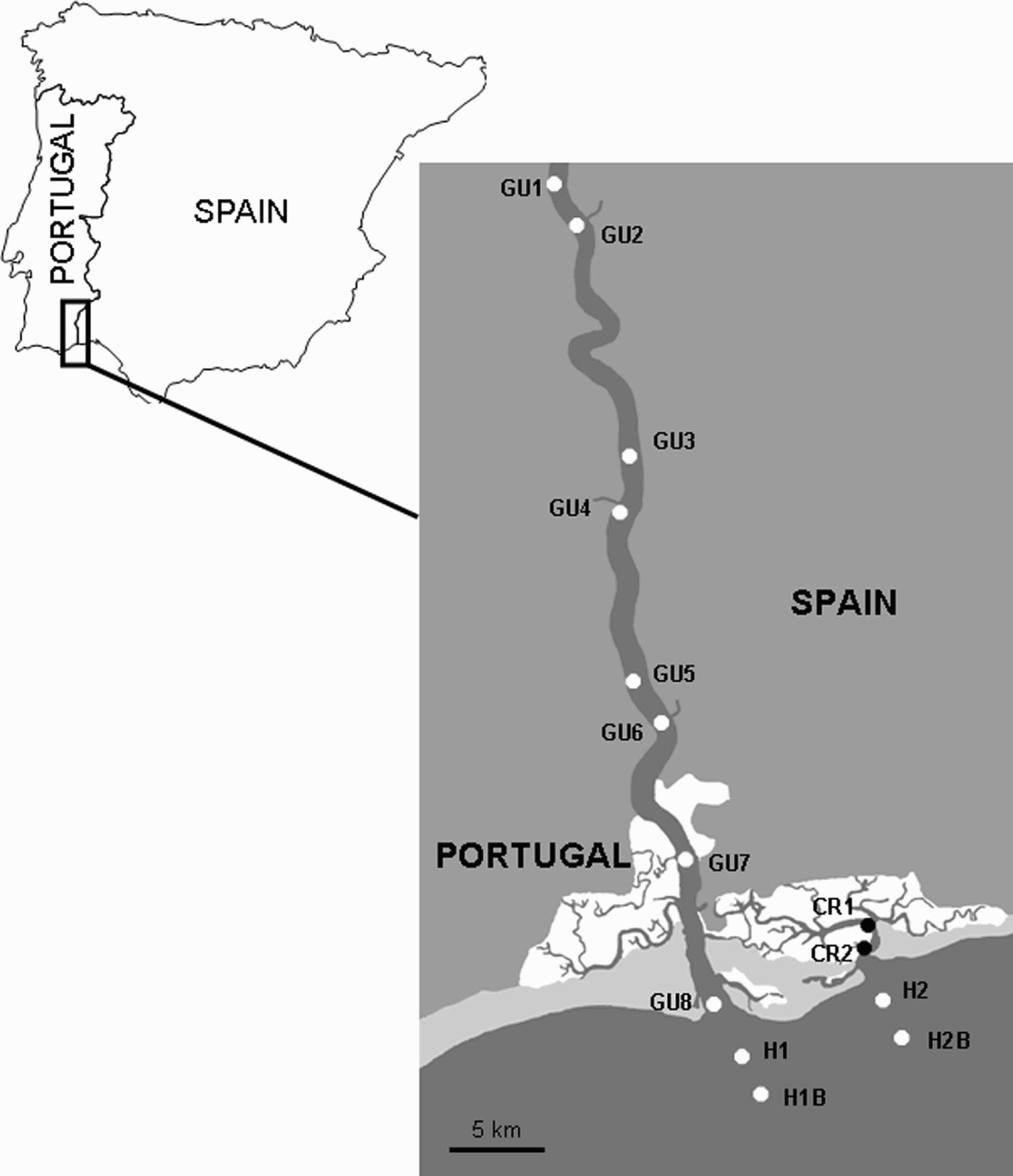
Sampling was undertaken in the summer of 2000 at 14 subtidal stations: 8 along 38 km in Guadiana main course, 2 in Carreras River (Isla Cristina Marshes) and 4 in near coastal area (Figure 1). At each station, six replicates samples (five for biological analysis and one for sediment analysis) were taken with a 0.05 m2 van Veen grab. Each replicate was sieved in seawater through a mesh of 0.5 mm, fixed with 4% formalin and stained with Bengal rose. Crustaceans were sorted and, whenever possible, identified to species level.
Location of the sampling stations at the Guadiana River estuary.

For sediment analysis, granulometry was assessed following Buchanan & Kein (Reference Buchanan, Kein, Holme and McIntyre1984) methodology, and organic matter percentage was obtained as weight loss by ignition at 450°C for 24 hours (mean value of 3 replicates per station). The other sediment parameters were measured by laboratories of the Environmental Agency of the government of Andalusia (South Spain): total organic carbon (TOC) was determined by EPA 415.1; total nitrogen in the sediment was assessed via Kjedahl digestion; phosphate was measured using UV visible spectrophotometry; and the metal contents were measured by SM 3111 A and B for Cd, Zn, Cu, Ni and Cr, and EPA 245.1 for Hg. The index of geoaccumulation (Igeo) has been used as a relative measure of metal pollution in the sediments for Cr, Cu and Zn according to the regional background established by Ruiz (Reference Ruiz2001) for unpolluted sandy sediments. Igeo = log2 (Cn/1.5 x Bn), where Cn is the value of the element n and Bn is the background data of that element. According to Ruiz (Reference Ruiz2001), the index values were divided in five groups: unpolluted (Igeo < 1); very low polluted (1 < Igeo < 2); low polluted (2 < Igeo < 3); moderate polluted (3 < Igeo < 4); highly polluted (4 < Igeo < 5); and very highly polluted (Igeo > 5).
For water analysis, a water sample per station was obtained close to the bottom by a vertical Alpha Van Dorn-style bottle. The following parameters were measured in situ: temperature, conductivity and salinity by conductivimeter WTW LF-323; pH by phmeter WTW 330i; and dissolved oxygen by oximeter WTW OXI-196.
Data analysis
Univariate and multivariate analyses for environmental variables and crustacean assemblages were performed using the PRIMER v 5.2.8 software package. Previously, the replicate data were pooled for the multivariate analysis. The crustacean data were analysed to obtain the total number of taxa, abundance, evenness and Shannon diversity index using neperian logarithms. Spatial differences for univariate variables were analysed by a one-way analysis of variance (ANOVA), after verifying normality (Kolmogorov–Smirnov test) and homogeneity of variances (Barlett test). The data were log10 (x + 1) transformed prior to analysis. Homogeneous groups were separated by a Tukey test set at the 5% significance level.
Affinities between stations were established using cluster and MDS (non-metric multidimensional scaling) analysis with the species abundance (transformed by the fourth root). Percentage of similarity analysis (SIMPER) (Clarke, Reference Clarke1993) was used to determine the taxa involved in grouping the different stations. This analysis, based on the matrix of similarity in taxa abundance obtained from the Bray–Curtis index, calculates the contribution of each taxa to either the dissimilarity between groups of stations (discriminatory taxa) or the similarity within a group (typical taxa).
The relationship between the physical environment and crustacean assemblages was analysed by BIOENV and canonical correspondence analysis (CCA). BIOENV analysis consists in the comparison, through the harmonic rank correlation coefficient of Spearman, the rank similarity matrix on species abundance and the rank similarity matrix obtained through Euclidean distances with the abiotic variables (Clarke & Ainsworth, Reference Clarke and Ainsworth1993). CCA is based on a unimodal response model that constrains the ordination axes to be linear combinations of the environmental variables that maximize the dispersion of sample or taxa scores (Ter Braak, Reference Ter Braak1986, Reference Ter Braak1990). In the ordinations, stations were represented as points and statistically significant environmental variables (after a Monte-Carlo permutation procedure) as arrows.
RESULTS
Environmental analysis
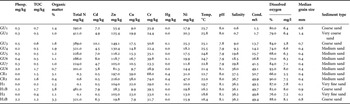
Water and sediment characteristics are shown in Table 1. Water parameters showed a natural trend of estuarine systems, for example increases in salinity and pH from inner to outer points. Estuarine sediments were dominated by medium sand with the exception of the upstream stations (GU1, GU2 and GU3) with coarse or very coarse sand. In the coastal areas, there was a gradient from very fine sand (shallower stations) to coarse sand with biogenic elements (deeper points). The organic matter in sediment showed scarce variations along the study area with moderate or low values. The same trend was shown by other parameters such as TOC, phosphates and total nitrogen. In relation to metal contents, the majority of the sites showed low or moderate concentrations with scarce spatial differences. In relation to the geoaccumulation index, the stations were classified as having low or very low levels of pollution by Cr; and were unpolluted by Cu in most of the study area, except stations GU2 and GU3 (very low levels of pollution) and Carreras River stations (low levels of pollution); meanwhile for Zn, the main channel stations were moderately polluted, the marine area had low or very low levels of pollution, and the Carreras River was highly polluted.
Values of sediment and water parameters in each station.

Crustacean community analysis
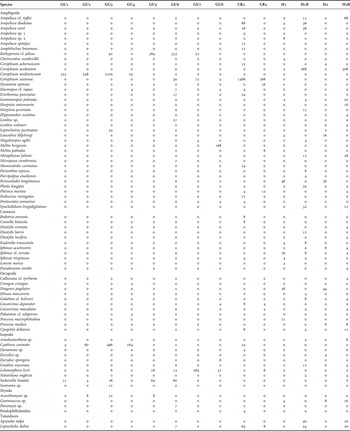
A total of 76 crustacean taxa belonging to six orders were found in the studied area: 38 amphipods, 11 cumaceans, 11 decapods, 10 isopods, 4 mysids, and 2 tanaids. Abundance data for each station are shown in Table 2.
Abundance (ind. m−2) of the crustacean species identified in the Guadiana River estuary.

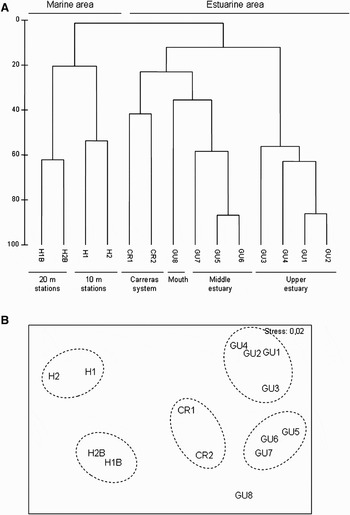
The dendrogram obtained by cluster analysis for the crustacean community distinguished two major groups: estuarine and marine areas (Figure 2A). The estuarine area was further divided into four sub-groups: upper estuary (stations GU1 to GU4), middle estuary (GU5 to GU7), mouth area (station GU8) and the Carreras River system (although these stations have shown a low similarity with the other sites). The marine area was sub-divided into deep stations (H1B and H2B) and shallow stations (H1 and H2). MDS analysis showed results similar to those of the cluster (Figure 2B), and furthermore, a spatial pattern can be observed from the upper estuary to the mouth area.
Dendrogram based on cluster analysis (A) and multidimensional scaling ordination (B) for all stations using Bray–Curtis similarities on species abundance. Stress coefficient: 0.02.

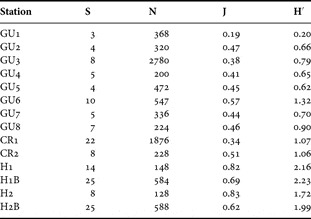
Values of univariate measures are shown in Table 3. The number of species, diversity index, and evenness showed a general pattern of increasing toward the mouth. These parameters ranged over a wide interval (e.g. 3 and 25 species or 0.20 and 2.23 on the diversity index at stations GU1 and H1B, respectively). However, total abundance did not show a clear spatial trend, with the maximum values at stations GU3 (high dominance of Corophium multisetosum and Cyathura carinata with 2100 and 496 ind./m2, respectively) and CR1 (high dominance of Corophium sextonae with 1468 ind./m2).
Number of species (S), total abundance (N: ind. m−2), Pielou's evenness (J) and Shannon–Wiener diversity index (H′) for each station.

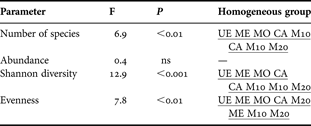
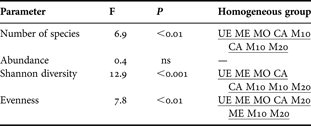
According to the cluster and MDS groups, the spatial differences of these univariate parameters were tested by one-way ANOVAs with the station values as replicates (Table 4). In all the parameters except abundance there were significant differences between estuarine and marine areas, with the Carreras system functioning as a transitional area.
Results of the one-way analysis of variance for the spatial differences of univariate parameters. The homogeneous groups according to the Tukey test (P < 0.05) are indicated with a continuous line. F, statistic; ns, not significant. Group key: UE (upper estuary); ME (middle estuary); MO (mouth); CA (Carreras River); M10 (marine 10 m); M20 (marine 20 m).
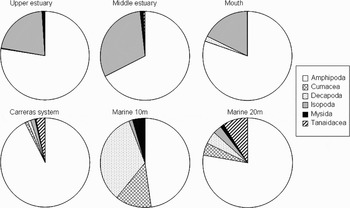
The contribution in abundance of the crustacean orders in each area is plotted in Figure 3. The order Amphipoda was the best represented (ranging from 93% in the Carreras River to 48% in shallow marine stations) due to the contributions of different species in each area (e.g. Corophium multisetosum in the upper estuary, Bathyporeia cf. pilosa in the middle estuary, Corophium sextonae in the Carreras River, or Corophium aculeatum in deeper marine stations). Isopoda was the next most frequently represented order along the Guadiana channel due to the abundance of Cyathura carinata, Lekanesphera levii and Saduriella losadoi; however they were scarcely represented in Carreras and marine areas. In marine areas, the contribution of other orders was greater than in estuarine areas. For example, Decapoda was well represented in shallow marine stations with 33% due to the contribution of Diogenes pugilator; meanwhile Tanaidacea showed the maximum percentage in the deeper marine stations (9% due to the abundance of Apseudes talpa and Leptochelia dubia).
Relative abundance (%) of each crustacean order in the areas determined by multivariate analyses.

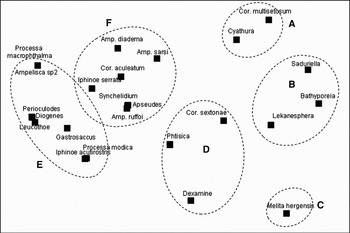
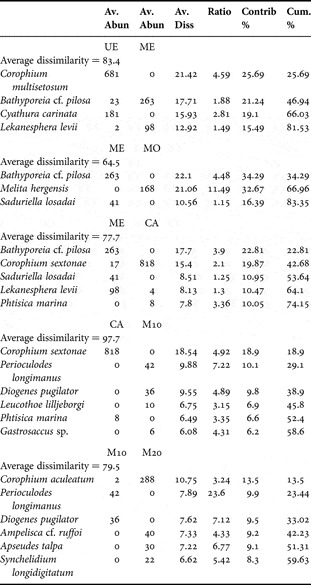
Using the SIMPER analysis, we obtained in each case the best discriminating taxa between the groups of stations identified in the multivariate analyses (Table 5). Between the upper and middle estuary, the differences (average dissimilarity = 83.4%) were mainly based on the exclusive presence and high abundance of Corophium multisetosum and Cyathura carinata in the upper estuary and a higher abundance of Bathyporeia cf. pilosa and Lekanesphera levii in the middle estuary. Between the middle and the mouth estuary, the main differences were based on the presence of Bathyporeia cf. pilosa and Saduriella losadoi in the upper areas of the estuary and the high abundance of the amphipod Melita hergensis at the mouth. In spite of the middle estuary and the Carreras system seeming to be similar environmental zones, they showed 83.4% average dissimilarity. This was mainly due to the high abundance of Corophium sextonae in the last area (average dissimilarity = 77.7%). This species, together with typical marine species such as Diogenes pugilator, was responsible for the separation of Carreras River and the shallow marine area. An MDS analysis based on the abundance data of the dominant species (numerical dominance >4% at any station) to determine the species affinities showed six groups at similarity levels of about 40% (Figure 4). These groups matched the forward stations groups and included the discriminating species shown in the SIMPER analysis.
Multidimensional scaling ordination based on the abundance data of the dominant species (numerical dominance >4% at any station). Stress coefficient: 0.04.

Average abundance (Av. Abun.) of the most relevant taxa of the stations located in each area identified in the multivariate analyses. Taxa are listed in decreasing order according to their contribution to the average of the dissimilarity (Av. Diss.) between areas. Group key as stated in Table 4.

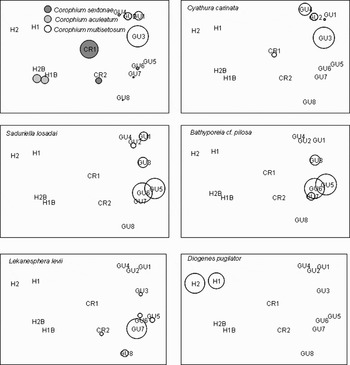
Besides, MDS ordination of stations with superimposed values of abundance of the more characteristic species showed that stations appeared distributed according to the presence of these species along the environmental gradient of the estuary (Figure 5). For example, there was a segregation of the three species of the amphipod genus Corophium along the study area; the isopod Cyathura carinata was located in the upper estuary; the amphipod Bathyporeia cf. pilosa and the isopod Lekanesphera levii were located in the middle estuary; the isopod Saduriella losadoi was located along the main channel of Guadiana; and the decapod Diogenes pugilator was only found in the shallow marine stations.
Multidimensional scaling ordination based on the species abundance with superimposed circles representing the relative abundance of some dominant species. Stress coefficient: 0.02.

Relationship between environmental and crustacean community
The results of the BIOENV analysis indicated that the best correlations always occurred with water characteristics and granulometry (maximum correlations of 0.69 with temperature, and of 0.68 with temperature, salinity, percentage silt, and TOC).
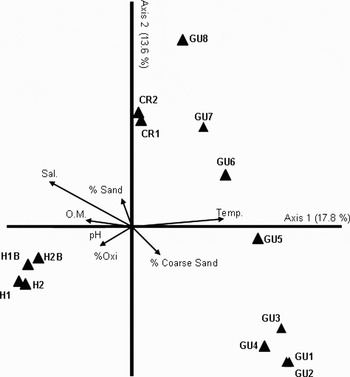
The CCA (Figure 6) showed a clear division between estuarine and marine stations and a similar distribution of the six groups of stations identified by multivariate analyses. Again the environmental variables that best explained the observed community distributions were mainly water characteristics, and secondly granulometry and organic matter. The Monte-Carlo test was significant for both axes (P = 0.01).
CCA analysis plot for all stations from selected parameters of water and sediment: pH, temperature (Temp), salinity (Sal), % of sand, % of coarse sand, organic matter content (OM) and % of dissolved oxygen (% Oxi). The percentage of variability explained by the axis is given.

DISCUSSION
The crustaceans of the Guadiana River and area of influence were distributed as a function of the different environmental conditions along the study zone. Especially, the main variations in the composition of the crustacean community were based on the differences between an estuarine and a marine environment. In each one, there were several crustacean assemblages related to the natural divisions of these systems which we have defined as upper estuary, middle estuary, mouth, Carreras River system, and shallow and deep marine areas. These areas agree with the results obtained for a study of the global soft-bottom macrofauna of the Guadiana River (Sanchez-Moyano et al., Reference Sánchez-Moyano, García-Adiego, García-Asencio and García-Gómez2003, Reference Sánchez Moyano, García Asencio, García Adiego, García Gómez, Leal Gallardo, Ollero de Castro and Fraidías2005) and for other assemblages such as fish (Chícharo et al., Reference Chícharo, Chícharo and Morais2006a) or plankton (Chícharo et al., Reference Chícharo, Chícharo and Ben-Hamadou2006b).
Most of the physicochemical parameters (e.g. heavy metals, nutrients and organic matter) have shown low or moderate values, even for estuaries. The sediment granulometry (predominance of sands) and the hydrodynamic characteristics of the river must facilitate the oxygenation of the substrate and the non-retention of organic elements (Savage et al., Reference Savage, Elmgren and Larsson2002). This was highlighted by the low or moderate concentrations of these elements (e.g. total nitrogen, organic matter and TOC) found along the study zone. In relation to the heavy metals, our data agree with the results obtained in this zone by Ruiz (Reference Ruiz2001), with a predominance of unpolluted or lightly polluted conditions by most of the metals, except the Carreras River (highly polluted by Zn). In the Guadiana estuary, the intense pyrite extraction has ceased in the last decade, and consequently the potential sources of contaminants may be the domestic sewages of the cities located near to the mouth (Domingues et al., Reference Domingues, Barbosa and Galvão2005) and some zones of extensive agricultural production near the channel borders, although they do not seem to have significantly affected the geochemical levels of the river (Ruiz, Reference Ruiz2001).
Since external disturbed elements were absent or negligible, the typical characteristics of estuaries and areas of influence seem to be mainly responsible for the composition and distribution of the crustaceans along the study zone. In fact, the natural gradients in salinity, granulometry, and organic content have been described as the most important factors to explain the distribution and abundance of macrobenthic communities in numerous estuarine ecosystems (Wolff, Reference Wolf and Ketchum1983; Rakocinski et al., Reference Rakocinski, Brown, Gaston, Heard, Walker and Summers1997; Ysebaert et al., Reference Ysebaert, Meire, Herman and Verbeek2002; Mucha et al., Reference Mucha, Vasconcelos and Bordalo2003; Sousa et al., Reference Sousa, Dias and Antunes2006). According to BIOENV and CCA analyses, the differences between crustacean communities were established by their locations along the estuary (indirectly by temperature, or directly by salinity and other sediment characteristics such as percentage sand, organic matter, TOC, or nitrogen). None of the pollutant parameters (e.g. heavy metals) have shown a significant influence on the community, which may demonstrate the scarce anthropogenic influence in this estuary.
The results of the univariate measures (number of species, Shannon diversity or evenness) corroborate the typical pattern of the estuarine ecosystems: the existence of a gradient of enrichment and structuring of the communities from upstream points to marine sites (Rakocinski et al., Reference Rakocinski, Brown, Gaston, Heard, Walker and Summers1997; Ysebaert et al., Reference Ysebaert, Herman, Meire, Craeymeersch, Verbeek and Heip2003). From 76 species found, a total of 39 were found in the estuarine zone. Compared with other estuaries of near temperate zones, the Guadiana system is one of the richest in species. For example: 9 species were found in Lima estuary (Sousa et al., Reference Sousa, Dias and Antunes2006), 16 species were found in Mondego estuary (Marques et al., Reference Marques, Maranhao and Pardal1993), 5 in Douro estuary (Mucha et al., Reference Mucha, Vasconcelos and Bordalo2003), and 15 in Minho estuary (Sousa et al., Reference Sousa, Dias, Freitas and Antunes2008), all them located in Portugal but under various anthropogenic impacts (harbour activities, periodic dredging, nutrient and chemical sewages). The nearest two great estuaries are Piedras River and the Tinto–Odiel system, both eastward of Guadiana on the south-west coast of Spain. López-Serrano (Reference López-Serrano1999) found up to 42 species in both subtidal and intertidal environments of Piedras estuary. Meanwhile, in the Tinto–Odiel system, one of the most polluted areas in the world, with extremely high concentrations of heavy metals in the bottom sediments (Sainz & Ruiz, Reference Sainz and Ruiz2006), we have found up to 20 species (unpublished data). The former is a small bar-built estuary with very restricted fluvial supplies. Like Guadiana, the potential sources of contaminants are some zones of extensive agricultural production and a small recreational harbour in the mouth. Therefore, the relatively high biodiversity of Guadiana River seems justified by the scarce influence of pollutants together with their hydrodynamic characteristics. In contrast to most of the estuaries (Wolff, Reference Wolf and Ketchum1983), these conditions favour granulometry with a predominance of medium sands and scarce fine elements. Since granulometry is a determining factor in the distribution of the soft-bottom macrofauna, this heterogeneous sediment may provide many microhabitats able to shelter a greater diversity (Warwick et al., Reference Warwick, Goss-Custard, Kirby, George, Pope and Rowden1991; Sousa et al., Reference Sousa, Dias and Antunes2006).
In relation to the identities of species, the crustacean assemblages were similar to those of other temperate estuarine systems. In the upper estuary, with low salinity, there was a small number of species but high dominance of the amphipod Corophium multisetosum and the isopod Cyathura carinata, one of the most abundant crustacean species in European estuaries (Cruz et al., Reference Cruz, Marques, Gamito and Martins2003). In the middle estuary, the amphipod Bathyporeia cf. pilosa and the isopods Lekanesphera levii and Saduriella losadoi showed the major abundances. Saduriella losadoi is an estuarine species that has been restricted to the north-western Iberian Peninsula (e.g. Holthuis, Reference Holthuis1964; Marques et al., Reference Marques, Maranhao and Pardal1993; Cunha et al., Reference Cunha, Sorbe and Moreira1999; Sousa et al., Reference Sousa, Dias, Freitas and Antunes2008). However, Baldó et al. (Reference Baldó, Megina and Cuesta2000) reported a record of a unique specimen in the Guadalquivir estuary (the other great estuary from south-western Spain located 100 km eastward of Guadiana), which, according to these authors, could be a case of accidental introduction. The presence of this species in Guadiana demonstrates that there is a well-established population of Saduriella in this area. In the Guadiana mouth, the main dominant species was the amphipod Melita hergensis, widely distributed on the Atlantic coast of Europe and the Mediterranean and often located in localities with freshwater influences (Karaman, Reference Karaman and Ruffo1982). The spatial segregation of the three Corophium species is noticeable: C. multisetosum, in the upper estuary, is a typical species in fresh or weakly brackish habitats of the Atlantic coasts of Europe (Sousa et al., Reference Sousa, Dias and Antunes2006, Reference Sousa, Dias, Freitas and Antunes2008); C. sextonae, located in the Carreras system and middle estuary, is a cosmopolitan species building tubes on algae, hydroids, or sponges; and C. aculeatum, located in the deeper marine zone, is so far considered as an endemic Mediterranean species from North Africa (Myers, Reference Myers and Ruffo1982), so that our zone is now the westernmost limit of its known distribution. Finally, in the marine area we found a greater number of species and a lesser number of dominant species than in estuarine areas. In coastal areas, the environment fluctuates less and allows the establishment of more complex animal communities.
The crustacean assemblages of the Guadiana estuary were highly correlated with the salinity and the sediment characteristics. Salinity is a parameter that affects the physiological functioning of all estuarine organisms and although most of them are generally euryhaline, a few occur throughout the entire range of salinities (Sklar & Browder, Reference Sklar and Browder1998). Reductions of the freshwater flow directly affect saltwater intrusion and downstream sediment transport (Drake et al., Reference Drake, Arias, Baldo, Cuesta, Rodríguez, Silva-Garcia, Sobrino, Garcia-Gonzalez and Fernandez2002; Chícharo et al., Reference Chícharo, Chícharo and Ben-Hamadou2006b). Chícharo et al. (Reference Chícharo, Chícharo and Morais2006a) argued that the freshwater deficit caused by droughts and dams in the Guadiana estuary has resulted in increased salinities in the estuary which have affected the distribution, abundance, biomass and nursery sites of fish assemblages. Morais et al. (Reference Morais, Chícharo and Chícharo2009) have considered the river inflow as the most important factor in determining abiotic and biotic variability in the Guadiana estuary. Changes in the spatial distribution of the macrofauna have also been observed in the Guadalquivir estuary as a result of interannual changes in salinity (Drake et al., Reference Drake, Arias, Baldo, Cuesta, Rodríguez, Silva-Garcia, Sobrino, Garcia-Gonzalez and Fernandez2002). In this sense, it is expected that the crustacean assemblages of the Guadiana estuary will also change their spatial distributions in response to the increased marine influence on upstream areas. Many species could elongate or shorten their distributions within the estuary as a function of their abilities to tolerate different salinities (Drake et al., Reference Drake, Arias, Baldo, Cuesta, Rodríguez, Silva-Garcia, Sobrino, Garcia-Gonzalez and Fernandez2002) and, in the last case this could indicate a significant change in the food web structure of this system.
Since the Alqueva Dam will reduce the river discharges and may cause changes in the abiotic characteristics such as granulometry of sediments or salinity, this study provides baseline information against which a monitoring programme or follow-up studies could measure any significant effects of the dam or related impacts. The study of these assemblages provides a number of advantages as a management tool for subsequent monitoring studies; for example, crustaceans are one of the groups of soft-bottom macrofauna that are most sensitive to different environmental disturbances, so they offer important environmental information per se; the degree of specialist intervention and the time required to analyse samples are reduced; it would be possible to extend the study area, analysing higher numbers of samples per site and time period or completing the study within a much shorter time period; and the standard sampling methodology and statistical tools allow cross-comparison with other sites or studies. Other possible ways of minimizing both costs and duration of study include focusing monitoring studies on the major structuring environmental parameters for these communities, such as salinity and sediment characteristics. Because the macrofauna estuarine community shows a natural spatial and temporal variability (especially in a Mediterranean climatic area, where alternation between severe droughts and rainy seasons is common), the establishment of a long term programme to evaluate the possible influence of the Alqueva Dam on the crustacean assemblages would be necessary. Since the Guadiana River is the main sediment source for the entire northern Gulf of Cadiz (González et al., 2007), this monitoring programme should also be enlarged to the nearby marine area.
ACKNOWLEDGEMENTS
We thank Dr Carlos García-Gómez, Emilio García-Adiego, David Ciudad and Javier Sánchez-Matamoros for their assistance in the field and in the laboratory; and the crew members of the ship ‘AMA 6’ (Blas Brito and José María Ávila).