I. INTRODUCTION
Janus referred to the two-faced Roman god originally. De Gennes described the colloid particles with different chemical composition in his 1991 Nobel lecture. Reference de Gennes1 Since then, physicochemical investigations were opened up about the study of Janus particles. Janus particles have being attracting tremendous attention due to their dual anisotropy with two distinct sides. Reference Walther and Muller2–Reference Zheng, Chen, Chen and Lin6 The two sides may differ in amphiphilic, optical, catalytic, electrical, and magnetic properties. Reference Shah, Kim and Weitz7–Reference Knauer, Csáki, Fritzsche, Serra, Leclerc and Michael Köhler9 Janus particles have great promise for molecular recognition, Reference Yin, Zhou, You and Wu10 optical sensors, Reference McConnell, Kraeutler, Yang and Composto11,Reference Sun, Chen, Wang and Wu12 asymmetric catalysis, Reference Ning, Wang, Ngai and Tong13 functional solid surfactants, Reference Liang, Shen, Qu, Zhang, Wang, Li, Liu and Yang14,Reference Chen, Liang, Yang, Zhang, Wang, Qu, Li, Cai, Qiu and Yang15 etc. In the past years, studies on Janus materials were mainly focused on their synthesis and properties particularly. Reference Shah, Kim and Weitz7,Reference Lee, Hwang, Yoon, Bhaskar, Park and Lahann16–Reference Chen, Chen, Zheng and Lin19 However, there was rarely research on Janus composite particles involving the application, especially in catalyst.
Phase transfer catalysts had widely applications in the reaction of two or more immiscible phases mutually. Reference Khalaf and Hasan20–Reference Enders and Nguyen22 There are many types of phase transfer catalysts, such as onium salt, crown ether, polyethylene glycol, and triphase catalysis. However, the key challenge in application of phase transfer catalysts is separation and recovery of the catalysts. Reference Thompson and Ellman23,Reference Chen, Xu, Yang and Wang24 Polymer-supported phase transfer catalysts are especially promising application because of their characteristics. Polymer-supported phase transfer catalysts can easily be isolated and recovered by precipitation and filtration. Reference Neumann and Cohen25,Reference Annunziata, Benaglia, Cinquini, Cozzi and Tocco26 Phase transfer catalysts have played a significant role in many aspects of synthetic organic chemistry, and especially in esterification reaction. Crossley et al. had reported that the solid nanoparticles could control the biofuel upgrade reactions at the interface of oil and water and were recoverable. Reference Crossley, Faria, Shen and Resasco27 As described by Lahann et al., the Janus catalysts controlled chemical reactions spatially. Reference Lv, Lee, Li, Park, Hwang, Hart, Zhang and Lahann28 To the best of our knowledge, however, a whole phase transfer catalytic system has never been attached to Janus composite particles.
Herein, the aim of this work is to synthesize phase transfer catalyst supported on Janus composite particles. Benzyl acetate was produced by benzyl chloride and sodium acetate under the Janus material of titania–quaternary ammoniated poly(vinylbenzyl chloride–divinylbenzene) (TiO2–QApoly(VBC–DVB)). We investigated the catalytic activity and recycling of the phase transfer catalyst supported on Janus composite particles. The recycling of TiO2–QApoly(VBC–DVB) had the characters of no solvent extraction and no pollution.
II. EXPERIMENT
A. Materials
Ethanol, NaOH, trimethylamine (approximately 33% in water), azobisisobutyronitrile (AIBN), magnesium sulfate anhydrous, sodium acetate, and benzyl chloride were purchased from Sinopharm Medicine Holding Co., Ltd. VBC (Acros, 90%) and DVB (Aladdin, 80%) were used after purification by alkaline Al2O3 to remove the inhibitor.
B. Synthesis of the Janus composite particles of TiO2–poly(VBC–DVB)
The synthesis of TiO2–poly(VBC–DVB) was performed using the method described in the literature. Reference Chen, Zheng, Chen and Lin29 We have previously reported the synthesized anisotropic Janus composite particles by emulsion swelling assisted protrusion with mixed monomers of VBC and DVB. After crosslinked with the monomers of DVB, the target product of the Janus composite particles of TiO2–poly(VBC–DVB) was achieved.
C. Synthesis of the Janus composite particles of TiO2–QApoly(VBC–DVB)
About 0.05 g of dried TiO2–poly(VBC–DVB) was dispersed in 5 mL ethanol. And then, 0.25 g of trimethylamine and 0.125 g of NaOH were added under stirring at the water bath of 45 °C for 5–8 h. The product was centrifugated and washed with ethanol and water. The Janus composite particles of TiO2–QApoly(VBC–DVB) were obtained after freeze-drying.
D. Reaction system
A reactor was charged with TiO2–QApoly(VBC–DVB) (0.05 g), sodium acetate (3.89 g), benzyl chloride (5.00 g), and some distilled water. The resulting slurry was stirred for 2 h at the oil bath of 120 °C. After the reaction was completed, the mixture was centrifugated. The precipitate of TiO2–QApoly(VBC–DVB) was recycled after washing with water and ethanol. The separated organic layer was washed with saturated salt water and dried with magnesium sulfate anhydrous. And then, the product of benzyl acetate was achieved by vacuum distillation.
E. Characterization
The morphology of the samples was carried out with a JSM-7500F scanning electron microscope (SEM; JEOL, Tokyo, Japan). The composition of the samples was performed with an Oxford Inca energy-dispersive x-ray (EDX; Oxford Instruments, Oxford, UK) analyzer joining to SEM. Transmission electron microscopy (TEM) images were obtained with a JEM-2010 electron microscope (JEOL, Tokyo, Japan). Fourier transform infrared spectra (FTIR) of the dried samples were measured by the KBr pellet method on Nicolet-5700 (Thermo Nicolet, Madison, WI) in the range of 4000–400 cm−1. The thermogravimetric analyses (TGA) were performed on METTLER TGA/SDTA 851 (Mettler-Toledo, Schwerzenbach, Switzerland) in N2 flow and at a heating rate of 2 °C/min. X-ray photoelectron spectroscopy (XPS) analyses were also characterized with a Thermo Scientific ESCALAB 250 spectrometer (Thermo Fisher Scientific, Waltham, MA) using an Al Kα monochromatized source. Elemental analysis was performed with a Vario EL III elemental analyzer (Elementar, Hanau, Germany) for C, H, and N determination.
III. RESULTS AND DISCUSSION
A. Janus composite particles of TiO2–QApoly(VBC–DVB)
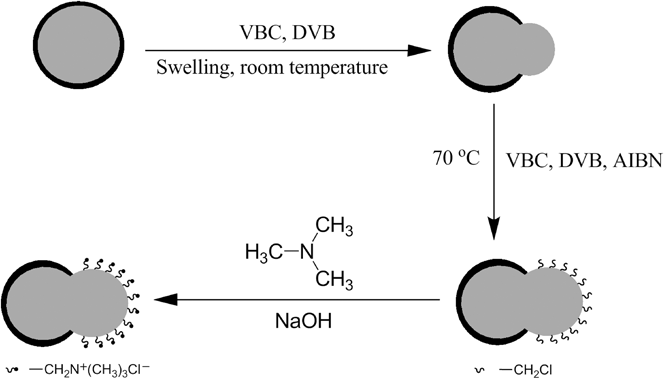
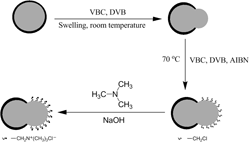
The anisotropic Janus composite particles of TiO2–poly(VBC–DVB) were achieved from the core–shell composite particles by swelling and crosslinking with the mixed monomers of VBC and DVB. Reference Chen, Zheng, Chen and Lin29 The groups of chloromethyl on the surface of TiO2–poly(VBC–DVB) particles easily reacted with trimethylamine and generated TiO2–QApoly(VBC–DVB) in an alkaline solution of NaOH. Reference Gao, Wang, Du and Li30 The synthetic procedure of the Janus composite particles of TiO2–QApoly(VBC–DVB) is shown in Fig. 1. We used SEM and TEM to characterize the morphology and the inner structure of the as-synthesized Janus particles. As shown in Figs. 2(a) and 2(c), the snowman-like Janus composite particles of TiO2–poly(VBC–DVB) were synthesized. It could be seen that the coarse part with tiny particles was TiO2 lobe and the other part was poly(VBC–DVB) lobe [Fig. 2(c)]. Compared to Fig. 2(a), the Janus composite particles of TiO2–QApoly(VBC–DVB) still kept the characteristic snowman-like morphology [Figs. 2(b) and 2(d)]. In general, there were few significant changes of them but the QApoly(VBC–DVB) lobe became large slightly after quaternization [Figs. 2(c) and 2(d)].
Illustration of the synthetic procedure of the Janus composite particles of TiO2–QApoly(VBC–DVB).

SEM and TEM images of the Janus composite particles of (a, c) TiO2–poly(VBC–DVB) and (b, d) TiO2–QApoly(VBC–DVB).

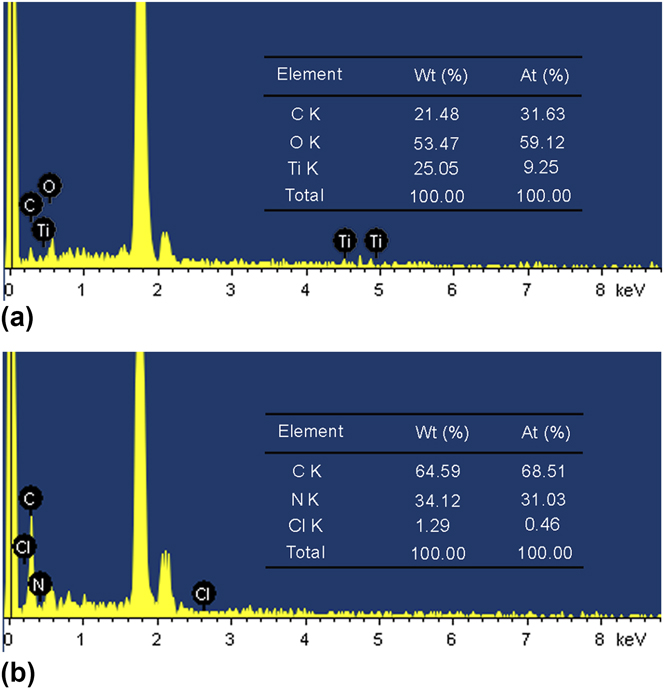
To confirm the compositions of TiO2–QApoly(VBC–DVB), the characterization of EDX was performed. EDX survey spectra were used to determine which elements were on the surface of Janus particles after quaternization. Figure 3 presented the EDX spectra of the TiO2 lobe and the QApoly(VBC–DVB) lobe of TiO2–QApoly(VBC–DVB). Figure 3(b) demonstrated that there were C, N, and Cl elements in the QApoly(VBC–DVB) lobe of TiO2–QApoly(VBC–DVB). EDX results showed that the Janus composite particles of TiO2–QApoly(VBC–DVB) were synthesized as expected. In addition, elemental analysis demonstrating the content of C, H, and N elements of TiO2–QApoly(VBC–DVB) was as follows: C = 78.24%, H = 7.305%, N = 0.501%.
EDX spectra of (a) the TiO2 lobe and (b) the QApoly(VBC–DVB) lobe of the Janus composite particles of TiO2–QApoly(VBC–DVB).

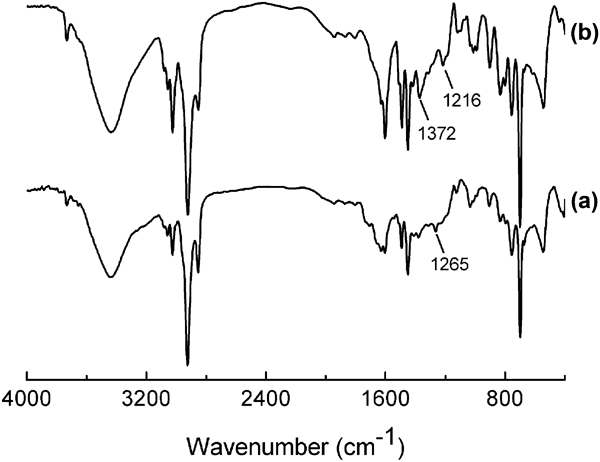
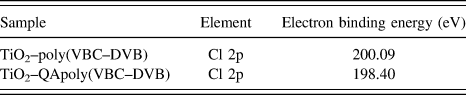
From FTIR spectrum [Fig. 4(a)], the characteristic band at 1265 cm−1 assigned to the in-plane bending vibration of C–H bond in the groups of –CH2Cl revealed the presence of the groups of –CH2Cl on the Janus composite particles of TiO2–poly(VBC–DVB). Compared to the absorption peak of Fig. 4(a), the peak at 1216 cm−1 was assigned to the stretching vibration of C–N bond in the groups of quaternary ammonium [Fig. 4(b)]. Additionally, the strong peak at 1372 cm−1 was assigned to the bending vibration of –CH3 groups. These results revealed the existence of quaternary ammonium groups on the surface of the Janus composite particles of TiO2–QApoly(VBC–DVB). To confirm the product further, as-synthesized Janus particles were detected by XPS. The Cl atoms accepted the electron of N atoms which resulted that the electron binding energy of Cl 2p decreased from 200.09 to 198.40 eV (Table I). Both of them indicated that quaternization of the Janus composite particles of TiO2–poly(VBC–DVB) was successful.
FTIR spectra of the Janus composite particles of (a) TiO2–poly(VBC–DVB) and (b) TiO2–QApoly(VBC–DVB).

Electron binding energy of the Janus composite particles of (a) TiO2–poly(VBC–DVB) and (b) TiO2–QApoly(VBC–DVB).

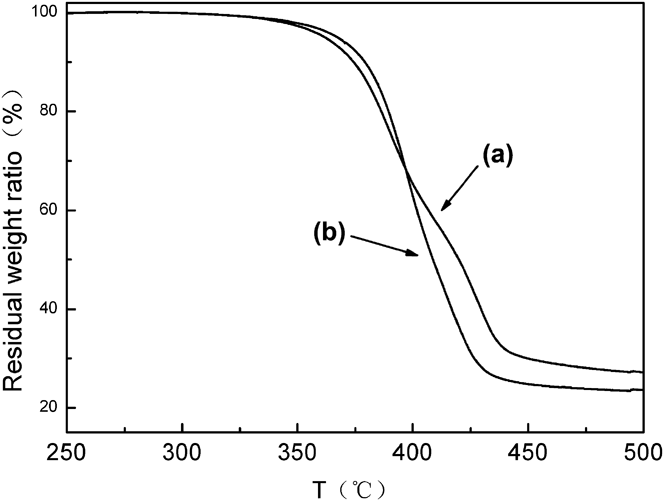
As shown in Fig. 5, the Janus composite particles of TiO2–poly(VBC–DVB) had a weight loss of approximately 72.8% when heated till 500 °C at a heating rate of 2 °C/min; the weight loss of TiO2–QApoly(VBC–DVB) was about 76.4%. It could be inferred that the weight loss of 3.6% was mainly for the quaternary ammonium groups of TiO2–QApoly(VBC–DVB). The result also confirmed the successful synthesis of the Janus composite particles of TiO2–QApoly(VBC–DVB). Additionally, the initial thermal decomposition temperature of the Janus composite particles of TiO2–QApoly(VBC–DVB) was higher than the Janus composite particles of TiO2–poly(VBC–DVB), indicating that the thermal stability of TiO2–QApoly(VBC–DVB) was better than that of TiO2–poly(VBC–DVB).
TGA curves of the Janus composite particles of (a) TiO2–poly(VBC–DVB) and (b) TiO2–QApoly(VBC–DVB).

B. Catalytic activity
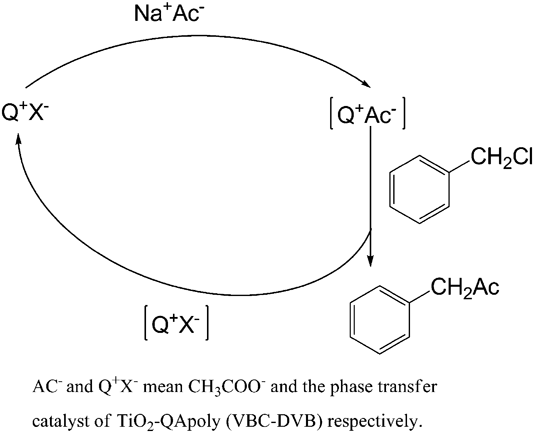
The benzyl acetate was obtained according to the route as shown in Fig. 6. Reference Hongjie and Zhang31 Without catalyst, the active component of CH3COO− can access into the organic phase depending on mixing and interfacial diffusion only. But it was different for preparing benzyl acetate with phase transfer catalytic, especially in the presence of the amphiphilic Janus material for phase transfer catalysis. As described by Yang et al., the Janus composite colloids with different interfacial properties could serve as solid surfactants to emulsify oil/water immiscible mixtures. Reference Liu, Liu, Liang, Wang, Zhang, Qu, Li, Qiu and Yang4,Reference Tang, Zhang, Liu, Qu, Li and Yang32 In the esterification reaction of benzyl acetate, the coarse TiO2 parts faced toward the aqueous phase and the polymer parts with quaternary ammonium groups of QApoly(VBC–DVB) lobe tended to both the oil phase and the aqueous phase. Thus, the amphiphilic Janus composite particles of TiO2–QApoly(VBC–DVB) could mix the reactants fully. The phase transfer catalytic mechanism for the esterification reaction is expressed in Fig. 7. In water phase, the phase transfer catalyst of TiO2–QApoly(VBC–DVB) reacted with sodium acetate, forming the ion pair of [Q+Ac−]. The ion pair of [Q+Ac−] entered into the organic phase and reacted with benzyl chloride. As a result, the benzyl acetate was generated. The Cl atoms detached from benzyl chloride molecules were combined with the positive quaternary ammonium ion of TiO2–QApoly(VBC–DVB) and were carried into water phase. Like this, the process continued until the reaction is complete.
The esterification reaction of benzyl chloride and sodium acetate to benzyl acetate.

Mechanism of phase transfer catalyst for the esterification reaction of benzyl chloride and sodium acetate to benzyl acetate.

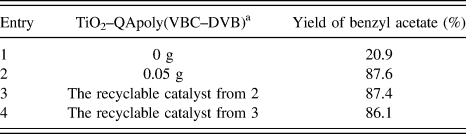
As summarized in Table II, when no catalyst was there in the reaction system, the yield of benzyl acetate was low because the reaction occurred only at the limited interface between two liquid phases. However, the system of phase transfer catalyst of TiO2–QApoly(VBC–DVB) showed fairly good yields in the esterification reaction of benzyl chloride and sodium acetate to benzyl acetate. According to our experimental data, we can suggest that the quaternary ammonium groups on TiO2–QApoly(VBC–DVB) increase the reaction's ability of benzyl chloride and sodium acetate strongly. The regenerative phase transfer catalyst of TiO2–QApoly(VBC–DVB) supported on Janus particles could maintain the nearly same esterification yields even if it was reused three times. Additionally, the catalyst of TiO2–QApoly(VBC–DVB) could be easily regenerated by a simple process of centrifugation and washed with water and ethanol.
The yield of benzyl acetate.

a The reaction was carried out with sodium acetate (3.89 g), benzyl chloride (5.00 g), and distilled water (5 mL).
IV. CONCLUSIONS
In conclusion, the Janus composite particles of TiO2–QApoly(VBC–DVB) have been synthesized by quaternization reaction. Both the peaks of N element in EDX spectrum and the stretching vibration of C–N bond at 1216 cm−1 confirmed the existence of quaternary ammonium groups in the lobe of QApoly(VBC–DVB). The quaternary ammonium groups endowed the Janus composite particles of TiO2–QApoly(VBC–DVB) higher initial thermal decomposition temperature than that of TiO2–poly(VBC–DVB). The product was expected to be used as phase transfer catalysts, which was confirmed by the synthesis of benzyl acetate. The system of phase transfer catalyst of TiO2–QApoly(VBC–DVB) showed that the highest yield of benzyl acetate was 87.6%. The anisotropy phase transfer catalyst supported on Janus composite particles possessed high catalytic activity and could be used repeatedly. Importantly, this amphiphilic Janus material for phase transfer catalysis can realize orienting arrangement and achieve directional catalysis. Moreover, as a kind of solid catalyst, it can be recovered easily, so it is a non-polluting green catalyst.
ACKNOWLEDGMENTS
This work was supported by the National Science Foundation of China (No. 51103024) and the Fujian Normal University Foundation for Excellent Young Teachers (No. fjsdky 2012004).