


Introduction
Many Western countries recommend CBT for everyone with psychosis (e.g. Galletly et al., Reference Galletly, Castle, Dark, Humberstone, Jablensky, Killackey and Tran2016; National Institute for Health and Care Excellence, 2014), but treatment delays and high drop-out rates impede timely access to ‘full dose’ therapy. Average duration of untreated psychosis stubbornly persists at around one year (Drake et al., Reference Drake, Husain, Marshall, Lewis, Tomenson, Chaudhry and Birchwood2020; McGlashan, Reference McGlashan1999; Salazar De Pablo et al., Reference Salazar De Pablo, Aymerich, Guinart, Catalan, Alameda, Trotta, Armendariz, Martinez Baringo, Soler-Vidal, Rubio, Garrido-Torres, Gómez-Vallejo, Kane, Howes, Fusar-Poli and Correll2024), 15–30% of people with first episode psychosis disengage from services (Doyle et al., Reference Doyle, Turner, Fanning, Brennan, Renwick, Lawlor and Clarke2014; Robson and Greenwood, Reference Robson and Greenwood2022), and over 40% of people referred do not attend or drop out from CBT in routine clinical practice (Fanning et al., Reference Fanning, Foley, Lawlor, McWilliams, Jackson, Renwick and O’Callaghan2012; Richardson et al., Reference Richardson, Dasyam, Courtney, White, Tedbury, Butt and Newman-Taylor2019).
Delays to evidence-based treatments, including CBT for psychosis (CBTp), are likely to be due to a combination of structural service barriers and individual factors (Birchwood et al., Reference Birchwood, Connor, Lester, Patterson, Freemantle, Marshall and Singh2013; Tiller et al., Reference Tiller, Maguire and Newman-Taylor2023). High rates of insecure attachment in people with psychosis constitute a key individual level obstacle to accessing and utilising services (Berry et al., Reference Berry, Barrowclough and Wearden2007; Gumley et al., Reference Gumley, Taylor, Schwannauer and MacBeth2014; Lavin et al., Reference Lavin, Bucci, Varese and Berry2020; Murphy et al., Reference Murphy, Goodall and Woodrow2020). Insecure avoidant attachment is characterised by negative beliefs about others, deactivating affect regulation (e.g. suppression), and a reluctance to seek help when needed, whereas insecure anxious attachment involves negative self-beliefs, hyperactivating affect regulation (e.g. rumination), and repetitive, ineffective help-seeking (Bowlby, Reference Bowlby1969; Bowlby, Reference Bowlby1988; Shaver and Mikulincer, Reference Shaver and Mikulincer2002). Clinicians will be familiar with these patterns of beliefs, emotion regulation, and interpersonal behaviours, and how they can hinder therapeutic engagement and impact (cf. Gumley et al., Reference Gumley, Taylor, Schwannauer and MacBeth2014).
Attachment-congruent adaptations to CBTp could improve engagement, retention, and clinical outcomes for people with insecure attachment styles. In addition to focusing on problematic beliefs and behaviours, if we attended directly and early to emotion regulation and help-seeking behaviours, aligned with individuals’ attachment style, we may be better able to engage the more complex people we see in services, offer ‘full dose’ CBTp, and improve recovery outcomes. This is supported by evidence that people with psychosis are likely to rely on maladaptive emotion regulation strategies (such as suppression and rumination; Lawlor et al., Reference Lawlor, Hepworth, Smallwood, Carter and Jolley2020; Lincoln et al., Reference Lincoln, Schulze and Renneberg2022; Ludwig et al., Reference Ludwig, Werner and Lincoln2019; O’Driscoll et al., Reference O’Driscoll, Laing and Mason2014), and struggle to seek and utilise help (Skrobinska et al., Reference Skrobinska, Newman-Taylor and Carnelley2024), which can in turn lead to delayed or sub-optimal recovery.
While the wider psychosis literature has prioritised help-seeking for over three decades (Skrobinska et al., Reference Skrobinska, Newman-Taylor and Carnelley2024), this has not been a target in CBTp to date. This may be because we assume that help-seeking is beyond our remit, or that people are already engaged at the point of psychological assessment, or perhaps we are unsure how to go about this. Given high rates of non-attendance and early drop-out from CBTp, and our broader role to support multi-disciplinary colleagues, we suggest that as psychological therapists we should routinely be attending to help-seeking behaviours in CBT.
Single case methodology is well suited to examining the acceptability and potential impact of theory-driven adaptations to psychological therapies (Morley, Reference Morley2018; Persons and Boswell, Reference Persons and Boswell2019). This design has been successfully utilised to test feasibility, theoretical assumptions, and potential impact of innovations in cognitive and behavioural interventions (e.g. Blackwell and Holmes, Reference Blackwell and Holmes2010; Renner et al., Reference Renner, Arntz, Peeters, Lobbestael and Huibers2016; Watkins et al., Reference Watkins, Scott, Wingrove, Rimes, Bathurst, Steiner and Malliaris2007), including for people with psychosis (e.g. Pitfield et al., Reference Pitfield, Maguire and Newman-Taylor2020; Silva et al., Reference Silva, Maguire, McSherry and Newman-Taylor2021; Taylor et al., Reference Taylor, Bee, Kelly, Emsley and Haddock2020; Heriot-Maitland et al., Reference Heriot-Maitland, Gumley, Wykes, Longden, Irons, Gilbert and Peters2023). In this service development evaluation, we used an ABC design to examine the impact of CBTp incorporating attachment-congruent adaptations, and the pattern of responses in key recovery outcomes, for people routinely referred for psychological therapy.
Method
Design
We used a single case series ABC design and gathered sessional data over baseline, intervention and follow up phases (Kazdin, Reference Kazdin2019) to determine the impact of the adapted therapy. We followed best practice guidelines for implementing, reporting, and analysing single case series (Kratochwill et al., Reference Kratochwill, Hitchcock, Horner, Levin, Odom, Rindskopf and Shadish2013; Morley, Reference Morley2018; Shadish, Reference Shadish2014; Tate et al., Reference Tate, Perdices, Rosenkoetter, Wakim, Godbee, Togher and McDonald2013), and attended to typical sample size requirements for this design (2–10 participants; Lobo et al., Reference Lobo, Moeyaert, Cunha and Babik2018). The independent variable was the adapted CBT intervention, and the dependent variables were state measures of paranoia, voices, help-seeking, coping, and personalised goals, each measured regularly over the course of therapy.
We worked with the NHS Trust R&D Department to determine whether the study constituted service evaluation or research. The adapted intervention incorporates minor modifications to current practice; the augmented therapy remains aligned with clinical guidelines for CBT for psychosis in content, duration, and expertise of clinicians, and introduces novel aspects in line with attachment theory – a more explicit attention to emotion regulation and interpersonal behaviours, particularly help-seeking. The primary purpose of the project was local service improvement, rather than the generation of generalisable knowledge. On this basis, the R&D Department confirmed that the study met criteria for service development/evaluation. We followed the UK Health Research Authority guidelines for service development and evaluation to deliver and measure potential improvements in the quality of healthcare provision. As a service development evaluation, there was no randomisation, replication or blinding. No procedural changes occurred over the course of the study.
Participants
Individuals were recruited via routine referrals for CBT from early intervention in psychosis services (EIP) and community mental health teams (CMHTs) in the South of England. All were identified by referrers and/or screening clinicians as people with complex presentations who may benefit from augmented CBT given emotion regulation or interpersonal difficulties in addition to distressing psychosis. All who were offered the adapted therapy accepted. Two were unable to continue due to changed personal circumstances. Here, we report the first five participants (three women and two men) who completed therapy, weekly measures, and agreed for their anonymised data to be used for publication. Participants met criteria for psychosis diagnoses as assessed by their psychiatrist. Table 1 gives demographic details.
Demographic, service, and presentation details

Table 1. Long description
A table with five rows and six columns detailing demographic, service, and presentation information of participants in a study. The columns are labeled Participant, Age, Gender, Ethnicity, Service, and Presenting problem(s)/diagnosis. The rows provide specific details for each participant. Row 1: Participant A, Age 31, Male, White British, Service EIP, Presenting problem(s)/diagnosis Psychosis. Row 2: Participant B, Age 30, Female, Mixed White Asian, Service CMHT, Presenting problem(s)/diagnosis Hallucinations/delusional disorder. Row 3: Participant C, Age 32, Female, White British, Service EIP, Presenting problem(s)/diagnosis Derogatory voices. Row 4: Participant D, Age 36, Male, White British, Service CMHT, Presenting problem(s)/diagnosis Paranoia and anxiety. Row 5: Participant E, Age 50, Female, White British, Service EIP, Presenting problem(s)/diagnosis Psychosis.
EIP, Early Intervention in Psychosis team; CMHT, Community Mental Health Team. *As determined and recorded by psychiatrist (noting increasing tendency to record the broad category ‘psychosis’ or specific symptoms rather than diagnostic categories, particularly in EIP).
Weekly measures
Paranoia – Adapted Paranoia Checklist (APC; Schlier et al., Reference Schlier, Moritz and Lincoln2016)
The APC is a 5-item measure of state paranoia. Items are rated ‘at the moment’ on an 11-point scale (0 = not at all, 10 = very much), with higher scores indicating greater paranoia. The APC has good internal consistency (α = .83).
Voices – Hamilton Program for Schizophrenia Voices Questionnaire (HPSVQ; Van Lieshout and Goldberg, Reference Van Lieshout and Goldberg2007)
The HPSVQ is a 4-item measure of voices. Respondents rate voice interference, distress, how bad the voices make the person feel, and compliance, over the previous week, on a 4-point scale (a little bit/rarely to extremely/always), with higher scores indicating greater problem severity. The HPSVQ has acceptable internal consistency (α = .74).
Help-seeking – Help-Seeking Measure-Trait (HSM-T; Tiller et al., Reference Tiller, Maguire and Newman-Taylor2025, following Sood et al., Reference Sood, Carnelley and Newman-Taylor2021)
The HSM-T is a 3-item measure of behavioural intentions when feeling upset. Participants are asked to rate items for the previous week on a 5-point scale (1 = not at all, 5 = extremely), with higher scores indicating greater help-seeking intentions. Internal consistency is excellent (α = .91).
Coping and personalised recovery goals
We used 7-item visual analogue scales to assess ‘coping with difficult thoughts and feelings’ and achievement of up to three personalised goals (0 = not at all; 6 = very well/completely). Participants are asked to respond for the previous week.
Pre/post measures
Paranoia – Paranoid Cognitions Questionnaire (PCQ; Newman-Taylor et al., Reference Newman-Taylor, Graves and Stopa2008)
The PCQ is a 23-item measure of automatic thought level paranoia. Frequency is rated on a 5-point scale (1 = thought never occurs, 5 = thought always occurs). Conviction and distress are rated from 0 (I do not believe this thought at all/not at all distressing) to 100 (I am completely convinced that this thought is true/extremely distressing). The scales have excellent internal consistency (αs > .90).
Voices – Beliefs about Voices Questionnaire (BAVQ-R; Chadwick et al., Reference Chadwick, Lees and Birchwood2000)
The BAVQ-R is a 35-item measure of beliefs and emotional and behavioural responses to voices, yielding five subscales: malevolence (6 items), benevolence (6 items), omnipotence (6 items), resistance (9 items), and engagement (8 items). All items are rated on a 4-point scale (0 = disagree, 3 = strongly agree). The subscales have acceptable to excellent internal consistency (αs > .74).
Attachment – Psychosis Attachment Measure-Revised (PAM-R; Pollard et al., Reference Pollard, Bucci, MacBeth and Berry2020)
The PAM-R is a 20-item measure of attachment style in adults with psychosis, yielding three subscales: attachment anxiety (8 items), attachment avoidance (6 items), and attachment disorganisation (9 items). Items are rated on a 4-point scale (0 = not at all, 3 = very much). The subscales have acceptable to excellent internal consistency (αs > .79).
Psychological distress – Clinical Outcomes in Routine Evaluation (CORE-10; Barkham et al., Reference Barkham, Bewick and Mullin2013)
The CORE-10 is a 10-item measure of psychological distress for use in routine service settings. Items are rated on a 5-point scale (0 = not at all, 4 = most or all of the time). Internal consistency is excellent (α = .90).
Recovery – Choice of Outcome in Cognitive Therapy for Psychoses-short form (CHOICE-short; Jolley et al., Reference Jolley, Garety, Peters, Fornells-Ambrojo, Onwumere, Harris and Johns2015) and the Hope, Agency and Opportunity (HAO; Newman-Taylor et al., Reference Newman-Taylor, Garner, Vernon-Wilson, Paas, Herbert and Au-Yeung2017)
The CHOICE-short is an 11-item measure of personal recovery goals for therapy. Items are rated on an 11-point scale (0 = worst, 10 = best). The CHOICE-short has good internal consistency (α = not reported). The HAO is a 4-item co-developed measure of mental health recovery. Items are rated on a 5-point scale (0 = none of the time, 4 = all of the time). The measure has acceptable internal consistency for very brief measures (α = .67).
Intervention
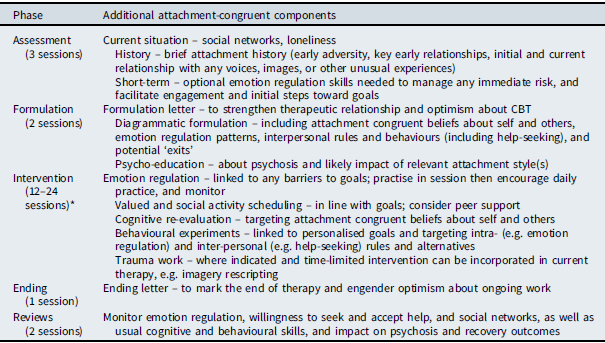
The UK National Institute for Health and Care Excellence (National Institute for Health and Care Excellence, 2014) recommends CBT for everyone with a diagnosis of schizophrenia. Our adapted protocol met all requirements for CBTp – delivered on an individual basis, over at least 16 sessions; facilitating an understanding of the links between the person’s psychosis and their thinking, feelings, and behaviours; supporting re-evaluation of distressing perceptions and appraisals; and development of alternative ways of coping to reduce distress and improve functioning. In terms of facilitating understanding, supporting re-evaluation, and developing alternative ways of coping, we incorporated a number of attachment-congruent adaptations (see Table 2).
Attachment-congruent adaptations to CBT for psychosis

Table 2. Long description
A table detailing phases and components of attachment-congruent adaptations to CBT for psychosis. The table is divided into five phases: Assessment, Formulation, Intervention, Ending, and Reviews. Each phase includes specific components. The Assessment phase spans 3 sessions and covers current situation, history, short-term affect regulation skills, and initial goals. The Formulation phase spans 2 sessions and includes a formulation letter and diagrammatic formulation. The Intervention phase spans 12-24 sessions and includes psycho-education, affect regulation, valued and social activity scheduling, cognitive re-evaluation, behavioral experiments, trauma work, and imagery rescripting. The Ending phase spans 1 session and includes an ending letter. The Reviews phase spans 2 sessions and monitors affect regulation, willingness to seek and accept help, social networks, and impact on psychosis and recovery outcomes.
This does not comprise a full protocol but highlights specific attachment-congruent adaptations. *More sessions typically included if direct trauma indicated, e.g. in blocks of six additional sessions.
Adaptations aligned with the person’s predominant attachment style, targeting beliefs about self and others, emotion regulation strategies, and help-seeking behaviours, associated with three insecure attachment styles, within a CBT framework.
Individuals with a predominantly anxious attachment style were given information about how common this is, and how anxious attachment can affect (1) how they see themselves (e.g. I am unsafe, I can’t cope) and others (e.g. others are unreliable, can’t be trusted), (2) how they cope with strong feelings (e.g. needing to express and sometimes escalate these to get help), and (3) willingness to ask for help (e.g. being able to ask but struggling to feel satisfied with help offered).
Those with a predominantly avoidant attachment style were given information about how common this is, and how avoidant attachment can affect (1) how they see themselves (e.g. I am alone) and others (e.g. others can’t be trusted, will hurt me), (2) how they cope with strong feelings (e.g. pushing these out of mind), and (3) a reluctance to seek or accept help, even when needed.
Those with a predominantly disorganised style were also given information about how common this is, and how this can be associated with fears about getting close to others and difficulties trusting people, often with a mix of both anxious and avoidant patterns of self- and other-beliefs, ways of managing strong feelings, and willingness to seek help. We emphasise how this mix of beliefs, ways of coping with feelings, and help-seeking can be confusing for them and those close to them.
We ensured procedural fidelity through peer supervision.
Procedure
People routinely referred for CBTp whose referral details indicated that they may also struggle with emotion regulation and/or interpersonally were offered CBTp as usual or the adapted therapy. They were told that the difference was the inclusion of measures and strategies focused on managing emotions and relationships. Those who expressed an interest in the augmented therapy were treated by a clinical psychologist or CBT therapist with expertise in CBT for psychosis. Trait measures were completed as part of usual CBT assessment and at end of therapy, and weekly measures just before or during sessions.Footnote 1 Clinicians followed the NICE guideline for CBTp, augmented with the attachment-congruent adaptations (as described above).
Data analysis strategy
We plotted session-by-session data for visual inspection and simple statistical analyses (following Morley, Reference Morley2018). Single case studies are analysed per participant – each person acts as their own control across baseline, intervention and follow-up phases, and analyses supplement (rather than trump) visual inspection of data (Morley, Reference Morley2018). We calculated the broadened median for each phase to reduce impact of extreme scores (Morley, Reference Morley2018).
Results
Methodological rigour
We assessed methodological quality using the Single-Case Reporting Guideline in Behavioural Interventions (SCRIBE) scale (Tate et al., Reference Tate, Perdices, Rosenkoetter, Shadish, Vohra, Barlow and Wilson2016). Two independent raters generated quality assessment scores of 25/25, with inter-rater agreement of 100%, reliably evidencing a robust study design (see Supplementary material, Table S1).
Participant characteristics
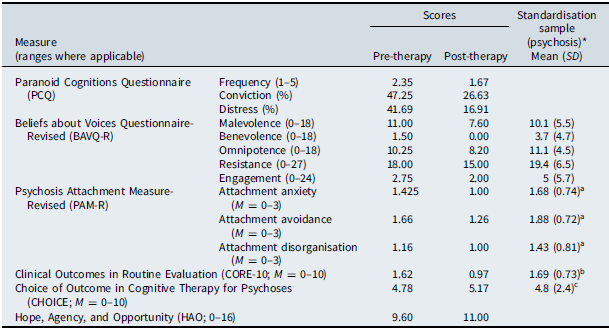
Descriptive statistics for trait measures are given in Table 3. These show that participants reported high levels of paranoia, impact of voices, and psychological distress, at the start of therapy. These, and mean levels of attachment insecurity, were comparable to clinical standardisation samples (within 1 SD of the mean). These levels of severity and complexity are typical for people under routine secondary care services.
Trait measures pre- and post-therapy

Table 3. Long description
A table comparing trait measures pre- and post-therapy. The table has 10 rows and 4 columns. The columns are labeled Measure (with ranges where applicable), Scores Pre-therapy, Scores Post-therapy, and Standardisation sample (psychosis) with Mean (SD). The rows list different measures and their respective scores. Row 1: Paranoid Cognitions Questionnaire (PCQ), Frequency (1-5), 2.35, 1.67, N/A. Row 2: Paranoid Cognitions Questionnaire (PCQ), Conviction (%), 47.25, 26.63, N/A. Row 3: Distress (%), 41.69, 16.91, N/A. Row 4: Beliefs about Voices Questionnaire-Revised (BAVQ-R), Malevolence (0-18), 11.00, 7.60, 10.1 (5.5). Row 5: Beliefs about Voices Questionnaire-Revised (BAVQ-R), Benevolence (0-18), 1.50, 0.00, 3.7 (4.7). Row 6: Beliefs about Voices Questionnaire-Revised (BAVQ-R), Omnipotence (0-18), 10.25, 8.20, 11.1 (4.5). Row 7: Beliefs about Voices Questionnaire-Revised (BAVQ-R), Resistance (0-27), 18.00, 15.00, 19.4 (6.5). Row 8: Beliefs about Voices Questionnaire-Revised (BAVQ-R), Engagement (0-24), 2.75, 2.00, 5 (5.7). Row 9: Psychosis Attachment Measure-Revised (PAM-R), Attachment anxiety (M = 0-3), 1.425, 1.00, 1.68 (0.74). Row 10: Psychosis Attachment Measure-Revised (PAM-R), Attachment avoidance (M = 0-3), 1.66, 1.26, 1.88 (0.72). Row 11: Psychosis Attachment Measure-Revised (PAM-R), Attachment disorganisation (M = 0-3), 1.16, 1.00, 1.43 (0.81). Row 12: Clinical Outcomes in Routine Evaluation (CORE-10; M = 0-10), 1.62, 0.97, 1.69 (0.73). Row 13: Choice of Outcome in Cognitive Therapy for Psychoses (CHOICE; M = 0-10), 4.78, 5.17, 4.8 (2.4). Row 14: Hope, Agency, and Opportunity (HAO; 0-16), 9.60, 11.00, N/A.
Provided for published psychosis samples where available, for comparison purposes; aLevi et al. (Reference Levi, Pierce, Baird and Berry2025), bFarhall et al. (Reference Farhall, Cugnetto, Goldstone, Gates, Clemente and Morris2024), cJolley et al. (Reference Jolley, Garety, Peters, Fornells-Ambrojo, Onwumere, Harris and Johns2015).
Changes across phases
As a service development evaluation, all clinical decisions were made by therapists in collaboration with participants. Duration of phase A (assessment and formulation) was five sessions for all but one person (participant B had six sessions). Phase B (intervention) varied from 8 to 25 sessions. Phase C (follow-up) was two sessions for all participants. No adverse events were reported over the duration of the study.
Figure 1 shows sessional measures across phases for each participant. Visual analysis of the data indicates that all participants improved in paranoia, impact of voices, help-seeking, coping, and personalised recovery goals (with one exception – participant B did not change in help-seeking), and that gains made from baseline to intervention were typically maintained or improved further at follow-up. The graphs indicate high and variable levels of paranoia and voice severity over the baseline and intervention phases (as is typical in clinical practice).
Sessional scores and broadened medians. Continuous lines indicate sessional scores; dashed lines indicate broadened median across baseline, intervention and follow-up phases. Participant C completed their last measure of coping and personal recovery goals at session 15.

Figure 1. Long description
The image contains multiple line graphs showing sessional scores and broadened medians for participants A to E across various metrics. Each participant has a set of graphs representing different measures. Panel A: Participant A’s graphs include Paranoia (APC), Voices (HPSVQ), Help-seeking (HSM), Coping (VAS), and Personal recovery goals (VAS). The x-axis represents session numbers, and the y-axis represents the respective metric scores. Continuous lines indicate sessional scores, while dashed lines indicate broadened medians across baseline, intervention, and follow-up phases. Panel B: Participant B’s graphs follow the same structure and metrics as Participant A. Panel C: Participant C’s graphs also follow the same structure and metrics, with the note that Participant C completed the last measure of coping and personal recovery goals at session 15. Panel D: Participant D’s graphs include Paranoia (APC), Help-seeking (HSM), Coping (VAS), and Personal recovery goals (VAS), following the same structure. Panel E: Participant E’s graphs also include the same metrics as Participant D, following the same structure. Each graph shows trends and variations in the respective metrics over the sessions.
Changes across the three phases (baseline, intervention, and follow-up) are seen most clearly in the broadened medians which reduce the impact of extreme scores (Morley, Reference Morley2018).
Discussion
This single case series is the first evaluation of attachment-congruent adaptations to CBT for psychosis. We used an ABC design, following single case methodology (Morley, Reference Morley2018), with demonstrable methodological rigour (Supplementary material, Table S1). Pre-therapy trait measures indicate high levels of paranoia, voices, and psychological distress. Severity of psychosis experiences, distress, and attachment insecurity are typical of the complex presentations seen in routine secondary mental health services.
Sessional measures show that attachment-congruent CBTp led to reduced paranoia and voices, increased help-seeking, and improved coping and personal recovery goals, with gains largely sustained at follow-up. While we cannot draw conclusions about the impact of therapy on trait measures (given the study design), these are included for information.
Clinical researchers have advocated for attachment-congruent interventions and services for people with psychosis for over 20 years (e.g. Berry et al., Reference Berry, Barrowclough and Wearden2007; Gumley et al., Reference Gumley, Schwannauer, MacBeth and Read2008). Single case methodology is well suited to evaluating acceptability and preliminary impact of novel, theory-driven interventions, and potential mechanisms of change (Morley, Reference Morley2018; Persons and Boswell, Reference Persons and Boswell2019). This study shows that attachment-based adaptations to CBTp were feasible, acceptable, and beneficial to the people with psychosis who were also insecurely attached, in the current study.
CBTp does not routinely target emotion regulation or help-seeking, although attachment theory predicts that these are likely to be key to therapeutic engagement and impact. Our findings suggest that personalised emotion regulation and help-seeking interventions can be incorporated in CBTp. The pattern of results, in which help-seeking improves broadly in line with symptomatic change, is consistent with this being a pre-requisite or moderator of therapeutic outcome. Additionally, the impact of therapy on individuals’ personal goals suggests that these may be a primary outcome, in line with first person accounts that prioritise recovery (‘living well with’) over symptom reduction (cf. Newman-Taylor et al., Reference Newman-Taylor, Maguire and Bowen2019; van Eck et al., Reference Van Eck, Burger, Vellinga, Schirmbeck and de Haan2018).
Clinically, many of the people we see in secondary care services report cognitive, affective, and behavioural patterns associated with early adversity and insecure attachment. Attachment-congruent adaptations to CBTp, incorporating formulation and targeting of emotion regulation and interpersonal (particularly help-seeking) difficulties, alongside more typical cognitive and behavioural interventions, may constitute an effective way of personalising therapy for people with these complex presentations.
Limitations
While we had sufficient baseline datapoints (Gast, Reference Gast2010), we would have greater confidence in our results with less variability over baseline and intervention phases (acknowledging that variability is very common in clinical groups; Bak et al., Reference Bak, Drukker, Hasmi and van Os2016). Length of intervention phase varied from 8 to 25 sessions. As a service development evaluation, all clinical decisions were made by therapists and participants, leading to minor deviation from the protocol (which suggests 12–24 intervention sessions). Single case designs are well-suited to initial assessment of novel treatments (Morley, Reference Morley2018), and the sample size was within the typical range (2–10 participants; Lobo et al., Reference Lobo, Moeyaert, Cunha and Babik2018), although generalisability is inevitably limited (Tsang, Reference Tsang2014), and a protocol driven research study, e.g. a multiple-baseline design with clearly defined phases, and effect estimates based on single case analyses (e.g. Tau-U, reliable change index), is now needed to evaluate the adapted therapy with greater methodological rigour. Our sample was predominantly White British, also limiting generalisability.
Conclusion
People with psychosis are able to make good use of CBT for psychosis, augmented to take account of patterns of cognition, emotion regulation, and interpersonal behaviours characteristic of insecure attachment. This is the first study to examine the impact of attachment-congruent adaptations to a best practice treatment for psychosis, and demonstrates impact on both clinical and recovery outcomes for people with severe and complex presentations. The use of a robust single-case design gives confidence in the time series data gathered in this small and ecologically valid sample.
Supplementary material
To view supplementary material for this article, please visit https://doi.org/10.1017/S1352465826101404
Data availability statement
The data that support the findings of this study are available from the corresponding author, K.N.-T., upon reasonable request.
Acknowledgements
We would like to thank everyone who took part in this study. We thank Katherine Wakelin, Nico Westbrook, Rebecca Phillips and Melanie Osafo for helpful discussions in supervision, Elin Lewis and Greg Pike for support with data management, and Priyanka Selvakumar for completing the quality assessment tool. Preparation of this manuscript was supported by K.N.-T. attending the University of Southampton Faculty of Medicine/Faculty of Environmental and Life Sciences Writing Retreat in January 2025.
Author contributions
Katherine Newman-Taylor: Conceptualization (equal), Data curation (equal), Formal analysis (equal), Supervision (lead), Writing - original draft (lead), Writing - review & editing (equal); Nicola Abba: Data curation (equal), Writing - review & editing (equal); Amity Hurley: Data curation (equal), Writing - review & editing (equal); Blue Pike: Data curation (equal), Writing - review & editing (equal); Rachael Wood: Data curation (equal), Writing - review & editing (equal); Genevieve Wordsworth-Hughes: Data curation (equal), Writing - review & editing (equal); Tania Correia: Data curation (equal), Formal analysis (equal), Writing - review & editing (equal); Tess Maguire: Conceptualization (equal), Data curation (equal), Writing - review & editing (equal).
Financial support
This research received no specific grant from any funding agency, commercial or not-for-profit sectors.
Competing interests
Katherine Newman-Taylor is associate editor for Behavioural and Cognitive Psychotherapy and the Cognitive Behaviour Therapist, and has no other interests to declare. All other authors have no interests to declare.
Ethical standards
The authors have abided by the Ethical Principles of Psychologists and Code of Conduct as set out by the BABCP and BPS. Southern Health NHS Foundation Trust R&D Department, confirmed that the study comprised evaluation of provision in line with best practice guidelines, and therefore did not require NHS Research Ethics Committee approval. This research received no specific grant from any funding agency in the public, commercial, or not-for-profit sectors.



 Open access


Comments
No Comments have been published for this article.