Introduction
Genetic and environmental factors are commonly considered as basic determinants of chronic disease and longevity.Reference Passarino, De Rango and Montesanto1 Emerging evidence, however, indicates that both health status and longevity potential may be programmed early in life, in particular, during the prenatal and neonatal periods.Reference Vaiserman2,Reference Vaiserman, Koliada and Lushchak3 In the majority of human populations, especially those living in regions with pronounced climatic differences between seasons, the most sensitive (prenatal and neonatal) stages of human development occur in seasonally contrasting conditions. It might likely be a factor significantly affecting human development and risk for adult-life chronic diseases. The seasonal differences, in particular, in the food availability, are particularly expressed in low-income developing countries. More specifically, quantity, variety, and freshness of fruits, vegetables, and cereals vary significantly according to the season in these countries.Reference Watson and McDonald4 Other potentially important factors that change seasonally include outdoor temperature,Reference Poeran, Birnie, Steegers and Bonsel5,Reference Li, Wang and Xu6 infectious exposures,Reference Roy7 as well as the duration of sunlight and vitamin D synthesis.Reference Ideraabdullah, Belenchia and Rosenfeld8 Moreover, potentially contributing to maternal lifestyle factors such as physical activityReference Smith, Crippa, Woodcock and Brage9 and substance abuseReference Vaiserman10 also vary seasonally. Therefore, it is not unexpected that season-of-birth patterns exist for many human developmental outcomes. Moreover, and more unexpectedly, such patterns were repeatedly found for late-life health outcomes, including risks for chronic diseases and longevity.
In this review, the research evidence for the seasonality of birth in adult-life disorders is provided and potential mechanisms underlying the phenomenon of seasonal programming of chronic disease and longevity are discussed.
Search strategy
A literature search was conducted in the PubMed and ScienceDirect databases to find all published studies providing (or not) evidence for the season-of-birth patterns in human anthropometric parameters, adult-life physiological characteristics and health status, and also mortality and longevity. Various combinations of search terms such as “early development”, “season of birth”, “month of birth”, “seasonality”, “seasonal programming”, “birth weight”, “climatic factors”, “health”, “disease”, “incidence”, “prevalence”, “aging”, “mortality”, and “longevity” were used in searching relevant references from journal articles and book chapters. Moreover, since conceptual issues were discussed regarding the potential mechanistic basis for the “seasonal programming” phenomenon, an additional search was carried out with terms “developmental programming”, “DOHaD”, “predictive adaptive response”, “catch-up growth”, and “thrifty phenotype hypothesis”. The time period covered by the search was January 1988–June 2020. Only papers written in English were included. There was no restriction on the type of study design; therefore, all the cohort, cross-sectional, and case–control studies satisfying search criteria were included. In the case if multiple publications exist in the literature concerning a specific topic discussed (e.g. seasonality of birth in schizophrenia), then review articles (including meta-analyses) on this particular topic were used as information sources. During the literature searching process, the exclusion criteria were grey or non-English literature, inappropriate research methodology, and also not statistically significant results due to the small sample size. If the methodological quality of the included study was assessed as dubious (e.g. due to a low statistical power because of small sample size), these methodological deficiencies were indicated in the text.
Season of birth and life course physiology
Birth weight
Seasonal factors were repeatedly shown to influence prenatal human development and affect birth characteristics. The seasonality of birth weight has been reported across countries. For example, in the Chodick et al. Reference Chodick, Flash, Deoitch and Shalev11 review of global patterns, individuals born during the winter period tended to have low birth weight and those born during the summer period tended to have high birth weight in the high- and low-latitude regions, while the opposite association was found in the midlatitude regions. In a more recent study by Day et al. Reference Day, Forouhi, Ong and Perry12, summer-born infants also had higher birth weights compared to those born in other seasons in the UK population. In comparing the extreme differences between birth months, those individuals who were born in February had 1.23 times higher odds to have low birth weight than those who were born in September (p < 0.001). An association between the month of birth and future anthropometric measures has been reported in a recent systematic review by Hemati et al. Reference Hemati, Keikha and Riahi13 More specifically, those persons who were born in winter months tended to have higher weight and body mass index (BMI) in childhood across countries. Interestingly, this association is opposite to that reported by Chodick et al. Reference Chodick, Flash, Deoitch and Shalev11 for the birth weight. The catch-up growth phenomenon (i.e. a development mode when those individuals who are born with low birth weight subsequently exhibit accelerated weight gain in infancyReference Martin, Connelly, Bland and Reilly14) could be one potential explanation for this inconsistency.
Life cycle events
Associations between season of birth and age at female life cycle events such as menarche and menopause have been also demonstrated. In determining whether month of birth can affect the maturation rate of Polish females, girls born in summer were found to have the first menstruation at younger ages than girls born in other seasons.Reference Kliś, Jarzebak and Borowska-Strugińska15 Remarkably, no association between birth season and age at menarche in Central India, where differences between seasons in temperature and photoperiod are very small, has been observed.Reference Liczbińska, Gautam, Dubey, Ahirwar, Chaurasia and Kosińska16 In China, more early ages of both menarche and menopause were revealed in women born in spring compared to ones born in other seasons.Reference Si, Meng and Lyu17 In Italy, menopause was found to occur earlier in women born in the spring than in the autumn.Reference Cagnacci, Pansini and Bacchi-Modena18 The earliest menopause has been observed in women born in March and the latest one in women born in October.
Adult physiological characteristics and health status
Since birth weight is, in turn, associated with adult-life health outcomes,Reference Vaiserman19 it is not surprising that seasonality of birth is seen for many human chronic disorders, including the later life-onset ones. Association between season of birth and human health status has been reported repeatedly. An important point in the context reviewed is that seasonality of birth has been found not only for childhood diseases, but also for age-related late-onset disorders, indicating that season-of-birth effects can persist lifelong, thereby contributing to aging-associated processes.
In a recent research where a health deficit indices have been calculated for 21 European countries included in the Survey of Health, Aging, and Retirement in Europe (SHARE) dataset, elderly European men were shown to age faster if they were born in spring and summer compared to those born in autumn.Reference Abeliansky and Strulik20 At any given age, spring- and summer-born persons developed about 3.5% more health deficits than autumn-born individuals. These differences were not mediated by potentially confounding factors such as body size or education level. Interestingly, the birth season played a nonsignificant role for old-age health in a subsample of Southern Europe countries. The authors assumed that this might be due to the smaller seasonal variation in sunlight in these regions. In a subsample of Northern Europe countries, in contrast, the season of birth was shown to significantly affect most of the indices calculated. At any age, spring-born elderly Northern European men had developed about 8.7% more health deficits than those born in autumn. The estimated aging rates were also associated with birth season in this research.
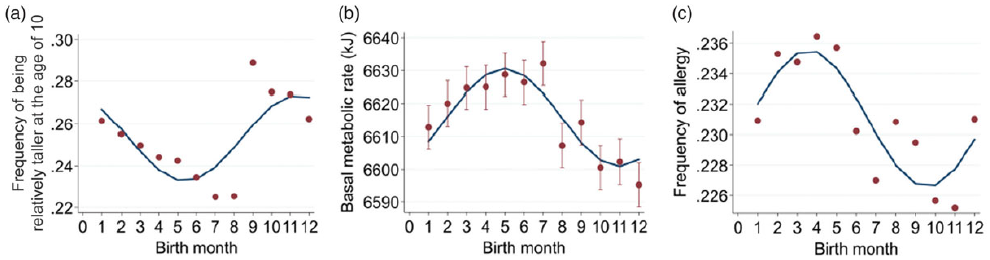
Findings suggesting that season of birth can affect later life characteristics have been also obtained in other recent population-based large (n = 502,536) study conducted using the UK Biobank cohort (Didikoglu et al., 2019, 2020).Reference Didikoglu, Maharani, Payton, Pendleton and Canal21,Reference Didikoglu, Canal, Pendleton and Payton22 In this research, evidence was obtained that season of birth can affect the basal metabolic rate, which is regarded as one of the important determinants of the aging rate (Frisard and Ravussin, 2006).Reference Frisard and Ravussin23 More specifically, individuals who were born in July had a higher basal metabolic rate (Fig. 1b) and frequency of having allergy later in life (Fig. 1c) compared to those born in December.Reference Didikoglu, Canal, Pendleton and Payton22 Moreover, findings from this study indicated that season of birth may affect growth parameters (Fig. 1a).
Month of birth and (a) frequency of being taller at the age of 10, (b) basal metabolic rate, and (c) frequency of having allergy in the UK Biobank cohort. Red scatter plots show prevalence in (a) and (c) and mean ± standard error in (b). Reproduced from the article by Didikoglu et al. Reference Didikoglu, Canal, Pendleton and Payton22 with permission of the publisher. © 2020 Wiley Periodicals, Inc.

Sleep characteristics
Season of birth was also shown to program adult-life sleep characteristics. In particular, spring and summer birth seasons were found to be associated with a higher insomnia rate compared to autumn and winter birth seasons. It seems important because sleep pattern can significantly influence the health status and ultimately affect longevity. In particular, evening-oriented sleep timing preferences (chronotype) have been shown to be associated with a higher risk of type 2 diabetes, obesity, cardiovascular diseases, psychiatric disorders, and also with increased mortality than the morning-oriented ones.Reference Knutson and von Schantz24 Importantly, the adult chronotype was shown to be differently programmed depending on the season of birth.Reference Didikoglu, Maharani, Payton, Pendleton and Canal21
Seasonality of birth in disease phenotype
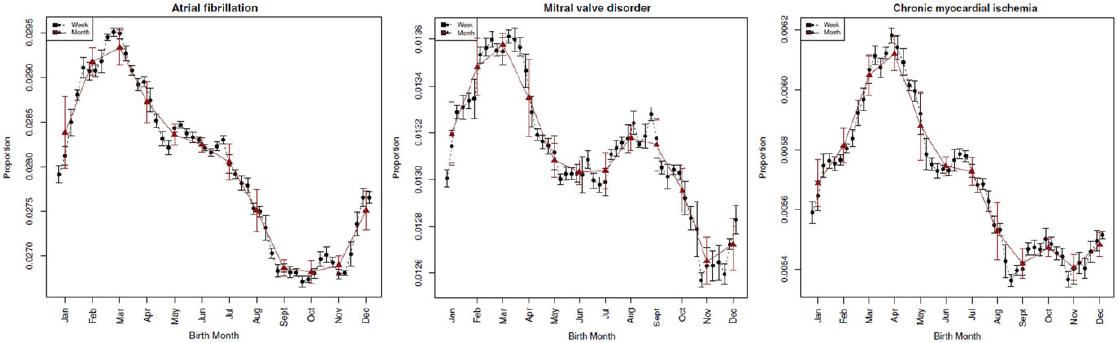
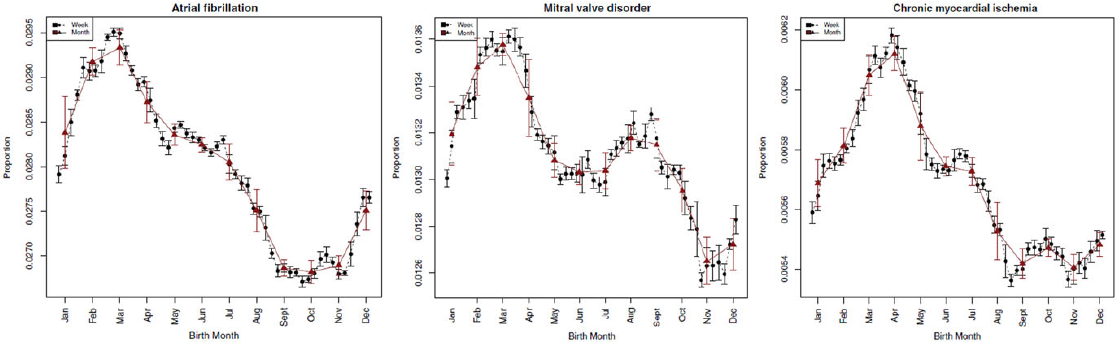
An association between month of birth and risk for chronic diseases that develop during the individual’s lifetime has been reported repeatedly in the literature. In a retrospective population study of relationships between month of birth and lifetime risks for 1688 pathological conditions in the US (total n = 1,749,400), the association with birth month was found for 55 diseasesReference Boland, Shahn, Madigan, Hripcsak and Tatonetti25 (Fig. 2). Findings from these phenome-wide studies were subsequently partly confirmed in the same US cohort.Reference Borsi26 The results of the latter research, however, indicate that observed outcomes may be context-sensitive, and significantly influenced by differences in the cohort composition and location. The epidemiological and clinical findings indicative of the link between season of birth and the risk for pathological conditions in later life are reviewed below.
Association between month of birth and risks for cardiac pathological conditions such as atrial fibrillation (left panel), mitral valve disorder (central panel), and chronic myocardial ischemia (right panel) in adulthood. Prevalences are shown as percentages (mean ± standard error) of corresponding general populations. Reproduced from the article by Boland et al. Reference Boland, Shahn, Madigan, Hripcsak and Tatonetti25 available under the Creative Commons CC-BY-NC license. Copyright © 2015, Oxford University Press.
Neurological disorders
In the context reviewed here, the seasonality of birth has been most thoroughly studied for its role in developing schizophrenia. Schizophrenia is obviously not an age-related disease (its symptoms usually begin between ages 16 and 30), although it shortens life expectancy by up to 15–20 years, primarily owing to the high risk of cardiovascular disease and obesity likely related to the lack of physical activity, unbalanced diet, smoking, and substance abuse.Reference Ringen, Engh, Birkenaes, Dieset and Andreassen27 A significant excess of winter–spring births and a decrease of summer births have been observed consistently among schizophrenia patients. Such a pattern was described in more than 200 papers to date.Reference Demler28 Recently, in studying whether effects of season of birth can be confounded by gene-environment interactions, it has been demonstrated in the UK Biobank cohort (n = 136,538) that season-of-birth effect in schizophrenia does not depend on genetic factors and reflects a true pathogenic effect of early life environmental exposures.Reference Escott-Price, Smith and Kendall29 Among the factors most likely contributing to this season-of-birth pattern, there are nutrition, ambient temperature, sperm quality, and also exposures to infections, maternal hormones, and external toxins.Reference Tochigi, Okazaki, Kato and Sasaki30 Birth seasonality was also found for some other neuropsychiatric disorders. Seasonal variation in autism spectrum disorder births with modestly increased risk for children born in the fall and decreased risk for children born in the spring was observed in Finland and Sweden.Reference Lee, Gross and Francis31
The effects of month of birth on adult depression were also demonstrated. In the US, a significant association between month of birth and subsequent depression risk, with spring and summer month births corresponding to significantly more depression, has been reported.Reference Schnittker32 Remarkably, this association was strong in earlier cohorts born at the beginning of the 20th century, but it has largely disappeared in the 1940 birth cohort when living conditions have improved and seasonal variation in the food supply has decreased. The consistent seasonal pattern was also observed in epilepsy, with an excess of patients born in December and January and a deficit of those born in September, compared to the general population.Reference Procopio, Marriott and Williams33
Seasonal pattern of birth was found for multiple sclerosis, an autoimmune disease of the central nervous system characterized by chronic inflammation, demyelination, gliosis, and neuronal loss (Ghasemi et al., 2017).Reference Ghasemi, Razavi and Nikzad34 In a recent meta-analysis, an excessive risk for development of multiple sclerosis was observed in those individuals born in the spring months and a reduced risk in those born in October and November.Reference Pantavou and Bagos35 The maternal vitamin D levels and exposure to ultraviolet light were regarded to be potential mechanistic candidates (Dobson et al., 2013).Reference Dobson, Giovannoni and Ramagopalan36
Neurodegenerative diseases
An association between the season of birth and the risk for Alzheimer’s disease (AD), a neurodegenerative disorder which is the most common cause of aging-related dementia worldwide, was investigated in several studies. A substantial excess of first-quarter births among AD patients has been revealed compared to the expected general population birth rates in the UK.Reference Philpot, Rottenstein, Burns and Der37 Similar season-of-birth pattern in AD was subsequently found in California.Reference Frazee, Russell and Chicota38 In Québec, a significant deficit of AD births was observed in May.Reference Vézina, Houde and Charbonneau39 In Chinese elderly aged 60 and above, the risk for dementia was shown to be substantially lower among those born in winter than that for the summer-born.Reference Ding, He, Song and Zheng40 These findings, however, have not been confirmed in studies conducted in other Northern Hemisphere countries, where no evidence for seasonality of birth in AD patients was found.Reference Dysken, Kuskowski and Skare41–Reference Tolppanen, Ahonen and Koponen44 No seasonal pattern was also observed in the Southern Hemisphere (Australia) (Henderson et al., 1991).Reference Henderson, Korten and Jorm45
The association between season of birth and the risk of developing Parkinson’s disease (PD), the second most common neurodegenerative disease affecting 1%–2% of people over 60 years of age,Reference de Lau and Breteler46 was also evaluated in several studies. The reported findings are, however, modest and inconsistent. For example, a 30% higher risk of PD associated with spring versus winter birth was observed in the US study.Reference Gardener, Gao and Chen47 This association was, however, modest and nonsignificant only. No evidence for the systematic season-of-birth variations for PD incidence was found in the Postuma et al. Reference Postuma, Wolfson and Rajput48 and Palladino et al. Reference Palladino, Moccia and De Pascale49 studies. The sample sizes in most studies aimed at investigating seasonality of birth in AD and PD were, however, small, so findings from these studies are rather inconclusive.
Evidence for seasonality of birth was also obtained for the amyotrophic lateral sclerosis (ALS), a neurodegenerative disease predominantly affecting upper and lower motor neurons, resulting in progressive paralysis and death from respiratory failure. The peak age of onset of this disease is 55–70 years.Reference Martin, Al Khleifat and Al-Chalabi50 Among the Swiss ALS patients, an excess of births was found in the spring months (March–May).Reference Ajdacic-Gross, Wang and Gutzwiller51 In Sweden, individuals born from October through December were at 11% increased risk of ALS compared to those born from April to June.Reference Fang, Valdimarsdóttir and Bellocco52 In Australia, ALS birth rates were shown to increase between late summer and early winter, and to decrease between midwinter and early summer.Reference Pamphlett and Fang53
Cardiometabolic disorders
Skewed season-of-birth patterns have been found for various cardiometabolic pathological conditions. Prevalence of obesity was found to be greater among those men who were born in Hertfordshire (UK) in January–June than among those born in July–December.Reference Phillips and Young54 In Canada, the proportion of class III obese persons was higher among adult individuals who were born throughout winter/spring.Reference Wattie, Ardern and Baker55
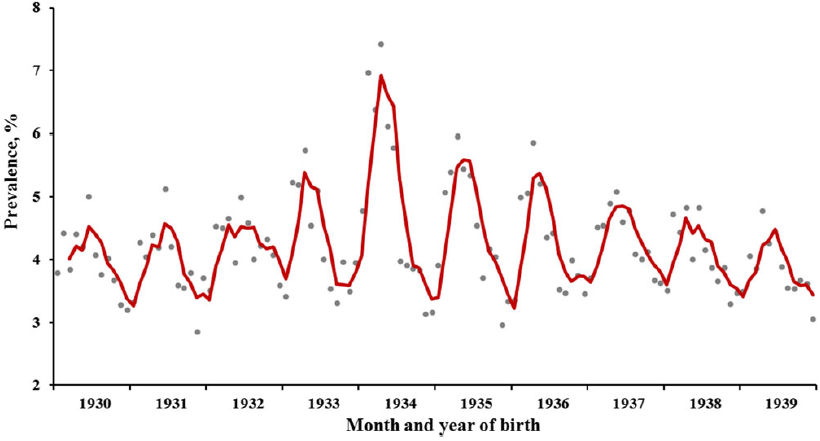
Seasonality of birth for patients with type 1 diabetes has been reported repeatedly around the world.Reference Laron, Lewy and Wilderman56 In contrast to the well-established seasonality of birth in childhood diabetes persons, the birth seasonality in adult type 2 diabetic patients has been detected in a few studies only. Most of these studies were small sample sized and findings were inconsistent. For example, seasonal birth patterns were found for 155 type 2 diabetic adolescent African-AmericansReference Grover, Lipton and Sclove57 and for 282 adult patients in the Netherlands.Reference Jongbloet, van Soestbergen and van der Veen58 By now, the most convincing evidence for seasonality of birth in type 2 diabetes patients was obtained in the Ukrainian population.Reference Vaiserman, Khalangot and Carstensen59 The peak prevalence of type 2 diabetes has been revealed in both men and women born in April and the lowest one was observed in women born in December and in men born in November. Remarkably, in the cohort born during 1930–1939 years, the highest monthly prevalence of type 2 diabetes was observed among individuals born in April 1934, i.e. about 9 months after mortality caused by the Ukraine famine of 1932–1933 peakedReference Lumey, Khalangot and Vaiserman60 (see also Fig. 3 based on our unpublished data). This suggests that the long-term effects of early life seasonal factors may be more pronounced if early human development occurs in severe conditions such as natural or man-made disasters. In another large prospective study conducted in China, both male and female participants born in summer had a lower risk of type 2 diabetes in comparison with those born during other seasons.Reference Si, Yu and Guo61 No evidence for seasonality of birth, however, was obtained in adult patients with type 2 diabetes in Denmark.Reference Jensen, Zimmermann and Gamborg62
Prevalence of type 2 diabetes in Ukraine cohort born during 1930–1939 years, according to month and year of birth. Points indicate monthly prevalence estimates.

Seasonal variations in mean systolic blood pressure, with a minimum level in adults born in spring and summer and maximum level in those born in autumn and winter, have been observed in Spanish men aged 45–64 years.Reference Banegas, Rodríguez-Artalejo and de la Cruz63 In China, those persons who were born in winter were shown to have an increased risk of coronary artery disease in adult life compared to those born in spring.Reference Zhang, Zhao and Yang64 In a large US sample (n = 1,169,599), strong season-of-birth patterns were found for lifelong risks of the cardiovascular condition such as essential hypertension, coronary arteriosclerosis, cardiomyopathy, atrial fibrillation, chronic myocardial ischemia, and pre-infarction syndrome.Reference Li, Boland, Miotto, Tatonetti and Dudley65 The risks for these cardiovascular adverse events were shown to be highest in those individuals who are born during the late winter/early spring. In a Canadian province, Ontario, higher risks of hypertension and coronary heart disease were found in those persons who were born in January and April.Reference Poltavskiy, Spence, Kim and Bang66 In the UK, women born during the winter had a significantly higher prevalence of coronary heart disease, dyslipidemia, insulin resistance, and poor lung function than those born during other seasons.Reference Lawlor, Davey Smith, Mitchell and Ebrahim67
Cancer
Seasonality of birth has been repeatedly reported for different types of tumors. In Northern England, significant sinusoidal variation in month of birth was observed for childhood acute lymphoblastic leukemia (peak in March), acute non-lymphocytic leukemia (peak in September), and also astrocytoma and osteosarcoma (for both, peaks in October). Such sinusoidal month-of-birth patterns were found for all lymphomas (peak in March) and Hodgkin’s lymphoma (peak in January) in girls.Reference Basta, James, Craft and McNally68 In a subsequent UK study, birth peaks for patients with gliomas (except for astrocytoma and ependymoma) were observed in May and November.Reference van Laar, Kinsey, Picton and Feltbower69 A significant February month-of-birth peak was also shown for childhood leukemia in another UK study.Reference Higgins, dos-Santos-Silva, Stiller and Swerdlow70 In Sweden, an increased risk of non-Hodgkin (but not Hodgkin) lymphoma was revealed in children and young adults born in spring or summer.Reference Crump, Sundquist, Sieh, Winkleby and Sundquist71
In a meta-analysis by Georgakis et al.,Reference Georgakis, Ntinopoulou, Chatzopoulou and Petridou72 the risk for occurrence of central nervous system tumors or tumor subtypes was significantly associated with birth season in 8 of the 10 included studies in children and in 4 of the 8 studies in adults, with a clustering of births mainly in autumn and winter months. Seasonality of birth was also observed for other cancer types such as skin cancer,Reference La Rosa, Liso, Bianconi, Duca and Stracci73 colorectal cancer,Reference Francis, Curtis, Noble, Cortina-Borja and Salib74 lung cancer,Reference Hao, Yan, Ke, Wang and He75 and breast cancer.Reference Yuen, Ekbom, Trichopoulos, Hsieh and Adami76 Most of these studies, however, were conducted with small size samples, so, these findings are rather inconclusive and show only correlation but no causal relationships.
Early life seasonal programming of longevity
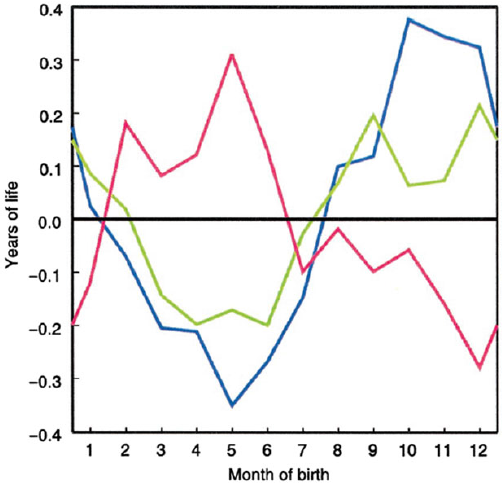
Among all identified season-of-birth effects, the impacts on mortality are of great interest because they represent lifelong health outcomes. Evidence for the impacts of season of birth on human longevity has been repeatedly demonstrated across countries. To date, the dependency of human longevity on month of birth has been most firmly established in the study by Doblhammer and Vaupel.Reference Doblhammer and Vaupel77 In this research, it has been shown that those individuals who are born in autumn tend to live longer than those who are born in spring in the Northern Hemisphere countries such as Denmark and Austria. Remarkably, in the Southern Hemisphere country, such as Australia, the season-of-birth pattern was shifted by half a year, with a minimum of the mean age at death in the autumn-born persons and maximum in the spring-born ones (Fig. 4). In the subsequent study conducted on the basis of 15 million US death certificates for the years 1989–1997, DoblhammerReference Doblhammer78 found that those people who were born in autumn lived almost half a year longer than those born in spring. These differences were largest for those who were less educated, were never married, and for African-Americans, and they were more pronounced in the South than in the North. Significant month-of-birth patterns were also observed for all major causes of death including infectious diseases, cardiovascular disorders, and malignant neoplasms. The author concluded that findings from her study are consistent with a role of nutrition and infectious exposures (but not temperature or daylight) in the seasonal programming of longevity. In another prospective cohort study performed in the US, those women who were born in the spring and summer demonstrated a slight but significant increase in cardiovascular mortality; no birth-of-month effect was found, however, for overall mortality.Reference Zhang, Devore, Strohmaier, Grodstein and Schernhammer79 In analyzing 17,082 male and 19,075 female individuals who were followed from 1986 to 2006 in the US, males born in the fourth quarter were 11% less likely to die and females born in the third quarter were 14% less likely to die than those born in the first quarter.Reference Sohn80
Deviation in the remaining lifespan of people born in specific months from the average remaining lifespan at the age of 50. In the Northern Hemisphere countries of Denmark (green line) and Austria (blue line), the people born in the fourth quarter of the year live longer than those born in the second quarter. For Australia (red line), the pattern is shifted by half a year. Reproduced from the article by Doblhammer and VaupelReference Doblhammer and Vaupel77 with permission from Proc Natl Acad Sci USA. Copyright (2001) National Academy of Sciences, U.S.A.

In studying genealogical longevity records for women from European aristocratic families, Gavrilov and GavrilovaReference Gavrilov and Gavrilova81 found that women born in May lived 3.61 years longer and those born in December lived 3.21 years longer on average than those born in August. Effect of the birth’s season on longevity was revealed in historical cohorts of French-Canadian women who were born before 1750.Reference Gagnon82 A significant impact of the season of birth on long-term survival has been also found in birth cohort 1800–1870 born in Minorca Island (Spain).Reference Muñoz-Tudurí and García-Moro83 In this cohort, summer births had a decreased death risk after 15 years of age. In utero nutrition was proposed to be a leading causal factor. In Greece, birth during the autumn and winter seasons was associated with significantly increased longevity.Reference Flouris, Spiropoulos, Sakellariou and Koutedakis84 These effects were mediated, at least in part, by outdoor temperature at the time of birth. Longevity was shown to be significantly associated with season of birth of both male and female individuals in Kiev (Ukraine).Reference Vaiserman, Collinson, Koshel, Belaja and Voitenko85 Mean age at death was lowest in those who were born in April–July, and highest in those born at the beginning and end of the year. Minimum and maximum monthly values differed by 2.6 years in males and 2.3 years in females. For all major death causes, longevity was highest in individuals born during the fourth quarter. In a large (n = 6,194,745) nationwide population-based cohort study conducted in Sweden, month of birth was found to be a significant predictor of mortality.Reference Ueda, Edstedt Bonamy, Granath and Cnattingius86 After adjusting for sex and education level, the lowest level of mortality in ages above 50 years was found for persons born in November and the highest level in those born during the spring/summer. In the same cohort, month of birth has been also shown to be associated with mortality from infectious and cardiovascular diseases, but not from cancers or external causes.Reference Ueda, Edstedt Bonamy, Granath and Cnattingius87 The cardiovascular mortality rate was highest in those born in March/April, and the mortality from infections was lowest in the September-born, compared to persons born in November. Among residents of North Rhine-Westphalia who died in the years 1984 (n = 188,515) and 1999 (n = 188,850), those who were born in May through July had the lowest age at death, and those born between October and December had the highest.Reference Lerchl88 In Japan, healthy male elderly individuals who were born in December were found to be more likely to die earlier, whereas those who were born in January had lower mortality.Reference Inoue, Stickley and Yazawa89
Evidence for the impact of season of birth on the later life mortality was also obtained in some low-income developing countries. In rural Gambia, people born during the annual wet “hungry” season (July–December) were up to 10 times more likely to die prematurely during their young adulthood.Reference Moore, Cole and Poskitt90 Since the majority of these premature deaths were caused by infections or infection-associated disorders, a permanent effect of malnutrition throughout prenatal growth on development of the immune system was proposed as a likely explanation.Reference Moore, Cole and Collinson91 These findings, however, have not been consequently confirmed in other populations residing in regions with distinct differences between seasons, such as rural Senegal and Bangladeshi populations.Reference Moore, Fulford, Streatfield, Persson and Prentice92,Reference Simondon, Elguero and Marra93
In several studies, evidence was obtained that season of birth can affect the chance of becoming a centenarian. In the US population, siblings born in September–November was shown to have significantly higher odds to live to be 100 years old than their siblings born in March.Reference Gavrilov and Gavrilova94 More recently, it has been demonstrated that most centenarians were born in the US in the second half of the year.Reference Gavrilov and Gavrilova95 In studying German semi-supercentenarians aged 105+, it has been shown that odds to survive to age 105+ was 16% higher in December-born persons than average, while among the June-born, these odds were 23% lower.Reference Doblhammer, Scholz and Maier96
Mechanistic insights
In discussing mechanisms underlying season-of-birth effects, it has been initially assumed that this phenomenon may be explained by seasonal differences in the quality of semenReference Rojansky, Brzezinski and Schenker97 or oocytes at ovulation or at fertilization.Reference Jongbloet, Groenewoud, Huber, Fieder and Roeleveld98 More recent findings, however, indicate that such effects may be rather explained by processes related to developmental programming. The mechanisms potentially contributing to these effects are described in subsections below.
Nutrition
Nutrition is one of the most important factors that influence these processes.Reference Vaiserman2 Currently, the impact of this factor is rather low in developed countries depending only slightly on seasonal factors owing to the year-round availability of fresh produce from a global market, but it is certainly high in low-income and primarily agricultural societies. In these populations, babies born during periods of seasonal malnutrition can develop adaptive metabolic responses aimed at maximizing the metabolic efficiency in order to optimize the use and storage of nutrients.Reference Zhu, Cao and Li99 Such developmental adaptation can lead to a reallocation of resources aimed at better protection of brain at the expense of other fetal organs, such as adipose tissue, liver, muscles, and pancreas.Reference Kim100 These processes may be mediated by impaired development of hypothalamic appetite-regulating circuits and feeding behavior.Reference Zeltser101 As a consequence, long-lasting alterations can arise in glucose–insulin metabolism. Such metabolic changes, including lowered insulin secretion and insulin resistance, may result in an improved capacity to store fat throughout adult life. If the prenatal development occurs under poor climatic conditions and seasonal malnutrition, while postnatal development occurs during the abundant seasonal supply of nutrition, such a developmental scenario can lead to catch-up postnatal growth, and consequently, to long-term adverse health outcomes.
Infection exposure
Infection exposure can be one more factor potentially influencing processes involved in developmental programming. It is firmly established that adult immune responses can be programmed by neonatal exposure to certain immune-modulating stimuli throughout the process of priming of the antibody-forming system.Reference Spencer, Galic and Pittman102 The process of neonatal maturation of the immune system seems to be very important in determining lifelong health status since chronic inflammation is well known to contribute to most chronic pathologies such as cardiometabolic disorders, neurodegeneration, and cancer.Reference Rajendran, Chen and Chen103 It seems to be important in the context discussed because patterns of infectious exposures are definitely different in various seasons. Indeed, in the Northern Hemisphere, late summer or early autumn seasonality exists in enteroviral infections and predominantly wintertime seasonality exists in viral respiratory infections.Reference Fisman104 So, neonatal exposure to differing seasonal infectious patterns may likely result in differing disease profiles in adult life.
Gut microbiota profile
Environmental factors acting during early life development also contribute to establishment of the gut microbiota profile (the totality of microorganisms inhabiting the intestine).Reference Vandenplas, Carnielli and Ksiazyk105 It is certainly an important point to consider with respect to the early life seasonal programming, since microbiota composition is known to establish early in life (a “microbial programming” phenomenonReference Koleva, Kim, Scott and Kozyrskyj106) and then remains fairly unchanged and determines health status throughout the whole life course.Reference Codagnone, Spichak and O’Mahony107,Reference Stinson108 Remarkably, the establishment of the adult-like profile of the gut microbiota is known to continue from the periconception period up to 2 years of ageReference Butel, Waligora-Dupriet and Wydau-Dematteis109 and thus, it largely coincides with a critical period of human developmental plasticity. Nutritional factors certainly play a crucial role in these processes,Reference Dahl and Rivero Mendoza110 although other environmental exposures (day length, infections, environmental toxicants and pollutants, etc.),Reference Karl, Hatch and Arcidiacono111 perinatal vitamin D levelsReference McGrath112 and lifestyle factors (alcohol and drug intake, smoking, physical activity, etc.)Reference Flandroy, Poutahidis and Berg113 can be also of great importance. All these factors significantly fluctuate with the season changes, especially in regions with strong climatic seasonality. Substantial seasonal differences in the human microbiota composition have been observed in some studies. Most evidence for such differences was obtained in autochthonous hunter-gatherer communities like the Hadza hunter-gatherers of TanzaniaReference Smits, Leach and Sonnenburg114 or in isolated ethnoreligious groups such as Hutterites.Reference Davenport, Mizrahi-Man and Michelini115 Evidence for seasonal microbiome shifts was also found on the population level in the US,Reference Korownyk, Liu and Garrison116 and also in samples from general populations in MongoliaReference Zhang, Guo and Lim117 and Ukraine.Reference Koliada, Moseiko and Romanenko118
Epigenetic processes
The effects of all the above factors can be mediated by epigenetic processes (including DNA methylation, histone modifications, chromatin remodeling, and noncoding regulatory RNAs) known to play a central role in the Developmental Origins of Health and Disease (DOHaD) phenomenon.Reference Safi-Stibler and Gabory119 The persistent epigenetic alterations triggered by certain seasonal cues during early development may, due to predictive adaptive response, have adaptive significance in postnatal development, but they might predispose to chronic disorders later in life. The evidence for an association among season of birth and profiles of DNA methylation in adult life has been obtained in the study by Lockett et al. Reference Lockett, Soto-Ramírez and Ray120 In this epigenome-wide association study (EWAS) conducted in 367 participants aged 18 from the UK, methylation at 92 CpG dinucleotides has been found to be associated with the season of birth. Four of the associations observed have been replicated in an independent series of 207 children aged 8 from the Netherlands. Season-of-birth-associated methylation patterns were enriched in gene pathways involved in cell cycle, development, and apoptosis. Remarkably, these season-related methylation profiles were nearly absent in newborns, but they were evident in 18-year-old participants. These findings, however, have not been confirmed in a subsequent study by Dugué et al. Reference Dugué, Geurts and Milne121 attempted to replicate 92 associations revealed by Lockett et al. Reference Lockett, Soto-Ramírez and Ray120 using 2774 adults aged 40–70 residing in Southern Hemisphere (Australia). The difference between analytical approaches applied was proposed as a potential explanation for the inconsistency between these studies.Reference Lockett, Zhang, Karmaus and Holloway122 The authors agreed that more in-depth research is required to determine the role of epigenetic mechanisms in season-of-birth programming of adult-life disease.
Discussion
People who are born in different seasons experience different environmental exposures during their prenatal and early postnatal development. Therefore, studying the effects of the season of birth on long-term health status may be an effective research approach in clarifying mechanistic pathways underlying the developmental programming phenomenon. In these studies, month of birth can serve as a useful proxy for seasonally varying environmental conditions including diet, outdoor temperature, day length, infections, etc., around the perinatal period. This is especially the case in low-income countries, predominantly rural, where populations are more dependent on climatic factors, and for those individuals who were born several decades ago, when living conditions were more seasonally contrasting than they are now. For example, in temperate Northern Hemisphere countries, including most regions of Europe and the US, the prenatal development of subjects born in April–May took place in conditions of the nutritionally marginal period from late autumn to early spring. Moreover, these persons were at high risk to be prenatally exposed to unfavorable factors (maternal respiratory infections, low vitamin D levels, etc.). Postnatal months of these individuals, on the contrary, took place during prosperous and plentiful months of the year. Such a developmental scenario conforms to the thrifty phenotype hypothesis, assuming that if the developing fetus is undernourished due to suboptimal nutrient supply caused by maternal malnutrition, stress, infection, etc., an adaptive response can occur aimed at reallocation of resources in order to maximize the metabolic efficiency.Reference Hales and Barker123 As a consequence of this ontogenetic adaptive strategy, long-lasting adaptive alterations occur in glucose–insulin metabolism, including the reduced ability for insulin secretion and insulin resistance, which ultimately result in an enhanced capacity to store fat and in the development of various metabolic disorders, including obesity and type 2 diabetes later in life. Remarkably, just this period of the year (April–May) was found to be the highest risk birth period for subsequent developing type 2 diabetes in a temperate-climate country such as Ukraine.Reference Vaiserman, Khalangot and Carstensen59 In contrast, the prenatal development of subjects born in November–December, which demonstrated the lowest risk of type 2 diabetes, occurred during the nutritionally plentiful season, followed by scarce seasons (winter–spring) throughout their early postnatal development.
In discussing mechanisms underlying the season-of-birth effects, it must be taken into account that most associations between season of birth and long-term health outcomes were found in observational (mostly cross-sectional) studies. The cross-sectional design is an important limitation of these studies because it precludes causal inference. In particular, nonbiological mechanisms might also contribute to these effects. For instance, findings from many studies indicate that season of birth can affect the children’s educational attainment. Indeed, it has been reported in many studies across Europe and the US that those children who are born later in the academic year have, on average, lower educational attainment than those who are born earlier in the year.Reference Crawford, Dearden and Greaves124 This is attributed to the fact that schoolchildren born shortly before the cut-off date for the start of the school year are usually almost a year younger than their classmates. These children are in earlier stages of their physical, intellectual, and emotional development and they may be thereby relatively disadvantaged.Reference Doebler, Shuttleworth and Gould125 These early life effects can likely influence the professional success and income, as well as, indirectly, the health status in adulthood.Reference Solli126 Such effects are, however, usually more pronounced in the first 2 years of primary school and largely disappear during the next school years.Reference Verachtert, De Fraine, Onghena and Ghesquière127 Therefore, they are unlikely to significantly affect the season-of-birth-related long-term health outcomes.
In conclusion, research findings summarized in this review indicate that seasonal developmental programming phenomenon can likely have important implications for health status in human populations. This is especially true, given the central role of epigenetic mechanisms in developmental programming processes. Due to the involvement of these mechanisms, developmentally programmed epigenetic changes may be transgenerationally transmitted to subsequent generations, determining their health statusReference Xavier, Roman, Aitken and Nixon128,Reference King and Skinner129 and even longevity.Reference Vaiserman, Koliada and Jirtle130 Given this, it seems important to take into account season of birth as an additional risk factor for developing various diseases, especially in populations living in seasonally contrast conditions. The mechanistic basis for the seasonal developmental programming phenomenon should be addressed in future studies.
Acknowledgments
The author would like to thank Ms. Tatyana Papurina for the technical assistance.
Financial support
This research received no specific grant from any funding agency, commercial, or not-for-profit sectors.
Conflict of interest
None.