The fisheries sector (and biodiversity) in the Mediterranean Sea has suffered from the impacts of species migration. The number of alien fish species increased recently in the Mediterranean Basin because of the opening of the Suez Canal, climate change and other vectors (Drake & Lodge, Reference Drake and Lodge2004). In total, the number of alien species in the Mediterranean has exceeded 790; most of which are benthic and fish species (Zenetos et al., Reference Zenetos, Vassilopoulou, Salomidi and Poursanidis2008).
The blunthead puffer Sphoeroides pachygaster (Müller & Troschel, 1848) is one of the best known alien species in the Mediterranean Sea (Golani et al., Reference Golani, Relini, Massuti and Quignard2010). It is relatively a deep water species, found between 100 and 500 m depth, and distributed circumglobally in tropical and temperate waters on both sides of the Atlantic Ocean (Sampaio et al., Reference Sampaio, Lopes and Olavo2001), Indian Ocean (Golani et al., Reference Golani, Orsi-Relini, Massuti and Quignard2002), Pacific Ocean (Hardy, Reference Hardy1981) and south of the Strait of Gibraltar (Séret & Opic, Reference Séret and Opic1981).
It is known in the Mediterranean (especially in Italian waters) where at least 31 records were reported (Ligas et al., Reference Ligas, Sirna and Sartor2006), the latest being from the Strait of Messina (Giordano et al., Reference Giordano, Profeta, Pirrera, Soraci, Perdichizzi, Greco, Perdichizzi and Rinelli2012). The easternmost extension range of the species in the Mediterranean being the Adriatic Sea (Dulčić, Reference Dulčić2002), Aegean Sea, the eastern Levant Basin and the southern Tunisian coast (Chérif et al., Reference Chérif, Ben Amor, Bdioui, Ben Salem, Missaoui and Canapé2010), where a substantial population seems to be at present definitively established.
Information available strongly supports the general opinion which considers S. pachygaster as a recent immigrant, probably undergoing a fast diffusion eastwards (Ragonese et al., Reference Ragonese, Jereb and Morana1997) even though Relini & Relini (Reference Relini and Relini1995) speculated on the possibility of a previous presence of the species within the Mediterranean.
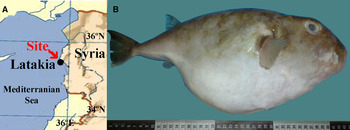
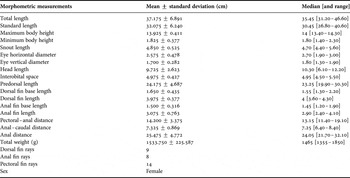
Four individuals of blunthead puffer Sphoeroides pachygaster were caught on 14 September 2012, on a muddy bottom of Syrian marine waters (Latakia) (Figure 1). They were caught by bottom longlines, at 250 m depth, concomitantly with Merluccius merluccius (Linnaeus, 1758) and Scorpaena elongate (Cadenat, 1943). The specimens were weighed to the nearest gram and measured to the nearest mm. Measurements (% total length, meristic counts and weights) were recorded on fresh specimens (Table 1).
(A) Map of the eastern Mediterranean showing the capture site of Sphoeroides pachygaster in Syrian waters; (B) S. pachygaster, female specimen (40.6 cm, standard length; 1850 g) caught 14 September 2012 (map from Google Maps).

Morphometric measurements and meristic counts carried out on 4 individuals of Sphoeroides pachygaster captured in the Syrian marine waters.

The fish were photographed (Figure 1), preserved in 7% formaldehyde, and placed at the High Institute of Marine Research (HIMR) of Tishreen University (Latakia, Syria).
Both macroscopic and microscopic examination allowed consideration of all the specimens as adult females.
The skin is completely smooth and lacking scales, spines and body plates. Body is inflatable with large head, rounded snout, papillary lips and beak like jaws with two large teeth on each jaw forming a dental plate with entire cutting edge. The lateral line on both sides is convoluted, pelvic fin absent and caudal fin truncated or slightly concave. The dorsal fin is single and placed in front of the similar shaped anal fin, and eyes are big and oval with a flat interorbital space. The colour is greyish on the dorsal surface with brownish spots; belly whitish pale grey and the caudal and dorsal fins bases are dark (Figure 1).
All morphometric measurements, meristic counts, morphology and colour agree with the known descriptions of blunthead puffer species (Ragonese et al., Reference Ragonese, Jereb and Morana1997; Golani et al., Reference Golani, Orsi-Relini, Massuti and Quignard2002; Giordano et al., Reference Giordano, Profeta, Pirrera, Soraci, Perdichizzi, Greco, Perdichizzi and Rinelli2012). The fact that four specimens of this species had been collected in Syrian marine waters indicates that this may not be a passing episode. Introduction of this species to new marine waters is considered to be a major threat to the biodiversity and its structure and function (Boudouresque et al., Reference Boudouresque, Ruitton, Verlaque, Velikova and Chipev2005). Migration of S. pachygaster towards the eastern Mediterranean is probably due to the fact that Syrian marine waters (as other Mediterranean areas) is becoming warmer (Francour et al., Reference Francour, Boudouresque, Harmelin, Harmelin-Vivien and Quignard1994), showing both regular and permanent processes of tropicalization (Quignard & Tomasini, Reference Quignard and Tomasini2000).
Movements of a species in relation to global warming may increase spatial overlapping between exotic and endemic species, which is a critical issue for the conservation of biodiversity.
Sphoeroides pachygaster is devastating to both fisheries and habitats and is an aggressive predatory species. It destroys fishing gears, leading to economic losses for fisheries. In addition, this fish bio-concentrates tetrodotoxin (TTX), a very potent poison making the fish unmarketable and poses a great risk to human health if consumed.
Finally, further confirmation by genetic methods is needed to study the genotypical changes of the new populations driven by natural selection through the interactions with indigenous populations and in response to the new abiotic environment.
ACKNOWLEDGEMENTS
We thank Tishreen University who provided the research grant (No. 2255) and the High Institute of Marine Research, Latakia for the logistic support.