1. THE AESTHETIC ORIGIN OF LIUBAI
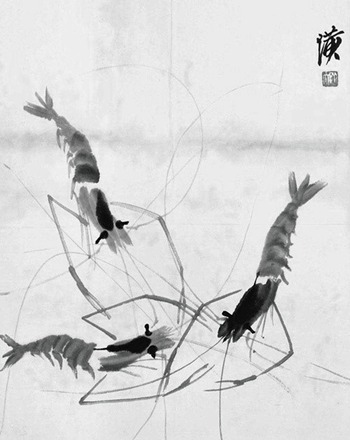
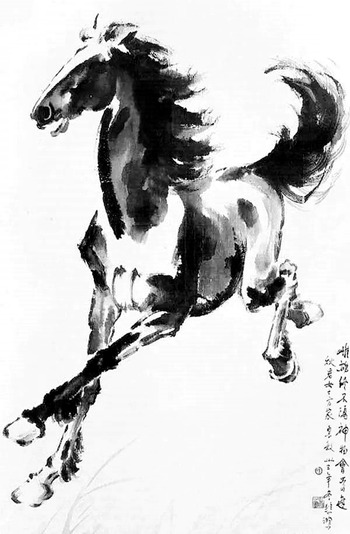
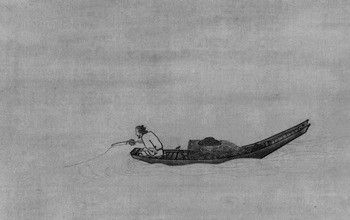
Liubai was originally used in Chinese classical painting in order to evocate harmony and exquisiteness of a work and leave room for imagination. The core spirit of the technique is inextricably linked to ancient Chinese Taoism and traditional aesthetics (Bai Reference Bai2008). The artistry allows the conveying of both content and spirit by not overusing one stroke, and the appropriate combination of essence and reality by leveraging the power of the invisible (blankness) and the inaudible (silence) (Gao and Zhang Reference Gao and Zhang2021). Chinese painting masters have long been employing blankness to highlight the beauty of spirit and essence. For example, Qi Baishi’s (齐白石)Footnote 1 Shrimp (虾) (Figure 1) presents perfectly clear water without a single water wave drawn – ‘There are just some shrimps in view, there is no grass floating around, there’s not even more any water! The work is filled with “blankness”. But you can learn about nature’s vital force from just these few shrimps because Qi Baishi simply wanted to focus on and express the life force of nature’ (Luo Reference Luo2015); Xu Beihong’s (徐悲鸿)Footnote 2 Horse(马) (Figure 2) brings to life moving air around running horses without any effort to draw the wind; Ma Yuan (马远)Footnote 3 is famous for his Fishing Alone in the Cold River (独钓寒江图) (Figure 3), which depicts vast water around a flat boat with only a few strokes of wave lines, a quintessence of delivering abundance with emptiness.
Shrimp – Qi Baishi.

Horse – Xu Beihong.

Fishing Alone in the Cold River – Ma Yuan.

This artistic technique of liubai has been used in the fields of drama, poetry, architecture, design and calligraphy. It can be found in the implicit expression of poems and songs, restrained and concise style of furniture of the Ming dynasty, simplicity of Ruyao wares of the Song dynasty,Footnote 4 and black tiles with white walls of Huizhou-style architecture.
Liubai has also been utilised in music (Luo Reference Luo2018). Lao-tzu(老子) once stated that ‘The greatest sound is no sound’ in his Tao Te Ching (道德经) (Lao-tzu Reference Mitchell1988: 41). ‘No sound’ here is an example of liubai with silence complementing sound, which is in line with the nature-embracing Daoist philosophy. The Confucean school puts forward in the music section of the Book of Rites (礼记.乐记) that ‘great music must be simple’; this means that if too much attention is given to artistry, the spirit will be neglected (Sun Reference Sun1994). Therefore, an emphasis is placed on liubai or blankness in terms of technique so that the heart or essence will not be influenced or even impaired by the use of skills. Chuang-tzu recorded a dialogue on education between Confucius and his student Yan Hui (颜回), where the idea of listening to qi (气, energy of life) was mentioned, or, as he put it, ‘do not listen with the mind, but with the spirit’ (Chuang-tzu Reference Yu-lan2012: 72). The phrase means that ears only hear tangible sounds, but more importantly, one needs to feel with the heart. Instead of being fettered by the senses, one should listen to the qi, or the blankness from the breathing of notes, and ultimately appreciate emptiness, softness and lofty tranquility.
An example of the liubai technique is the musical work ‘Lang Tao Sha’ (浪淘沙), a title which can be rendered as ‘Outside my window blinds, the rain’s dripping’ (Sound Example 1). It was first performed by the author, written by Ling Huijuan (凌慧娟, for vocal music composition) and Xu Zhixin (徐枝新, electroacoustic creation). This article tries to delve into the liubai technique in this song from the perspective of the performer.
2. LYRICS – DREAM AND REALITY
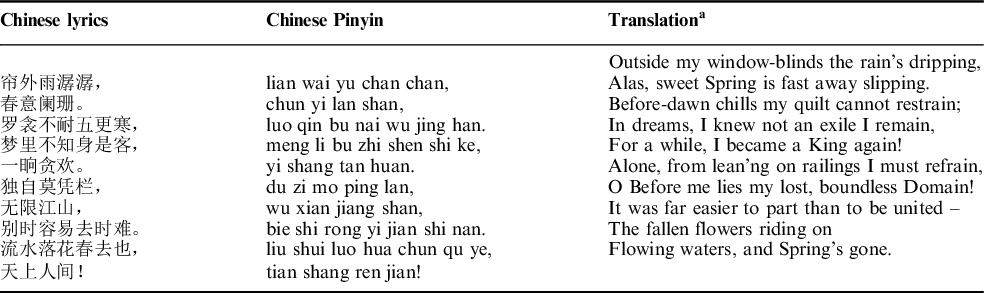
Table 1 provides the Chinese lyrics, Chinese Pinyin and translation of ‘Lang Tao Sha’.
‘Lang Tao Sha’

a Translation by Frank C. Yue.
The lyrics of this song come from the poem Lang Tao Sha written by Li Yu (李煜), the last ruler of the southern Tang state during imperial China’s Five Dynasties and Ten Kingdoms period (907–979). The work depicts both dream and reality while the use of liubai leaves room for imagination and renders the essence and artistic beauty of the poem (Jia Reference Jia2015: 55).
Li Yu reigned the southern Tang state from age 24 in 961 until age 39 in 976, when he was captured by the invading Song dynasty armies that annexed his kingdom. During the 15 years of his reign, Li was not devoted to political affairs but indulged in pleasure. With his kingdom annexed, he died by poison on orders of Emperor Taizong of Song after three years as an exiled prisoner. ‘He tried hard to appear inconspicuous, focusing his considerable talents on poetry, painting and music’ (Kurz Reference Kurz2011: 91). He was exceptionally good as a lyric poet.
There are 54 characters in the lyrics of this poem. They are divided into two parts, with the first part expressing overwhelming emotions upon waking up from a dream, and the second revealing reminiscence of happy life when peering into the distance while leaning the rail.Footnote 5
The first half uses the flashback technique. ‘Rain outside the blinds’ (帘外雨, lian wai yu) and ‘before-dawn chills’ (五更寒, wu jing han) are scenes in reality while ‘I can ignore this sojourner’s life of mine’ (不知身是客, bu zhi shen shi ke) and ‘yearn for a moment joy’ (一晌贪欢, yi shang tan huan) are memories in the dream. The poet starts with the sense of listening by describing the ‘drips and splashes’ (潺潺, chan chan) of spring rain. The cold and wet weather reflects the gloomy mood. Following is the visual sense. ‘The mood of spring is soon to fade’ (春意阑珊, chun yi lan shan) is a description of the fading spring, showing the poet’s nostalgia. Then comes the sense of touch. ‘Gossamer covers cannot ward off the chill of the last night watch’ (罗衾不耐五更寒, luo qin bu nai wu jing han) means thin and soft clothes cannot resist the cold of the late spring. What really cannot be escaped is the inner cold from years of exile life. The electroacoustic part here uses granulation techniques to break the vocal sound into small grains with three layers. Each layer has its unique grain envelope and grain duration to create a rain-like texture that matches the mood described in the texts. Delay lines are also deployed in order to broaden the image of the entire soundscape.
‘Within my dreams I can ignore this sojourner’s life of mine, And just for a moment yearn for joy’ (梦里不知身是客,一晌贪欢, Meng li bu zhi shen shi ke, yi shang tan huan) is the transition from reality (vision, hearing, touch) to dream, where the poet did not realise that his kingdom had been annexed and himself exiled. Instead, in the dream, he was still a ruler enjoying endless pleasure. The transition creates a sharp contrast and provokes violent emotions.
In the second half, ‘I should not lean alone against a railing, endless, the towering mountains, so easy it seemed to take my leave, how hard to ever meet’ (独自莫凭栏,无限江山,别是容易见时难, du zi mo ping lan, wu xian jiang shan, bie shi rong yi jian shi nan) (Bryant Reference Bryant1982: 99) means the poet refrains himself from looking out from a height since the kingdom had been once under his reign but no longer so. It is impossible for the clock to go backwards. The sentence highlights the poet’s regret, yearning and helplessness. The character ‘should not’ (莫 mo) in particular highlight the tangled emotions, which is why the composer also highlights that character in the song. In addition to the granulation and delay lines, some fixed sounds have been added to the electroacoustic part in this section. The fixed sounds come from either the processed vocal sounds or are generated by frequency modulation synthesis. Various Risset bell-like timbres were deployed to depict the bitterness.
The poem ends with the falling flowers in the rain, a contrast to the beginning of spring (Jia Reference Jia2015: 56): ‘A flowing river, falling blossoms, gone all away’ (流水落花春去也, liu shui luo hua chun qu ye). The meaning of ‘Heaven above, and the world of men’ (天上人间, tian shang ren jian) is twofold. First, it refers to the dream and the reality, with the best time of the poet behind. Second, it means the poet was in heaven in the past but in the mortal world, full of suffering today. In the initial stage of writing the music, the two composers and the author decided on the second interpretation, which directly matches the singer’s choice of timbre.
3. MUSIC CREATION – VOCAL AND ELECTROACOUSTIC
The practice of electroacoustic music in China started roughly from 1984 (Zhang Reference Zhang2012). Since then, Chinese composers and musicians have made a lot of efforts to involve traditional culture in their practices. As of the twenty-first century, composers of electroacoustic music have created some influential works. Most of them were still strongly influenced by Western music, especially in timbres and sound-processing techniques.
Thus, some composers started to explore new methods of sonic creation, derived from the traditional Chinese culture. Some of the examples include Zhang Xiaofu’s Beijing Aria (北京咏叹, Beijing yong tan 1997), which has a monologue quoted from the classics San zi jin (三字经)Footnote 6 read in Beijing’s dialect. His Nuo ri lang (诺日朗 1996) used Buddhist chanting as one of the sonic features (Liu Reference Liu2019; Battier Reference Battier, Puckette and Hagan2020). Tao Yu’s (陶钰) A Q (阿 Q 2011) and Jin Ping’s (金平) Chen san niang (陈三娘 2016) have elements that are derived from Chinese dramas. Composers such as Liu Jian (刘健), Zhuang Yao (庄曜), Wu Yuebei (吴粤北), Feng Jian (冯坚) and Guan Peng (关鹏) have pieces that embrace Chinese traditional culture as well (Zhao Reference Zhao2019). For Western composers, Chinese traditional culture was not something new. After World War II, Western composers, foremost John Cage, started to use ancient Chinese philosophical thoughts, especially from I Ching (易经), to achieve their musical ideas (Jensen Reference Jensen2009). As international exchanges became frequent, Western composers created electroacoustic pieces for Chinese traditional instruments. Marc Battier’s Mist on a Hill for pipa and electroacoustics (Yang and Zhou Reference Yang and Zhou2022), Constellations for zheng and electroacoustics (Shi Reference Shi2014: 45), Anthony De Ritis’s Plum Blossoms (De Ritis Reference De Ritis, Zhang and Browne2018: 175–8), Leigh Landy’s SHENG (Sonic Highway Exits Neglect Grammar) are all good examples among them.
Mixed pieces with voice play an important role in this process. As many pieces use elements from Chinese traditional drama, such as Beijing opera, and literature. Zhang Xiaofu’s Shan Gui (山鬼 1996) used Chinese opera techniques to create a chant-like effect. Wang Xuan’s (王铉) Nuo – The Mask (傩·面具, Tan mianju 2009) used a minority dialect and traditional chants as the main elements of the recorded vocal parts. Although composers had created many electroacoustic vocal pieces that took ideas from Chinese traditional culture, not many of them are strictly written in the form of Western singing style.
The song ‘Lang Tao Sha’ was performed for the first time at the University of Cincinnati College-Conservatory of Music in 2016. The two composers, Ling Huijuan and Xu Zhixin, had an in-depth discussion during the early stage of creation, where the liubai technique was chosen as the major means of artistic expression. The vocal music was composed by Ling and the electroacoustic parts was created by Xu. The following are some aspects of the creation process.
3.1. Nothingness and reality – Liubai in electroacoustic timbre
The intertwining vocals and electroacoustic effects run through the whole piece of music, and the two timbres follow what images are to be conveyed. This kind of auditory shift takes the audience back and forth between nihility and reality, bringing about a sense of vast space.
The electroacoustics in this piece were realised in both fixed and live processing. The live electronics use seven delay lines and several layers of live granulation to render the vocal sound into various sorts of particles and sound clouds through the combination of those grains. The fixed part use filters, vocoder and Fast Fourier Transform (FFT)-based effects to reshape the spectrum of sampled vocals in order to bring out certain pitches in the beginning (Sound Example 2, first 18 seconds). Frequency modulation synthesis (Chowning Reference Chowning1973: 526–34) was used in the fixed part to create bell-like sounds, based on the Risset bell algorithm (Risset and Wessel Reference Risset, Wessel and Deutsch1999).
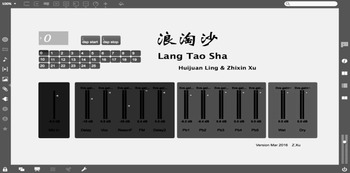
The patch used to transform the singer’s voice was written with Max/MSP (Figure 4). During the performance, the sound was processed and played through Max with the music programming language RTcmix (Garton and Topper Reference Garton and Topper1997). An 8.1 sound system is required to realise the intended spatial effects that are designed for the piece.
Main Max patch for ‘Lang Tao Sha’.

3.2. Liubai in the electroacoustic parts
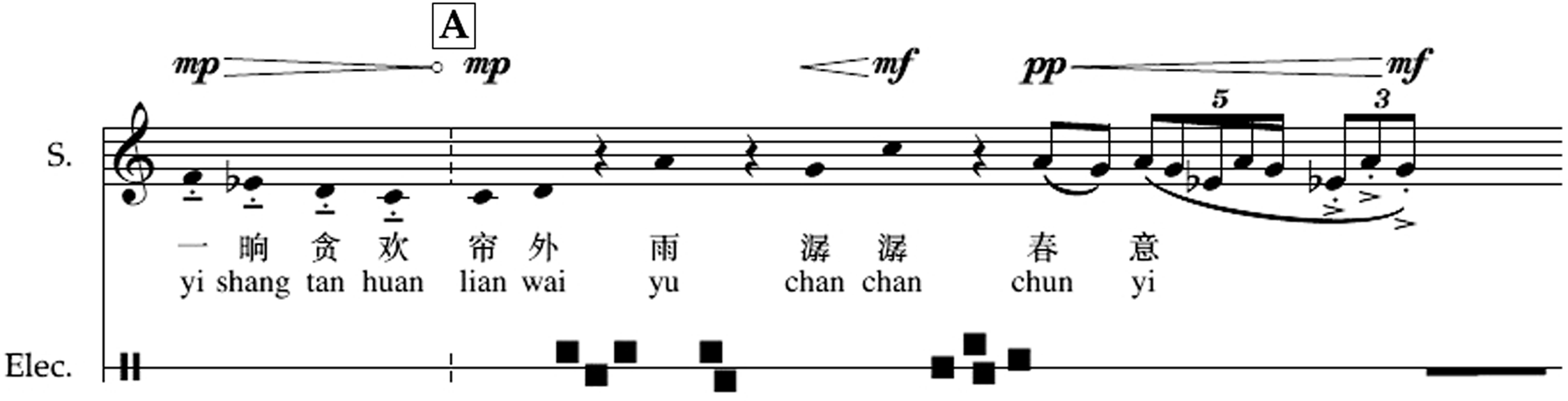
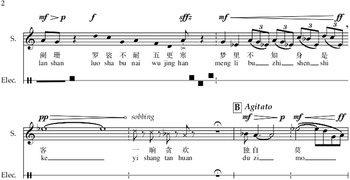
The electroacoustics were created after the vocal part was recorded. Ling purposefully inserted fragments of blankness or silences in the electroacoustics at an early stage of creation. The strategies of the design and realisation of the electroacoustics proceed in two ways. For the longer moments of liubai, a fixed sound is played following the pause of the vocals (see Figure 5). However, the live processing is almost always running in the background to slightly fill the liubai when the fixed part is not playing.
Live part, Lang tao sha, page 1, at 1′21″–1′45″.

Two other methods of liubai have been employed. The first one is based on images. Figure 6 is an example of granulation for the rain image.
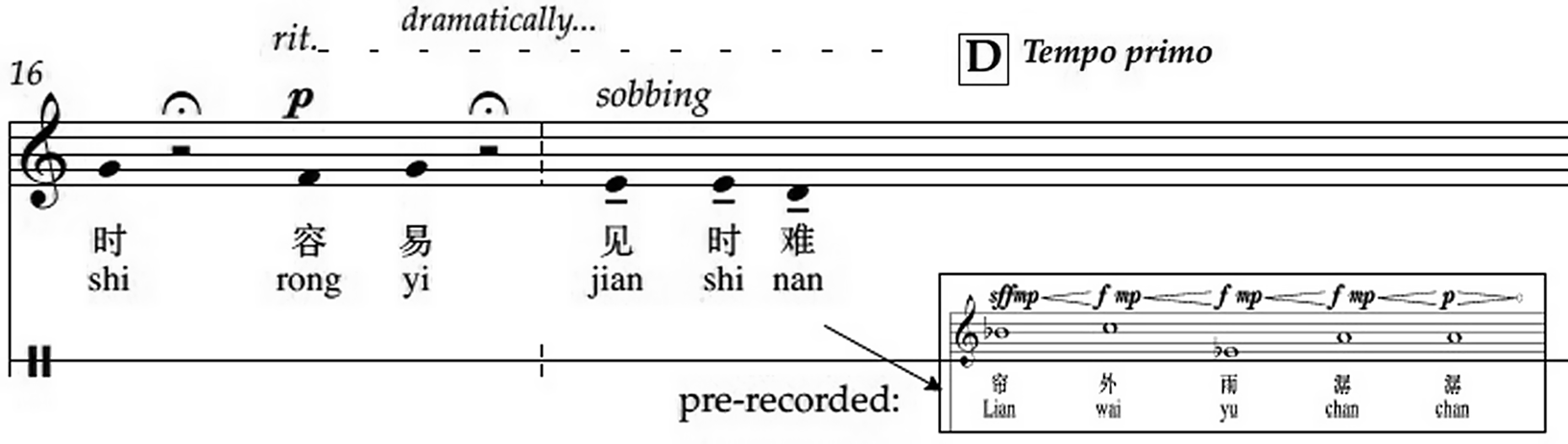
Pre-recorded vocal material, page 3, at 5′10″–5′24″.

The second is structure-oriented, such as the adding of a pre-recorded fragmented voice material in rehearsal mark A, as shown in Figure 6.
4. SING PERFORMANCE
Western-influenced Chinese art song began to develop in the early twentieth century. Chinese composers initially drew lessons from German Lied (Hallis Reference Hallis1995). An example is China’s first art song ‘The Mighty River Flows Eastward’ (大江东去, da jiang dong qu) composed by Qing Zhu (青主) (Liu Reference Liu and Mason2010: 92–4). The Chinese pentatonic style then became the mainstream with stronger national characteristics, with the song ‘A Night Mooring by Maple Bridge’ (枫桥夜泊, feng qiao ye bo) by Li Yinghai (黎英海) (Liu Reference Liu and Mason2010: 366) as a representative. This was then followed by a more lyric period, such as ‘I Love This Land’ created by Lu Zaiyi (陆在易). Up to the present day, writing Chinese art songs has spanned more than a hundred years.
In the past decades, composers have created pieces for electroacoustic and Chinese elements, such as Zhang Xiaofu’s (张小夫) ‘Feng ma qi’ (风马旗 2016) and ‘Ya lu zang bu’ (雅鲁藏布 2001), Wu Yuebei’s (吴粤北) ‘Mo suo ren jia’ (摩挲人家 1994), but only few of them created pieces for voice and electroacoustic.
For the author as a singer, the process to perform an art song is first to grasp the meaning of the lyrics, understand the purpose of the composer and then choose the appropriate singing timbres and the best suitable vocal skills to present the work. The song ‘Lang Tao Sha’ is very special, because it was co-written with the two composers as a parting gift for the author who was about to leave the United States. Therefore, her many opinions were exposed during discussions with the composers at an early stage of creation. First, the range of this work perfectly suits a coloratura soprano, allowing her to give full play to her singing capabilities and alternate between different timbres. Second, there is no difficulty to understand the creative ideas. The three share a unified understanding of the essence of the song.
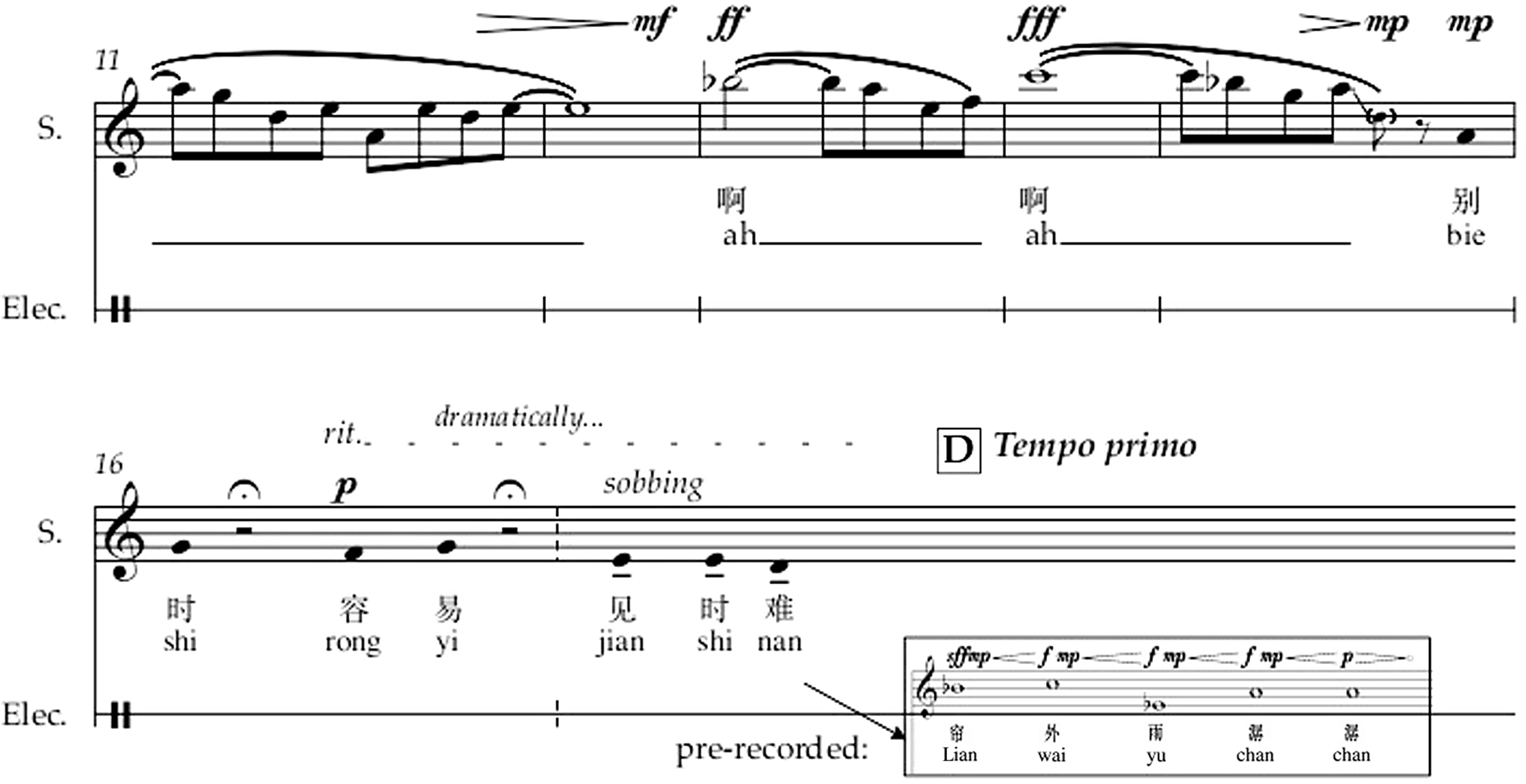
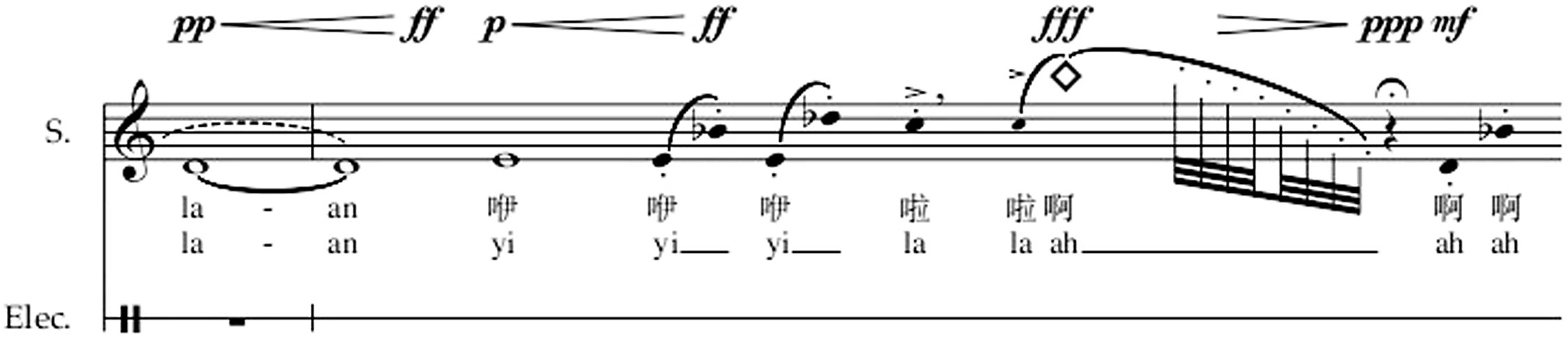
Opening the score reveals that Ling has used many exaggerated and nuanced contrasts. Sometimes the dynamics change from fff to p within two bars (Figure 7), which is very difficult to sing, and almost impossible within the very short time of two bars, given the tempo. A reasonable solution is that instead of dynamics change, the contrast can better be interpreted as changes in timbre or between full-voiced and falsetto. In the process of singing, the singer would therefore change the intensity of vocal cords closure to alternate between full-voiced and falsetto.
Dynamics change from page 3, bars 14–16, at 4′39″–5′08″.

There are no bar lines in some parts of the score, which is also intentional. China has a long tradition of reciting poetry (Figure 8). The advantage of the speed dispersion here is that the singer is given more initiative in adjusting depth and speed of breathing based on her understanding of the logics of the poem, as well as to create liubai and charm.
No bar lines and no electroacoustic part in that passage, page 3, at 3′37″–3′53″.

There are four tones in Chinese mandarin. If the relationship between pitch and lyrics is in harmony, the language will be accurately expressed, and if not, ambiguity occurs. The singer has sung the music according to the characteristics of the tones, the clear pitches and sprechgesang on the score, in order to present tactful and distant charm (Figure 9).
Sprechgesang (half singing, half speaking) passage, page 2, at 1′46″–2′17″.

All the lights were kept off throughout the performance in the concert hall, deliberately encouraging the audience to give up vision and solely focus on hearing. This gesture separates the spirit from the real world, helping the audience to eliminate distractions in their heart. The arrival of the two electroacoustic sounds at the very beginning of the song is introducing liubai, creating the artistic beauty of the music.
The use of electroacoustics play a positive role in the creation of a particular music atmosphere, the auditory expression of lyrics and the changes of timbre.
5. CONCLUSION
Because ‘The complicated history, exposed to political turmoil and, in some cases, lack of opportunities to communicate with the rest of world’ (Battier and Liao Reference Battier, Liao and Emmerson2018: 6), there were very few music works about real-time interactive Chinese art song. For those who study classical vocal singing, how do you combine electronic music and vocal? How do you use electroacoustic music to help the audience understand the meaning of lyrics (poetry) and experience artistic moment? How do you convey the essence of Chinese culture and collide with Western thought? It is a subject we need to study.
‘Lang Tao Sha’ is a bold attempt to address those problems. The use of the liubai technique in the composition, electroacoustics and singing parts are not only for the expression of the music itself, but also for a more profound meaning beyond music. It created a language whereby the traditional Chinese art song and sounds generated by technical means can talk to each other.
SUPPLEMENTARY MATERIAL
To view supplementary material for this article, please visit https://doi.org/10.1017/S1355771822000486