Introduction
Economic development has led to an increase in urbanization, as people migrate from rural areas in search of job and education opportunities (UN-Habitat, 2016). In many developing countries, this has, in turn, led to an increase in urban poverty, reflected in poor housing, infrastructural support, and social and health services – characteristics that define slum settlements (UN, 2003; Ooi and Phua, Reference Ooi and Phua2007). Although there have been initiatives to reduce poverty, such as the strategies undertaken in pursuit of the Millenium Development Goals, the number of slum residents increased by 28% from 1990 to 2014 (from 689 to 881 million) (UN, 2005; UN-Habitat, 2016).
The conditions imposed on urban slum residents, such as lack of adequate sanitation and garbage collection, provide resource-rich environments supporting large populations of rats (Riley et al. Reference Riley, Ko, Unger and Reis2007; Costa et al. Reference Costa, Ribeiro, Felzemburgh, Santos, Reis, Santos, Fragal, Araujo, Santana, Childs, Reis and Ko2014a). The Norway rat, Rattus norvegicus Berkenhout (1769), has been the most successful invasive mammalian species, exhibiting tolerance to a wide range of temperatures, a high reproductive rate and adaptability to rural and urban environmental modification (Long, Reference Long2003; Vadell et al. Reference Vadell, Gómez Villafañe and Cavia2014; Panti-May et al. Reference Panti-May, Carvalho-Pereira, Serrano, Pedra, Taylor, Pertile, Minter, Airam, Carvalho, Júnior, Rodrigues, Reis, Ko, Childs, Begon and Costa2016; Puckett et al. Reference Puckett, Park, Combs, Blum, Bryant, Caccone, Costa, Deinum, Esther, Himsworth, Keightley, Ko, Lundkvist, McElhinney, Morand, Robins, Russell, Strand, Suarez, Yon and Munshi-South2016). This species has been associated with economic losses due to its eclectic diet, contamination of food stores with feces and urine, and infrastructure damage inflicted through gnawing and burrowing (Childs et al. Reference Childs, McLafferty, Sadek, Miller, Khan, DuPree, Advani, Mills and Glass1998; Singleton et al. Reference Singleton, Hinds, Krebs and Spratt2003; Almeida et al. Reference Almeida, Corrigan and Sarno2013). Additionally, R. norvegicus is a host for several agents that can infect humans (Webster and Macdonald, Reference Webster and Macdonald1995; Ko et al. Reference Ko, Reis, Dourado, Johnson, Riley, Ferrer, Guerreiro, Salgado, Pereira, Velloso, Carvalho, de Codes, Orrico, Tavares-Neto, Pereira and Lee1999; de Faria et al. Reference De Faria, Calderwood, Athanazio, McBride, Hartskeerl, Pereira, Ko and Reis2008; Costa et al. Reference Costa, Porter, Rodrigues, Farias, de Faria, Wunder, Osikowicz, Kosoy, Reis, Ko and Childs2014b) including the bacteria Leptospira (primarily of the Icterohaemorrhagiae serogroup). These pathogens impart a large burden of disease in human populations, with leptospirosisis being by far the most important with an estimated 1 000 000 annual human cases and 60 000 deaths (Costa et al. Reference Costa, Hagan, Calcagno, Kane, Torgerson, Martinez-Silveira, Stein, Abela-Ridder and Ko2015a). Norway rats are also reservoir hosts of several helminths that cause disease in humans (Rafique et al. Reference Rafique, Rana, Khan and Sohail2009; Hancke et al. Reference Hancke, Navone and Suarez2011; Walker et al. Reference Walker, Carvalho-Pereira, Serrano, Pedra, Hacker, Taylor, Minter, Pertile, Panti-May, Carvalho, Souza, Nery, Rodrigues, Bahiense, Reis, Ko, Childs, Begon and Costa2017). For example, the cestode Hymenolepis nana is associated with diarrhoea cases, whereas the nematode Angiostrongylus cantonensis can cause eosinophilic meningitis (EoM) (Alicata, Reference Alicata1965; Schantz, Reference Schantz1996; Alruzug et al. Reference Alruzug, Khormi and Alhanoo2016).
Notwithstanding the importance of the descriptive work in characterizing helminth communities of R. norvegicus (Gómez Villafañe et al. Reference Gómez Villafañe, Robles and Busch2008; Kataranovski et al. Reference Kataranovski, Kataranovski and Deljanin2010; Hancke et al. Reference Hancke, Navone and Suarez2011; Nursyazana et al. Reference Nursyazana, Mohdzain and Jeffery2013), it is additionally important to understand the potential risk factors structuring these communities (Mohd Zain et al. Reference Mohd Zain, Behnke and Lewis2012; Simões et al. Reference Simões, Luque, Gentile, Rosa, Costa-Neto and Maldonado2016), enabling understanding of the risk of spillover to humans. This is especially relevant to slum settlement since the peridomestic habits of Norway rats and high human densities lead to frequent human–rodent contact and human exposure to environments contaminated with the infectious stages of parasites shed in rat excreta (McGarry et al. Reference McGarry, Higgins, White, Pounder and Hetzel2015; Costa et al. Reference Costa, Wunder, De Oliveira, Bisht, Rodrigues, Reis, Ko, Begon and Childs2015b). Despite the effort to characterize the risk factors aforementioned, these studies have been especially concentrated on environmental variables and demographic variables of the rats. However, individuals in natural populations will also vary in their ability to acquire necessary resources, which can affect their body condition, and fitness, by influencing vulnerability and resistance to infection (Beldomenico and Begon, Reference Beldomenico and Begon2010). In this sense, susceptible hosts are more likely to get an infection, further reducing their body condition, in a vicious circle. This, in turn, may influence the concentration of parasites excreted in the environment (e.g., Costa et al. Reference Costa, Wunder, De Oliveira, Bisht, Rodrigues, Reis, Ko, Begon and Childs2015b), raising the chance for infection of other hosts, including humans. In this study, therefore, we combined environmental variables, variables of rat demography and body condition, and signs of rat infestation (as proxies for rat density), to identify potential risk factors that are associated with the probability and intensity of infection of helminths of the digestive tract in an urban population of R. norvegicus.
Materials and methods
Study area
The study area was located in the periphery neighbourhood of Pau da Lima (13°32′53·47″ S; 38°43′51·10″ W) in the city of Salvador (BA – Brazil), which has a high human population density, varying from 13 742 to 128 997 inhabitants km−2 (IBGE, 2010). The area, 0·17 km2 in extent, covers residential areas in three valleys characterized by poor sanitation conditions, with open sewers and lack of refuse collection (Reis et al. Reference Reis, Ribeiro, Felzemburgh, Santana, Mohr, Melendez, Queiroz, Santos, Ravines, Tassinari, Carvalho, Reis and Ko2008). The valleys are occupied by people commonly living in an informal infrastructure of houses (determined by residents’ patterns of settlement and permeable to rats), also lacking access to officially-provided services (Riley et al. Reference Riley, Ko, Unger and Reis2007). The area was selected for study as it presents high annual incidence of Leptospira asymptomatic infection (35·4 per 1000 person-years) and of severe leptospirosis cases (19·8 per 100 000 pop.) (Felzemburgh et al. Reference Felzemburgh, Ribeiro, Costa, Reis, Hagan, Melendez, Fraga, Santana, Mohr, dos Santos, Silva, Santos, Ravines, Tassinari, Carvalho, Reis and Ko2014; Hagan et al. Reference Hagan, Moraga, Costa, Capian, Ribeiro, Wunder, Felzemburgh, Reis, Nery, Santana, Fraga, dos Santos, Santos, Queiroz, Tassinari, Carvalho, Reis, Diggle and Ko2016), acquired from spirochetes shed in the contaminated urine of Norway rats, and residents are therefore at high risk of infection by intestinal parasites maintained by the same reservoir host.
The sampling design has been reported previously (Panti-May et al. Reference Panti-May, Carvalho-Pereira, Serrano, Pedra, Taylor, Pertile, Minter, Airam, Carvalho, Júnior, Rodrigues, Reis, Ko, Childs, Begon and Costa2016). Briefly, it included a randomized sample, from spatial maps, of 150 trapping points in the three valleys of Pau de Lima. However, in slum environments, such as in Pau da Lima, residents and visitors are subject to violence due to drug traffic and hence there is restricted access, so that the trapping locations were reduced to 101 (valley 1 : 25 points, 2 : 36 and 3 : 40) (see Supplementary Fig. S1). Each of the 101 trapping points included three different trapping sites within an area of 30 m2.
Trapping methods and tissue sampling
Rodents were trapped with Tomahawk traps (45 × 16 × 16 cm3) from the three valleys during two sampling campaigns in 2014: a rainy season (March to July 2014) and a dry season (October to December 2014). In each campaign, two trapping sessions were performed at each of the 101 points, at least one month apart. One of three sites randomly chosen within the area of 30 m2 was sampled; a sampling scheme previously described (Panti-May et al. Reference Panti-May, Carvalho-Pereira, Serrano, Pedra, Taylor, Pertile, Minter, Airam, Carvalho, Júnior, Rodrigues, Reis, Ko, Childs, Begon and Costa2016). In each site, two traps were set and baited at 9:00 am, and checked within 24 h. The expected number of trap-nights was of 2424 and 1616 (points × sessions × traps × nights) for the rainy and the dry seasons, respectively. The trapping efforts were shortened for the dry season sampling (from 6 to 4 nights) due to a complementary analysis performed with trapping information from previous campaigns, which showed that the mean abundance estimations of rats did not change significantly when reducing sampling effort for four nights. This was consistent with the previous expectation of capturing a higher number of rats during the first days of sampling (Hacker et al. Reference Hacker, Minter, Begon, Diggle, Serrano, Reis, Childs, Ko and Costa2016).
Previously developed environmental surveys were conducted at each point of capture once in each session (Costa et al. Reference Costa, Ribeiro, Felzemburgh, Santos, Reis, Santos, Fragal, Araujo, Santana, Childs, Reis and Ko2014a; Santos et al. Reference Santos, Sousa, Reis, Ko and Costa2017). Variables, subsequently included as covariates in our model development, were used to assess evidence of the presence of rats (presence of feces and trails, and number of burrows) and availability of food and harbourage sites for rats (pet food, human garbage, water sources and vegetation coverage by number of trees), in addition to assessing information relevant to helminth parasite survival and potential for human exposure (completely permeable or partially paved ground, and site proximity of at least 10 m to an open sewer). Daily rainfall data (mm) was obtained from the Environment and Water Resources Institute of the state of Bahia (INEMA) station, and the total rainfall (mm) per month was computed for the campaigns of active trapping and for lags of 30, 60 and 90 days. Traps containing individuals of R. norvegicus were placed in plastic bags and transported to a field laboratory, where individual rats were anesthetized and humanely killed. For each individual rat we obtained characteristics informative of population demography (mass, body length, sex and reproductive status) and of body condition (weight and length – for the estimate of an index later described – presence of wounds and internal fat – visceral or subcutaneous) (see Supplementary Table S1) (Glass et al. Reference Glass, Childs, Korch and LeDuc1988; Costa et al. Reference Costa, Porter, Rodrigues, Farias, de Faria, Wunder, Osikowicz, Kosoy, Reis, Ko and Childs2014b; Himsworth et al. Reference Himsworth, Jardine, Parsons, Feng and Patrick2014). These were recorded in an online database (REDCap). During the necropsies, performed for purposes of a larger project on leptospirosis (Costa et al. Reference Costa, Wunder, De Oliveira, Bisht, Rodrigues, Reis, Ko, Begon and Childs2015b; Panti-May et al. Reference Panti-May, Carvalho-Pereira, Serrano, Pedra, Taylor, Pertile, Minter, Airam, Carvalho, Júnior, Rodrigues, Reis, Ko, Childs, Begon and Costa2016), fecal samples were collected directly from the intestines and placed in 10% formalin for subsequent analysis. Trapping and handling of rodents followed protocols previously validated and described (Mills et al. Reference Mills, Childs, Ksiazek, Peters and Velleca1995; Costa et al. Reference Costa, Porter, Rodrigues, Farias, de Faria, Wunder, Osikowicz, Kosoy, Reis, Ko and Childs2014b, Reference Costa, Wunder, De Oliveira, Bisht, Rodrigues, Reis, Ko, Begon and Childs2015b) and approved by the Ethical Committee of the Animal Use (CEUA) protocol 003/2012 of the CPqGM – Oswaldo Cruz Foundation (Fiocruz).
Data collection
Formalin-fixed fecal samples were taken to a laboratory of parasitology for identification of helminth eggs by sedimentation (Hoffman et al. Reference Hoffman, Pons and Janer1934), taking into account helminth lists previously described for R. norvegicus (Martins and Pessôa, Reference Martins and Pessôa1977; Vicente et al. Reference Vicente, Rodrigues, Gomes and Pinto1997). Subsequently, Gordon and Whitlock's (Reference Gordon and Whitlock1939) flotation technique with McMaster chambers was carried out for the quantification of helminth eggs in eggs per gram of feces (EPG). Because fecal samples had already been processed for the previous method, to perform the flotation technique we discarded the supernatant (10% formalin) and mixed the fecal content with a saline solution (Zinc Sulphate, gravity: 1·20), as recommended (Faust et al. Reference Faust, D'Antoni, Odom, Miller, Peres, Sawitz, Thomen, Tobie and Walker1938; Bartlett et al. Reference Bartlett, Harper, Smith, Verbanac and Smith1978; Schnyder et al. Reference Schnyder, Maurelli, Morgoglione, Kohler, Deplazes, Torgerson, Cringoli and Rinaldi2011). The volume of saline solution added to each fecal sample varied with fecal weights since it was not always possible to collect 2 g of feces from the rats (we adapted the technique by adding a proportional volume of saline solution).
Statistics
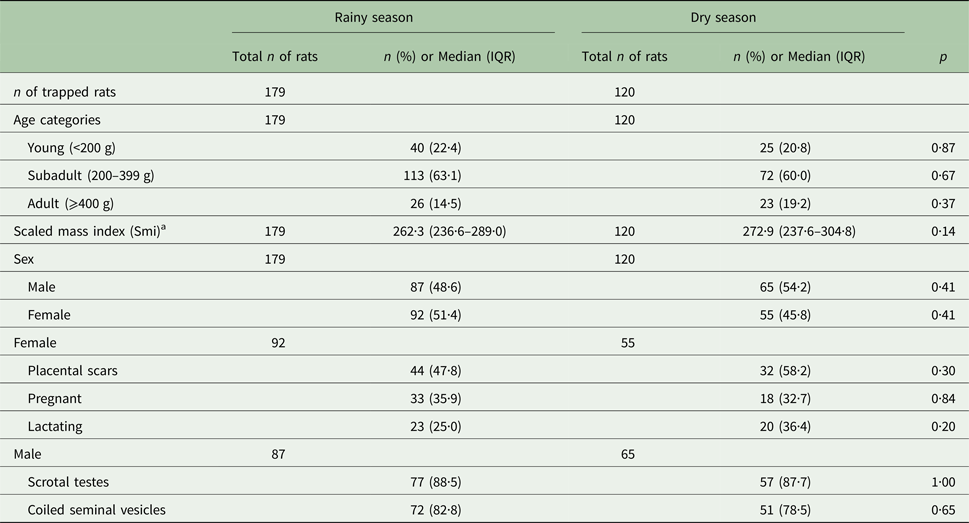
The variable mass was used as a surrogate estimate of rat ‘age’ (Table 1) as used by other studies to allow for direct comparisons (Glass et al. Reference Glass, Childs, Korch and LeDuc1988; Costa et al. Reference Costa, Ribeiro, Felzemburgh, Santos, Reis, Santos, Fragal, Araujo, Santana, Childs, Reis and Ko2014a). However, we also estimated age in days [age(d)] using a statistical model derived from published age–weight growth curve for wild rats (Calhoun, Reference Calhoun1962), as described by Panti-May et al. (Reference Panti-May, Carvalho-Pereira, Serrano, Pedra, Taylor, Pertile, Minter, Airam, Carvalho, Júnior, Rodrigues, Reis, Ko, Childs, Begon and Costa2016) (see Supplementary Fig. S2). We also improved the use of a weight/length ratio index of overall body condition variable, by using a scaled mass index (Smi), which accounts for the effect of age (Peig and Green, Reference Peig and Green2009). Then, to assess whether the demographic features of the populations sampled in the two seasons were similar, we compared age categories, sex and reproductive status through two-way contingency tables using chi-squared (χ 2) test, and Smi using Wilcoxon rank sum test (since the assumption of normality was not met) (Table 1) (Crawley, Reference Crawley2007). Variables of reproductive status (e.g., presence of placental scars in females or presence of coiled seminal vesicle in males) were used to create a single three-level categorical variable of maturity for males and females – classified as immature, young-mature (first pregnancy; only females) or mature – to be assessed as a risk factor later (for details see Supplementary Table S1).
Demographic characterization of R. norvegicus populations in the two campaigns of capture

IQR, Interquartile range.
a Peig and Green (Reference Peig and Green2009).
Helminth richness (the number of species present) was estimated for each individual rat and means were compared between sex and maturity, using Wilcoxon rank sum test and permutation ANOVA (Fisher LSD post-test), respectively, as richness distributions between sexes or maturity categories did not follow the normal distribution. Whether helminth richness varied with rats age (d) was also assessed by a generalized linear model (GLM) with Poisson family errors. The prevalence of each helminth species or group (see below) was estimated (% positive of feces sampled) and compared between sampling campaigns through two-way contingency tables using χ 2 test. The laboratory technique used to estimate eggs in feces produces an estimate of EPG, rounded to the nearest 50, hence estimated zeros correspond to EPG between zero and 25. Samples in which a helminth egg infection was identified during sedimentation (presence/absence method), but found to be absent during McMaster counting are ‘false negatives’. By this definition, approximately 25% of the rats found positive to one helminth species were false negatives. For these, we replaced the zero by an imputed value as follows. Cumulative plots of the recorded EPG showed a variety of shapes. We assumed that the lower tail of the cumulative distribution for each species followed a power law, i.e. a linear relationship on a log-log scale. We fitted this relationship to each species ignoring the false negatives, then shifted the false negatives to the corresponding x-value on the fitted line, and back-transformed this value to the original scale to give an imputed value (see Supplementary Fig. S3).
To investigate the risk factors associated with the probability (dependent binary variable) and intensity (dependent continuous variable, including only positive individuals) of infection of each helminth species, GLMs with binomial or Gamma errors, respectively, were applied (Crawley, Reference Crawley2007). Because the EPG values are proxies for the intensity of helminth infestation in R. norvegicus, the EPG values were log2 transformed for ease of interpretation. Additionally, we included the time interval (in months) between fecal sampling and laboratory quantification analysis’ – Interval-sampling-analysis’ – as a covariate in the intensity models to control for any effect of formalin fixation in the egg quantification. Initially, univariate analyses were applied and only variables with values of P < 0·1 were included in subsequent models, which were developed in steps. First, a model was built with statistically significant environmental variables, collected during the application of the environmental surveys as previously described. Then, model simplifications were conducted using a threshold of 2 Akaike Information Criterion, corrected for small samples [corrected Akaike's information criterion (AICc)] according to Hurvich and Tsai (Reference Hurvich and Tsai1989), to generate a minimal adequate model of environmental predictors. Next, the rat demographic variables [sex, maturity and age(d)] were added and the model simplifications were re-run. Finally, to the minimal adequate model containing both environmental and rat demographic predictors, variables of rat body condition (Smi, the presence of wounds and internal fat) were added and model simplifications again re-conducted. The most parsimonious model was chosen with a ΔAICc < 2 compared with the final minimum model (indistinguishable explanatory power). We present the odds ratio (OR) and rates (Rate) of the significant variables in the binomial and gamma models, respectively. For all models, observations with missing values for any of the variables under evaluation were excluded. All the analyses were performed in R (R Development Core Team, 2011), considering a significance level of P < 0·05.
Results
Samples from 299 individuals of R. norvegicus were obtained: 179 in the rainy season, and 120 in the dry season, after an effort of 2318 and 1494 trap-nights, respectively. The demographic features of rats did not differ between campaigns of capture (Table 1).
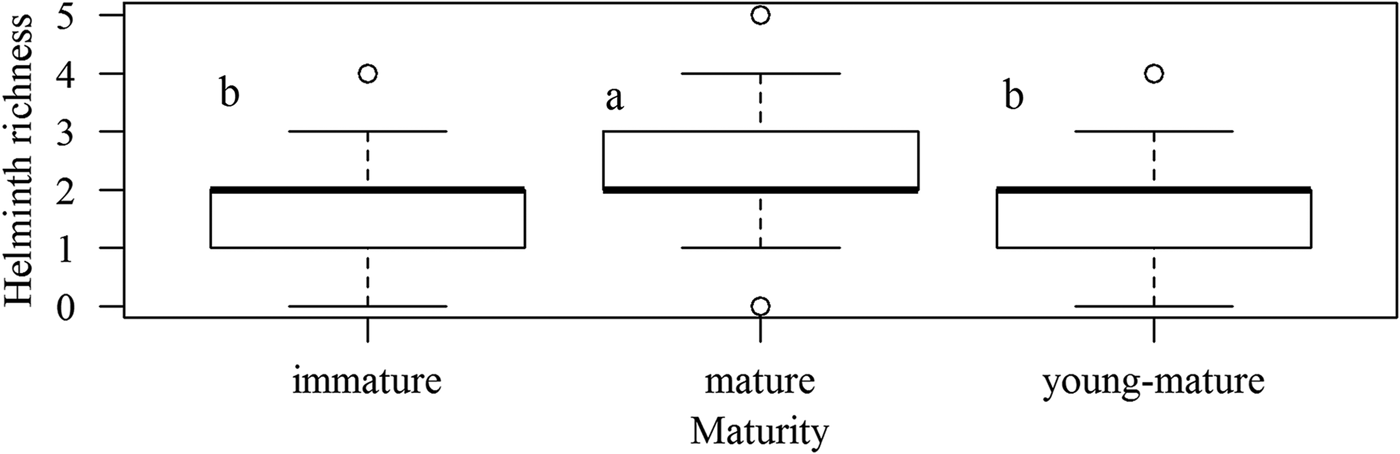
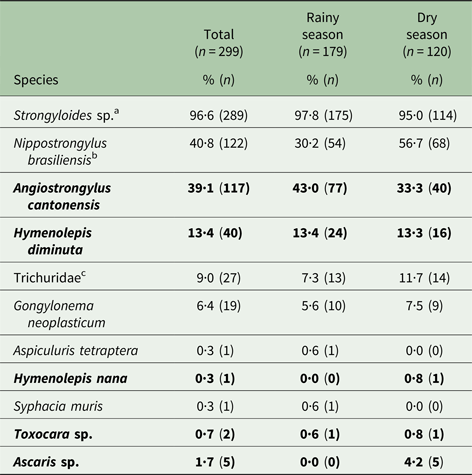
Eleven species/groups of helminths were identified in the feces of R. norvegicus (Table 2). Richness ranged from zero to five helminth species per individual rat, with a median of two (interquartile range of 1–2 species) (n = 299 rats). Mean richness did not differ between sex or age (d), however mature rats presented with higher richness than immature and young mature rats (5000 iterations; P < 0·0001) (Fig. 1). Overall, the most frequent species were Strongyloides sp., A. cantonensis and Nippostrongylus brasiliensis. For N. brasiliensis, the prevalence in the dry season was significantly higher than in the rainy season (χ 2 = 19·802, df = 1, P < 0·0001). The five potential pathogenic species for humans are shown in bold in Table 2. Of these, A. cantonensis, which in feces occurs in the larval stage (L1), was among the most prevalent species and Hymenolepis diminuta also moderately common. Eggs of Toxocara sp. and Ascaris sp. were also observed in feces samples, but not included in any analysis as rats do not serve as natural reservoirs.
Boxplots of richness by the maturity of rats (n = 299). Different letters mean statistical significance.

Prevalence of helminth species of the digestive tract identified, by eggs or larvae, in an urban population of R. norvegicus

Species potentially pathogenic to humans are shown in bold.
a S. ratti or S. venezuelensis.
b Prevalence was significantly higher in the dry season (P < 0·0001).
c Capillaria gastrica or Trichuris muris.
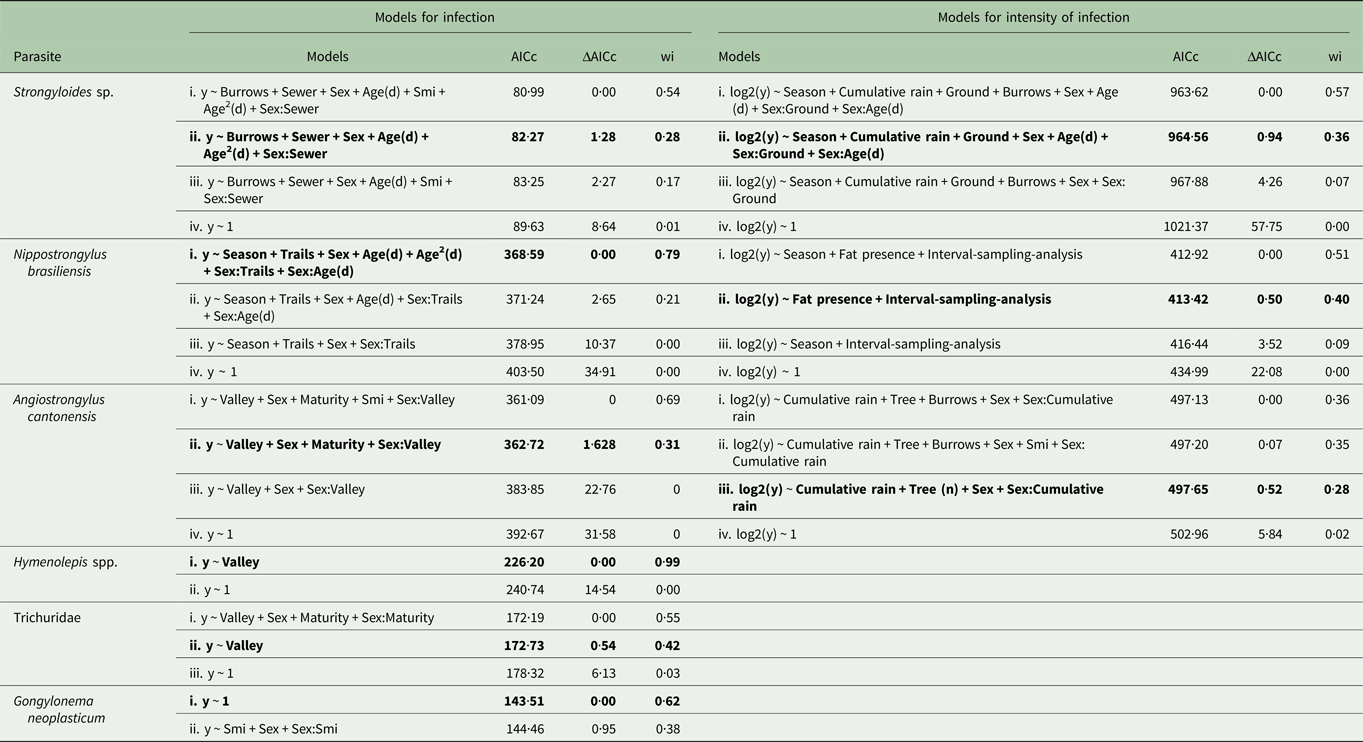
Aspiculuris sp. infection was likely to have been incidental (Falcón-Ordaz et al. Reference Falcón-Ordaz, Pulido-Flores and Monks2010) and, together with Syphacia muris was excluded from the statistical models later performed due to the low prevalence. Positive results for H. nana were pooled with those of H. diminuta, because of phylogenetic proximity and mode of transmission; this group will be referred to, hereafter, as Hymenolepis spp. The summaries of model selections for the probabilities and intensities of infection of each helminth species or families of helminth species are provided in Table 3. Details of each final model are available in Supplementary Table S2.
Summary of model performances in explaining the probability of infection (glm, family = binomial) and intensity [glm, family = Gamma(link = ‘identity’)] of each helminth species

AICc, corrected Akaike's information criterion; ΔAICc, difference between AICc score and lowest AICc score; wi, Akaike's model weight.
The most parsimonious models are shown in bold.
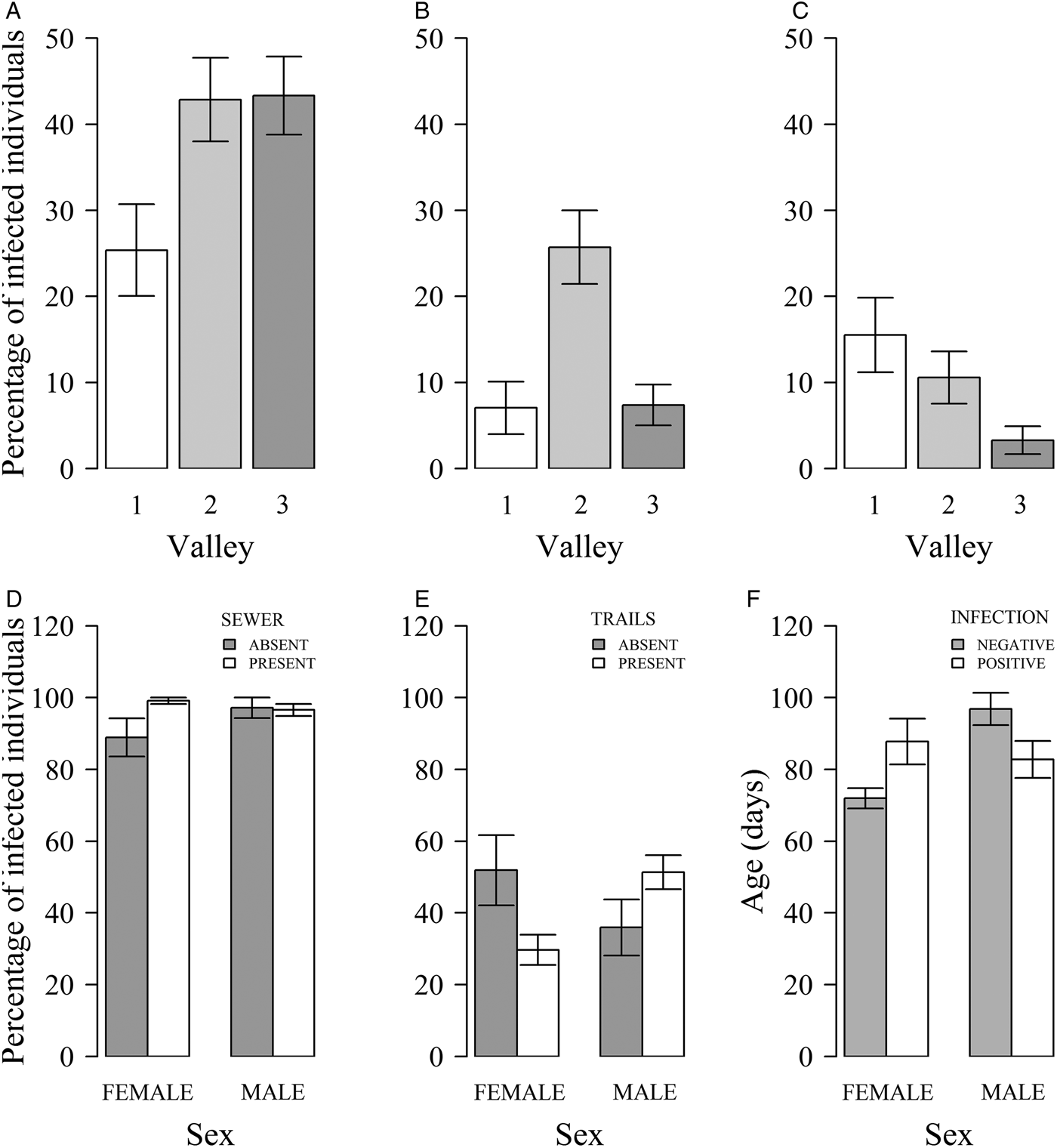
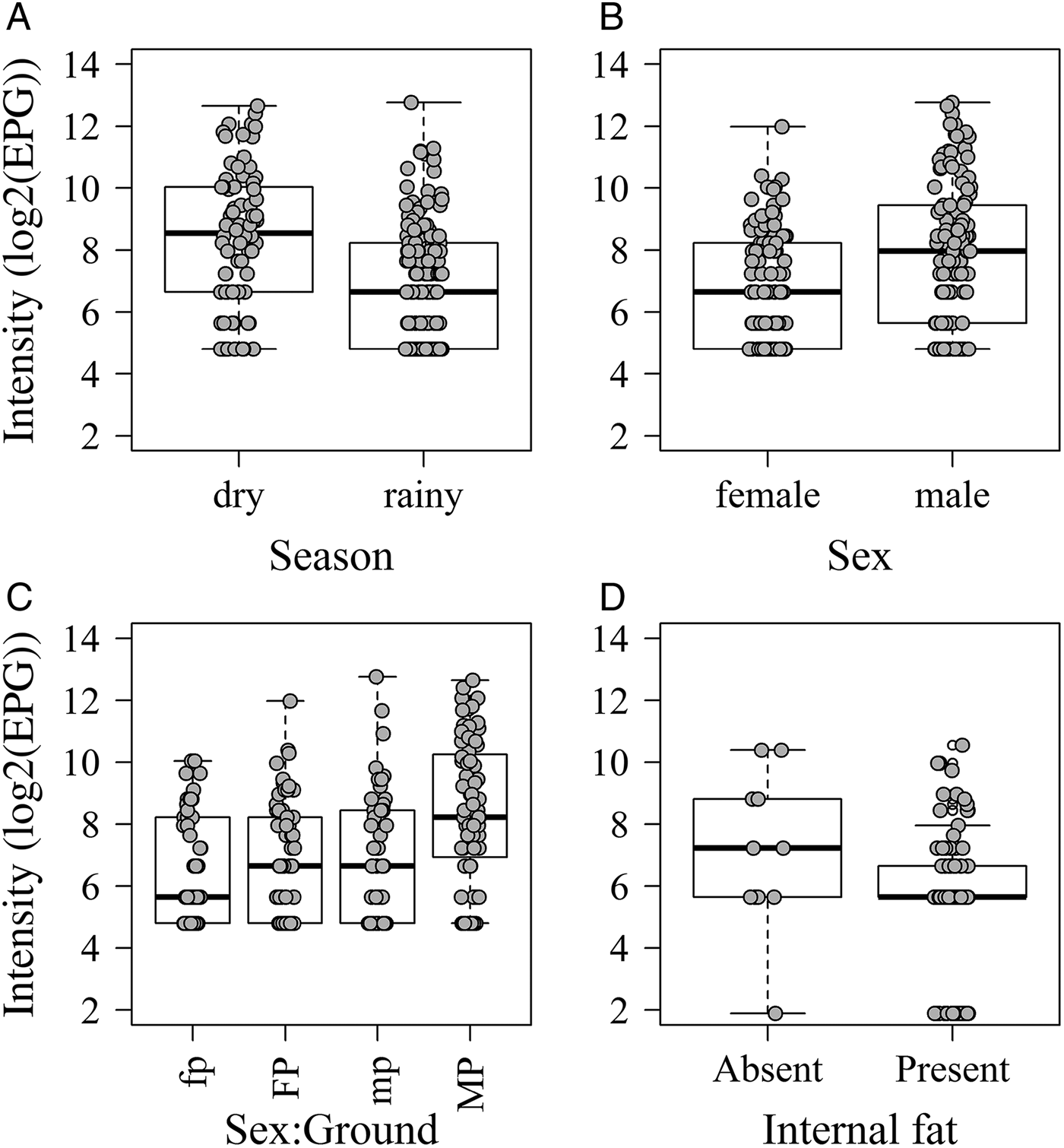
Variables of the environmental features and the demography and condition of the rats were significantly associated with the probabilities and intensities of infection of the helminth species, except for Gongylonema neoplasticum. Valleys 2 and 3 within the study area were significantly associated with higher probabilities of infection by A. cantonensis [Valley 3: OR, 3·67 (95% CI, 1·44–9·91)] and Hymenolepis spp. [Valley 2: 4·57 (1·80–14·07)] relative to valley 1 (Fig. 2A and B). On the other hand, compared with valley 1, valley 3 was significantly associated with lower probabilities of infection by Trichuridae [Valley 3: OR, 0·18 (95% CI, 0·05–0·57)] (Fig. 2C). The dry season was significantly associated with higher intensities of Strongyloides sp. [Rainy season: Rate, 0·24 (95% CI, 0·14–0·41)] (Fig. 3A).
Mean percentages of infected rats (A–E). Infections by A. cantonensis (A), Hymenolepis spp. (B) and Trichuridae (C) per valley; by Strongyloides sp. (D) per sex and presence of sewer; by N. brasiliensis (E) per sex and presence of trails. F – Mean ages (days) of N. brasiliensis infected and not infected individuals by sex. Whiskers represent standard errors.

Boxplots of helminths’ intensities (log2(EPG)). Strongyloides sp. by season (A); Strongyloides sp. by sex (B) and by sex and ground (C); N. brasiliensis by internal fat (D). In ‘C’, fp, female:partially-permeable-ground; FP, female:permeable-ground; mp, male:partially-permeable-ground; MP, male:permeable-ground.

For infections of both Strongyloides sp. and N. brasiliensis (females only) age(d) was only significant if combined with age2(d), indicating curvilinear associations. For Strongyloides sp., the fact that age(d) was positive and age2(d) negative indicates an increased probability of being infected that levelled off or even declined in older individuals (see Supplementary Table S2). For N. brasiliensis, on the other hand, age(d) in females, when considered alone, was positive and the inclusion of age2(d) also represented a positive association, indicating an increased probability of being infected that accelerated with age (see Supplementary Table S2). Maturity, a similar variable to age2(d), was also significantly associated with the infection by A. cantonensis [Mature: OR, 5·20 (95% CI, 2·65–10·89)], and therefore, after reaching maturity all individual rats shared a similar probability of being infected by this lungworm. Associations with sex alone only bordered significance. Nonetheless, with the probability of infection by Strongyloides sp. and N. brasiliensis, interactions terms with other variables (females used as reference in the analyses) indicated, first, that it was more likely to find Strongyloides sp. in females if there was an open sewer within 10 m of the trapping site [Male:Sewer: OR, 0·01 (95% CI, 0·00–0·41)] (Fig. 2D). Also, it was more likely to find male rats infected with N. brasiliensis if rat trails were present [Male:Trails: 5·02 (1·49–17·25)] or if males were younger [Male:Age(d): 0·97 (0·96–0·99)] (Fig. 2E and F). Once infected, male rats were significantly associated with high intensities of Strongyloides sp. [Rate, 4·324 (1·640–11·343)] compared with females, especially if the ground was permeable [2·501 (1·155–5·414)] (Fig. 3B and C). Among the variables used as a proxy for rat body condition, the only significant association was the presence of internal fat being significantly associated with lower intensities of N. brasiliensis [Rate, 0·39 (95% CI, 0·15–0·85)] (Fig. 3D).
Discussion
A high global richness of enzootic parasites was identified in urban populations of R. norvegicus, including five zoonotic species. Helminth species were differently associated with a variety of risk factors, including environmental features, and demographic and body condition variables of the rat population, together with sex interactions. The potential zoonotic transmission of some of these parasites to humans is significant in the environments studied, illustrated by the high prevalence, and ubiquity, of A. cantonensis (almost 40%) in the population of urban rats of the study area.
The fact that rats have been found infected by A. cantonensis indicates that the lungworm is able to complete its life cycle in the area. This may be due to the expansion of intermediate hosts distributions in Brazil (Thiengo et al. Reference Thiengo, Faraco, Salgado, Cowie and Fernandez2007; Carvalho et al. Reference Carvalho, Scholte, Mendonça, Passos and Caldeira2012; Moreira et al. Reference Moreira, Giese, Melo, Simões, Thiengo, Maldonado and Santos2013). Humans are accidental hosts of A. cantonensis, becoming infected after ingesting contaminated raw or undercooked intermediate hosts (snails or slugs), vegetables or paratenic hosts, such as crustaceans and other molluscs (Wang et al. Reference Wang, Lai, Zhu, Chen and Lun2008). The infective third stage larvae, then, migrate to the central nervous system, where they trigger a strong inflammatory response caused by the increased production of eosinophils, leading to EoM (>10% of eosinophils in the cerebrospinal fluid), alternatively they may move to the eye chamber leading to ocular angiostrongyliasis (Lo Re and Gluckman, Reference Lo Re and Gluckman2003; Wang et al. Reference Wang, Wu, Wei, Owen and Lun2012). This has been considered an emerging disease in Brazil – the first case was reported in 2006 (Garcia et al. Reference Garcia, Moraes, Almada and Araújo2008) – and it is probably under-recognized due to lack of proper diagnostics and the scarcity of information on the distribution of A. cantonensis in the country (Morassutti et al. Reference Morassutti, Thiengo, Fernandez, Sawanyawisuth and Graeff-Teixeira2014), and of its intermediate host species, which can vary at local scales. Apart from A. cantonensis, a moderate prevalence of H. diminuta and low prevalence of H. nana were identified in the rat population. While the first is considered to rarely infect humans with asymptomatic or mild symptoms (Tena et al. Reference Tena, Pérez Simón, Gimeno, Pérez Pomata, Illescas, Amondarain, González, Domínguez and Bisquert1998; Kunwar et al. Reference Kunwar, Subba, Shrestha, Chapagain, Jha, Subedi, Blangero, Williams Blangero and Towne2005; Patamia et al. Reference Patamia, Cappello, Castellano-Chiodo, Greco, Nigro and Cacopardo2010; Tiwari et al. Reference Tiwari, Karuna and Rautaraya2014), the second can cause diarrhoea, especially in children (Mirdha and Samantray, Reference Mirdha and Samantray2002).
Of the 299 rat feces examined, all except for five were infected by at least one helminth species. Higher richness was observed among mature rats, which are likely to be more susceptible to infection due to reproductive expenditure (Zuk, Reference Zuk1990). The overall helminth richness found in our study, with a community mostly formed by nematodes, is consistent with helminth richness and community characteristics in R. norvegicus worldwide (richness range of four to eleven species) (Araújo, Reference Araújo1967; Waugh et al. Reference Waugh, Lindo, Foronda, Ángeles-Santana, Lorenzo-Morales and Robinson2006; Gómez Villafañe et al. Reference Gómez Villafañe, Robles and Busch2008; Rafique et al. Reference Rafique, Rana, Khan and Sohail2009; Kataranovski et al. Reference Kataranovski, Kataranovski and Deljanin2010; Hancke et al. Reference Hancke, Navone and Suarez2011; Mohd Zain et al. Reference Mohd Zain, Behnke and Lewis2012). However, the distribution of parasites within an area can vary at small scales, since it depends on local environmental conditions, host densities and, in some cases, on the presence of intermediate hosts. In this study, we found that A. cantonensis, Hymenolepis spp. and Trichuridae infections were significantly associated with different geographic valleys, and this might be due to differences in the distribution of intermediate hosts within these valleys, which require further investigation.
N ippostrongylus brasiliensis was the only helminth species that presented with differing prevalence between campaigns of capture, being higher in the dry season. Moreover, the other high prevalent soil-transmitted helminth found in this study, Strongyloides sp., interestingly, presented with higher intensities in the dry season of capture compared with the rainy season. This finding is contrary to what might be expected, given Strongyloides species’ dependency on moist environments for larval viability (Gillespie and Chapman, Reference Gillespie and Chapman2006). Because this was a cross-sectional study, a potential explanation may be that in the rainy season, where there are more humid spots for infection, more rats were caught with recent acquired Strongyloides infections, which might have dragged down the intensity estimates in that season; whereas in the dry season, rats might have been caught mostly carrying old infections, which were therefore more intense.
Sex interactions associated with differing probabilities of infection or intensities of helminths in the rat population highlight behavioural differences in space use between males and females (Wolff, Reference Wolff, Singleton, Hinds, Krebs and Spratt2003). The fact that more females were found to be infected with Strongyloides sp. where an open sewer was close may indicate that they spend more time in burrows situated close to sewers which offer more access to humid environments. Males, in turn, have a larger home range than females, which might increase their rate of contact with contaminated environments. Moreover, males are more susceptible to infection, owing to more energy-costly reproductive behaviours and to hormones that can both reduce immunocompetence and affect genes which determine infection resistance (Zuk, Reference Zuk1990; Klein, Reference Klein2000). Therefore, it is reasonable to have found more intense Strongyloides sp. infections in males, and more males infected with N. brasiliensis. This parasite was also found more in younger males. Adult rats are more capable of triggering an immune response for the expulsion of N. brasiliensis than younger rats, which, if exposed to N. brasiliensis, may have a persistent infection until adulthood (Jarret et al. Reference Jarret, Jarret and Urquhart1966, Reference Jarret, Jarret and Urquhart1968; Dineen and Kelly, Reference Dineen and Kelly1973). Moreover, rats in poorer body condition (absence of fat) were found to be carrying higher intensities of N. brasiliensis. Despite this seeming an intuitive conclusion, body condition is often neglected when assessing the risk factors for the probability or intensity of infection of parasites in the field. This result suggests the importance of adding body condition (as a proxy of health) variables in the models, given that individuals vary within natural populations and, therefore, in their susceptibility to infection by a parasite. However, it is worth noting that rather than previous poor condition has caused the infection, N. brasiliensis may have reduced the body condition of infected rats, as the parasite can cause anorexia (Mercer et al. Reference Mercer, Mitchell, Moar, Bissett, Geissler, Bruce and Chappell2000).
Aside from these results, the observation of eggs of Toxocara sp. and Ascaris sp. in the feces of R. norvegicus indicates recent contact with these parasites’ eggs. While Ascaris sp. is likely to be a pseudoparasite for rats, presumably after ingesting human feces (Pinto et al. Reference Pinto, Mati and Melo2014), R. norvegicus are considered paratenic hosts for Toxocara sp., as after ingesting animal feces, mature eggs hatch and larvae migrate into rats’ tissues, where they do not mature (Lescano et al. Reference Lescano, Queiroz and Chieffi2004; Santos et al. Reference Santos, Lescano, Castro and Chieffi2009). These findings indicate the circulation of these pathogens in the study area – knowledge which is of public health importance, as both can infect humans.
The sample size was a limitation of this study. With one campaign per season, the confirmation of seasonal patterns of probability and intensity of infection of the helminth species may have been prevented. Apart from that, this study was limited by the method of assessing the helminth infection (eggs in feces), which, in terms of intensity, only allowed the use of proxies by EPG. However, fecal egg counts in EPG give reliable estimates of parasite burden for a diversity of host species and are an essential tool when other intensive methods are impractical (Cringoli et al. Reference Cringoli, Rinaldi, Veneziano, Capelli and Scala2004; Adejinmi and Emikpe, Reference Adejinmi and Emikpe2011; Lynsdale et al. Reference Lynsdale, Franco dos Santos, Hayward, Mar, Htut, Aung, Soe and Lummaa2015). Moreover, the McMaster technique applied has been considered a robust method (accurate multiplication factor) and sensitive enough to allow comparisons between different laboratories (Levecke et al. Reference Levecke, Behnke, Ajjampur, Albonico, Ame, Charlier, Geiger, Hoa, Kamwa Ngassam, Kotze, McCarthy, Montresor, Periago, Roy, Tchuem Tchuenté, Thach and Vercruysse2011).
This study provides relevant information about the helminth community of rats in a tropical slum settlement. Among the helminths, it is important to highlight the presence of species pathogenic to humans, such as A. cantonensis found in high prevalence, a finding of notable public health system importance. Along with the prevalence of helminths, the main risk factors associated with the probabilities and intensities of infection of these parasites among rats included a variety of environmental features and the demography and body condition variables of the rat population. This potentially suggests different risk factors involved in the routes for human infection. Given the high richness of helminth species found within the rat population, further work should take co-infection into account in seeking to understand how potential associations between parasites may explain their probabilities and intensities of infection and the subsequent risk of transmission to humans.
Supplementary material
The supplementary material for this article can be found at https://doi.org/10.1017/S0031182017001755
Acknowledgements
The authors are grateful to the Fundação de Amparo à Pesquisa do Estado da Bahia – Fapesb and the Brazilian Federal Agency for Support and Evaluation of Graduate Education – Capes, which granted Mrs. Carvalho-Pereira scholarships, making this work possible. We would like to thank the staff of the Center for the Control of Zoonoses (CCZ) from Salvador for their assistance in conducting the study. This work could not be accomplished without the joint collaborative effort of the resident associations, community leaders and residents, which constitute the Urban Health Council of Pau da Lima.
Financial support
This work was supported by the Oswaldo Cruz Foundation and Secretariat of Health Surveillance, Brazilian Ministry of Health, the National Institutes of Health of the United States (grant numbers F31 AI114245, R01 AI052473, U01 AI088752, R01 TW009504 and R25 TW009338) and by the Wellcome Trust (102330/Z/13/Z).