Introduction
Fetal alcohol spectrum disorders (FASD) is the umbrella term used to denote several conditions associated with prenatal alcohol exposure, particularly fetal alcohol syndrome (FAS), partial FAS (pFAS), and Alcohol Related Neurodevelopmental Disorder (ARND). To date, a large body of evidence shows individuals with FASD have significant cognitive, behavioral and social impairments. Their cognitive deficits include reduced levels of intelligence (Mattson, Riley, Gramling, Delis, & Jones, Reference Mattson, Riley, Gramling, Delis and Jones1997) and memory (Rasmussen, Horne, & Witol, Reference Rasmussen, Horne and Witol2006; Willoughby, Sheard, Nash, & Rovet, Reference Willoughby, Sheard, Nash and Rovet2008), as well as difficulties with attention (Coles, Platzman, Lynch, & Freides, Reference Coles, Platzman, Lynch and Freides2002; Mattson, Calarco, & Lang, Reference Mattson, Calarco and Lang2006) and executive functioning (Rasmussen, McAuley, & Andrew, Reference Rasmussen, McAuley and Andrew2007; Rasmussen, Wyper, & Talwar, Reference Rasmussen, Wyper and Talwar2009). Behavior problems reflect high rates of attention deficit hyperactivity disorder (ADHD; Nash et al., Reference Nash, Rovet, Greenbaum, Fantus, Nulman and Koren2006; Rasmussen et al., Reference Rasmussen, Benz, Pei, Andrew, Schuller, Abele-Wester and Lord2010), conduct disorder (Nash, Koren, & Rovet, Reference Nash, Koren and Rovet2011) and autism traits (Bishop, Gahagan, & Lord, Reference Bishop, Gahagan and Lord2007; Stevens, Nash, Koren, & Rovet, Reference Stevens, Nash, Koren and Rovet2012), while their social difficulties include inappropriate peer relationships (Keil, Paley, Frankel, & O’Connor, Reference Keil, Paley, Frankel and O’Connor2010; O’Connor et al., Reference O’Connor, Frankel, Paley, Schonfeld, Carpenter, Laugeson and Marquardt2006), lack of social judgment (Kodituwakku, Reference Kodituwakku2007), and poor social problem solving abilities (McGee, Bjorkquist, Price, Mattson, & Riley, Reference McGee, Bjorkquist, Price, Mattson and Riley2009; McGee, Fryer, Bjorkquist, Mattson, & Riley, Reference McGee, Fryer, Bjorkquist, Mattson and Riley2008; Stevens, Major, Rovet, & Desrocher, Reference Stevens, Major, Rovet and Desrocher2012). Research investigating the impact of exposure severity shows mixed results, with some studies describing poorer cognitive performance in children with FAS (Chasnoff, Wells, Telford, Schmidt, & Messer, Reference Chasnoff, Wells, Telford, Schmidt and Messer2010) and others showing children without the full FAS profile being at higher risk of social functioning deficits (Fast, Conry, & Loock, Reference Fast, Conry and Loock1999; Schonfeld, Mattson, & Riley, Reference Schonfeld, Mattson and Riley2005). To date, the determinants of their sociobehavioral difficulties are poorly understood and although recent evidence suggests that one key ability, social cognition, is particularly compromised in FASD (Greenbaum, Stevens, Nash, Koren, & Rovet, Reference Greenbaum, Stevens, Nash, Koren and Rovet2009; Rasmussen et al., Reference Rasmussen, Wyper and Talwar2009), the underlying relationship between their social cognitive and sociobehavioral difficulties is not known.
Social cognition, which is essential for effective social functioning, involves two main components, theory of mind and empathy (Davis, Reference Davis1996; Ruby & Decety, Reference Ruby and Decety2004). Theory of mind, also known as social perspective taking, refers to one’s ability to comprehend the mental states of others (Premack & Woodruff, Reference Premack and Woodruff1978). Theory of mind first develops during the preschool years (Wellman, Cross, & Watson, Reference Wellman, Cross and Watson2001) and is generally more advanced in females than males (Happe, Reference Happe1995). Recent studies indicate children with FASD have inadequately developed theory of mind skills that reflect their marked difficulties in recognizing the mental states (Coggins, Reference Coggins1997; Kodituwakku et al. Reference Kodituwakku, May, Ballinger, Harris, Aase and Aragon1997; Rasmussen et al., Reference Rasmussen, Wyper and Talwar2009) and emotions of others (Greenbaum et al., Reference Greenbaum, Stevens, Nash, Koren and Rovet2009). Notably, these problems have also been linked to some of the behavioral difficulties seen in this population (Greenbaum et al., Reference Greenbaum, Stevens, Nash, Koren and Rovet2009; Rasmussen et al., Reference Rasmussen, Wyper and Talwar2009). Furthermore, while theory of mind skills are generally seen to develop rapidly during the early childhood years in typically developing children (Wellman et al., Reference Wellman, Cross and Watson2001), deficits in this area become more pronounced with age in FASD, suggesting atypical development (Rasmussen et al., Reference Rasmussen, Wyper and Talwar2009). Empathy, which is another key component of social cognition, refers to one’s affective response to another person’s emotional state (Eisenberg, Spinrad, & Sadovsky, Reference Eisenberg, Spinrad and Sadovsky2006) and has been shown to develop abnormally in several populations, such as conduct disorder and ADHD (Marton, Wiener, Rogers, Moore, & Tannock, Reference Marton, Wiener, Rogers, Moore and Tannock2009; Wied, de Wied, & de van Boxtel, Reference Wied, de Wied and de van Boxtel2010). Like theory of mind, females are reported to be more empathic than males (Bryant, Reference Bryant1982; Marton et al., Reference Marton, Wiener, Rogers, Moore and Tannock2009). However, despite parents’ claims that their children with FASD have difficulty understanding others’ emotions (Caldwell, Reference Caldwell1993) empathy has not to our knowledge been directly investigated in this population.
The current study sought to address these outstanding issues. Our primary goals were to compare social perspective taking and empathy abilities in children with FASD versus typically developing controls (TDC) and identify whether specific deficits in either domain contribute to sociobehavioral difficulties in the FASD group. A series of secondary goals were to compare facets of social cognition in FAS/pFAS versus ARND diagnostic subgroups, examine for sex differences, and compare the developmental trajectories of social cognition in FASD versus TDC. We hypothesized that children with FASD would perform below TDC on indices of social perspective taking and empathy, and that their performance would predict parent-rated social difficulties. Among children with FASD, we expected the ARND subgroup to perform more poorly than pFAS/FAS on social cognitive measures (Fast et al., Reference Fast, Conry and Loock1999; Schonfeld et al., Reference Schonfeld, Mattson and Riley2005) and that females would score lower than males on parent-rated social skill indices (Rasmussen, Becker, McLennan, Urichuk, & Andrew, Reference Rasmussen, Becker, McLennan, Urichuk and Andrew2011; Schonfeld, Paley, Frankel, & O’Connor, Reference Schonfeld, Paley, Frankel and O’Connor2006). We also expected the developmental trajectories of social cognition to differ between FASD and TDC groups (Rasmussen et al., Reference Rasmussen, Wyper and Talwar2009).
Methods
Participants
Studied were fifty-eight 8- to 12-year-old children, 37 with FASD (mean age=10.03±1.4 years; 20 males) and 21 TDC (mean age=10.54±1.2 years; 11 males). Recruitment took place between December 2010 and June 2012. The FASD group was ascertained from two sources: letters mailed to families of past patients diagnosed at the Motherisk Clinic at the Hospital for Sick Children or postings at local FASD parent support groups. Approximately 50% of the families contacted agreed to participate partly because the current study, conducted in the context of a larger intervention study (Nash et al., Reference Nash, Stevens, Greenbaum, Weiner, Koren and Rovet2014), also included a brain imaging component and required a large time commitment from families. Primary reasons for non-participation were: no response to initial letter, phone number on file not in service, time commitment, and/or family lived too far from the hospital. As these reasons are not uncommon in intervention studies we believe our clinical group is representative of the FASD population. Children in the TDC group were recruited from community postings or were biological children of participating adoptive or foster parents. For both groups, exclusionary criteria were parent report of a neurological or chronic medical condition (e.g., epilepsy). Potential TDC candidates were excluded if they had a previous neurodevelopmental or behavioral diagnosis, a learning disability, IQ below 70, or if they had gestational exposure to alcohol or other substances of abuse. The Research Ethics Boards at the Hospital for Sick Children and the University of Toronto approved all procedures.
The FASD group was diagnosed in the Motherisk Clinic at the Hospital for Sick Children (n=13) or at one of several other Ontario FASD diagnostic facilities (n=22); information regarding diagnostic source was missing for two cases. All children had documented evidence or supportive family testaments corroborating alcohol was the primary exposure during pregnancy as indicated by reports of heavy daily drinking and/or frequent binges. Cases with minimal exposure were not considered for diagnosis. The assessment at Motherisk involved an intensive evaluation with the Canadian Guidelines system used in formulating the diagnosis (Chudley et al., Reference Chudley, Conry, Cook, Loock, Rosales and LeBlanc2005). Children diagnosed with FAS needed to show the requisite facial dysmorphology, significant growth retardation, deficits in a minimum of three functional domains (e.g., cognition, attention, achievement, executive functioning), while children with pFAS showed milder/fewer dysmorphic facial features along with the requisite cognitive deficits. Children with ARND showed only the cognitive deficits. At the other diagnostic facilities, the Washington 4-Digit Code system (Astley & Clarren, Reference Astley and Clarren2000) was used, which classified children into FAS, pFAS, or ARND groups based on presence or absence, as well as severity of facial, growth, neurobehavioral deficits, and exposure. In the current sample, two children had FAS (6%), seven had pFAS (20%), and 26 had ARND (74%), not including the two cases whose specific diagnostic source was unavailable.
Tests and Measures
All parents completed a structured case history form yielding information on demographics and developmental history. The Hollingshead scale (Hollingshead, Reference Hollingshead1975), which assigns a score to the occupation and educational level of each parent, was used to measure socioeconomic status (SES). The two subtest (Vocabulary and Matrix Reasoning for full-scale IQ; FSIQ-2) version of the Wechsler Abbreviated Scale of Intelligence (Weschler, Reference Weschler1999) was used to measure children’s intelligence.
Sociobehavioral questionnaires
Parents completed the Child Behavior Checklist (CBCL; Achenbach, Reference Achenbach2001) and Social Skills Improvement System (SSIS; Gresham & Elliott, Reference Gresham and Elliott2008). Both have strong reliability and validity (Gresham, Elliot, Vance, & Cook, Reference Gresham, Elliot, Vance and Cook2011; Nakamura, Ebesutani, Bernstein, & Chorpita, Reference Nakamura, Ebesutani, Bernstein and Chorpita2009). The CBCL (ages 4–18 years) yields three broadband scales and multiple narrowband scales (T score mean=50; SD=10). Four CBCL indices were investigated: Internalizing, Externalizing and Total Behavioral Problems broadband scales and the Social Problem narrowband scale.
The SSIS (ages 3–18 years) provides both social and behavioral scales (standard scores mean=100; SD=15). Recorded presently were the Social Skills and Behavior Problems scales. Higher Social Skills scores indicated fewer social difficulties; whereas higher Behavior Problems scores indicated more behavioral difficulties.
Social perspective taking
The NEPSY-II Theory of Mind subtest (Korkman, Kirk, & Kemp, Reference Korkman, Kirk and Kemp2009) and the Test of Social Cognition (Saltzman-Benaiah & Lalonde, Reference Saltzman-Benaiah and Lalonde2007) were used to assess social perspective taking. Both have good reliability and validity (Brooks, Sherman, & Strauss, Reference Brooks, Sherman and Strauss2010; Saltzman-Benaiah & Lalonde, Reference Saltzman-Benaiah and Lalonde2007).
NEPSY-II Theory of Mind consists of two subtasks, a Verbal task assessing how well the child understands what a person in a story knows, and a Contextual task requiring the child to select from a set of photographed faces how a person in a given social situation is feeling. Raw scores from each subtask and their combined score (Total) were used in the analyses.
Children received four of the five subtests from the Test of Social Cognition. In False Beliefs, the examiner reads 8 stories describing a situation of false belief, sarcasm or deception along with an accompanying picture. The child has to make a prediction and provide an explanation regarding one of the character’s beliefs (total score=8). In Strategic Control of Emotions, the examiner presents four stories, each describing a situation in which the main character hides their true emotions, with two of the stories involving social rules and two involving self-protection. The child has to indicate the character’s feelings using a set of faces (total score=12). In Personalized Emotions, children hear stories involving two separate events, whereby the first potentially influences the main character’s feelings toward the second. Children have to predict and explain how the character feels in the second event (total score=3). Personalized Thoughts involves four scenarios acted out with props and dolls. In each, a child doll gives to either an adult or infant doll ambiguous or unambiguous information about the location of a hidden prize. Children have to indicate whether the adult or infant doll know where the prize is hidden (total score=4). For each subtest, results were converted to Z-scores (Saltzman-Benaiah & Lalonde, Reference Saltzman-Benaiah and Lalonde2007).
Empathy
Empathy was assessed via two measures: the child-completed Index of Empathy (Bryant, Reference Bryant1982) and the parent-completed Empathy subscale from the SSIS (Gresham & Elliott, Reference Gresham and Elliott2008). Index of Empathy (ages 6 years and above) contains items seeking information on one’s feelings toward familiar and unfamiliar people. Raw scores were used, with higher scores indicating higher empathy levels. The SSIS Empathy subscale examines children’s empathy from the parent’s perspective. In the current study, raw scores from the SSIS Empathy scale were used, with higher scores indicating greater empathy.
Statistical Analyses
All analyses were conducted in SPSS version 22.0 for Macintosh. Initially, groups were compared for demographic characteristics using one-way analyses of variance (ANOVA) for continuous variables and chi-square analyses for categorical variables. Several of the demographic variables applicable for both groups were considered as potential covariates. To compare FASD and TDC groups and to examine for the effects of sex and age, we used analyses of covariance (ANCOVA) or multivariate analyses of covariance (MANCOVA), depending on whether tasks involved single or two or more indices. Simple main-effect analyses were conducted for significant interactions. For all comparisons, effect sizes were determined using partial eta-squared (η2). To assess for FAS/pFAS versus ARND diagnostic subgroup differences and given the unequal sizes of these subgroups, we used non-parametric Mann Whitney tests and Bonferroni-corrected p-values for multiple comparisons. Within-group Pearson correlations with the Bonferroni p-correction for multiple comparisons were used to examine the relations between performance on social perspective taking and empathy measures and parent-rated social skills. Finally to compare age trajectories of FASD and TDC groups, we performed linear regressions with group and age as regressors on indices showing a significant age covariate effect in the MANCOVA and ANCOVA analyses. For all analyses, except when the Bonferroni correction was applied, significance was set at p<.05.
Results
Demographic Measures
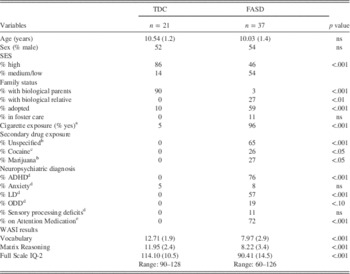
Table 1 presents parent reported demographic and background information and IQ data for children in both FASD and TDC groups. Groups did not differ in age or sex distributions, but did differ in SES, with 86% of the TDC children coming from a high SES background versus 46% of the FASD group. Accordingly, SES was used as a covariate in subsequent analyses. Almost all children in the TDC group were living with one or both biological parents (90%), whereas 97% of children with FASD were living with biological relatives, adoptive or foster parents. Most biological mothers of children with FASD were known to have smoked cigarettes during pregnancy, in contrast to only one mother of a child in the TDC group. Twenty-seven percent of children with FASD were exposed in utero to marijuana and 26% to cocaine, while none in the TDC group were exposed to these substances. Most children with FASD had a comorbid diagnosis, the most common being ADHD (76%) and learning disability (57%). In addition, 72% of children in the FASD group were taking attention medications compared with none in the TDC group.
Mean and standard deviations (SD) demographic characteristics for children in the TDC and FASD groups

Note. Wechsler Abbreviated Scale of Intelligence (WASI; mean=100; SD=15). SES=Socioeconomic status; ADHD=Attention Deficit Hyperactivity Disorder; ODD=Oppositional Defiant Disorder; LD=Learning Disability
a Information was missing on 3 TDC and 10 FASDs
b Information was missing on 11 FASDs
c Information was missing on 10 FASDs
d Information was missing on 1 TDC
e Information was missing on 1 TDC and 1 FASD.
Groups differed on all IQ indices, with the FASD group scoring significantly below TDC on FSIQ-2 [F(1,56)=43.05; p<.001; η2=0.44] and the Vocabulary [F(1,56)=43.55; p<.001; η2=0.44] and Matrix Reasoning subtests [F(1,56)=19.71; p<.001; η2=0.26]. Despite these differences, we chose not to use IQ as a covariate in subsequent analyses given the convincing argument of Dennis et al. (Reference Dennis, Francis, Cirino, Schachar, Barnes and Fletcher2009) this is unnecessary if low IQ is one of the components of a neurodevelopmental disability.
Parent-Rated Behavior and Social Skills
CBCL and SSIS scores were analyzed via a single MANCOVA with Group and Sex as independent variables and Age and SES as covariates. Since one child in the TDC group did not have an SSIS Behavior Problems score, this analysis was based on 20 TDC and 37 FASD.
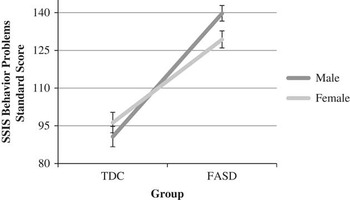
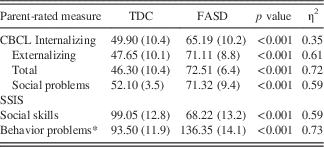
Results showed a significant omnibus effect of Group [F(6,48)=46.30; p<.001; η2=0.85] and a trend-level Group by Sex interaction [F(6,48)=1.94; p<.10; η2=0.20]; effects of Sex, Age, and SES were not significant. Univariate analyses indicated parents rated the FASD group significantly higher than the TDC group on CBCL and SSIS Behavior Problems indices and significantly lower on the SSIS Social Skills index (Table 2). For both questionnaires, the FASD group’s average scores were in the clinical range (T score >65). In addition, a significant univariate Group by Sex interaction was obtained for SSIS Behavior Problems [F(1,53)=4.34; p<.05; η2=0.08]. Analyses of simple main effects indicated males with FASD had more behavior problems than their female counterparts [F(1,35)=4.46; p<.05] (Figure 1).
Sex differences on the SSIS Behavior Problems subscale showing a significant group by sex interaction, reflecting higher scores for males than females in the FASD group.

Means (SD) for TDC and FASD group on CBCL and SSIS

Note: CBCL lower T scores indicate fewer problems; SSIS Behavior Problems lower standard scores indicate fewer behavior difficulties; SSIS Social Skills higher standard scores indicate fewer social difficulties.
* Females with FASD < males with FASD (p<.05).
Social Perspective Taking and Empathy
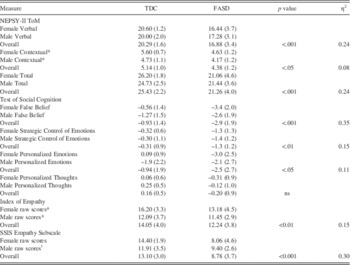
On the NEPSY-II Theory of Mind, three children in the FASD group did not complete the Contextual subtest; therefore MANCOVA was based on 34 FASD and 21 TDC. Results indicated significant omnibus effects for Group [F(2,49)=7.91; p<.001; η2=0.24], Sex [F(2,49)=4.29; p<.05; η2=0.15], and Age [F(2,49)=3.60; p<.05; η2=0.13] but not the Group by Sex interaction or SES covariate. Univariate analyses revealed the FASD group scored significantly below TDC on Verbal (p<.001; η2=0.24), Contextual, (p<.05; η2=0.08), and Total indices (p<.001; η2=0.24) (Table 3). In both groups, males scored lower than females on the Contextual subtest [F(1,50)=7.83; p<.01; η2=0.14]. Significant age-related changes in performance were observed for Contextual (p<.05; η2=0.11) and Total (p<.05; η2=0.10) indices while the effect for the Verbal index approached significance (p<.10; η2=0.07).
Means (SD) for TDC and FASD Group on the Social Perspective Taking and Empathy Measures
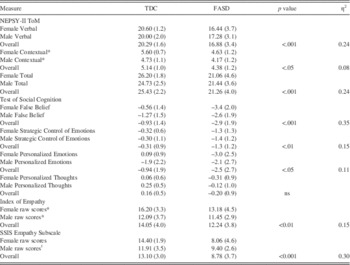
Note. NEPSY Verbal, Contextual and Total values are shown in raw scores. Test of Social Cognition subtest values are shown in in z scores; higher z scores indicate better performance. Raw scores were used for empathy measures. Higher scores on the Index of Empathy and SSIS Empathy indicate higher levels of empathy.
* Males<females (p<0.01)
t TDC females>TDC males (p<0.05).
For the Test of Social Cognition, significant main effects of Group [F(4,50)=8.34; p<.001; η2=0.40] and Age [F(4,50)=4.66; p<.01; η2=0.27] were found; Sex, SES, and the Group by Sex interaction were not significant. Univariate analyses revealed the TDC group performed better than FASD on False Beliefs (p<.001; η2=0.35), Strategic Control of Emotions (p<.01; η2=0.15), and Personalized Emotions (p<.05; η2=0.11) subtests but not Personalized Thoughts (Table 3). A univariate age-covariate effect was seen for False Beliefs only (p<.001; η2=0.22).
For the Index of Empathy, significant main effects were observed for Group [F(1,53)=9.18; p<.01; η2=0.15], Sex [F(1,53)=10.92; p<.01; η2=0.17] and SES [F(1,53)=9.64; p<.01; η2=0.15], but not the Group by Sex interaction or Age. The Group effect reflected the significantly lower scores of the FASD group while the effect of Sex reflected the lower scores by males in both groups (Table 3).
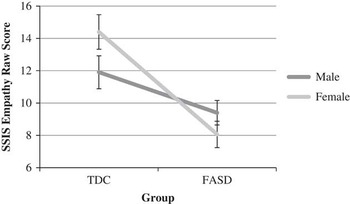
Regarding the SSIS Empathy subscale, results indicated a significant effect of Group [F(1,54)=22.65; p<.001; η2=0.30] and Group by Sex interaction [F(1,54)=4.25; p<.05; η2=0.07], but no main effects of Sex, Age, or SES. Parents rated TDC children higher in empathy than children with FASD (Table 3). Simple effects analyses revealed that parents rated females from the TDC group as more empathic than males [F(1,19)=4.03; p<.05] (Figure 2).
Sex Differences on the SSIS Empathy subscale showing a significant group by sex interaction, reflecting higher parent-rated empathy scores for females than males in the TDC group.

FASD Subgroup Comparisons
Nine children had pFAS or FAS and 26 children had ARND. Mann-Whitney results revealed no subgroup differences on the three WASI indices (FSIQ-2, Vocabulary, Matrix Reasoning), parent-rated behavior problems and social skills, NEPSY-II, or the Index of Empathy, after Bonferroni correction. On the Test of Social Cognition, after Bonferroni correction (0.05/4=0.013), there was a significant group difference on False Beliefs (U=51.00; p<.013), whereby children with ARND (M=-3.3; SD=2.1) scored lower than children with pFAS/FAS (M=-1.62; SD=0.95). A significant group difference was also found on the SSIS Empathy subtest (U=65.50; p<.051), with parents rating children with ARND (M=8.12; SD=3.7) lower in empathy scores than children with pFAS/FAS (M=11.1; SD=3.2).
Correlations between Social Perspective Taking Scores and Parents’ Social Skills and Behavior Ratings
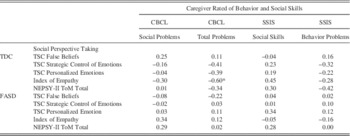
Pearson correlations were conducted between indices of social perspective taking and parent-rated social skills and behavior. Within the FASD group, significant correlations were observed between CBCL Social Problems and Index of Empathy (p<.05; r=0.34), and SSIS Social Skills and Personalized Emotions (p<.05; r=0.34). Within the TDC group, SSIS Social Skills and Index of Empathy (p<.05; r=0.45), and CBCL Total Behavior Problems and Index of Empathy were significantly correlated (p<.005; r=-0.60). However, after Bonferroni correction (0.05/9=0.006), only the negative correlation between CBCL Total Behavior Problems and Index of Empathy remained significant, suggesting TDC children who described themselves as less empathic were reported by parents to have more behavior difficulties (Table 4).
Correlations between Social Perspective Taking and Caregiver Ratings of Behavior and Social Skills

* p< .01 after Bonferroni correction.
Age Trajectories
Linear regressions were performed on the two social perspective taking measures showing significant age covariate effects, namely NEPSY-II Theory of Mind Total and Test of Social Cognition False Beliefs. These were based on 34 FASD and 21 TDC. For NEPSY-II Theory of Mind, results revealed a significant Group by Age interaction [F(2,52)=12.57; p<.001]. Within-group analyses indicated age significantly predicted Theory of Mind in the TDC group [F(1,19)=5.91; R2=0.24; p<.05, slope=0.25; 95% CI=0.04 to 0.46], with older children outperforming younger. No effect of Age on the NEPSY-II Theory of Mind subtest was observed in the FASD group. For the False Beliefs subtest, results revealed a significant Group by Age interaction [F(2,55)=16.83; p<.001]. Within-group analyses indicated Age significantly predicted False Beliefs scores in the FASD group, reflecting a decline in performance with age [F(1,35)=12.15; R2=0.26; p<.001; slope=-0.35; 95% CI=−0.56 to −0.15]. No comparable effect was observed in the TDC group.
Discussion
The current study sought to compare children with FASD and typically developing children on multiple indices of social cognition and relate these findings with parent ratings of social skills and behavior. Further goals were to compare FASD subgroups, as well as examine sex and age trajectories. Results indicated the FASD group had deficiencies on most indices of social perspective taking and empathy. In addition, parents of children with FASD rated them as having significantly more behavior and social problems and as being significantly less empathic than parents of children in the TDC group. A significant negative correlation was observed in the TDC group between parent-rated behavior difficulties and self-reported empathy. Correlations were not significant in the FASD group. With regard to FASD subgroups, children with ARND scored below children with pFAS/FAS on a measure of theory of mind and parent-rated empathy. Although no sex differences in social skills were seen, parents of children with FASD rated males as having more behavior difficulties than females, while parents rated TDC females as having higher empathy levels than TDC males. In both groups, males scored below females on indices of theory of mind and empathy. Contrary to our hypothesis, females in the FASD group were not found to have lower social skills than males. Finally, we observed theory of mind performance declined with age in the FASD group but improved with age in the TDC group.
Regarding social perspective taking, findings from both NEPSY-II Theory of Mind and three of the four Test of Social Cognition subtests indicated children with FASD have difficulty understanding how another person feels or what that person believes, regardless of whether they responded verbally or via visual prompts, consistent with previous research (Coggins, Reference Coggins1997; Greenbaum et al., Reference Greenbaum, Stevens, Nash, Koren and Rovet2009; Kodituwakku et al., Reference Kodituwakku, May, Ballinger, Harris, Aase and Aragon1997; Rasmussen et al., Reference Rasmussen, Wyper and Talwar2009). However, children with FASD did not differ from TDC on the Personalized Thoughts subtest, which involved simply knowing where a hidden object was placed. This discrepancy between subtests signifies that children with FASD may have adequate understanding of simple perspective taking (e.g., knowing whether a location is correct or not), but lack more complex social comprehension abilities. This may reflect the level of difficulty since Personalized Thoughts is easier than the other tasks. According to Kodituwakku (Reference Kodituwakku2007), children with FASD show a particular difficulty with complex information processing, as required in social perspective taking. From this, deficits in processing and integrating complex social information may be a characteristic feature of the behavioral phenotype in FASD.
Current findings based on both self-report and parent-rating scales indicate children with FASD have reduced empathy, compared with TDC, showing particular difficulty understanding others’ emotions. These findings are, to our knowledge, novel in the FASD population. It is important to note that reduced empathy has been reported as a risk factor for both inattentive and aggressive behavior (Freshbach, Reference Freshbach1997; Wied et al., Reference Wied, de Wied and de van Boxtel2010) and this may explain some of the social relationship difficulties experienced by children with FASD in their everyday life. However, the current study did not find any correlations between parent-rated social skills or behavior and social cognition in FASD. In contrast, a significant correlation was observed within the TDC group, for whom those with reportedly higher parent-rated behavior difficulties also self-reported lower empathy levels. Since this effect was observed only in typically developing children, it may be the case that the relationship is more complex for children with FASD or may be influenced by other factors. Furthermore, because this observation was based on a single parent-rated measure, the finding should be interpreted with caution. Future work would benefit from conducting behavioral observations of children in several social situations (e.g., classroom, peer groups) where empathy and social perspective taking can be rated naturalistically and by multiple raters, including teachers.
Our comparisons between FASD subgroups revealed that children with ARND scored lower than pFAS/FAS on False Beliefs and parent-rated empathy. Although these findings are based on a small sized sample, they support previous work showing children without the full FAS profile may be at increased risk of poor social functioning (Fast et al., Reference Fast, Conry and Loock1999; Schonfeld et al., Reference Schonfeld, Mattson and Riley2005). Although differences in IQ between FASD subgroups are typically used to explain discrepancies in behavior, this may not be the case currently, as no IQ differences were seen between ARND and pFAS/FAS subgroups. Alternatively, it has been proposed that children who do not have the full FAS profile may be more vulnerable to secondary disabilities (Schonfeld et al., Reference Schonfeld, Paley, Frankel and O’Connor2006; Streissguth et al., Reference Streissguth, Bookstein, Barr, Sampson, O’Malley and Young2004), including lower social functioning, due to the lack of physical characteristics that make their identification more difficult. Consequently, these children may be less likely to receive interventions. These findings highlight the importance of early identification and intervention for children who do not meet full FAS diagnostic criteria.
Sex-related differences were observed on several social cognitive indices, however, contrary to our hypothesis, parents did not rate females in the FASD group as having lower social skills. The sex-differences reflected the higher scores of females in both the FASD and TDC groups on the NEPSY-II Contextual scale and the self-reported Empathy Index, as seen in other populations (Bryant, Reference Bryant1982; Marton et al., Reference Marton, Wiener, Rogers, Moore and Tannock2009). In addition, parents of children in the TDC group rated females as more empathic than males, whereas parents of children in the FASD group rated males as having more behavior difficulties than females. The latter finding is consistent with previous work showing males with FASD are more likely to be diagnosed with externalizing disorders, such as ADHD, than are females (Herman, Acosta, & Chang, Reference Herman, Acosta and Chang2008). In other clinical populations, such as prenatal tobacco exposure, males similarly are reported to have higher rates of conduct disorder symptoms (Fergusson, Woodward, & Horwood, Reference Fergusson, Woodward and Horwood1998; Weissman, Warner, Wickamaratne, & Kandel, Reference Weissman, Warner, Wickramaratne and Kandel1999). Our findings have important implications in designing targeted interventions for children with FASD that focus on the different sociobehavioral issues between males and females.
Finally, the current study also investigated developmental trends in social cognition. In contrast to the TDC group whose social cognition improved with age, children with FASD showed a decline with age. The increase in performance for TDC children on NEPSY-II Theory of Mind versus the age-related decline for children with FASD on the Test of Social Cognition may reflect the fact that the NEPSY-II subtest used raw scores and the Test of Social Cognition used age-normed scores. Regardless, these findings suggest that children with FASD failed to show the normal age-related improvements in social perspective taking. This finding is consistent with previous work reporting age-related declines in more complex social abilities in FASD (Rasmussen et al., Reference Rasmussen, Wyper and Talwar2009; Thomas, Kelly, Mattson, & Riley, Reference Thomas, Kelly, Mattson and Riley1998; Whaley, O’Connor, & Gunderson, Reference Whaley, O’Connor and Gunderson2001), signifying their social deficits become more pronounced with age and adversely affect their social functioning throughout life. Thus, as children with FASD get older, they may lag further behind their peers in social skills and relationships. However, because the current study did not collect longitudinal data, age-specific conclusions cannot be made.
The relationship between theory of mind and language may also be used to explain the current findings, as both of these domains are influenced following prenatal alcohol exposure (Coggins, Reference Coggins1997; McGee, Bjorkquist, Riley, & Mattson, Reference McGee, Bjorkquist, Riley and Mattson2009; Timler, Olswang, & Coggins, Reference Timler, Olswang and Coggins2005). To investigate this relationship, we explored correlations between language (WASI Vocabulary), social perspective taking and empathy in FASD. Indeed, vocabulary scores were positively related to performance on the False Beliefs, Personalized Emotions, and NEPSY-II Verbal subtests (after Bonferroni correction). This sub-analysis suggests that children with FASD who have higher vocabulary knowledge scored higher on complex social perspective taking tasks. Because higher-level language skills develop with age, and children with FASD have difficulty in language domains, this may have also contributed to our finding that older children performed more poorly than younger children in social perspective taking. Future work would benefit greatly from more in-depth examinations of this relationship.
Although the present study provides unique information on social cognition in FASD, several limitations are worth noting. First, we were not able to control for factors such as dose or timing of alcohol, other polysubstance exposure, or environmental confounders such as home environment, maternal nutrition and parental psychopathology, as is typical of many clinical studies in this area. We did use SES as a covariate and observed this was related to self-reported empathy, suggesting a possible impact of environment. However, because the current study measured SES using the Hollingshead scale, which depends heavily on both parental education and occupation, future research should consider other environmental and SES measures. A second limitation concerns the different systems used to diagnose FASD in our clinical sample. While it would have been ideal to recruit this sample through one source, we were unable to do so given the specific age-range and time commitments of the larger study. Third, while strong relationships are known to exist between theory of mind, language and executive functions (Coggins, Timler, & Olswang, Reference Coggins, Timler and Olswang2007; Marton et al., Reference Marton, Wiener, Rogers, Moore and Tannock2009), we did not originally investigate these cognitive abilities. However, as the FASD group did not display impairments on all orally presented subtests and based on our secondary correlational analyses, it is possible that present findings were not solely due to language impairments. Important future work would benefit from designing a study specifically based on a theoretical framework of social cognition to better assist our understanding of the FASD phenotype. Fourth, we only compared the FASD group with typically developing children and not other clinical populations such as autism, ADHD and learning disabilities. The inclusion of these groups in future work would be beneficial in determining whether there is a specific social and cognitive profile attributed to prenatal alcohol exposure. Nevertheless, our finding that children with FASD had intact basic social skills but were impaired with higher-level social functions contrasts with findings on children with autism, whose social skills are impaired at a basic level.
In conclusion, the present study has found that children with FASD show difficulty in various aspects of social perspective taking and empathy. Several other noteworthy findings include the greater parent-rated behavior difficulties in males with FASD, as well as a decrease in theory of mind ability in children with FASD as they get older. Overall, this research highlights the importance of understanding the impact of prenatal alcohol exposure on social cognitive processing, including the roles of exposure severity, sex, and development, especially as social cognition relates to future intervention approaches. The current findings have clinically significant meaning since poor social perspective taking and lower empathy skills negatively influence peer relationships and may lead to further isolation and exclusion for children with FASD. In light of Kodituwakku’s (Reference Kodituwakku2010) claim that neurobehavioral research can serve to guide interventional approaches for FASD, our findings support the need for therapies specifically designed to facilitate social cognitive development in this population.
Acknowledgments
This research was funded by the Canadian Institutes of Health Research (CIHR) and Canadian Foundation on Fetal Alcohol Research (CFFAR). The authors thank Anishka Greene, Dragana Ostojic, Michelle Vitti, and Hayyah Clairman. We also extend our thanks to the reviewers of this manuscript for their insightful comments. The authors are especially grateful to the parents/caregivers and their children for their participation in this study. There are no conflicts of interest regarding this work.