Introduction
When the member states of the European Union (EU) agree on a new directive, this policy instrument still has a long way to go before it is finally implemented. For a directive to become ‘law in action’, member states must transpose it into national law before national or subnational administrations and agencies can apply the new rule. Transposition is thus a critical precondition for the effective implementation of European policy. Without proper transposition, a directive will not be fully integrated into the national legal order, and the acquis communautaire risks becoming fragmented and unevenly applied.
Most EU member states appear to have some difficulty in transposing EU directives despite their obligation to comply. The European Commission monitors the performance of member states by publishing ‘scoreboards’ on the transposition of internal market directives,Footnote 1 which since Spring 2003 have been supplemented with data on the progress of transposition of all EU directives in force.Footnote 2 Stressing the importance of full transposition, member states agreed at the Stockholm European Council (2001) to reduce their untransposed European legislation to no more than 1.5% of the total number of directives in 2002. At the Barcelona European Council (2002), they authorized the Commission to adopt a ‘zero tolerance’ approach to enforcing implementation of the acquis communautaire. More recently, member states went even further by agreeing to reduce untransposed legislation to under 1% by 2009 (2007 Brussels European Council). Despite such agreements and pressures, the performance of member states lags behind these transposition goals. Many member states have cases in which legislation was not transposed, or in the Commission’s view not correctly transposed, sometimes exceeding the EU mandated deadlines by more than 2 years.Footnote 3 This paper focuses on the critical issue of transposition to improve our understanding of why member states have difficulty in transposing directives in a timely fashion.
Studies on Europeanization offer differing perspectives on how domestic actors receive and process European policy, each drawing upon arguments found in different political science and public administration approaches (Börzel and Risse, Reference Börzel and Risse2000). Tallberg (Reference Tallberg2002), Börzel et al. (Reference Börzel, Hofmann and Sprungk2004), and Linos (Reference Linos2007) take an international relations perspective and perceive noncompliance as the consequence of either a state’s general unwillingness to act or a lack of administrative capacity to act. Others perceive these delays primarily as the result of a ‘mismatch’ between the goals and instruments proposed by the directive and the existing domestic norms and ideas about policy (Héritier, Reference Héritier1996; Knill, Reference Knill1998; Knill and Lenschow, Reference Knill and Lenschow1998; Knill and Lehmkuhl, Reference Knill and Lehmkuhl1999; Risse et al., Reference Risse, Cowles and Caporaso2001; Graver, Reference Graver2002). A mismatch requires adaptation at the domestic level, a change which may not take place and thus may lead to delay or misapplication of European law. A third perspective highlights domestic opposition to the implementation of the directive, pointing to the different views that can emerge among key domestic actors regarding a preferred regulatory regime (Haverland, Reference Haverland2000; Dimitrova and Steunenberg, Reference Dimitrova and Steunenberg2000). Delays, according to this line of argument, reflect domestic opposition to the implementation of the directive. Conflicting interests lead to ‘legislative’ or ‘bureaucratic’ drift when lower-level policy actors deviate from the policy specified in the directive.
Empirical work, however, shows that neither distinct domestic norms nor resistance from institutional ‘veto players’, as inspired the work of Tsebelis (Reference Tsebelis2002), provide sufficient explanation for transposition delays. Extensive case-study research on transport directives (Héritier et al., Reference Héritier, Kerwer, Knill, Lehmkuhl, Teutsch and Douillet2001) and environmental directives (Knill and Lenschow, Reference Knill and Lenschow1998; Knill and Lenschow, Reference Knill and Lenschow2000: 256) shows no straightforward relationship between general, country-based, or sector-wide characteristics and the performance of a member state in transposing and implementing EU directives. This finding is supported by comparative work on the implementation of the parental leave directive (Falkner et al., Reference Falkner, Hartlapp, Leiber and Treib2002) and social policy directives more generally (Falkner et al., Reference Falkner, Treib, Hartlapp and Leiber2005). At the same time, institutional variables related to how the national legislative process is organized also fail to provide a convincing explanation (Lampinen and Uusikylä, Reference Lampinen and Uusikylä1998; Mbaye, Reference Mbaye2001, Reference Mbaye2003; Giuliani, Reference Giuliani2003; Börzel et al., Reference Börzel, Hofmann and Sprungk2004).
This paper takes a different approach, one premised on the argument that political and administrative actors at different levels of government shape the outcome of transposition, but that they do so within sector-specific boundaries. While previous studies have focused on political and administrative dynamics affecting transposition as well, they have done so from a national perspective. They tend to focus on the general characteristics of a country’s legislative process when deriving explanatory variables for transposition. The approach outlined here is motivated by new empirical findings showing that transposition measures are often taken at the ministerial and cabinet (or government) level, rather than at the national (or parliamentary) level. Looking only at the general characteristics of a national legislative process, therefore, is too imprecise. Scholars need to focus on the different decision-making processes affecting transposition, many of which take place within specific boundaries governed by a single ministry or agency. This more nuanced approach, which includes the functioning of various units within the national administration in the transposition process, should not only give rise to new research designs, but also improve our understanding of why transposition processes in the EU exceed mandated deadlines in a significant number of cases.
This paper proceeds as follows. It first reviews the findings of recent empirical studies in the field. After highlighting some shortcomings in these studies, the paper presents a quantitative analysis of member states’ transposition based on recently collected data on the transposition of directives in the areas of transport, food, public utilities, and social policy. Using survival analysis, the paper then shows how such an approach offers a better account of the key factors behind member state performance on transposition.
Changing the perspective in transposition research
Research on why EU member states comply with European law has mushroomed of late, bolstered by a growing number of quantitative studies seeking more generalizable results. These studies examine different aspects of member state compliance ranging from transposition rates (Lampinen and Uusikylä, Reference Lampinen and Uusikylä1998; Mastenbroek, Reference Mastenbroek2003; Kaeding, Reference Kaeding2006; Berglund et al., Reference Berglund, Gange and van Waarden2006; Borghetto et al., Reference Borghetto, Franchino and Giannetti2006; Haverland and Romeijn, Reference Haverland and Romeijn2007; König and Luetgert, Reference König and Luetgert2009) to formal infringements (Mbaye, Reference Mbaye2001, Reference Mbaye2003; Sverdrup, Reference Sverdrup2004; Börzel et al., Reference Börzel, Hofmann and Sprungk2004; Jensen, Reference Jensen2007; Perkins and Neumayer, Reference Perkins and Neumayer2007). The empirical results of these studies are often contradictory. Several explanatory variables used in earlier studies are disconfirmed in subsequent studies. Based on Tsebelis’ (Reference Tsebelis2002) veto player theory, the number of ‘formal’ or legislative veto players has been used in several studies. Yet while Giuliani (Reference Giuliani2003), Mbaye (Reference Mbaye2003), and Linos (Reference Linos2007) find a negative relationship with compliance, Mbaye (Reference Mbaye2001) reports no correlation. Other variables for which relationships have been reported and subsequently disconfirmed include a member state’s power in the Council, EU net fiscal transfers, national parliamentary scrutiny, whether transposition requires the passing of law, satisfaction with or support for EU membership, the degree of corporatism, and corruption. The relative instability of these results suggests that some popular theoretical relationships proposed in the literature, such as the importance of veto players in explaining compliance problems, do not hold up well under empirical testing and thus require further elaboration.
One complication is that the data sets used for research on compliance vary substantially in scope. First, as noted earlier, studies can be based on infringement cases, cases of transposition, or composite measurements of both. In addition, studies on transposition, which have become fairly popular, typically focus on a very limited number of directives (for instance, Falkner et al., Reference Falkner, Treib, Hartlapp and Leiber2005; Thomson, Reference Thomson2007), or only the directives in specific policy fields such as social policy (Linos, Reference Linos2007; Haverland and Romeijn, Reference Haverland and Romeijn2007), food and utility regulation (Berglund et al., Reference Berglund, Gange and van Waarden2006; Berglund, Reference Berglund2009), or transport (Kaeding, Reference Kaeding2006). Other transposition studies focus on specific countries, like the Netherlands (Mastenbroek, Reference Mastenbroek2003) or Italy (Borghetto et al., Reference Borghetto, Franchino and Giannetti2006). Results based on only a handful of directives, or for directives in only one policy sector or in one country, may not accurately represent performance across other sectors or countries. Such differences could be responsible for substantial variations in results.
Another common feature of studies intending to explain late, incomplete, or failed transposition is that they focus on the general characteristics of the national political and administrative arena. Transposition is regarded as a national responsibility and is thus seen as related to the broad characteristics of a domestic political system. In most member states, however, the actual work of adapting and changing national legal rules is performed within administrative bodies, including ministries and agencies. The extent to which directives are transposed through the introduction of law, which requires the passing of a bill through parliament, is actually rather limited. The proportion of laws used to transpose EU directives varies roughly between 10% and 40% in most EU member states (Bovens and Yesilkagit, Reference Bovens and Yesilkagit2005; Steunenberg and Voermans, Reference Steunenberg and Voermans2006: 126; Jenny and Müller, Reference Jenny and Müller2005). Even in the UK, where the parliament is formally involved in the process, one gets the impression that parliamentary scrutiny is much lower for European transposition than is typical for normal national legislation.
In short, most directives are not transposed by adopting a law under the national legislative procedure. Transposition is therefore influenced less by national level factors and more by differing administrative procedures. The latter are not uniformly organized, but instead reflect different patterns of consultation, coordination, and decision-making. These processes include various ministerial and inter-ministerial actors, for instance, depending on the scope of the directive. In addition, external stakeholders such as interest groups and subnational governments are involved, depending on the procedures used in a particular policy area. Only if the transposition of a directive requires a change in law, or is subjected to a call-back procedure, is parliament involved. The context of transposition is therefore predominantly bounded by administrative processes, which may vary per sector, rather than by horizontal legislative processes within a country.
Focusing on variables related to these different processes is essential to understanding transposition. Using country-specific characteristics, as do many of the existing studies, may lead to a focus on the wrong explanatory variables. For instance, the number of legislative veto players, the number of effective parties, or an executive control index is not relevant if transposition is decided within a ministry or the government without any parliamentary involvement.Footnote 4 A national political culture index, or public opinion on national democracy, or the EU more generally may not be relevant if transposition is primarily shaped by a particular ministry’s experience with rulemaking. In other words, approaches which presume that transposition follows the same process, independent of the directive at stake, are not able to provide a sufficient explanation of how member states adapt to EU policy and may have great difficulty in complying within the required period of time.
Main ingredients of our analysis
Dependent variable: time until transposition
Our focus on assessing why member states often take so much time to transpose European legislation requires a dependent variable measured in the number of weeks a member state expends in transposing a directive. We focus on what might be called the ‘production’ period of transposition, measured as the number of weeks between the date of publication of the directive in the Official Journal of the European Union and the date of publication of the national implementing measures. For cases in which the national publication date was missing, the date of the signing of the national instrument or its date of adoption was used.
To avoid cases in which member states might still be attempting to transpose a directive, the analysis focuses on directives with deadlines before 1 January 2003. The last date for adding new information on pending cases was 1 February 2004. In the new data set presented here, the duration of transposition very much depends on the period under investigation. In the 1980s, Germany took about 13 years to transpose a social policy directive. Such extreme delays became rarer in subsequent years, however, partly because of more active Commission monitoring and infringement policing. In the second half of the 1990s, transposition delays were no longer than five years maximum.
Independent variables
Our approach to explaining transposition is based on the premise that actors pursuing their interests have a major role in determining decision outcomes. Under that premise, we view the main players in transposition as political and administrative actors who are in a position to shape processes at a particular moment and within a particular context (Dimitrova and Steunenberg, Reference Dimitrova and Steunenberg2000; Steunenberg, Reference Steunenberg2006, Reference Steunenberg2007; Toshkov, Reference Toshkov2009). Those players are not limited to actors occupying ‘formal’ positions in national legislative processes, such as lawmakers or political parties, however (Tsebelis, Reference Tsebelis2002: 19). They include actors further down the political and administrative hierarchy who may play a less obvious but equally formative role. The latter can serve as ‘factual veto points’, a concept developed by Héritier et al. (Reference Héritier, Kerwer, Knill, Lehmkuhl, Teutsch and Douillet2001: 12) to refer to actors with de facto decision-making authority. Conflict amongst actors with either formal or de facto decision-making authority can impair outcomes. Negotiations may be required to postpone decisions, resolve deadlines, extract contentious issues, or reframe solutions, all of which, even if complete deadlock is avoided, will add time to decision-making processes (Héritier, Reference Héritier1999: 16–17).
We view these processes as not only actor specific but also context specific, in as much as they are shaped by features within specific sectors administered by ministries or agencies. This feature is typical within national governments, where portfolios and policy jurisdictions are restricted to particular sectors such as social policy, environmental regulation, or monetary policy (Peters and Wright, 2001). It is also familiar in the EU setting, where supranational competences are functionally specified along sectoral lines, handled by different Commission directorates and Council formations (Christiansen, Reference Christiansen2006). This sector-specific context thus extends upward to the European level, and downward into the ministerial and even departmental levels. Within this context, actors engage at various levels and conflicts may take place at different levels. At the European level, for instance, delicate compromises may be struck, but those compromises must be carried through the implementation phase at the domestic level. Similarly, earlier conflicts played out in Brussels can continue at domestic levels, sparking new debates as to how an EU law should be transposed. Over time, those conflicts and debates may influence new rounds of decision-making in Brussels. In this way, the long process of formulating, deciding, and implementing EU legislation is a multilevel, sector-specific process shaped by political and administrative conflict.
Based on these assumptions, hypotheses can be drawn from three categories of explanation: explanations based on the features of a directive itself, combined with Commission monitoring; explanations based on national variables; and explanations based on transposition process-related variables.
Features of the directive and Commission monitoring
Transposition is expected to be affected by the characteristics of the directive that needs to be transposed, an expectation that stems from studies showing that differences between the European and the domestic policy can be a cause of problems (see especially Héritier, Reference Héritier1996). Since this paper seeks to explain the period of time a member state needs to transpose a directive, a first characteristic is the amount of time made available for transposition according to the text of the directive itself. If the member states of the EU already foresee difficulties in transposition, they may grant a more generous period before which a directive has to be transposed. Although the granting of a more generous deadline does not resolve fundamental tensions between European and national policies, one might nevertheless expect that:
Hypothesis 1. The more time a member state is granted, the more time the member state uses to transpose a directive.
The available time to transpose a directive is measured as the number of days between the date of publication of the directive in the Official Journal and the deadline as stipulated in the directive.
A second feature relates to the complexity of the directive. One might reasonably expect that the more complex a directive, the more difficulty domestic actors have in transposing the text. This complexity can be measured in different ways; for instance, by counting the number of pages or the number of articles in the directive, or by counting the length of technical appendices. However, earlier empirical research indicates that the numbers of pages or articles do not provide suitable indications of complexity. In an analysis on transport directives, for instance, Kaeding (Reference Kaeding2006) found that these indicators are not significantly related to delay. Measured in such ways, technical complexity does not seem to matter.
A better approach to operationalizing complexity might be called ‘political complexity’. If member states are unable to resolve contentious issues during debates on a directive, it may increase the difficulty of interpreting and transposing the directive. Kaeding (Reference Kaeding2006) suggests that the number of recitals, which are found in the preface of a directive, often demonstrates how many issues were left unresolved during discussions of the directive and thus could be an indicator of political complexity. In the EU, it has become customary for member states wishing to make reservations or clarifications to an act to add a recital making their point. An additional observation, made by Steunenberg and Kaeding (Reference Steunenberg and Kaeding2009: 435), is that recitals are sometimes added by members of the European Parliament as a way of increasing their political visibility. To take such action, members of the European Parliament must view an issue as particularly salient and thus worthy of the effort to have recitals added to a corresponding directive. For these reasons, the number of recitals can be regarded as a much better indicator of political complexity than the number of articles or pages. Facing transposition of a complex European directive, domestic actors are likely to spend more time engaged in negotiations and conflicts with other actors over how to transpose the directive, and using which national instruments. This leads to the following expectation:
Hypothesis 2. The more recitals a directive has, the more time that is needed to transpose the directive.
Two other features that may play a role are whether the directive amends an earlier one, and whether the directive is issued by the Commission. For a directive modifying an earlier one, the expectation is that transposition will be easier than for a new directive, as it concerns adaptation of an existing policy already introduced into the domestic arena. Since domestic adaptation demands will be less, domestic actors will have less reason to oppose one another over the new measure. Transposition, therefore, will take less time. One might expect that:
Hypothesis 3. If a directive is new, more time is required to transpose the directive.
Commission directives, which are based on the delegation of policymaking power to the Commission as part of European law, usually refer to a further elaboration of standards and technical issues. As these directives fit into a broader policy, which has been adopted before by the Council, they are also expected to be easier to transpose. This expectation is confirmed by Mastenbroek (Reference Mastenbroek2003), who finds that the delays related to Commission directives are smaller than for directives adopted by the Council or the Council and the European Parliament. So one might presume that:
Hypothesis 4. If a directive is passed by the Commission, less time is needed to transpose the directive.
An important feature, in addition to the characteristics of a directive, is the intensity of Commission monitoring. As indicated earlier, the intensity of Commission monitoring has varied over the past decades. In her study, Börzel (Reference Börzel2001) notes that infringement proceedings vary over time, partly owing to factors unrelated to member state compliance. One such factor, according to Börzel, is the Commission’s enforcement strategy (see also Tallberg, Reference Tallberg2002). In seeking explanations for missing values in the Celex database, the main legislative database for the EU, we noted a close relationship with variation in the intensity of Commission monitoring. Since the Commission’s enforcement strategy varies over time, controlling for this factor is preferable. Following Börzel, we expect that:
Hypothesis 5. The more the Commission monitors transposition, the less time domestic actors take to transpose a directive.
Based on this expectation, the study reported here includes as an indicator the average number of formal letters of notification sent by the Commission to member states in a specific year, normalized to the [0,1]-interval.
National variables
The third group of variables measures features of the member state and are labeled as national level variables. The first variable concerns national attitudes toward Europe, which may indicate whether more general domestic opposition against European policy is expected. This is a nationwide variable based on Eurobarometer data that measures popular support in a country for Europe. As suggested by Mbaye (Reference Mbaye2001, Reference Mbaye2003), the higher the public support for Europe, the less time that is expected to be required to transpose directives.
Hypothesis 6. The more the EU is supported in a member state, the less time domestic actors take to transpose a directive.
Other variables in this group are country-dummy variables measuring any additional deviations between various member states. These variables aim to control for systematic differences between sectors with regard to the duration of transposition. As in the case of Mbaye’s support variable, we do not expect these dummy variables to be significant.
Transposition process-related variables
The fourth group of variables refers to the specific process of transposition, which may differ per directive and country. The first is a procedural veto player index, which takes account of the fact that the number of veto players involved depends on the procedure that is used. Assuming that the preferences of domestic actors are distributed differently over issues as well as over time, the involvement of more veto players delays transposition and increases the period in which a national implementing measure is adopted. One might reasonably assume that:
Hypothesis 7. The more domestic veto players are involved, the more time that is needed to transpose a directive.
This index was constructed based on the knowledge that the general/parliamentary legislative process involves the highest possible number of administrative and political veto players: in addition to parliamentary actors, the bill must also be approved by the government (or cabinet), along with the ministries involved in the preparatory process. Existing indices, such as the veto player index proposed by Schmidt (Reference Schmidt1996) and Tsebelis (Reference Tsebelis2005), focus only on the legislative stage.Footnote 5 The decision-making processes within ministries and cabinets work differently. Transposition in these cases relies upon the making of ministerial orders, a process that does not involve the entire government and thus other members of the governing coalition. This process is ignored by most authors.
Our new index uses insights related to the actual stages of national transposition and we construct it as follows. If transposition is handled at the ministerial level, by adopting a ministerial order or similar instrument, the number of ministries involved is counted.Footnote 6 If transposition is decided at cabinet level, by adopting a government decree or similar instrument, a score based on the autonomy of the prime minister is added to the index. This score is based on the analysis by Bergman et al. (Reference Bergman, Müller, Strøm and Blomgren2003) of cabinet governments in Western Europe (see also Blondel and Müller-Rommel, Reference Blondel and Müller-Rommel1993) and takes account of various aspects of the prime minister’s position in government. The original measurement is rescaled to the [0,1] interval. A very powerful prime minister, who dominates the decision-making in the cabinet, has a value of one, while a weak prime minister, unable to exercise power over his or her ministers, has a value close to zero. Finally, if transposition requires the passing of a bill, the national legislative veto player index, as proposed by Tsebelis (Reference Tsebelis2005), is added.
The second indicator measures a member state’s experience with transposition. Again, viewing transposition as a process-specific activity demands that we look to the rulemaking experience of a ministry or agency. Typically, scholars try to approximate the ‘experience’ variable by using the date of accession to the EU, a rather crude measure. The data analyzed here, which includes all directives in a policy area, indicate how much previous administrative experience exists with regard to the transposition of a directive and provide us with the opportunity to measure experience in a more specific fashion. Following scholars who find that limited administrative capacity is a major problem to swift transposition (Tallberg, Reference Tallberg2002), we expect that:
Hypothesis 8. The more experience domestic actors have in transposition, the less time that is needed to transpose a directive.
To capture the experience dimension, a ranking of directives was created (based on when each directive was transposed in relation to all the other directives at the policy sector and sub-policy sector levels). The variable was calculated through the following steps. First, the directives in the data set were ranked by publication date for each policy sector or subsector. Second, rank numbers were assigned to each directive depending on the sector or subsector. Finally, these numbers were normalized so that the highest value reflects the directive transposed last.Footnote 7
Another variable relates to whether the start of transposition – measured by the year of publication of the directive in the Official Journal – is in the same year as the national elections. National elections may cause risk-averse administrators to slow transposition processes in order to ward off potential criticism during political campaigning. Furthermore, ministers could be involved in, and distracted by, their political party’s campaign seeking re-election. Such a dynamic would delay the transposing process in that year, leading to a longer period before the national implementing measure is adopted and/or published.
Hypothesis 9. If transposition coincides with national elections, more time is needed to transpose a directive.
The final variables are dummy variables measuring any additional deviations between various policy sectors included in our data set. These variables aim to control for systematic differences between sectors with regard to the duration of transposition.
Data set and related issues
The data used in this paper are new and drawn from four policy areas and five EU member states. The policy areas are food legislation, social policy, transport, and utility regulation.Footnote 8 Each area includes a sufficiently large number of directives, enough to permit a quantitative analysis of transposition. These policy areas also differ sufficiently in terms of the time at which they were developed at the European level, allowing for differences in policy characteristics and national transposition experiences. The data set includes 944 cases of transposition of food legislation directives, 485 cases of transposition of social policy, 516 cases of transport, and 322 cases of utilities regulation (for a total number of 2267 cases of transposition of directives, including directives that are no longer in force). The member states in this data set are Germany, Greece, Spain, the Netherlands, and the United Kingdom. This selection includes some of the founding member states of the Union as well as more recent members (UK in 1973, Greece in 1981, and Spain in 1986). Moreover, these countries display substantial variation on transposition performance, as indicated by the Commission’s transposition ‘scoreboards’ over the last couple of years,Footnote 9 covering most of the variation that can be found between EU member states.
Most data on national implementing measures were gathered from the Celex database (currently EurLex), which is compiled by the European Commission. Celex provides information on national implementing measures and adoption dates for roughly 60% of the 2269 cases of transposition in our investigation. These data were verified and supplemented with information from other Commission services and national ministries, from which we frequently gained access to multiple data sources. This approach yielded an approximate completion rate of 75%.
Despite making every effort to unearth missing data using European and national sources, there are still a large number of cases for which information is missing. There are several plausible reasons for this. One reason relates to member states’ actions. A member state may not have transposed the directive, may be in the midst of transposition, or may have transposed the directive but failed to notify the Commission. These types of circumstances, however, cannot explain the majority of missing cases since it is unlikely that real or perceived non-implementation would remain undetected for so many years (especially in the light of the Commission’s more stringent monitoring approach of late).Footnote 10
A better explanation of missing cases is the nature of administrative databases. The Celex database, which was the starting point for our data collection, was originally established by the Commission for administrative purposes. It was never intended as a source for scientific research. The history of Celex reveals different data sources and downloading procedures during different periods of time. Moreover, the unit maintaining the database has been changed, sometimes working with a rather limited staff leading to capacity problems in processing the national information into the system. A more systematic verification of the letters of notification was introduced only in 2002. Incomplete data entry seems to be closely related to administrative upheavals and the transfer of responsibilities, rather than express intention.Footnote 11
Missing data in Celex, therefore, are not related to specific member states or their performance, a condition we were able to verify using national sources such as central government information, ministerial data, and in some case national agencies. This suggests that missing information can be regarded as a result of a random process and is not affected by factors related to specific directives or member states. In the analysis reported below, directives for which there is no information on the national implementing measures have been excluded.Footnote 12
As discussed previously, the focus of this analysis is on directives published before 1 January 2003, a strategy used to avoid observing member states that might still be in the process of transposition. Cases of transposition preceding the date when a country became a member of the EU were also excluded. This holds for directives adopted before 1973 in the case of the United Kingdom, and directives before 1981 and 1986 for Greece and Spain, respectively. In addition, the analysis does not include the following cases:
• Transposition cases of directives that were published before 1978, mainly because we do not have information for some of the explanatory variables (including the number of formal letters of notification).
• Cases of codify directives, as they combined several existing directives, repealing directives, or directives correcting mistakes made in earlier directives. These cases often have ‘negative’ periods between the date of publication in the Official Journal and the deadline.
• Cases in which member states felt that they had already complied with the new directive, thus also resulting in a ‘negative’ transposition period.Footnote 13
Following several other studies, we used the first national implementing measure as an indicator of transposition duration (see Berglund et al., Reference Berglund, Gange and van Waarden2006: 697–698; Berglund, Reference Berglund2009: 76–77). We chose this strategy for several reasons. First, the adoption of the first implementing instrument is an important step since it puts national transposition into motion. Moreover, as found in other empirical studies on transposition (Mastenbroek, Reference Mastenbroek2007; Steunenberg and Kaeding, Reference Steunenberg and Kaeding2009), the first instrument is legally the most important one, perhaps a law if such a measure is needed, after which a number of other, more operational measures may follow. Second, the adoption of the first implementing instrument is taken as an indicator that transposition is underway, particularly in the eyes of the European Commission. The Commission does not have the resources to assess in each and every case whether some instruments fully transpose a directive. Third, transposition often requires a limited number of measures. In a study on maritime directives by Steunenberg and Kaeding (Reference Steunenberg and Kaeding2009), in which the data were based on expert assessment about which measures were needed to transpose a directive, in the bulk of the cases (74%) only a single measure was required for transposition.
Finally, and most importantly, choosing the final instrument used in a transposition process leads to conceptual problems that are not easily resolved, especially in large-scale studies. To determine whether a measure is ‘needed’ to fully transpose a directive, one needs to make a qualitative judgment based on both the directive as well as the existing national law. A reference to a directive is not sufficient to label it as ‘necessary’, since initially adopted implementing measures are often later amended based on changes in national priorities. Furthermore, in order to determine whether the already adopted measures are sufficient, their content needs to be assessed in the light of existing national law. Such qualitative assessments are rarely made,Footnote 14 and if done, still leave us with a margin of uncertainty. The rhetorical question asked by Berglund et al. (Reference Berglund, Gange and van Waarden2006: 698) is apropos of this problem. They ask, ‘ … is 80% or 90% completeness sufficient, or does completeness require 100%’?
Survival analysis: results
In the analysis of transposition cases in the period 1978–2002, member state transposition processes were often delayed. In 60% of the cases, the first transposing measure was adopted after the official deadline expired. While the median value for the deadline of transposing the directive was 57 weeks, the median duration of a transposition process was 76 weeks (about 19 months). When an implementing measure was adopted after the deadline, the median delay was 37 weeks (about 9 months).Footnote 15 Compared to the other policy sectors in the sample, the transposition of social policy directives seems to take the most time: these cases have longer preparatory periods before the deadline as well as longer periods until national approval of a first instrument.
To estimate the impact of the explanatory variables on the speed of transposition, a Cox regression model with time-independent covariates was used. This model is preferable to parametric models because the distributional form of the hazard function does not need to be specified. Parametric models require an estimation of the distributional shape of the hazard rate before a further exploration of explanatory (covariates) variables can start. A misspecification of this hazard rate, however, has severe consequences for the estimates of the covariates (see Box-Steffensmeier and Jones, Reference Box-Steffensmeier and Jones2004: 47–48). Since this study is primarily interested in discovering whether key characteristics of directives and the national policy context affect the speed of transposition, the aim is not to model directly how time affects the likelihood of transposition.
Although conventional survival analyses use real time expressed in days or weeks, for instance, this conception of time creates a problem with regard to transposition. Different directives grant different time periods to national authorities for their work, meaning that these periods (as well as possible delays) are not comparable. If one implementing authority needs to transpose a measure in a period of 6 weeks, for example, a delay of 3 weeks can be seen as rather substantial. However, if the deadline for transposition was 6 months after EU approval, such a delay becomes unimportant. In order to compare the length of transposition processes and the seriousness of possible delay over different cases of transposition, analysts must normalize the transposition period by dividing it by the time member states were granted to do the work (i.e. the time until the deadline). Thus, the study uses normalized time in its analysis, a measure of time increments reflecting a proportion of the total allotted time.
An additional feature of time as defined in this paper is that the transposition period is perfectly related to transposition delay as often used in empirical studies (see, for instance, Mastenbroek, Reference Mastenbroek2003; Borghetto et al., Reference Borghetto, Franchino and Giannetti2006; Kaeding, Reference Kaeding2006; Thomson et al., Reference Thomson, Torenvlied and Arregui2007; König and Luetgert, Reference König and Luetgert2009). If one denotes the transposition period as T and the time granted to member states to transpose a directive as G, our normalized transposition period is T/G. Delay can be defined as T–G, and normalized delay can be calculated as (T–G)/G = T/G−1. Although both variables have different values, they have the same variance and are statistically equivalent. This means that the findings reported in this study relate to analyses of delay as well. An important benefit of normalization is that one may study all transposition cases whether they are concluded before or after the deadline. Existing studies only focus on cases of delayed transposition because of the impossibility of using non-positive time values (i.e. cases of too early transposition or transposition on time) (see Borghetto et al., Reference Borghetto, Franchino and Giannetti2006: 20). Limiting analysis to this subset of cases for only technical reasons is far from desirable; therefore, the analysis here presents results for all cases, whether they are late or not.
In applying the Cox model, a few considerations are due. First, we explored the impact of outliers and influential cases but did not find substantial changes in the estimated coefficients or significance levels. Second, a test was conducted as to whether the analysis here satisfies a key assumption of the conventional Cox regression model, that is, the proportional hazards assumption. The test revealed no indication that this assumption was violated.Footnote 16 Finally, a check was made as to whether the analysis is affected by unaccounted systematic effects related to specific clusters of observations. Since the data have a multilevel structure using different observations at the level of similar directives, countries, or policy sectors in which transposition takes place, one might find effects related to these levels or clusters that are not explained by the variables used in our analysis. A shared frailty model (see Box-Steffensmeier and Jones, Reference Box-Steffensmeier and Jones2004: 146–148) was used to test whether such effects occur. A significant shared frailty effect was found for directives, but not for countries or policy sectors when the dummy variables were introduced in our analysis.Footnote 17
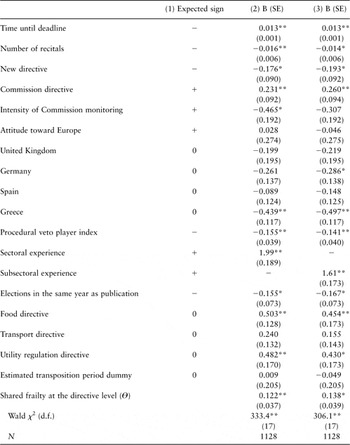
The results of the survival analysis are presented in Table 1. The first column presents the sign of expected relationships. The results for the model, including the sectoral experience indicator, are presented in column two. The next column reports the results for an alternative specification using the subsectoral experience indicator (column three). This indicator does not improve the empirical fit of the equation. Moreover, the coefficient for subsectoral experience suggests a weaker impact on the likelihood of finishing a transposition process or hazard. An increase of experience with 0.1 increases the likelihood of transposition with 22% for the sectoral experience indicator and 17% for the subsectoral indicator.Footnote 18 One should note that the dummy variable for the proposed estimating method for missing values on the transposition period is not significant. This indicates that the method does not systematically under- or over-estimate these periods.
Results based on Cox regression for normalization duration in weeks

Regression using the Efron method for ties. ** and * indicate significance at 1% or 5% level, respectively.
Most covariates related to the features of directives are significant and have the expected effect. The number of recitals as an indicator of the directive’s complexity affects the likelihood of transposition negatively, as expected. This result replicates the findings of Kaeding (Reference Kaeding2006) and suggests that more complex directives require a longer preparatory period. Furthermore, the dummy variable indicating whether the directive is new or modifies previous legislation has, as expected, a negative sign. New directives are expected to be ‘more difficult’ than modifying directives, an effect that is supported by our data. In our analysis, the transposition of a new directive decreases the likelihood of transposition by 16%. Whether directives are adopted by the Commission, as part of a comitology procedure, or by the Council (consultation) and sometimes the European Parliament (cooperation or codecision), also has the expected impact. These directives are transposed faster – the likelihood of transposition increases by 26% – as shown by the positive and significant coefficient. This result replicates the findings of earlier studies on the Netherlands (Mastenbroek, Reference Mastenbroek2003) and Italy (Borghetto et al., Reference Borghetto, Franchino and Giannetti2006). The positive (reducing) impact of this covariate on the duration of transposition is now established for a much broader sample of countries.
Remarkably, the covariate indicating the time until deadline has a positive and not, as expected, negative effect. The effect of one week additional time allowed to transpose is an increase in the likelihood of transposition by 1.3%.Footnote 19 In other words, allocating more time to member states actually speeds up transposition. It should be recalled that this study measured the dependent variable in terms of normalized time, while the time until the deadline is expressed in weeks. If a directive provides member states with more time in weeks, the duration will be relatively shorter. This finding suggests that finishing transposition on time is easier if member states were granted a longer period until the deadline. The result contradicts earlier findings, which suggest that member states have substantial delays in transposition when directives grant them generous deadlines (Mastenbroek, Reference Mastenbroek2003; Kaeding, Reference Kaeding2006).
Another finding is that the intensity of Commission monitoring indeed helps to explain transposition performance, but in another way than expected. The coefficient of this covariate has a negative sign indicating that more monitoring leads to a slowing down of transposition. This unexpected effect may reflect the fact that most directives in the database originated in the 1990s and have faced a fairly constant level of intensity of Commission monitoring. Furthermore, this study focused on directives that were published between 1978 and 2002. It is possible that recent increases in the intensity of Commission monitoring are not reflected in the data set.
The national level covariates do not contribute much to the explanation of transposition performance. The covariate indicating the attitude toward Europe is insignificant. Furthermore, the country-dummies, which were included to measure any effect of nationwide factors in comparison with the Netherlands, are not significant for the UK, Spain, and Germany.Footnote 20 Only Greece’s dummy is significant, suggesting that the likelihood of timely transposition is 36% lower in Greece than in the other countries included in the study.Footnote 21
The relevant policy-specific covariates have a significant impact on the time needed to transpose a directive. The procedural veto player index, as well as the sectoral experience indicator, is significant and has the predicted sign. A unit increase in the procedural veto player index reduces the likelihood of transposition by about 14%. A 0.1-unit increase in the sectoral experience indicator increases, as discussed before, this likelihood by 22%. Elections have a negative (delaying) impact on the likelihood of transposition. If elections are held in the first year of a transposition process, it reduces the likelihood of finishing the work by 14%. These findings are in accordance with expectations. Moreover, they support a process-specific approach to transposition, since these indicators are related to the way in which directives are handled in the domestic political and administrative arena.
Some of the dummy variables related to policy fields are significant as well (compared to directives in the field of social policy).Footnote 22 Directives on food and utility regulation have approximately a 65% higher likelihood of completion than the social policy directives. This variation between policy areas indicates that the study here has not yet identified all factors relevant to the explanation of transposition duration. What one may say with confidence, however, is that these as yet unidentified factors must be related to the specific features of a policy field. These may include differences between national ministries in dealing with transposition and rulemaking or between policy sectors that cut across national boundaries. Moreover, the relatively small variation between food and utility regulation directives suggests that it is not the general features of these policies that are relevant for transposition duration as much as it is the similarities and differences in the political and administrative context in which transposition takes place. This finding suggests that further work is needed to fully account for why member state performance differs with regard to the implementation of the acquis communautaire.
Variations in veto player indices
An important element in this analysis is the construction of a procedural veto player index, which accounts for the procedural stages involved in approving legal instruments associated with the transposition of a directive. As indicated, these instruments include ministerial orders, government decrees and, occasionally, parliamentary acts. In this section, a further assessment is made of the importance of a procedural index by comparing it with some alternatives, including the index proposed by Tsebelis (Reference Tsebelis2005).
In measuring the various obstacles to drafting and approving a national transposing measure, a number of different specifications are possible. A first possibility is to use dummy variables for measures adopted by the government (such as government or presidential decrees, Verordnung or Algemene Maatregel van Bestuur) or an individual minister (ministerial orders or decisions, Orden or statutory instruments). Dummy variables that have a value of one, if a government decree or a ministerial order is used, are expected to reflect a shorter period of time than the preparation of a legislative act. Lawmaking involves more veto players than the making of a government decree, while the making of a government decree involves more veto players than the making of a ministerial order. The main drawback of dummy variables is that they do not account for the number of different players at each of the stages in the decision-making process.
A second option, which is used more frequently (Giuliani, Reference Giuliani2003; Mbaye, Reference Mbaye2001, Reference Mbaye2003; Börzel et al., Reference Börzel, Hofmann and Sprungk2004), takes the number of legislative veto players, an approach inspired by Tsebelis (Reference Tsebelis2005). This index is designed to assess the differences in legislative decision-making in various countries. It is not designed to reflect the occurrence of political or administrative veto players in the preparation of various public measures, especially non-parliamentary decisions such as government decrees and ministerial orders.
A third option is to design, as this paper does, a procedural veto player index, which measures the number of veto players depending on the process of transposition. The index counts the number of players at each relevant stage of this process: the preparations of a measure by one or more ministries (which is sufficient for the adoption of a ministerial order), decision-making within the cabinet (which, together with the first stage, is sufficient for the adoption of a government decree), and decision-making within parliament (which is necessary for the adoption of a bill). Depending on the kind of instrument used or needed to transpose, the index reflects the number of players involved at each stage of the process.
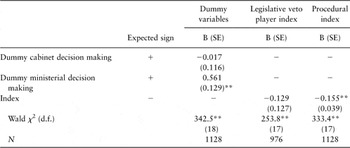
The model used in this study was applied to each of the proposed measurements of procedure and veto players, with results presented in Table 1 (column 2). The results are summarized in Table 2 without the estimates of the ‘other’ covariates.
Different measurements of procedure and veto players: estimates for the model with sectoral experience

Differences in the number of observations are due to missing values on the veto player index.
Note: The other covariates are not included in this table. ** and * indicate significance at 1% or 5% level, respectively.
The empirical results show that only one of the procedural dummy variables is significant. A procedure in which a minister may finalize transposition is significantly shorter than the other procedures. It leads to an increase in the likelihood of transposition by 75%. In the case of cabinet decision-making, however, no significant impact is found that differs from a parliamentary process. This could be a consequence of the fact that in most European countries the political parties in the government also have a majority in parliament. Whether a proposal is discussed in the cabinet or parliament does not change transposition duration since a conflict between these parties delays both cabinet and parliamentary decision-making.
The legislative veto player index, proposed by Tsebelis, is not significant. This puzzling finding, in our view, is related to the fact that this index is not suitable for explaining the amount of time needed for transposition. Legislative veto players have hardly any bearing on ministerial decision-making. The index therefore overestimates the importance of these players. The procedural index, which accounts for this problem, is significant and has the expected sign. The more the players, as measured by these indices, are involved in transposition, the more the time that is needed.
Conclusions
Research on the transposition of European directives is steadily increasing as a part of a broader research agenda on the impact of the EU on its member states. Studying how European laws are processed, adapted, and implemented at the domestic level provides fine-grained insights useful for scholars of different stripes. Transposition shows how European laws become caught up in national political processes and conflicts. It reveals the extent to which member states are likely to swiftly (and faithfully) implement European legislation. And it suggests the ways in which ‘Europe’, as expressed in European law becoming ‘law in action’, is likely to touch upon the daily lives of citizens.
However, research on transposition is also entering a formative period. With the benefits on offer from quantitative data, scholars are conducting analysis and testing a myriad of variables. At the moment, such testing shows equivocal findings and uncertain outcomes. Explanatory variables tend to be crudely stipulated and operationalized in ways that apply to the wrong government processes. If this field is to progress in line with accurate, generalizable findings, and to do so in a way that allows for the accumulation of knowledge, more accurate conceptualizations of transpositions are required, as well as the application of more relevant variables.
This paper took a modest step in that direction, with hopes of helping to structure this burgeoning field of study. We noted the problems facing existing research findings, and attributed them to the tendency to treat transposition as a process that takes place in the ‘regular’ legislative process. We argued that research on transposition must begin with the assumption that transposition takes place in a particular context, one more akin to ‘executive’ branch processes in which individual ministers and administrative actors play major roles. Those processes are influenced by conflicts and negotiations that took place at the European level, but also display their own configuration of actors with different interests, degrees of experience, and proclivities toward conflict.
To capture this essential dynamic, which we described in terms of actor-based conflicts within narrow governmental settings, we constructed a procedural veto player index. That index measures the number of veto players based on the particular transposition process used. Applying that index to our data set of about 1100 cases, the results show a significant and predicted positive relationship: the higher the number of procedural veto players, the longer the transposition process. Other variables tested also show intriguing results. The measure of a particular administrative unit’s rulemaking experience in relation to each directive performed particularly well in explaining the amount of time that EU member states require to transpose directives. The negative relationship holds as well: the more experience a particular administrative unit has in transposing directives, the shorter the transposition time.
The analysis also showed that the likelihood of transposition increases with modifying directives, directives that are issued by the Commission, and politically less complex directives as measured by a limited number of recitals. These features are mostly associated with less adaptation required by the national policy sector, which suggests that the relationship between the European policy, as specified in a directive, and the national context in which this policy needs to be implemented still is a relevant factor. Although earlier research seems to suggest otherwise, policy mismatch is an important explanatory factor next to factors related to the domestic policy process in which transposition takes place.
Our approach, based on a conceptualization of transposition as a process managed within a particular political-administrative setting, shows promise and should encourage more subtle and well-specified explanations for transposition problems. Scholars working in the field of transposition, and the broader field of implementation, are prone to generalizations regarding the key actors within national administrations. Much of our collective attention in the field of transposition goes toward parliamentary actors and prime ministers, for instance, when it is more likely the case that lower-level actors working within particular, formative settings are the real ‘players’ in transposition. Features such as the likelihood of conflict and experience with transposition shape the ability of these decision-makers to incorporate a directive as swiftly as possible into the national legal order. Moreover, transposition is sometimes solely decided in an administrative context, due to generous clauses in existing national law delegating political authority to administrative actors. This paper confirms previous findings that individual units deep within ministries often determine the process of transposition (see, for instance, the cases described in the studies of Mastenbroek, Reference Mastenbroek2007; Kaeding, Reference Kaeding2007; Berglund, Reference Berglund2009).
This perspective should give pause for thought as to the appropriateness of one widely used approach to explaining transposition: veto player theory (Tsebelis, Reference Tsebelis2002). As we identified in this paper, the concept of a ‘player’ is not always clear. When applying veto player theory to settings other than legislative decision-making, the ‘institutional’ players typically used in legislative veto player indices should be changed to ‘factual’ players (Héritier et al., Reference Héritier, Kerwer, Knill, Lehmkuhl, Teutsch and Douillet2001). Furthermore, the influence of different players in a transposition process varies considerably. To identify these players, one should focus on the ‘real’ distribution of power and not so much on power distributions as inferred from formal structures and rules, even though this requires obtaining additional empirical information regarding the actual power distributions. The findings in this paper are therefore consistent with those that show the importance of informal rules in shaping the distribution of power in legislative processes (Farrell and Héritier, Reference Farrell and Héritier2003, Reference Farrell and Héritier2004).
The veto player approach should also be reconsidered in the light of the fact that not all players with power accurately represent a ‘veto’. Veto power theory assumes that power is equally distributed across players as they aim for consensus in making a decision. In a context in which administrative actors, as well as interest groups, participate, consensus seeking among all the identified actors may not be a reasonable assumption. If power is unevenly distributed, one may have to ‘weight’ these differences, which can be represented by different decision-making rights. This, too, requires additional study of how different types of players may affect the outcomes of decision-making, including decision-making for transposition.
As the field of transposition studies grows toward adolescence (if not maturity), it is crucial for scholars to assess the gains made in recent years and to evaluate the state of the field. In this paper, we offered a review of the most prevalent findings within the field, and questioned why those findings are so often inconsistent. We proposed a more nuanced way to conceptualize transposition, and demonstrated a series of techniques for refining independent variables to capture that nuance. We questioned traditional approaches that appear to be inhibiting understanding in this growing field. By so doing, we hope to spur scholars toward more refined studies that benefit not just transposition studies, but also the field of implementation analysis more broadly.
Acknowledgments
The data used in this paper were collected as part of four PhD projects associated with the ‘Analyzing European Policies: The Transposition of Directives’ program (see http://www.transposition.leidenuniv.nl/). We are tremendously grateful for the work of Ieva Gange (food policy), Marleen Romeijn (social policy), Michael Kaeding (transport policy), and Sara Berglund (utilities regulation). We are also appreciative of the research assistance of Rutger Hagen, and for the constructive comments of Christine Arnold, David Lowery, Dimiter Toshkov, and the referees of this journal. Finally, we wish to thank the members of the research group associated with the ‘Analyzing European Policies: The Transposition of Directives’ program (including Kees van Kersbergen, Frans van Waarden, Antoaneta Dimitrova, and Markus Haverland) and the participants of the 2005 conference on ‘Progress and problems in building a European legal order’ in Luxembourg and the 2005 conference of the Netherlands Institute of Government in Nijmegen for their valuable comments and suggestions.