Introduction
Under-five mortality (U5M), defined as the number of children per 1000 live births dying before their fifth birthday (aged 0–59 months), has remained unacceptably high in most developing countries. Although the global under-five mortality rate fell to 38 deaths per 1000 live births in 2019 from 93 in 1990 and 76 in 2000, the average in low-income countries, including Nigeria, was 68 deaths per 1000 live births in 2019 as against 69 in 2017 (UN IGME, 2020). Globally, almost half of all under-five deaths recorded in 2019 took place in Nigeria, India, Pakistan the Democratic Republic of the Congo and Ethiopia, with Nigeria and India accounting for almost a third of these deaths (UN IGME, 2020). Despite the progress in reducing under-five mortality in recent years, under-five deaths remain high in Nigeria, being the sixth highest in the world and second highest in Africa (UN, 2019). In 2018, the U5M rate of 132 deaths per 1000 live births implies that more than 1 in every 8 children in Nigeria dies before the age of five (NPC & ICF International, 2019). There was a decline from 213 deaths per 1000 live births in 1990 to 132 deaths per 1000 live births in 2018 (NPC & ICF International, 2019). This slow pace of decline can be attributed to poor progress in child survival interventions (Akinyemi et al., Reference Akinyemi, Bamgboye and Ayeni2015), possibly including exposure to household air pollution due to inefficient cooking practices such as the use of solid biomass fuel, which is more affordable than non-solid cooking fuel (WHO, 2018).
Globally, around 3 billion people cook with polluting open fires fuelled by biomass, including wood, animal dung, crop waste and coal, and most of these people are poor and live in low- and middle-income countries (LMICs) (WHO, 2018). Consequently, 3.8 million people die prematurely annually from illness attributable to the household air pollution caused by inefficient cooking practices using solid fuels. Exposure to household air pollution almost doubles the risk of childhood pneumonia and is considered to be a contributory factor in most pneumonia deaths in children less than 5 years old (WHO, 2018). In Nigeria, the percentage of households using solid cooking fuels is high (79%), with 61% using wood. This includes 87% of households in rural areas and 47.7% in urban areas (NPC & ICF International, 2019). The use of some solid fuels has been shown to be associated with indoor air pollution, unsafe levels of toxic air pollutants and mortality in both adults and children (Ezzati & Kammen, Reference Ezzati and Kammen2001; Zelikoff et al., Reference Zelikoff, Chen, Cohen and Schlesinger2002). Children are more susceptible to housing air pollution than adults since they spend most of their time indoors and their organs are not fully developed (Wargocki & Wyon, Reference Wargocki and Wyon2013; Thabethe et al., Reference Thabethe, Engelbrecht, Wright and Oosthuizen2014). As a result, children from households where solid fuels are the main sources of cooking amenities are more likely to experience acute respiratory infections (ARIs) (Rana et al., Reference Rana, Uddin, Peltier and Oulhote2019).
Poverty and children’s health outcomes are connected in diverse ways. Children from less-privileged households are more exposed to air pollution and poor sanitation, which are risk factors for under-five mortality (Adepoju et al., Reference Adepoju, Akanni and Falusi2012; UNICEF, 2015). Poverty is negatively associated with child health (Lampert & Kuntz, Reference Lampert and Kuntz2019), and without doubt, exposure to household air pollution from inefficient cooking practices using solid fuels as a result of poverty harms children’s health. Children living in poverty are more likely to experience respiratory health problems (Jans et al., Reference Jans, Johansson and Nilsson2018). They are exposed to harmful emissions from biomass smoke at home, which significantly increases the risk for acute lower respiratory tract infections, upper respiratory tract infections, asthma and pneumonia (Bassani et al., Reference Bassani, Jha, Dhingra and Kumar2010; Khan et al., Reference Khan, Islam, Islam and Rahman2017; WHO, 2019). Most under-five child deaths from ARIs are closely associated with environmental factors, such as the use of solid cooking fuels (WHO & UNICEF, 2017; Ullah et al., Reference Ullah, Mridha, Arnold, Matias, Khan and Siddiqui2019). The avoidance of use of solid fuels, such as wood stoves, has been recommended to reduce the risk of ARIs in under-five children (Noonan et al., Reference Noonan, Semmens, Ware, Smith, Boyer and Erdei2020).
The association between household cooking fuels and the health outcome of under-five children in Nigeria has been well studied. Samuel et al. (Reference Samuel, Oni, Samir, Wurzer and Akinyemi2018) looked at the effects of solid cooking fuels using binary logistic regression; Adesanya et al. (Reference Adesanya, Darboe, Rojas, Abiodun and Beogo2017) examined the contributory factors to regional inequalities in ARIs symptoms among under-five children, and Adebowale et al. (Reference Adebowale, Morakinyo and Ana2017) investigated household materials as predictors of under-five death using 2013 Nigeria DHS data. However, to the authors’ knowledge, no previous studies have examined the roles of neighbourhood poverty and the use of solid cooking fuels within the house on U5M in Nigeria. Nigeria is one of the five countries with the largest populations living in extreme poverty and home to about 23% of the world’s poor (United Nations, 2020), and poverty plays a major role in the choice of solid cooking fuels, exposing under-five children to harmful emissions in the home.
Neighbourhood poverty, is simply described as the percentage of households living in the poorest wealth index quintile and is usually associated with lack of basic needs and the use of solid cooking fuels (Vandemoortele, Reference Vandemoortele2000; Rustein & Kiersten, Reference Rustein and Kiersten2004), directly impacting people’s health (Nand, Reference Nandy, Irving, Gordon, Subramanian and Smith2005). This study examined the roles of neighbourhood poverty and the use of solid cooking fuels on under-five mortality using the latest NDHS data using Cox proportional regression analyses. The effects of neighbourhood poverty and use of solid cooking fuels on U5M are important to understand the consequences of residential segregation and the distribution of health outcomes, especially among children. The findings should help develop policies towards aimed at reducing poverty, and attaining universal access to affordable, reliable, sustainable and modern energy in Nigeria, as well as reducing U5M in the country.
Theoretical framework
The study adopted socio-ecological models to examine the roles of neighbourhood poverty and use of solid cooking fuels on U5M. The models consider individuals as being embedded within larger social systems and describe the interactive characteristics of individuals and environments that underlie health outcomes (Stokols, Reference Stokols1992; Sallis et al., Reference Sallis, Owen, Fisher, Glanz, Rimer and Viswanath2008). Ecological models specific to health promotion are multifaceted, targeting environmental, behavioural and social policy changes that help individuals make healthy choices in their daily lives (McLeroy, Reference McLeroy, Bibeau, Steckler and Glanz1988). They are unique in the study of the risk of death by taking into account the physical environment and its relationship to people at intrapersonal, interpersonal, organizational, community and public policy levels. Socio-ecological models have offered promising results in preventing many public health problems (Breslow, Reference Breslow1996; Stokols, Reference Stokols1996). In line with socio-ecological models, Stokols observed that the social, physical and cultural aspects of an environment have a cumulative effect on health (Stokols, Reference Stokols1992, Reference Stokols1996). He maintained that the environment itself is multilayered since institutions and neighbourhoods are embedded in larger social and economic structures; and that the environmental context might influence the health of individual people differently, depending on their unique beliefs and practices. As a result, creating sustainable health improvements is most effective when all of these factors are targeted simultaneously. It is, therefore, hypothesized that areas of high neighbourhood poverty influence the use of solid cooking fuels, which invariably influence children’s health outcomes.
Methods
Data source
The study was conducted in Nigeria and data were obtained from the birth re-code data file of the 2018 Nigeria Demographic and Health Survey (NDHS). This is a cross-sectional study and the sixth survey of its kind to be implemented by the National Population Commission (NPC) in Nigeria. The 2018 survey is the latest in the periodic Demographic and Health Survey (DHS) series, which started in Nigeria at the national level in 1990 and conducted in 1999, 2003, 2008, 2013 and 2018. The 2006 National Population and Housing Census of the Federal Republic of Nigeria (NPHC), conducted by have been were published for 774 Local Government Areas (LGAs). A combination of information from cartographic material demarcating each EA and the LGA population estimates from the census was used to identify a list of EAs, estimate the number of households and distinguish EAs as urban or rural for the survey sample frame.
The 2018 NDHS provides information on the background characteristics of women aged 15–49 years, men aged 15–59 years and children aged 0–5 years. Data were collected for socioeconomic, demographic and health indicators, as well as type of household cooking fuel, early childhood mortality and maternal mortality and maternal and child health. The 2018 NDHS used a stratified, two-stage cluster design, with enumeration areas (EAs) sampling units selected in the first stage. The second stage involved a complete listing of households in each of the 1400 selected EAs, resulting in a representative sample of 41,668 households. Data were generated from 41,821 women aged 15–49 and 13,311 men aged 15–59. A detailed report of the data collection methods and procedures for 2018 NDHS has been published elsewhere (NPC & ICF International, 2019).
This study was child-based, using data from the birth re-code file of the 2018 NDHS covering live births born to women during the period 2013 to 2018. It included a weighted sample of 124,442 births that occurred within 5 years of the 2018 survey (i.e. after the 2013 NDHS) to improve the representativeness of the data from the group of women interviewed in the survey. Women whose births histories were included in the sample were those of childbearing age (15–49 years) and who reported giving birth to at least one child between 2013 and 2018, irrespective of socioeconomic and demographic background. Only women who reported using cooking fuels in kitchens located within their house were included in the analysis.
Outcome variable
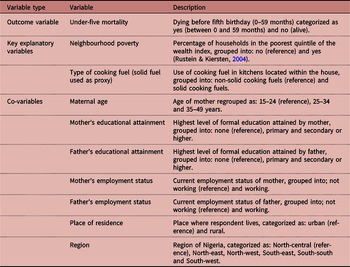
The study outcome variable was under-five mortality, defined as the risk of a live-born child dying between birth and their fifth birthday (0–59 months). This was measured as the duration of survival since birth in months. Survival time was the age at death, while children who were alive by the survey date were censored at their age.
Explanatory variables
The key explanatory variables were neighbourhood poverty and use of solid cooking fuel. Neighbourhood poverty was measured as the percentage of households in the poorest wealth index quintile (Rustein & Kiersten, Reference Rustein and Kiersten2004). Solid fuel included coal/lignite, charcoal, wood, straw/shrubs/grass, agricultural crops and animal dung; non-solid fuels were considered to be electricity, gas and kerosene. The use of solid fuels for cooking was used as a proxy because exposure to smoke within the home, rather than in a separate building or outdoors, from cooking with solid fuels has potentially harmful health effects (Samuel et al., Reference Samuel, Oni, Samir, Wurzer and Akinyemi2018; NPC & ICF International, 2019). Apart from the key explanatory variables, he following co-variables were included in the analyses: maternal age, mother’s educational attainment, father’s educational attainment, mother’s employment status, father’s employment status, place of residence and region. To make interpretations simpler and more meaningful, some variables were re-grouped from their original categories in the datasets. For instance, age: 15–24/25–34/35+ years; and educational attainment: no education/primary/secondary or tertiary (see Table 1). The choice and selection of key explanatory variables and co-variables were informed by their documented significant association with mortality and other related potential health implications.
Summary of variables and their categories

The reference category was the most common category for each variable.
Statistical analysis
Three levels of analysis (univariate, bivariate and multivariate) were employed. Pearson’s chi-squared test was used at the bivariate level to investigate the relationship between the outcome variable (under-five mortality) and each of the key explanatory variables and co-variables. At the multivariate level, Cox proportional regression analysis was used to examine the risk of under-five mortality. This is a useful analytical technique for the analysis of survival data. At the multivariate level, three models were fitted in all. Model 1 presents the univariate hazard ratio (HR) showing the relationship between under-five mortality and the key explanatory variables, as well as co-variables. Model 2 considered the adjusted HR for the effect of the two key explanatory variables. Model 3 adjusted for all the selected key explanatory and co-variables. The results are presented as HR with 95% confidence intervals (CIs). A variable with an HR greater than 1.00 implies that the variable increases the likelihood of the outcome (under-five mortality), while the opposite is the case when the HR is less than 1.00. All the analyses were conducted using Stata software (version 14).
Results
Percentage distribution of variables in study sample
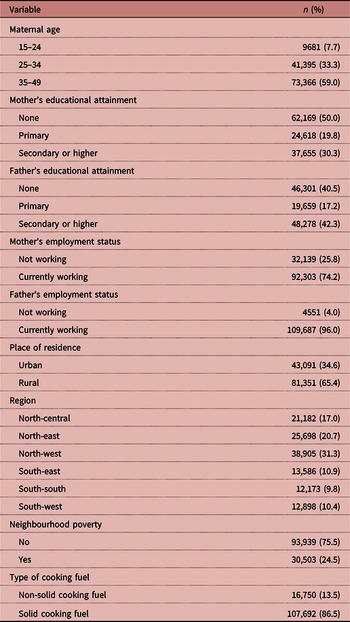
The percentage distributions of the socio-demographic and ecological factors among the study sample are presented in Table 2. The largest proportion of children (59.0%) were those of mothers aged 35–49. Mothers with no formal education had the largest number of children (50.0%), while 42.3% were children of mothers whose partners had secondary or tertiary education. Over two-thirds of children (74.2%) had mothers who were currently working. An overwhelming majority of the children (96.0%) were born of mothers whose partners reported currently working. The mothers who were rural residents had the majority of children (65.4%) in the sample. Also, the largest proportion of children (31.3%) and the lowest proportion of children (9.8%) were children of mothers in the North-west and South-south regions, respectively. With respect to the key explanatory variables, about 25% of the children had mothers from areas of high neighbourhood poverty, and over two-thirds (86.5%) had mothers who reported using solid fuels for cooking within the house.
Distribution of study sample by socioeconomic, demographic and ecological variables, NDHS 2018

Socioeconomic and demographic factors associated with under-five mortality
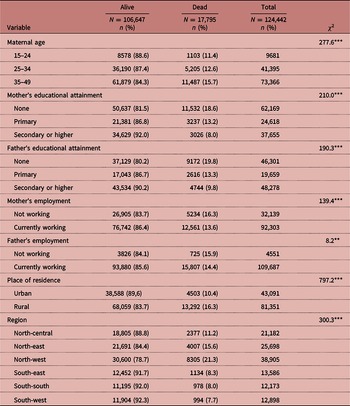
The bivariate relationship between under-five deaths and selected socioeconomic and demographic variables is presented in Table 3. All the variables were found to be significantly associated with under-five mortality. The highest percentage of under-five deaths was observed among the children of mothers aged 35–49 (15.7%) and lowest among the children of those aged 15–24 (11.4%; p<0.001). As expected, the highest percentage of under-five deaths was reported among children of mothers with no formal education (18.6%; p<0.001), as well as the children of mothers whose partners had no formal education (19.8%; p<0.001). More under-five deaths occurred among the children of mothers who were not working (16.2%; p<0.001); whose partners were not working (15.9%; p<0.01); and who were rural residents (16.3%; p<0.001). Under-five deaths among mothers ranged from 15.6% in the North-east to 7.7% in the South-west.
Under-five deaths by socioeconomic and demographic factors, NDHS 2018

**p<0.01; ***p<0.001.
Socio-ecological factors associated with under-five mortality
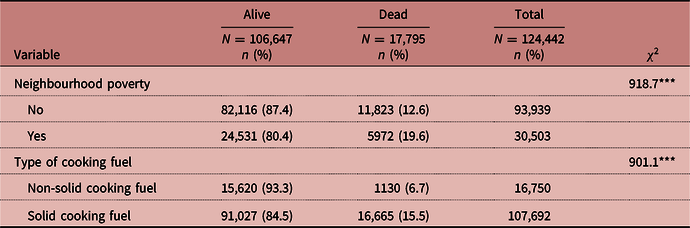
Table 4 presents the bivariate relationship between U5M and socio-ecological factors (key explanatory variables). Both key explanatory variables were significantly associated with U5M. The relationship between neighbourhood poverty and U5M showed that a higher percentage of under-five deaths occurred among mothers residing in areas of high neighbourhood poverty (19.6%; p<0.001). The percentage of under-five deaths was higher among the children of mothers living in houses where solid fuels were used for cooking within the house (15.5%), relative to their counterparts in households where non-solid fuels were used (6.7%; p<0.001).
Under-five deaths by socio-ecological factors, NDHS 2018

***p<0.001.
Risk factors of under-five mortality: survival analysis
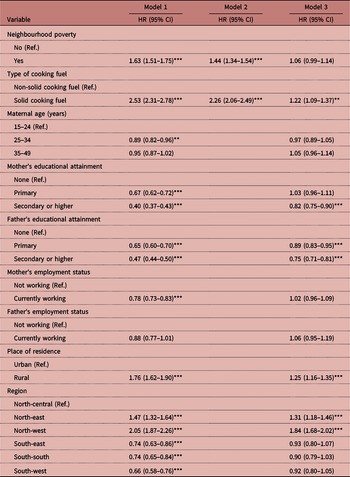
The results of the survival analysis are presented in Table 5. In all, three models were fitted to examine the risk factors of under-five mortality. Model 1 presents the unadjusted HR showing the relationship between under-five mortality and the two key explanatory and selected co-variables. Model 2 considered the adjusted HR for the effect of the two key explanatory variables. Model 3 adjusted for all the selected key explanatory and co-variables.
Hazard ratios (HR) and 95% confidence intervals (CI) for socio-ecological and demographic factors associated with U5M, NDHS 2018

**p<0.01; ***p<0.001; Ref.=reference category.
The results of the unadjusted hazard model (Model 1; Table 5) showed a significant relationship between the risk of U5M and all variables. Regarding socio-ecological factors, the risk of under-five death was increased significantly for children whose mothers resided in areas of high neighbourhood poverty (HR: 1.63, CI: 1.51–1.75) and children of mothers who used solid fuels for cooking within their house (HR: 2.53, CI: 2.31–2.78), compared with their counterparts in the reference categories. Considering socio-economic and demographic factors, the risk of under-five death was significantly reduced for the children of mothers aged 25–34 years (HR: 0.89, CI: 0.82–0.96), those whose partners had at least primary education and those who were currently working (HR: 0.78, CI: 0.73–0.83), relative to those in the reference categories. The results of Model 1 further showed that the risk of under-five death was significantly increased for the children of mothers who were rural residents (HR: 1.76, CI: 1.62–1.90) and those who lived in the North-east (HR: 1.47, CI: 1.32–1.64) and North-west (HR: 2.05, CI: 1.87–2.26) regions, relative to those in the reference categories. However, the risk of death was significantly reduced for children of mothers from the South-east, South-south and South-west.
The adjusted HR for the two socio-ecological factors in Model 2 (Table 5) showed similar results to those observed in Model 1. The risk of under-five death increased significantly for the children whose mothers resided in areas of high neighbourhood poverty (HR: 1.44, CI: 1.34–1.54) and the children of mothers who used solid fuels for cooking within the house (HR: 2.26, CI: 2.06–2.49), compared with their counterparts in the reference categories. After adjusting for the socioeconomic and demographic variables in Model 3, the results revealed a significantly higher risk of death for the children of mothers who used solid fuels for cooking within the house (HR: 1.22, CI: 1.09–1.37), relative to those in the reference category. The results in Model 3 further showed that the risk of death reduced significantly for children whose mothers had secondary or tertiary education (HR: 0.82, CI: 0.75–0.90) and children whose mothers had partners with at least primary education. On the other hand, the risk of under-five death was higher among the children of mothers residing in rural areas (HR: 1.25, CI: 1.16–1.35), as well as the children of mothers living in the North-east (HR: 1.31, CI: 1.18–1.46) and North-west (HR: 1.84, CI: 1.68–2.02) regions, compared with those in the reference categories.
Discussion
It is well documented that poverty and household air pollution affect the health outcomes of individuals. This study examined the socio-ecological determinants of under-five mortality in Nigeria with a special focus on the roles of neighbourhood poverty and the use of solid cooking fuels. In line with the observations of previous studies in Nigeria, the results established that residing in areas of high neighbourhood poverty, and using solid cooking fuels within the house, are risk factors for under-five mortality in Nigeria (Pamuk et al., Reference Pamuk, Fuchs and Lutz2011; Mesike & Mojekwu, Reference Mesike and Mojekwu2012; Ezeh et al., Reference Ezeh, Agho, Dibley, Hall and Page2014). The reason for this could be that members of poor households are generally exposed to high levels of air pollution, which increase the risk of respiratory problems in children (Adesanya et al., Reference Adesanya, Darboe, Rojas, Abiodun and Beogo2017).
About a quarter of the study children were born to mothers residing in areas of high neighbourhood poverty, and the overwhelming majority (86.5%) had mothers who used solid fuels for cooking within the house. The bivariate results showed that coming from areas of high neighbourhood poverty and using solid cooking fuels within the house were significantly associated with U5M. These results have some policy implications in line with SDG targets of attaining universal access to affordable, reliable, sustainable and modern energy, as well as reducing under-five deaths by less than 25 per 1000 live births in Nigeria. Interventions aimed at improving under-five children’s health outcomes should take into account the roles of neighbourhood poverty and the use of solid cooking fuels within the house.
The findings from the Cox proportional regression analyses revealed that the risk of under-five death was significantly higher among the children whose mothers resided in areas of high neighbourhood poverty than those of mothers in low neighbourhood poverty areas. This finding corroborates that of previous studies – that living in poverty is negatively associated with child health (Jans et al., Reference Jans, Johansson and Nilsson2018; Lampert & Kuntz, Reference Lampert and Kuntz2019). Furthermore, it gives credence to other studies showing that children from less-privileged households are more vulnerable to poor sanitation and household air pollution, which are risk factors for diverse childhood diseases (Adepoju et al., Reference Adepoju, Akanni and Falusi2012; UNICEF, 2015). Also, the study showed that the children of mothers who used solid fuels for cooking within the house were at greater risk of U5M. This validates previous studies, which found that most under-five deaths are closely associated with environmental factors, including the use of solid fuels for cooking within the house (WHO & UNICEF, 2017; Ullah, Reference Ullah, Mridha, Arnold, Matias, Khan and Siddiqui2019). A major cause of under-five deaths is acute respiratory illness, and this is closely associated with environmental factors, including the use of solid fuels for cooking (Khan, Reference Khan, Islam, Islam and Rahman2017; WHO & UNICEF, 2017; Ullah, Reference Ullah, Mridha, Arnold, Matias, Khan and Siddiqui2019; WHO, 2019).
After adjusting for all the selected socioeconomic and demographic factors, mother’s education, father’s education, place of residence and region were found to be significantly associated with the risk of under-five death. For instance, having parents with formal education significantly reduced the risk of under-five death, and this has been validated by previous studies (Ezeh et al., Reference Ezeh, Agho, Dibley, Hall and Page2014; Chowdhury et al., Reference Chowdhury, Khan, Rafiqul, Perera, Shumack and Kader2016; Salim et al., Reference Salim, Pintu and Pradip2019). Also, children living in homes using solid fuels for cooking have previously been shown to be at a greater risk of acute respiratory illnesses (Deng et al., Reference Deng, Deng, Lu, Li and Norbäck2018; Norbäck et al., Reference Norbäck, Lu, Wang, Zhang, Li, Zhao and Huang2018). Plausibly, the choice of household cooking fuel in a household could be determined by the level of education of the mother and father. Thus, parental level of education contribute to U5M through their knowledge of the harmful effects of solid cooking fuel, and education level in Nigeria is intrinsically linked to poverty.
The findings of the influence of rural residence on the risk of under-five death were as expected. Poverty in rural households in Nigeria could make it impossible for most rural dwellers to afford non-solid cooking fuels. It is evident that most households in rural Nigeria do not have the means to afford non-solid cooking fuel, and hence resort to using of solid fuels, which are abundant in rural areas. This has policy implications, as there is a need for more pragmatic strategies towards eradicating poverty among rural dwellers, as well as achieving universal access to affordable, reliable, sustainable and modern energy to improve under-five health outcomes in Nigeria. Previous studies have attributed the higher risk of under-five death in rural areas of Nigeria to exposure to air pollution associated with cooking and heating with solid fuel within the house in these areas (Ettarh & Kimani, Reference Ettarh and Kimani2012) and health challenges, including ARIs (Adesanya et al., Reference Adesanya, Darboe, Rojas, Abiodun and Beogo2017).
There were regional variations in the risk of U5M in Nigeria, with the children of mothers from the North-east and North-west regions perhaps suffering more from neighbourhood poverty and being more likely to use solid fuels for cooking. The rates of under-five death in the North-west and North-east (187 and 134 deaths per 1000 live births, respectively) were higher than in the country at large (NPC & ICF International, 2019). This is an indication that mothers suffering more from neighbourhood poverty are more likely to use solid fuels for cooking, and this could be a contributory factor to the higher risk of U5M in the North-east and North-west than their counterparts in other regions in the country.
In conclusion, the number of deaths among under-five children remains a problem in Nigeria, and its under-five mortality rate is estimated to be the highest in Africa. This study established that the risk of U5M is significantly linked to high neighbourhood poverty and use of solid cooking fuels in the house in Nigeria. Also, mother’s education, father’s education, place of residence and region were significantly associated with the risk of under-five death. The use of solid cooking fuels in the house might be greater in areas of high neighbourhood poverty, and be linked to other socio-demographic factors. There is the need to empower and re-sensitize women, especially disadvantaged ones in areas of high neighbourhood poverty, to adopt the use of clean fuels for cooking to improve the health of their children. Women, particularly more disadvantaged, uneducated women from rural areas and northern regions, should be taught the possible link between air pollution from the use of solid cooking fuels and adverse child health outcomes. This should be done in local languages. Government and non-governmental organizations should initiate mitigation and adaptation strategies to empower mothers and discourage them from using solid cooking fuels within the house to reduce harmful emissions and their child health consequences.
The study has its limitations. Use of cross-sectional DHS data meant cause–effect relationships could not be determined, and the explanatory variables were only temporal factors associated with child survival. Also, because the women self-reported information, there was a likelihood of reporting bias on neighbourhood poverty and type of cooking fuel used within the house. Despite these limitations, the findings of this study are important to formulating current policies and programmes for reducing U5M by ending poverty in all its forms, and attaining universal access to affordable, reliable, sustainable and clean cooking energy in Nigeria.
Acknowledgments
The authors are grateful to ICF International for making DHS datasets publicly available that made this study possible.
Funding
This research received no specific grant from any funding agency, commercial entity or not-for-profit organization.
Conflicts of Interest
The authors have no conflicts of interest to declare.
Ethical Approval
This study utilized a secondary dataset with all personally identifiable information removed. Hence, confidentiality and anonymity are guaranteed. The survey protocol was reviewed and approved by the National Health Research Ethics Committee of Nigeria (NHREC) and the ICF Institutional Review Board (NPC & ICF International, 2019). This study was part of a larger study, for which permission to download and use the NDHS data was obtained from Measure DHS/ICF International, USA. Therefore, no further ethics approval was required. The NDHS 2018 birth recode (BR) dataset was used for this study and is freely available from the DHS Program archive at https://www.dhsprogram.com/data/dataset.
Author Contributions
ICK: conceptualization and design of the study; access and use of the dataset, literature review, statistical analyses and interpretations, drafting of the manuscript, revision for intellectual input, read and approval of the final manuscript. NDW participated in the revision for important intellectual input. Both authors read and approved the final manuscript.