For several years now, historians of mathematics have discussed the effects of historical writing on the representation of mathematics as a discipline. They have emphasized the fruitfulness of bridges established with history of science and history in general, which have contributed to strengthen local (as opposed to universal) aspects of mathematical knowledge and the dynamics of the discipline (Corry Reference Corry2004; Ehrhardt Reference Ehrhardt2010; Gispert Reference Gispert2015, foreword). Recent historiographical trends have contributed to shift the focus from the development of mathematical knowledge towards its broader cultural and social place. How is mathematical knowledge socialized, especially thanks to its teaching? what kind of values does it embody? how much prestige does it enjoy and for whom? what kind of mathematical practices do different social groups develop, and how are they influenced by historical events? These have become legitimate questions for historians of mathematics and science, which have resulted in showing the stratification of the mathematical milieu in different countries and in single national contexts (see for instance Belhoste Reference Belhoste1998; Bottazini & Dahan Dalmedico Reference Bottazini and Dalmedico2001; Chabert and Gilain Reference Chabert, Gilain, Aubin and Goldstein2014).
In this paper, I aim at exploring further the French and English cases of the 1950s by focusing on specific sources which contribute to shape representations of mathematics – school textbooks. In doing so, I use textbooks as a strategic site for investigating mathematical conceptions in a given national context rather than for a study of classroom practices. Since the professional and personal profiles of textbooks authors are varied, these sources give indeed an access to the written productions of an extended mathematical milieu (Gispert Reference Gispert2015; D'Enfert Reference D'Enfert2012a). Moreover, textbooks are both reflections of on-going representations and active agents that contribute to (re)shape those representations. Far from being only an adaptation of conceptions held in the academic sphere, textbooks encapsulate and stabilize formulations that result from a process of book-making which confronts heterogeneous constraints and involves different professional communities (Radtka Reference Radtka2013, 303–364; Shapiro Reference Shapiro2012, Reference Shapiro2013). Once they come into being, they tend to materialize certain conceptions and to define what the subject they deal with should be for their readers. Mathematics textbooks thus contribute to building the discipline and to defining its identity – even though this textbook identity might be called into question by mathematicians working in the university. Because there is no reason to suppose textbooks held homogeneous conceptions of mathematics in a given context, they can be considered as sources susceptible to give an access to a plurality of representations. Following this idea, I investigate in this article potentially fluctuant identities of mathematics by focusing on textbooks issued at the end of the 1950s and at the beginning of the 1960s.
This moment witnessed in many countries numerous debates about mathematics and its teaching. Regarding the situation within academic research, it was in particular in France a period when competing conceptions of mathematics opposed each other. The development of computers and the work on discrete problems and coding theories opened new fields of research. Yet, it was difficult for practitioners working in these fields to be recognized as fully-fledged mathematicians as their activities greatly differed from the dominant Bourbakist approach (Petitgirard Reference Petigirard2004, 525–531; see also Dahan Dalmedico Reference Dahan Dalmedico2005). Regarding the situation within the educational sphere, it was a period of questioning in many countries. As Gispert and Schubring (Reference Gispert and Schubring2011) showed for the French and German cases, debates which then took place cannot only be understood from within mathematics education or even within the school system. They have to be related to changing social and cultural values as well as to changing epistemological conceptions of mathematics.Footnote 1 The comparative approach undertaken in this paper is hence a means to take into account such diverse parameters and to identify specificities in the discourses about mathematics and mathematics teaching.
In the 1950s, France and England shared some common features regarding mathematics teaching, and in both cases, a competitive textbook market existed. In order to be able to conduct a relatively detailed analysis of the numerous textbooks published at the time, I have chosen to focus on textbooks that had been published for the growing audience of 11- to 15-year-old children, and more specifically, for the most ordinary (that is those who were not part of a recognized élite) of these youngsters. This age-range constituted then an inescapable issue for mathematicians, politicians, education administrators and educators: more and more children pursued their studies at a post-elementary level and thus called into question the institutional organization of the schooling system, the teaching methods, and the aims of education. The first section of this article sets the terms of late 1950s debates on mathematics teaching and describes the context in which mathematics textbooks for 11- to 15-year olds were published. This section is more than a stage setting as the educational context was part of the dynamics, along with publishing practices and scientific considerations, which determined the textbooks contents. It also underpins the analysis of textbooks which forms the second section of the article.
1. Mathematics Teaching in a Period of Intense Changes and Debates: Post-War Transformations of Education and Mathematics
After World War II, an international reform movement in mathematics education was re-launched through the work of the International Commission on Mathematics Instruction (ICMI).Footnote 2 The ICMI started an international study motivated by the idea that mathematics teaching was linked to the social role of mathematics and mathematicians. Based on the gathering of national investigations dealing with Germany, Austria, France, the Netherlands, Italy, and the United States, a report was presented by Georg Kupera at the 1954 international congress of mathematicians in Amsterdam (Kupera Reference Kupera1955).
Overall it emphasized the influence of the war years on the evolution of mathematics and their social embedding: growing numbers of mathematicians (which included engineers) worked in fields as diverse as structures, logic, optimization, calculators, numerical analysis, statistics, and computer science.Footnote 3 They were pictured as key players in the industrialized society. Such a situation required a change in teaching methods and in the subjects taught, during a period when “education and the cultural and scientific effort become massive” (Kupera Reference Kupera1955, 108). It justified the implication of mathematicians in debates regarding mathematics teaching. Since the report prepared for the international congress of Amsterdam dealt with mathematics teaching for 16- to 21-year-old youngsters, the situation also required further investigation of the state of mathematics teaching, by looking at the situation of children under 15 years old (ICMI 1955, 263). A phenomenon of generalization of education, especially at a secondary level, was indeed underway in many countries. Together with changes within mathematics and their social embedding, this phenomenon shaped international and national debates regarding mathematics teaching.
1.1. Expanding audiences of 11- to 15-year-old children and their accommodation in France and England
Since the end of the war, the preparation of an important institutional reform had dominated debates regarding education in France: between 1947 and 1959, when a reform named after the minister of Education Jean Berthoin actually took place, 14 reform projects had been worked out. All planned to widen the access to secondary education. However the growth of the number of pupils engaged in post-elementary education had not awaited actual reform (Chapoulie Reference Chapoulie2010). Long-term trends show that more and more pupils pursued their education in one of the different types of schools which were, at the time, accommodating 11-to 15-year-old children.
The educational system was then still organized according to the principles put forward by the Third Republic. It distinguished pupils according to their social origins, their expected professional and social destinies, and their results in schools. Autonomous and parallel courses of study, theoretically independent from each other, catered for, on the one hand, pupils of the people and, on the other hand, pupils of the social élite. The first stream was called the “primary” order: it included elementary and more advanced education. Post-elementary education was delivered in écoles primaires supérieures, cours complémentaires, and specifically for teachers-to-be in écoles normales and écoles normales supérieures of Saint-Cloud and Fontenay. The second stream was called the “secondary” order: pupils received elementary education in “small classes” of collèges and lycées, and could continue their studies in these types of schools until the Baccalauréat, the exam which opened the path towards University. Post-Baccalauréat education was also included within this order with the preparatory forms to competitive exams for national higher schools, such as notably the École normale supérieure (located at rue d'Ulm in Paris) which trained future lycées “professors.” Thus, progressively, an entirely separated system had developed and assured that primary schools pupils were taught by teachers having a similar educational (and social) background to theirs, and that secondary schools pupils were taught by professors having received secondary and higher education (Lelièvre Reference Lelièvre1990; Prost Reference Prost2004, 232–236; Caspard, Luc, and Savoie Reference Caspard, Luc and Savoie2005, intro.).
The system that still accommodated children at the end of the 1950s had been thought of as a system that would reproduce the social order. However, over the years and more remarkably since the interwar-period, reforms and children schooling paths have progressively undermined the strong theoretical separation between the “primary” and the “secondary” orders,Footnote 4 known as the “educational duality.” After World War II, growing pressure on the schooling system caused by the rise in population of children also prompted the question of the 11- to 15-age group of pupils and its teachers as a major issue. In order to designate the different types of schools that accommodated 11- to 15-year-old pupils, I use the phrase “middle-school level.” By the use of this category, I follow recent historiography which helps to focus on an age-group representing high stakes for educational reforms in the late 1950s.Footnote 5
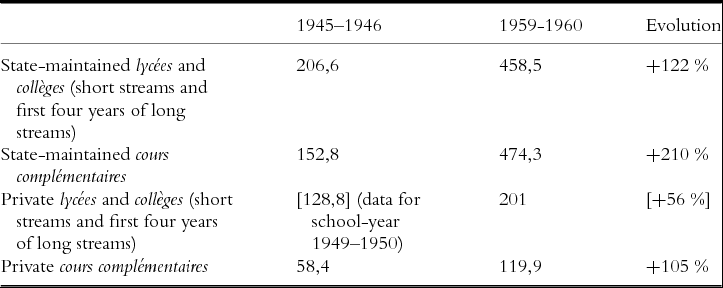
At this stage, children in France were accommodated according to their social origins and their expected academic and professional futures. An important percentage of children who were not expected to study beyond the compulsory school age went to “Classes de fin d’études” and were trained by primary school teachers.Footnote 6 Others were incorporated in schools where they would be able to receive post-compulsory education. Among them, an important percentage of children attended cours complémentaires Footnote 7 and short courses in lycées and collèges where they stayed up to the age of fifteen. They were expected to access intermediary jobs or to pursue technical or vocational studies. Other children, who would sit the Baccalauréat, attended long courses in lycées and collèges up to 18. Thus, at the middle school level, children (and their teachers) could belong either to the primary order (classes de fin d’études and cours complémentaires) or to the secondary order (short and long streams of collèges and lycées). While the increase in pupils’ population was general, the cours complémentaires were actually the streams which knew the stronger increase in numbers during the 1950s (Table 1). At the start of the school year 1959–60, there were more pupils accommodated in the first year of cours complémentaires than in the first year of collèges and lycées (including collèges modernes which were the heirs of the écoles primaires supérieures Footnote 8 ) (Chapoulie Reference Chapoulie2010, 418; Prost Reference Prost2004, 268).
Evolution of the number of pupils accommodated at the middle-school level in France, 1945–1960 (thousands of pupils).

Adapted from Prost (Reference Prost2004, 268) and d'Enfert & Kahn (Reference D'Enfert and Kahn2010, 9).
The difference between the orders was not only an administrative one; it was also social and intellectual. Regarding the curricula, the aims, objectives and practices within both orders traditionally diverged. For science education, primary school teachers were often “bivalent,” which means that they had been trained in both mathematics and physics at a relatively advanced (even though non-university) level.Footnote 9 By contrast, university-educated teachers of the secondary order were specialized in one discipline. Even at a time when changes contributed to widening the teachers’ population of secondary schools and to slowly changing their practices and culture,Footnote 10 differences between the two orders were still noticeable in the late 1950s. Collèges and lycées education was traditionally a scholarly one, while cours complémentaires (and modern streams of collèges and lycées) inherited a much more practical approach of education.
What is more, children followed different syllabi according to their school. Regarding the sciences, those enrolled in cours complémentaires and in short modern streams of collèges and lycées were taught a two-year course of physical sciences in addition to the mathematics and natural sciences four-year courses. Pupils who attended long courses in lycées and collèges studied physical sciences only in the fifth year. Moreover, the curricula were still influenced by the “educational duality” inherited from the Third Republic. Regarding mathematics, it meant that for secondary and university-educated teachers and students, the subject would rather be abstract, theoretical, and deductive, while for primary teachers and students, it would be more concrete and practical (D'Enfert Reference D'Enfert2012c).
The question of accommodating a growing population of pupils was also central in England. As was the case in France, different paths and types of schools could accommodate children who had completed their elementary education. However, the repartition of children among these types of schools did not obey the same criteria as in France; the meanings of the terms “primary” and “secondary” were also different.
In England, thoughts and decisions regarding schooling, organization, and pedagogical practices had been prompted by the 1944 Education Act which had made secondary education compulsory and free up until children's fifteenth birthday. Thus an entire new kind of audience gained access to post-elementary schooling, defined as education after 11 years old and called “secondary” education: in 1955, more than 2 million pupils were provided with secondary education.Footnote 11 As no existing structures comparable to the French “primary” schools that provided post-elementary education were in place to accommodate this new audience, a new organization (as well as new schooling facilities) had to be built.Footnote 12 Debates, recommendations, and exam systems were strongly shaped by the idea that the system should respond to a great variety of needs, types of interests, and abilities. The stress put upon the diversity of situations the system was required to meet can be related to noticeable differences with the French case. First, while the social question was not absent from the English reflections, it was not put at the forefront of the arguments as it had been in France for decades. Second, the Ministry of Education had a lesser role in the organization of the system and Local Educational Authorities (LEAs) were in charge of defining the number and types of schools in their jurisdiction. Last, external examinations were prominent in the way one could think about children's paths and pupils’ inflow planning in the different types of schools.
In England, the social élite attended expensive (and sometimes renowned) “public schools,” but most children were accommodated in state-funded schools. For the latter, an exam taken at the end of primary education, the eleven-plus, served as a means to select and direct children to different types of schools. Even though the role of LEAs was essential for the organization of schooling, a “tripartite system” was promoted after the Second World War at a national level through reports, pamphlets, and public speeches given by ministers of education. This system distinguished grammar schools from technical schools and from secondary modern schools. It had been designed to mirror a vision of the repartition of intelligence and types of minds already expressed before the war (McCulloch Reference McCulloch and Aldrich2002, 36–41): the first two types of schools accommodated those who were believed to have, respectively, either an academic or a practical type of mind, while the latter type of school was supposed to cater to the rest of pupils.
In fact what has been called a “bipartite” system of grammar and modern schools by McCulloch (Reference McCulloch and Aldrich2002, 43) was put in place in many local areas. Indeed, secondary technical schools catered to fewer children than had been anticipated, and by 1961 they represented only three per cent of secondary schools. For their part, grammar schools represented by 1961 22 per cent of secondary schools (Price Reference Price1994, 155). As they notably opened the route towards university, grammar schools were the most prestigious type of schools. Secondary modern schools generally suffered from a lower consideration, but they accommodated the vast majority of the 11 to 15-age group. In 1955, there were 1,250 thousand pupils in secondary modern schools. Their number kept increasing over the years despite the problems the schools encountered, so that there were more than 1,500 thousand pupils accommodated in secondary modern schools in 1960 (Bédarida Reference Bédarida1990, 331).
According to McCulloch (Reference McCulloch1998, 77), it had become apparent during the 1950s that secondary modern schools mainly catered to working class pupils. However recommendations for teaching within these schools from the ministry of education and debates among teachers associations and educationists remained shaped by arguments of local needs and children's various interests and abilities. Such recommendations and debates were important in the English case as no national curriculum (as the one existing in France) determined the contents of teaching. It was even more the case for secondary modern schools as these newly-established schools were strongly encouraged to work out syllabuses on their own. Besides, contrary to grammar schools which took for models prestigious public schools and determined their syllabuses according to the preparation of external examinations such as the General Certificate of Education (GCE) Ordinary (O) and Advanced (A) levels, secondary modern schools were invited to free themselves from the preparation of external examinations.
A discrepancy existed between intentions and actual classroom practices. Independence regarding external examinations remained for a large part an instance of wishful thinking and teaching in secondary modern schools questioned the absence of recognized certification (Brooks Reference Brooks2008). Progressively, more and more secondary modern teachers engaged their pupils in the preparation of external examinations. At the end of the 1950s more than 15,000 candidates sitting the GCE O-levels came from secondary modern schools while the number of candidates sitting the four main non-GCE external examinations that could be passed below 16 years old (such as the ones delivered by the College of Preceptors or the Royal Society of Arts) grew up to 70 per cent (Brooks Reference Brooks2008). The question of mathematics teaching within this type of school was thus also shaped by the teachers’ opinions regarding the preparation of external examinations – a parameter that was not central in the French case.Footnote 13 However, despite the differences underlined in the current section, the English and French cases shared an important common feature: during the 1950s in both countries, mathematics teaching was considered as one (among others) means to achieve modernization.
1.2. Science and technology at the forefront of countries’ general and educational policies
Both in France and in England, as well as in other countries, science and technology were put at the forefront of policies during the 1950s and the 1960s. In Britain, important investments were dedicated to the construction of research laboratories (often in a military context), and the government encouraged the extension of higher education especially in science and technology (Edgerton Reference Edgerton1996, Reference Edgerton, Krige and Pestre1997, Reference Edgerton2005a, Reference Edgerton2005b). What is more, a strong relationship developed between science and national identity (Agar Reference Agar1996, 18–23). Within the field of education, reform movements were engaged in order to adapt training to new political, social and cultural demands. A strong emphasis was put on the grammar and public schools for which sponsors and agencies of reform in the 1950s advocated a replacement of the traditional classical training by a more scientific and technological one (McCulloch Reference McCulloch1988). Such an emphasis also permeated general recommendation for the secondary level, especially when it came to mathematics teaching. As the Minister of Education Geoffrey Lloyd stated in the foreword of a pamphlet issued by the Ministry of Education in 1958: “Our standard of living and our position in the world depend upon our ability to remain in the forefront of scientific advance, both pure and applied” (Ministry of Education (ME) 1958, iii).
For their part, the authors of this very pamphlet stressed the necessity of identifying future specialists and training children for their future occupation, in which mathematics were believed to play a key role.
In France, the 1950s and 1960s knew similar dynamics. Progressively, French industry and identity became entwined with science and technology. The trend resulted in some very well-known cases such as the links established between France and nuclear technology (Hecht Reference Hecht1998), as well as in a generally recognized role overtaken by the general De Gaulle regarding scientific research (Larcan Reference Larcan2003). Actually the stress put upon science and technology by politicians did not wait for De Gaulle to be in power: already in the 1950s close relationships had been established between scientists, entrepreneurs, state administrators, and politicians, especially around Pierre Mendès France (Chatriot and Duclert Reference Chatriot and Duclert2006). Organized in Caen in 1956 by those close to Mendès France, a colloquium exemplified how the wish to “do something for scientific research” resulted in the necessity to take into account the situation of “secondary education, academic structures, CNRS, medical reform” (Crémieux-Brilhac Reference Crémieux-Brilhac1995). As I have shown in my PhD thesis, the debates actually tackled education more generally as they included remarks and reflections on the “primary” order and on teaching contents and practices (Radtka Reference Radtka2013, 72–73).
The thought that reforming education was necessary to prepare citizens for modern society was an internationally widespread idea during these decades; it got reinforced with the 1957 launch of Sputnik. Especially in the United States, the event gave reformers more influence by raising the specter of an advantage of the Soviet Union on the Western world (Rudolph Reference Rudolph2002) and the history of mathematics teaching modernization became entwined with the history of the Cold War (Philipps Reference Phillips2015, 22-46). In Europe, mathematics teaching did not remain only a national issue. It was also taken over by organizations for European economic development implemented within the framework of the Marshall plan. The OEEC (Organisation for European Economic Cooperation), later renamed OECD (Organisation for Economic Cooperation and Development), became an important actor on the subject and promoted reform of the contents and methods of mathematics instruction for 12- to-19-year-olds (Gispert Reference Gispert, Coray, Furinghetti, Gispert, Hodgson and Schubring2003, Reference Gispert, D'Enfert and Kahn2010). It initiated meetings of experts in order to outline the general orientations of a modern program of mathematics teaching, the first of which took place in France, in Royaumont, in 1959.
Among the participants of these meetings, there were members of international mathematical organizations such as the ICMI and the International Commission for the Study and Improvement of Mathematics Teaching (CIEAEM) (the latter had been founded in 1952). These organizations held different reflections from the economic ones: during the 1950s, the ICMI focused on the societal dimensions of mathematics while the CIEAM was particularly interested in the psychological dimension of mathematics learning (Gispert Reference Gispert, D'Enfert and Kahn2010). However, through meetings and circulation of ideas and people, these different trends converged at the end of the 1950s. They influenced contemporaneous debates on mathematics teaching and progressively prompted the idea that modernization of mathematics teaching would take the form of implementation of “new math”Footnote 14 curricula (Gispert and Schubring Reference Gispert and Schubring2011). These international reflections were also mirrored at national levels, as prominent members of the international organizations were actors on the national stage, especially within teachers associations.
1.3. Reflections on the modernization of mathematics teaching in France and England
As in international debates, the emphasis on the societal and economic dimension of science met a reflection on the modernization of mathematics teaching in both England and France. In France, a major actor of this reflection was the association of mathematics teachers of public secondary schools, Association des professeurs de mathématiques de l'enseignement public (APMEP). In England, two different associations were key players in these debates, the Mathematical Association (MA) and Association for Teaching Aids in Mathematics (ATAM) which became in 1962 the Association of Teachers of Mathematics.
In both countries, debates were linked with the extension of the audience for post-elementary mathematics. What is more, the diversification of the audience and, especially the access to secondary education (in the English sense) gained by children who traditionally were leaving school early to enter the labor market, prompted debates regarding the kind of mathematics such children should study, even among bodies like the MA or the APMEP which traditionally took a low interest in such audiences.Footnote 15 Founded in 1897, the Mathematical Association (MA) was a recognized body.Footnote 16 It had been a long-standing partner for the Board of Education (and later the Ministry of Education) in the elaboration of recommendations regarding the curriculum (Price Reference Price1994, 153–158). In 1949, the MA published an interim report dealing with mathematics in secondary modern schools; it was followed by a more developed report ten years later (MA 1949, MA 1959). In-between its journal, the Mathematical Gazette, published some articles on works dealing with the subject conducted in local branches of the association. Through these reports and articles, the association fostered the idea that secondary modern schools required other mathematics than grammar schools. This alternative mathematics was pictured as rather “practical” than abstract or deductive, even though the meaning of the phrase “practical mathematics” was far from stable.
According to the different proposals, the label could be applied to works done in modeling or 3-D construction, as well as to works involving surveying, navigation, and technical drawing, or even to works using graphical or experimental approaches (Price Reference Price1994, 173–174). Moreover, in the English context, the phrase also established a link with a view advocated by the engineer and educational reformer John Perry (1850-1920) at the end of the nineteenth century. According to Perry, “practical mathematics,” which was part of engineers’ education, was also useful for pupils of elementary and secondary schools (Price Reference Price1981, 221-228). This particular background added to the diversity of meanings that could be attached to the notion.
Some of the most active teachers and educators within the MA on the question of mathematics for secondary modern (and primary) schools also promoted a shift of emphasis from mathematics teaching to its learning. This shift came along with a greater focus on the learning process and child psychology, as well as an interest towards the educational environment and teaching aids. After the Second World War, the interest in material aids for education (that is audio, visual, and tactile) was quite general. It contributed to the foundation of a new association, the Association for Teaching Aids in Mathematics (ATAM). The ATAM started its work under Caleb Gattegno's presidency, who was also the founder of the CIEAEM.
Gattegno was a cosmopolitan person with a very diverse academic itinerary. Born in Alexandria in 1911, he studied physics in France, earned a doctorate in mathematics in Switzerland, taught mathematics in Egypt. After World War II he settled in England where he trained mathematics teachers, worked at the London Institute of Education, and founded the Cuisenaire Company. He was also influenced by the Swiss philosopher and psychologist Jean Piaget and translated some of his works into English (Powell Reference Powell2007). Caled Gattegno published his first article in the Mathematical Gazette in 1947, and was then co-opted to the primary schools subcommittee of the MA in which he promoted the shift towards children's modes of thought and Piagetian ideas. Despite this work in collaboration with the MA, his views were very different from those usually promoted by the MA, and the foundation of the ATAM partly resulted from disagreements (Cooper Reference Cooper1985, 70).
The ATAM rapidly increased in size and its aims diversified. Initially focused on teaching aids, the young association also started to promote a renewal of the contents of mathematics teaching, which prompted divergences among its members (ibid., 78–83). The journal of the association, Mathematics Teaching, reflects these changes (Radtka Reference Radtka2013, 116–117). In articles dealing with mathematics teaching in primary and secondary modern schools and reports of working groups and conferences about the subject, a growing disagreement among ATAM members appears: while some educators remained over the years strong advocates of a non-preparation for external examination in order to design a curriculum based on children's centers of interests and skills, other teachers who actually taught in such schools defended their preparing pupils to sit external examinations.
Besides, these debates were soon overtaken by the shift of emphasis towards “new math” which dominated the 1960s. During the 1950s, some articles presented original teaching practices specifically designed for secondary modern school children (for instance Hodgkinson Reference Hodgkinson1958). From 1959 onwards, the journal included articles signed by prominent mathematicians and educators such as Gustave Choquet or Lucienne Félix (for instance, Choquet Reference Choquet1960), and soon enough Mathematics Teaching became a platform promoting “new math.” Debates over such suggestions did not completely disappear as the journal welcomed in its columns critiques and commentaries of other teachers who expressed their doubts, but the journal progressively promoted the idea that the best way to prepare children to modern society would be to study the same kind of mathematics whatever pupils’ abilities or needs, and that this mathematics would be “new math.”
In France, a similar progressive shift took place even though different mathematical traditions were still supported by the educational structures. As contents, methods, and aims of mathematics teaching were called into question in relation to the general emphasis put on science education and the growing population of pupils at the middle school level (D'Enfert Reference D'Enfert, Bjarnadóttir, Furinghetti, Matos and Schubring2012b; Gispert Reference Gispert2009; see also Gispert and Schubring Reference Gispert and Schubring2011), the role of the APMEP in this shift was important. The association was indeed, since the beginning of the 1950s, particularly committed to promoting a change in both teaching methods and mathematical contents aiming at introducing “modern mathematics” in secondary education (D'Enfert Reference D'Enfert, D'Enfert and Kahn2010, 120). Many of its active members were influenced by the works of the Bourbaki group and were convinced that mathematics that was taught in schools was no longer in line with mathematics that was practiced by mathematicians (D'Enfert Reference D'Enfert, D'Enfert and Kahn2010; Barbazo and Pombourcq Reference Barbazo and Pombourcq2010; Barbazo Reference Barbazo2010; Carsalade et al. Reference Carsalade, Goichot, Marmier, Barbin and Moyon2013). Reformers wanted to introduce the “spirit” of contemporaneous mathematics in schools and, in particular, modern algebra. For them, this introduction had to be understood as an encompassing project: even though it could be seen as a way to better prepare future students to university, the idea was to make pupils learn mathematics that were actually practiced by mathematicians. Such a project had consequences not only in the last stages of secondary education, but also at the middle school level and even in elementary schools. This objective went hand in hand with a renewal of teaching methods.
Ideas regarding the introduction of “new math” contents occasioned controversy among the members of the APMEP, and in other mathematical spheres, especially within the Inspection générale which, at the time, contributed to the writing of the syllabi (Legrand Reference Legrand and Rioux2002). The use of “active” pedagogical methods, and among them the introduction of mathematical notions through so-called “practical works” (travaux pratiques), was on the other hand quite consensual. Here, we can stress the fact that during the 1950s, “new math” promoters were not opposed to the use of concrete and material devices in mathematics teaching, quite the reverse. For them, “practical works” were considered to be a means to make children access, thanks to a concrete start, the “abstract essence” of mathematics. More generally, thanks to “active methods,” children would be put in situations in which they would solve problems and explore the mathematical world – that is work as mathematicians. Eventually, as “new math” contents would be introduced, the unity of mathematics would become apparent (D'Enfert Reference D'Enfert, D'Enfert and Kahn2010).Footnote 17
Actually, “active methods” were already applicable in mathematics teaching as they had been advocated during the interwar years. For the Inspecteur général Émile Blutel (1862–1945) for instance, such methods implied that pupils were encouraged to elaborate solutions to problems and exercises by themselves under the teacher's guidance. Be it in secondary or in primary schools, mathematics teaching should no longer be considered as the observation and reproduction by pupils of solutions first exposed by teachers, but it would imply experimentation and manipulation (D'Enfert Reference D'Enfert2015, 23).
Moreover, the phrase “practical works” also echoed the practical culture of primary school mathematics teachers. This culture was related to the objectives of primary schools: preparing pupils for the time when they leave schools as citizens and workers. In order to do so, mathematics was considered a tool for responding to everyday life and job requirements. As such, theoretical and abstract aspects were excluded and stress was put on calculating practices and solving problems. These problems were to be related to everyday life or working situations (such as commercial, industrial or agricultural situations), to usual operational practices, and should involve real (and not invented) data (such as prices, trains time tables, etc.) (Sarrazy Reference Sarrazy2003; D'Enfert Reference D'Enfert2015, 21–22).
Despite or maybe thanks to the diverse meanings of “practical works” and “active methods,” APMEP reformers influenced the official directives of the national curriculum published from 1957 onwards: mathematics syllabi included some “practical works” for pupils in collèges and lycées, as well as for pupils in cours complémentaires.Footnote 18 Listed among such works, one could find activities as diverse as the use of instruments (a ruler, a compass, a chronometer, or a surveyor's chain), astronomical observations, construction of fractions of geometrical shapes, or the listing of equivalent fractions. The influence of the APMEP was quite important, and after the Berthoin reform, in 1960, teachers of all the different sixième and cinquième forms (which became with the reform an “observation stage” (cycle d'observation)) were invited to model themselves on teachers who introduced “new math” contents to their pupils and to use “practical works” as a means to give access to the “abstract essence” of mathematics (D'Enfert Reference D'Enfert, D'Enfert and Kahn2010, 126–127).
However, the syllabi remained overall traditional, and former directives showed that the intentions behind the syllabi differed according to the type of schools, even when the contents looked similar. It was in particular the case for “practical works”: in January 1958, “practical works” were presented in collèges and lycées as “a means to bring, slowly but in greater numbers, our children towards the abstract essence of mathematics” (quoted by D'Enfert Reference D'Enfert2015, 462), but they had more practical objectives in cours complémentaires. In the latter case, they were a means to teach children how to use instruments (and through them understand the significance of order of magnitudes and margins of error), to link geometrical shapes with their representations, and to help pupils experimentally test mathematical proprieties.Footnote 19 Thus, in France, despite on-going changes that tended to bring mathematics teaching closer in the different types of schools and to progressively promote “new math” contents, the situation in the late 1950s was far from being stable and homogeneous: the “new math” reform that would completely rebuild mathematics teaching in France was still to come, and the plurality of meanings of key pedagogical notions as well as existing traditions left room to important variations.
As a result, in both France and England, while official directives stressed the need to expand the recruitment of scientists, engineers, and technicians in order to meet the challenges of the time and insisted upon the role of mathematics in this regard, the kind of mathematics that was actually to be taught remained subject to debate. Textbook publishing in the late 1950s and at the beginning of the 1960s can thus be seen not only as a mirror of contemporaneous practices, but also as a way for their authors to take part in this debate.
2. Late 1950s Mathematics Textbooks: A Window on a Plurality of Proposals within Each National Context
Within a period of turmoil or (re)definition of the boundaries and identity of a subject, studying textbooks that are actually published is particularly fruitful (Armatte Reference Armatte1991)Footnote 20 : textbooks have then to be seen not only as mirrors of on-going debates, but also as tools for their authors (and possibly, even though to a lesser extent, for their publishers) to promote their personal ideas regarding epistemological conceptions of the discipline. If homogeneity appears amongst textbooks during a period of intense debates, the results also invite readers to study the forces that tend to normalize textbook production.
In both France and England, textbook production was a liberal business in the 1950s: private publishing houses had the initiative of publication, and they advertised, through different means, their production to teachers. In France, textbooks had to follow the syllabi defined by the national curriculum, but the State did not control the books before their release. As a result, in both countries, several textbooks were in competition on a textbooks market.
Identifying these textbooks is not an easy task: it first requires defining what has to be considered as a proper textbook for the purpose of the studyFootnote 21 and to actually construct a corpus of textbooks. I have chosen to select only books that stated explicitly their didactical intentions (and thus I have excluded books that might have been used in classrooms whereas they had not been published as textbooks per se). The covers of such books usually indicate in which context (i.e., type of school, school year, or form) they should be used. They are also, most often, part of textbook series which usually establish equivalence between the school year and the book number in the series.
In order to identify textbooks series I have used different sources according to the national context. For the French case, my identification is based on the supplement “Rentrée des classes” of the Bibliographie de la France published by the Cercle de la Librairie for the years 1958 to 1961. This source consists of a compilation of publishers’ brochures which usually distinguished in the late 1950s textbooks for cours complémentaires (and later collèges d'enseignement général Footnote 22 ) on the one hand, and textbooks for collèges and lycées on the other hand. For the English case, I have used the Education Book Guide published by the National Book League for the years 1956 to 1964. The latter source organizes the textbooks’ production according to (among other criteria) their intended audience: I have chosen to follow its categories and to include textbooks published in previous years if their references were still given by the Guide for the years 1956 to 1964.
Besides, I have restricted the corpus to textbooks dedicated to the mass of 11- to 15-year-olds who were not part of an educational élite. This choice aims at focusing on the growing audience that accessed post-elementary education after World War II. As we shall see below, some textbooks did not mention specific audiences but encompassed an entire generation – in such cases they have been included in my study. Other books were explicitly and exclusively dedicated to the educational élite of pupils (books for grammar schools in the English case for instance); these have been excluded of the study.
As a result, I have identified:
-
(1) for the French case: 24 textbooks series published by 20 publishing houses;
-
(2) for the English case: 45 textbooks series published by 27 publishing houses.Footnote 23
The purpose of the study is to identify whether these competing textbooks tended to foster different or even antagonist conceptions of mathematics. Moreover, when heterogeneity occurred through the textbooks in each national context, my ambition was to characterize the different proposals. In order to do so, I have conducted an analysis which takes into account visual and material aspects of the books (the typography, layout, pictures types, etc.), together with the grammatical type of texts. In such an approach, I have considered books rather than texts, and followed methods put forward in book history, semiotics, and mathematics textbook analysis (Chartier Reference Chartier1989; Eco Reference Eco2010; Kress Reference Kress2009; Breakell Reference Breakell2001; Dowling Reference Dowling1996; Haggarty and Pepin Reference Haggarty and Pepin2002).Footnote 24
I have conducted the analysis on different scales and I have progressively restricted the number of textbooks to scope when getting closer to mathematical content:
-
(1) First, at a general level, I provide an overview of the different textbooks by focusing on all features (title, function, graphic displays) that appeared prominently on each book's front cover. Even though the cover of a book cannot be considered as a straightforward image of the book's contents (in particular because it is strongly determined by commercial arguments) it contributes to emphasizing some features of the subject. Thus it participates to the shaping of the subject's identity and has to be considered in a book analysis;
-
(2) Second, I bring to light different conceptions of mathematics expressed at the time by textbooks’ authors. For this purpose, I select some textbooks within the corpus and focus on forewords and addresses to the reader (which I call “paratexts”) in which authors alluded to on-going debates or explicitly discussed the kind of mathematics their books featured;
-
(3) Lastly, I give some details on the status attributed to practical approaches of mathematics by focusing on specific contents. As we have seen, the meaning that ought to be attributed to phrases as “practical works,” “concrete mathematics,” or “practical mathematics” was far from stable in the discourses. It is thus important to see how the diversity of meanings could be actually handled when it came to actual teaching media, such as textbooks.
Throughout the analysis, the methodology had to be adapted to publishing practices in each country. Thus the treatment of the English and French cases is not rigorously symmetrical.
2.1. Grasping a diversity of visions: using textbooks covers as indicators
In order to compete on the market for textbooks, publishers have developed various commercial strategies, notably by giving a clear identity to their production. This trend has led to the constitution of textbook series – that is several books which shared graphic rules and denomination and were usually (but not systematically) written by the same authors. Giving a title to a textbook series and clearly featuring the authors’ names on a cover constitute different ways to identify textbook series. As we shall see such publishing practices are not meaningless regarding the identity of the subject dealt with: titles can convey ideas regarding mathematics identity; authors’ names, especially when they are followed by authors’ functions or indications regarding their training, can refer to different traditions of mathematics teaching.
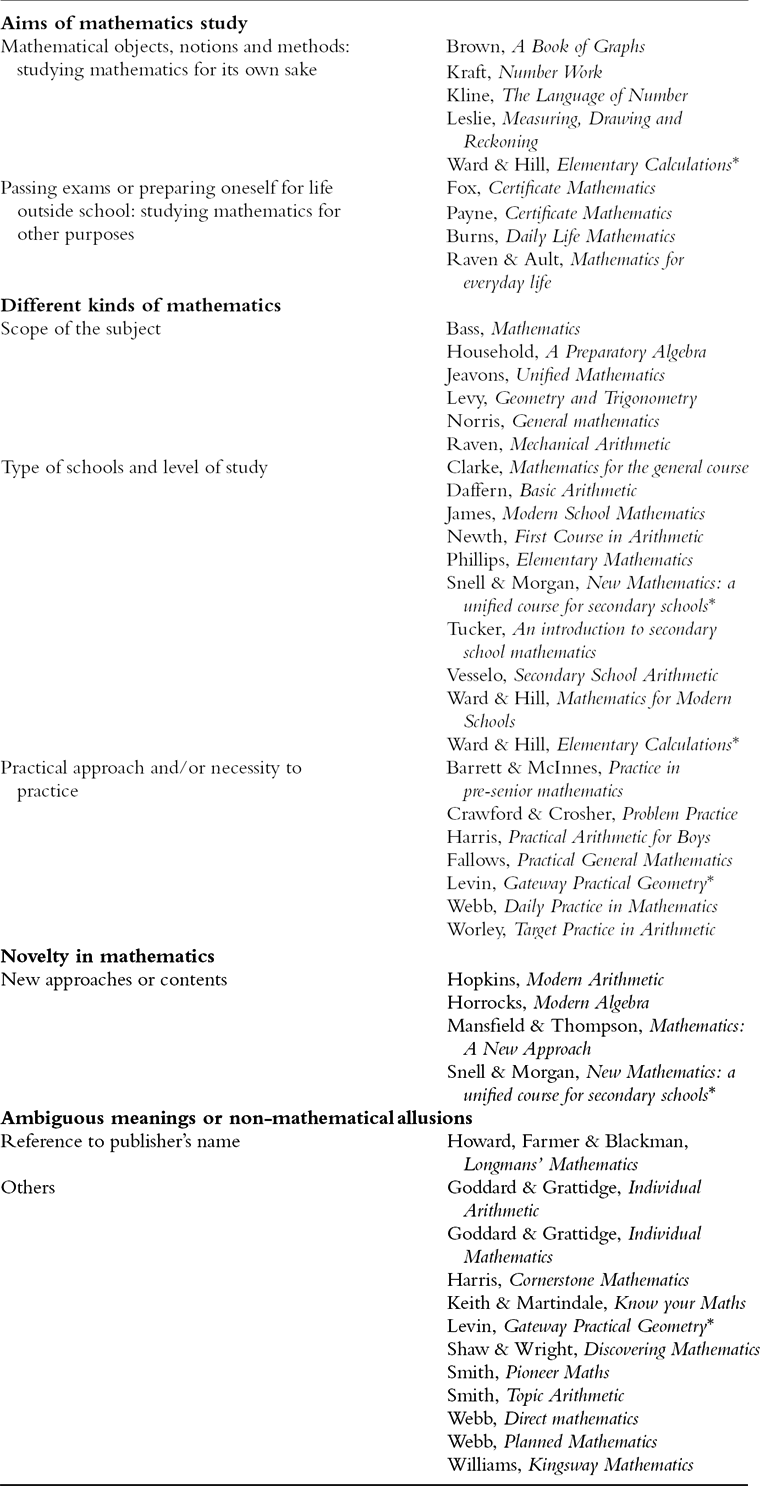
In the English case, publishers often gave an original name to the textbook series: in the late 1950s, less than a quarter of titles referred exclusively to the subject (that is, mathematics, or a subdivision of mathematics as geometry), possibly restricted or modified by the level or context of study. These types of titles apart, textbooks’ headings gave connotations to the subject, and slogans or catchphrases involving the term “mathematics” could express a specific sense regarding what was at stake in mathematics teaching at the time. In what follows, I propose a classification of titles given in the late 1950s. Different classifications can be made of these titles; mine distinguishes titles that alluded to the aims of mathematics learning, from titles that made reference to a certain kind or portion of mathematics, and from titles that made reference to modernity or novelty in the subject (see Table 2).
Categories driven from English late 1950s mathematics textbooks’ titles.

* Titles appearing twice in the table, showing the plurality of meanings that can be made from the titles given to textbooks series.
Why or for what reason should children study mathematics? Two opposite views regarding this question could be evoked simply through the title given to textbooks by their publishers. Giving the name of a mathematical object or notion to a textbook series, such as “A Book of Graphs” or “Measuring, Drawing and Reckoning,” tended to present mathematics as a specific world, inhabited by objects one might study or manipulate thanks to particular methods. In such cases, textbooks appeared as tools to study this particular world for its own sake. On the contrary, other choices regarding the titles could highlight the usefulness of mathematics: be it in order to pass examinations when “certificate mathematics” was featured or to be it “for everyday life,” mathematics appeared in these cases to serve other purposes.
Alongside titles referring to the question of purpose, most titles made actual reference to the type of mathematics children would study. I include within this category titles that made reference to the types of schools or the level of mathematics tackled by the textbooks, as well as those which stressed the “practical” aspect of mathematics. In doing so, I consider the word “practical” as a reference to on-going debates and existing traditions on the English scene rather than as an allusion to mathematics’ usefulness. I add to this group titles that emphasized the repeated practice the subject required when the word “practice” was used.
Another group of titles also emerges, which includes references to new approaches or contents of mathematics. Titles such as “modern algebra” or “new mathematics” clearly referred to debates regarding not only the use of modern pedagogical methods but also the very contents of the courses. In such cases, titles tended to position the textbooks’ authors in favor of the introduction of “new math” in schools.
Eventually more ambiguous titles are brought together: the category includes titles alluding to the publisher's name, as well as titles sounding like puns or slogans. Indeed if a title such as “Pioneer Maths” can evoke a novelty in mathematics, its meaning is far less straightforward than a simple phrase such as “New Mathematics” in the context of the late 1950s. For this reason, it cannot be added to the previous group. Similarly, even though a title such as “Individual Mathematics” can evoke a repeated practice, its meaning seems too uncertain in the context to count it among the titles referring to a certain kind of mathematics.
Such a classification of titles cannot be directly related to approaches and contents featured within the textbooks. However it provides an overview that indicates that, for English publishers of the time, playing with words in order to give an identity to their books could be a means to stress some characteristics of mathematics that were, in the given time, debatable. As this commercial practice could convey the promise of textbooks adapted to diverse approaches teachers could choose to follow in the classroom, it also resulted in picturing a situation remarkable for its diversity. Right away, the English situation escapes a uniform characterization, labeled “English,” of mathematics’ conceptions presented to an increasing number of children.
Besides, the comparison with the French situation indicates that publishing practices have consequences regarding the picture drawn at this general level. Indeed, in France, titles given to textbooks series obeyed a stricter norm: most covers indicated the subject (“mathematics” or a sub-subject such as “geometry” or “arithmetic”), and the form or type of school. They also often made a reference to the national curriculum or official instructions. For instance, a Mathématiques. Classe de 6e. Arrêté du 12 août 1957 by François Brachet and Jean-Auguste Dumarqué and a Mathématiques. Classe de 4e, lycées et collèges. Programme 1958 by Victor Lespinard and Roger Pernet were issued in 1958 respectively by the publisher Delagrave and by Desvigne. As a result, a more formal conception of the subject than in England, directly articulated to the organization of the educational system and to the national curriculum, was promoted. Thus despite a relatively important number of competing series, a more homogeneous conception of mathematics seemed to emerge in the French case compared to the English one.
For all that, French textbooks covers still reflected the complex institutional, epistemological and pedagogical situation of the late 1950s. Other precisions evoked indeed the different approaches and teaching traditions of the time as textbooks’ series were often identified thanks to the name of their authors or editors. Besides their identifying function, these names allowed the publishers to present some of the authors’ titles and professional functions. Because they referred to their training and professional origins, such mentions tended to indicate the authors’ position regarding the “educational duality” that still characterized the French system at the time and was to be related with different conceptions of mathematics: rather practical, concrete and experimental for teachers of the primary order and rather formal and deductive for those of the secondary order.
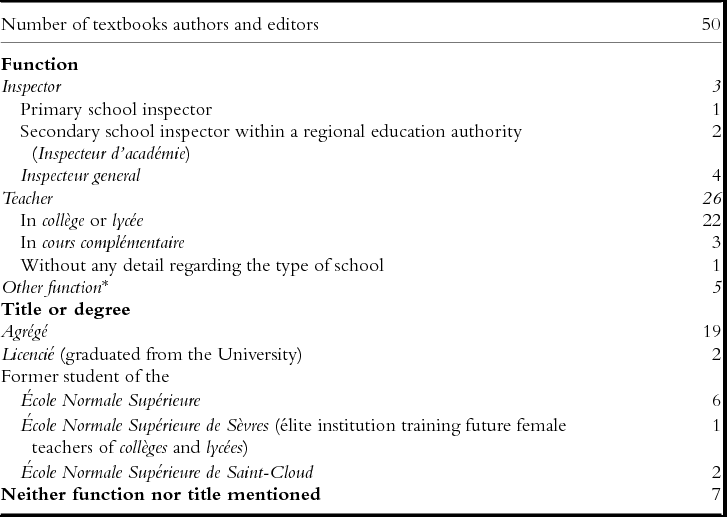
For instance, following the publication of the new version of mathematics syllabi, the publishing house Armand Colin published in 1958 the first volume of its new series entitled Cours de Mathématiques J. Marvillet after the name of its editor, Joseph Marvillet. He was presented as a former student of the École Normale Supérieure and a current teacher in Strasbourg Lycée Kléber. Another important publishing company, Nathan, also took the opportunity of the curriculum change to publish new versions of its long-standing series named Cours de mathématiques Lebossé et Hémery. Its two authors, Camille Lebossé and Constantin Hémery, were respectively identified as agrégé de mathématiques and teacher at Lycée Claude-Bernard (which implicitly meant in Paris) for the first one, and agrégé de mathématiques and teacher at Collège Lavoisier (also implicitly in Paris) for the second one. At the same time, Hachette published, under the name of one of its regular authors, a new textbook series: the Inspecteur général Roland Maillard, who had been an associated author of previous mathematics series since the 1940s, became the editor of the Cours R. Maillard written with other mathematics teachers. Considered all together, the authors’ and editors’ titles and functions of the different textbooks series indicated that the secondary tradition of mathematics teaching would be more widely present than the primary tradition: agrégés de mathématiques and lycées teachers dominated thus suggesting that the textbooks’ authors had mostly been trained at the University or in the École Normale Supérieure (see Table 3).
Titles and functions of French authors such as given by mathematics textbooks and publishers’ brochures.

* Other functions represented among the authors were school directors or administrators, as well as university professors or lecturers.
In this table, I separated functions from titles, whereas it was usual for a textbook author or editor to mention both aspects at the same time. The reader should keep in mind that I copy the titles and functions as they are presented on the cover pages of the textbooks. Such mentions result from an editorial choice and make invisible the complexity of some individual career paths.
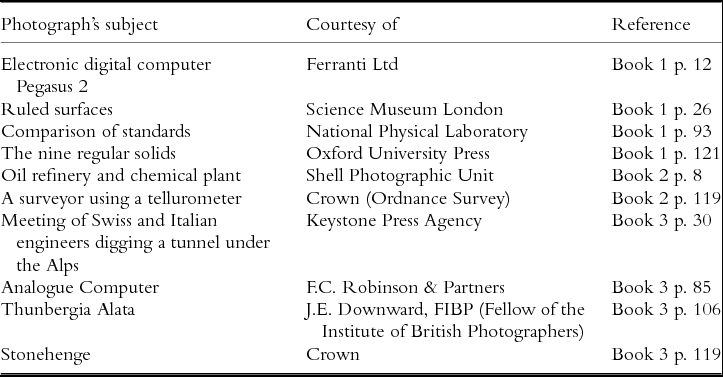
List of photographic plates in the Mathematics: A New Approach series.

Indeed, many of the authors of late 1950s textbooks obtained the Agrégation during the 1920s-1930s. They were of the same generation as the future founders of Bourbaki with whom some of them got acquainted at the École Normale Supérieure.Footnote 25 During the interwar years, the education that the latter received at the École Normale Supérieure consisted mainly of courses given at the Sorbonne. Many of the most famous mathematicians who then started a career felt that their teaching was not up-to-date (Andler Reference Andler and Sirinelli1994). Despite their disappointment, they received training and benefited from a certain freedom which allowed many of them to pursue and renew their mathematical research in the following years in logic and algebra (be they members of Bourbaki as Jean Dieudonné or Charles Ehresmann or not as Jacques Herbrand or Paul Dubreil),Footnote 26 but not in more practical branches of mathematics which were generally despised in this institution.Footnote 27 Other students of the École Normale Supérieure became lycées teachers according to the choice they could made at the end of their studies between teaching and research. Some of them pursued their career in the inspectorate. They conducted inspections of secondary schools either within a regional education authority when they were inspecteurs d'académie or on a national scale for those who joined the inspection générale. In the latter case, they also participated to the writing of official syllabi.
Some former students of the École Normale Supérieure and other laureates of the Agrégation also became editors or authors of textbook series which included volumes for 11- to 15-year olds accommodated in collèges and lycées. Their textbooks could also be aimed at pupils of cours complémentaires when titles did not specify any type of school besides the name of the form (as was for instance the case of the Collection Cossart et Théron named after its two editors Édouard Cossart and Pierre Théron who both were former students of the École Normale Supérieure Footnote 28 ) or when they explicitly targeted audiences belonging to both primary and secondary orders (as did for instance the Collection Paul Dubreil named after its editor who was then professor at the Faculty of Sciences in Paris and written by teachers who all were agrégés of mathematicsFootnote 29 ). Thus some series written by authors coming from the secondary order and its élite institutions presented undifferentiated books for students accommodated in all types of schools, and conveyed a unified conception of mathematics whatever their audience.
However, other textbook series suggested differentiating mathematics teaching according to the type of schools. In such cases, the series included five to six textbooks instead of four, which otherwise covered the four school-years at the middle-school levelFootnote 30 : this was the case for the series published by Bourrelier and written by Roger Duma and Gilbert Mallet (5 volumes), the above-mentioned Cours de Mathématiques J. Marvillet (5 volumes), the series La Classe de Mathématiques (6 volumes) published by Belin, the Cours Complet Lespinard & Pernet (6 volumes) published by Desvigne, and the Cours de mathématiques Lebossé et Hémery (6 volumes) published by Nathan.Footnote 31
These textbooks were written by authors of various pedagogical, scientific, and social backgrounds. Some were written by authors coming from the secondary order even though they distinguished in separate volumes the mathematics they presented according to their audiences: it was the case for the series published by Nathan and written by, as I have already mentioned, Camille Lebossé and Constantin Hémery who were both agrégé teachers in respectively a lycée and a collège, and for the Cours Complet Lespinard & Pernet, also written by two agrégés. The other series gave more important space to authors belonging to the primary order. Thus, while Roger Duma was an agrégé who had left teaching to become a school inspector, his co-author Gilbert Mallet was a cours complémentaires teacherFootnote 32 (who specified that he also had a university degree in science). Maurice Monge and Marcel Guinchan, authors of the series La Classe de Mathématiques, also formed a mixed team as the first one was a former student of the École normale supérieure and a lycée teacher while the second one taught in cours complémentaires. Regarding the Cours Marvillet, two authors belonged to the secondary order (Robert Girard and Lucette Chopard-Lallier who both were agrégés and taught in lycées), but the other two, Pierre-Marie Fournier and Alphonse Adam, belonged to the primary order as they were respectively head of a school of cours complémentaires and primary school inspector. For his part, even though it was not visible for the audience, the editor of the series Joseph Marvillet was an example of existing links between the primary and secondary orders. As I have mentioned above, he was presented on the books’ covers as a former student of the École normale supérieure and a lycée teacher, but he actually came from the primary order since he had been initially trained, after the First World War, to become a primary school teacher.Footnote 33
A primary-order background also characterized the authors of a textbook series which was the unique complete series entirely and specifically dedicated to cours complémentaires pupils after the release of the new mathematics syllabi in 1957. Published by Hachette and entitled Mathématiques avec travaux pratiques, this series was authored by Marcel Hémeret and Albert Lermusiaux who both were former students of the École Normale Supérieure de Saint-Cloud – that is the élite school of the primary order.Footnote 34 The situation was less clear for older series dedicated to this particular audience and still presented by the publishers in their brochures in the late 1950s, but for these series too, the authors’ backgrounds matched their audience to some extent.Footnote 35
All the complexity of individual career paths was not apparent to the textbooks’ readers. Nonetheless, when the publishers mentioned some of the titles and functions of their authors, they conveyed references to the dual structure of the French educational system and to the different mathematics teaching traditions that existed at the time. Such references also accounted for a possibly greater diversity of mathematics within French textbooks than the homogeneity of titles and the predominance of authors coming from the secondary order would have suggested. As a result, the necessity to identify different textbook series on a competing market also drew a picture of diversity when the whole of the books is considered. Thus, even though publishing practices were different in France and England, they displayed in both cases hints on the books’ covers which suggested diverse treatments of mathematics. Such hints invite to look more in-depth at some of the textbooks published in the late 1950s to see whether contemporary debates were explicitly addressed by the authors within their textbooks.
2.2. Identifying competing conceptions of mathematics and mathematics teaching: following the authors’ words
Both in France and England, many textbooks opened with forewords or addresses to the readers where, in this period of redefinition of curricula and debates on mathematics teaching, authors or editors could justify the choices they had made during the conception of their textbooks. In this section I focus on just a few books in each national context that were identified, thanks to their covers, as potentially different with regards to the kind of mathematics they presented.
For the French case, I have selected, because of the various backgrounds of their authors, the series edited by Paul Dubreil, Joseph Marvillet, and Roland Maillard as well as the series written by Albert Lermusiaux and Marcel Hémeret. All were published after the release of new syllabi for mathematics from 1957 onwards. For the English case, the analysis is restricted to series that announced, through their titles, potentially different approaches to mathematics teaching in secondary modern schools. I have selected the first series that was explicitly dedicated to this type of school, Modern School Mathematics written by Edward J. James and published in 1954–56, a series which later advocated the preparation of external examinations, Certificate Mathematics written by Ronald W. Fox and a series entitled Mathematics: A New Approach published by Chatto and Windus in the early 1960s. The span-time considered in the English case is thus longer than in the French case; it is a means to take into account the debates of the second part of the 1950s in a context where no official syllabi were issued for secondary schools.
In the French context, divergences in the identity of mathematics and the aims of mathematics teaching were most clearly stated when authors and editors commented on the “practical works” that were the pedagogical innovation of the recent official syllabi. For instance, the mathematician Paul Dubreil considered “practical works” to be a pedagogical means that favored actual practice in mathematics because it was opposed to lectures and permitted children's active involvement. Such a means was essential because, as he insisted in the foreword of the sixième textbook he edited, work in mathematics required constant practice, not only when it came to practical works, but in all its different areas:
I cannot recommend strongly enough to attach the greatest importance to the first part of this book, entitled – overly modestly to my mind – ‘calculation practice’. Other parts of the book show the importance and interest of practical works, more lively and efficient than ex cathedra teaching. In particular, some chapters are almost exclusively constituted by descriptions of practical works that ought to be really done by pupils.Footnote 36 (Dubreil Reference Dubreil1961, 5)
The authors of the Cours J. Marvillet insisted for their part on another aspect of practical works. They too made a reference to the importance of this pedagogical innovation and quoted an extract from the national curriculum, but they gave their own interpretation of the use in mathematics teaching of facts and events that were actually “practicable” or “observable”:
In no instance, should this attention towards the use of intuitive or experimental notions as starting points make one lose sight of the training of logical thought. . . . The purpose of practical exercises cannot be reduced to the intuitive discovery or to the verification of a property or a result. They shall aim at helping the pupil to progressively appreciate the necessity of rigor and the requirement of demonstration.Footnote 37 (Marvillet Reference Marvillet1958, foreword)
Such a distinctive identity of mathematics was also apparent in the forewords written by the authors of the Cours R. Maillard when they noticed that “practical works” were an opportunity to “take advantage of children's existing knowledge to acquire new knowledge and to rise from concrete situations to precise notions”Footnote 38 (Maillard Reference Maillard1958, 5). A similar idea, stressing the dynamics of elevation from the concrete to mathematical precision and abstraction is again stated in the next textbook, published the following year (Maillard Reference Maillard1959, 7).
By contrast, the former pupils of the École Normale Supérieure de Saint-Cloud, Albert Lermusiaux and Marcel Hémeret, succinctly commented in the syllabus by highlighting yet another aspect of practical works. Following the official directives they insisted on the need to include this approach within mathematics teaching, and stressed the importance of “experience and concrete reality.” They also brought to light a more organizational aspect of teaching in cours complémentaires when they recommended “the closest link between manual works and mathematics” and noticed that: “If the mathematics teacher is not in charge of manual works, teachers of both subjects should establish together the exercises of manual works”Footnote 39 (Hémeret & Lermusiaux Reference Hémeret and Lermusiaux1958, 2).
Manual works (travaux manuels) were an instance of technical teaching, which underwent at the time an important curriculum change, related to contemporary institutional evolutions (Lebeaume Reference Lebeaume, D'Enfert and Kahn2010). This short extract taken from Hémeret & Lermusiaux (Reference Hémeret and Lermusiaux1958) indicates that, while a specific profession was emerging for this subject, its teaching could remain in practice the responsibility of mathematics teachers, thus accounting for some closeness between mathematics and more physical and practical subjects. Such closeness also appeared in the suggestions made for some practical works for the sixième form in this book: for solid geometry, pupils were invited to use objects they had constructed during manual works to introduce the definitions of some mathematical solids. Thus, at least to a certain extent, mathematical notions and definitions would be constructed in continuity with the physical word, and concrete objects would appear adaptable to different viewpoints, rather than as mere starting points to introduce a distinct approach typical of mathematics as the forewords of the Cours J. Marvillet and Cours R. Maillard suggested.
Textbooks published for the next forms took these competing views further, as they also made diverse positions regarding the teaching of “modern mathematics” apparent. While Paul Dubreil suggestively noticed that the book for the troisième form he had edited showed the authors’ refusal to “tone down” (édulcorer) mathematics (Dubreil Reference Dubreil1963, 5), textbooks for the troisième forms of the Cours J. Marvillet were advertised in a more explicit manner. Among the main characteristics of the books, the publisher stressed in his catalogue the “exclusive use of deductive reasoning (except for solid geometry) and modern terminology,” as well as “the prudent introduction of the notion of set.” These indicated a commitment for the “new math” which was explicitly stated when the books were described as a means to “give lycée pupils a closer contact with the modern point of view which would only be studied in seconde form, and allow short-stream pupils not to leave school while ignoring the new orientation of mathematics” (Librairie Armand Colin 1961). The Cours R. Maillard, which shared with the Cours J. Marvillet a conception of mathematics as an abstract, logical, and deductive subject, insisted on the contrary on the novelty of the method rather than on the introduction of “new math” content: the entire series was advertised as a “proposal to renew the traditional manner both in the exposition of lessons and in the presentation of subjects for practical works and problems that would be of interest for the pupils as news topics” (Hachette 1960).
For its part, the series written by Albert Lermusiaux and Marcel Hémeret fostered yet another approach in the textbook for the quatrième form. The book included a long foreword in which the authors justified the approach they had followed in the previous books in response to critics who had pointed out a certain lack of rigor. Meanwhile, they stressed the importance they dedicated to demonstration and reasoning. They also presented their book as a response to dilemmas which were peculiar to mathematics teaching in cours complémentaires and highlighted the interest of an experimental approach in order to meet contradictory aims:
It must be acknowledged that traditional mathematics teaching was a bit too much intended for brilliant pupils, which is why it appeared as an uninterrupted succession of logical and rigorous deductions, with only a remote connection with everyday life. Yet most pupils of cours complémentaires will rapidly need useable mathematics. . . . However teaching in cours complémentaires should not handicap pupils who would study further, especially future students at teacher schools. To try to reconcile these very different priorities, new mathematics teaching dedicates a very great space to practical works; these are useful to make mathematics teaching less austere, more concrete while at the same time they give an opportunity to show children how useful mathematics is and how its applications have been developing.Footnote 40 (Hémeret & Lermusiaux Reference Hémeret and Lermusiaux1960, foreword; emphasis added)
All together, these different assumptions show that long-standing traditions in mathematics teaching and considerations regarding the children's academic paths were still put forward by textbooks authors in late 1950s France. As a result, while institutional dynamics and on-going debates fostered more and more the idea that mathematics teaching could be quite similar for different audiences at the middle-school level, these textbooks suggested to their users (both teachers and pupils) diverse approaches. For some, experimental approaches based on the manipulation and study of concrete objects and their physical properties would tend to be considered as a proper mathematical method. For others, such approaches would be mere pedagogical methods, which may be necessary regarding the pupils age but could not be typical of “true” mathematics. However, despite these important differences, all textbooks’ authors also mentioned the importance attributed to demonstration and reasoning, whatever the audience. This feature distinguished the French case from the English one.
As I already mentioned, in England no national curriculum defined compulsory contents that had to be taught in school in the late 1950s. Even more than other types of schools, secondary modern schools were invited to design their own syllabi, according to children's aims, needs, and identified aptitudes, but the preparation of external examinations progressively played an increasing role in these schools too. In such a context, textbooks were presented as tools to help in curriculum design. The first to explicitly and exclusively address secondary modern school pupils in its textbooks, Edward J. James, was a teacher at Redland Training College whose interest in the subject was recognized within the MA, since he joined the association's subcommittee on secondary modern schools the very same year he published the first textbook of his series (Price Reference Price1994, 177; James Reference James1954). In this textbook, Edward J. James added some notes intended for the teachers after the pupils’ contents. There, he expressed the issues faced by Secondary Modern School teachers in curriculum shaping, which justified for him an approach different from the ones followed in other schools: “Merely adding more material to an existing syllabus is not a suitable means of catering for the increased age-range of the pupils; nor is simplifying a Grammar school syllabus a method for satisfying the new status of the school. An entirely fresh approach is needed” (James Reference James1954, 133).
Having considered these challenges, he presented his course as aiming “to show mathematics in use and, at the same time, to introduce to children a wide range of mathematical ideas which they can understand and enjoy.” For him, the choice of the method was essential in order to allow children to understand and use mathematical notions and processes: “In Modern School Mathematics subjects such as algebra, geometry, trigonometry, etc., are introduced, but in each case the approach to the subject and the work done are both especially planned for Modern school pupils” (ibid.). James did not give his approach a name in this text; he rather insisted on the importance for children to “make up their own examples similar to those given in the book” and on the necessity to introduce mathematical ideas before using formal definitions and technical terms.
Eight years later, Ronald W. Fox, head of the Mathematics Department at Vincent County Secondary School, took a pragmatic stance. As he justified his textbooks’ specific organization by the preparation of external examinations, he highlighted what had become in-between an influential trend on the organization of schooling:
The increasing desire amongst Secondary School pupils to secure qualification by external examination has produced a need for a series of text-books designed to cover their particular needs. . . . The course has been arranged in three terms based on the hope that this will assist the teacher in planning the allocation of time to the various topics. (Fox Reference Fox1962a, v)
To his mind, such a requirement should lead teachers to distance themselves from contemporaneous recommendations regarding mathematics teaching:
The present tendency to teach the various branches of mathematics as an integrated subject is no doubt highly desirable yet . . . is not necessarily best suited to the need of the average child. The slower pupil, the late developer is less academic in his approach and usually prefers to have the subject arranged tidily in its various compartments. (Ibid.)
As a result, whatever the conception of mathematics might be for the teachers, children's needs and aptitudes would determine the design of the curriculum. To Fox's mind, mathematics represented above all for children a tool to secure a qualification. Could such an opinion be considered as lacking ambition or even potentially prompting a misconception of mathematics? Some parts of Fox's foreword tend to say so as he reassured his readers by asserting that “integration [of the subject] occurs quite naturally at a later stage” and that “a belief that pupils should learn something of the wider aspects of mathematics has encouraged the author to add a fourth section to each volume” which dealt with “a variety of topics, including an insight into the history of mathematics, simple surveying and elementary statistics.” Considering the risk of being accused of giving away mathematics’ identity and integrity in favor of immediate benefits of qualification, Fox's position was quite a bold one. it signaled that the wish for a different, but not precisely characterized, approach that had been expressed by James eight years earlier had become difficult to maintain.
Contemporaneous debates on mathematics teaching and evolutions witnessed by secondary modern schools in the late 1950s also found an echo in the first volume of Mathematics: A New Approach published by Chatto and Windus. Its foreword was signed by Pr. Bryan Thwaites, who chaired in 1961 a conference organized at the University of Southampton as a follow-up to the conference of Royaumont organized by the OEEC. In England, he initiated the School Mathematics Project (SMP), a research project of the University of Southampton on mathematics teaching in secondary schools (About the Collaborative Group for Research in Mathematics Education 2010). Such an imprimatur emphasized the closeness between the approach adopted in Mathematics: A New Approach and the international “New Math” movement. Thwaites also praised the novelty introduced by the authors and its actual usefulness for teachers, and in a way which stood out from the usual arguments, he stressed the interest of the book for mathematics (rather than for pupils):
If mathematics is to survive the ever-growing and desperate shortage of competent teachers, it must present a new face to young people in schools, a face looking forward to the challenge of modern technological civilization rather than sideways to the mechanical repetition of obsolescent formulae. This book is facing in the right direction. (Mansfield & Thompson Reference Mansfield and Thompson1962, foreword)
For their part, the authors of the series were less radical. Donald Mansfield and Derek Thompson, authors of the first three volumes of the series, were both heads of mathematics department in secondary schools,Footnote 41 while Maxim Bruckheimer who authored the books 4 and 5 with D. Mansfield was professor in a technological institute in London. They considered the first three volumes of the series to be an introductory course to mathematics, suitable for all children.Footnote 42 They thus broke with the idea that mathematics teaching should be adapted to the different types of schools and diverse children's aptitudes. In coherence with the series’ title, they also emphasized the issue of approach, which was for them the most important aspect of mathematical teaching. To the authors’ minds indeed, its modernization was less a question of introduction of lessons about modern contents than the modernization of the approach (Mansfield and Bruckheimer Reference Mansfield and Bruckheimer1965, 7). It resulted in an “attempt to combine the new mathematics with the old” (Mansfield and Thompson Reference Mansfield and Thompson1962, 11) which, even though it might appear difficult for the teacher, simplified the pupils’ work because it allowed economy of thought (Mansfield and Bruckheimer Reference Mansfield and Bruckheimer1965, 7). For the pupils’ attention they described mathematics neither as a mere tool for other subjects, nor as a set of formulas and algorithms to use, but as a discipline organized in thematic branches, which had evolved in time and became integrated by the search of laws which explained and predicted observable phenomena.
While expressing a unified view of mathematics, the authors of this new series shared with their competitors on the textbook market a way of arguing by referring to one or several characteristics of their intended audience, which in turn influenced the kind of mathematics pupils had to study. In doing so, they echoed contemporary debates on the national scene. As we have seen, the parallel between debates and explanations given by authors in the textbooks’ paratexts also existed in the French context even though arguments relied there more on existing traditions of mathematics. Another difference between the French and English contexts also permeated paratexts in some textbooks series. In England, the study of mathematics could be linked more clearly than in France to applications and modern technologies. The authors of Mathematics: A New Approach stated such a close relationship in the clearest way when they mentioned technological developments that could be related to the Second World War and its following years:
Science, engineering and all the many kinds of technology are forms of applied mathematics. There has been, since World War II, an enormously rapid increase of activity in all the fields which depend on mathematics. Jet propulsion, computers, artificial satellites, space flight, radio astronomy, atomic and nuclear energy, new metals, new plastics, new methods of manufacture, new ways of reasoning, new and better ways of controlling machines and factories, automation: all these are new, all expanding rapidly, and all depend on mathematics. (Mansfield and Thompson Reference Mansfield and Thompson1962, 11)
Such a conception was not a mere advertisement; as we shall see in the subsequent section, it was also materialized in the contents of the textbooks.
2.3. Investigating in greater detail mathematics’ identity: focusing on textbook contents and their presentation
Considering the diverse conceptions expressed by the authors in England and in France, one might expect many differences within textbook contents. However, it is useful to start this section by pointing out a common feature of all these books – might it seem obvious to the reader: the importance of numerous exercises and problems, some of which were solved and used as worked examples. Far from being a common feature of all science textbooks in the late 1950s, the space devoted to exercises and problems tended to characterize mathematics as a subject that required actual practice rather than as a subject that could be described or narrated (as physical or natural sciences could be) (Radtka Reference Radtka2013, 492). As we shall see, this primary distinction could be lessened or on the contrary reinforced by other ways used to present knowledge in these textbooks.
Among the different textbook series studied in section 2.2, the one which presented a very limited part of descriptive or explicative texts was the Modern School Mathematics (James Reference James1954). In line with the foreword's introduction, the textbooks of this series invited their readers mostly to work out exercises by themselves. Instructions were given so the reader would “write down” numbers, “copy” tables, “find” missing numbers, “use” his protractor, “draw” lines, “express” angles in degrees, etc. and to, more generally, answer questions and use worked examples as models. The wording of exercises and chapters’ titles linked the skills that were progressively acquired by the pupil with everyday life or practical situations. Punctually, explanations or vocabulary was introduced, but it directly followed or preceded an exercise to solve: no more typographical tools than the use of bold fonts added emphasis to the text. In the case of this series, the visual aspect of the books paralleled a conception of mathematics as an activity of handling numbers and figures.
In the English case, Ronald W. Fox's Certificate Mathematics also gave exercises a central role. However, different types of texts were identified and visually organized the book's contents. Each section started with a text describing and explaining either the purpose of the following exercises, or the object of a specific branch of mathematics, or the links for the reader with already studied methods or notions. Besides, some “notes” were punctually inserted at the end of exercises, examples, or explanations; and (mostly in geometry sections), generalizations, conventions, rules were distinguished as definitions, theorems, axioms, etc. The theoretical or practical aspect of the activities was also emphasized by labels. Accordingly, this series did not leave it for the teacher to decide whether a clarification of the status of these different statements was required or useful for the student: rather, it tended to impose the image of mathematics as a logically organized body of knowledge. Thus, graphical and typographical choices were constitutive of the conception of mathematics materialized in the textbooksFootnote 43 : the reader was dealing with neither an uninterrupted succession of exercises nor a linear narrative; he was confronting a mixture of explanations to read, exercises to solve, and examples to follow which progressively constructed a unified and relatively autonomous body of knowledge.
Such a parallel between textbooks layouts and the presentation of mathematics as a logically organized body of knowledge also existed in the French case, but in an even more explicit way. As in the case of Fox's textbooks, French textbooks’ different layouts pointed out to the reader the diverse nature of successive sections of the text, and a stronger emphasis was put on phases of reasoning and demonstration.Footnote 44 Typographical and graphical choices supported the authors’ commitment to rigorous demonstration and reasoning expressed in forewords even when, as was the case for Lermusiaux and Hémeret, they advocated an experimental and practical conception of mathematics for pupils of cours complémentaires. This common feature, expressed in forewords and supported by books’ layouts, also resulted in forging an overall deductive identity to mathematics in the French case.
Contrasting visual aspects within a single textbook: pages 196–197 and pages 294–295 in Certificate Mathematics Book 1 (Fox Reference Fox1962a).

Linking mathematics with contemporaneous technological developments: pages 8–9 of Mathematics: A New Approach Book 2 (Mansfield & Thompson Reference Mansfield and Thompson1963).

Identifying different types of texts thanks to the layout: pages 116–117 of Cours R. Maillard classe de 3e (Maillard Reference Maillard1960).

The relationship existing between the conceptions of mathematics that textbooks tended to foster and their visual aspect can also be pointed out in cases that broke with this overall image, both in the English and in the French situations. For instance, the series Certificate Mathematics featured some “topics” the author considered as “diversions” (Fox Reference Fox1962a, vi): history of mathematics, surveying techniques, weighing instruments, calculating machines or elementary statistics, etc. were introduced in specific sections. Then, the pages displayed descriptive texts, pictures and drawings. As a result, the visual aspect of the books changed: exercises were no longer a dominant feature, and description (thanks to text and picture) took first place.Footnote 45 In French textbooks too, some sections slightly modified the conception of mathematics which resulted from dominant layouts and suggested links between at least some part of mathematics and physics. It was in particular the case of sections devoted to astronomy, which were in the late 1950s included in all textbooks in the form of practical works,Footnote 46 and of sections exposing physical quantities and measurement units in textbooks for the sixième and cinquième forms. There, the space devoted to images (including photographs) and descriptive texts was more important than in other sections of the textbooks, which resulted in blurring, to some extent, the boundaries between mathematics and physics (Radtka Reference Radtka2015, 736–740).
In the French case, while the trend was general because of the existence of official syllabi, it was not unequivocal. As was the case regarding the aims of the introduction of “practical works” in the official syllabi, the treatment of such contents was adaptable, and was indeed, adapted by the authors according to their various audiences (Radtka Reference Radtka2015, 740–743). Heterogeneity in the English case is to be expected even more, because of the absence of official syllabi and of the diverse proposals promoted by the authors in their forewords. There, while in the case of the series Certificate Mathematics, the adaptation of the layout contributed to underline the different status granted by the author to different pieces of knowledge, an original visual aspect supported the novelty advocated by the competing series Mathematics: A New Approach.
Indeed, Mathematics: A New Approach included remarkably long texts – so much so that some critics regretted their length even when they positively praised the series (ATAM 1962, 73; ATAM 1963, 61). Besides, the series also gave greater space to photographs than usual: while in other textbooks the iconography consisted mostly of charts, diagrams, geometrical figures, and some illustrative simple drawings, the photographs of Mathematics: A New Approach materialized the authors’ conception of mathematics. As they stated in the foreword, mathematics was at the basis of almost all technologies and physical realities, the range of photographs’ subjects and providers varied greatly and was a means to display modernity within the textbooks.Footnote 47 Through such choices, the series broke with established publishing practice and materialized the promise of its title.Footnote 48
The series distinguished itself with regard to both the English and the French contexts also when it came to its treatment of mathematical notions. Indeed, this series put forward new aspects that were related to modernity. The first type of modernity exposed in the textbooks derived directly from the introduction of “modern mathematics.” For instance in the first book, algebra was not presented as a branch in which, as a competing textbook (Fox Reference Fox1962a, 1) stated, “we use symbols as well as figures and these symbols can be treated just as we treat numbers in arithmetic”; it was used in the plural, in the sense of a structure, and its study lead to the introduction of the notion of sets of operations (Mansfield and Thompson Reference Mansfield and Thompson1962). The third book of the series Mathematics: A New Approach devoted even more space to “modern mathematics” as it dealt with sets, matrices and determinants, descriptive topology, and algebraic structures (Mansfield and Thompson Reference Mansfield and Thompson1964). In this regard, this series was different from its competitors on the English textbook market,Footnote 49 but also from its French counterparts. In France, because “modern mathematics” was not part of the official syllabi at the time, its promoters could only prepare the ground for such contents, as the authors of the Cours J. Marvillet tried to do in their textbook for the last form of the middle-school level.
However, Mathematics: A New Approach was not all about “new math.” Traditional subjects and contents were still an important part of the textbooks. For instance, the series classically opened with the study of the “ordinary” system of numeration and, for geometry, with the study of simple geometrical shapes. Yet its authors innovated. The decimal system was introduced by a presentation of electronic computers and binary numbers and the study of simple geometrical shapes started only after the presentation of geometries (in the plural). Here again, this series is remarkable with regard to both the English and the French markets, not so because it introduced mathematical notions by leaning on objects and instruments or by situating it in a wider field of knowledge (these were common features at the timeFootnote 50 ), but because these objects, instruments and knowledge were characterized by some sort of modernity. The idea of a plurality of geometries alluded to academic work in mathematics; it was thus an original way to introduce the study of simple geometrical shapes, especially in the English context where the knowledge of current work done by mathematicians was not considered as an essential need for pupils of secondary modern schools.
For its part the presentation of computers and calculating devices referred to recent applications and technologies. As we have already mentioned, this was a more general commitment to expose modern achievements which was paralleled by iconographic choices. Compared with other English textbooks, the proposal was not unique, but Mathematics: A New Approach was the first series to present a modified aspect and to visually treat developments regarding mathematics (as a field of knowledge), exposition of modern devices, and treatment of mathematical contents in the same way. This was a position that differed from its competitors, even those who, as R.W. Fox (Reference Fox1962a, Reference Fox1962b) did, dedicated some space to mathematics’ past and present by exposing some instruments, techniques and applications and their inventors.
Compared with French textbooks, the proposal put forward by Mathematics: A New Approach looked even more original. In the French case indeed, even when modern achievements and applications were mentioned in textbooks they were given only an illustrative status. In French textbooks, twentieth-century instruments and achievements found a limited space, mostly thanks to some photographs. Thus, the textbook for the sixième form of the Collection Théron et Cossart (Krüger Reference Krüger1959) was the one which included most photographs. By displaying for instance a military rocket or the CNIT (Centre des nouvelles industries et technologies) constructed in Puteaux (near Paris) in 1958, such photographs indicated that the question of modernity was also raised in France with regard to mathematics teaching. Yet, publishing practices did not result in displaying numerous photographs in mathematics textbooks and pictures of modernity remained quite rare.
Conclusion
My analysis of late 1950s French and English textbooks has shown that different mathematical conceptions existed in post World-War II education for 11–15 year-old children not only when one country is compared to the second one, but also within single national frameworks. Because authors justified mostly their diverse proposals by referring to characteristics of their intended audience for the English ones, and to existing traditions of mathematics teaching and current institutional organization of the schooling system for the French ones, textbooks echoed contemporary debates in mathematics teaching. They also fostered competing conceptions of mathematics which resonated with divergent academic conceptions, teaching traditions, authors’ backgrounds and pupils expected needs. As a result, late 1950s textbooks have to be seen not only as mirrors of the diversity of conceptions and arguments existing in each national context, but also as actual promoters of one or another conception.
Such a status is particularly important to take into account when it comes to the question of “new math” curricula in the English case. As I have shown in my analysis, “new math” contents were to some extent already present within late 1950s textbooks – quite in advance of what could be expected according to the historiography of the “new math” movement. As English textbooks made up for the absence of a national curriculum, the fact that there is no French equivalent of an explicit commitment in favor of “new math” might not seem surprising. Yet it still has to be nuanced since some authors tried to prepare the ground to the introduction of “new math” contents in their textbooks. Besides, in France taking part in contemporaneous debates thanks to textbooks actually referred to the divergences of meaning and status attributed to practical works and experimental approaches in mathematics. Thus, in both France and England, textbooks were a means to promote alternative conceptions and possible agents to change the fate of debates and, indirectly, of classroom practices when they reached an important audience – which was for instance the case of Mathematics: A New Approach (Breakell Reference Breakell2001). More generally, for both cases, further investigation would be required to understand what happened to the diverse and competing conceptions of mathematics in the following decades, especially with regard to the introduction of the “new math” curricula.
So far, my study pointed out the richness, the diversity, and also the complexity of late 1950s mathematics when seen through the lense of school textbooks. It illustrated the close relationship formed in the educational sphere between mathematics’ identity and its audience. It also stressed the necessity to enrich our knowledge of mathematics by taking into account various and socially diversified practices and conceptions, thus avoiding the pitfall of limiting the scope of this question to the academic sphere or to an élite culture.
This is not to say that there is no relationship between the academic and the educational spheres. As can be deduced from this study, such links existed not only because some teachers considered mathematics teaching at the middle-school level as a step in the training of future mathematicians, but also because some textbook authors came from or had been trained in elitist academic institutions and had exposed a unified conception of mathematics to their readers, whatever their schooling paths. This is not to say that the complexity brought to light from the analysis of school textbooks prevents us from the possibility of bringing out some national features.
In the French case, the opposition between abstraction and practicality that existed in the educational sphere echoed a similar opposition existing in the academic sphere. There, the dominance of an abstract and formal conception of mathematics obstructed the research on digital computing and the use of computers within mathematics, all aspects that were also absent from mathematics textbooks in the late 1950s even when authors favored, especially for cours complémentaires pupils, experimental and practical approaches. Research on digital computing eventually developed but in relationships with engineering or physics communities (Petigirard Reference Petigirard2004, 449–458). As we have seen in this study, there is no equivalence, in the French case, between experimental and practical approaches and interest in computing and applied aspects of mathematics but, in addition to a less formal conception of mathematics, primary school pupils were also engaged in more technical curricula than secondary school pupils. Together with the trend which tended to more and more present scientific and technical careers as prospects to primary schools pupils, such elements invite us to investigate whether a rather primary conception of mathematics could have influenced actors who later became engineers or mathematicians. They also tend to characterize the French case when compared with the English one: in the latter case, there was no opposition within mathematics to applications, experimental, and algorithmic approaches and some of these aspects found a material existence in school textbooks.
List of referenced mathematics textbooks
Each entry listed below matches a textbook series, i.e. most often several books. I thus give the period of publication and all the authors’ names.
English textbooks
-
1. Barrett, W.G., and M. McInnes. 1961. Practice in Pre-Senior Mathematics. London: Cassell.
-
2. Bass, D. 1963–1966. Mathematics. London: Cassell.
-
3. Brown, A. 1961. A Book of Graphs. London: Cambridge University Press.
-
4. Burns, P.F. 1952–1960. Daily Life Mathematics. London: Ginn.
-
5. Clarke, R.H. 1963. Mathematics for the General Course. London: Harrap.
-
6. Crawford, D.R., and G.R. Crosher. 1959–1961. Problem Practice. London: Methuen.
-
7. Daffern, T.G. 1951–1955. Basic Arithmetic. Oxford: Blackwell.
-
8. Fallows, T. 1958. Practical General Mathematics. London: Dent.
-
9. Fox, R.W. 1962–1963. Certificate Mathematics. London: Edward Arnold.
-
10. Goddard, T.R., and A.W. Grattidge. 1955–1956. Individual Arithmetic. Huddersfield: Schofield & Sims.
-
11. Goddard, T.R., and A.W. Grattidge. 1959–1960. Individual Mathematics. Huddersfield: Schofield & Sims.
-
12. Harris, R.E. 1957. Practical Arithmetic for Boys. London: Macmillan.
-
13. Harris, R.E. 1961–1964. Cornerstone Mathematics. London: Macmillan.
-
14. Hopkins, C.H. 1962–1963. Modern Arithmetic. London: Longmans.
-
15. Horrocks, A.J. 1962–1964. Modern Algebra. London: Longmans.
-
16. Household, H.L.M. 1959. 1961 [2nd ed.]. A Preparatory Algebra. London: University of London Press.
-
17. Howard, A.E., W. Farmer, and R.A. Blackman. 1963–1965. Longmans' Mathematics. London: Longmans.
-
18. James, E.J. 1954–1956. Modern School Mathematics . Oxford/London: Oxford University Press.
-
19. Jeavons, W. 1958–1960. Unified Mathematics. London: Black.
-
20. Keith, A., and A. Martindale. 1956–1957*. Know your Maths. Glasgow: Blackie.
-
21. Kline, M. 1960–1961. The Language of Number. London: Harrap.
-
22. Kraft, E. 1959–1962. Number Work. London: Methuen.
-
23. Leslie, G.H. 1956. Measuring, Drawing and Reckoning. Watford: Odhams.
-
24. Levin, D. 1961–1963. Gateway Practical Geometry. London: Methuen.
-
25. Levy, L. 1961. Geometry and Trigonometry. London: Longmans.
-
26. Mansfield, D.E., D., Thompson, and M. Bruckheimer. 1962–1964. Mathematics: A New Approach. London: Chatto & Windus.
-
27. Newth, G.H.R. 1958 [4th ed.]. 1960 [5th ed.]. First Course in Arithmetic. London: University Tutorial Press.
-
28. Norris, E.T. 1955. General Mathematics. London: Nelson.
-
29. Payne, N.P. 1962. Certificate Mathematics. London: Pitman.
-
30. Phillips, L.W. 1957 [2nd ed.]. 1961 [3rd ed.]. Elementary Mathematics. London: Macdonald.
-
31. Raven, A.J. 1958–1961. Mechanical Arithmetic. London: Heinemann.
-
32. Raven, A.J., and S.M. Ault. 1962–1964. Mathematics for Everyday Life. London: Heinemann.
-
33. Shaw, H.A., and F.E. Wright. 1960–1963. Discovering Mathematics. London: Edward Arnold.
-
34. Smith, C.V. 1960–1961. Pioneer Maths. Leeds/London: E.J. Arnold.
-
35. Smith, H. 1960. Topic Arithmetic. London: Hulton Educational Publications.
-
36. Snell, K.S., and J.B. Morgan. 1960. New Mathematics: A Unified Course for Secondary Schools. London: Cambridge University Press.
-
37. Tucker, G.L. 1963. An Introduction to Secondary School Mathematics. London: Hutchinson Educational.
-
38. Vesselo, I.R. 1955–1956. Secondary School Arithmetic. London: Allen and Unwin.
-
39. Ward Hill, T.H. 1955–1956. Elementary Calculations. London: Harrap.
-
40. Ward Hill, T.H. 1962. Mathematics for Modern Schools, Alternative Book 4. London: Harrap.
-
41. Webb, H. 1954–1955. Direct Mathematics. London: Nelson.
-
42. Webb, H. 1962. Planned Mathematics. London: University of London Press.
-
43. Webb, H. 1963. Daily Practice in Mathematics. London: Nelson.
-
44. Williams, S.E. 1955. Kingsway Mathematics. Supplementary Series. London: Evans.
-
45. Worley, R. 1957. Target Practice in Arithmetic. London: Chambers.
*Even though this is a Scottish publication, I count it in my corpus as it is mentioned in the Education Book Guide together with English publications.
French textbooks
-
1. 1958. Algèbre. Enseignement secondaire court, cours complémentaires et commerciaux. Par une réunion de professeurs. Paris: Ligel.*
-
2. 1958–1962. Arithmétique. Par une réunion de professeurs. Paris: Ligel.*
-
3. 1960. Géométrie. Cours complémentaires et enseignement secondaire court. Par une réunion de professeurs. Paris: Ligel.*
-
4. Boutin, P. 1959–1960. Mathématiques. Paris: De Gigord.
-
5. Brachet, F., and J. Dumarqué. 1958. Cours F. Brachet, J. Dumarqué, R. Rostolland. Paris: Delagrave.
-
6. Brailly-Marchand, A., A. Fouché, M. Clavier, and H. Mazet. 1961–1963. Collection Paul Dubreil. Mathématiques. Paris: Vuibert.
-
7. Bréard, C. 1960. Mathématiques. Paris: Les éditions de l’école.
-
8. Breton J., and J. Serré. 1949. Algèbre 2e année, Cours complémentaire. Paris: Delalain.
-
9. Chauvel, J. sd. Géométrie. Lyon: Vitte.**
-
10. Draux, M., and É. Benoist. sd. Collection Draux-Benoist. Paris: Magnard.***
-
11. Duma, R., and G. Mallet. 1961–1963. Mathématiques. Paris: Bourrelier.
-
12. Echard, R. 1955–56. Mathématiques. Cours complémentaires et collèges modernes. Paris: Charles-Lavauzelle.
-
13. Girard, R., P.-M. Fournier, A. Adam, L. Choppard-Lallier, and J. Marvillet. 1958–1961. Cours de Mathématiques J. Marvillet. Paris: Librairie Armand Colin.
-
14. Hémeret, M., and A. Lermusiaux. 1958–1961. Mathématiques avec travaux pratiques. Paris: Hachette.
-
15. Huisman, A., and J. Itard. 1961–1964. Cours de Mathématiques. Paris: Wesmael-Charlier.
-
16. Krüger, L., M. Couturier, P.-G. Théron, and É. Galmard. 1959–1962. Collection Cossart et Théron, Mathématiques. Paris: Bordas.
-
17. Lebossé, C., and C. Hémery. 1958–1961. Cours de Mathématiques Lebossé et Hémery. Paris: Nathan.
-
18. Lespinard, V., and R. Pernet. 1959–1961. Collection Lespinard et Pernet. Cours complet. Programmes 1958. Lyon: Desvigne.
-
19. Maillard, R., and A. Millet. 1954–1957. Mathématiques. Cours complémentaires. Paris: Hachette.
-
20. Maillard, R., R. Cahen, and E. Caralp. 1958–1959. Cours de mathématiques R. Maillard. Paris: Hachette.
-
21. Monge, M., and M. Guinchan. 1958–1960. La Classe de Mathématiques. Paris: Belin.
-
22. Roux, L., and E. Miellou. 1958–1961. Cours de Mathématiques Roux & Miellou. Grenoble: Didier et Richard.
-
23. Schaeffer, H., and J. Lebaile. 1959–1960. Cours Schaeffer-Lebaile. Mathématiques. Paris: Delagrave.
-
24. Thiberge, L., and E. Gilet. 1958–1960. Cours de Mathématiques sous la direction de G. Cagnac et L. Thiberge. Paris: Masson.
* I count three different series for the textbooks published by Ligel according to their title and cover illustration. Under the title Arithmétique, one can find a single volume for the four forms of the middle school (sixième to troisième) or separated volume for each form.
** The textbooks belonging to this series (one for cinquième and quatrième forms and another one for the troisième form) are promoted in the publisher's brochures up until 1961, but there are absent from the collections of the Bibliothèque nationale de France and of the library of the Institut français de l’Éducation. That is why I give no date for their publishing.
*** The textbooks (four volumes entitled resp. Algèbre des debutants, Géométrie des débutants, Algèbre and Géométrie) belonging to this series are promoted in the publisher's brochures. I was unable to find volumes printed in the late 1950s in the libraries, but I found some copies printed in the middle of the decade at the library of the Institut français de l’Éducation and some copies printed in the 1960s at the Bibliothèque nationale de France, which is why I give no date but include this series within my corpus.
Acknowledgments
This article is an outcome of my PhD thesis on French, Polish and English science textbooks from the late 1950s and the 2000s. Its writing has been made possible thanks to my position as lecturer at the Paris Sud University in the academic year 2013-2014 and, later, thanks to a postodoctral fellowship of the Centre national d'études spatiales (CNES). I would like to thank Loïc Petitgirard and Hélène Gispert for their remarks and guidance on earlier versions of this article. I am also grateful to Moritz Epple and the two anonymous referees whose remarks have helped me to improve the paper.