Introduction
Stalked echinoderms are little known in the Devonian of South America. After the earliest descriptions in the late 19th and early 20th centuries (e.g., Katzer, Reference Katzer1897, Reference Katzer1903, Reference Katzer1933; Knod, Reference Knod1908; Kirk, Reference Kirk and Clarke1913), there are just a few taxonomic papers, most of them in the 1980s (e.g., Branisa, Reference Branisa1965; Macurda, Reference Macurda1979; McIntosh, Reference Mcintosh1981, Reference McIntosh1987, Reference McIntosh1988; Waisfeld, Reference Waisfeld1989; Haude, Reference Haude1995) and recently during the 21st century (e.g., Haude, Reference Haude, Heinzeller and Nebelsick2004; Scheffler et al., Reference Scheffler, Fernandes and Fonseca2006, Reference Scheffler, Silva, Gama, Fonseca and Fernandes2011, Reference Scheffler, Fernandes and Fonseca2013, Reference Scheffler, Fernandes and Fonseca2014, Reference Scheffler, Fonseca and Fernandes2015; Scheffler and Fernandes, Reference Scheffler and Fernandes2007a; Thompson et al., Reference Thompson, Ausich and Smith2013; see Scheffler et al., Reference Scheffler, Fernandes and Fonseca2013 and Scheffler, Reference Scheffler2015 for a listing of known taxa). Among stalked echinoderms, the most representative is the Crinoidea, which has 29 known taxa, based on formal taxonomy (Scheffler et al., Reference Scheffler, Fernandes and Fonseca2013), including the taxa described here. Of these 29 taxa, 16 are genera or species endemic to South America, classic representatives of the Malvinokaffric Realm (Scheffler et al., Reference Scheffler, Fernandes and Fonseca2013; supplemented with the data in this paper).
Due to the high degree of similarities of Malvinokaffric fauna, especially in the Lower Devonian, among Bolivia, Brazil (mainly in the Paraná Basin), Argentina, Uruguay, Falkland Islands, Antarctica, and South Africa, more echinoderm genera and species in common would be expected. However, there is little similarity among the echinoderm faunas in the various sedimentary basins. One of the few examples is the presence of the crinoid Ophiocrinus stangeri Salter, Reference Salter1856 in the Pragian–early Emsian of Brazil (Scheffler and Fernandes, Reference Scheffler and Fernandes2007b; Scheffler et al., Reference Scheffler, Fernandes and Fonseca2013) and South Africa (Jell and Theron, Reference Jell and Theron1999), and of the blastoid Pachyblastus dicki Breimer and Macurda, Reference Breimer and Macurda1972 in the Emsian of Brazil (Scheffler and Fernandes, Reference Scheffler and Fernandes2007b), Bolivia (Macurda, Reference Macurda1979), and South Africa (Jell and Theron, Reference Jell and Theron1999). Jell and Theron (Reference Jell and Theron1999) commented that South African echinoderms, at the current stage of knowledge, appear to have more shared taxa with North America and Europe, but that future studies of South American echinoderms may reveal a greater affinity, which occurs with other invertebrates of the Malvinokaffric fauna, such as brachiopods (Jell and Theron, Reference Jell and Theron1999).
In spite of these predictions, knowledge of the crinoids in South America has increased in the last two decades, but the South American fauna remains dominated by camerates, mainly of the order Diplobathrida. This crinoid fauna has no similarity with the fauna of South Africa (except by Ophiocrinus stangeri), but has taxa associated with the eastern United States of America, and mainly Europe and northern Gondwana (Scheffler et al., Reference Scheffler, Fernandes and Fonseca2013; Scheffler, Reference Scheffler2015). Although elements that have similarity to Europe and northern Gondwana Old World Realm have long been known in other Devonian invertebrate groups of South America (e.g., Katzer, Reference Katzer1897, Reference Katzer1903, Reference Katzer1933; Clarke, Reference Clarke1913; Isaacson and Perry, Reference Isaacson and Perry1977; Melo, Reference Melo1985, Reference Melo, Mcmillan, Embry and Glass1988; Fonseca and Melo, Reference Fonseca and Melo1987; Isaacson and Sablock, Reference Isaacson and Sablock1990; Fonseca, Reference Fonseca2004; Carvalho and Ponciano, Reference Carvalho and Ponciano2015; Távora et al., Reference Távora, Dias and Ramalho2017), the Malvinokaffric fauna has always been considered to have great similarity throughout its distribution area, including southern Brazil, Bolivia, and South Africa (Boucot, Reference Boucot1971, Reference Boucot, Mcmillan, Embry and Glass1988; Boucot and Racheboeuf, Reference Boucot, Racheboeuf and Suarez-Soruco1993). Therefore, these data suggest that: (1) the known crinoids are still a very small part of the actual class diversity in this period for South America; and/or (2) this class, unlike almost all other faunal groups of the Malvinokaffric Realm (e.g., trilobites, brachiopods, conulariids, bivalves, gastropods), has a high degree of endemism within each sedimentary basin, even among the typically Malvinokaffric basins. Considering the large number of taxa described in recent years, the two hypotheses seem likely.
With respect to the taxa described in this article, Meperocrinus angelina n. gen. n. sp. is the youngest record of its family, which until now was exclusive to the eastern United States during the Silurian. This represents the influence of the Eastern Americas Realm in the Malvinokaffric Realm echinoderms, as already noted by Webster (Reference Webster2000). According to McIntosh (Reference Mcintosh1981) the few known crinoid genera from the Lower Devonian of the United States are a remnant of a more cosmopolitan Silurian crinoid fauna, which apparently also entered the Malvinokaffric Realm with sea level rises during the Lower Devonian or early Middle Devonian. Influence of the Eastern Americas Realm in the Malvinokaffric Realm has already been described for other macroinvertebrates such as brachiopods, whose origin is attributed to the Appalachian fauna (Boucot et al., Reference Boucot, Johnson and Talent1969). Tuberocrinus lapazensis n. gen. n. sp. and Aenigmaticumcrinus rochacamposi n. gen. n. sp. belongs to two new families of the dimerocrinitacea (Tuberocrinidae and Aenigmaticumcrinidae), possibly with affinities to the Dimerocrinitidae, or Aenigmaticumcrinidae n. fam. may also be similar to primitive ptychocrinids. Because this group emerged and diversified during the Ordovician and Silurian in eastern North America, this would be further evidence of the influence of the Eastern Americas Realm in the origin of the Malvinokaffric Realm fauna.
Geological and stratigraphical setting
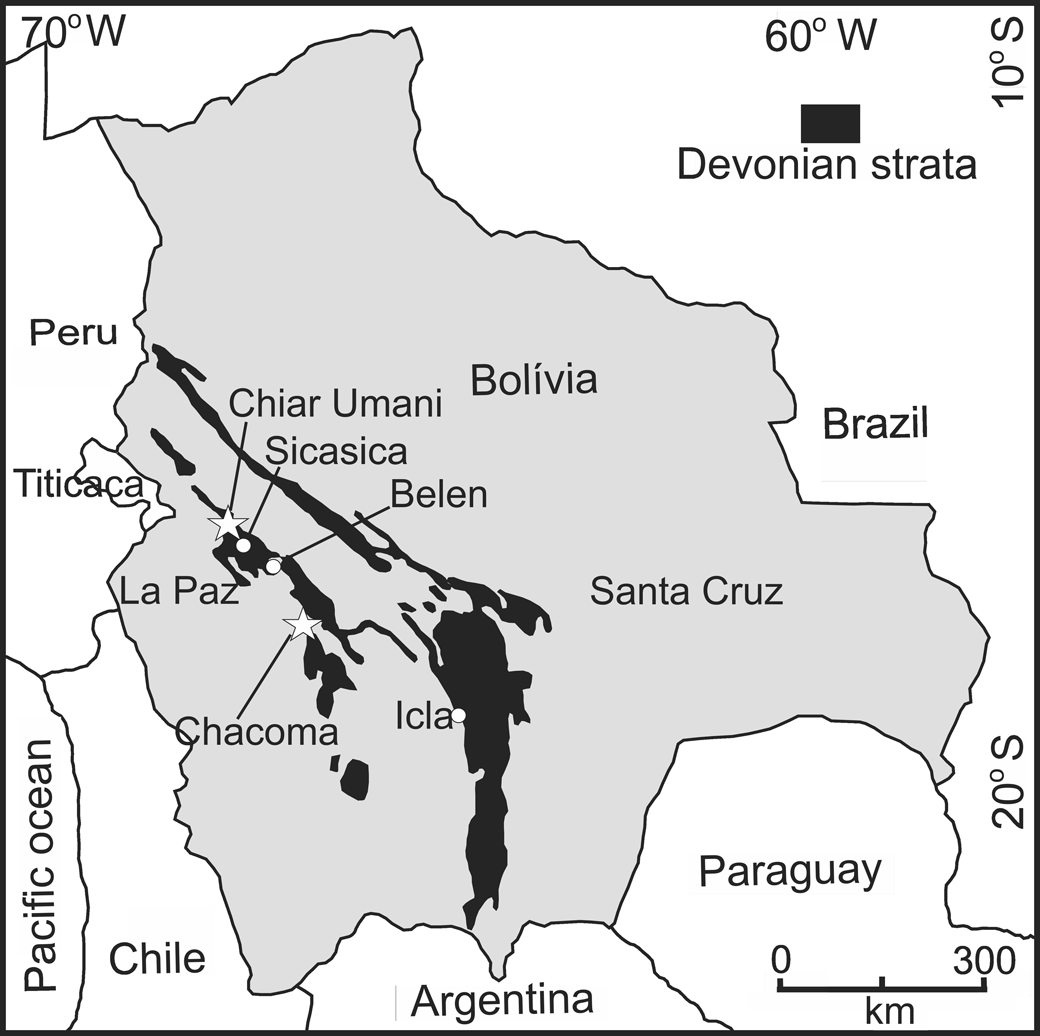
The crinoids described and identified here do not have precise collection sites and still have incorrect data recorded in the paleontology collection of the Universidade de São Paulo (USP). Despite this mistaken information, some considerations can be made regarding the origin of this material, which lead us to be almost sure of the approximate localities of the sample collections as coming from the Icla Formation and, especially, coming from the Belén Formation, Peru-Bolivia Basin (see Fig. 1, and occurrences in systematic paleontology).
Geological map showing the occurrence of the Bolivian Devonian rocks and the probable origin of the specimens from the USP paleontology collection (stars): from north to south locality of Chiar Umani (Tuberocrinus lapazensis n. gen. n. sp.) and locality of Chacoma (Aenigmaticumcrinus rochacamposi n. gen. n. sp.). Modified from Leme et al. (Reference Leme, Simões and Van Iten2006).

The Peru-Bolivia Basin (also divided as Tarija Basin and Madre de Dios Basin, e.g., Di Pasquo et al., Reference Di Pasquo, Amenábar, Noetinger and Konigshof2009) includes part of northwestern Argentina, western Paraguay, most of Bolivia and Peru, and Ecuador to western-most Brazil (Grahn, Reference Grahn2002). The outcrops of its sedimentary fill form an elongate, almost continuous belt of sedimentary rocks parallel with the present-day Andes.
During the early and middle Paleozoic, a seaway connected the Peru-Bolivia Basin to the Chaco-Paraná Basin in northeastern Argentina and the Paraná Basin in eastern Paraguay and southern Brazil (Grahn and Gutiérrez, Reference Grahn and Gutiérrez2001). The Bolivian Icla Formation conformably overlies the late Lochkovian–early Pragian Santa Rosa Formation. Distinct lower and upper divisions of the Icla Formation were recognized (Grahn, Reference Grahn2002). The lithologies consist of silty mudstones with intercalated sandstone beds, ~20–80 cm thick. The Icla Formation corresponds to a rapidly transgressive system tract (early Pragian) and a subsequent incipient highstand system tract (late Emsian–Eifelian) and, thus, include a maximum flooding episode, which is marked in the basin by an apparent condensation or hiatus of the latest Pragian-early Emsian (Blieck et al., Reference Blieck, Gagnier, Bigey, Edgecombe, Janvier, Loboziak, Racheboeuf, Sempere and Steemans.1996).
The Bélen Formation is laterally equivalent to the Icla Formation; however, the Bélen crops out in the western Bolivian Altiplano (Belén-La Paz-Sicasica region), whereas the Icla occurs in Sierras Subandinas of central Bolivia (Icla-Padilla region) (Carvalho et al., Reference Carvalho, Edgecombe and Smith2003). The basal portion of both formations is considered to be time-equivalent, within the “Scaphiocoelia-bearing beds” (Isaacson, Reference Isaacson1977), recognized as the Scaphiocoelia Assemblage Zone by Eldredge and Branisa (Reference Eldredge and Branisa1980). According to Grahn (Reference Grahn2002), the chitinozoan assemblages suggest an early to late Pragian age for the lower Icla Formation, and a late (possibly including latest early) Emsian–earliest Eifelian age for the upper Icla Formation, in the south-central region of Bolivia. Isaacson (Reference Isaacson1977) deduced that the paleoenvironment recorded in the Icla and Belén formations was a shallow cool sea.
Materials and methods
The systematics and nomenclature were used according to Ubaghs (Reference Ubaghs, Moore and Teichert1978), Ausich (Reference Ausich1998), Cole (Reference Cole2017), and Wright et al. (Reference Wright, Ausich, Cole, Peter and Rhenberg2017).
Repositories and institutional abbreviations
The specimens are deposited in the collections of the Geology Department of the Universidade de São Paulo (acronym GP), in the paleoinvertebrates of the Geology Department of the Museu Nacional/Universidade Federal do Rio de Janeiro (acronym MN-I), and in the Biology Department of the Universidade de Guarulhos (acronym CB).
The USP collection material cited in this paper were loans to study from the Museu Nacional at the time of the fire on 2 September 2018. The holotype of Tuberocrinus lapazensis n. gen. n. sp. (GP 1E 4692, former number GP / 1C 304) had its internal mold recovered, however, the external mold and its rubber cast were lost in the fire. The holotype of Aenigmaticumcrinus rochacamposi n. gen. n. sp. (GP / 1C 323) was completely lost, as was its rubber cast. Despite this situation, they are properly figured in this article.
Systematic paleontology
Class Crinoidea Miller, Reference Miller1821
Subclass Camerata Wachsmuth and Springer, Reference Wachsmuth and Springer1885
Infraclass Eucamerata Cole, Reference Cole2017
Order Diplobathrida Moore and Laudon, Reference Moore and Laudon1943
Superfamily Rhodocrinitacea Roemer, Reference Roemer1855
Family Emperocrinidae Frest and Strimple, Reference Frest and Strimple1981
Type genus
Emperocrinus Miller and Gurley, Reference Miller and Gurley1895.
Other genera
Emperocrinus Miller and Gurley, Reference Miller and Gurley1895, middle Silurian (Wenlock); Peremocrinus Frest and Strimple, Reference Frest and Strimple1981, late Silurian (Ludlow); Tormosocrinus Eckert and Brett (Reference Eckert and Brett2001), early Silurian (late Llandovery); Meperocrinus n. gen., early to middle Devonian (late Emsian–early Eifelian).
Emended diagnosis
Rhodocrinitaceans with depressed base, low bowl-shaped calyx; bases of arms lobed in some genera, pentagonal outline in aboral view. Infrabasals five, small, situated in aboral concavity. Radial circlet divided by basals, first interradial, and primanal. Intrabrachials and anal plates few. Median ray ridge absent. Tegminal plates large, polygonal. Anal tube present. Arms ten or twenty, biserial. Column circular.
Remarks
The diagnosis is emended because of the absence of median ray ridges and presence of the circular column in all genera of the family. Therefore, we chose to retain these characteristics of the original diagnosis from Frest and Strimple (Reference Frest and Strimple1981), which had been removed in the emended diagnosis of Eckert and Brett (Reference Eckert and Brett2001). However, the main change in the diagnosis is that the members of the family may have 10 or 20 biserial arms, as in Tormosocrinus and Meperocrinus n. gen., the only two genera in which the arms are known.
Meperocrinus new genus
Type species
Meperocrinus angelina n. gen. n. sp. The genus is monospecific.
Diagnosis
As for the type species by monotypy.
Occurrence
As for the type species by monotypy.
Etymology
Anagram of the type genus of the family Emperocrinidae, Emperocrinus Miller and Gurley, Reference Miller and Gurley1895.
Remarks
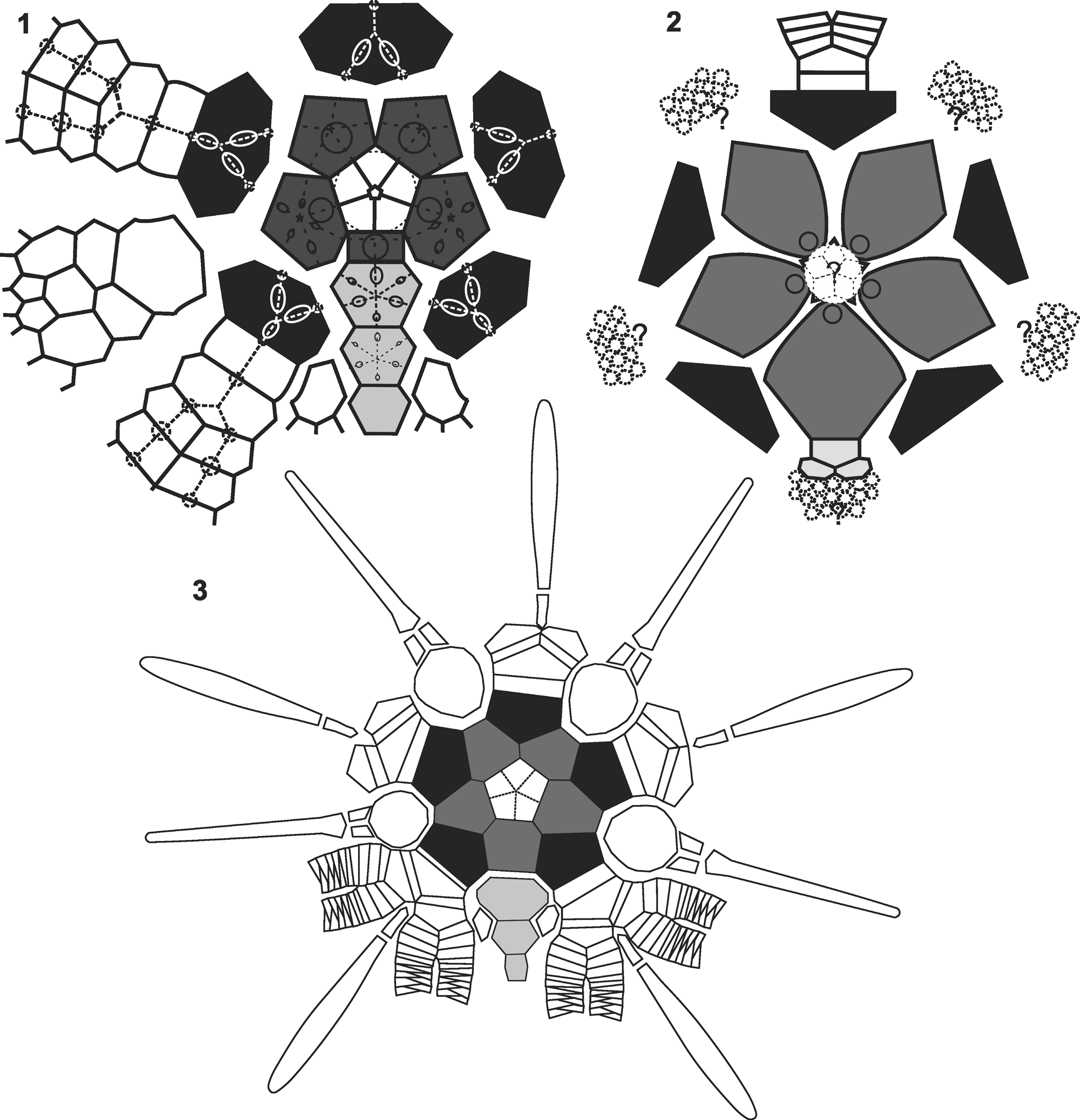
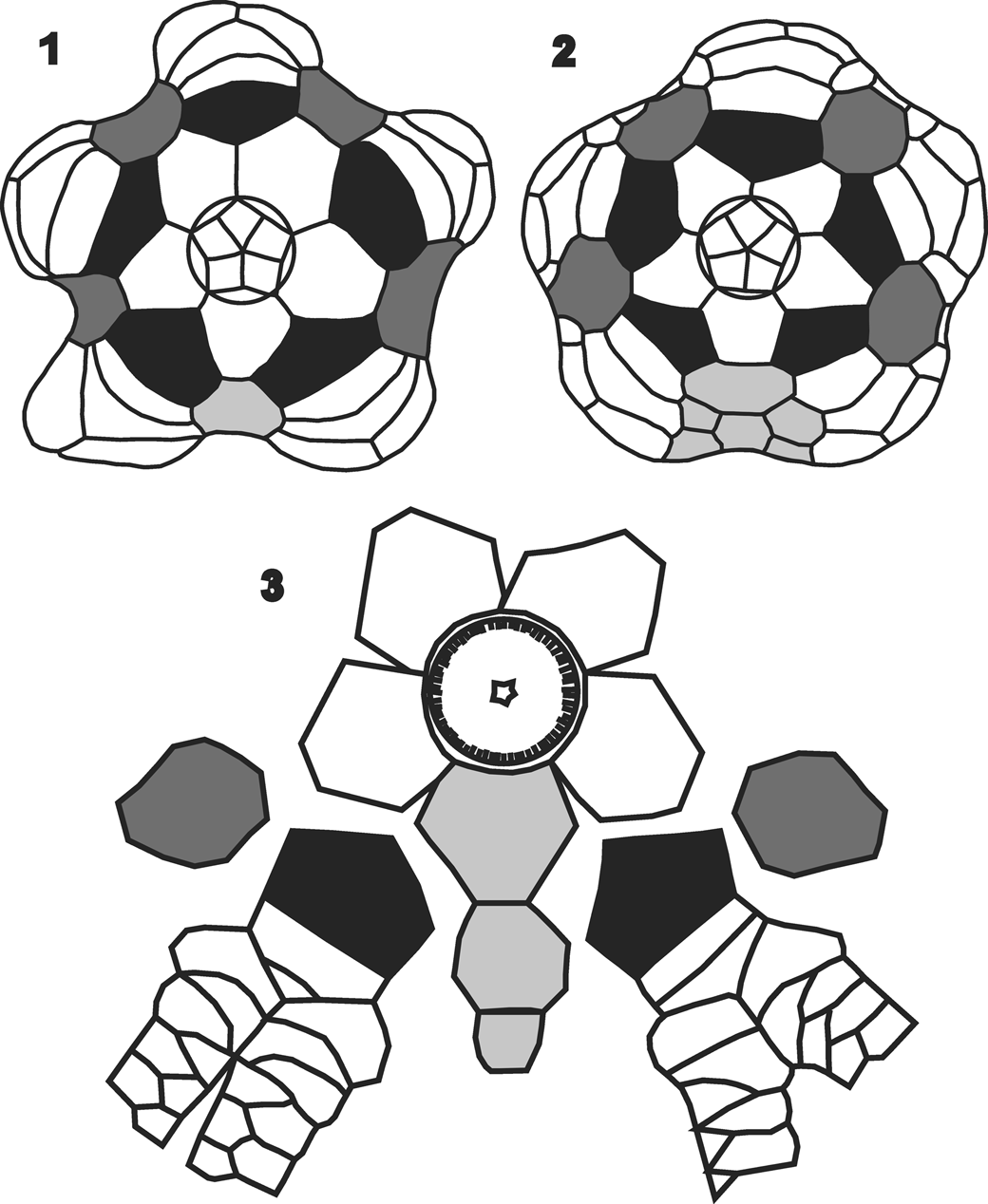
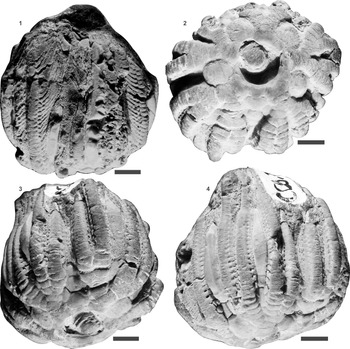
Meperocrinus n. gen. differs from the three genera already described for the family Emperocrinidae (Emperocrinus, Peremocrinus, and Tormosocrinus) due mainly to the greater number of arms (20 instead of 10). The presence of wing plates supported by the intrabrachials and interradials plates also seems to represent a unique characteristic within the family (Figs. 2.3, 3, 5). Meperocrinus n. gen. has a pentagonal outline in aboral view, rather than pentalobate, and a deep invagination in the base of dorsal cup (intracalical cylinder). These features, along with the biserial arms, are similar to Tormosocrinus, although the intracalical cylinder is much wider and deeper in Meperocrinus n. gen. The arms become free on the first tertibrachial, different from Emperocrinus and Peremocrinus, where the arms become free on the first secundibrachial or in Tormosocrinus only on the second secundibrachial. This enlargement of the oral region of the calyx must be related to the increase of space in the tegmen to host the nine wing plates. The CD interray is different from the lateral interrays, with the basal more quadrangular and more adorally broad than other species, and the presence of an anitaxis with three plates is more similar to Peremocrinus than to Tormosocrinus, with an anitaxis with two plates, and to Emperocrinus, with only the primanal. Meperocrinus n. gen. and Peremocrinus are also similar in having the largest number of plates in the CD interray, different from Emperocrinus and Tormosocrinus where all the interrays have the same width and are formed by a single plate. However, Peremocrinus has two additional plates in each side of the anitaxis and Meperocrinus n. gen. has only one. It differs also from Peremocrinus because in Meperocrinus n. gen. the basal plate is even bigger and has fewer interradials (two per lateral interray versus three in Peremocrinus) and the intracalical cylinder is quite bigger. In addition, Meperocrinus n. gen. has an intrabrachial plate adjacent to secundibrachials, also supporting a blade-like or wing plate, which alone would be enough to create a new genus because there is no evidence of these plates in Tormosocrinus, Peremocrinus, or Emperocrinus. The new genus is more similar to Tormosocrinus because of the large intracalical cylinder, pentagonal outline in oral view of the calyx, and biserial arms; yet the entire organization of the calyx plates is much more similar to Peremocrinus, from the late Silurian of Illinois (USA), from which the new genus probably evolved. The three genera previously described in this family (Tormosocrinus, Emperocrinus, and Peremocrinus) occur in the early, middle, and late Silurian, respectively, and therefore, this represents the youngest stratigraphic occurrence of an Emperocrinidae, in addition to the first citation of the family in South America.
Schematic drawings showing the organization of the calyx plates of the new species described from the Icla and Belén formations, early–middle Devonian, Bolivia. (1) Tuberocrinus lapazensis n. gen. n. sp., Belén Formation, La Paz Department (Holotype GP 1E 4692); (2) Aenigmaticumcrinus rochacamposi n. gen. n. sp., Belén Formation, La Paz Department (Holotype GP/1C 323); and (3) Meperocrinus angelina n. gen. n. sp., Icla Formation, uncertain locality, Icla sensu stricto shales (CB-01). Radials black, basals dark gray, anitaxis light gray.

Schematic drawing of the calyx plates of Emperocrinidae, Silurian, United States of America: (1) Emperocrinus indianensis Miller and Gurley, Reference Miller and Gurley1895, Salamoni Dolomite, Indiana; (2) Peremocrinus depressus (Weller, Reference Weller1900), Racine Dolomite, Illinois; and (3) Tormosocrinus furberi Eckert and Brett, Reference Eckert and Brett2001, Wolcott Limestone, Mudge Creek, New York. Radials black, lateral interays dark gray, CD interay light gray.

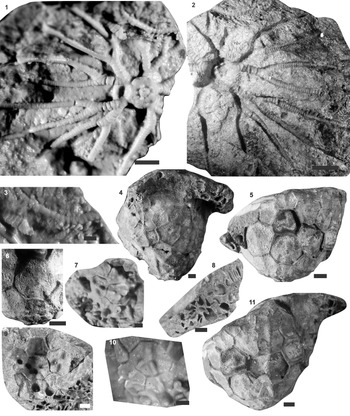
Crinoids from the Belén Formation, early–middle Devonian, Bolivia. (1–3) Rubber cast, holotype GP/1C 323, and rubber cast of the pinnule, respectively, of Aenigmaticumcrinus rochacamposi n. gen. n. sp., Belén Formation, La Paz Department; (4–11) Tuberocrinus lapazensis n. gen. n. sp., Belén Formation, La Paz Department (Holotype GP 1E 4692): (4) EA interray view, (5) CD interray view, (6) detail of the CD basal and primanal in the internal mold, (7) rubber cast of the external mold of the CD interray, (8) brachials and pluricolumnals, (9) CD interray view in the external mold, (10) D radial and DE basal view in the rubber cast of the external mold, (11) D ray view. Scale bars = 5 mm (1, 2), or 2 mm (3–11).

Meperocrinus angelina n. gen. n. sp. from the Icla Formation, early–middle Devonian, Bolivia (holotype CB-01). (1) EA interray view showing the pinnules and broken wing plates; (2) aboral view showing the pentagonal outline, large intracalical cylinder, and CD interray; (3) aboral CD interray view; (4) C ray view, showing the pinnulate brachials, the BC interray wing plate, and the C intersecundibrachial wing plate. All scale bars represent 5 mm.

Meperocrinus angelina new species
Figures 2.3, 5
Reference Branisa1965 Crinoidea indet. 1, Branisa, p. 110, pl. 23, fig. 1.
Reference Scheffler2007 Emperocrinidae, Scheffler, p. 297.
Holotype
CB-01.
Diagnosis
Calyx low, bowl-shaped, depressed base; lobed, and pentagonal outline in oral view; sutures depressed; large basal concavity (intracalical cylinder); nine wing plates between the arms, supported by interradials and intrabrachial plates adjacent to secundibrachials; wing plate absent in CD interray. Basal plate of the CD interray quadrangular and wider proximally. CD interray with anitaxis, wider than lateral interrays. Twenty biserial arms.
Occurrence
Icla Formation (Pragian–Eifelian), Bolivia, uncertain locality. Branisa (Reference Branisa1965) reported three calyces of this genus, which he considered a probable new genus, coming from the upper part of the Icla Formation (Icla stricto sensu shales), possibly late Emsian (Troth et al., Reference Troth, Marshall, Racey and Becker2011) or early Eifelian (Grahn, Reference Grahn2002), of the Sub-Andean region (located in the central “interandean belt” of the Eastern Cordillera geological province).
Description
Calyx of medium size, low bowl-shaped, depressed base (diameter 20 mm, height 10 mm), pentagonal outline in oral view, lobed. Large basal concavity (intracalical cylinder), located in which are the infrabasals, half of the basals, and aboral part of the radials. Infrabasals not visible, hidden by the stem; hexagonal basals joined laterally; basal plate of the CD interray larger than other basals; also hexagonal, but proximally wider than the others, yielding a quadrangular aspect, and supporting the anal series; pentagonal radial plates, separated from each other by large interradial plates. Wide interradial areas, same diameter, presenting a rounded interradial plate (except interray CD), in contact with all fixed primibrachials and secundibrachials, depressed, followed by two smaller, rectangular plates, that support a long, thin, blade-shaped plate (wing plate) that extend between arms; one elongated intrabrachial plate adjacent to secundibrachials in the adjacent ray, supporting wing plate similar to the interrays; CD interray wider than lateral interrays, not supporting wing plate; anal series with three plates, beginning with a large plate (primanal) followed by three plates in the second range, one bigger central plate (belongs to anitaxis), in addition to two smaller and elongated plates, laterally positioned in relation to the anitaxis; one plate in third range (belongs to anitaxis). Arms bifurcate twice inside the calyx; four free arms per ray; brachials wider than high; rays formed of two primibrachials, the second axillary (except in the D ray where the first primibrachial is absent); half ray formed of two secundibrachials, second axillary; a quarter of ray formed by one fixed tertibrachial; others tertibrachials free, pinnulated; free arms, biserial from the fourth or fifth tertibrachial. A striking feature of the specimen is the presence of nine long, narrow, blade-shaped plates (wing plates), supported by the interradial plates and intrabrachial plates adjacent to secundibrachial plates, and positioned to extend up between the arms. This plate is missing from the CD interray. Circular heteromorphic stem; columnals width 3 mm in diameter, apparently pentagonal lumen, very small.
Etymology
Regarding its angelic form, due to unusual expansions resembling wings, as well as its delicate contours.
Type estratum
Icla Formation, Bolivia.
Paleobiology of the genus
The wing plates of Meperocrinus angelina n. gen. n. sp. appear to be morphologically and functionally similar to those in the genus Pterotocrinus Lyon and Casseday, Reference Lyon and Casseday1860, implying a hydrodynamic function, related to the stability of the theca and feeding (Welch, Reference Welch1978; Baumiller and Plotnick, Reference Baumiller and Plotnick1989). As in Pterotocrinus, the resulting forces would produce a similar effect, with consequent reduction of the rotation tendency of the crown, which would allow M. angelina n. gen. n. sp. to assume the feeding posture by bending the stalk proximally, so that the oral-aboral axis is oriented parallel to the current direction and the oral end is pointing down-current (Baumiller and Plotnick, Reference Baumiller and Plotnick1989), as the feeding posture of the extant stalked Articulata. Welch (Reference Welch1978) argued that an increase in food capture effectiveness could occur even with the calyx and the ambulacral side upright, with arms enfolded between the wing plates. However, Baumiller and Plotnick (Reference Baumiller and Plotnick1989) and Tobenski (Reference Tobenski2012) argued that the convex down-stream posture should be the correct interpretation, because the wing plates served the rudder function, passively orienting the crown away from the current, especially in environments with variable current direction, perhaps up to fair weather wave base. As in Pterotocrinus, in addition to the rudder function, the wing plates (blade-shaped) had the function of increasing the turbulence of the stream, retaining the flow of water around the arms longer, causing the food particles to eddy over the ambulacral grooves (Welch, Reference Welch1978).
The efficiency of these structures and the rudder function led to the convergence of these wing plates into several biologically distant genera (Baumiller and Plotnick, Reference Baumiller and Plotnick1989), such as Pterotocrinus and Meperocrinus n. gen., maintaining an effective feeding posture, in the absence of muscular articulations in the column.
Monstrocrinus also has thecal expansions with hydrodynamic function. However, it is calyx plate expansions and not tegminal structures, and although they exhibit thecal stabilization behavior against rotational motions and for increased feeding effectiveness (see Monstrocrinus aliformis Le Menn, Reference Le Menn1990 and M. icognitus Scheffler et al., Reference Scheffler, Silva, Gama, Fonseca and Fernandes2011), the morphologically distinct nature is probably explained by feeding posture with the calyx and the ambulacral side upright due to the absence of stalk (Le Menn, Reference Le Menn1990; Scheffler et al., Reference Scheffler, Silva, Gama, Fonseca and Fernandes2011).
Remarks
This species is most similar to Peremocrinus depressus (Weller, Reference Weller1900) and Tormosocrinus furberi Eckert and Brett (Reference Eckert and Brett2001), especially to the first one, but differs for reasons already discussed for the genus.
Superfamily Dimerocrinitacea von Zittel, Reference Von Zittel1879
Family Tuberocrinidae new family
Type genus
Tuberocrinus n. gen. The family is monogeneric.
Diagnosis
Median ray ridges present, large first interradial plates, interrays not depressed, connected with tegmen; CD basal much smaller than the others, quadrangular, supporting primanal positioned below the radial circlet.
Occurrence
Belén Formation, Lower (Pragian–Emsian) or Middle (early Eifelian) Devonian of Bolivia.
Etymology
Regarding the large number of nodes in the calyx of the type genus.
Remarks
Although this new family has interradial plates organized in a regular pattern, a typical characteristic of the families Dimerocrinitidae, Pterinocrinidae, Lampterocrinidae, and Orthocrinidae, it differs from these and all the families of the superfamily Dimerocrinitacea by the particular organization of the basal plates. None of the Dimerocrinitacea families has basal plates with different shapes, except for Aishacrinidae Prokop, 2010 and the dimerocrinitid Duncanicrinus Jell, 1999. However, the Aishacrinidae are much more similar to the Gazacrinidae (see Prokop, Reference Prokop2010), and Duncanicrinus, although the posterior basal is much larger than the others, is a typical Dimerocrinitidae in all other characteristics (see Jell, Reference Jell.1999). The quadrangular basal in the CD interray, much smaller than the others, and the primanal situated below the adjacent radial plates instead of to the side or slightly above, is a unique feature of this new family (Figs. 2.1, 4.5, 4.6, and 4.9). It also differs greatly from the aberrant family Syndetocrinidae Prokop and Petr, Reference Prokop and Petr1989.
Genus Tuberocrinus new genus
Type species
Tuberocrinus lapazensis n. sp.
Diagnosis
As for the type species by monotypy.
Occurrence
As for the type species by monotypy.
Etymology
Regarding the large number of nodes in the calyx.
Remarks
The presence of a quadrangular basal in the CD interray that is much smaller than the others, basals with three different shapes, and large tubercles, mainly in the basals and radials, differentiate this genus from all other genera of Dimerocrinitacea. The presence of large nodes on the basals hiding the infrabasals is present in some pterinocrinoids; however, nodes on the radial and anal plates in addition to more than one node per plate are unique in the superfamily (Fig. 4.7, 4.9, 4.10). Apurocrinus sucrei McIntosh, Reference Mcintosh1981 has adult specimens similar to this new genus because of the calyx shape, overall shape, shape of the calyx plates, and ray ridges positioned very similarly in the internal mold (see Thompson et al., Reference Thompson, Ausich and Smith2013, fig. 4.4, 4.5). However, the presence of five infrabasals in Tuberocrinus n. gen. instead of three in Apurocrinus, the very reduced CD basal, the primanal positioned below the radial circlet, and the nodes mentioned above, distinguish Tuberocrinus lapazensis n. gen. n. sp. from Apurocrinus sucrei.
Tuberocrinus lapazensis new species
Figures 2.1, 4.4–4.11
Holotype
GP 1E 4692 (old number GP/1C 304).
Diagnosis
Calyx of medium cone-shaped, convex base; basal plates with three different shapes: a quadrangular basal in the CD interray much smaller than the others, two symmetrical pentagonal basals in the AB and EA interrays, and two asymmetric hexagonal basals in the BC and DE interrays. Presence of many nodes, mainly on the basals and radial plates, but also on the primanal. CD interray much wider than the others. Ten uniserial pinnulate free arms.
Occurrence
Belén Formation (Devonian), Bolivia. In the catalogue of the Paleontology collection of the Universidade de São Paulo, the origin of the sample is listed as from the Cerro Prieto Formation, Amotape Mountains in Peru (collected in 1969 by Petroperu). However, in the sample is a written note listing Chiarumani (a probable field annotation), likely referring to the locality of Chiar Umani, south of La Paz, Department of La Paz, Bolivia. This sample was collected in a field activity carried out in Bolivia and Peru by the Professor Antonio Carlos Rocha-Campos, of the Universidade de São Paulo (A.C. Rocha-Campos, personal communication, 2010), and incorrectly cataloged. Based on the geographical position, this sample must come from the Belén Formation (Pragian–early Eifelian), the stratigraphic equivalent of the Icla Formation in the Bolivian Altiplano (Racheboeuf et al., Reference Racheboeuf, Le Hérissé, Paris, Babin, Guillocheau, Truyols-Massoni and Suarez-Soruco1993).
Description
Calyx convex base, medium cone-shaped, pentagonal outline in aboral view (height 2.5 cm; diameter 2.5 cm). Infrabasals small, rhomb like; infrabasal circlet forming a small pentagon on the aboral side, almost totally covered by the proximal columnal. Symmetrical and pentagonal basal plates in the AB and EA interrays; asymmetric and hexagonal basal plates in interrays BC and DE, due to the very different much smaller and quadrangular CD basal plate, supporting the primanal in contact only with other basals and primanal. Large radials, wider than high, heptagonal, in sutural contact laterally except in the CD interray, where the radials are separated by the primanal. Articulation of the radial with the primibrachial almost half of the width of the radial. First primibrachial quadrangular, second primibrachial heptagonal and axillary. Two fixed secundibrachials and the third partially? fixed, incorporated into the calyx; other brachials free. Ten free arms emerge from the calyx. Ray ridges well developed, bearing pronounced nodes on the basals (one large node in EA, AB, and CD basals, one large node and five small nodes in BC and DE basals), radials (three nodes), and primanal (five nodes). Internally there are very pronounced grooves in the fixed brachials and radials; these grooves diverge from the radials towards the basals and from these to all adjacent plates; below the basals these grooves coincide with the sutures between the infrabasals and converge to form the sides of the pentagonal stem; a circular groove connects all the basals. These internal grooves are well developed, giving rise to chambers, in the region of articulation between radial and first primibrachials, and especially between brachials (especially between first primibrachial and second primibrachial). These structures probably reflect the position of the aboral nervous system and its associated ganglia in the rays, radial trunks and pentagonal commissure linking the basals, instead of connecting the radials as Neocrinus decorus (Thomson, Reference Thomson1864) (see Breimer, Reference Breimer, Moore and Teichert1978). Wide, not depressed interrays, formed by large plates; first interradial plate large, octagonal, succeeded by one tier of two interradial plates, one tier of three interradial plates, one tier of two interradial plates, and one tier of aproximatelly six interradial plates; interrays in contact with the tegmen, which is a flat cone, much lower than the calyx. Differentiated CD interray, much wider than the others, with an anitaxis, consisting of three visible plates; primanal adjacent to the radials, situated in contact with the small and quadrangular basal; interray CD also with other small plates, lateral to the anitaxis, positioned above the level of the radial plates. Uniserial free arms, pinnulate, with brachials slightly wedge-shaped, at least proximally; symplexy articulations with 15 culmina, which can branch; presenting a horizontal transverse ridge at the height of the aboral canal. Columnal with circular to slightly pentagonal shape, heteromorphic; noditaxis 8? columns; nodal with epifacet with keel slightly convex at half height, symmetrical, and smooth. Facet with small circular to slightly pentagonal lumen, and crenularium with ~70 thin, apparently straight, long and simple culmina.
Etymology
Referring to the La Paz Department, Bolivia.
Holotype cast
MN 11450-I.
Type stratum
Belén Formation, Chiar Umani, Bolivia.
Remarks
Due to the absence of compound bipinnulate brachials, Tuberocrinus lapazensis n. gen. n. sp. differs greatly from Pterinocrinidae, as defined by McIntosh (Reference McIntosh1987; a clade already represented in South America by Bogotacrinus scheibei McIntosh, Reference McIntosh1987, in Colombia; Apurocrinus sucrei McIntosh, Reference Mcintosh1981 in Bolivia; and Pterinocrinus? australis Haude, Reference Haude1995, in Argentina) and close to some representatives of the family Dimerocrinitidae, such as Macarocrinus Jaekel, Reference Jaekel1895, Nexocrinus Eckert, Reference Eckert1984, and Ptychocrinus Wachsmuth and Springer, Reference Wachsmuth and Springer1885, which have slightly cuneate brachials, and uniserial, pinnulate arms. However, the small quadrangular basal plate of the CD interray differs greatly from this and from any other genera of the Dimerocrinitidae or Pterinocrinidae. Interrays are also not depressed with numerous interradials, which is not a common condition in the Dimerocrinitacea (except in the primitive Dimerocrinidae ptychocrinids Ptychocrinus, Euptychocrinus, and Nexocrinus, which, however, have a typical pattern of the Dimerocrinitidae family in other characteristics of the calyx).
Family Aenigmaticumcrinidae new family
Type genus
Aenigmaticumcrinus n. gen. The family is monogeneric.
Diagnosis
Calyx apparently high bowl-shaped, depressed base; large inflated quadrangular basals, higher than wide, occupying more than half the height of the calyx; very low, very wide, and pentagonal radials; radial facet angustary; interrays formed by numerous small, polygonal plates; primanal pentagonal and large, supporting two rectangular plates; followed by numerous small polygonal plates.
Occurrence
Belén Formation, Lower (Pragian–Emsian) or Middle (early Eifelian) Devonian.
Etymology
Referring to very different morphology of the type genus.
Remarks
Presence of very high basals, occupying more than half of the calyx, is a unique feature in the superfamily Dimerocrinitacea, as well as the presence of numerous polygonal interradial plates (Figs. 2.2, 4.1, 4.2). In general, the superfamily has a reduced number of very regular interradial plates. Because of the high basals and the wide radials with angustary radial facet it resembles more the family Orthocrinidae Jaekel, Reference Jaekel1918 (Orthocrinus robustos Breimer, Reference Breimer1962, and O. primaevus Le Menn, Reference Le Menn and Plusquellec1980). This family is represented only by the genus Orthocrinus Jaekel, Reference Jaekel1895, which occurs in the Lower Devonian of Spain and France and the Middle Devonian of Germany and Spain. Orthocrinids have large infrabasals, a reduced number of interradial plates, compound, and bipinnulate brachials that differs greatly from the Bolivian specimen.
However, the presence of many disorganized interradial plates and uniserial arms make Aenigmaticumcrinidae n. fam. more similar to primitive dimerocrinitids, such as Ptychocrinus (Upper Ordovician and Silurian of North America), Nexocrinus (Upper Ordovician and Silurian of North America, and Silurian and Lower Devonian of Australia), and Euptychocrinus (Middle and Upper Ordovician of North America and Silurian of Scotland). It is possible that these genera form a clade that arose in the USA in Ordovician (Eastern America Realm) and that later, during the Silurian, arrived to Baltica (Old World Realm) and during Devonian to the south of the Gondwana (Malvinokaffric Realm and south of Old World Realm).
Genus Aenigmaticumcrinus new genus
Type species
Aenigmaticumcrinus rochacamposi n. gen. n. sp.
Diagnosis
As for the type species by monotypy.
Occurrence
As for the type species by monotypy.
Etymology
Based on very different morphology in relation to the superfamily, mainly by the large basals and numerous irregular interradial plates.
Remarks
Although Aenigmaticumcrinus n. gen. presents the basic plan of the superfamily Dimerocrinitacea (i.e., a dicyclic calyx, with the radial circlet only interrupted in the CD interray, and the primanal positioned above the basal), this specimen differs from all genera of the families already proposed for this superfamily. The basic pattern of the dorsal cup resembles Nyctocrinus (Nyctocrinidae, middle Silurian, USA): large basals curving into concavity, in which are located five small infrabasals; and large radials with narrow radial facets. However, it differs greatly from Aenigmaticumcrinus n. gen. especially because of the radials adjoining each other all around. In addition, Aenigmaticumcrinus n. gen. has the anitaxis restricted to the calix, many interradial plates, presence of fixed brachials, uniserial arms, and basals forming most of the dorsal cup.
Aenigmaticumcrinus n. gen. resembles members of Dimerocrinitidae and Pterinocrinidae by the general organization of infrabasal, basal, and radial plates. This specimen has the typical small infrabasals, enclosed by prominent nodes on the basal plate, such as Pterinocrinus and Apurocrinus. However, it differs for several reasons. It exhibits a much larger number of interradials, differing from the classic Dimerocrinitidae pattern of Ubaghs (Reference Ubaghs, Moore and Teichert1978), followed by Ausich (Reference Ausich1998), and from the Pterinocrinidae pattern of McIntosh (Reference McIntosh1987) (i.e., large interradials with one first interradial plate, followed by two). It also differs from the basic pattern in the CD interray, where one plate should be followed by three, and the radial plates have a very narrow facet, angustary.
The large number of interradial plates and the pattern of the uniserial arms are closer to primitive ptychocrinids Dimerocrinitidae, such as Nexocrinus (see Nexocrinus wallanensis Jell, Reference Jell.1999), Ptychocrinus (see P. adamsensis Ausich and Dravage, Reference Ausich and Dravage1988), and Euptychocrinus (see E. skopaios Brower, Reference Brower1994) with uniserial arms. In some ptychocrinids, the basal plate can also have nodes aborally, partially hiding the infrabasals (see Ptychocrinus insperatus [Rowley, Reference Rowley1904] in Ausich, Reference Ausich1987, fig. 2.1]. However, ptychocrinids and Aenigmaticumcrinus n. gen. differ in the number of fixed brachials, presence or absence of median-ray ridges, and in other characteristics of the calyx (see remarks for the family). Among all the ptychocrinids, it more closely resembles Nexocrinus, by the greatly reduced infrabasals and by the presence of four arms per ray (for a more complete discussion of ptychocrinids, see Brower, Reference Brower1994).
Aenigmaticumcrinus rochacamposi new species
Figures 2.2, 4.1–4.3
Holotype
GP/1C 323.
Diagnosis
Calyx with large inflated quadrangular basals, higher than wide, occupying more than half the height of the calyx; infrabasals concealed by the proximal column and bulbous basals (with one large aboral node); radial plates very low, very broad, and pentagonal; radial facet angustary, half width of the radial; interrays formed by numerous small, polygonal plates; large pentagonal primanal supporting two rectangular plates; followed by numerous small polygonal plates; radials followed by two primibrachial plates per ray, second axillary; ray ridges absent; four uniserial, pinnulate arms per ray; arms are divided once in the calyx and once in the free arms.
Occurrence
Sample collected in the expedition of the 1960s by prof. Antonio Rocha-Campos to Bolivia and Peru (A.C. Rocha-Campos, personal communication, 2010) and presents the same problem as the previous sample. It has a field annotation that reads Chacoma (Ordovician). Locality of Bolivia, located in the Department of Oruro, west of the city of Oruro, 10 km south of the city of Choquecota. However, many areas with Devonian rocks in Bolivia until the 1990s were still considered to be of Ordovician age (see for example the region west of Cochabamba; Blieck et al., Reference Blieck, Gagnier, Bigey, Edgecombe, Janvier, Loboziak, Racheboeuf, Sempere and Steemans.1996). The locality of Chacoma is in the Bolivian Altiplano, and therefore this material must belong to the Belén Formation (early Pragian–Eifelian). According to Branisa (Reference Branisa1965), the upper fifth part of the lower member of the Belén Formation is sandy and may represent the layers from which the present sample was collected.
Description
Calyx apparently high bowl-shaped, depressed base. The oral-aboral flattening masks the exact shape. Infrabasals almost completely hidden by the circular proximal columnal. Large inflated quadrangular basals, very convex, higher than wide, with very convex lateral margins, with small tubercle externally at the base (aboral side); occupying more than half the height of the calyx. CD basal plate pentagonal, supporting a pentagonal primanal that separates the C and D radials. Very low, very wide, pentagonal (height/width = 0.5) radials; radial plates in lateral contact, with exception of the CD interray; radial facet angustary, approximately half width of the radial. Arms divided once in the calyx and once in the free arms; four uniserial, pinnulate arms per ray. Radials followed by two primibrachials, second axillary. Ray ridges absent. Six secundibrachials in each half ray, sixth axillary; first secundibrachial fixed, others free; 50 tertibrachials observed in a quarter of ray. Brachials much wider than high, pinnulate. Tertibrachials gradually become slightly cuneate in the distal region, with alternating pinnules. Numerous small plates in interrays, apparently not very rigid (because they appear deformed by compression) joining the tegmen, ?polygonals, with limits and shape not very clear in the specimen. CD interray differentiated, being wider than the others; primanal pentagonal and large, supporting two rectangular plates; followed by numerous small polygonal plates, similar to the other interrays. Circular heteromorphic stem; noditaxis with four columnals; nodal with small nodes in the latera (~10); priminternodal and secundinternodal with slightly convex latera.
Etymology
In honor of the collector of the specimen, Dr. Antonio Carlos Rocha-Campos, professor of the Universidade de São Paulo.
Observation
In the same sample there is a very curved pluricolumnal, which appears to have the same pattern of noditaxis as the specimen, but ontogenetically older. Columnals are higher, with larger nodes in the nodal and low nodes in the priminternodal. It may be the distal part of the stem, used for fixing by coiling on hard substrate or other organisms. Anchored by coiling around objects on the seafloor and keeping the distal stem in a horizontal position, this recumbent mode of life has been described for primitive dimerocrinitids (see Brett, Reference Brett1978), such as Ptychocrinus medinensis Brett, Reference Brett1978.
Holotype cast
MN 11451-I.
Type stratum
Belén Formation, Chacoma, Bolivia.
Remarks
As for the genus.
Discussion
The descriptions of Meperocrinus angelina n. gen. n. sp., Tuberocrinus lapazensis n. gen. n. sp., and Aenigmaticumcrinus rochacamposi n. gen. n. sp. reinforce the endemic character of the Bolivian Malvinokaffric fauna, as indicated by the Emperocrinidae, which has an evolutionary tendency of increasing number of plates in the calyx in relation to the other genera of the family. This trend is inversely related to the evolutionary trend of the Rhodocrinitacea, which is the reduction of plates in the calyx. In addition, the two new families of Dimerocrinitacea, Tuberocrinidae n. fam. and Aenigmaticumcrinidae n. fam., are very aberrant, with calyx plate construction very different from the other families of the order.
According to Scheffler et al. (Reference Scheffler, Fernandes and Fonseca2013) and Scheffler (Reference Scheffler2015), the echinoderm fauna of South America, including the Malvinokaffric fauna, displays a strong endemism, with a marked influence of the Rhenish Massif (Southern Baltica), Armorican Massif, Iberian Peninsula, Bohemia, and North Africa (northern Gondwana, Ibarmaghian Domain, sensu Plusquellec et al., Reference Plusquellec, Boumendjel, Morzadec and Paris1997). This suggests that, as commented by other authors, the Rheic Ocean suffered a significant reduction mainly during the Emsian and did not represent an effective barrier to the dispersal of many species (Morzadec et al., Reference Morzadec, Pans, Plusquellec, Racheboeuf, Weyant, Mcmillan, Embry and Glass1988; Robardet et al., Reference Robardet, Blaise, Bouyx, Gourvennec, Lardeaux, Le Herrisse, Le Menn, Melou, Paris, Plusquellec, Poncet, Regnault, Rioult and Weyant1993; Plusquellec et al., Reference Plusquellec, Boumendjel, Morzadec and Paris1997; Robardet, Reference Robardet2003).
There are just a few examples of taxa that seem to have migrated from the Eastern Americas Realm to the Malvinokaffric Realm. The most characteristic example is Boliviacrinus isaacsoni McIntosh, Reference McIntosh1988, from the Eifelian of Bolivia, which seems to represent the youngest member of the patelliocrinids and probably developed from an ancestral stock from the Silurian of North America, where they were well established (Thompson et al., Reference Thompson, Ausich and Smith2013). The present paper provides two more examples: M. angelina n. gen. n. sp. is the newest representative of the family that only occurs during the Silurian of United States and A. rochacamposi n. gen. n. sp. that is more similar to primitive dimerocrinitids, termed ptychocrinids, that arose North America.
As previously mentioned, due to the great similarities of the Malvinokaffric fauna, especially in the Lower Devonian, it would be expected that South Africa and South America would have more taxa in common at genus and species levels. However, there is a strange lack of similarity in the echinoderm fauna, as already noted by Jell and Theron (Reference Jell and Theron1999). The fauna in Argentina, Bolivia, and Brazil, where the echinoderms are more widely studied in South America, are quite different from each other and South Africa, sharing just a few taxa (see Scheffler et al., Reference Scheffler, Fernandes and Fonseca2013, Scheffler, Reference Scheffler2015). This is reinforced by the three genera and species described in this paper that are presently only known in Bolivia.
The presence of M. angelina n. gen. n. sp., T. lapazensis n. gen. n. sp., and A. rochacamposi n. gen. n. sp. also reinforces another peculiarity of the crinoid fauna of South America. This fauna is dominated by Camerata, mainly Diplobathrida (13 taxa), followed by Cladida (nine taxa) and Monobathrida (four taxa). This is an odd fact when we analyze the Crinoid Evolutionary Fauna (CEF) established for the Paleozoic by Baumiller (Reference Baumiller, David, Guille, Féral and Roux1994) and Ausich et al. (Reference Ausich, Kammer and Baumiller1994). According to Ausich (Reference Ausich2009) the CEF of the middle Paleozoic occurred from the Silurian to the early Carboniferous, and camerate monobathrids, cladids, and flexibles were predominant. Therefore, the great abundance of diplobathrids in sedimentary deposits of the Devonian of South America is unusual. This is not the case in South Africa, where there is an absolute predominance of cladids, followed by monobathrids (Jell and Theron, Reference Jell and Theron1999; Scheffler et al., Reference Scheffler, Fernandes and Fonseca2013). The fewer occurrences of cladids may also be due to the lack of studies in South America, as exemplified in Branisa (Reference Branisa1965), who cited several indeterminate crinoids, of which at least two are cladids. However, we cannot rule out the hypothesis that these cold-water epicontinental seas represented a refuge for the Diplobathrida, which was declining in the tropical and temperate seas of the Old World Realm and Eastern Americas Realm.
Acknowledgments
The author thanks the Instituto Virtual de Paleontologia, the Fundação Carlos Chagas de Apoio à Pesquisa do Rio de Janeiro (FAPERJ E-26/200.110/2019), and the Conselho Nacional de Desenvolvimento Científico e Tecnológico (CNPq 474954/2013-4) for financial support. The author thanks M.I. Manes, and M.A. Carvalho for the revision of the English language. The author also thanks W.I. Ausich and the anonymous reviewer for their contributions.