The twentieth chapter of the Gospel of John begins with Mary Magdalene going to Jesus' tomb, followed by a switch of focus to Peter and the beloved disciple going to the same location (20.2–10). It is clear that the three of them knew the tomb where Jesus' body had been laid. In v. 11, the narrator returns to Mary Magdalene, who, while mourning at the tomb, looked in and saw ‘two angels sitting in white,Footnote 1 one at the head and the other at the feet where the body of Jesus had been lying' (20.12). That their positions could be recognized is obvious from the story, as Peter and John are reported to have seen ‘the linen cloths lying there, and the napkin which had been on his head, which was not lying with the linen cloth, but rolled up in a separate place by itself’ (20.5–7). The fact that there are two angels seems significant for John;Footnote 2 the other gospels give slightly different reports.Footnote 3
‘And they said to her: “Woman, why are you crying?”’ (20.13). The messengers only ask why she is crying. Is that their message? Or is it a rhetorical question, implying an imperative not to cry?Footnote 4 Mary Magdalene explains that she is searching for her Lord (20.13) and after a significant double turn (20.14, 16),Footnote 5 she meets Jesus. He sends her to his brothers, to whom she witnesses: ‘I have seen the Lord’ (20.18). If the angels' question expresses that there is no reason for Mary Magdalene to cry, does the scene communicate why she should not cry? Their appearance in white indicates that something ‘supernatural’ is going on.Footnote 6 But even without reference to their heavenly appearance, by flanking the place where Jesus had been lying, the messengers mark an empty space. According to Ridderbos, the angels are there ‘to mark—as it were—the emptiness of that space’.Footnote 7 Indeed, Mary Magdalene realizes that Jesus is not there—even in her tears. Should this emptiness change her tears into a risus paschalis—and if so, how?
Of this empty space between the two angels and the ‘divine reality’, Witherington III says: ‘God's activity is involved in this emptiness between them. There is a void, but it is not devoid of meaning.’Footnote 8 The two angels, and the empty space they mark, function thus not only on a narrative level within the story: they might also have communicated even more to certain readers of the Fourth Gospel.Footnote 9 Realizing how much the Fourth Gospel is loaded with meaning, this article studies the two angels and the space between them, searching for how they may be understood symbolically.
Most scholarly publications either omit to mention the two angels or minimize their role.Footnote 10 This is sometimes linked to the thesis that the scene is incomplete.Footnote 11 As Frey has it, the angels in John 20.12 are not, unlike in Mark 16.6, turned into ‘Verkündigern der Osterbotschaft, sondern nur zu “Mäeuten” der Trauer um Jesus’. Rather, the scene breaks off, since the angels do not respond to Mary's question and Mary turns away.Footnote 12 Others suggest that the angels' white clothes, their number, or simply their presence in the empty tomb emphasize Jesus' resurrection as supernatural.Footnote 13 Dietzfelbinger likewise claims that their presence merely ensures that this was really Jesus' tomb, then asks about the two angels: ‘Do they have a function beyond this?’Footnote 14
1. The Egyptian Context as One Context for the Fourth Gospel
The Fourth Gospel, even in Antiquity, was already being read in different contexts. These contexts therefore provide the Gospel with meaning beyond the hermeneutical frameworks of authorial intention and that of the text itself (the latter possibly supplying various textual contexts according to what was accepted as Holy Writ). Although the narrative setting is the natural and appropriate context for the first reading of a text, a second reading within a specific situation, or one which pays special attention to one aspect of the commonly accepted, often generalized, ‘original’ setting, can shed new light, corroborating elements from the first reading and showing aspects which ‘at first sight’ were overlooked. It is important to take into account not only different reader groups, but also the effect of the process of re-reading the story, by which the reader, ‘on reflection’, has become aware of the complete narrative and therefore also pays extra attention to the symbolism within it.Footnote 15
One important example of a reader group for the Fourth Gospel is the subset of readers who, like its author, were acquainted with the OT. Along with the Jewish liturgy and calendar of the first centuries CE,Footnote 16 the OT background is an important source which contributes to the theological meaning of the Fourth Gospel, and of this passage.Footnote 17
The present article, however, focuses on what we shall call the ‘Egyptian context’. Originally a geographical term, here ‘Egyptian’ broadly denotes the atmosphere of Egyptian influence all over the Roman Empire. As the Isis cult is the most important ingredient of this context to be discussed in this article,Footnote 18 let us make clear that the Isis cult itself is not the context for reading the Fourth Gospel. The readers of the Fourth Gospel were Christians and those within Christian communities, some of whose members might have had, in addition to a general knowledge of the Isis cult and Egyptian culture, a deeper familiarity with this context, for instance, because they converted from the Isis cult to Christianity. Others also, even potentially the author(s) of the Fourth Gospel, may not only have known about the Isis cult but also have been aware of the parallel discussed in the present article. It is argued that the image, motif, or ‘icon’ of Isis and Nephthys flanking a bier, to which this article will turn, was sufficiently contemporary and conspicuous in the first centuries CE that John's description of Mary Magdalene seeing the two angels would recall it. Moreover, as will become clear, since both John's description and this Egyptian pictorial constellation address the theme of (mourning and) ‘resurrection’, this link is offered as a possible perception of the text in Antiquity.
Before proceeding, it is necessary to make some remarks with respect to the meaning of ‘resurrection’. It is hard to grasp the concept of rising again,Footnote 19 but resurrection clearly has to do with overcoming death, in both the JewishFootnote 20 and the Egyptian tradition.Footnote 21 Assmann explains resurrection with the idea of three human realms: life, death, and the Elysian world, a state of immortality that one enters after life. At first, only a king could enter the Elysium, since the realm beyond death, like a royal realm in life, is beyond the ordinary human realm.Footnote 22 Assmann gives as a common denominator for Christ's and Osiris's resurrection, that both ‘opened a realm beyond the realm of death’ in the presence of the divine.Footnote 23 Not everyone agrees with such an assessment, arguing for more differentiation between the various religious traditions; the Christian idea of resurrection is then denied for Osiris.Footnote 24 Part of the disagreement might be rooted in how the textual evidence is applied to both Osiris and Horus and the roles Horus and Isis have in resuscitating Osiris. Assmann argues in this context for a unity between father and son (Osiris and Horus), and concludes that Osiris was raised from death in a physical sense with the help of Isis, and in a social sense with the help of Horus, as a son guaranteeing the continuity of kingship.Footnote 25 Acknowledging different nuances and that the present idea of resurrection has mainly been shaped by Christian tradition, for our present comparative purposes we shall keep to the term ‘resurrection’.Footnote 26 Within the Gospel of John, it is important to realize that Jesus' resurrection, like (or possibly even more so than) his death, can only be understood as part of his glorification and its relevance for salvation in the present that is marked by the experience of his presence, the Spirit, and loving community.Footnote 27
2. The Egyptian Context: Its Presence and Importance
Within the ‘Egyptian context’, this article focuses on the Isis cult and its reception.Footnote 28 Obviously, the ‘Isis cult’ does not have a direct relationship with Christianity,Footnote 29 but it was a cult thriving in the Roman Empire of the first century,Footnote 30 having been spread by sailorsFootnote 31 throughout the Eastern Mediterranean. In its reception, Isis was identified with Artemis.Footnote 32 The Isis cult might be regarded as a religious competitor of early Christianity.Footnote 33 Granted the identification of Isis and Artemis, such an ‘Isis context’ would be even stronger if the Fourth Gospel was composed in Ephesus,Footnote 34 as is often assumed.Footnote 35
Because of the prominence of the Isis cult, comparisons have been made between the Isis cult and early ChristianityFootnote 36 and with the Gospel of John in particular.Footnote 37 Not only did the Isis cult spread over the Eastern Mediterranean, the Gospel of John is supposed to have reached Egypt early. An important piece of evidence for this might be the Fourth Gospel fragment in the John Rylands Library (Manchester), which was found in Egypt. This piece has been dated to the first half of the second century.Footnote 38 This argument would be stronger, if there were evidence that the history of this fragment (as part of a copy of the Gospel) started in Egypt (or that the fragment reached Egypt early). As well as this fragment, many more papyri with parts of the Fourth Gospel have also been found in Egypt.Footnote 39 It is not strange that some have suggested an Egyptian origin for the Fourth Gospel.Footnote 40
3. The Egyptian Context: ‘Resurrection’ as Meaning
Besides the above considerations concerning the Isis cult, for the further development of this article it should be noted how much emphasis John puts on ‘seeing’ (e.g. John 1.14; 9; 14.9; 17.24; 20.24–29).Footnote 41 Therefore, the following analysis draws on visual elements available in the context of the first communication of the Fourth Gospel.
Morris trivializes the reference to the place and posture of the angels in John 20.12, pointing out: ‘We should not put too much emphasis on the position of the angels; there is no reason for thinking that they did not move’.Footnote 42 On the contrary, this section shows how the beings designated as angels relate to the resurrection precisely because of their positions.
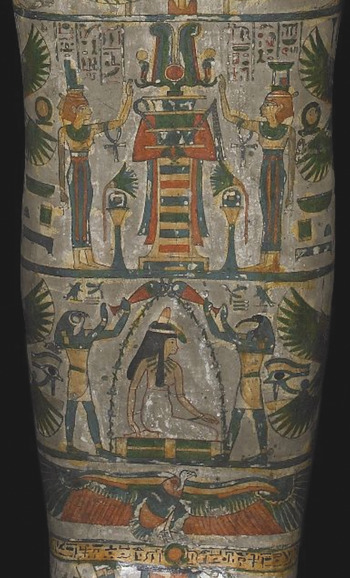
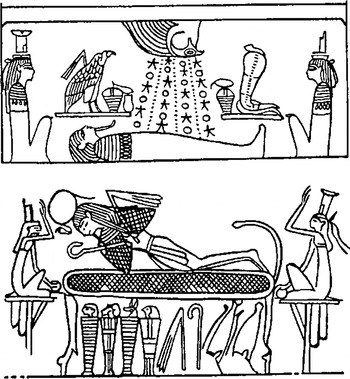
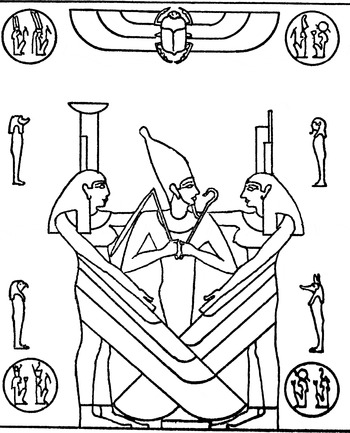
Within the Egyptian context, the portrayal in particular of Isis with her sister NephthysFootnote 43 provides a striking parallel of figures opposite to one another (sitting or standing, sometimes winged),Footnote 44 flanking a bier or a deceased person or mummy (sometimes in an upright position). In line with Warburg's Mnemosyne, there is an iconologicalFootnote 45 similarity in motif between John 20.12 and the images of Isis and Nephthys mourning Osiris and assisting him in his resurrection (see Fig. 1). According to Assmann, it is the wailing lamentation of Isis and Nephthys that proves powerful enough to reanimate Osiris's body.Footnote 46 Even though flanking also occurs in several other contexts, this iconological comparison also shares the main point of both scenes: resurrection, alongside mourning, the tomb setting, and so on.
Detail from a woman's coffin of painted cartonnage belonging to the priestess Tentmutengebtiu. The top scene shows Isis (to the left, as lady of the throne—see the head dress) and Nephthys (to the right, as lady of the house) flanking Osiris in the form of a djed pillar. The lower scene depicts Horus (left) and Thoth (right) purifying the deceased woman with water. This sarcophagus from Thebes, now in the British Museum (EA 22939), is dated to about 900 BCE. © Trustees of the British Museum, used with kind permission; detail as in: Ian Shaw and Paul Nicholson, The Dictionary of Ancient Egypt (New York: Harry N. Abrams, 2nd ed. 2003) 201

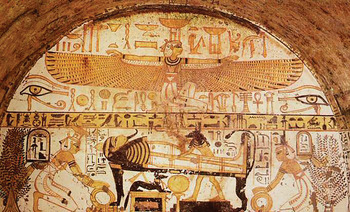
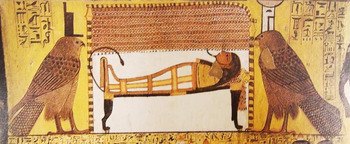
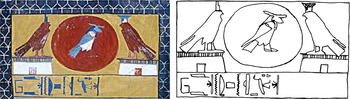
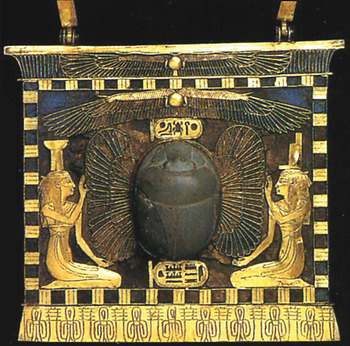
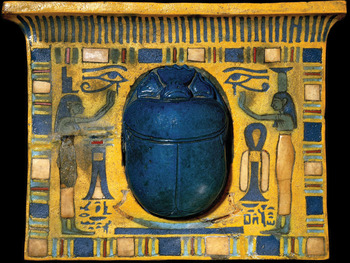
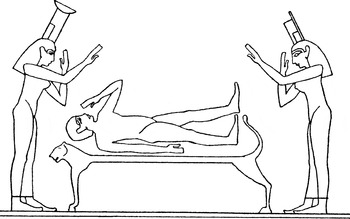
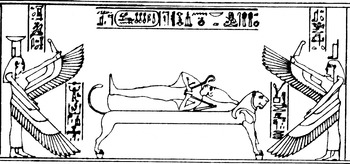
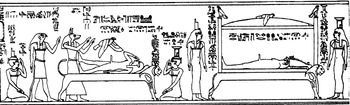
The motif of Isis and Nephthys assisting Osiris in his resurrection was employed in Egyptian tombs as a symbol of resurrection, by those seeking to secure their own afterlife (as in Fig. 2).Footnote 47 This composition shows Isis and Nephthys seated on both sides of the bier mourning Osiris, and Nephthys in the frieze as a figure with wings. Isis and Nephthys can also be represented as kites (Fig. 3). In this form they flank a mummy wearing an Osiris mask, which serves to identify it with Osiris's death and resurrection. Even more striking than merely flanking the bier, they explicitly sit at both ends of the bier: ‘one at the head and the other at the feet’ of the corpse. Moreover, the bier itself, being a lion bed, has head and foot ends, marked by the lion's head and the lion's tail.Footnote 48 The bird motif was also used for the three main roles of the composition. Figure 4 shows two kites flanking Re's ba, represented by a bird with a ram's head. The same flanking construction occurs with Isis and Nephthys as human figures flanking a winged scarab, another symbol of resurrection (Figs. 5 and 6).Footnote 49Figure 7 shows another example of Isis and Nephthys mourning and in another scene assisting Osiris in his resurrection. Figure 8 stems from Syria and provides evidence that the motif, in slightly different form, was not limited to Egypt.
Fresco 2 in the tomb of craftsman Khabekhenet at Deir el-Medina, dated to the 13th century BCE, depicting Nephthys and Isis mourning Osiris (upper register shows a winged Nephthys as lady of the sky). Cf. Alexandre Piankoff, Mythological papyri. Vol. 1, Texts (Egyptian Texts and Representations 3; Bollingen Series 40/3; New York: Pantheon, 1957) 51 (Fig. 34). Colour image: http://jfbradu.free.fr/egypte/LES%20TOMBEAUX/LES%20HYPOGEES/VALLEE-DES-ARTISANS/vallee-des-artisans07.php3?r1=5&r2=3&r3=0 (accessed 18 Feb. 2011)

Wall painting of the upper register of the west side of the south wall of the tomb of craftsman Sennedjem depicting Isis and Nephthys as kites flanking the mummy with an Osiris mask (13th century BCE). Source: G. Andreu, ed., Les artistes de Pharaon: Deir el-Médineh et la Vallée des Rois (Paris: Réunion des Musées Nationaux, 2002) 307. A similar image is known from the tomb of Nefertari (wife of Ramses II), Valley of the Kings, 13th century BCE. © Photo courtesy of photographer Georges Poncet, www.georges-poncet.fr/

Ceiling painting in the tomb of King Siptah (Valley of Kings 47), 12th century BCE, showing the Ba of Re as ram-headed bird, flanked by Isis and Nephthys as kites. Cf. B. M. Bryan, ‘Steatite Figures of Amenhotep III: An Example of the Purposes of Minor Art’, Chief of Seers: Egyptian Studies in Memory of Cyril Aldred (ed. E. Goring; Studies in Egyptology; London: Kegan Paul International, 1997) 60–82, esp. 67–8, 74 n. 53. Colour image: http://www.kv5.de/html_german/data_kv47_german.html (accessed 18 Feb. 2011); © Francis Dzikowski. Line drawing by author

Pectoral of Sheshonq II, 9th century BCE, found at Sheshonq's tomb in Tanis (now in Cairo Museum). Winged scarab flanked by seated Isis and Nephthys. Cf. E. Feucht-Putz. ‘Die königlichen Pektorale: Motive, Sinngehalt und Zweck’ (PhD diss., Munich, 1967) Plate XV, fig. 51. Colour image: http://jfbradu.free.fr/egypte/LA%20RELIGION/MOMIFICATION/amulettes.php3 (accessed 18 Feb. 2011)

Pectoral of Ptahemheb, c. 1275 BCE, from Memphis (now in British Museum, EA7865). Scarab flanked by standing Isis and Nephthys. Source: postcard from the British Museum; © 2006, Trustees of the British Museum

Two fragments of papyri with Isis and Nephthys seated and flanking Osiris, while mourning his death and assisting him in his resurrection. Dated to 1070–945 BCE. Source: O. Keel, Die Geschichte Jerusalems und die Entstehung des Monotheismus (Orte und Landschaften der Bibel 4/1; Göttingen: Vandenhoeck & Ruprecht, 2007) 724, figs. 492–3. See also: N. Rambova in Piankoff, Mythological papyri, 65 and 57 (figs. 53 and 42). Image used with permission

Ivory from Arslan Tasch, c. 1000 BCE, depicting the Horus child on a lotus flanked by two winged figures. Source: O. Keel, ‘Die Herrlichkeitserscheinung des Königsgottes’, Mythisches in biblischer Bildsprache: Gestalt und Verwandlung in Prophetie und Psalmen (ed. H. Irsigler; Qd 209; Freiburg im Breisgau: Herder, 2004) fig. 52 (cf. also figs. 48, 49, and 51). Image used with permission

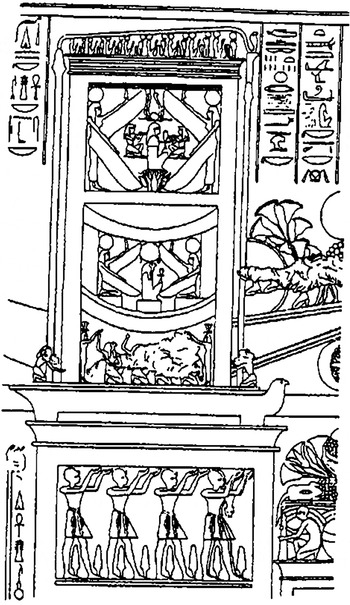
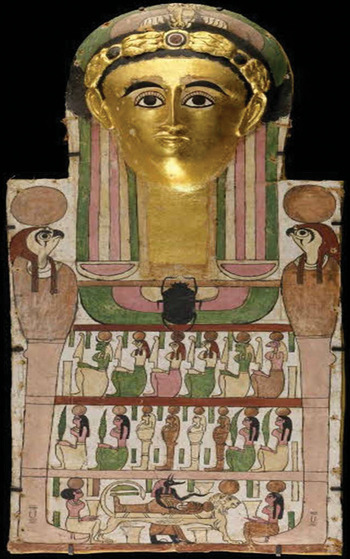
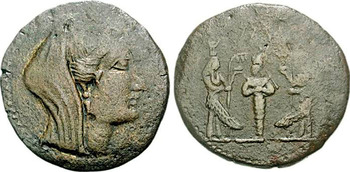
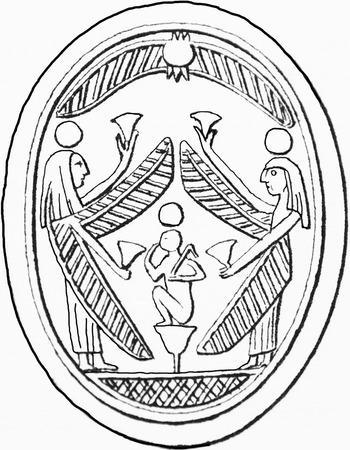
The iconological evidence given above for the motif can be dated far earlier than the text of John's Gospel. Although it cannot be denied that the Isis cult would have changed over the centuries, it is striking that this motif was found in later centuries as well. Similar drawings are known from the Isis temple in Philae (Figs. 9 and 10), which co-existed with Christianity.Footnote 50 The motif of Isis and Nephthys assisting Osiris in his resurrection not only decorated walls of tombs or mummy cartonnages (such as the second century CE example from Deir el-Medineh—Fig. 11), where few would see it, but it also appears on coins (Fig. 12), a medium which provides evidence for a wider distribution of the motif. A variant is also known from oil lamps; although Diana appears to be in the place of Nephthys, the motif is otherwise the same.Footnote 51 These two examples of small media make the case that this motif was indeed widespread. A related motif, symbolizing resurrection by means of the image of Isis (and Nephthys) protecting the Horus child, is also known from other coins, as well as from amulets (Fig. 13). These media indicate the dispersion and appropriation of these motifs and, moreover, of these flanking figures which mourn and mark resurrection. Together with the evidence from Philae, various drawings from Dendérah dated 80 BCE to 30 CE (Figs. 14–16) provide evidence that this motif was known and conspicuous in the first century.
Bas-relief at the eastern wall of the hall to the naos terrace of the temple in Philae, depicting Osiris standing between Isis and Nephthys. After: G. Bénédite, Le temple de Philae 1: Textes hiéroglyphiques (Mémoires publiées par les membres de la Mission Archéologique Française au Caire, Ministère de l'Instruction Publique et des Beaux-Arts 13; Paris: Leroux, 1893) Plate XXXVIII (detail on the left-hand side of the door)

Bas-relief at at the southern wall of the naos of the temple in Philae, depicting Isis and Nephthys bewailing the death of Osiris. After: Bénédite, Le temple de Philae, Plate XL (middle band, left side)

Painted coffin cartonnage belonging to Cratès with, in the lower register, Cratès identified with Osiris flanked by Isis and Nephthys. From Deir el-Medineh (now in the Louvre; E14542ter), dated to Roman Egypt (30 BCE–392 CE), probably 2nd century CE. Height: 75cm. © 2010, Musées du Louvre/Georges Poncet, http://www.louvre.fr/oeuvre-notices/masque-plastron-de-crates (accessed 25 March 2012)

Bronze coin of Melita (Malta), 218–175 BC (28mm; 12.39g). Obverse: veiled female head. Reverse: Osiris between winged Isis and Nephthys. Cf. Henry Clay Lindgren, Ancient Greek Bronze Coins: European Mints from the Lindgren Collection (San Mateo: Chrysopylon, 1989) Plate 29, item 659 (more examples can be found on: http://coins.mos.net.au/romancoins.htm, and http://www.bio.vu.nl/home/vwielink/WWW_MGC/Punic_map/Melita_map/Melita.html, both accessed 18-02-2011). Colour image: http://www.acsearch.info/record.html?id=81082 (accessed 5 Jan. 2012) Photo courtesy of Classical Numismatic Group, Inc. www.cngcoins.com. For a line drawing of a similar coin: A. della Marmora, Memoria sopra alcune antichità Sarde ricavate da un manoscritto del XV secolo (Torino: Stamperia Reale, 1853) 136, fig. a (offprint from Memorie della R. Accademia scienze di Torino: Scienze morali, storiche e filologiche, 2nd series 14 [1854] 101–252)

Cornelian gem found at Tharros (Sardinia) with Isis (mirrored or together with Nephthys) flanking the Horus child on lotus. Line drawing: Della Marmora, Sopra alcune antichità Sarde, Plate A, fig. 41. For similar gems from Sardina, Ibiza, Spain, Tunesia, and Cyprus: http://www.beazley.ox.ac.uk/gems/scarab/scarab11.htm, esp. items 11/118–11/125

Fragment from a wall painting of Isis and Nephthys flanking Osiris, while mourning his death and assisting him in his resurrection. Found at Dendérah, dated 80 BCE–30 CE. Source: A. Mariette, Dendérah: Description générale du grand temple de cette ville: IV (Paris: Franck, 1873) Plate 69: Grand Temple, chambre de la terasse. Osiris du sud, chambre No. 3; left part (cf. O. Keel, Gott weiblich: Eine verborgene Seite des biblischen Gottes [Freiburg im Üchtland: Bibel + Orient Museum, 2008] Fig. 17). Different versions of the motif Isis and Nephthys flanking Osiris are frequent in Dendérah (see below)

Grand Temple, chambres de la terrasse. Osiris du nord, chambre No. 1: Isis and Nephthys as winged figures flanking Osiris, while assisting him in his resurrection. Source: Mariette, Dendérah, Plate 73

Grand Temple, chambres de la terrasse. Osiris du nord, chambre No. 1: Isis and Nephthys (sitting on the left side and standing on the right side) flanking Osiris, while assisting him in his resurrection. Source: Mariette, Dendérah, Plate 90

Taken together, the iconological similarities and the historical-geographical co-incidence between, in the first instance, Isis and Nephthys flanking the bier of someone rising from the dead, and, secondly, the description in John 20.12 of ‘two angels sitting in white, one at the head and the other at the feet where the body of Jesus had been lying’, make a compelling case. We suggest that readers of the Fourth Gospel may have been familiar with the Isis cult and therefore could have understood the description of John 20.12 as an ‘icon of resurrection’.Footnote 52 This is not to say that these readers would have been unaware of the differences between John's description and the Egyptian ‘icon of resurrection’, such as most obviously Jesus' absent body, Jesus' victory over death without help of others, and furthermore the unique, once-for-all nature of his resurrection in opening ‘the realm beyond death’. Nevertheless, our argument is that they may have recognized important similarities between the two images. This hypothesis is even stronger if the Fourth Gospel was written in Ephesus. If this is the case, not only might readers familiar with the Isis cult have received the text as an allusion to this motif, but, one is even tempted to ponder, the Gospel's author also might perhaps have consciously phrased this verse to echo this iconography of Egyptian origin.
Two additional remarks, one on mourning and the other on a possible link with Gnosticism, round off this section.
1. The paragraphs above focus on the element of resurrection. It is clear that the aspect of mourning could have been worked out as a further parallel. It should be noted, however, that it is Mary Magdalene who mourns, while the angels wonder at her weeping, as their message is Jesus' resurrection. The mourning, though, underlines the point that Jesus' death is absolutely real and therefore also suggests that resurrection transforms the body, distinguishing it from a process of either returning from death and dying again, as with Lazarus,Footnote 53 or cyclically dying and rising again, as with Osiris.
John's account of Mary Magdalene seems to have been problematic within the discussion about gender roles in the Early Church. The Fourth Gospel might be read as evidence of the discussion because it mixes Mary's visit to the tomb with that of Peter and John. Moreover, it does not report any reaction by the disciples to Mary's testimony of her encounter with the risen Lord. Setzer assumes this gender issue to be symbolic of the Orthodox–Gnostic struggle.Footnote 54 Gnostic circlesFootnote 55 would have had more room for the role of women.Footnote 56 This leads to the second point.
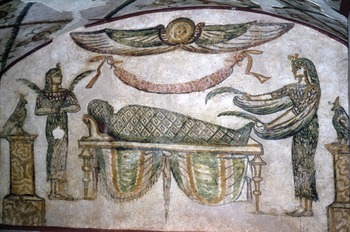
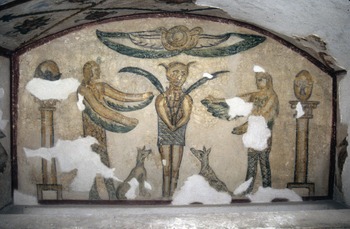
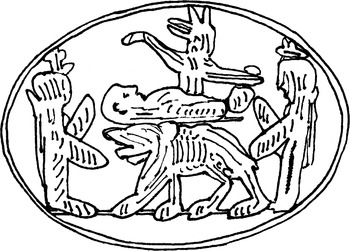
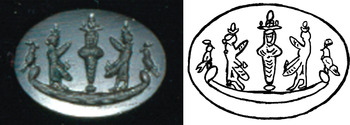
2. Besides suggesting the Isis cult as a possible background for understanding John 20.12, the motif of Isis and Nephthys flanking Osiris while assisting him in his resurrection appears elsewhere as well. Possibly in the context of an Isis mystery cult, it might have gained meaning as a metaphor of re-birth in initiation rituals.Footnote 57 Marjorie Venit interprets the early second-century CE tomb fresco of Figure 17 as the bier of an initiate in the Isis cult; and she makes a case that Figure 18, which adds the standing version of the motif to that portraying the figure horizontally, shows how someone is initiated, or reborn into the mystery cult.Footnote 58 This example, although again found in a tomb, is corroborated by other striking evidence of familiarity with this motif and its significance in later Christian or Gnostic sources.Footnote 59 The strict contrast between Christian and Gnostic is highly questionable in these cases, as there are amulets with NT scenes on one side and motifs from Egyptian religion on the other side.Footnote 60 The motif of Isis and Nephthys flanking Osiris and assisting him in his resurrection is also known from amulets that can be catalogued as Gnostic amulets.Footnote 61 Other than the scene in the Tigrane tomb, which Roman-Hellenistic influence has provided with a Roman bed (Fig. 17), these amulets still have the lion bed and the other elements of the traditional Isis–Osiris–Nephthys scene (Figs. 19 and 20); the latter even has both Isis and Nephthys and the birds. This Gnostic evidence may provide further evidence of familiarity with this motif.
Fresco from the central niche of the Tigrane Tomb (Alexandria), first half of the 2nd century CE. The fresco depicts a mummy on a bier, flanked by Isis and Nephthys. Source: M. Venit, ‘Isis in Tombs of Alexandria and the Egyptian Chora: Tradition and Innovation’, Isis on the Nile: Egyptian Gods in Hellenistic and Roman Egypt: Proceedings of the IV thInternational Conference of Isis Studies, Liège, November 27–29 2008 (ed. L. Bricault and M. J. Versluys; RGRW 171; Leiden: Brill, 2010) 89–119, esp. 109, fig. 12 (black-and-white). Photographer: Marjorie S. Venit who kindly granted permission to use this image and provided the colour photograph for the digital version of the present article

Fresco from the left niche of the Tigrane Tomb (Alexandria), first half of the 2nd century CE. The fresco depicts a male holding palm branches, flanked by two jackals and by two ‘winged, nemes-headdressed, trousered males’. Source: Venit, ‘Isis in Tombs of Alexandria and the Egyptian Chora’, 110–11, fig. 13 (black-and-white). Photographer: Marjorie S. Venit who kindly granted permission to use this image and provided the colour photograph for the digital version of the present article

Green jasper amulet (Staatliche Kunstsammlung Kassel 142, line drawing by author based on various photos), dated to the 2nd century CE. The obverse depicts Isis and Nephthys flanking the mummy of Osiris on a lion (bed?); Anubis stands behind the lion with Osiris. Cf. P. Zazoff, ed., Antike Gemmen in deutschen Sammlungen: Berlin, Braunschweig, Göttingen, Hamburg, Hannover, Kassel, München. Band 3: Braunschweig, Göttingen, Kassel. 1: Text; 2: Tafeln (Wiesbaden: Steiner, 1970) Text: 231; Tafeln: plate 102, Kassel 142

Green jasper amulet from Egypt (now in the Kelsey Museum, KM26061), possibly dated to the 1st century CE. The obverse depicts Isis and Nephthys flanking the mummy of Osiris (upright). The three are standing on a boat and are flanked by two birds (kites or hawks?). © Kelsey Museum of Archaeology, University of Michigan. Line drawing by author. Cf. C. Bonner, Studies in Magical Amulets Chiefly Graeco-Egyptian (University of Michigan Studies: Humanistic Series 49; Ann Arbor: University of Michigan, 1950) 253 + Plate I, 2. Colour image kindly provided by the Kelsey Museum of Archaeology

In sum, a number of the readers (and possibly even authors or editors) of the Gospel of John may be assumed to have been familiar with the Isis cults. The (Hellenistic versions of the) Isis cult provides a striking visual parallel with John 20.12. Both underline the themes of mourning and resurrection. Reception of the Fourth Gospel in Gnostic circles would have further strengthened the recognition of this parallel.
4. Summary and Conclusions
The angels whom, according to John 20.12, Mary Magdalene sees in the empty tomb are usually ignored beyond the narrative level of the resurrection account given in John 20.1–18. Only a few scholars have explored the meaning of the angels and the space between them. On the narrative level, the angels can be regarded as something supernatural, their question can stress Mary Magdalene's sorrow and distress, and the empty place between them could be filled with the message of the resurrection. If more meaning is suggested, such usually draws on a familiarity with the OT.
This article has presented arguments demonstrating that certain readers of the Fourth Gospel would have been familiar with influences from Egypt, as acknowledged by other scholars, and in particular, that one visual element would have been contemporary and conspicuous in the Roman Empire, spread by the (Hellenistic versions of the) Isis cult; that is, Isis and Nephthys flanking a bier. Further, focusing on this well-known visual expression, this article has compared John 20.12 with the motif of Isis and Nephthys mourning Osiris and assisting him in his resurrection. Besides presenting this iconological comparison, the present article has also corroborated the link historically by pointing out the presence of this motif in the first centuries CE. The various media (frescos, reliefs, coins, amulets, oil lamps) which carry the motif indicate how widespread this constellation was. Its reception in Gnostic circles might also have contributed to an awareness of this motif among readers of John.
Readers familiar with the motif of Isis and Nephthys flanking Osiris are assumed to have recognized it in the description of the angels in John 20.12. Tentatively, it has even been pondered whether the Gospel's author himself would have consciously phrased this verse to echo this Egyptian motif. If this is the case, this might perhaps have highlighted the differences between the resurrections of Jesus and Osiris, such as the assistance Osiris received versus Jesus' resurrection as part of his glorification, having overcome death in his own death on the cross.
Thus, assuming its readers' familiarity with the Isis cult, we strongly suggest that John 20.12 has been read as an icon of resurrection. This iconographic connection affirms and deepens the meaning of the text, and we have shown that it can also be confirmed through other forms of exegesis. Thus, the Fourth Gospel's early historical context, in which the Isis cult played a significant role, also confirms the two angels as an icon of mourning and resurrection. Finally, although at the narrative level it is not until Mary Magdalene recognizes the risen Jesus that she can testify to having seen the Lord, when one re-reads John 20.12, aware of the complete narrative and focusing on the symbolic level, this ‘Egyptian context’ points out why the space between the angels is empty and thus confirms that Mary Magdalene can change her mourning tears into a risus paschalis, an Easter laugh.Footnote 62