Introduction
Interspecific competition plays an important role in shaping community composition (Schoener Reference Schoener1983; Morin Reference Morin2009). According to the competitive exclusion principle, if two coexisting populations of different species with different population growth rates occupy the same ecological niche, the dominant species will replace the other species (Hardin Reference Hardin1960; Cushing et al. Reference Cushing, Levarge, Chitnis and Henson2004; Johnson and Bronstein Reference Johnson and Bronstein2019). However, many competing species with overlapping ecological niches can coexist when some degree of niche differentiation exists (Schoener Reference Schoener1974). The common mechanisms of niche differentiation include spatial or temporal resource partitioning, ecological displacement, and partitioning along a resource spectrum (Brown and Wilson Reference Brown and Wilson1956; MacArthur Reference MacArthur1984; Dayan and Simberloff Reference Dayan and Simberloff2005).
When they co-occur in the same host (Hawkins Reference Hawkins2005), parasitoids have overlapping ecological niches. Due to the scarcity of hosts, competition for hosts is inevitable (Van Alebeek et al. Reference Van Alebeek, Rojasrousse and Leveque1993). Interspecific competition is an important factor influencing the coexistence of parasitoid species and the use of host resources (Godfray and Godfray Reference Godfray and Godfray1994). Interspecific competition for host resources may occur between adult parasitoids (extrinsic competition; Van Alphen and Visser Reference Van Alphen and Visser1990; Harvey et al. Reference Harvey, Poelman and Tanaka2013; Crespo et al. Reference Crespo, Martinez and Castelo2015) or between larval parasitoids developing within the host (intrinsic competition; Laing and Corrigan Reference Laing and Corrigan1987; Yamamoto et al. Reference Yamamoto, Henderson, Corley and Iwabuchi2007). Extrinsic competition is affected mainly by parasitoid search efficiency and reproductive ability on the host. Intrinsic competition is mainly affected by the larval development rate of the parasitoid and the order and interval of parasitoid oviposition (Cusumano et al. Reference Cusumano, Peri, Vinson and Colazza2012).
Understanding the factors affecting interspecific competition is particularly important when parasitoids are used as biological control agents. Depending upon the researcher, the release of multiple parasitoid species is believed to either enhance (Stiling and Cornelissen Reference Stiling and Cornelissen2005) or reduce (Briggs Reference Briggs1993; Denoth et al. Reference Denoth, Frid and Myers2002) suppression of the pest population. Pachycrepoideus vindemmiae and Spalangia endius (Hymenoptera, Pteromalidae) are important pupal parasitoids of the house fly, Musca domestica (Diptera: Muscidae). In one study of broiler-breeder chicken facilities in the United States of America, approximately 8.0–10.2% of house fly pupae were parasitised, with P. vindemmiae and S. endius accounting for approximately 28.9–38.0% and 24.0–42.4% of parasitoids, respectively (Dry et al. Reference Dry, Steinkraus, Steelman, McNew and McKay2007). Both parasitoid species currently are used in biological control, with their mass release proving effective for controlling house fly populations (Morgan et al. Reference Morgan, Patterson, Labrecque, Weidhaas, Benton and Whitfield1975; Tormos et al. Reference Tormos, Beitia, Böckmann, Asís and Fernández2009; Van Lenteren Reference Van Lenteren2012; Cranshaw and Broberg Reference Cranshaw and Broberg2015).
Both P. vindemmiae and S. endius are solitary ectoparasitoids with similar development times (mean ± standard deviation; P. vindemmiae = 19.7 ± 1. 7 days; S. endius = 18.7 ± 1.4 days) at 25 °C but differing in other key aspects, such as parasitism rate, adult longevity, and fecundity (Zhan et al. Reference Zhan, Zhou, He, Chen, Duan, Hu and Xiao2013; Chen et al. Reference Chen, He, Ji, Tang and Hu2015). In particular, parasitism rate is an important indicator of parasitic ability in wasps (Harvey et al. Reference Harvey, Poelman and Tanaka2013). However, most studies on the parasitism rates of these two species have not considered actual field situations (Wang and Messing Reference Wang and Messing2004b; Hu et al. Reference Hu, Chen, Duan, Zheng and Zhang2012). Typically, in the reproductive period of the house fly, many parasitoids are present simultaneously in or near the habitat of the host. Studies in natural and experimental conditions have revealed that P. vindemmiae and S. endius can parasitise the same host, a behaviour termed “multiparasitism” (Van Alphen and Visser Reference Van Alphen and Visser1990; Gibson and Floate Reference Gibson and Floate2004; Harvey et al. Reference Harvey, Poelman and Tanaka2013). Because host resources typically support the development of only a single parasitoid, competition for hosts is high. Moreover, the sequence of oviposition events and the time interval between successive oviposition events are important factors influencing the result of parasitoid competition (Magdaraog et al. Reference Magdaraog, Harvey, Tanaka and Gols2012; Valente et al. Reference Valente, Afonso, Goncalves and Branco2019). The first larva usually occupies a dominant position because it starts using limited resources before competitors do. However, some studies show that a parasitoid species may display a superior competitive ability regardless of the order and time interval of oviposition (Mucheru et al. Reference Mucheru, Jiang, Kongoro, Bruce and Schulthess2009; Bai et al. Reference Bai, Li, Chen, Cheng and He2011).
We examined and assessed niche differentiation and the intrinsic competitiveness of these two parasitoid species. The larvae of the house fly usually occupy moist habitats with temperatures of approximately 30–40 °C, but they move to drier sites at 20–25 °C a few days before pupating. House fly pupae are often found on the sides of dung piles, on the soil surface, and a few centimetres below the surface (Hafez Reference Hafez1953). To assess niche differentiation, we examined the ability of the parasitoids to locate host pupae buried at different depths in three types of substrate. To assess intrinsic competitiveness, we allowed first one species, then the other species, to parasitise the same host individuals within set periods of time of each other.
Materials and methods
Insect rearing
House fly adults were collected on the campus of Anhui Normal University (31° 20′ 10.48″ N, 118° 22′ 9.82″ E) in Anhui Province, China in 2015 and were maintained in laboratory culture. Adults were housed in cages (40 cm × 40 cm × 40 cm) and fed granulated sucrose and a 1:1 mixture of condensed milk with water. We put 200 g of wet wheat bran containing 40% water in a dish into the cage to obtain eggs. The dishes were removed every 24 hours, and the wheat bran with house fly eggs was transferred to another plastic basin with about 2 kg wet wheat bran. Each day, the basin with 2 kg of wheat wet bran was gently mixed to more evenly distribute the larvae within the diet. Extra wet wheat bran was added if movement of larvae to the surface of the bran suggested additional food was required. Five days later, older house fly larvae were moved to an empty basin that contained dry wheat bran. One day later, larvae pupated on the bottom of the dry wheat-bran plastic basin.
The parental stock of P. vindemmiae and S. endius originated from house fly pupae collected in 2016 on the campus of Anhui Normal University and subsequently maintained in laboratory culture on house fly pupae within glass vials (diameter: 25 mm; height: 50 mm). Wasp adults were provisioned with cotton wool soaked with honey for food. Insect colonies were maintained, and experiments were performed under conditions of 25 °C ± 1 °C, 70% ± 5% relative humidity, and a 14:10-hour light : dark photoperiod.
In the present study, we used house fly pupae (aged three days) and female wasps (aged two to three days) that had been mated one day previously. Females were obtained by isolating parasitised fly pupae in 1.5-mL Eppendorf tubes until emergence of adult wasps (after ca. 15 days). Males were then paired with virgin females (both sexes 24–48 hour posteclosion) and monitored for five minutes, by which time mating was normally observed. Females that had not mated by this time were not used in the study.
Substrate and host depth
To assess the effect of substrate porosity on the ability of parasitoids to locate host pupae, we used three types of substrate: sand (low porosity), dry wheat bran (intermediate porosity), and spent fly diet (high porosity). The sand was commercial construction sand ranging in size from 0.25 to 0.50 mm. The dry wheat bran was purchased from local markets. The spent fly diet was diet in which house fly larvae had been reared for colony maintenance and then dried.
For each type of substrate, we set up plastic cups (diameter: 7 cm; height: 9 cm) in which house fly pupae (40 pupae per cup) were buried at depths of 0, 1, 2, 4, or 6 cm. Then, three parasitoid treatments were tested: (1) one mated adult female P. vindemmiae and one mated adult female S. endius parasitoid were placed into each of a series of cups, (2) one mated adult female P. vindemmiae was placed into each of a second series of cups, and (3) one mated adult female S. endius was placed into each of a third series of cups. A cotton ball dipped in 10% honey water was also placed in each cup to provide food for the adult parasitoids. Five replicate cups were set up for each combination of depth, substrate, and parasitoid treatment. After 24 hours, the parasitoid(s) and pupae were removed from each cup. With five replicates for each combination of depth, substrate, and parasitoid treatment, a total of 225 cups were observed (5 depths × 3 substrates × 3 parasitoid treatments × 5 replicates).
Pupae removed from cups were held individually in 1.5-mL Eppendorf tubes for emergence of flies or parasitoids, with the species and number of parasitoids recorded. After allowing one week for the complete emergence of the parasitoids (about 30 days after the exposure to parasitoids), pupae from which neither flies nor parasitoids had emerged were dissected under a microscope (VHX-5000; Keyence Corporation, Osaka, Japan). Adult parasitoids recovered from these pupae were recorded as emerged, given that emerged parasitoids often re-entered the empty host pupae.
Time interval and sequence of oviposition
To examine the effect of time interval and oviposition sequence on the outcome of competition between P. vindemmiae and S. endius within a host, we exposed house fly pupae within a glass vial (diameter: 4 cm; height: 5 cm; 10 pupae/vial) to either a P. vindemmiae or a S. endius female. After oviposition behaviour on the host pupae was observed, the pupae were immediately removed and then re-exposed to a female of the other species after 0, 24, 48, 72, or 96 hours. House fly pupae parasitised only by P. vindemmiae or S. endius were used as controls. Five replicate vials were set up for each combination of parasitoid sequence and time.
Data analyses
To examine the effect of substrate and host depth when house fly pupae were exposed concurrently to S. endius and P. vindemmiae, as reflected by the number of parasitoid wasp progeny, analysis was conducted with generalised linear models. A Poisson distribution model was used for the analysis of count data, and a binomial distribution model was used for the analysis of proportions. The level of compliance between the analysed data and the assumed distribution type was determined by calculating the HF (residual/df) value of the model. A large HF value (>1) indicates deviation from the assumed distribution type, which will cause the overestimation of significance. In such cases, a quasi-Poisson model was used instead of a Poisson model for count data, and a quasi-binomial model was used instead of a binomial model for proportion data. Each model was screened after preliminary fitting, and the final model was selected based on the F test. To examine the effect of substrate and host depth when house fly pupae were exposed to either S. endius or P. vindemmiae, the above method was also used.
To examine the effect of exposure sequence and interval between exposure periods, the data of offspring were analysed using the χ2 test or Fisher’s exact test. All data analyses were done using the R statistical environment (R Core Team 2008).
Results
Substrate and host depth
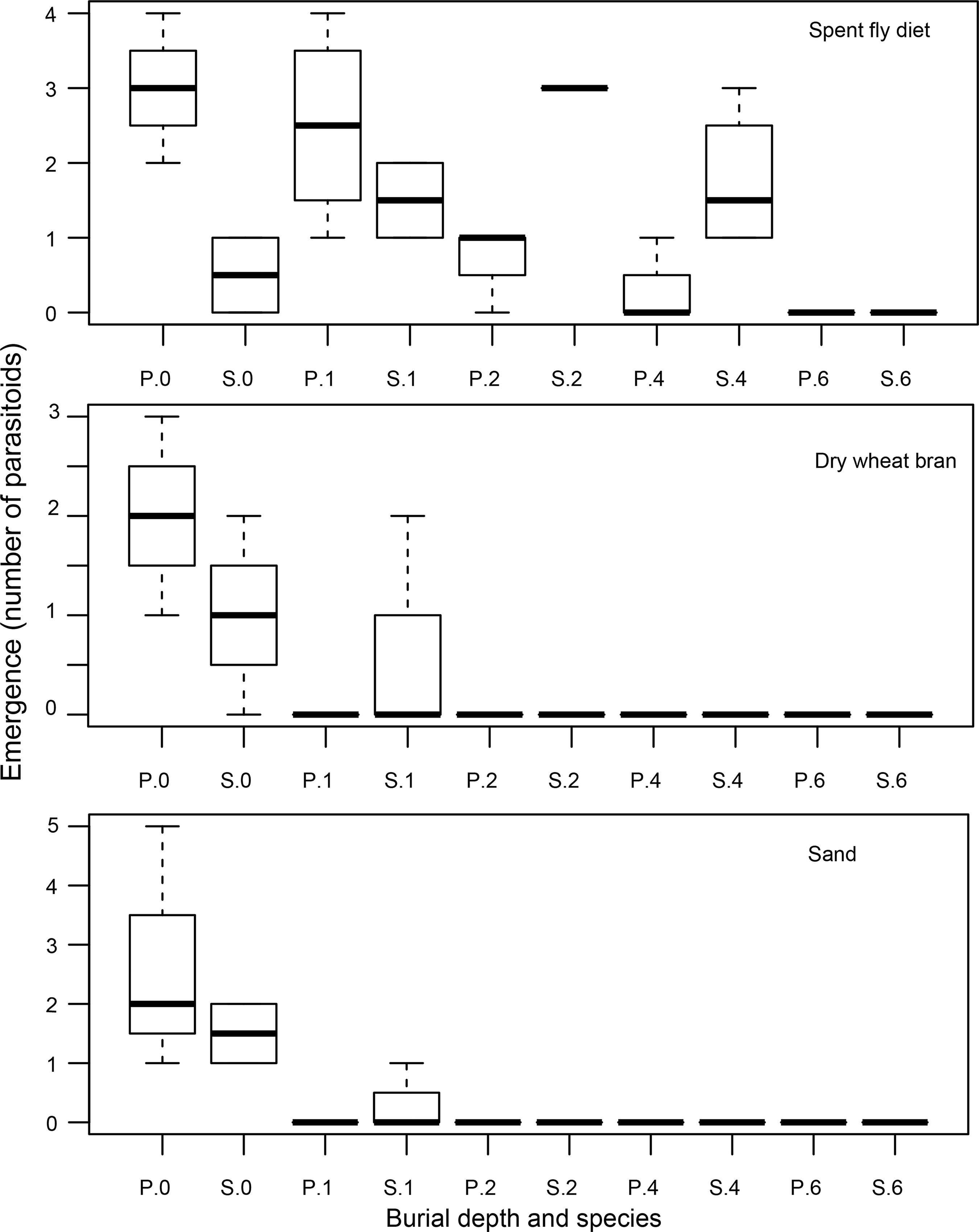
In cups in which house fly pupae were exposed concurrently to both species of parasitoids, S. endius exhibited a greater ability to locate host pupae buried in each type of substrate (Fig. 1). Significant differences occurred in the number of offspring between the two parasitoid species at each depth except at 6 cm in the spent fly diet. The quantity of P. vindemmiae offspring exhibited a gradual decline with increasing depth, whereas the quantity of S. endius offspring exhibited a parabolic shape, first increasing and then declining with depth (Fig. 1). In addition, the percentage of P. vindemmiae offspring significantly decreased in the spent fly diet as the depth increased, whereas that of S. endius significantly increased (F = 19.97, df = 1,14, P < 0.01; F = 23.54, df = 1,14, P < 0.01). Also, in dry wheat bran, the substrate was so dense that the parasitoids produced no offspring at depths greater than 1 cm, although S. endius produced more offspring than P. vindemmiae did (except at the depth of 0 cm). Furthermore, in the sand substrate, only S. endius offspring emerged from the depth of 1 cm; no offspring emerged from the other depths.
Effect of burial depth (0, 1, 2, 4, and 6 cm) and substrate (spent fly diet, dry wheat bran, and sand) on the emergence of parasitoids from house fly pupae exposed concurrently to Pachycrepoideus vindemmiae (P) and Spalangia endius (S).

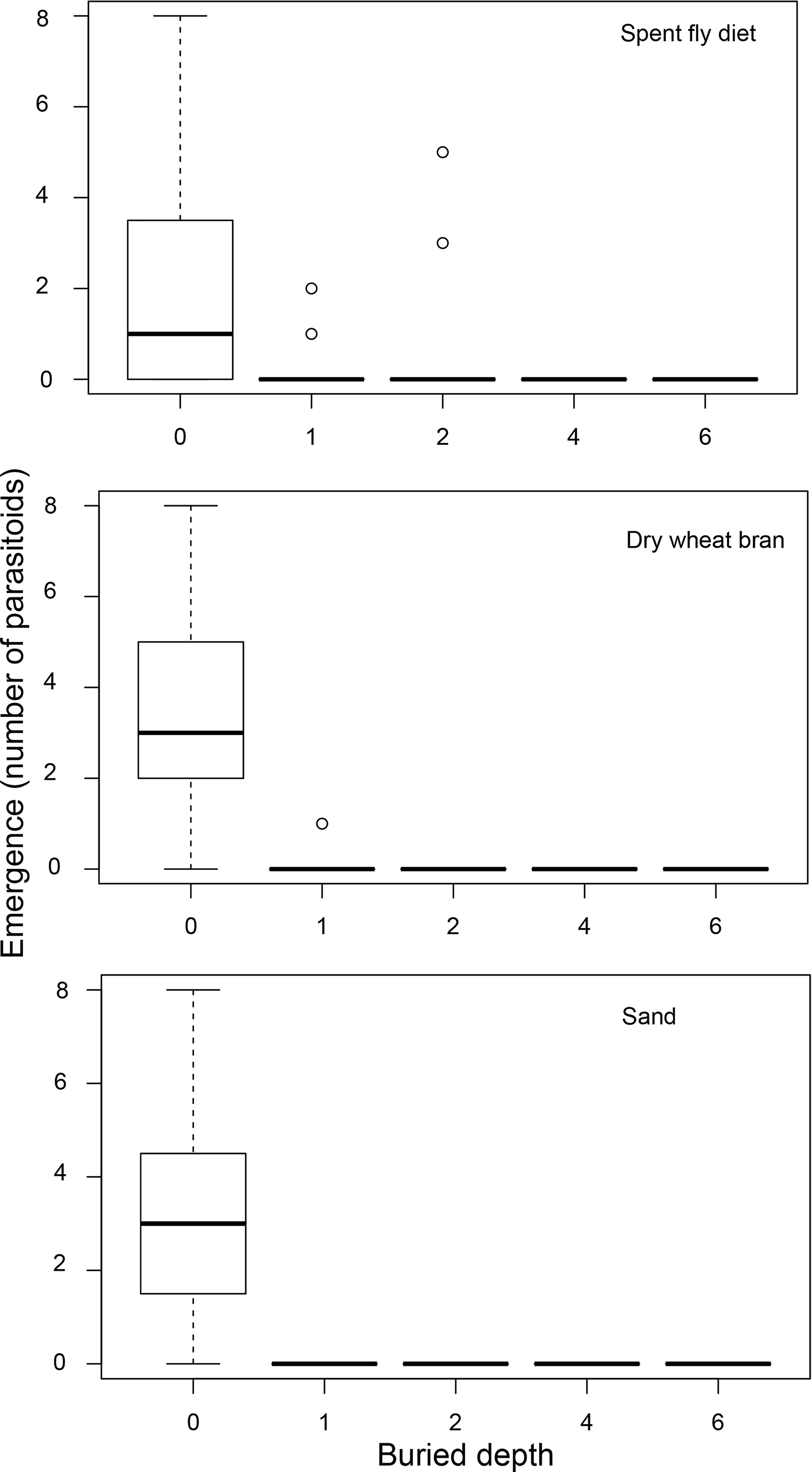
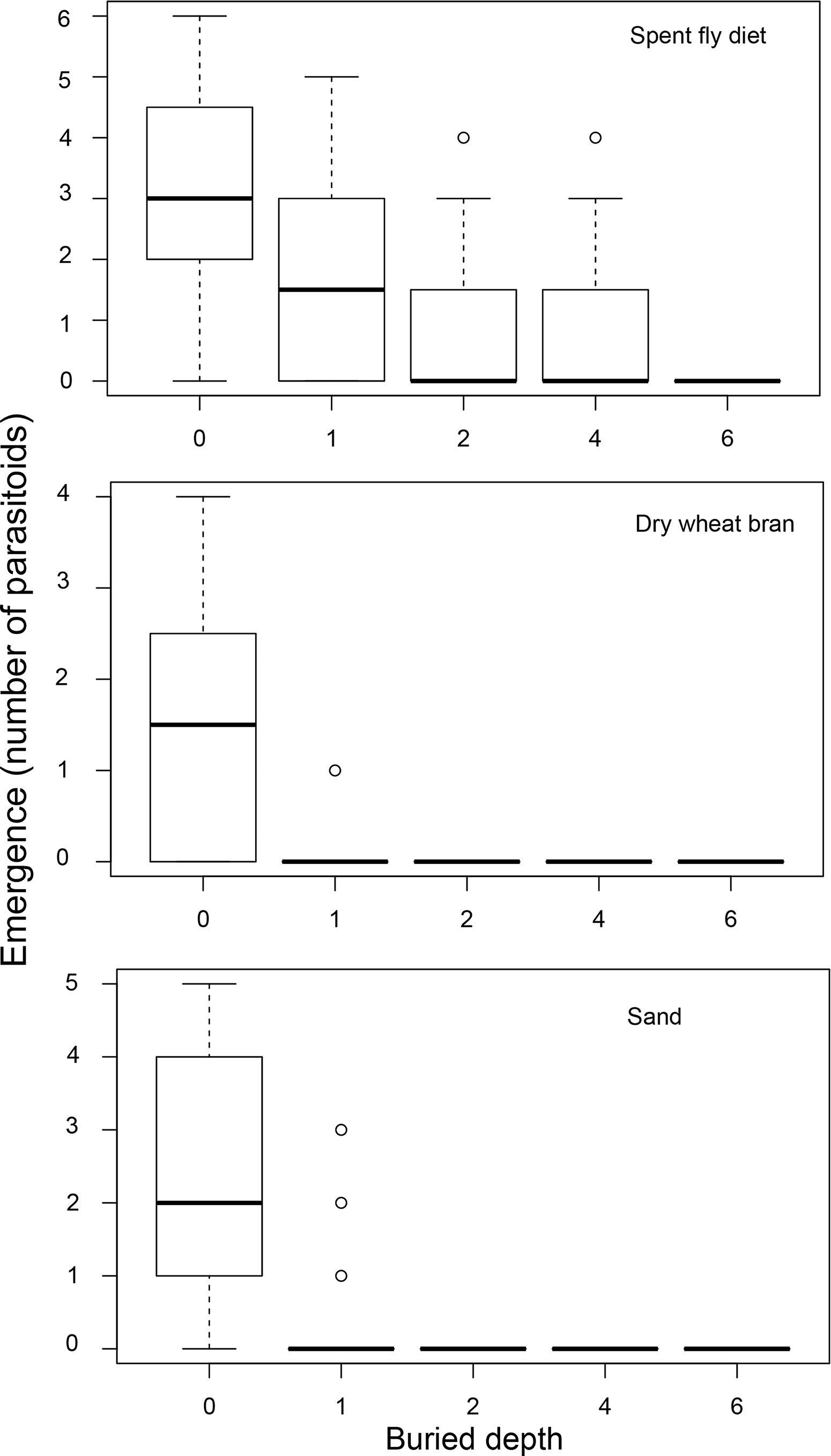
In cups in which house fly pupae were exposed to either P. vindemmiae or S. endius, burial of house fly pupae reduced parasitism in each substrate (F = 88.68, df =1,298, P < 0.01; F = 148.48, df = 1,298, P < 0.01). The number of offspring did not differ between the two parasitoids at the depth of 0 cm (i.e., on the surface of the substrate; F = 1.40, df = 1,118, P > 0.05; Figs. 2–3). However, at the depth of 1 cm, the difference between the two species was significant, with significantly more S. endius offspring than P. vindemmiae offspring occurring (F = 17.69, df = 1,118, P < 0.01). At the depth of 2 cm, adult wasps emerged only in the spent fly diet. Furthermore, at the depth of 4 cm, only S. endius yielded progeny and only in the spent fly diet. At the depth of 6 cm, neither parasitoid species produced offspring.
Effect of burial depth (0, 1, 2, 4, and 6 cm) and substrate (spent fly diet, dry wheat bran, sand) on the emergence of parasitoids from house fly pupae exposed to Pachycrepoideus vindemmiae.

Effect of burial depth (0, 1, 2, 4, 6 cm) and substrate (spent fly diet, dry wheat bran, sand) on the emergence of parasitoids from house fly pupae exposed to Spalangia endius.

Time interval and sequence of oviposition
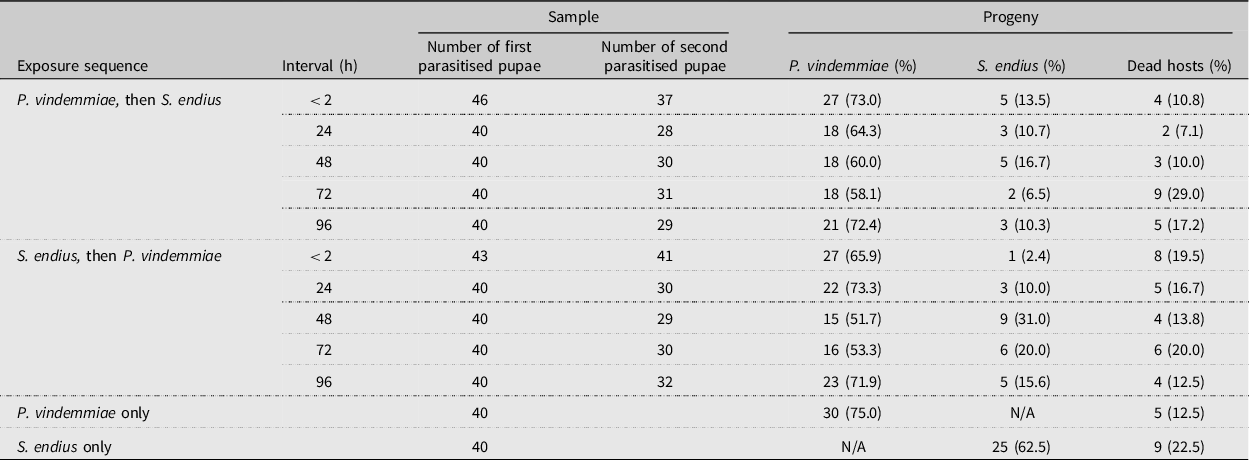
When pupae of M. domestica were first parasitised by P. vindemmiae, then by S. endius at a time interval of less than two hours, S. endius oviposited in 80.0% of the hosts (n = 46; Table 1). We investigated additional time intervals of 24, 48, 72, and 96 hours and found that time interval did not affect the proportion of host pupae parasitised by the second wasp species – that is, by S. endius (χ 2 = 1.53, df = 4, P > 0.05). After approximately 17 days, wasps began to emerge from the hosts, and the results showed that P. vindemmiae adults emerged from 73% of the host pupae when the time interval was within two hours, which was significantly greater than the corresponding percentage for S. endius (χ 2 = 8.58, df = 1, P < 0.01). Furthermore, significantly more P. vindemmiae adults than S. endius adults emerged from hosts regardless of time interval (Fisher’s exact test, all P < 0.01).
Emergence of parasitoids from house fly pupae exposed first to one of Pachycrepoideus vindemmiae or Spalangia endius, then to the other after time intervals of less than 2, 24, 48, 72, and 96 hours.

We conducted a similar experiment wherein hosts were subjected to oviposition first by S. endius and then by P. vindemmiae. The results showed that 95.3% of the host pupae (n = 43) were parasitised by P. vindemmiae when the time interval was less than two hours. Time interval had no significant effect on the proportion of pupae parasitised by P. vindemmiae (χ 2 = 5.40, df = 4, P > 0.05). The number of S. endius individuals emerging from hosts was significantly affected by time interval (χ 2 = 12.23, df = 4, P > 0.01), with more S. endius adults emerging as the time interval increased. However, more P. vindemmiae than S. endius successfully emerged from hosts when combined across all time intervals excluding 48 hours (Fisher’s exact test, all P < 0.05).
Discussion
Our combined results (Figs. 2–3) indicate that P. vindemmiae was better able to parasitise host pupae on the surface of substrates but that S. endius was better able to locate pupae buried within substrates. This finding suggests that, compared to P. vindemmiae, S. endius has a stronger ability to better penetrate into the substrate or detect the host by smell (Machtinger et al. Reference Machtinger, Geden, Kaufman and House2015). Previous studies have found that P. vindemmiae is weak at parasitising hosts in fruit or soil (Wang et al. Reference Wang, Kacar, Biondi and Daane2016). Many studies have shown that parasitoids search for hosts by odour (Penaflor et al. Reference Penaflor, Erb, Miranda, Werneburg and Bento2011; Morawo and Fadamiro Reference Morawo and Fadamiro2016; Roscoe et al. Reference Roscoe, Lyons, Ryall and Smith2016). For example, Nasonia vitripennis (Hymenoptera: Pteromalidae) locates hosts using the olfactory cues of the host and its immediate environment – that is, fly puparia and bird nests (Peters Reference Peters2011). Different species of parasitic wasps are attracted to different odours in nature; for example, the foraging strategy of Tachinaephagus zealandicus (Hymenoptera: Encyrtidae) may focus on the carrion–blowfly ecosystem rather than the manure–muscid system (Geden and Skovgård Reference Geden and Skovgård2014). Thus, greater parasitism of buried host pupae by S. endius might reflect a stronger ability than that possessed by P. vindemmiae to locate the host by its odour. Future studies should focus on the ability of these two species to detect hosts by odour. In a field survey, Skovgård (Reference Skovgård2006) found that buried fly pupae were more likely to be parasitised by Spalangia cameroni than by Muscidifurax raptor (Hymenoptera: Pteromalidae), which suggested to the authors that M. raptor may be more phototropic. Therefore, we speculate that these two parasitoid species coexist in nature due to niche differentiation. Other studies also show differences in the ability of parasitoid species to locate and parasitise house fly pupae at different depths in various substrates (Legner Reference Legner1977; Rueda and Axtell Reference Rueda and Axtell1985; King Reference King1997; Floate and Spooner Reference Floate and Spooner2002; Geden Reference Geden2002).
Ovipositing P. vindemmiae and S. endius co-occur in habitats that support house fly development (Dry et al. Reference Dry, Steinkraus, Steelman, McNew and McKay2007; Chiel and Kuslitzky Reference Chiel and Kuslitzky2016), such that cases of multiparasitism are inevitable (Haccou et al. Reference Haccou, Glaizot and Cannings2003). In the present study, the two parasitoid species competed in the same patch, and the number of parasitoids emerging from hosts declined with increasing burial depth. However, relative to that of P. vindemmiae, the parasitism rate of S. endius increased gradually with depth and exceeded that of P. vindemmiae beyond a certain depth. Both S. endius and P. vindemmiae are solitary parasitoids, with only one wasp emerging from each host. Under competition in the same habitat, P. vindemmiae had a higher parasitism ratio of hosts at the substrate surface. It can be speculated that P. vindemmiae was dominant in interspecies competition between the wasps, having a stronger ability to compete for hosts.
To further study the interspecific competition between these two parasitoid species, the effects of parasitism interval and sequence of the two parasitoid species were investigated. Usually, it is beneficial to be the first species to exploit a host. The immature progeny of the first parasitoid develops in the absence of competitors and potentially can kill the eggs or larvae of parasitoids that may later oviposit in that same host (Mackauer et al. Reference Mackauer, Michaud and Volkl1996; Wang and Messing Reference Wang and Messing2003; De Moraes and Mescher Reference De Moraes and Mescher2005). Conversely, in some cases, the first larva injects material into the host to improve the larval environment but then dies from the host’s immune response, whereas the second larva survives in the changed environment (Poelman et al. Reference Poelman, Gols, Gumovsky, Cortesero, Dicke and Harvey2014). However, inconsistent with the above two observations, we found no influence of oviposition time interval or oviposition sequence on the outcome of competition. More P. vindemmiae than S. endius individuals emerged from the hosts, with P. vindemmiae winning in intrinsic competition against S. endius. The results suggest that P. vindemmiae has a competitive advantage over S. endius.
Previous studies have shown that P. vindemmiae exhibits facultative hyperparasitism and strong larval competition (Wang and Messing Reference Wang and Messing2004a). For this reason, we speculate that this species may have an excellent competitive ability or strong mobility ability in the larval stage and that it may cause the death of other parasitoid eggs or larvae. Goubault et al. (Reference Goubault, Fourrier, Krespi, Poinsot and Cortesero2004) showed that P. vindemmiae adults exhibit ovicide and larvicide, being able to kill the eggs or larvae of other parasitoids in previously parasitised hosts. In addition, Chen et al. (Reference Chen, Liu, He, Duan and Hu2011), He et al. (Reference He, Liu, Chen, Chen, Duan and Hu2013), and Zhan et al. (Reference Zhan, Zhou, He, Chen, Duan, Hu and Xiao2013) have shown that P. vindemmiae develops more rapidly than S. endius. Together, these studies indicate that multiple factors may contribute to the dominance of P. vindemmiae in competition with S. endius.
Generally, in this study, we found that P. vindemmiae was more likely to emerge from host pupae in cases of multiparasitism but that adults of S. endius were more efficient than P. vindemmiae at locating buried hosts. Through the differentiation of their ecological niche, these two parasitoid species have achieved coexistence. In addition, the results of this study suggest that to enhance biological control, parasitoid species could be selected according to environmental features – for example, the host habitat and the risk of interspecific competition (Pawson et al. Reference Pawson, Petersen and Holtzer1987; Wang and Messing Reference Wang and Messing2004a; Geden and Skovgård Reference Geden and Skovgård2014; Machtinger et al. Reference Machtinger, Geden, Kaufman and House2015). Future research efforts should investigate the frequency of multiparasitism occurring in natural environments, especially in relation to niche differentiation of insect communities.
Acknowledgments
The authors thank the anonymous reviewers for their many useful comments. This work was supported by the National Natural Science Foundation of China (31672351, 31172145).