Introduction
Conducting intensive space-related studies are essential as sooner or later humans will make the first steps towards colonizing space. A large variety of experiments are carried out in space stations (Ichijo et al., Reference Ichijo, Yamaguchi, Tanigaki, Shirakawa and Nasu2016; Nadir, Reference Nadir2017; Checinska Sielaff et al., Reference Checinska Sielaff, Urbaniak, Mohan, Stepanov, Tran, Wood, Minich, McDonald, Mayer, Knight, Karouia, Fox and Venkateswaran2019; Voorhies et al., Reference Voorhies, Mark Ott, Mehta, Pierson, Crucian, Feiveson, Oubre, Torralba, Moncera, Zhang, Zurek and Lorenzi2019). For successful exploration, the safety of space stations and astronauts play a key role. Except for radiation, stress and medical effects on astronauts' health, microbes play a pivotal role. Microorganisms may cause direct and indirect harm in spaceships. The first corresponds to the diseases-causing infections, and the second implies corrosion of space equipment.
Among the various metals aluminium (Al) is selected for the construction of spacecraft equipment due to its lightweight, durability and strength out of other benefits (Calle et al., Reference Calle, Li, Buhrow, Johansen and Calle2018). However, it can still be vulnerable to microbial impact. In particular, certain bacteria and fungi can cause corrosion which is called microbiologically influenced (or induced) corrosion (MIC) that refers to electrochemical interaction of metal surface and microorganisms which causes metal degradation (Gu et al., Reference Gu, Xu, Zhang, Li and Lindenberger2015). As the microbiome isolated and identified in spaceships is initially terrestrial, the pre-launch microbial diversity of the space stations during assembly merits attention. Among two types of metal corrosion caused by microbes, type II represents a more speedy process and is defined as metabolite MIC (biocorrosion associated with microbial metabolic products, such as organic/inorganic acids, exopolymers, etc.) which includes acid-producing bacteria and fungi (Gu and Galicia, Reference Gu and Galicia2012). Many microorganisms are capable to produce acids. Metal corrosion rate increases in a low pH environment (Gu and Galicia, Reference Gu and Galicia2012). Metal surfaces become more susceptible when the environment between the metal and the biofilm is acidic (Videla and Herrera, Reference Videla and Herrera2005; Castaneda and Benetton, Reference Castaneda and Benetton2008; Kryachko and Hemmingsen, Reference Kryachko and Hemmingsen2017). Moreover, Al is known to become soluble along with the acidity increment (Martin, Reference Martin1986; Macdonald and Martin, Reference Macdonald and Martin1988) that makes it toxic to microorganisms (Pina and Cervantes, Reference Pina and Cervantes1996; Kunito et al., Reference Kunito, Isomura, Sumi, Park, Toda, Otsuka, Nagaoka, Saeki and Senoo2016). Thus, Al-resistant microbes that also tolerate high acidity merit attention with respect to the acceleration of Al corrosion.
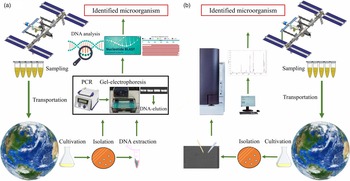
Despite the existing preventive operations, the environment in space station assembly cleanrooms cannot be sterile (La Duc et al., Reference La Duc, Dekas, Osman, Moissl, Newcombe and Venkateswaran2007; Ghosh et al., Reference Ghosh, Osman, Vaishampayan and Venkateswaran2010; Koskinen et al., Reference Koskinen, Rettberg, Pukall, Auerbach, Wink, Barczyk, Perras, Mahnert, Margheritis, Kminek and Moissl-Eichinger2017). Thus, studying potentially material-damaging extremophilic microbes isolated from space station assembly cleanrooms is of significant importance as it can aid to prevent possible risks of structural failure in space stations and effectively optimize the prevention strategies. The first step of the microbial survey is to identify them to evaluate the risk we are dealing with. The conventional identification methods, e.g. 16S ribosomal RNA (16S rRNA) gene and internal transcribed spacer (ITS) sequencing, are successfully used. However, the disadvantage still exists as these methods are quite time-consuming and laborious (Sauer et al., Reference Sauer, Freiwald, Maier, Kube, Reinhardt, Kostrzewa and Geider2008). Matrix-assisted laser desorption/ionization time-of-flight mass spectrometry (MALDI-TOF MS) is a rapid and reliable technology used for the identification of microorganisms which is based on the mass detection of molecules, particularly proteins (Sören Schubert and Kostrzewa, Reference Sören Schubert and Kostrzewa2017). MALDI-TOF MS is a feasible, robust, method while the subsequent steps of conventional method include DNA extraction, agarose gel electrophoresis, DNA elusion, processing the resulted sequences and blasting on the National Center of Biotechnology Information (NCBI). The schematic illustration of the comparison of two identification methods is given in Fig. 1. To sum up, using MALDI-TOF MS significantly shortens the time of identification (Rahi et al., Reference Rahi, Prakash and Shouche2016; Sören Schubert and Kostrzewa, Reference Sören Schubert and Kostrzewa2017). This method is well implemented in clinical laboratories as it effectively replaces conventional biochemical and phenotypic analytical methods (Sören Schubert and Kostrzewa, Reference Sören Schubert and Kostrzewa2017; Welker et al., Reference Welker, Van Belkum, Girard, Charrier and Pincus2019). The present study aimed to isolate acid- and Al-tolerant bacteria and fungi from China space station assembly cleanroom (CSSAC) surfaces using Al-containing and acidic media; and to identify microbes with two methods: traditional (16S rRNA/ITS sequencing) and relatively new (MALDI-TOF MS); and to evaluate the feasibility of each method.
Comparison of two identification methods. (a) The procedures needed to identify microorganisms isolated from the space station using 16S rRNA/ITS sequencing methods. (b) The identification of microorganisms isolated from the space station using the MALDI-TOF MS method.

Materials and methods
pH measurement
The pH was checked by pH-meter (Horiba, LAQUAtwin-pH-22) which requires a few drops of a liquid sample to be placed on the flat sensor.
Sampling sites and sample processing
Samples were taken from 39 different surfaces in the Assembly, Integration, and Test (AIT) centre (Tianjin, China). These sampling locations include a logistic channel (LC), clean storage (CS) area, air shower room (AS), dressing room (DR) and encapsulation hall (EH). The sampling was conducted with sterile cotton swabs in accordance with the ECSS-Q-ST-70-55C standard (ECSS 2008). The heads of the swabs were pre-moistened with the sterile phosphate-buffered saline (PBS). Each swab was applied for every 25 cm2 over the entire area horizontally, vertically and diagonally (Kwan et al., Reference Kwan, Cooper, La Duc, Vaishampayan, Stam, Benardini, Scalzi, Moissl-Eichinger and Venkateswaran2011); then the swabs, with sticks still attached, were placed in tubes containing 10 ml of sterile PBS. The swabs only moistened with PBS were used as negative controls. For detaching the microbes from the swab heads, sample tubes were ultra-sonicated at 40 kHz for 2 min and vortexed thoroughly before aseptically removing the cotton heads from the solution. In total, 1.5 ml sample suspensions were placed at 4℃ for a week while the microbes were isolated and analysed. The rest of the sample solutions were stored at −80℃ freezer in a 50% glycerol solution. The samples were named according to the location of the AIT centre which is located in Tianjin (TJ), China. The consistency of sample codes with the identified strains and sampling sites is given in Tables 1 and 2.
Identified bacteria and their origins

Identified fungi and their origins

Note: (*) indicates the strain that was not included in the MALDI-TOF MS analysis because they were not represented in the MALDI-TOF MS reference database.
Isolation of acid- and aluminium-tolerant microbes
The liquid media was selected for inoculation of acid and Al-tolerant microorganisms as follows: Modified Luria-Bertani (LB) broth was prepared with mixing 10 g of tryptone, 5 g of yeast extract and 10 g of NaCl, and filled with distilled water up to 1 l. After autoclaving it on 121℃ for 20 min, Al2(SO4)3 water solution and 30 ml citric acid monohydrate (2 M) water solution were added using 0.22 μm filter papers and syringes in order to make the final concentration of Al 100 ppm and pH 3.5 in the liquid media.
In total, 500 μl of the sample was introduced into 20 ml of media in 50 ml tubes. This was followed by incubating all the samples in a shaker (128 rpm) at 28℃ for 1 week. Then 100 μl of each sample was inoculated and spread on LB (pH = 6.4) and Potato Dextrose Agar (PDA) (pH = 4.7) solid media using two methods: normal spreading method and facultative anaerobes method (Henning et al., Reference Henning, Vijayakumar, Adhikari, Jagannathan, Gautam and Muriana2015) – after another layer of solid media was poured above the microbial lawn to form a facultative anaerobic environment for the microorganisms (see in Fig. 2). The growth of colonies was observed. The media always contained Al with a concentration of 100 ppm in both LB and PDA. After the final isolation of strains, polymerase chain reaction (PCR) and 16S rRNA and ITS sequencing analysis were carried out, respectively, for bacteria and fungi. At the same time, the isolated strains were frozen at −80℃ in glycerol solution.
The inoculation method for facultative anaerobes: after spreading the microbial consortia, another layer of media is poured on the microbial lawn.

Identification
16S rRNA sequencing
After obtaining isolated colonies, colony PCR (Walch et al., Reference Walch, Knapp, Rainer and Peintner2016) was carried out using P0 forward: 5′-GAGAGTTTGATCCTGGCTCAG-3′ and P6 reverse: 5′-CTACGGCTACCTTGTTACGA-3′ primers specific to the 16S rRNA gene (Popović et al., Reference Popović, Ivanović, Živković, Trkulja and Ignjatov2013). The PCR reaction was carried out in a total volume of 25 μl containing 2.5 μl of 10X Taq buffer, 1.5 μl of 25 mM MgCl2, 0.5 μl of 2.5 mM dNTPs (Tiangen, Beijing, China), 0.5 μl of 100 nmol P0, 0.5 μl of 100 nmol P6 (Sangon Biotech, Beijing, China), bacterial colony sample, 0.3 μl of 5 U μl−1 DNA-polymerase (Thermo Scientific, Beijing, China) and 19.2 μl double-distilled (dd) water. The reaction regimen of PCR was as follows: denaturation for 90 s at 95℃ was followed by 30 cycles of denaturation at 95℃ for 30 s, annealing at 56℃ for 30 s and extension at 72℃ for 60 s. The reaction was completed with 72℃ for 10 min. After confirmation of DNA amplification with agarose gel electrophoresis with fragments of approximately 1500 bp, the samples were sent to Sangon Biotech (Beijing, China) where the amplicons were purified (SanPrep Column PCR Product Purification Kit, Sangon Biotech, Beijing, China) and the sequencing was performed via Sanger sequencing method.
ITS sequencing
Once isolation of fungi was attained and single colonies were formed, DNA extraction was conducted using the thermolysis method according to Zhang et al. (Reference Zhang, Zhang, Liu, Wen and Wang2010).
The primers used for ITS region amplification were: ITS1 forward: 5′-TCCGTAGGTGAACCTGCGG-3′ and ITS4 reverse: 5′-TCCTCCGCTTATTGATATGC-3′ (Kumar and Shukla, Reference Kumar and Shukla2005; Zarrin et al., Reference Zarrin, Ganj and Faramarzi2016). The PCR reaction was carried out in a total volume of 25 μl containing 2.5 μl of 10X Taq buffer, 1.5 μl of 25 mM MgCl2, 0.5 μl of 2.5 mM dNTPs (Tiangen), 0.5 μl of 100 nmol ITS1, 0.5 μl of 100 nmol ITS4 (Sangon Biotech, Beijing, China), 1 μl of fungal extracted DNA, 0.3 μl of 5 U μl−1 DNA-polymerase (Thermo Scientific) and 18.2 μl dd water. The PCR conditions were the following: the initial denaturation by heating to 95℃ for 90 s, followed by 25 cycles of 95℃/30 s, 52℃/30 s, 72℃/60 s. The reaction was completed with 72℃ for 10 min. After verification of the successful DNA amplification by agarose gel electrophoresis with fragments of approximately 550 bp, the DNA samples were sent to Sangon Biotech (Beijing, China) where the amplification products were purified (SanPrep Column PCR Product Purification Kit, Sangon Biotech, Beijing, China) and the sequencing was performed via Sanger sequencing method.
Constructing phylogenetic trees
The trimmed sequences were aligned and the phylogenetic trees were constructed using the neighbour-joining method available in MEGA version 7.0.26 and the Kimura 2-parameter model (Kumar et al., Reference Kumar, Stecher and Tamura2016). The tree topology was evaluated by bootstrapping based on 1000 replicates.
MALDI-TOF MS
Bruker MALDI Biotyper was used for the current experiment. The main procedure of this analysis includes the cultivation of microorganisms (bacteria, fungi) sampling microbial cells from a single colony with the sterile toothpick and smearing it on a metal target plate which is followed by applying formic acid, after drying it α-Cyano-4-hydroxycinnamic acid is overlaid. All this procedure is needed to improve the protein extraction. Once the plate is dry, the laser desorption/ionization time of flight analysis takes place (Jang and Kim, Reference Jang and Kim2018). First, the ionization of sample molecules via laser occurs. Then the detector detects masses of molecules. The calibration was performed using the standard strain of Escherichia coli DH5alpha BRL. The standard contained a carefully manufactured extract of this microorganism that shows a characteristic peptide and protein profile in MALDI-TOF MS spectra. The detected spectrum peaks correspond to the mass of the most abundant proteins in a sample which turns out to be specific for the analysed microbial species (Singhal et al., Reference Singhal, Kumar, Kanaujia and Virdi2015; Seuylemezian et al., Reference Seuylemezian, Aronson, Tan, Lin, Schubert and Vaishampayan2018). Thus, identification occurs automatically using software Bruker Biotyper MS version 3 which is responsible to compare the spectral profile of tested microorganism with a reference database DB 7311. MN945389, MN945392, MN945398 were not analysed by this method as they were not included in the MALDI-TOF MS library.
Results
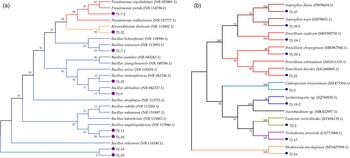
Out of 39 surface samples, nine bacterial and 10 fungal strains were isolated and identified (Tables 1 and 2). All the microbes were found to be aerobic or facultatively anaerobic. After blasting the sequences on NCBI, the accession numbers were assigned (MN932154–MN932161, MT027600; MN945389–MN945398) and the phylogenetic trees of 16S rRNA and ITS genes were constructed for bacteria and fungi, respectively ( Fig. 3).
Phylogenetic trees of identified microorganisms. (a) Phylogenetic tree of 16S rRNA genes showing the position of isolated bacterial strains; the predominant identified bacterial genus is Bacillus. The rest of the bacteria are of Pseudomonas and Brevundimonas genera. (b) Phylogenetic tree of ITS genes showing the position of isolated fungal strains. The predominant fungi were of Penicillium and Aspergillus genera which were followed by Cladosporium, Sordariomycetes, Trichoderma and Fusarium.

Concurrently, the isolated microorganisms were identified using the MALDI-TOF MS method. Some of the strains showed identical results to the conventional method while most did not (Tables 3 and 4). Only two of the nine bacterial isolates (Table 3) were identified as the same genus and species between the two methods (TJ-32 and TJ-35), and of the MALDI-TOF MS identifications that had positive reliability levels (five of the nine isolates), one was identified as a different genus (TJ-9). Concerning the fungal isolates that could be identified by MALDI-TOF MS, three out of the seven isolates (Table 4) were identified as the same genus and species between the two methods (TJ-37, TJ-39-2 and TJ-16), and of the MALDI-TOF MS identifications that had positive reliability levels, all identified the same genus. However, only three of the seven MALDI-TOF MS fungal identifications had positive reliability levels. Thus, when MALDI-TOF MS identifications had positive reliability levels, it often identified the same genera of bacteria and fungi, but different species.
The comparison of bacteria identified by two methods: conventional 16S rRNA gene sequencing and MALDI-TOF MS

The sign (+++) indicates highly probable species, (++) indicates secure genus identification and probable species, (+) indicates probable genus identification, and (−) indicates not reliable identification.
The comparison of fungi identified by two methods: conventional ITS region sequencing and MALDI-TOF MS

The sign (+++) indicates highly probable species, (++) indicates secure genus identification and probable species, (+) indicates probable genus identification, and (−) indicates not reliable identification.
Discussion
Certain inconsistencies were detected in the results of two identification methods. The mismatch may be explained by several reasons. The insufficient spectra in the database are among them. This might result in an incorrect identification or not reliable identification. Mismatches may also take place when part of the analysed microbial species is presented in the MALDI-TOF library while others are absent (Rychert, Reference Rychert2019). One of the limitations of MALDI-TOF is the difficulties to differentiate between certain highly related organisms (Dingle and Butler-Wu, Reference Dingle and Butler-Wu2013; Rychert, Reference Rychert2019). Another reasonable cause of such diverse results may be the different and unique protein expression as prior to identification they have encountered to environmental stress such as low pH (3.5) of growth media which can cause mutations and changes in their metabolism (Farrell and Finkel, Reference Farrell and Finkel2003; Maurer et al., Reference Maurer, Yohannes, Bondurant, Radmacher and Slonczewski2005), including altered protein production via upregulation or downregulation of certain genes (Tucker et al., Reference Tucker, Tucker and Conway2002; Broadbent et al., Reference Broadbent, Larsen, Deibel and Steele2010). MALDI-TOF MS bio-typing is already common in clinical microbiology but its reference database still seems to be insufficiently accessible.
In the current study, Bacillus was the predominant genus isolated from CSSAC. Bacillus spp. use several mechanisms against the adaptation of various stress conditions, such as acidic milieu. The cells survive harsh environments through maintenance of their cell wall integrity (Goswami et al., Reference Goswami, Panda, Samanta, Boro, Modi, Bujarbaruah and Barooah2018) as well as developing their stress response which enables their survival in the low pH environment (Browne and Dowds, Reference Browne and Dowds2002; Thomassin et al., Reference Thomassin, Jobin and Schmitt2006). Bacillus is one of the most dominant genera isolated from MIR (Russian manned spacecraft) (Novikova, Reference Novikova2004) and ISS (Novikova et al., Reference Novikova, De Boever, Poddubko, Deshevaya, Polikarpov, Rakova, Coninx and Mergeay2006; Lang et al., Reference Lang, Coil, Neches, Brown, Cavalier, Severance, Hampton-Marcell, Gilbert and Eisen2017; Checinska Sielaff et al., Reference Checinska Sielaff, Urbaniak, Mohan, Stepanov, Tran, Wood, Minich, McDonald, Mayer, Knight, Karouia, Fox and Venkateswaran2019). According to the existing data, it is resilient to the harsh cleaning methods (Zhang et al., Reference Zhang, Zhang, Li, Xin, Li, Wang and Deng2019) as well as space conditions including gravity-associated stress, radiation (Kacena et al., Reference Kacena, Merrell, Manfredi, Smith, Klaus and Todd1999; Gabani et al., Reference Gabani, Copeland, Chandel and Singh2012; Fajardo-Cavazos et al., Reference Fajardo-Cavazos, Narvel and Nicholson2014), as well as the acidity (Goswami et al., Reference Goswami, Panda, Samanta, Boro, Modi, Bujarbaruah and Barooah2018). Cortesao et al. have demonstrated that Bacillus subtilis spores can survive the simulated Mars surface environment (Cortesão et al., Reference Cortesão, Fuchs, Commichau, Eichenberger, Schuerger, Nicholson, Setlow and Moeller2019). Bacillus is also reported to cause metal corrosion (Rajasekar and Ting, Reference Rajasekar and Ting2010; Xu et al., Reference Xu, Li, Song and Gu2013; Karn et al., Reference Karn, Fang and Duan2017; Liu et al., Reference Liu, Wang, Pan, Zhao, Zhan, Gao, Guo, Guo, Sand, Chang, Dong and Yin2019). Another isolated operational taxonomic unit (OTU) Pseudomonas is also found to cause metal deterioration (Abdolahi et al., Reference Abdolahi, Hamzah, Ibrahim and Hashim2014). It represents the slime-forming microbe meaning that after producing the number of enzymes and other extracellular substances it can form biofilms (Kim et al., Reference Kim, Tengra, Young, Shong, Marchand, Chan, Pangule, Parra, Dordick, Plawsky and Collins2013; Telegdi et al., Reference Telegdi, Shaban, Trif and El-Sherik2017) on metal surfaces which is also common for Bacillus spp. (Rajasekar and Ting, Reference Rajasekar and Ting2010). Biofilm is a microbial consortium with self-produced extracellular polymeric substances on surfaces, e.g., metal surfaces. Its development can alter electron transfer and accelerate metal corrosion (Beech and Sunner, Reference Beech and Sunner2004; Moura et al., Reference Moura, Pontual, Paiva, Coelho and Méndez-Vilas2013). The biofilms have already appeared and had negative effects on materials used to make space station components (Klintworth et al., Reference Klintworth, Reher, Viktorov and Bohle1999; Zea et al., Reference Zea, Nisar, Rubin, Cortesão, Luo, McBride, Moeller, Klaus, Müller, Varanasi, Muecklich and Stodieck2018). The impact can be more adverse when the pH beneath the biofilm is low due to organic acid production (Kryachko and Hemmingsen, Reference Kryachko and Hemmingsen2017). In the current study, except for Bacillus, and Pseudomonas, another genus Brevundimonas was also identified. Brevundimonas originally classified under the Pseudomonas genus is already isolated from the spacecraft assembly cleanroom (Stieglmeier et al., Reference Stieglmeier, Rettberg, Barczyk, Bohmeier, Pukall, Wirth and Moissl-Eichinger2012) as well as ISS (Checinska et al., Reference Checinska, Probst, Vaishampayan, White, Kumar, Stepanov, Fox, Nilsson, Pierson, Perry and Venkateswaran2015) and owes the biofilm formation capacity (Mori et al., Reference Mori, Gomi, Matsumune, Niizeki and Sakagami2013).
Many fungi are known to be resistant to hostile environmental conditions as well as having degradation ability. The identified fungal genera in the current study coincide with the ones isolated from space stations, such as Penicillium, Aspergillus (Knox et al., Reference Knox, Blachowicz, Palmer, Romsdahl, Huttenlocher, Wang, Keller and Venkateswaran2016; Checinska Sielaff et al., Reference Checinska Sielaff, Urbaniak, Mohan, Stepanov, Tran, Wood, Minich, McDonald, Mayer, Knight, Karouia, Fox and Venkateswaran2019), Cladosporium (Novikova, Reference Novikova2004; Novikova et al., Reference Novikova, De Boever, Poddubko, Deshevaya, Polikarpov, Rakova, Coninx and Mergeay2006), Rhodotorula (Reidt et al., Reference Reidt, Helwig, Müller, Plobner, Lugmayr, Kharin, Smirnov, Novikova, Lenic, Fetter and Hummel2017; Checinska Sielaff et al., Reference Checinska Sielaff, Urbaniak, Mohan, Stepanov, Tran, Wood, Minich, McDonald, Mayer, Knight, Karouia, Fox and Venkateswaran2019). Furthermore, the studies have revealed their metal deterioration capacity, e.g., Penicillium (Yang et al., Reference Yang, Chen, Wei and Lin1996, Reference Yang, Lin and Lin1998; Smirnov et al., Reference Smirnov, Belov, Sokolova, Kuzina and Kartashov2008), Aspergillus (Dai et al., Reference Dai, Wang, Ju, Cheng, Cong and Newby2017; Jirón-Lazos et al., Reference Jirón-Lazos, Corvo, De la Rosa, García-Ochoa, Bastidas and Bastidas2018), Cladosporium (Yang et al., Reference Yang, Lin and Lin1998), Fusarium (Yang et al., Reference Yang, Lin and Lin1998; Smirnov et al., Reference Smirnov, Belov, Sokolova, Kuzina and Kartashov2008). Penicillium and Aspergillus are also studied to be acid-tolerant genera (Kawai et al., Reference Kawai, Zhang and Sugimoto2000; Glukhova et al., Reference Glukhova, Frank, Danilova, Avakyan, Banks, Tuovinen and Karnachuk2018). Interestingly, Trichoderma has been evidenced to survive for about 1 year in outer space (Neuberger et al., Reference Neuberger, Lux-Endrich, Panitz and Horneck2015). According to the abovementioned, up to now, Bacillus, Penicillium, Aspergillus and Cladosporium represent predominant and perhaps problematic microbial genera in crewed spacecraft.
The microbes analysed in the present study are acid- and Al-tolerant that are found to be space-associated and involved in metal deterioration processes. The studies referenced above have already revealed acid production and metal degradation ability of the same genera. Thus, the identified microorganisms in this work might have the potential of acid production and Al corrosion capacity. However, the research needs to be continued in this direction to further evaluate the direct impact of isolated microbes on Al. The coexisting microbial consortia, especially in biofilms, usually represent more of a threat than each microbe separately (Yang et al., Reference Yang, Lin and Lin1998). Hence, the experiments studying the risks which may arise by the joint impacts of the identified microorganisms are needed to be carried out as well.
Accessing the information on acid- and Al-tolerant microorganisms that are abundant on the surfaces of CSSAC is noteworthy for making the space exploration safer. More information can improve the implementation of preventive and protective methods. As a result, the transportation of microbes into the China Space Station (CSS) can be minimized. This will significantly decrease the chance of Al corrosion. The coincidence of strains isolated in ISS, MIR and CSSAC is given in Table 5. Bacteria and fungi isolated from CSSAC are resistant to the harsh environment and they survive the preventive methods. Besides the environmental stress, in the space station, there is no preferred medium for microbes. These conditions might stimulate the mutation of genes to survive. The protective biofilm formation capacity may also play a certain role in the prevention of Al corrosion in space stations.
Dominant bacteria and fungi isolated from MIR, ISS and from the surfaces of CSSAC

The boldface indicates the common genera and species for CSSAC isolates and MIR/ISS.
Despite all the preventive procedures, e.g. continuous monitoring, frequent cleaning, using biocides, coatings, the environment of spaceships prior to launch is not aseptic (La Duc et al., Reference La Duc, Dekas, Osman, Moissl, Newcombe and Venkateswaran2007; Schwendner et al., Reference Schwendner, Moissl-Eichinger, Barczyk, Bohmeier, Pukall and Rettberg2013). Interestingly, there are some studies regarding the anti-bacterial properties of bacteriophages – bacterial viruses that act very specifically and are already in use in medicine (Parfitt, Reference Parfitt2005; Torres-Barceló, Reference Torres-Barceló2018). Moreover, phages have already been studied as anti-corrosion agents (Pedramfar et al., Reference Pedramfar, Maal and Mirdamadian2017). Thus, the researches with the direction of phage-therapy development against metal corrosion seem to be promising.
Conclusions
To conclude, this is the first study where Al- and acid-tolerant bacteria and fungi were isolated from CSSAC surfaces and identified with conventional and MALDI-TOF MS methods. Bacillus and Penicillium represent the predominantly detected genera. The majority of the analysed microbes in this work match with the previously reported acid-producing and Al-corrosive OTUs from ISS. This stipulates their accidental transportation in spacecraft despite the constant monitoring measures. The provided data might be useful for further evaluation and prevention of Al corrosion. Making the MALDI-TOF database more comprehensive will further facilitate the identification of extremophilic microbes. Consequently, this research may lay the groundwork for studies toward the direction of evaluating Al corrosion by the isolated microbes.
Acknowledgements
This study was supported by the National Natural Science Foundation of China, Project No.31600404, and the Pre-research Foundation of Manned Space-Flight, Project No.020301.
Conflict of interest
None.