





Evidence suggests that a person in a high-income country (according to World Bank classification: https://datahelpdesk.worldbank.org/knowledgebase/articles/906519-world-bank-country-and-lending-groups), such as, e.g. the USA, makes more than 200 daily decisions about what food to purchase, prepare or consume(Reference Stok, Hoffmann and Volkert1); which directly relate to the fat content of ingested foods. The most relevant to human health types of fats, include SFA, PUFA and MUFA(2–Reference Shea, Reeves and Wells4). Higher intake of SFA increases LDL-cholesterol, a biomarker associated with CVD(Reference Johnson, Kirkpatrick and Miller5). Studies indicate that substituting carbohydrates with 1 % of total energy intake from SFA is associated with an increase in LDL-cholesterol by 0·036 mmol/l (95 % CI: 0·030, 0·043)(Reference Mensink6).
The recommendation to limit the intake of fat has been the cornerstone of dietary guidelines for over 65 years, and recently has been specified to cover most importantly saturated fat(Reference Johnson, Kirkpatrick and Miller5–10). Fats constitute a very heterogeneous group differing in the fatty acid chain length, the number of unsaturated bonds and their configuration (i.e. cis or trans). The effect of SFA consumption on health, especially long-chain fatty acids, remains at the centre of debate(Reference Perna and Hewlings7), with many observational studies suggesting that the reduction of SFA intake leads to lower risk of CVD or cancer(Reference De Souza, Mente and Maroleanu11–Reference Zhao, Deng and Lin16), while other studies do not indicate clear benefits(Reference Zhao, Deng and Lin16,Reference Talukdar, Steen and Goldenberg17) .
One of the methodologies used in developing guidelines is Grading of Recommendations, Assessment, Development and Evaluation. According to the Grading of Recommendations, Assessment, Development and Evaluation approach, understanding people's health-related values and preferences is essential for developing public health and clinical practice guidelines(Reference Valli, Santero and Prokop-Dorner18–Reference Zhang, Coello and Brozek20). The people's values and preferences refer to the degrees of subjective satisfaction, distress or desirability that patients or potential patients associate with a particular health outcome(Reference Bulto, Munn and Stern21). Therefore, the aim of the review was to investigate and synthesise available evidence on values and preferences regarding fats consumption.
Methods
The protocol was registered in PROSPERO database (identification number CRD42020219863)(Reference Zajac, Bala and Prokop-Dorner22). In reporting the review, we followed the Preferred Reporting Items for Systematic reviews and Meta-Analyses statement (PRISMA)(Reference Moher, Liberati and Tetzlaff23) (see Appendix 1).
Data sources and searches
We searched MEDLINE (via PubMed), EMBASE (via Ovid), Web of Science (Institute for Scientific Information), Social Sciences Citation Index (SSCI), CAB abstracts (via CABI; Centre for Agriculture and Bioscience), AGRIS (International System for Agricultural Science and Technology) and FSTA (Food Science and Technology Abstracts) from inception, up to 20th May 2025. The search strategy included keywords specific to various types of fats and fat-containing products as well as keywords referring to values, preferences, behaviours, attitudes and consumer opinions or perspectives. Both MeSH and free text terms restricted to titles and abstracts were included (see Appendix 1 Table 1 for search strategy). The reference lists of included studies were also browsed. No restrictions were applied regarding the language or date of publication. The records were downloaded to Endnote X8·2. (Clarivate Analytics), deduplicated and then transferred to systematic review software Covidence (Veritas Health Innovation)(24).
Study selection
We included primary studies of adults (aged ≥ 18 years) with or without cardiometabolic conditions. Eligible articles included quantitative study design (i.e. cross-sectional surveys, questionnaires) and/or qualitative study design (i.e. in-depth interviews, focus groups). Studies on populations with specific dietary recommendations (e.g. pregnant or breast-feeding women, individuals with pancreas diseases), topics related to food science (e.g. food composition, sensory quality and palatability factors), as well as safety measures (e.g. adherence to HACCAP/ISO criteria (HACCAP, Hazard Analysis and Critical Control Point System; ISO, International Organization for Standardization)) were excluded(Reference Arvanitoyannis, Kassaveti and Arvanitoyannis25). Industry conducted studies on consumption trends and market analyses (i.e. studies about market research designed to inform or meet consumer preferences) were also excluded. After a calibration process, six pairs of reviewers independently screened the titles and abstracts of all retrieved articles, followed by full-text assessment of potentially eligible studies. Any disagreements in their assessments were resolved through discussion. We used Covidence for the study selection process.
Data extraction and quality assessment
We developed two data extraction forms in MS Excel for quantitative and qualitative studies based on the previous systematic review on similar topic(Reference Valli, Rabassa and Johnston26). After the calibration process, two pairs of reviewers extracted data from eligible studies including study design, population details, intervention or exposure, main findings as well as limitations and assessed the risk of bias in each study. Any discrepancies in the assessments were resolved via consensus or the help of the third senior reviewer.
For quantitative studies, our methodological quality evaluation followed GRADE guidance for the risk of bias domains designed for the values and preferences studies, which included evaluating the selection of participants, completeness of data collection and measurement method used(Reference Zhang, Alonso-Coello and Guyatt27). Possible ratings included: high, moderate and low quality. For the qualitative studies, we used the Critical Appraisal Skills Programme instrument(28). The checklist consisted of ten questions: aim of the study, methodological appropriateness, design, recruitment strategy, data collection, relationship between researcher and participants, ethical issues, strictness of the analysis, as well as study findings, and research value. Possible ratings were: ‘no or minor limitations', ‘moderate limitations' and ‘serious limitations'.
Data synthesis and analysis
Data were summarised narratively using convergent integrated approach based on simultaneous quantitative and qualitative data collection and analysis(Reference Stern, Lizarondo and Carrier29). First, based on the full texts, articles were classified into three main topic groups: health concerns, willingness to pay and willingness to change. Then, on the basis of at least two articles from each group, we identified key themes that formed a code book applied across all the included studies. Subsequently, associated codes referring to similar concepts were reclassified into broader categories and critical meta-narrative synthesis for summarising quantitative data was applied(Reference Stern, Lizarondo and Carrier29,Reference Karimi and Clark30) . See Appendix 1 Table 2 for the detailed explanation of the process.
For the overall assessment of the certainty of quantitative evidence for each theme, we assessed each of the GRADE domains: risk of bias, imprecision, inconsistency, indirectness and publication bias(Reference Guyatt, Oxman and Schünemann31). Similarly, for the qualitative findings, the GRADE-CERQual methodology was applied for the following domains: methodological limitations, relevance, coherence and adequacy(Reference Lewin, Bohren and Rashidian32). Findings were initially considered as ‘high certainty' and were downgraded if serious concerns were detected in any domain, resulting in the final assessment of high, moderate, low or very low certainty.
Pre-planned subgroup analyses based on participant's characteristics (sex, age, the presence of cardiometabolic disorders, BMI) or sensitivity analysis based on the risk of bias or investigators' perceived conflicts of interest was not possible due to the small number of studies and their diversity.
Results
Study selection
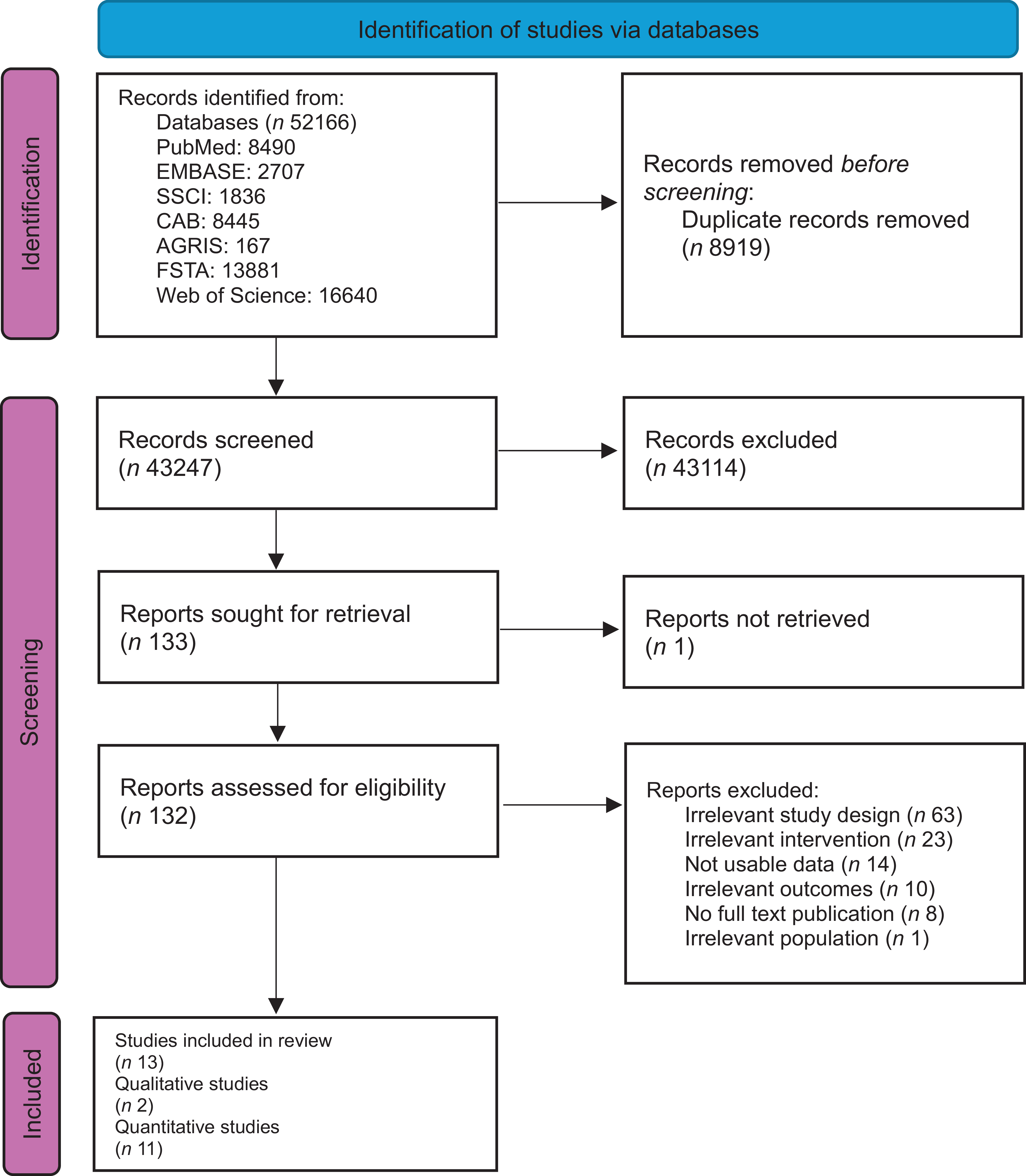
The electronic database searches yielded 52 166 articles to screen, of which 133 full texts were potentially eligible. Eventually thirteen studies were included: two qualitative(Reference Gustafsson and Sidenvall33,Reference Wilson, Villani and Mantzioris34) and eleven quantitative(Reference Clarke and Best35–Reference Hooks, Madigan and Woodside45) (Figure 1). Excluded studies with exclusion reasons are presented in Appendix 1, Table 3. Figure 1 presents the study flow and the selection process.
Flow diagram with the search results and selection of studies.

Figure 1. Long description
The flowchart illustrates the process of identifying and screening studies for inclusion in a review. The process begins with the identification of studies via databases, where records are identified from various sources including PubMed, EMBASE, SSCI, CAB, AGRIS, FSTA, and Web of Science. Duplicate records are removed before screening. The remaining records are screened, and those excluded are noted. Reports sought for retrieval are listed, with one record not retrieved. Reports assessed for eligibility are detailed, with reasons for exclusion provided, such as wrong study design, wrong intervention, not usable data, wrong outcomes, no full text publication, and wrong population. Finally, studies included in the review are categorized into qualitative and quantitative studies.
Study characteristics
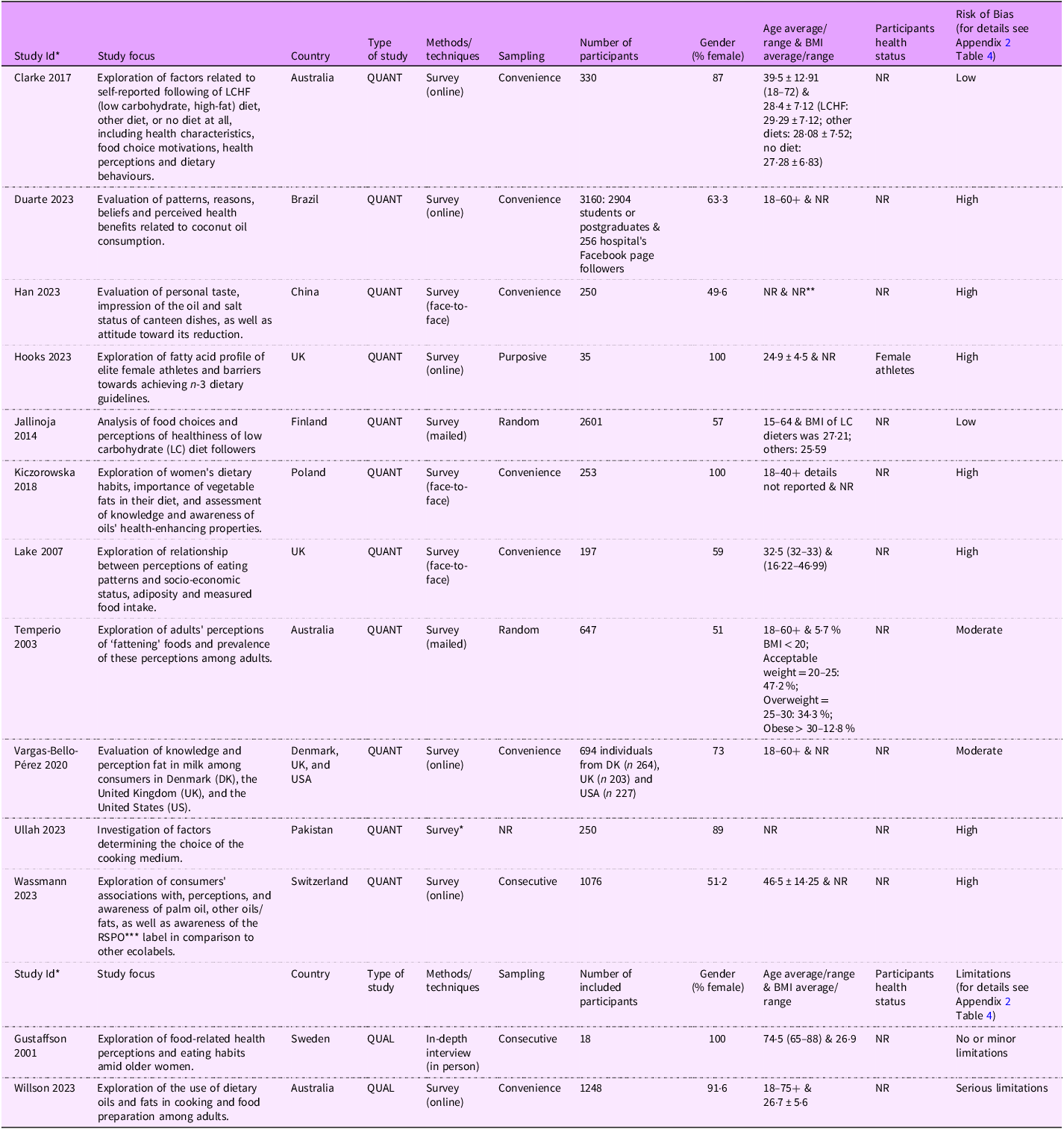
The included studies were published between 2001 and 2023 and involved participants from Australia (in three studies), Brazil, China, Finland, Poland, Denmark, UK (in three studies), USA, Pakistan, Switzerland and Sweden. The number of participants in the eleven quantitative studies ranged between 35 and 3160, while in the two qualitative studies the sample size ranged from 18 to 1248. The participants in the studies were predominantly females (66 %), aged from 15 to 88 years or older, with BMI between 16·22 kg/m2 and 46·99 kg/m2. Information about the health status or cardiovascular risk was not provided. One study included young athletes and one focused exclusively on older women (also without reporting their health status). Table 1 presents characteristics and aims of the included studies, with methodological assessments of each article reported in Appendix 1, Table 4.
Characteristics of the included studies

Table 1. Long description
A table comparing characteristics of included studies. The table has 13 rows and 9 columns. Column headers are Study ID, Study focus, Country, Type of study, Methods/techniques, Sampling, Number of participants, Gender (% female), and Age average/range & BMI average/range. Row 1: Clarke 2017, Exploration of factors related to self-reported following of LCHF (low carbohydrate, high-fat) diet, other diet or no diet at all, including health characteristics, food choice motivations, health perceptions and dietary behaviours, Australia, QUANT, Survey (online), Convenience, 330, 87, 39.5 ± 12.91 (18-72) & 28.4 ± 7.12 (LCHF: 29.29 ± 7.12; other diets: 28.08 ± 7.52; no diet: 27.28 ± 6.83). Row 2: Duarte 2023, Evaluation of patterns, reasons, beliefs and perceived health benefits related to coconut oil consumption, Brazil, QUANT, Survey (online), Convenience, 3160: 2904 students or postgraduates & 256 hospital Fb page followers, 63.3, 18-60+ & NR. Row 3: Han 2023, Evaluation of personal taste, impression of the oil and salt status of canteen dishes, as well as attitude toward its reduction, China, QUANT, Survey (face-to-face), Convenience, 250, 49.6, NR & NR**. Row 4: Hooks 2023, Exploration of fatty acid profile of elite female athletes and barriers towards achieving n-3 dietary guidelines, UK, QUANT, Survey (online), Purposive, 35, 100, 24.9 ± 4.5 & NR. Row 5: Jallinoja 2014, Analysis of food choices and perceptions of healthiness of low carbohydrate (LC) diet followers, Finland, QUANT, Survey (mailed), Random, 2601, 57, 15-64 & BMI of LC dieters was 27.21; others: 25.59. Row 6: Kiczorowska 2018, Exploration of women's dietary habits, importance of vegetable fats in their diet, and assessment of knowledge and awareness of oils' health-enhancing properties, Poland, QUANT, Survey (face-to-face), Convenience, 253, 100, 18-40+ details not reported & NR. Row 7: Lake 2007, Exploration of relationship between perceptions of eating patterns and socio-economic status, adiposity and measured food intake, UK, QUANT, Survey (face-to-face), Convenience, 197, 59, 32.5 (32-33) & (16.22-46.99). Row 8: Temperio 2003, Exploration of adults' perceptions of ‘attening' foods and prevalence of these perceptions among adults, Australia, QUANT, Survey (mailed), Random, 647, 51, 18-60+ & 5.7% BMI < 20; Acceptable weight = 20-25: 47.2%; Overweight = 25-30: 34.3%; Obese > 30-12.8%. Row 9: Vargas-Bello-Pérez 2020, Evaluation of knowledge and perception fat in milk among consumers in Denmark (DK), the United Kingdom (UK), and the United States (US), Denmark, UK, and USA, QUANT, Survey (online), Convenience, 694 individuals from DK (n 264), UK (n 203) and USA (n 227), 73, 18-60+ & NR. Row 10: Ullah 2023, Investigation of factors determining the choice of the cooking medium, Pakistan, QUANT, Survey*, NR, 250, 89, NR. Row 11: Wassmann 2023, Exploration of consumers' associations with perceptions, and awareness of palm oil, other oils/fats, as well as awareness of the RSPO** label in comparison to other ecolabels, Switzerland, QUANT, Survey (online), Consecutive, 1076, 51.2, 46.5 ± 14.25 & NR. Row 12: Gustafsson 2001, Exploration of food-related health perceptions and eating habits amid older women, Sweden, QUAL, In-depth interview (in person), Consecutive, 18, 100, 74.5 (65-88) & 26.9. Row 13: Willson 2023, Exploration of the use of dietary oils and fats in cooking and food preparation among adults, Australia, QUAL, Survey (online), Convenience, 1248, 91.6, 18-75+ & 26.7 ± 5.6.
NR=not reported; QUAL=qualitative study QUANT=quantitative study; UK=United Kingdom, USA=United States of America, DK=Denmark, BMI=Body Mass Index, LC=low carbohydrate, LCHF=low carbohydrate, high fat.
*Mode of survey collection not stated.
**Only subjectively perceived impression of ones' body weight was measured: 67 % of respondents perceived themselves as being ‘overweight'.
***Roundtable on Sustainable Palm Oil.
Findings
We identified five main themes: (1) Negative perception of fat in food (five quantitative studies, 4469 participants; one qualitative study, 18 participants); (2) positive perception of vegetable and/or seed oil as being beneficial to health (6 quantitative studies, 7670 participants; two qualitative studies, 1266 participants); (3) willingness to lower fat consumption (one quantitative study, 250 participants and one qualitative study, eighteen participants); (4) willingness to pay for food with healthier fat content (1 quantitative study, 694 participants) and (5) barriers related to unsaturated fat consumption (one quantitative study, thirty-five participants). Across the five themes, the most abundant data referred to respondents' negative perception of fatty foods and the positive perception of vegetable and/or seed oil as healthy (each theme reported in five or more independent studies), while the theme less represented in the studies related to people's willingness to lower fat consumption (2 studies).
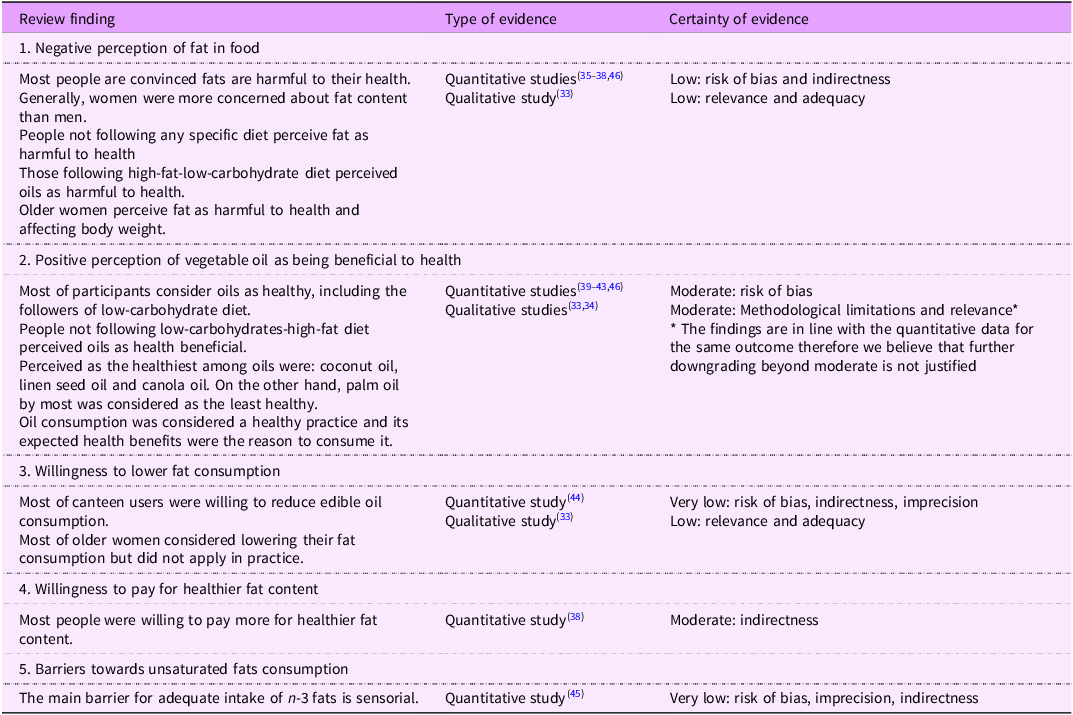
The main findings along with our certainty of evidence ratings are reported in Table 2 and Appendix 1, Table 5. In general, the certainty of evidence ranged from ‘very low' to ‘moderate', and the evidence was downgraded because of the risk of bias (limited information about pilot testing of measurement instrument or questionnaire, instrument validation and/or reliability, as well as unclear reporting of missing data) and indirectness or relevance (data from high-income countries).
Review findings and certainty of evidence

Table 2. Long description
A table with four rows and three columns. The columns are labeled Review finding, Type of evidence, and Certainty of evidence. The rows are labeled with findings related to the perception of fat in food, perception of vegetable oil as beneficial, willingness to lower fat consumption, willingness to pay for healthier fat content, and barriers to unsaturated fats consumption. Each row details the type of evidence and the certainty of evidence for each finding. The table includes specific studies and their methodologies, highlighting the risk of bias, indirectness, and relevance.
1) Negative perception of fat in food
Quantitative studies
Five studies reported negative perception of fat in food. In one study, the consumption of products low in fat was considered healthy (cross-sectional survey in the UK)(Reference Kiczorowska, Samolińska and Klebaniuk40), while in another, the fat content determined the fattening properties of food, while greater proportion of women, compared to men, had a stronger belief that fat-rich foods were unhealthy and ‘fattening' (cross-sectional survey in Australia)(Reference Timperio, Burns and Cameron-Smith37).
A 2020 multinational study (n 694), conducted among adults in Denmark (DK), the United Kingdom (UK) and the USA, which focused on opinions on fat present in milk, indicated that milk was considered unhealthy because of its cholesterol content and was regarded as the contributor to obesity or CVD(Reference Vargas-Bello-Pérez, Faber and Osorio38).
In two cross-sectional studies (2017; 2014) conducted in Australia (n 330) and Finland (n 2601), respectively, people not following any specific diet were mostly convinced that animal fat was harmful to health(Reference Jallinoja, Niva and Helakorpi39,Reference Clarke and Best46) contrary to those following low-carbohydrate-high-fat diet, who mostly believed that oils are harmful to health(Reference Clarke and Best46).
The overall certainty for this outcome was assessed as ‘low' and was downgraded two levels because of concerns regarding the risk of bias and indirectness (details in Appendix 1, Table 15.1).
Qualitative studies
One qualitative study (n 18) with older Swedish women (65–88 years old), published in 2001, found that the predominant attitude associated with fat avoidance was the fear of fat and the fear of gaining weight, or the desire to lose weight(Reference Gustafsson and Sidenvall33). The overall certainty of this finding was assessed as low and was downgraded two levels due to serious concerns noted in subsequent domains: relevance and adequacy (details in Appendix 1, Table 15.1).
‘We like food. We really do. It should taste nice, of course. So I use butter and cream. I usually say to my husband, of course I can cook, but we have to cut down a bit [in order to lose weight]. You can't go on like this all the time.' (woman, 68 y.o.)
‘And I tell you, I'm eating all this light stuff – I eat low-fat cheese, just 10 % fat, and low-fat milk and everything, but I haven't lost a pound!' (woman, 77 y.o.)
It is worth noting that some participants felt misled by media information about food and its properties:
‘I suppose some of it is good, but it is almost too much. They [mass media and authorities] frighten you so you get scared of everything[foods].' (woman, 77 y.o.)
One participant in the study reported being forced as a child to eat fatty foods and remembered this experience as very unpleasant, due to jelly-like consistency. The jelly-like fat was considered good food due to limited [economic] resources. The same participant enjoyed the [availability of] low-fat products as an adult and found reduced fat foods to be pleasurable:
‘It's a diet meal, but very nice. I think it is the pleasure of the day, because we don't get a lot of fat.' (woman, 67 y.o.)
2) Positive perception of vegetable oil as being beneficial to health
Quantitative studies
Six studies reported positive perception of oil in food. In most of the studies, participants were asked to choose between vegetable oil/oils and other type/types of fat according to their healthiness.
Participants of all the six studies either declared that oil consumption is beneficial for health or reported using oil because of its health benefits. The majority of participants of one Brazilian cross-sectional survey were convinced that coconut oil was beneficial for health and that was the main reason for its consumption(Reference Duarte, Spiazzi and Merello42). On the other hand, most Polish women enquired in the cross-sectional study perceived linen seed oil as the one having the best health enhancing properties, while coconut oil was indicated as the second most healthy(Reference Kiczorowska, Samolińska and Klebaniuk40). In another cross-sectional study, for the Swedish participants canola oil and then, coconut oil were regarded as the healthiest ones, while palm oil was rated as the least healthy(Reference Wassmann, Siegrist and Hartmann41). Pakistani participants, on the other hand, reported a much more frequent use of vegetable oil than traditional ghee due to health concerns(Reference Ullah, Ali and Ahmed43).
In two studies people who did not follow any specific diet were mostly convinced that oil was beneficial to health while those who adhered to low-carbohydrate or low-carbohydrate-high-fat diets(Reference Kiczorowska, Samolińska and Klebaniuk40) mostly believed that animal fat consumption was beneficial(Reference Jallinoja, Niva and Helakorpi39,Reference Clarke and Best46) .
The overall certainty of this finding was assessed as moderate and was downgraded one level due to serious concerns regarding the risk of bias domain (details in Appendix 1, Table 5.2).
Qualitative studies
One qualitative study on older Swedish women reported that using oil was considered as adherence to healthy diet habits(Reference Gustafsson and Sidenvall33).
‘I use margarine when I fry…You should fry in olive oil, and I have done so sometimes. But I think it's difficult to fry with it…But it's supposed to be more wholesome, so you have to try it, maybe. But with margarine, there's a lot of dangerous stuff, I saw it on the telly one morning…But you can't really know those things. I think you are very exposed; it is difficult to be informed and understand how much is true.' (woman, 77 y.o.).
The second qualitative study found that expected health benefits were the main reason for using oils; olive oil was the most commonly used(Reference Wilson, Villani and Mantzioris34).
The overall certainty of this finding was assessed as ‘moderate' and was downgraded due to moderate concerns in subsequent domains: methodological limitations and relevance (details in Appendix 1, Table 5.2).
3) Willingness to lower fat consumption
Quantitative study
Chinese participants of one cross-sectional study enquired about their willingness to reduce fat consumption and the potential reasons behind that indicated disease prevention as the most important factor followed by weight control. Further, the inclination to lower the consumption of oil was significantly associated with perceived body shape: those who regarded themselves as overweight were more willing to consume less oil(Reference Han, Fan and Li44).
The overall certainty of this finding was assessed as ‘very low' and was downgraded three levels due to the concerns regarding risk of bias, indirectness and imprecision domains (details in Appendix 1, Table 5.3).
Qualitative study
One qualitative study reported that older Swedish women considered cutting down on overall fat or calorie intake as a mean to achieve desirable weight goals. However, the reported behaviour did not reflect this opinion as consuming low-fat dairy products was not common, perhaps due to their attachment to the already established habits.
‘No, I don't bother at all about it…[referring to fat and high-fat foods]I think when you are this old, you shouldn't change your food habits. Because if you feel good about the way it has been, then you can go on that way.' (woman, 76 y.o.)
‘You cannot add so many hours to your life, I suppose, if you avoid everything…[including high-fat foods]. It's best if you have the same habits as when you were growing up…what's damaged is damaged in the body. If anything is damaged, it can't be restored.' (woman, 76 y.o.)
Moreover, those who used low-fat dairy products were disappointed with their effects on body weight:
‘And I tell you, I'm eating all this light stuff – I eat low-fat cheese, just 10 % fat, and low-fat milk and everything, but I haven't lost a pound!' (woman, 77 y.o.)
Interestingly, most women thought that their usual food habits were healthy. The study shows overall discordance between the declared practice and willingness to change(Reference Lewin, Bohren and Rashidian32).
The overall certainty of this finding was assessed as ‘low' and was downgraded due to concerns in subsequent domains: relevance and adequacy (details in Appendix 1, Table 5.3).
4) Willingness to pay more for healthier fat content
One multinational study reported that respondents mostly opted to pay more for milk with healthier fat content; however, it did not explicitly specify what was meant by ‘healthier fat content'(Reference Vargas-Bello-Pérez, Faber and Osorio38).
The overall certainty of this finding was assessed as ‘moderate' and was downgraded one level due to the serious concerns regarding indirectness domain (details in Appendix 1, Table 5.4).
5) Barriers towards unsaturated fats consumption
One study, exploring barriers towards achieving the recommended intake of n-3 fats (PUFA-rich food listed in the study as: seafood, walnuts, rapeseed oil, flaxseed, flaxseed oil, chia seeds, vegetable margarine and n-3 supplement) among sport women found that most commonly reported barriers included: smell and taste of fish, followed by the lack of practical cooking skills and the lack of knowledge about the health benefits of n-3 fats(Reference Hooks, Madigan and Woodside45).
The overall certainty of this finding was assessed as ‘very low' and was downgraded three levels due to the serious concerns regarding risk of bias, indirectness and imprecision domains (details in Appendix 1, Table 5.5).
Discussion
Main findings
The perception of fats and oils in diets is complex and often contradictory, with most people viewing high-fat products as unhealthy and associating them with weight gain, while oils are generally perceived to be beneficial. However, these views can vary significantly depending on gender, age and dietary patterns, with some groups, e.g. low-carbohydrate-high-fat diet followers, holding opposing beliefs. More recently, there has been a lot of talk on social media about seed oils; however, none of our included studies specifically addressed seed oils. Overall, the evidence supporting these perceptions is of moderate to very low certainty. To optimally inform guidelines on dietary fat recommendations, there is a need for more robust research on public values and preferences regarding the health impacts of fat reduction or modification in the light of the best available scientific evidence.
Our results in the context of previous research
To the best of our knowledge, other than studies done for marketing purposes(Reference Asioli, Zhou and Halmemies-Beauchet-Filleau47), this is the first systematic review aimed at assessing values, preferences and related concepts (e.g. attitudes) to fats and fat-containing food products.
Our findings that women have stronger beliefs related to health and their willingness to avoid certain food types is consistent with results of our previous studies about values and preferences related to meat consumption(Reference Valli, Santero and Prokop-Dorner18,Reference Haverstock and Forgays48,Reference Prokop-Dorner, Piłat-Kobla and Zajaȩc49) . Although people recognise the need to limit intake of certain types of fat and commonly attempt to do so, misconceptions about CVD risk, limited knowledge about dietary fat content and uncertainty about the effects of various fat reduction strategies may impede effective dietary change(Reference Webster and Heeley50).
In a recently published review of willingness to pay for healthier food, twenty-three out of twenty-six included studies indicated people's willingness to pay more for healthier foods, and certain factors such as age (60+), sex (women), health status (suffering from obesity) and regular physical activity were the predisposing factors. Similar readiness was described in our findings, where the majority of survey respondents, mostly women, were willing to pay more for milk with ‘healthier fat content' (not specified further)(Reference Christenson, O'Kane and Farmery51). Both studies were conducted in high-income countries.
Our finding regarding barriers for optimal intake of n-3 fats is similar to other studies on drivers and barriers to fish consumption, in which health and the liking of the taste of fish were the main drivers of fish intake, whereas taste and sensory preferences, together with costs and some concerns about the fish quality, were the main barriers(Reference Christenson, O'Kane and Farmery51,Reference Alexander, Lindberg and Firemark52) .
Strengths and limitations
Our study has several strengths. First, we performed a mixed-methods review, which included both quantitative and qualitative evidence using convergent integrated approach, allowing us to have higher confidence while interpreting our findings. Second, our inclusion and exclusion criteria were explicitly reported, and the methodology was set a priori and published in the protocol(Reference Zajac, Bala and Prokop-Dorner22). We also applied the GRADE approach to assess the certainty of the findings.
The main limitation of our study is the low number of eligible studies (n 13) and the diversity of their scope and study designs. For example, some studies focused on different types of oils, others on fat in general, while using diverse questionnaires. Second, only two of the included studies used random sampling strategy(Reference Timperio, Burns and Cameron-Smith37,Reference Jallinoja, Niva and Helakorpi39) . Third, many studies did not consistently report participant characteristics, and seven (64 %) out of eleven studies had high risk of bias. Fourth, three out of thirteen publications focused entirely on women, while in other four studies, 70 % of their participants were female. As a result, the generalisability of our findings to other contexts is limited.
Conclusions
Public perceptions of fats and oils remain inconsistent and shaped by demographics and followed dietary patterns. Despite widespread beliefs linking fats with poor health and oils with benefits, these views often lack strong evidence. Given the overall low to moderate certainty of existing data, more rigorous research on population values and preferences is essential to guide evidence-based dietary fat recommendations. When collecting value and preference data, to improve the certainty of findings, there is also a need to ensure that study participants understand absolute estimates of effect linked to health outcomes that matter to them (e.g. weight gain and heart attack risk) and the certainty of evidence for estimates of effect.
Implications for research
Our review shows the need for well-designed studies investigating values and preferences and the public's willingness to change their dietary habits related to saturated fats intake when faced with the available published evidence related to risk reduction of a specific outcome and the certainty of the evidence.
Implications for practice
Additionally, the findings of this study may inform the development of instruments that can be used to create educational programmes and materials tailored to patients' beliefs and practices related to dietary fats. These resources could subsequently be used to educate individuals about the role of fats in the daily diet and to increase their nutrition literacy.
The template data collection forms, data extracted from included studies, data used for all analyses, analytic code and other materials used in this review are available from the authors upon request.
Supplementary material
For supplementary material accompanying this paper visit https://doi.org/10.1017/S1368980026102882
Acknowledgements
This review was carried out as part of a project initiated by NutriRECS to support the development of guidelines based on GRADE guidance, work that we believe will greatly improve the reliability, transparency and usability of future guideline recommendations.
Author contributions
J.Z.: Conceptualisation-Equal, Formal analysis-Lead, Investigation-Equal, Methodology-Equal, Writing – original draft-Lead, Writing – review & editing-Lead; M.M.B.: Conceptualisation-Equal, Investigation-Equal, Methodology-Lead, Supervision-Lead, Writing – original draft-Equal, Writing – review & editing-Equal; A.P-D.: Investigation-Equal, Methodology-Equal, Writing – original draft-Supporting; P.A-C.: Conceptualisation-Equal, Methodology-Equal, Writing – review & editing-Equal; G.G.: Conceptualisation-Equal, Methodology-Equal; M.M.: Data curation-Equal, Investigation-Equal, Writing – original draft-Equal; K.W.: Data curation-Equal, Methodology-Equal, Writing – original draft-Equal; K.Z.: Data curation-Equal, Formal analysis-Equal, Writing – original draft-Equal; S.W.: Data curation-Equal, Formal analysis-Equal, Writing – original draft-Equal; Z.S.: Data curation-Equal, Formal analysis-Equal, Writing – original draft-Equal; D.S.: Data curation-Equal, Formal analysis-Equal, Methodology-Equal, Writing – original draft-Equal; C.V.: Data curation-Equal, Formal analysis-Equal, Writing – original draft-Equal; M.Ś.: Data curation-Equal, Formal analysis-Equal, Writing – original draft-Equal, Writing – review & editing-Equal; A.K.A.: Data curation-Equal, Formal analysis-Equal, Writing – original draft-Equal; J.S.: Data curation-Equal, Formal analysis-Equal, Writing – original draft-Equal; B.C.: Data curation-Equal, Formal analysis-Equal, Writing – original draft-Equal; M.R.: Data curation-Equal, Formal analysis-Equal, Investigation-Equal, Writing – original draft-Equal; L.C.L.: Data curation-Equal, Formal analysis-Equal, Writing – original draft-Equal; E.P-J.: Data curation-Equal, Formal analysis-Equal, Methodology-Equal, Writing – original draft-Equal; B.J.: Conceptualisation-Equal, Methodology-Equal, Supervision-Equal, Writing – original draft-Equal, Writing – review & editing-Equal. All authors have read and agreed to the published version of the manuscript.
Financial support
No sponsors or funding sources
Competing interests
B.J., G.H.G. and M.M.B. are GRADE working group members. B.J. has received a start-up grant from Texas A&M AgriLife Research to fund investigator-initiated research related to saturated and polyunsaturated fats. The grant was from Texas A&M AgriLife institutional funds from interest and investment earnings, not a sponsoring organisation, industry or company. B.J. has also received funds from the National Institute of Diabetes, Digestive and Kidney Diseases (NIDDK) R25 to support training in evidence-based nutrition practice. M.M.B. received funds for lectures on research methods to Formedis – HTA consulting company. No further competing interests were disclosed.
Ethics of human subject participation
Not applicable.


 Open access

