1. Introduction
That human cognitive behavior in general and linguistic discourse in particular cannot reasonably be reduced to one monolithic system of mental processing is a hypothesis that has been voiced in several different directions of research. It surfaces in particular in the psychological work on brain activity by Kahneman (2012), in neurolinguistic research on linguistic processing by Van Lancker Sidtis (Reference Sidtis, Canterucci and Katsnelson2009), and in linguistic work on performance (Clark, Reference Clark1996; Clark & Fox Tree, 2002), on speech act formulas (Pawley, Reference Pawley, Corrigan, Moravcsik, Ouali and Wheatley2009), on discourse organization (Kaltenböck, Heine, and Kuteva, Reference Kaltenböck, Heine and Kuteva2011; Heine, Kaltenböck, Kuteva, & Long, Reference Heine, Kaltenböck, Kuteva, Long, Bischoff and Carmen2013), or on bilingualism (Maschler, Reference Maschler1994). What all this research suggests is that cognitive processing appears to exhibit a dualistic organization.
The present paper is restricted to two of the models that have been proposed, asking the following question: Are there any significant correlations between the two modes of processing proposed by Van Lancker Sidtis (Reference Sidtis, Canterucci and Katsnelson2009) and the two domains of discourse organization distinguished in the framework of Discourse Grammar (Heine et al., Reference Heine, Kaltenböck, Kuteva, Long, Bischoff and Carmen2013; Kaltenböck et al., Reference Kaltenböck, Heine and Kuteva2011)? Note that the two frameworks were developed on different kinds of data. In Discourse Grammar it is linguistic discontinuities that provided the basis of analysis, while in the dual process model of Van Lancker Sidtis (Reference Sidtis, Canterucci and Katsnelson2009) it is observations on patients with left or right hemisphere damage that marked the starting point of analysis. While the findings made within the two frameworks are largely compatible with one another, the present paper suggests that hemisphere-related brain activation appears to be influenced at least to some extent by the discourse functions that speech serves.
The paper is organized as follows. An outline of the two frameworks is presented in Section 2. Section 3 deals with the question of whether Discourse Grammar is able to shed any light on the relationship between language structure and neural organization in a similar way to the dual process model. To this end, two small sets of aphasic speech are analyzed. Section 4 looks at this issue in a wider perspective by contrasting linguistic categorization with findings that were made in neurological studies on brain lateralization. Section 5 is devoted to the nature of and the role played by formulaic linguistic expressions in Discourse Grammar. The conclusion reached in the final Section 6 is that, like the dual process model, Discourse Grammar can contribute to a better understanding of certain characteristics associated with the hemispheric lateralization of the human brain.
2 The two frameworks
The main purpose of the present paper is to contrast two theoretical frameworks of linguistic analysis with a view to exploring how certain forms of linguistic behavior are reflected in patterns of brain activation. Section 2.1 provides a sketch of Discourse Grammar, while Section 2.2 is devoted to the dual process model.
2.1 discourse grammar
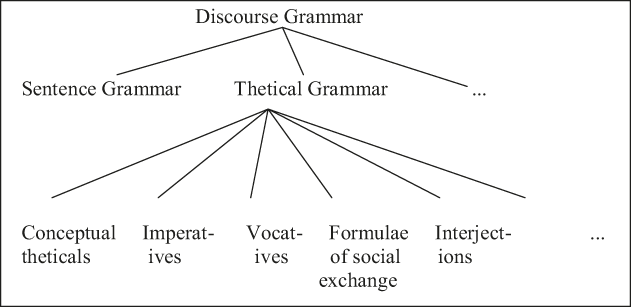
Discourse Grammar, as proposed by Kaltenböck et al. (Reference Kaltenböck, Heine and Kuteva2011) and Heine et al. (Reference Heine, Kaltenböck, Kuteva, Long, Bischoff and Carmen2013), is composed of all the linguistic resources that are available for constructing spoken or written (or signed) texts; an outline of its architecture is provided in Figure 1.Footnote 1 It is based on the assumption that there are two domains of discourse organization that need to be distinguished, referred to respectively as sentence grammar (SG) and thetical grammar (TG). Discourse Grammar thus differs from, and must not be confused with the model of Functional Discourse Grammar (FDG; Hengeveld & Mackenzie, Reference Mackenzie and Brady2008, Reference Hengeveld, Mackenzie, Heine and Narrog2011), which does not make such a distinction.Footnote 2
A sketch of the architecture of Discourse Grammar.

The relationship between the two domains of Discourse Grammar in Figure 1 is complex; it is shaped most of all by cooptation, a mechanism whereby a chunk of SG, such as a clause, a phrase, a word, or any other unit, is deployed for use in TG (Kaltenböck et al., Reference Kaltenböck, Heine and Kuteva2011, pp. 874−875).
SG is well documented, having been the main or the only subject of theories of mainstream linguistics. It is based on propositional logic, and it is organized in terms of parts of speech or constituent types such as sentences, clauses, phrases, words, and morphemes plus the syntactic and morphological machinery to relate constituents to one another. The building blocks of TG are theticals, consisting on the one hand of thetical formulae and constructions and on the other hand of the ability to coopt information units of SG and deploy them for structuring discourse.Footnote 3 The main categories of theticals distinguished so far are illustrated in (1).Footnote 4
(1) Categories of Thetical Grammar (Heine et al., Reference Heine, Kaltenböck, Kuteva, Long, Bischoff and Carmen2013; Kaltenböck et al., Reference Kaltenböck, Heine and Kuteva2011)
a. He was a man who, unaccountably, had few friends. Conceptual thetical
b. Good morning! Formula of social exchange
c. Today’s topic, ladies and gentlemen, is astrophysics. Vocative
d. Hold on, are we late? Imperative
e. Damn, we’ve missed the bus. Interjection
Theticals differ from SG units in a principled way, their defining properties being listed in (2).Footnote 5 Note that this definition is prototypical rather than being based on necessary and sufficient criteria (see also Kaltenböck et al., Reference Kaltenböck, Heine and Kuteva2011, Section 2).
(2) Properties of theticals (Kaltenböck et al., Reference Kaltenböck, Heine and Kuteva2011, p. 853)
a. They are syntactically independent.
b. They are typically set off prosodically from the rest of an utterance.
c. Their meaning is non-restrictive.
d. They tend to be positionally mobile.
e. Their internal structure is built on principles of SG but can be elliptic.
The term ‘non-restrictive’ meaning is taken from Huddleston and Pullum (2002, p. 1352). Restrictive meaning is a characteristic of SG; it is grounded in the semantic structure of a sentence or its constituents. Non-restrictive meaning, by contrast, concerns reasoning processes and inferential mechanisms grounded in the situation of discourse. To be sure, any act of linguistic communication requires a situation of discourse, but in the case of SG its impact is minimal, being restricted to a few factors such as spatial, temporal, and personal deixis, deontic modality, etc. Such restrictions do not appear to exist when TG is involved. The situation of discourse consists of a network of interlocking components, namely the ones listed in (3).
(3) Components of the situation of discourse (Kaltenböck et al., Reference Kaltenböck, Heine and Kuteva2011, p. 861)
Text Organization
Source of Information
Attitudes of the Speaker
Speaker−Hearer Interaction
Discourse Setting
World Knowledge
In accordance with this distinction, units of SG differ from those of TG (i.e., theticals) in their semantic−pragmatic scope potential: whereas the former have scope over some constituent of the utterance, theticals may have wider scope, typically extending over the entire situation of discourse (Heine et al., Reference Heine, Kaltenböck, Kuteva, Long, Bischoff and Carmen2013, Section 2.2; Kaltenböck et al., Reference Kaltenböck, Heine and Kuteva2011, p. 861). We may illustrate this with the English item frankly. It is an adverb of SG, determining the meaning of the predicate in (4a). In (4b), by contrast, it is a thetical, called a stance adverbial by Biber, Johansson, Leech, Conrad, and Finegan (1999, p. 133), a sentence adverb by Brinton and Traugott (2005, p. 139), or a disjunct by Quirk, Greenbaum, Leech, and Svartvik (1985, pp. 648, 613). As a thetical, it is syntactically detached, typically set off prosodically (marked by commas in writing), and its meaning is non-restrictive: rather than determining the meaning of the predicate, it relates to and may have scope over the situation of discourse, most of all to Speaker−Hearer Interaction.
(4) a. She spoke frankly about herself now and then.
b. Frankly, Kris didn’t want to know. (Biber et al., Reference Biber, Johansson, Leech, Conrad and Finegan1999, p. 132)
It may not be surprising that the meaning of theticals has been described with reference to notions such as ‘subjectification’ (cf. the component Attitudes of the Speaker in (3)) or ‘intersubjectification’ (cf. Speaker−Hearer Interaction) by a number of authors (e.g., Traugott & Dasher, Reference Traugott and Dasher2002; Brinton, Reference Brinton2008), or as being ‘metalingual’ (Maschler, Reference Maschler1994), ‘procedural’, ‘metacommunicative’, ‘metatextual’, ‘metapragmatic’, ‘metadiscursive’, or ‘instructional’ (see Heine, Reference Heine, Kaltenböck, Kuteva, Long, Bischoff and Carmen2013).
2.2. the dual process model of van lancker sidtis (2009)
A detailed account of this model is found in various publications of Van Lancker Sidtis and associates (Sidtis, Canterucci, & Katsnelson, Reference Sidtis, Canterucci and Katsnelson2009; Van Lancker, Reference Van Lancker and Ellis1988, Reference Van Lancker1990, Reference Van Lancker1997; Van Lancker Sidtis, 2004, 2009, 2012; Van Lancker Sidtis & Postman, Reference Van Lancker Sidtis and Postman2006). Central to this model is the distinction between novel speech (or novel language, or newly created language, or propositional speech) and formulaic speech (or formulaic expressions or automatic speech). As these authors argue on the basis of substantial neurological and linguistic evidence, novel speech is represented in the left hemisphere, whereas formulaic speech is facilitated by a subcortical right hemisphere circuit.Footnote 6
The dual process model features an analytic mode for the generation of novel speech and a holistic mode for processing formulaic speech, the distinction being one between newly created or propositional and fixed or non-propositional language, respectively. Unlike the former, the latter is not newly created from the operation of grammatical rules on lexical items (Van Lancker Sidtis, Reference Van Lancker Sidtis, Corrigan, Moravcsik, Ouali and Wheatley2009, p. 445). Relying on this distinction, Van Lancker Sidtis summarizes a range of neurolinguistic findings thus:
The implications of these studies are that novel and formulaic language are affected differently by different types of brain damage: Left hemisphere damage leads to selective impairment of novel language (with relative preservation of formulaic language), while right hemisphere and/or subcortical damage lead to selective impairment of formulaic language (sparing novel language). (Van Lancker Sidtis, Reference Van Lancker Sidtis, Corrigan, Moravcsik, Ouali and Wheatley2009, p. 460)7
According to Van Lancker Sidtis (2004, 2009, 2012, and other works), formulaic speech has the characteristics listed in (5) (see also Section 3 below).
(5) Characteristics of instances of formulaic speech
a. They have stereotyped form, they are fixed and unitary.
b. They have a set intonation contour.
c. They have conventionalized meaning which is complex and usually non-literal, rife with nuance and connotations, and which depends in special ways on social context.
d. People know them intuitively.
Easily identified instances of formulaic speech are swear words, interjections, pause fillers (uh, um), discourse elements (well, so), non-literal lexical meanings for idioms (He was at the end of his tether), and proverbs. The functional criteria proposed pertain mostly to the repertory of speech formulas, such as Hello, Right, If you say so, How could you?, Here’s back atcha, and many others signaling “turn-taking, commentary, and assent, conveying countless attitudinal stances in conversational interaction” (Kreiman & Sidtis, Reference Kreiman and Sidtis2011; Van Lancker Sidtis, Reference Van Lancker Sidtis2012, p. 66).
In examining written transcripts of the spontaneous speech of patients who had suffered left or right hemisphere damage, Van Lancker Sidtis (2009, p. 452) distinguishes nine types of formulaic speech; we will deal with them in more detail in Section 3.
That brain lateralization shows positive correlations with two different modes of linguistic processing is an old hypothesis (see Van Lancker Sidtis, Reference Van Lancker Sidtis2004, 2009, p. 460, for detailed discussion). Already in the nineteenth century, the neurologist Hughlings Jackson (1874) provided examples of preserved aphasic speech, distinguishing between ‘propositional’ and ‘non-propositional’ (or ‘automatic’) speech associated with left and right hemisphere processing, respectively. Similar observations were made by subsequent authors. The neurologist Head (Reference Head1926) found that non-propositional speech appears first in both receptive and expressive aphasia, Bay (Reference Bay, De Reuck and O’Connor1964) described aphasia as an inability to propositionalize, and according to the Russian neuropsychologist Luria (Reference Luria1966), clinical observations showed that it was speech formulas, expletives, pause fillers, proper nouns, sentence stems, and serial speech that were preserved in aphasic speech.
But the most substantial evidence was presented in the work of Van Lancker Sidtis (2004, 2009, 2012, and other works), based on the distinction between novel and formulaic speech. Being extremely rare following right hemisphere damage, aphasia is almost exclusively associated with left hemisphere damage. Van Lancker Sidtis carried out a number of case studies to substantiate the hypothesis that brain lateralization shows positive correlations with two different modes of linguistic processing. In one kind of study she worked with three patients, where she made the following observations (Van Lancker Sidtis, Reference Van Lancker Sidtis, Corrigan, Moravcsik, Ouali and Wheatley2009, pp. 451−452):
− Case 1 involved a patient who had sustained a large right hemisphere lesion. Although language abilities were intact, his conversational speech was often pragmatically inappropriate.
− The same observation was made in Case 2, who had suffered right-sided subcortical damage. This patient complained that she no longer produced the “little words” in conversational interaction, having difficulties with greeting and leave-taking.
− Case 3 was a left hemisphere damaged patient with the diagnosis of transcortical sensory aphasia, who spoke fluently but with numerous formulaic expressions.
A separate study confirmed that the rate of formulaic expressions was low in Case 1 (11%) and Case 2 (16.9%), but high in Case 3 (51.9%), compared to 20.1% in the normal control group (Van Lancker Sidtis, Reference Van Lancker Sidtis, Corrigan, Moravcsik, Ouali and Wheatley2009, p. 454).
Examining written transcripts of the spontaneous speech of patients who had suffered left or right hemisphere damage, Van Lancker Sidtis and Postman (Reference Van Lancker Sidtis and Postman2006) found that persons with left hemisphere damage (LHD) use significantly more (30%) and persons with right hemisphere damage (RHD) significantly less formulaic utterances (17%) than normal subjects (25%). This finding compellingly implicates a role of the right hemisphere in the production of formulaic expressions (Van Lancker Sidtis, Reference Van Lancker Sidtis, Corrigan, Moravcsik, Ouali and Wheatley2009, p. 452).
Further support for the dual process model was found in two speech samples of aphasic patients (Van Lancker Sidtis, Reference Van Lancker Sidtis, Corrigan, Moravcsik, Ouali and Wheatley2009, pp. 454−457). In the first, taken from an aphasic subject who recovered some speech over a period of five treatments from early non-fluency, 64 percent of the text turned out to consist of formulaic expressions.
In the second speech sample, taken from a German aphasic patient before treatment, nearly all the speech products consisted of formulaic language. Of the thirty-nine information units uttered by the patient in conversation with a therapist, thirty, that is, 76.9 percent, were formulaic units (Van Lancker Sidtis, Reference Van Lancker Sidtis, Corrigan, Moravcsik, Ouali and Wheatley2009, pp. 456−457); we will return to these two cases in Section 3.
The reciprocal effect of lateralization on comprehension was demonstrated by using the Formulaic and Novel Language Comprehension Test of Kempler and Van Lancker (Reference Kempler and Van Lancker1996). The result was a ‘double dissociation’ to the effect that left hemisphere damaged subjects performed poorly on literal expressions but relatively better on idiomatic and formulaic language, while right hemisphere damaged patients performed relatively worse on formulaic and idiomatic language than on novel expressions (Van Lancker Sidtis, Reference Van Lancker Sidtis2004, p. 26).
Support for the dual process model comes from some recent lines of linguistic research, in particular from Pawley’s (Reference Pawley, Corrigan, Moravcsik, Ouali and Wheatley2009) work on speech act formulas:
It appears that competent speakers of a language know many linguistic entities in two ways: holistically and analytically, and can move between the two. People are good at generalising, at perceiving patterns, and the generalising capacity is essential to the learning of general rules. On the other hand, people have severely limited rapid processing capacity but they have an enormous memory, which allows them to store and retrieve, or recognize familiar complex form−meaning pairings. Thus, a realistic account of the cognitive processes that underpin nativelike command of a language should accommodate this kind of dual knowledge. (Pawley, Reference Pawley, Corrigan, Moravcsik, Ouali and Wheatley2009, p. 21)
3. On aphasic speech: two case studies
As the observations made in Section 2.2 suggest, the dual process model is able to capture significant correlations between linguistic and neural processing. The study of Discourse Grammar, on the other hand, has so far been confined to linguistic analysis; no relevant information is available on whether the distinction between the two domains of grammar is associated with any differential activation of the brain.
The question that we wish to look into in the present section is how the two frameworks relate to one another: Are they fundamentally different, are they similar, or are they perhaps underlyingly the same? In looking for an answer to this question, our focus will be on the speech behavior of persons suffering left hemisphere damage, and in particular of aphasic persons.
While aphasia may in rare cases be associated with right hemisphere damage, it is almost exclusively a phenomenon of left hemisphere dysfunction in the distribution of the middle cerebral artery. Extending over most of each hemisphere, this artery excludes a narrow strip on the anterior frontal lobe and another narrow area on the posterior parietal lobe (Van Lancker Sidtis, Reference Van Lancker Sidtis, Corrigan, Moravcsik, Ouali and Wheatley2009). Accordingly, with the term ‘aphasic speech’ we will refer exclusively to cases of aphasia caused by left hemisphere damage.
Examining written transcripts of the spontaneous speech of patients who had suffered left or right hemisphere damage, Van Lancker Sidtis (2009, p. 452) distinguishes the groups of linguistic units listed in (6), that she classifies as formulaic speech (see also Section 2.2 above):
(6) Groups of formulaic speech units (Van Lancker Sidtis, Reference Van Lancker Sidtis, Corrigan, Moravcsik, Ouali and Wheatley2009, p. 452)
a. idioms (e.g., lost my train of thought);
b. conventional expressions (as a matter of fact);
c. conversational formulaic expressions (first of all, right);
d. expletives (damn);
e. sentence stems (I guess);
f. discourse particles (well);
g. pause fillers (uh);
h. numerals; and
i. personally familiar proper nouns.
Most, though not all of these groups relate to our domain of Thetical Grammar introduced in Section 2.1; note that Van Lancker Sidtis portrays formulaic speech as serving mainly as social signals, which is also a function of many theticals (see Section 4, Table 5). While it is hard to decide without more detailed contextual information which of these categories qualify as theticals, it would seem on the basis of the examples provided by Van Lancker Sidtis that (6b) through (6g), i.e., six of the nine categories, are largely or entirely restricted to theticals: conventional expressions (6b), conversational formulaic expressions (6c), sentence stems (6e), and discourse particles (6f) have the appearance of formulaic conceptual theticals serving the organization of texts (see Section 5), be that as discourse markers (e.g., well) or comment clauses (I guess) (Heine, Reference Heine, Kaltenböck, Kuteva, Long, Bischoff and Carmen2013). The remaining two are classified in Discourse Grammar as interjections (Heine et al., Reference Heine, Kaltenböck, Kuteva, Long, Bischoff and Carmen2013, 4.6), namely expletives (6d) and pause fillers (6g).
In fact, at least two-thirds of the formulaic expressions discussed by Van Lancker Sidtis (Reference Van Lancker Sidtis, Corrigan, Moravcsik, Ouali and Wheatley2009) can be suspected to belong to TG. But what about the remaining ones, that is, (6a), (6h), and (6i)?
The answer to this question is complex. According to (6a), idioms qualify as instances of formulaic speech, but many of them are not theticals. For example, in a constructed sentence such as (7), the idiom lost my train of thought can be assumed to be an integral part of sentence structure, not to be prosodically separated from the rest of the utterance, and its meaning is not non-restrictive, hence it does not qualify as a thetical, it is part of SG. And much the same applies to the numeral three and the personally familiar proper noun Jim in the constructed example (7): they are syntactically, prosodically, and semantically parts of the sentence. Both the numeral three and the phrase with Jim are licensed by the syntax and semantics of the adverbial clause; they are part of the intonation contour of the clause. Accordingly, they belong to SG rather than to TG.
(7) After having spent three hours with Jim I lost my train of thought.
But the situation is different, e.g., in the case of personally familiar proper nouns serving as vocatives, like Jim in the constructed example of (8): vocative expressions conform to our definition of theticals in (2), being syntactically and prosodically detached and referring to a participant that is located outside the form and the meaning of the sentence (see (1c) and Figure 1 of Section 2.1). This means that instances of Van Lancker Sidtis’s category (6i) are theticals in some of their uses but not in other uses.
(8) This is not the whole story, Jim.
And in much the same way as there are instances of formulaic speech that are not theticals, there are also theticals that are not instances of formulaic speech. Take example (9) of spoken English: the information unit please don’t misunderstand me when I say this would seem to qualify as an instance of novel speech, suggestive of the analytic mode (Section 2.2). Nevertheless, it is a conceptual thetical (usually classified as a parenthetical), corresponding to our definition of theticals in (2): it is syntactically and prosodically independent from the rest of the utterance and its meaning is non-restrictive, that is, it is not part of the semantic structure of its host clause.
(9) Or are you being <,> uhm<,> please don ’ t misunderstand me when I say this<,> over-taught that is to say <,> being asked to attend <,> more lectures more seminars more tutorials than you can prepare for (DCPSE: DL-A03-0355)Footnote 8
Finally, there are also other differences in the classification of information units. We may illustrate this with two examples of aphasic patients, involving an English-speaking and a German-speaking subject. The first example concerns the text in (10), taken from spontaneous speech by an aphasic subject who had recovered some speech from early non-fluency after five treatment sessions. In this text, formulaic language is in italics and novel units are underscored.Footnote 9
(10) Uh.. uh good morning.. uh.. um.. meuh I want a.. big big ter//uh television,alright? Um, big. Alright? And uh.. money?Yes. Fine.. um.. big and. uh ... smallum.. TV. yes.. uh smallum.. Uh.. sky and cricket and.. uh soccer and movies and news and..alright? Um.. right. Uh.. Where?Ah! Alright! Boah! nice! Wow! Big! And small!Ho-ho, Jesus! Uh.. price? What? two thousand..oh Jesus! hm.. wait. um.. hm hm hm. yes. alright.. maybe uh. two thousand?Oh, Jesus. Alright. Uh phone and wait, alright? Uh.. oh, Jesus! Hi! Jane um.. phew.. uh what is the matter? Money?Oh, Jesus.. alright.. alright! thank you! see you! Uh salesman.. uh.. money, yes.. fine.. (Van Lancker Sidtis, Reference Van Lancker Sidtis, Corrigan, Moravcsik, Ouali and Wheatley2009, p. 455, Table 1
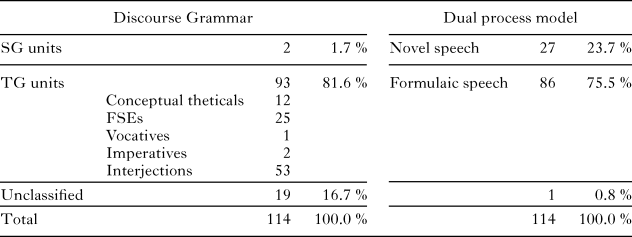
A contrastive breakdown of information units occurring in the speech sample of an English-speaking aphasic patient after five treatment sessions (based on Van Lancker Sidtis, Reference Van Lancker Sidtis, Corrigan, Moravcsik, Ouali and Wheatley2009, p. 455, Table 1)
)
On the basis of a Discourse Grammar approach, the analysis of (10) would be somewhat different from that of Van Lancker Sidtis (Reference Van Lancker Sidtis, Corrigan, Moravcsik, Ouali and Wheatley2009). Table 1 provides a quantitative overview of the two contrasting analyses. As Table 1 shows, there are only two Sentence Grammar (SG) units, defined as such on the basis of their propositional structure: I want a big big terevision, interrupted by uh, and I will phone. By far the largest group of information units classified as belonging to TG are interjections, such as Boah!, Jesus, phew, uh, um, and Wow! (notice that interjections include hesitation markers and pause fillers in Discourse Grammar; see Heine et al., Reference Heine, Kaltenböck, Kuteva, Long, Bischoff and Carmen2013, 4.6). The second largest group are formulae of social exchange (FSEs), such as Alright, fine, good morning, Hi! , see you!, thank you!, yes, and fine, followed by conceptual theticals (nice!, price?, What?, etc.). There are only two units that we classify as imperatives (phone and wait and wait), and one as a vocative (Jane).
All other information units must remain unclassified, namely units such as big, big and, me, money, small, TV, etc. The reason for not classifying them is that they could be interpreted alternatively as either elliptic SG units or as stand-alone units of TG. Without a more detailed analysis of the speech and the grammar of the patient concerned, any analysis of the discourse status of these units would seem premature.
A comparison of the data in Table 1 suggests that the outcome is similar between the two frameworks. There is a high correlation between Discourse Grammar and the dual process model: both TG units (81.6%) and formulaic speech units (75.5%) are clearly predominant, while SG units and novel speech form a minority of information units. The divergence is even more dramatic in Discourse Grammar than in the dual process model: there are hardly any SG units (1.7%; see below).
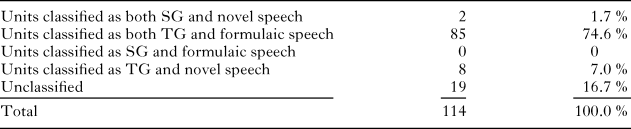
But is it also the same units that are classified in the same way in both frameworks? As Table 2 shows, the answer is essentially in the affirmative: there is a distinct majority of three-quarters of all information units that are classified as both TG and formulaic speech units (74.6%) and, conversely, all SG units that have been identified belong to novel speech (1.7%). The way the divergence of 7 percent of the units is to be interpreted, where the two frameworks yield contrasting analyses, is a matter for future research.
Discourse Grammar and the dual process model compared: utterances produced by an English-speaking aphasic patient after five treatment sessions (based on Van Lancker Sidtis, Reference Van Lancker Sidtis, Corrigan, Moravcsik, Ouali and Wheatley2009, p. 455, Table 1)
To conclude, on the basis of this limited set of data it would seem that the aphasic patient concerned, suffering left hemisphere damage, relies primarily on TG in constructing linguistic discourse, that is, like formulaic speech, TG appears to involve a strong implication of the right hemisphere.
Similar observations can be made about the speech of the second subject, a German aphasic patient before undergoing treatment. The text pieces in (11) are taken from a conversation between a therapist and the patient. To save space, we are restricted in (11) to the utterances of the latter (see Van Lancker Sidtis, Reference Van Lancker Sidtis, Corrigan, Moravcsik, Ouali and Wheatley2009, pp. 456−457, for all further information).Footnote 10
(11) Utterances of a German-speaking aphasic patient responding to a therapist (English glosses in parentheses; formulaic units are in italics, novel units are underscored; Van Lancker Sidtis, Reference Van Lancker Sidtis, Corrigan, Moravcsik, Ouali and Wheatley2009, pp. 456−457)
a. Ja. (yes)
b. Ah Gott ja. (Oh heavens yes)
c. Ja. (yes)
d. Ja. (yes)
e. Hallo, wie geht’s? Danke, gut, tja. ja, und? (Hello, how are you? Thank you, good, okay, yeah, and now?)
f. Äh, Haare waschen? Und, rot,ja, ja, och, ja. (Uh, wash hair? And, red, yeah, yeah, oh, yeah)
g. Nö, äh, ach Gott, und,ein, ehm, undund äh, und, und, Geld,nö, das ist so gut, das ist, das w.. (Nope, um, oh God, and, a, um, and and, money, nope, that’s just fine, that’s, that)
h. Ja. (yes)
i. Ja, sehr gut. (yes, very good)
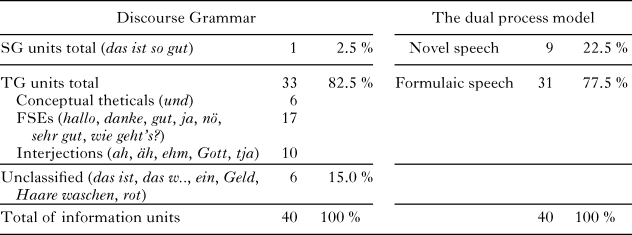
The following information units cannot be classified on the basis of the data available, for the reasons mentioned above: das ist ‘that’s’, das w.. ‘that’, ein ‘one’, Geld ‘money’, Haare waschen ‘hair wash’, rot ‘red’. Table 3 provides an overview of the two classifications of categories. The results for the German patient are strikingly similar to those obtained for the English-speaking aphasic patient: the vast majority of all information units are both TG units (82.5%) and instances of formulaic speech (77.5%). Accordingly, the contribution of SG units (2.5%) and novel language units (22.5%) is restricted to a fraction of the utterances. The difference between the last two figures can be accounted for by the large number of unclassified units (15%); conceivably, a more detailed analysis might reveal that they also qualify as SG units.
A classification of the information units in (11), produced by a German-speaking aphasic patient, comparing Discourse Grammar categories with the categories proposed within the dual process model of Van Lancker Sidtis (2009, pp. 456−457)
To conclude, the principles of organization used in Discourse Grammar and in the dual process model are different and, accordingly, the two need to be distinguished: there are both instances of formulaic speech that are not theticals and theticals that are not part of formulaic speech. Nevertheless, there are substantial overlaps in the categories proposed, and the results obtained in both frameworks turn out to be overall similar and to exhibit some degree of regularity. As Table 4 shows, regularities concern on the one hand the different languages of the two patients: both the English- and the German-speaking patient used an extremely low rate of SG units, namely below 3 percent, while the rate of TG units is extremely high, above 80 percent. Much the same regularity characterizes the analysis based on the dual process model: the contribution of novel speech amounts to 22−24 percent in both languages, and that of formulaic speech between 75 and 78 percent.
Comparing the results obtained by Discourse Grammar and the dual process model in the speech of an English-speaking and a German-speaking aphasic patient (percentages only; data based on Van Lancker Sidtis, Reference Van Lancker Sidtis, Corrigan, Moravcsik, Ouali and Wheatley2009, pp. 456−457)

The main functional domains of thetical categories
Another regularity concerns the two frameworks, which exhibit much the same differences for both patients and languages: both percentages of SG units and novel speech units are low, but the former are consistently lower (below 3%) than the latter (above 20%) and, accordingly, the figures of TG units are consistently higher than those of formulaic speech.
To conclude, there is a significant overlap between the two frameworks of analysis. What this suggests is the following: the dual process model has been demonstrated to be able to establish a regular correlation between linguistic behavior and the neurological distinction between the two cerebral hemispheres. The same can now also be claimed − at least with reference to the data looked at in this section − for Discourse Grammar. Note that the correlation is even more clear-cut in the case of the latter: as Table 4 shows, SG is almost entirely absent in the speech of these aphasic patients; that is, the speech production of both patients is essentially restricted to TG.Footnote 11
Which theoretical implications this difference between the two frameworks has is an issue that is beyond the scope of the present paper and needs to be addressed in future research. This research will have to be based on a more detailed study of the discourse organization of aphasic speakers. As we observed above, we had to leave unclassified a substantial number of the information units produced by the aphasic patients: without a more comprehensive knowledge of the way aphasics and other speakers with left or right hemisphere damage structure their texts, a classification of those units must remain conjectural.
4. A division of labor
We saw in Section 3 that persons suffering damage of the left cerebral hemisphere draw primarily on formulaic speech in their organization of linguistic discourse, as has been demonstrated abundantly by Van Lancker Sidtis and associates (Sidtis et al., Reference Van Lancker Sidtis, Corrigan, Moravcsik, Ouali and Wheatley2009; Van Lancker, Reference Van Lancker and Ellis1988, Reference Van Lancker1990, Reference Van Lancker1997; Van Lancker Sidtis, 2004, 2009, 2012; Van Lancker Sidtis & Postman, Reference Van Lancker Sidtis and Postman2006). Furthermore, we saw that there is also substantial overlap between the concept of formulaic speech and that of Thetical Grammar (TG).
As was mentioned in Section 2.1, utterances designed within the domain of SG are determined by the syntactic and semantic compositionality of sentences. The meaning of information units of TG, by contrast, is determined by the situation of discourse − that is, by what may be described as the pragmatic environment of linguistic communication.Footnote 12 To be sure, it is possible to form utterances by relying on information units of one domain only. For example, an utterance like I saw Mary yesterday consists of an SG unit only, whereas Good morning, Mary, how are you? is made up only of TG units (i.e., two formulae of social exchange and a vocative); but linguistic communication would be deficient if either of the two domains were absent.
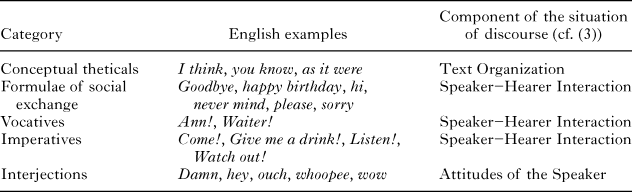
TG is made up essentially of five different linguistic categories with each being associated with a specific spectrum of communicative functions. As Table 5 shows, these functions concern specific components of the situation of discourse. Conceptual theticals relate an utterance to the situation of discourse beyond the structure of a sentence, formulae of social exchange and vocatives are used to maintain or reinforce social relations, while interjections concern most of all the internal emotional or mental state of the speaker or the interaction between speaker and hearer (cf. Ameka, 1992a, Reference Ameka1992b; Norrick, Reference Norrick2009, p. 876), and imperatives are typically used by the speaker to get the hearer to act (Aikhenvald, Reference Aikhenvald2010).
Linguistic categories dedicated to such elementary functions of human communication are almost entirely restricted to TG. While Sentence Grammar can be used to express virtually any meaning, it does not dispose of any dedicated categories for these functions.
We had a number of examples in Section 3 showing that linguistic forms for these functions can be immediately related to right hemisphere activity. A paradigm example is provided by the following patient diagnosed with global aphasia following a stroke that involved frontal, temporal, and parietal areas of the left hemisphere: he was unable to speak, name, or repeat, and his auditory−verbal language comprehension was severely limited. His linguistic production was restricted to automatic speech units, i.e., three formulae of social exchange (yeah, yes, no), two interjections (expletives, goddammit, shit), and one discourse marker (well). Note that these utterances were produced with good articulation and prosody (Van Lancker & Cummings, Reference Van Lancker and Cummings1999, p. 86).
The claim made in the present section is that speech functions expressed by categories of TG are exactly the ones that are suggestive of right hemisphere activation. To this end, we will now look at each of the three components distinguished in Table 5 in turn.
4.1. text organization
SG is determined by the syntactic and semantic compositionality of sentences. TG, by contrast, draws on inferential mechanisms that relate information units beyond their literal meaning to the speaker, the hearer, and to the situation in which speech operates − in short, TG is anchored in what is commonly described as pragmatics. For example, we saw in example (4a) that the meaning of the adverb frankly is determined by its function as an adverb modifying the predicate of the sentence. As a thetical in (4b), by contrast, where it is syntactically and prosodically detached, it relates the meaning of the utterance beyond the sentence to the attitudes and beliefs of the interlocutors. And if our hypothesis of a positive correlation between the use of TG and right hemisphere activity is correct, we will expect speakers suffering right hemisphere damage to have deficits in locating their speech appropriately within the situation of discourse and, more generally, in the world around them. TG is responsible in particular for the following functional goals:
(a) To design a coherent model of discourse.
(b) To anchor meanings in the situation of discourse rather than in the structure of sentences.
There is in fact neurolinguistic evidence in support of these two functional goals: both appear to be centrally associated with right hemisphere activity, rather than with the left hemisphere.
With reference to (a), there is a body of neurolinguistic observations suggesting that the left hemisphere is in charge of basic information (word recognition, syntactic processing). The right hemisphere, by contrast, tends to be activated to establish cohesive ties in narratives (Bloom, Reference Bloom, Bloom, Obler, De Santi and Ehrlich1994; Marini, Carlomagno, Caltagirone, & Nocentini, Reference Marini, Carlomagno, Caltagirone and Nocentini2005) and/or when the processing of higher-level information (integration of parts as a coherent whole), and what tends to be referred to as the ‘macrostructure’ of discourse, are involved (Robertson et al., Reference Robertson, Gernsbacher and Guidotti2000; see also Sherratt & Bryan, Reference Sherratt and Bryan2012, pp. 215−216), for instance the organizing and ordering of discourse structure (Lojek-Osiejuk, Reference Lojek-Osiejuk1996).
Confronting ten healthy, native English speaking volunteers with written texts which consisted on the one hand of titled and on the other hand of untitled paragraphs, St George, Kutas, Martinez, and Sereno (1999, pp. 1317, 1323) conclude that right hemisphere engagement occurs routinely as readers attempt to construct a unitary coherent model of a discourse and discover the producer’s intents. And it is especially the right middle temporal regions that appear to be important for the integrative processes needed to achieve global coherence during discourse processing, where ‘integration’ means that multiple pieces of information are integrated across sentences.
Right hemisphere damage following a stroke has been shown to lead to disturbances in communication skills, and these disturbances include difficulty in preserving the macro-structure and organization of discourse (Hough, Reference Hough1990; Joanette, Goulet, Ska, & Nespoulous, Reference Joanette, Goulet, Ska and Nespoulous1989). Accordingly, the content of discourse produced by RHD individuals tends to be characterized by reduced topic maintenance (Prutting & Kirchner, Reference Prutting and Kirchner1987) and to be incoherent, tangential, and self-oriented (Blake, Reference Blake2006).Footnote 13 And a number of authors argue that cognitive disorders in RHD individuals account for disturbed discourse skills (Bartels-Tobin & Hinckley, Reference Bartels-Tobin and Hinckley2005; Myers, Reference Myers1999; Penn, Reference Penn2000; Tompkins, Reference Tompkins1995).
That the integration task is of a different kind both between the two domains of Discourse Grammar and the two hemispheres can possibly be linked to the hypothesis proposed by Beeman (Reference Beeman, Beeman and Chiarello1998), according to which words are each associated with a large and diffuse semantic field in the right hemisphere but with a smaller, more focal, semantic field in the left hemisphere. Blonder et al. (1991, p. 1124) therefore suggest that activation in the left hemisphere is restricted to the target and its most closely linked associates, whereas in the right hemisphere many concepts give rise to weak activation for some time.
With regard to (b), the contribution of the right hemisphere is particularly evident in the domain of what has been referred to above as pragmatics (e.g., Bates, Reference Bates1976; Cutica, Bucciarelli, & Bara, Reference Cutica, Bucciarelli and Bara2006; Ferré, Ska, Lajoie, Bleau, & Joanette, Reference Ferré, Ska, Lajoie, Bleau and Joanette2011): left hemisphere patients typically exhibit primary impairment in comprehending and appropriately using syntactic and semantic aspects of language; persons with right hemisphere damage, by contrast, demonstrate great difficulty with pragmatic communication (Joanette, Goulet, & Hannequin, Reference Joanette, Goulet and Hannequin1990; Molloy, Brownell, & Gardner 1990; Moscovitch, Reference Moscovitch and Perecman1983; Ozonoff & Miller, Reference Ozonoff and Miller1996; Weylman, Brownell, Roman, & Gardner, Reference Weylman, Brownell, Roman and Gardner1989).
An impairment of RHD subjects has been referred to as a selective deficit in integrating pieces of information by means of inferences derived from the situational context (Carol, Baum, & Pell, Reference Carol, Baum and Pell2001; Delis, Wapner, Gardner, & Moses, Reference Delis, Wapner, Gardner and Moses1983; Jung-Beeman, Bowden, & Gernsbacher, Reference Jung-Beeman, Bowden and Gernsbacher2000;), and Marini et al. (2005, p. 53) speculate that the right hemisphere plays a relevant role in complex linguistic skills such as organizing a mental model for producing narratives.
Furthermore, patients with right hemisphere damage were found to have difficulty in interpreting indirect requests and commands and to rely on the literal meanings of conversations rather than pragmatic cues that involve deriving meaning from contextual information (Foldi, Reference Foldi1987; Hirst, LeDoux, & Stein, Reference Hirst, LeDoux and Stein1984; Weylman et al., Reference Weylman, Brownell, Roman and Gardner1989).
We observed in Section 3 that Van Lancker Sidtis (2009, pp. 451−452) found that one of the patients who had sustained a large right hemisphere lesion was characterized by conversational speech that was often pragmatically inappropriate, even though his language abilities were intact. Van Lancker and Cummings (1999, p. 96) observe that while the left hemisphere mediates most linguistic behaviors, the right hemisphere is important for broader aspects of communication. Other right hemisphere lesion patients were found to ignore context and were not able to fill in what was not present in the words (Myers, Reference Myers and Brookshire1978); Shields (Reference Shields1991) concludes:
It is not surprising that some right hemisphere lesion patients have difficulty utilising and responding to all the extralinguistic or pragmatic aspects of communication, or that the linguistic domain itself is inadequate in helping them to derive meaning from on-going events. (Shields, Reference Shields1991, p. 386)
The relationship between speech and pragmatics tends to be described in terms of inferential mechanisms and, in fact, some authors have pointed out that RHD individuals may lack the ‘mental flexibility’ for making inferences (Brownell, Potter, & Bihrle, Reference Brownell, Potter and Bihrle1986; but see also McDonald & Wales, Reference McDonald and Wales1986) or accessing indirect speech acts (Champagne-Lavau & Joanette, Reference Champagne-Lavau and Joanette2009). Note further that the right hemisphere has been argued to be relatively more involved in computing (non-linguistic) situation models that, in speaking, provide the input to specifying the propositional content of an utterance (see Menenti, Segaert, & Hagoort, Reference Menenti, Segaert and Hagoort2012, for discussion).
4.2. speaker−hearer interaction
Language structure provides a range of means to express interpersonal functions. But, as pointed out in the introduction to this section, the paradigm tools of expression are reserved for the domain of TG. One of the prominent functions of TG is to express interpersonal concepts: three of the five categories of this domain of grammar concern exclusively interpersonal communication, namely formulae of social exchange, vocatives, and imperatives (see Table 5). It would seem that theticals belonging to these three categories serve in particular the following functional goals:
(a) To establish and maintain contact with other speech participants.
(b) To create a social environment that is beneficial to all speech participants concerned.
(c) To address the hearer and ask him or her for action.
According to the ‘classical’ view surfacing from neurolinguistic analyses, the left temporal cortex is dominant in speech processing. The right cerebral hemisphere, by contrast, is more centrally associated with other functions. And it is in particular the above range of functions that appear to be more strongly associated with right hemisphere activity.
In accordance with (a), inappropriate social (and emotional) behavior is predominately associated with right frontal dysfunction (Joseph, Reference Joseph2000). People with right brain damage (RBD) are considered to be socially disconnected from the world around them (Myers, Reference Myers1999), and they have been found to have difficulties sharing the responsibility to develop and maintain adequately the exchange with the speaker (Hird & Kirsner, Reference Hird and Kirsner2003). In particular, RHD adults exhibit difficulties in governing verbal exchange since they take little account of their communicative partner. And they have problems with paralinguistic means of speaker−hearer interaction such as sending or receiving information via facial expression (Blonder et al., Reference Blonder, Bowers and Heilman1991), establishing and maintaining eye contact (Myers, Reference Myers and Chapey1994; Tompkins, Reference Tompkins1995), or spontaneously using gesture (Tompkins, Reference Tompkins1995). Note that many patients with acquired right hemisphere damage demonstrate paralinguistic deficits, including impairments in prosody and gesture (Joanette et al., Reference Joanette, Goulet and Hannequin1990).
Furthermore, persons with right hemisphere damage following stroke have been found to exhibit an impaired turn-taking and appreciation of the listener’s perspective (Chantraine, Joanette, & Ska, Reference Chantraine, Joanette and Ska1998; Kaplan, Brownell, Jacobs, & Gardner, Reference Molloy, Brownell, Gardner, Joanette and Brownell1990; Myers, Reference Myers and Chapey1994).
That the goal in (b) is distinctly more likely to involve activity in the right than in the left hemisphere has been pointed out by a number of researchers. The former hemisphere has been portrayed as providing the social context of linguistic communication (Berman, Mandelkern, Phan, & Zaidel, Reference Berman, Mandelkern, Phan and Zaidel2003) and serving successful social communication (Mitchell & Crow, Reference Mitchell and Crow2005). And a number of studies suggest a predilection for right hemisphere processing of social and real-world contextual associations for lexical items (Chiarello, Reference Delis, Wapner, Gardner and Moses1995; Drews, Reference Drews1987; see also Van Lancker, Reference Van Lancker1997; Van Lancker Sidtis, Reference Van Lancker Sidtis2004). As has been pointed out in some research findings, between 50 percent and 78 percent of individuals with right hemisphere damage may exhibit difficulties in one or more communication components, leading to inadequate social interactions (Ferré et al., Reference Ferré, Ska, Lajoie, Bleau and Joanette2011).
Interpersonal, as well as emotional, difficulties are among the main deficits experienced by patients who have suffered damage of the right hemisphere early in life or by inheritance (Shields, Reference Shields1991). It therefore comes as no surprise that for the two aphasic patients that we were concerned with in Section 3, formulae of social exchange were among the most frequently used speech units, topped only by interjections (Tables 1 and 3). And as we also saw in Section 3, one of the patients, having suffered right-sided subcortical damage, showed deficits in her command of information units concerning Speaker−Hearer Interaction, e.g., having difficulties with formulae of social exchange, such as greetings and leave-taking (Van Lancker Sidtis, Reference Van Lancker Sidtis, Corrigan, Moravcsik, Ouali and Wheatley2009, pp. 451−452).
4.3. attitudes of the speaker
The primary function of SG appears to be the structuring and expression of conceptual information in a propositional format. It relates primarily to what Jakobson (Reference Jakobson and Sebeok1960) calls the referential function, or Lyons (1977, pp. 50−51) the descriptive (or propositional, or ideational) function of language. But SG does not really dispose of dedicated tools, i.e., function-specific linguistic constructions, for the expression of emotions.
This is different in TG, which disposes of appropriate means for expressing speaker attitudes in general and emotional states in particular. In the sense of Jakobson (Reference Jakobson and Sebeok1960), there are dedicated categories in TG for the expression of conative, expressive, and phatic functions. Especially the thetical category of interjections (which also includes exclamatives; see Heine et al., Reference Heine, Kaltenböck, Kuteva, Long, Bischoff and Carmen2013, Section 4.6) provides cross-linguistically an ideal tool dedicated to the linguistic encoding of emotions (see Table 5).
That emotional behavior is strongly linked to the right hemisphere is an old observation in neurological research. Loss of propositional speech was reported in severely aphasic speech of patients already in the nineteenth century: these patients were found to be left only with expletives, interjections, and oaths (Van Lancker & Cummings, Reference Van Lancker and Cummings1999) − that is, with linguistic expressions that are all classified as interjections in the framework of Discourse Grammar (Heine et al., Reference Heine, Kaltenböck, Kuteva, Long, Bischoff and Carmen2013).
As has been established in a number of lesion studies, right brain damage usually results in deficits in both the linguistic and the non-linguistic comprehension and production of emotions (e.g., Borod, Andelman, Obler, Tweedy, & Welkowitz, Reference Borod, Andelman, Obler, Tweedy and Welkowitz1992; Borod et al., Reference Borod, Rorie, Haywood, Andelman, Obler and Welkowitz1996; Borod, Bloom, & Santschi Haywood, 1998; Borod et al., Reference Borod, Rorie, Pick, Bloom, Andelman and Campbell2000; Borod, Bloom, Brickman, Nakhutina, & Curko, Reference Borod, Bloom, Brickman, Nakhutina and Curko2002; Karow & Connors, Reference Karow and Connors2003; Myers, Reference Myers1999; Sherratt & Bryan, Reference Sherratt and Bryan2012; Wager, Phan, Liberzon, & Taylor, Reference Wager, Phan, Liberzon and Taylor2003). This generalization has received some support from brain-imaging studies, even though the latter have also shown that the expression of emotion also implicates left lateralization (Wager et al., Reference Wager, Phan, Liberzon and Taylor2003, p. 527).Footnote 14 Among the pragmatic aspects of language associated with the right cerebral hemisphere, emotions in speech have in fact a prominent place (e.g., Friederici & Alter Reference Friederici and Alter2004; Mitchell & Crow, Reference Mitchell and Crow2005). This hemisphere is said to be dominant in the processing of paralinguistic information, and to one’s affective state (Beeman & Chiarello, Reference Beeman and Chiarello1998; Devinsky, Reference Devinsky2000). Acknowledging that language and speech are typically related to the left hemisphere of the brain, Jakobson (1980, p. 23) adds that there are such verbal elements as interjections and exclamations that are typically associated with the right hemisphere (see also Tsur, Reference Tsur2010, p. 512). Kriendler and Fradis (1968, p. 111) observe that in all kinds of aphasia, motor articulation was dramatically better during ‘emotional speech’, and Blonder et al. (1991, p. 1116) conclude that the right hemisphere “houses a lexical representation of emotions”.
Furthermore, as we saw in the texts analyzed in Section 3, produced by two aphasic patients, interjections were clearly the linguistic units most frequently produced by both the English-speaking and the German-speaking subjects suffering left hemisphere damage (Tables 1 and 3).
A number of neurolinguistic studies suggest in fact that inappropriate emotional behavior is predominantly associated with right frontal dysfunction (e.g., Joseph, Reference Joseph2000), and Shammi and Stuss (Reference Shammi and Stuss1999) observe that individuals with RHD injury, especially when reaching the frontal cortex, do not react physically to emotions (laughing or smiling).
Both imaging and clinical evidence suggest in fact that the right hemisphere is highly relevant for the comprehension and production of emotional features in speech (Bloom, Borod, Obler, & Gerstman, Reference Bloom, Borod, Obler and Gerstman1992; Borod et al., Reference Borod, Bloom, Santschi Haywood, Beeman and Chiarello1998; Devinsky, Reference Devinsky2000; Rota, Reference Rota, Dogil and Reiterer2009). Ley (Reference Ley1980) and Ley and Bryden (Reference Ley, Bryden and Perecman1983) found that the presentation of emotional words during a list learning task selectively improved memory of stimuli directed to the right hemisphere.
Such observations are supported by studies on hemispheric differentiation in the activation of prosody. While prosodic processing requires a series of complex cognitive operations, there is evidence for a specialization of the right hemisphere for the processing of emotional prosody and of the left hemisphere for ‘linguistic’ prosodyFootnote 15 (Ferré et al., Reference Ferré, Ska, Lajoie, Bleau and Joanette2011). Ross et al. (Reference Ross, Thompson and Yenkisky1997) analyzed the mechanisms underlying affective–prosodic deficits following left and right brain damage by testing the ability of subjects to repeat and comprehend affective prosody under progressively reduced verbal–articulatory conditions. They conclude that reducing verbal–articulatory conditions robustly improves the performance of left but not right brain damaged patients, thus supporting the supposition that affective prosody is strongly lateralized to the right hemisphere.
4.4. discussion
As the observations made in this section suggest, there are positive correlations between the functions served by the categories of TG and right hemisphere activity. However, there is so far still a wide gap between what the linguist expects to find located somewhere in the brain and what the neurologist actually observes. Accordingly, the correlations pointed out in the preceding paragraphs must be taken with care, in particular for the following reasons. First, exactly which functions are activated where in the brain is an area that is still largely ill-understood, and this applies crucially to linguistic functions. For example, language dominance in the left hemisphere is not an absolute human characteristic. As a study of 188 right-handed subjects by Knecht et al. (Reference Knecht, Deppe, Dräger, Bobe, Lohmann, Ringelstein and Henningsen2000) showed, using a functional imaging technique, altogether 92.5 percent of the subjects turned out to have left hemisphere language dominance, while 7.5 percent had right hemisphere language dominance.
Second, there appears to be widespread consensus that most, if not all, language components include both left and right hemisphere processes – in the wording of Beeman and Chiarello (Reference Beeman and Chiarello1998, p. 6): “the right hemisphere and left hemisphere conjointly process language at all levels” (e.g., Hagoort, Brown, & Swaab, Reference Hagoort, Brown and Swaab1996; Jung-Beeman, Reference Jung-Beeman2005, p. 513).
And third, the two hemispheres appear to have mutually supportive functions. For example, when a child has one hemisphere injured or removed at an early age, the remaining hemisphere may, with minor adjustments, be able to compensate for the injured or absent hemisphere’s function (Beeman & Chiarello, Reference Beeman, Beeman and Chiarello1998, p. 2). But there appears to be an asymmetry in lateralization − one that might be directly relevant to the subject matter of this paper. The right hemisphere exhibits a remarkable capacity to reorganize originally left hemisphere functions while there does not appear to be good evidence for the reverse pattern of reorganization, e.g., after right hemisphere lesions.Footnote 16 Helmstaedter, Kurthen, Linke, and Elger (1994, p. 735) suggest that even if evidence would be found for a left hemisphere reorganization of right hemisphere functions, this would not be at the expense of originally left hemisphere functions.
Furthermore, the correlations pointed out earlier in Sections 3 and 4 raise a number of additional problems. One has already been discussed by Luria (Reference Luria1974), namely that linguistic performances are distributed in widespread cortical constellations or assemblies: neither neural distinctions of brain activity nor the linguistic structures distinguished in this work are as neatly separated from one another as was implied above. There are complex overlaps between the two − both between the two hemispheres and between the two domains of Discourse Grammar. And there is constant and massive interaction between the two structures, and interaction takes place both between subareas of the two hemispheres of the brain and of the two linguistic domains. The nature of this interaction is the subject of ongoing research.
These observations raise the question of whether the generalizations proposed by us can in fact be accounted for in terms of functional modularity where specific areas of the cortex can be held responsible for particular language-specific functions, or whether such functions should not more profitably be analyzed in terms of network-based accounts. According to some lines of research, there are no significant correlations between particular brain regions and speech processing. When taking a set of putative ‘speech areas’ of the brain and looking at the non-linguistic processes that activate them, Price, Thierry, and Griffiths (2006) found no macro-anatomical structures in the human brain dedicated to speech. Rather than correlations between brain structures and speech, these authors suggest, speech-specific processing emerges at the level of functional connectivity among distributed brain regions, each of which participates in processes that are engaged in both speech and non-speech tasks (p. 271).
A final problem concerns the question of whether the correlations between brain lateralization and language-related functions are in fact symmetrical in the way implied in this paper. Neuroimaging evidence on speech comprehension suggests, for example, that functional dissociation may not concern the distinction between right and left hemisphere but rather between a distributed bilateral domain relating to general perceptual and cognitive processing on the one hand, and a more specialized left hemisphere domain supporting key grammatical language functions on the other (Bozic, Tyler, Ives, Randall, & Marslen-Wilson, Reference Bozic, Tyler, Ives, Randall and Marslen-Wilson2010).Footnote 17
In spite of these and other caveats that have been voiced on hypotheses that assume a clear-cut division of language-related functions in brain lateralization, the evidence that has become available appears to allow for the following generalization on the neurological anchoring of Discourse Grammar: in the same way that SG, that is, ‘regular’ sentence structure, is unlikely to be activated without the participation of the left hemisphere, it is equally unlikely that the activation of TG phenomena, such as discourse markers, vocatives, interjections, or formulae of social exchange, can be achieved without any participation of the right hemisphere.
5 Why theticals tend to be formulaic
While there are considerable differences, we suggested in Section 3 that there is massive overlap between the two kinds of theoretical concepts examined in more detail, namely TG within the framework of Discourse Grammar and formulaic speech within the dual process model. For example, we saw in Table 2 that 76.3 (= 1.7 plus 74.6) percent of all information units produced by the English-speaking aphasic patient were classified the same way in the two frameworks, while only 7.0 percent were classified differently. The question that we wish to look into in the present section is what accounts for this overlap.
Formulaic information units are by no means restricted to theticals, they are also found in SG, as the rich literature on formulaic speech shows (e.g., Pawley, Reference Pawley and Bright1992, Reference Pawley, Corrigan, Moravcsik, Ouali and Wheatley2009; Wray, Reference Wray2002, Reference Wray, Corrigan, Moravcsik, Ouali and Wheatley2009). But, as this literature suggests, such units are distinctly less common in SG than in TG. Accordingly, in listings of formulaic speech units, theticals usually form a clear majority. Why should this be so? While we are not able to answer this question, we wish to contribute some observations that may be instrumental to finding a convincing answer.
It would seem that this answer has to do with the development of theticals. Only a small portion of them are etymologically opaque; that is, they cannot be derived from any other linguistic material. And these are almost exclusively primary interjections, such as ouch!, wow!, or pst! and text-planning units like uh or am (see Heine et al., Reference Heine, Kaltenböck, Kuteva, Long, Bischoff and Carmen2013). All other theticals are historically derived from SG via a spontaneous operation called cooptation (Section 2.1).
Being organized in terms of clauses and sentences, the internal structure of information units of SG is essentially compositional, consisting of clausal and phrasal constituents. This also applies to many instantaneous theticals: with few exceptions they are the result of cooptation, that is, they are transferred from SG to TG (see Section 2.1; Kaltenböck et al., Reference Kaltenböck, Heine and Kuteva2011, pp. 874−875), and accordingly they inherit the morphosyntactic structure of their SG source. To be sure, they may be coopted as incomplete pieces, such as comment clauses (I think, you know) or reporting clauses (he replied, they say), which both lack a complement, or question tags (didn’t he?), which lack a verb phrase, but many of them have the propositional structure of their SG equivalent, as in text example (12):
(12) Because on this theory and it’s very deeply helduh good educational news is by definition inadmissible as evidence. (DCPSE: DI-I01, #91; Kavalova, Reference Kavalova, Dehé and Kavalova2007, p. 147)
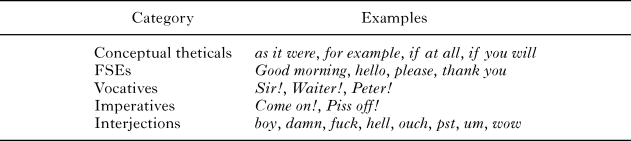
But once they are used recurrently they tend to assume the features of formulaic information units, becoming regular collocations, gradually losing their internal compositionality, and changing their analytic meaning into holistic meanings expressing functions that are grounded in the situation of discourse rather than in the structure of a sentence. And some of them develop into what Pawley (Reference Pawley, Corrigan, Moravcsik, Ouali and Wheatley2009) refers to as speech act formulas. Paradigm instances of such formulas are provided by thetical categories such as the formulae of social exchange or interjections: they are usually short, taking the form of what Mackenzie (Reference Mackenzie, Hannay and Bolkestein1998) and Hengeveld and Mackenzie (2008, pp. 3−4) call fixed holophrases, i.e., unanalyzable information units that do not have any propositional organization or other internal structure − and they need not: many of them can, and frequently do, form complete utterances of their own, relying on the situation of discourse for an appropriate interpretation. Table 6 lists a few examples of such holophrases.
Formulaic theticals of English
Formulaic theticals constitute a subset of formulaic sequences.Footnote 18 They have been defined by Kaltenböck et al. (2011, p. 871) as non-compositional information units that are usually short, morphosyntactically unanalyzable chunks, that tend to be positionally flexible and express functions that are mostly procedural, and that relate to the situation of discourse rather than to sentence syntax.
But why should theticals, more than SG units, have a disposition to turn into formulaic information units? All available evidence suggests that this has to do with their discourse functions. While SG contains a wide range of idioms and other kinds of prefabricated information units, it is essentially propositional and analytic in structure, consisting of utterances having a compositionally organized sentence structure. In this way, SG is able to express virtually any conceptual content in a coherent and consistent form by combining the lexical and morphological resources of a language in an unlimited way.
To the extent that TG feeds on SG, it also exhibits the inherited propositional format and may express complex conceptual information in the form of parentheticals. But the main task of TG is to respond to the communicative needs of speakers and hearers by relating speech to the situation of discourse, in particular to the Attitudes of the Speaker, Speaker−Hearer Interaction, and Text Organization (see (3) above). Accordingly, TG constitutes the primary linguistic tool of expression for functions concerning emotions, attitudes, social relationship, and discourse organization beyond the level of a sentence. While the list of such functions is large, it is as a rule only a limited catalog of functions that surface in regular linguistic communication, many involving social routines, and expressions for such functions tend to be used time and again.
What characterizes these expressions is, first, that they refer to stereotypic discourse functions involving what one may call participant-stable hic-et-nunc situations, where the deictics of person, space, and time remain constant, and hence predictable. Linguistic information on person, tense, and aspect is therefore usually redundant. And second, these expressions tend to be used recurrently in day-to-day interaction.
These two observations account for a number of properties that many theticals exhibit. First, when coopted from SG they are likely to lose their literal meaning in favor of their new function in discourse. For example, when English SG expressions involving the items shit or fuck were coopted as interjections, they lost much of their SG meanings in favor of discourse-specific functions relating to speaker attitudes. Or, when the expression God be with you! was coopted and subsequently grammaticalized to an information unit of TG as a formula of social exchange, it became restricted to one particular discourse function, namely farewell giving, eventually being reduced to Goodbye! In a similar fashion, an expression such as if you will lost much of its association with its SG meaning as a conditional protasis clause when it was coopted as a discourse marker.
Second, being used recurrently for some stereotypic discourse function, these units gradually lose their morphosyntactic compositionality, turning into fixed speech act formulas (Pawley, Reference Pawley, Corrigan, Moravcsik, Ouali and Wheatley2009) or fixed holophrases (Hengeveld & Mackenzie, Reference Mackenzie and Brady2008, pp. 3−4; Mackenzie, Reference Mackenzie, Hannay and Bolkestein1998) expressing stereotypic functions grounded in the situation of discourse. And third, due to their frequent use and high predictabiliy, the units may also be shortened, losing phonetic and/or morphological size.
To conclude, the fact that the formulaic speech of Van Lancker Sidtis (2009) exhibits significant overlaps with our category of formulaic theticals may not be surprising. Both appear to be the product of a process whereby information units are used recurrently on account of some salient discourse function and turn into formulaic information units that tend to be frozen, non-compositional and short expressions. Since such discourse functions relate in most cases to the situation of discourse, it may also not be surprising that clearly the majority of these units are theticals; that is, they belong to TG rather than to SG.
6 Conclusions
Much of what has been argued for in this paper concerns the contrast between orthodox sentence grammar and what is commonly referred to as ‘pragmatics’. Our interest was restricted to manifestations of pragmatics that can be reconstructed on the basis of the functions that surface in linguistic discourse. In the framework of Discourse Grammar, these functions are described with reference to the situation of discourse, the latter consisting of a network of interlocking components (see Section 2.1, (3)). Like Van Lancker Sidtis and associates, we argued that there appears to be a significant correlation between speech phenomena and brain activity: aphasic patients and other persons with left hemisphere damage tend to draw on linguistic expressions that relate to the situation of discourse, that is, the pragmatic environment in which discourse takes place. Persons with right hemisphere damage, by contrast, may have problems relating their utterances to the social or emotional dimensions of linguistic interaction.Footnote 19
The findings that were presented in Section 4 are in support of the hypothesis that specific speech phenomena characteristic of the domain of Thetical Grammar exhibit correlations with the neural factor of brain activity in the right hemisphere. These findings go beyond the ones presented in Section 3. First, they show that correlations concern not only individuals suffering left hemisphere dysfunctions but are also supported by observations on persons with right hemisphere damage. And second, they demonstrate that the hypothesis is supported not only by data on formulaic speech, that is, the regular collocation of linguistic units, but also by the analysis of linguistic functions. It would seem in fact that the functions that speech serves influence to some extent the way in which a particular part of the brain is activated, but more research is needed on this issue.
The observations made in the paper suggest on the one hand that the two frameworks surveyed in Section 2 differ from one another in a number of ways. First, while the two show roughly the same kind of correlation with brain lateralization, we saw that there is one divergence: instantaneous theticals, which are created spontaneously (cf. the examples in (9) or (12)), belong to Thetical Grammar but have the characteristics of novel speech, normally associated with Sentence Grammar (Kaltenböck et al., Reference Kaltenböck, Heine and Kuteva2011). Second, whereas the dual process model relies on formulaicness as its central parameter, in the framework of Discourse Grammar it is the conceptual and linguistic independence of theticals that is the central parameter. And third, all available linguistic evidence suggests that there is no discrete boundary separating formulaic from novel speech: the former appears to be generally the result of a diachronic process whereby free and fully compositional information units may gradually develop into prefabricated collocations and eventually into frozen combinations of formulaic speech. Accordingly, depending on which stage of development is at stake, the unit concerned may relate more closely to the one or the other end of the process (Wray, Reference Wray2002, Reference Wray, Corrigan, Moravcsik, Ouali and Wheatley2009).
On the other hand, the dual process model is to quite some extent compatible with our concept of Discourse Grammar, agreeing with it in the following main characteristics: first, both assume that linguistic behavior is channeled via two, to some extent distinct, lines of cognitive activity. Second, there is a substantial correlation between novel speech and SG on the one hand and formulaic speech and TG on the other: novel speech units are mostly found in SG while formulaic speech is overwhelmingly located in TG. And finally, in addition to linguistic evidence, both frameworks are supported by neurological evidence, involving the same kind of differential activation of the two hemispheres of the human brain.