Introduction
It is well established that caring for a family member with dementia can have a significant negative impact on the caregiver. As well as having social and financial implications, caregivers suffer higher levels of depression and anxiety, greater incidence of physical health problems, and a shortened life expectancy (Schulz et al., Reference Schulz, Martire and Klinger2005). Outcomes such as depression and caregiver burden are well researched, however in reviewing the caregiving literature, Zarit and Femia (Reference Zarit and Femia2008) criticized studies evaluating treatments for depression in caregivers which included caregivers who, although distressed, were not depressed. Zarit and Femia (Reference Zarit and Femia2008) recommended the use of an outcome measure, which is appropriate for the nature of the distress experienced by the caregiver. Apart from depression and burden, other psychological constructs relevant to caregiver distress, such as guilt, have been relatively neglected. Guilt is one of the diagnostic criteria for major depressive disorder in the DSM-IV (American Psychiatric Association, 2000), has been shown to be associated with depression in the general population (Kim et al., Reference Kim, Thibodeau and Jorgensen2011) and is a common experience of caregivers (Samuelsson et al., Reference Samuelsson, Annerstedt, Elmstahl, Samuelsson and Grafstrom2001; Rosa et al., Reference Rosa2010). Gonyea et al. (Reference Gonyea, Paris and Zerden2008) found that 65% of their sample of adult-child caregivers experienced guilt in relation to their caregiving role. Although definitive causal models have not yet been established, it has been suggested that interventions targeting guilt may reduce the distress associated with guilt itself, as well as preventing or reducing negative psychological symptoms with which guilt has been associated, including but not limited to, depressive symptoms (Kim et al., Reference Kim, Thibodeau and Jorgensen2011). Although there are relatively few studies to date, research into emotions frequently experienced by caregivers, such as guilt, will further inform clinical interventions where depression may not be an appropriate target for intervention. Although guilt is a common experience of caregivers, without a psychometrically robust measure with a clinical cut-off, it is difficult to measure and ascertain what level of guilt is likely to be dysfunctional.
Martin et al. (Reference Martin, Gilbert, McEwan and Irons2006) designed a caregiving shame and guilt scale, with six items pertaining to caregiver guilt, although subscales were not identified through factor analysis. In a sample of 70 dementia caregivers, Martin et al. (Reference Martin, Gilbert, McEwan and Irons2006) found guilt was not associated with depression in caregivers, a surprising finding given that guilt is associated with depression in the general population (Kim et al., Reference Kim, Thibodeau and Jorgensen2011). However, this finding may be confounded by correlating current depressive symptomatology, measured by the Center for Epidemiological Studies Depression Scale (CES-D: Radloff, Reference Radloff1977), with hypothetical situations which may induce feelings of guilt. Statements were conditionally phrased and worded in terms of how the caregivers would feel if they acted in a certain manner in relation to caregiving behaviors. An alternative guilt scale was identified by Ankri et al. (Reference Ankri, Andrieu, Beaufils, Grand and Henrard2005) in a factor analysis of the Zarit Burden Interview (ZBI; Zarit et al., Reference Zarit, Reever and Bach-Peterson1980). Ankri et al. (Reference Ankri, Andrieu, Beaufils, Grand and Henrard2005) identified a four-item guilt factor, which was found to be associated with depression. Given that current models of guilt (e.g. Tangney and Dearing, Reference Tangney and Dearing2002) suggest that the object of negative evaluation in guilt is thought to be specific behaviors, it is likely that a four-item (Ankri et al., Reference Ankri, Andrieu, Beaufils, Grand and Henrard2005) or six-item (Martin et al., Reference Martin, Gilbert, McEwan and Irons2006) scale will not measure all relevant caregiving behaviors which may relate to caregiver guilt. In addition, neither scale yields a clinical cut-off that indicates a level of guilt which is likely to be dysfunctional.
The Caregiver Guilt Questionnaire (CGQ; Losada et al., Reference Losada, Márquez-González, Peñacoba and Romero-Moreno2010), a 22-item self-report measure, was developed to address the shortcomings of existing measures. A large number of items were tested and reduced using factor analysis, in order to develop a measure of caregiver guilt, which encompasses a wide range of caregiving behaviors relevant to the experience of guilt in a psychometrically robust manner. In a sample of 288 Spanish dementia caregivers, a principal components analysis identified a five-factor structure, which explained 59.3% of the variance. Convergent validity was established with the ZBI guilt factor and internal consistencies for the whole scale and five subscales were found to be adequate to good (Cronbach's α 0.61–0.89). Although the CGQ was found to be associated with depression, in the absence of a cut-off it is difficult to ascertain what level of guilt is likely to be clinically significant. While the CGQ was published in English, its psychometric properties have not been evaluated with an English-speaking population. The aim of this study is to test the psychometric properties of the CGQ in a sample of British dementia caregivers and to establish a clinical cut-off.
Methods
Sample
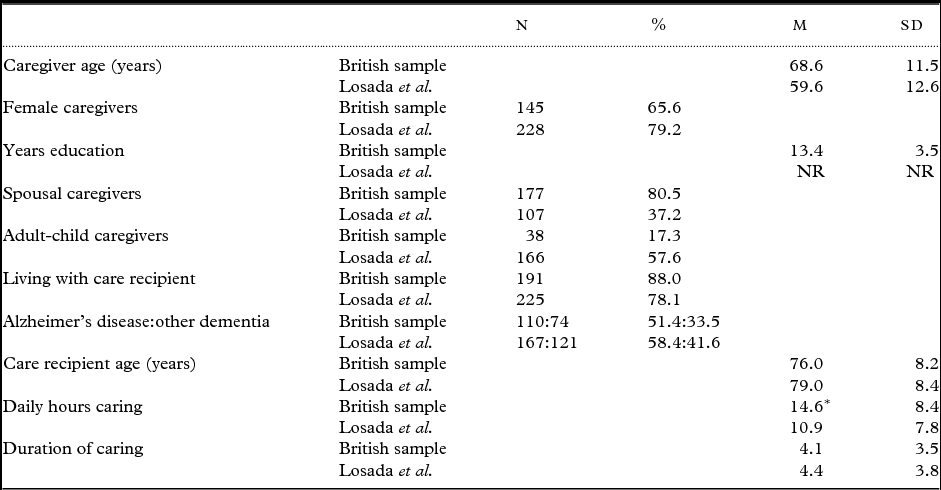
Participants were informal caregivers of persons with dementia and were recruited as part of a larger project investigating outcome measures for dementia caregivers. Participants were included if they were 18 years or older, spoke English as a first language, identified themselves as the primary unpaid caregiver for the person with dementia, and the person with dementia lived in the community. Caregivers were recruited through a postal survey sent to caregivers enrolled on the Scottish Dementia Clinical Research Network (SDCRN) research register, advertisements placed in a local Carers’ Centre newsletter and presentations given at local Alzheimer Scotland caregiver meetings. A three-month reminder pack was sent to caregivers on the SDCRN research register if they had not responded to the initial mailing. Five hundred and ninety-three questionnaire packs were sent out to SDCRN registrants and 226 were returned, a response rate of 40.3%, which is within the average range for questionnaire-based research (Baruch, Reference Baruch1999). It is not possible to compare response rates between this study and the Spanish development study (Losada et al., Reference Losada, Márquez-González, Peñacoba and Romero-Moreno2010) as the Spanish study used a different methodology (face-to-face interviews) and did not report how many caregivers were approached but declined to take part in the study. A further 13 responses were received from the other recruitment sources, giving 239 total responses. Eleven responses were excluded as the participants did not meet inclusion criteria and a further seven were excluded due to whole scales being left incomplete. As the sample is self-selected, it may not be representative of the caregiving population. Characteristics of the final sample (n = 221) and the sample from the Spanish development study (Losada et al., Reference Losada, Márquez-González, Peñacoba and Romero-Moreno2010) are shown in Table 1.
Sample characteristics for British and Spanish samples
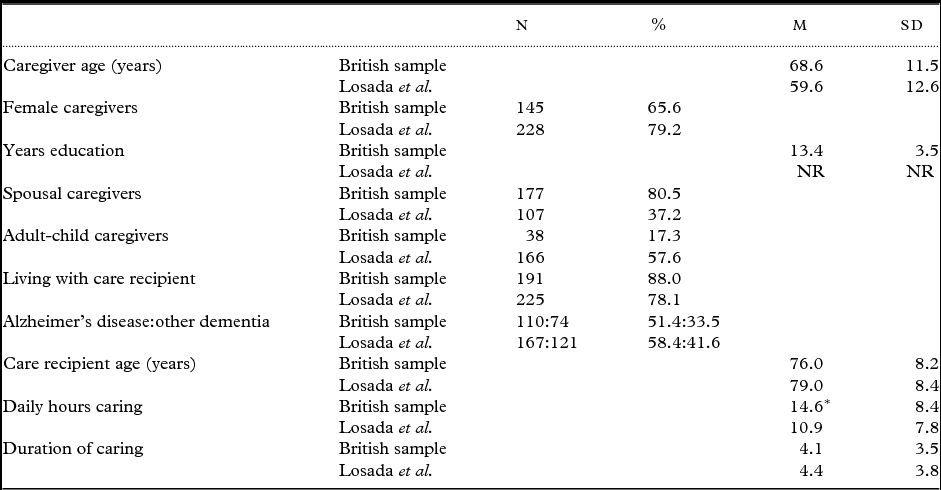
Note: Total sample n = 288 (Losada et al., Reference Losada, Márquez-González, Peñacoba and Romero-Moreno2010), n = 221 (British sample).
*This mean was calculated using all available data. Some caregivers (n = 57) reported spending 24 hours caring each day. This was accepted as the subjective, experience of caregiving was felt to be most important in this study. If caregivers who reported caring 24 hours each day are removed, the mean daily hours caring becomes 9.6 hours.
Measures
Demographic characteristics
The following demographic characteristics were assessed: age, sex, and education level of the caregiver, relationship to the person with dementia, and living arrangements. The caregivers were asked about length of the caring relationship, average time spent caring each day, and whether the caregiver receives help from others. Additionally, caregivers were asked to report the age and sex of the person with dementia and the type of dementia that had been diagnosed, if known.
Caregiver guilt questionnaire (CGQ: Losada et al., Reference Losada, Márquez-González, Peñacoba and Romero-Moreno2010)
This is a 22-item self-report measure. Participants rate how frequently they have experienced specified thoughts or feelings of guilt over the past two weeks. Sample items include “I have felt bad about getting angry with the person I'm caring for” and “I have felt bad for leaving my relative in the care of someone else while I had fun.” In a sample of 288 Spanish dementia caregivers, the scale was shown to have good internal consistency (Cronbach's α = 0.88 for the total scale).
Zarit burden inventory guilt factor (ZBI: Zarit et al., Reference Zarit, Reever and Bach-Peterson1980)
The four-item guilt factor from the ZBI identified by Ankri et al. (Reference Ankri, Andrieu, Beaufils, Grand and Henrard2005) was chosen for use as a measure of convergent validity in this study. This subscale produces a score between 0 and 16, where a higher score indicates a greater level of guilt. The use of this scale for convergent validity also permits comparisons between data obtained from this study and the original development study of the CGQ (Losada et al., Reference Losada, Márquez-González, Peñacoba and Romero-Moreno2010).
Center for epidemiological studies depression (CES-D: Radloff, Reference Radloff1977)
This is a widely used self-report measure assessing depressive symptomatology in community samples. The scale contains 20 items, and produces a score between 0 and 60, where a higher score indicates higher levels of depressive symptoms. A score of 16 or greater is used as the cut-off to indicate high levels of depressive symptoms. In the initial validation study (Radloff, Reference Radloff1977), internal consistency was found to be high (α coefficient of at least 0.84 across the four samples), the scale discriminated between clinical and non-clinical samples, and showed moderate correlations with other measures of depression. The CES-D has been shown to perform as a moderately accurate screening tool for major depressive disorder in an older adult population (Haringsma et al., Reference Haringsma, Engels, Beekman and Spinhoven2004).
Statistical power
Numerous rules of thumb exist regarding statistical power and sample size for exploratory factor analysis. Considering the ratio of participants (N) to items being analyzed (p), Gorsuch (Reference Gorsuch1983) recommends a minimum N:p ratio of 5:1; Everitt (Reference Everitt1975) recommends at least 10:1. A Monte Carlo study by MacCallum et al. (Reference MacCallum, Widaman, Zhang and Hong1999) suggested that sample sizes as low as 60 cases can be adequate if the communalities are consistently high (all greater than 0.6). With communalities in the 0.5 range, well-determined factors are required and a larger sample size (n = 100–200) in order to achieve a good recovery of population factors. The final sample size meets all three criteria.
Results
There was a low level of missing data in this study; across the CGQ, ZBI guilt factor, and CES-D items, 1.5% of responses were missing. Expectation maximization was used to impute missing data. Means and standard deviations for key variables are shown in Table 2. The mean score for the CGQ was 27.61 (14.10) out of a maximum score of 88.
Means and standard deviations for all variables in the whole sample and across relevant groups

CES-D = Center for Epidemiological Studies Depression scale; CGQ = Caregiver Guilt Questionnaire; ZBI = Zarit Burden Interview.
Factor structure of the CGQ
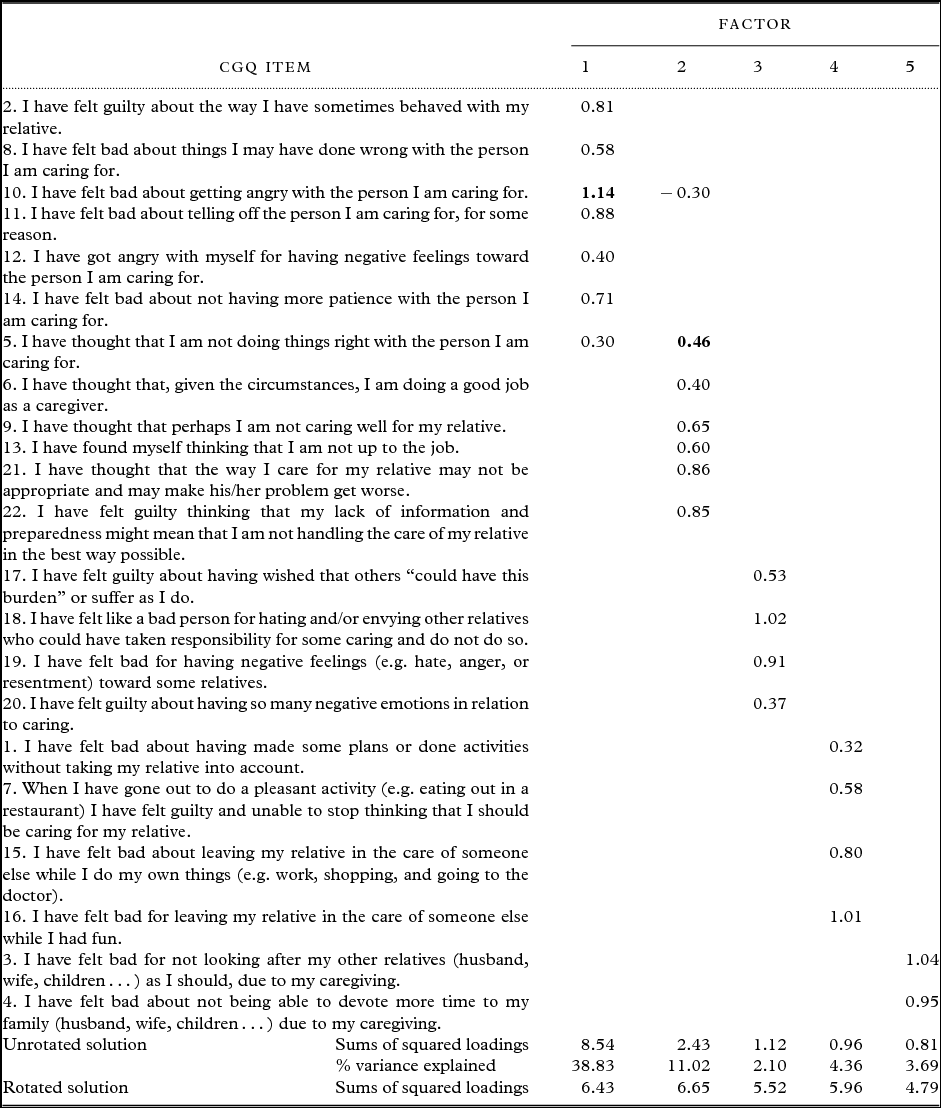
Principal axis factoring was used to analyze the factor structure of the CGQ. The scree plot, parallel analysis (conducted using 1,000 permutations of the original dataset), and Velicer's MAP test all indicated that five factors should be extracted. The unrotated solution explained 60% of the variance. A Promax oblique rotation was completed, as it was anticipated that the factors would correlate, which they did (r = 0.36–0.67). Factor loadings are shown in Table 3.
Factor loadings with oblique rotation of CGQ items
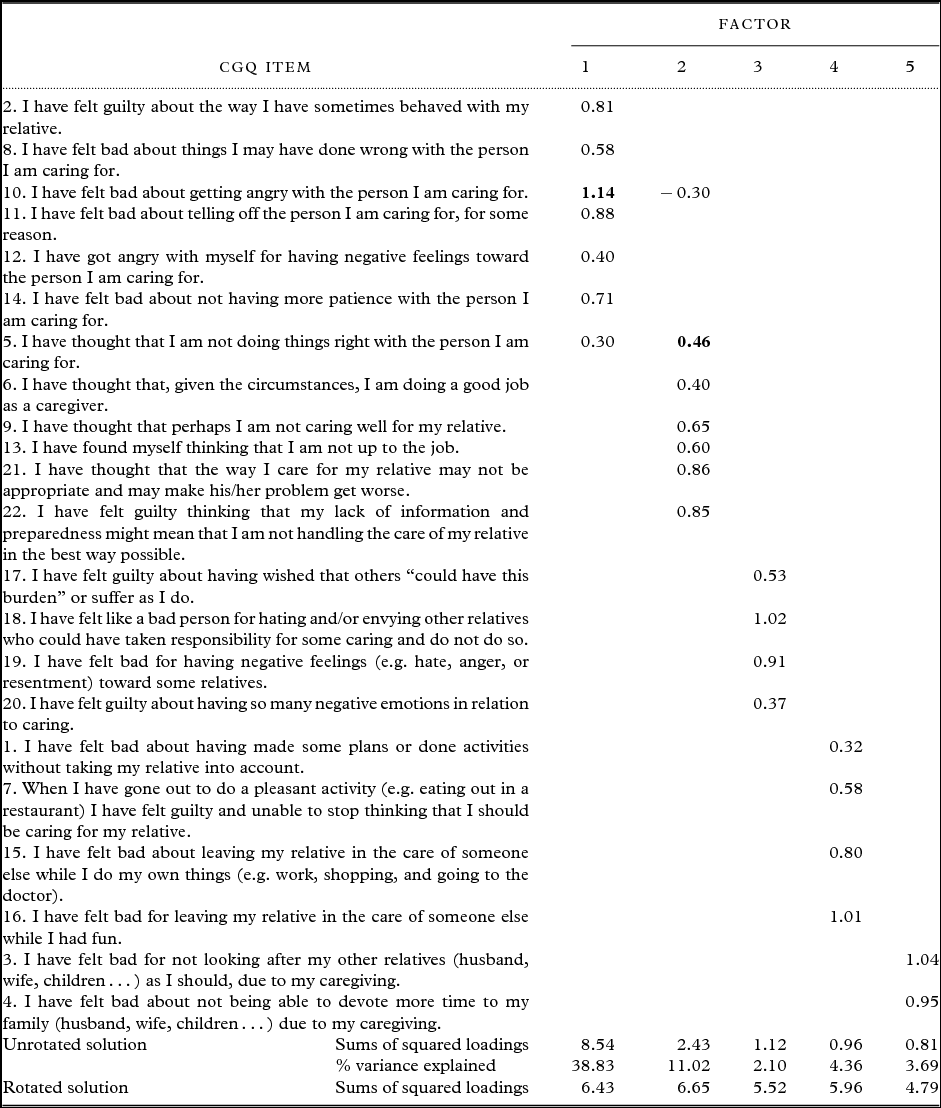
Note: Loadings <0.3 are not shown. Where an item loads on two factors >0.3, the loading in bold is the factor to which the item is allocated. Factor loadings > 1 are a result of oblique rotation. Factor 1 = guilt about doing wrong by the care recipient; Factor 2 = guilt about failing to meet the challenges of caregiving; Factor 3 = guilt over experience of negative emotions in relation to caregiving; Factor 4 = guilt about self-care; Factor 5 = guilt about neglecting other relatives.
The factors were interpreted as “guilt about doing wrong by the care recipient” (Factor 1), “guilt about failing to meet the challenges of caregiving” (Factor 2), “guilt over experience of negative emotions in relation to caregiving” (Factor 3), “guilt about self-care” (Factor 4), and “guilt about neglecting other relatives” (Factor 5). Twenty-one of the 22 items loaded on the same factors in this study as in the Spanish development study; the exception was item 20 (I have felt guilty about having so many negative emotions in relation to caring). This item loaded on Factor 1 (guilt about doing wrong by the care recipient) in the Spanish sample and loaded on Factor 3 in the in present study. All factors share the same labels in the British and Spanish study, with the exception of Factor 3 of the current study, where the inclusion of item 20 altered the interpretation. The third, fourth, and fifth factors extracted in this sample were extracted in a different order in the Spanish sample (Losada et al., Reference Losada, Márquez-González, Peñacoba and Romero-Moreno2010). Factor 3 in this study (guilt over experience of negative emotions in relation to caregiving) was extracted as the fifth factor in the Spanish study; Factor 4 in this study (guilt about self-care) was extracted as the third factor in the Spanish study; and Factor 5 in this study (guilt about neglecting other relatives) was extracted as the fourth factor in the Spanish study. Overall, however, the five-factor structure originally reported by Losada et al. (Reference Losada, Márquez-González, Peñacoba and Romero-Moreno2010) is replicated in the current sample.
Internal consistency
The internal consistencies, as measured by Cronbach's α, of the whole scale and all five factors within the British sample are good to excellent (Factor 1, α = 0.90; Factor 2, α = 0.80; Factor 3, α = 0.85; Factor 4, α = 0.84; Factor 5, α = 0.94; whole scale α = 0.93).
Clinical cut-off
In the initial development study of the CGQ (Losada et al., Reference Losada, Márquez-González, Peñacoba and Romero-Moreno2010), a clinical cut-off score was not reported. A receiver operating characteristics (ROC) analysis was conducted to analyze the association between the CGQ and the presence of a score on the CES-D above the clinical cut-off. The area under the curve (AUC), as shown in Figure 1, found with ROC analysis was 0.79 (SE = 0.03; 95% confidence intervals (CI) 0.726–0.844; p < 0.001). With a clinical score on the CES-D as the criterion, the cut-off score of 22 on the CGQ showed the optimal balance between sensitivity (80%) and specificity (61.5%), with a positive predictive value (PPV) of 70.2%.
ROC curve for CGQ.

Convergent validity
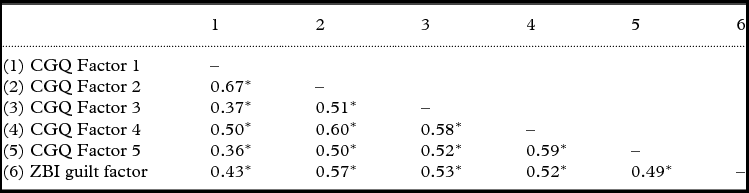
Convergent validity was assessed by correlational analysis with the guilt factor of the ZBI. In order to control for the risk of increasing the Type I error rate by performing multiple post hoc tests, the Bonferroni correction was applied for the two correlations undertaken, which reduced the acceptable p level to 0.025. The CGQ total score and the ZBI guilt factor correlated positively and significantly (r = 0.653, p < 0.001), indicating that caregivers with a high CGQ total score also had a high ZBI guilt factor score. Each factor of the CGQ also correlated positively and significantly with the ZBI guilt factor, as shown in Table 4.
Correlations between ZBI guilt factor and CGQ factors
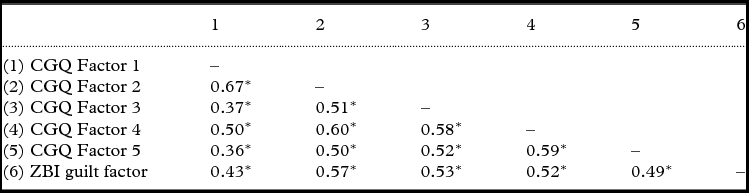
*p < 0.001.
CGQ = Caregiver Guilt Questionnaire; ZBI = Zarit Burden Interview.
Associations between caregiver guilt and demographic characteristics
Associations between demographic characteristics and the CGQ were examined using independent sample t tests. In order to control for the risk of increasing the Type I error rate by performing multiple post hoc comparisons, the Bonferroni correction was applied for the two t tests completed, which reduced the acceptable p level to 0.025. Levene's test was used to assess homogeneity of variance and where this assumption was not met, automatic statistical adjustment was made for the heterogeneity of variance. Means and standard deviations are shown in Table 2. Adult-child caregivers experienced significantly higher levels of guilt, as measured by the CGQ total score, (t(213)=2.334, p < 0.025) in comparison to spousal caregivers. The effect size was small to medium (d=0.41). Means and standard deviations are shown in Table 2. Female caregivers experienced significantly higher levels of guilt, as measured by the CGQ total score, than male caregivers (t(197.30)=3.639, p < 0.001). The effect size was small to medium (d=0.46).
Discussion
Psychometric properties of CGQ
The CGQ (Losada et al., Reference Losada, Márquez-González, Peñacoba and Romero-Moreno2010) was designed to measure feelings of guilt experienced by dementia caregivers. The initial development study found that the CGQ measured multiple facets of guilt; the five-factor structure found in the Spanish sample (Losada et al., Reference Losada, Márquez-González, Peñacoba and Romero-Moreno2010) was replicated in this study. All CGQ factors intercorrelated in the British sample, as expected for different facets of an emotion. However, variations in the strength of correlations between factors suggest that the factors do measure discernibly different aspects of guilt.
This study also sought to establish a clinical cut-off for the CGQ, which the initial development study did not do. In order to ascertain whether the level of guilt a caregiver experiences is likely to be associated with clinically significant symptoms and for the measure to be most useful to clinicians, a clinical cut-off is essential. ROC analyses indicated that the optimal cut-off was 22, to balance sensitivity and specificity (80% and 61.5%, respectively). Caregivers scoring 22 or above on the CGQ are likely to show clinical levels of depressive symptomatology (as measured by the CES-D). Although clinical cut-offs have been established with similar levels of specificity (e.g. Haringsma et al., Reference Haringsma, Engels, Beekman and Spinhoven2004), specificity of 61.5% is relatively low. It would be beneficial to repeat a ROC analysis with another caregiving sample to test the reliability of this cut-off. Higher cut-offs were considered; however, this quickly reduced the sensitivity of the measure and it was judged that, within clinical work, a higher rate of false positives (i.e. lower specificity) would be less harmful than a higher rate of false negatives (i.e. lower sensitivity). The cut-off of 22 is relatively low in comparison to the possible total score of 88. On examination of the data distribution, a slight positive skew is evident in caregivers’ responses. Caregivers did not use the full range of the scale and endorse the highest possible levels of guilt. Even though the caregivers in this sample had a higher mean score for guilt than in the Spanish sample (27.61 (14.10) cf. 17.90 (12.70)), this was still low in comparison to the level of emotionality which could have been endorsed.
It is important to note that the measure of depression used was an epidemiological measure, rather than a clinical diagnostic tool, therefore a score above the cut-off on the CGQ does not necessarily indicate the presence of a major depressive episode, but highlights a potentially treatable pattern of maladaptive cognition, emotion, and behavior, which may be associated with depression. As highlighted by Zarit and Femia (Reference Zarit and Femia2008), 50%–80% of caregiving samples do not show clinically significant symptoms of depression; however, guilt is a common experience of caregivers (Samuelsson et al., Reference Samuelsson, Annerstedt, Elmstahl, Samuelsson and Grafstrom2001; Gonyea et al., Reference Gonyea, Paris and Zerden2008; Rosa et al., Reference Rosa2010) and may have an impact on self-care and use of social support (Losada et al., Reference Losada, Márquez-González, Peñacoba and Romero-Moreno2010). Longitudinal studies are required to establish causation and mediation; however, as suggested by Kim et al. (Reference Kim, Thibodeau and Jorgensen2011), we also hypothesize that early interventions targeting caregiver guilt and its associated maladaptive cognitions and behaviors may lead to improvements in caregivers’ psychological well-being before the development of a major depressive episode.
Individual CGQ items loaded onto the same factors in the British and Spanish samples, with the exception of item 20 (I have felt guilty about having so many negative emotions in relation to caring). In the Spanish sample, this loaded most strongly onto Factor 1 ‘guilt about doing wrong by care recipient,’ however it also cross-loaded onto Factor 2 ‘guilt about failing to meet the challenges of caregiving.’ In the British sample, it loaded on Factor 3 ‘guilt about experience of negative emotions in relation to caregiving,’ with which it appears to have greater face validity. Although the original Spanish scale was translated into English and back-translated, it is possible that this item may have different nuances in English and Spanish.
The replication of the factor structure across the two samples suggests that these are relevant themes within the feelings of guilt to both Hispanic and British dementia caregivers. British caregivers endorsed higher levels of guilt than Spanish caregivers. This may be a methodological artifact; it is possible that the British sample may be skewed as caregivers experiencing less guilt may not have participated in the study. A further methodological difference lies in the method of recruitment, Losada et al. (Reference Losada, Márquez-González, Peñacoba and Romero-Moreno2010) used face-to-face interviews for completion of the CGQ; Spanish caregivers may have been less willing to acknowledge feelings of guilt over their actions or emotions to another person, whereas British caregivers may have acknowledged the presence of feelings of guilt more easily due to the anonymity of a postal study. There is little research comparing British and Spanish cultures; however, there may be pertinent differences which contribute to the differential levels of guilt found. However, the higher level of guilt endorsed by British caregivers suggests that clinicians should be alert to the experience of guilt in caregivers and the impact that this may have on the caregiver's self-care, use of support services, and expectations of themselves.
The five factors of the CGQ highlight the different levels at which caregivers experience guilt: in relation to their behaviors, in relation to their appraisal of their actions, and in relation to their emotional experience. As the evidence base indicates that individualized interventions are more effective for reducing psychological distress in caregivers (Selwood et al., Reference Selwood, Johnston, Katona, Lyketsos and Livingston2007), this suggests outcomes may be improved where a treatment approach addresses the different types of guilt a caregiver experiences. Within cognitive behavioural therapy, which has strong evidence to support its use with distressed caregivers (e.g. Gallagher-Thompson and Coon, Reference Gallagher-Thompson and Coon2007), this may involve targeting guilt appraisals about a caregiver's self-care, their performance as a caregiver, and their emotional experience, as well as teaching effective behavior management techniques. The CGQ could be used to evaluate such an intervention, where the distressed caregiver experiences significant levels of guilt, but may not meet diagnostic criteria for depression.
Factor 5 ‘guilt about neglecting other relatives’ only has two items loading on it in the British sample. This was also found in the Spanish development study (Losada et al., Reference Losada, Márquez-González, Peñacoba and Romero-Moreno2010). This aspect of guilt is conceptually different to the other four factors, as it relates to the caregivers’ role in the wider family system rather than to the caregiver's behavior in relation to the person with dementia. This factor contributes significantly to the total variance accounted for by the factor model; however, with only two items it is not a well-defined factor. In order to develop this into a well-defined factor, further items should be investigated for inclusion, for example guilt about neglecting other significant relationships out with the family, such as friends or colleagues.
The internal consistency of the CGQ scale and its five factors in the UK sample are all good. With the exception of Factor 4, all of the Cronbach's αs are equal or superior to those found in the Spanish development study (Losada et al., Reference Losada, Márquez-González, Peñacoba and Romero-Moreno2010). Based on the α values, this suggests that the total scale and subscales are reliable. The excellent internal consistency suggests that both the whole scale and subscales are likely to be useful to monitor changes in levels of guilt following clinical intervention, although test–retest reliability has yet to be established. Convergent validity was established; caregivers reporting higher levels of guilt on the CGQ also reported higher levels of guilt on the ZBI guilt factor and higher levels of depressive symptomatology on the CES-D. These results do not give an indication of causality; higher levels of guilt could be a consequence of depression as well as a precursor to it.
As well as the relative neglect of caregiver guilt in the research literature, variables associated with caregiver guilt have also been under-researched. British female caregivers, irrespective of their relationship to the care recipient, reported higher levels of guilt than male caregivers. Losada et al. (Reference Losada, Márquez-González, Peñacoba and Romero-Moreno2010) also found that female caregivers reported higher levels of guilt than male caregivers on the CGQ. Gender differences in psychological outcomes for caregivers have been attributed to differences in caregiving norms, that there is a stronger norm for caregiving and nurturing for women (Raschick and Ingersoll-Dayton, Reference Raschick and Ingersoll-Dayton2004). This may explain higher levels of self-reported guilt in female caregivers if they perceive that they have transgressed these norms.
Adult-child caregivers reported higher levels of guilt on the CGQ than spousal caregivers, which is consistent with other studies in this field (e.g. Ankri et al., Reference Ankri, Andrieu, Beaufils, Grand and Henrard2005; Losada et al., Reference Losada, Márquez-González, Peñacoba and Romero-Moreno2010) in other cultures. This finding is commonly attributed to adult-child caregivers being more likely to live separately from the care recipient, as well as a greater likelihood of role strain due to a greater number of competing demands (e.g. employment, caring for young children) (Yee and Schulz, Reference Yee and Schulz2000).
Comparison of British and Spanish samples
This study was a cross-cultural validation of the CGQ. Several key differences between the British and Spanish samples should be noted. There was a greater proportion of spousal caregivers in the UK sample in comparison to the Spanish samples (80.5% cf. 37.2%). Bond et al. (Reference Bond1999) conducted a large-scale survey (n = 1127) of informal caregivers of physically or mentally frail older people in England. Of all the older people who identified a key informal caregiver (n = 884), the caregiver was most commonly a spouse (39%) or an adult-child (39%). This suggests that spousal caregivers are relatively over-represented in this study in comparison to caregivers in the general population in the UK. A recent meta-analysis (Pinquart and Sorensen, Reference Pinquart and Sorensen2011) found that spousal caregivers reported significantly higher levels of depressive symptomatology than adult children; however, despite the differences in demographic characteristics, the mean depression score was very similar across the British and Spanish samples.
The British sample contained substantially more male caregivers than the Spanish sample (34.4% cf. 20.8%); however, this is consistent with the proportion of male caregivers found by Bond et al. (Reference Bond1999) in their UK-wide survey. Greater inclusion of male caregivers may be a result of recruitment methods; Losada et al. (Reference Losada, Márquez-González, Peñacoba and Romero-Moreno2010) recruited from local health and social care centers, whereas caregivers in the current study were principally recruited from a research register. Research has shown that men show less help-seeking behavior than women (Galdas et al., Reference Galdas, Cheater and Marshall2005); therefore, a strategy which seeks to recruit caregivers through the services that they receive, as used by Losada et al. (Reference Losada, Márquez-González, Peñacoba and Romero-Moreno2010) is less likely to recruit large numbers of men. This study recruited through a research register, which is not dependent on service use, which may explain the greater proportion of male caregivers in this sample. Pinquart and Sorensen (Reference Pinquart and Sorensen2011) also found that spousal caregivers are more likely to be male, therefore the higher number of spousal caregivers in this sample may also explain the greater number of male caregivers.
Future research and study limitations
The refinement of the CGQ presents avenues for further research; as noted earlier Factor 5 may benefit from inclusion of further items in order to create a well-defined factor and the reliability of the clinical cut-off would benefit from being tested in another caregiving sample, given the relatively low specificity. The test–retest reliability and sensitivity to change post-intervention of the CGQ has not been established with British caregivers, or its relationship with other key outcome variables, such as anxiety or placement of care recipients in care homes. The five-factor structure of the CGQ suggests that it is helpful to think about caregiver guilt as a multidimensional construct, which may influence a variety of behaviors, for example reducing social contact or reducing leisure time. These associations were examined in the Spanish development study (Losada et al., Reference Losada, Márquez-González, Peñacoba and Romero-Moreno2010); however, this has not yet been tested with a longitudinal design in order to establish causal relationships.
In order to achieve a representative sample of caregivers accessing caregiving services and those who were not, several avenues of recruitment were pursued. It is difficult to assess whether this aim was achieved; however, 29.4% of the sample reported receiving no help with caring and 32.1% reported receiving help from paid carers, suggesting broadly equal representation of both groups. Nonetheless as is the case with many such studies, the most distressed caregivers may not be represented here. It is interesting to reflect on recruitment of participants into studies examining the experience of caregiving. Those individuals who may feel the most acute challenges of caregiving may also be more likely to feel they do not have the time or emotional resilience to participate in research. Thus, as with most other studies, caregivers participating in this study may represent a subset of dementia caregivers, an issue that is frequently overlooked in this field. This does not negate the significance of the results of this study, yet the challenge remains for researchers in this field to actively seek out the most vulnerable and distressed caregivers.
Conclusion
Research into clinical assessment of and intervention for maladaptive guilt is in its infancy. However, the CGQ has been demonstrated to be a valid measure for use with dementia caregivers and is likely to be of use in clinical and research work. Test–retest reliability and sensitivity to change has yet to be established for this measure in the UK; however, the CGQ may be a useful screening tool in an initial therapeutic assessment with distressed caregivers. The establishment of a clinical cut-off will also help clinicians to determine the significance of a caregiver's score on the CGQ and identify potentially treatable patterns of maladaptive cognition, emotion, and behavior.
Conflict of interest
None.
Description of authors’ roles
Louise Roach designed the study, collected and analyzed the data, and wrote the paper. Ken Laidlaw contributed to the design of the study, supervised the data analysis, and contributed to writing the paper. David Gillanders supervised the design of the study and the data analysis, and contributed to writing the paper. Kathryn Quinn supervised the data collection and contributed to the writing of the paper.
Acknowledgments
The authors thank Andrés Losada for generously giving his time to discuss the development of the CGQ and his data. This work was supported by the Scottish Dementia Clinical Research Network who received funding from Scottish Ministers through the Chief Scientist Office. The views expressed in this publication are those of the authors and not necessarily those of Scottish Ministers or the Chief Scientist Office.