Implications
Conventional cages for laying hens are gradually being banned in the European Union and replaced by non-cage systems or furnished cages with nest box, perches and a pecking and scratching area. Although various models of furnished cages are available, none is optimal for both performance and expression of animal behaviour under practical conditions. This experiment was set up to determine the impacts of group size and provision of litter in the pecking and scratching area on laying performance and egg quality. Some conclusions are expected to contribute to the improvement of cage design and help producers in choosing cage models for investment.
Introduction
Battery cages are the most commonly used system in the world for housing laying hens (Magdelaine, Reference Magdelaine2009). They ensure low economic costs and limit sanitary problems but raise concerns about animal welfare. To improve the welfare of laying hens, the European Union Council Directive 1999/74/EC is therefore banning the use of conventional cages from 2012 onwards. From that date, egg production will only be allowed in non-cage systems or in cages furnished with a nest, perches, a litter area and a claw-shortening system. The furnished cage has been developed with the aim of giving laying hens the opportunity to perform certain natural behaviours while maintaining the economic and hygienic advantages associated with cages (Tauson, Reference Tauson2005). In France, 81% of laying hens are kept in cages, essentially in conventional cages (Guéméné, Reference Guéméné2007). However, some of these cages are designed to make it possible to add furnishings after 2012. The cages in which furnishings could be added are generally larger than the conventional cages and are known as large furnished cages (more than 12 hens per cage; EFSA, 2005). Increasing group size in furnished cages has sometimes been associated with higher mortality rates or risk of cannibalism and degradation of performance, especially in non-beak-trimmed hens (Appleby, Reference Appleby1998a; Appleby et al., Reference Appleby, Walker, Nicol, Lindberg, Freire, Hughes and Elson2002; Hetland et al., Reference Hetland, Moe, Tauson, Lervik and Svihus2004). It has also been suggested that an intermediate group size of about 30 birds may present social problems, causing adverse effects on production in on-floor laying hens because this group size would be too large to develop a stable hierarchy but too small for a tolerant social system occurs (Keeling et al., Reference Keeling, Estevez, Newberry and Correia2003). The effect of group size on performance in furnished cages, with equal space allowance per bird, has been studied mainly in small groups with fewer than 10 hens (Abrahamsson and Tauson, Reference Abrahamsson and Tauson1997; Appleby, Reference Appleby1998b; Shimmura et al., Reference Shimmura, Azuma, Eguchi, Uetake and Tanaka2009) or with various models of cages which could not strictly be compared (Vits et al., Reference Vits, Weitzenburger, Hamann and Distl2005). Thus, there is a need to assess the effects of group size at constant density and cage design on the performance of laying hens kept in large furnished cages with more than 12 hens.
Another major issue in the development of furnished cages is the requirement in the Directive to provide hens with litter for ‘pecking and scratching’ (European Commission, 1999). Litter has been defined as ‘any friable material enabling (laying hens) to satisfy (their) ethological needs’. In commercial cage models, the pecking and scratching area commonly consists of a mat on which litter is automatically distributed (Tauson, Reference Tauson2005). In many cases, no litter is provided under commercial conditions. Current research to improve the design of the pecking and scratching area and to find an optimal substrate for pecking, scratching and dust-bathing is focused on welfare and behavioural issues (Merrill et al., Reference Merrill, Cooper, Albentosa and Nicol2006; Wall et al., Reference Wall, Tauson and Elwinger2008). The main drawback, associated with the attractiveness of the pecking and scratching area, could be a redirection of the laying location from the nest to the litter area with a resulting alteration of egg quality (Appleby and Hughes, Reference Appleby and Hughes1991; Guesdon and Faure, Reference Guesdon and Faure2004). Therefore, the design of the pecking and scratching area in furnished cages must fulfil both behavioural needs and the zootechnical requirements prevailing in commercial egg production. An experiment was set up to respond to these concerns by determining the effects of group size and litter provision on laying performance, egg quality and eggshell contamination of hens housed in large furnished cages (housing 20 to 60 hens) in agreement with the directive 1999/74/CE. This study was a part of a project to investigate a number of physical, behavioural and physiological parameters relevant to the production and welfare of laying hens in furnished cages.
Material and methods
Animals and husbandry
Beak trimmed ISA Brown chicks were floor reared in a single pen with wood shavings following standard management practices. At 19 weeks of age, pullets (n = 4320) were transfered in furnished cages installed in one experimental building and kept until 72 weeks old. Food (11.3 MJ metabolisable energy/kg, 17.0% crude protein, 3.7% Ca, 0.3% available P) was distributed three times/day (160 g/hen per day) and water was available ad libitum. The light was turned on at 0600 h and turned off at 2200 h. The average light intensity, measured in front of the nest boxes of the cages was 2.5 lux (range: 1 to 3) and 19.1 lux (range: 16 to 24) in front of the pecking and scratching area.
Housing and experimental design
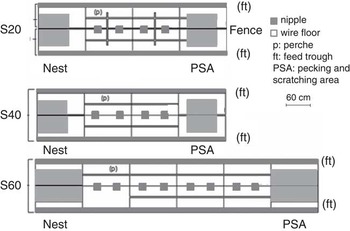
A 3 × 2 experimental design was adopted for testing three group sizes (S20, S40, S60) and two litter provision conditions (with (+) or without litter (−) provision). Hens were housed in three sizes of furnished cages, built by the same manufacturer (model MEC®, Zucami Poultry Products, Beriain, Spain) with a capacity of 20 hens per cage for group size S20, 40 hens for group size S40 and 60 hens for group size S60. The S20 cages were 2440-mm wide, 630-mm deep and 455-mm high at the rear of the cage. The S40 cages were formed by removing the rear panel to provide a cage approximatively 1260-mm deep (Figure 1). The S60 cages measured 3360 × 1260 × 455 mm. Hens in all three group sizes had 768 cm2 floor space per hen including 67 cm2 for the nest and 67 cm2 for the litter area, with 12 cm trough space per hen and 15 cm of perches per hen and a claw-shortening system (abrasive strips, one for 10 hens). The nest was lined with Astroturf (Astroturf Poultry Pads®, Piers, Estaires, France) and enclosed by plastic yellow curtains. The pecking and scratching area was placed opposite the nest and consisted of an Astroturf mat. Feed as litter was dispensed each hour from 1100 h to 1800 h (200 g/cage per day) in the pecking and scratching area of half of the cages. The litter was automatically dispended on the mat by a feed screw located in the middle of the cage. There were 18 cages per treatment randomly distributed in three batteries of three tiers. Each battery × tier formed a block (n = 9) for statistical purposes. Each block comprised 12 cages, 2 per size × litter conditions.
Schematic illustration of the three cage sizes.

Measurements
Culled and dead birds per cage were removed, recorded daily per cage and visually examined for wounds due to cannibalism. Dead birds were not replaced.
When the hens were 23, 27, 34, 39, 44, 49, 64 and 71 weeks of age, the eggs laid on 2 consecutive days were recorded per cage for nine cages per treatment. Cages were selected randomly at 23 weeks old and the same cages were used for the following measures. The eggs from each cage were visually examined to record the number of broken and dirty eggs. These data were classified according to where the eggs were laid, that is, in the nest or outside the nest. The eggs produced per cage were weighed to determine the mean egg weight. Samples of 10 eggs from S20 cages and 20 eggs from S40 and S60 cages were candled to determine the proportion of cracked eggs. Hen-housed egg production (eggs laid per cage × 100/number of hens housed per cage at the beginning of the experiment) and hen-day egg production (eggs laid per cage × 100/number of hens housed per cage at the time of recording) and the percentages of broken, dirty and cracked eggs per cage were calculated.
Between 46 and 47 weeks of age, 2 samples of 30 sorted eggs (eliminating dirty and broken eggs) were randomly sampled per treatment on 2 non-consecutive days. From 66 to 70 weeks of age, 4 samples of 15 sorted eggs laid in the nest and 4 samples of 15 sorted eggs laid in the rest of the cage were taken per treatment on 4 non-consecutive days. The eggs were kept for a maximum of 48 h in ambient conditions before being analysed by the laboratory LDA 35 (Rennes, France) according to the method developed by Protais et al. (Reference Protais, Queguiner, Boscher, Piquet, Nadard and Salvat2003). The mesophilic aerobic bacterial count on the eggshell was determined for one egg. The bacterial count for one egg was log-transformated prior to statistical analysis and was therefore expressed as log10 CFU/eggshell (Colony Forming Unit) for statistical analysis. The recovery of 0 CFU corresponded to <3.8 log10 CFU/eggshell. As this value could not be directly used in the statistical analysis, the value of 3.8 log10 CFU/eggshell was used, as previously suggested by Knape et al. (Reference Knape, Chavez, Burgess, Coufal and Carey2002).
Feed consumption at the trough was determined in nine cages per treatment (corresponding to the intermediate level of the three batteries) when the hens were 25, 48 and 65 weeks old. On the day of measure, the troughs were emptied by vacuuming and feed was manually distributed at 1500 h, 1900 h and 700 h on the following day. At 1500 h the feed remaining in troughs was removed and weighed to assess feed refusal per cage. The feed conversion ratio was determined from the feed consumption at the trough and egg mass produced for three cages per treatment. It was an apparent feed conversion ratio based on feed consumption at the trough because feed as litter eaten by the hens could not be quantified.
Statistical analysis
The mortality rate was analysed by χ 2 test for each main effect (group size and litter provision) followed by a χ 2 pair comparison when the overall comparison was significant. The egg production and egg quality measurements did not comply with the requirements of a variance analysis even after transformation, due to non-normally distributed residuals. The egg production measurements (hen-housed egg production, hen-day egg production, mean egg weight) were thus analysed with non-parametric tests for each date of measure. The test of the effect of group size was adjusted for the effect of litter provision and vice versa (Friedman's χ 2 test). The egg quality measurements expressed as percentage per cage (proportion of broken, dirty or cracked eggs; proportion of eggs laid outside the nest) were analysed by Poisson regression for repeated measures (eight ages) followed by post hoc Tukey tests when significant differences were detected. Four factors (group size, litter provision, block and age) and their interactions were tested. Any over-dispersion problem was detected by checking the χ 2/degrees of freedom ratio.
As no difference in contamination was noted for eggs sampled on different days within a given sampling period (weeks 46 to 47 and weeks 66 to 70), the weekly results were analysed together for each period. The effects of group size and litter provision on eggshell bacterial load were determined by period using adjusted tests on the ranks.
Feed consumption data and the feed conversion ratio were analysed by ANOVA for repeated measures, including group size and litter provision as fixed effects and adjustment on block effect. Tukey tests were used when significant differences were detected.
Results
Mortality
Cumulative mortality was analysed over the 53 weeks of lay. The overall cumulative mortality rate was 3.2% and 8 out of 140 dead hens presented wounds probably associated with cannibalism. Mortality rate was significantly higher in S40 cages (4.2%) than in S20 cages (2.4%) and S60 cages (2.6%; χ 2 test, df = 2, P = 0.01). However, this significant difference was mainly due to a single S40 cage where 11 hens died but with no observation of wounds associated with cannibalism. When this cage was excluded the cumulative mortality rate in S40 cages was 3.6% and the difference with the other group sizes was no longer significant. Mortality rate was not affected by litter provision: 2.9% for treatments with litter provision v. 3.4% without litter provision (χ 2 test, df = 1, P = 0.17).
Egg production and egg quality traits
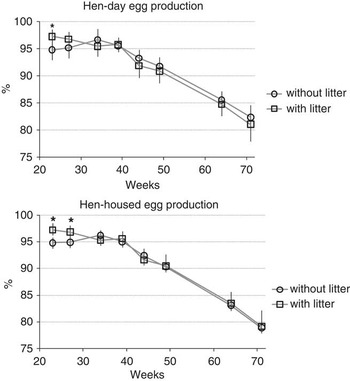
As technical problems in recording the number of eggs laid per cage were encountered during the first part of the laying period, the egg production parameters were calculated in fewer cages than originally planned: 43 cages at week 23 and 47 at week 27 instead of 54 cages. Hen-housed egg production and hen-day egg production were similar for all three group sizes at the eight dates of measures and decreased significantly over time as expected: the average hen-day egg production was 96.1% ± 4.0 at 23 weeks v. 81.7% ± 7.2 at 71 weeks. At 23 weeks old, hen-housed egg production and hen-day egg production were higher in treatments with litter provision but the difference disappeared after 27 weeks of age (Figure 2). Group size and litter provision had no effect on egg weight except at 39 weeks when the mean egg weight was significantly lower if litter was provided: 61.6 g ± 1.0 with litter v. 62.4 g ± 1.0 without litter (Wilcoxon test, df = 1, P = 0.02). As expected, egg weight increased with increasing days in lay (54.1 g ± 0.8 at 23 weeks of age; 64.6 g ± 1.5 at 71 weeks of age, Friedman's test for repeated measures, df = 7, P < 0.01). The effect of block (battery × tier) was tested for all egg production traits but no systematic effect was observed.
Hen-day egg production and hen-housed egg production (mean ± 95% CI) as influenced by litter provision. Values with asterisks indicate significant difference at P < 0.05 (Wilcoxon test).

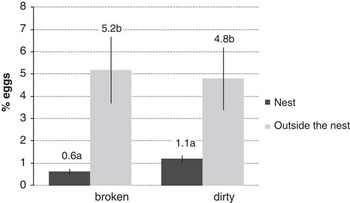
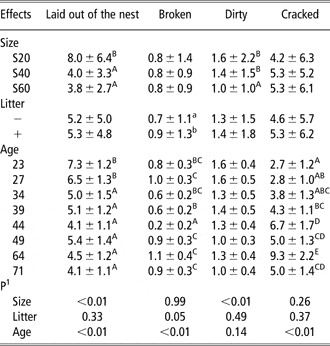
The proportion of eggs laid in the nest increased significantly from 93% to 96% between weeks 23 and 34, and thereafter remained constant at around 96%. Eggs laid outside the nest were more often broken and dirty than those laid in the nest (Figure 3). Over the laying period the highest proportion of eggs laid outside the nest was observed in S20 cages (8.0% ± 6.4%) in contrast to S40 cages (4.0% ± 3.3%) and S60 cages (3.8% ± 2.7%; Table 1). Similar frequencies of broken eggs and cracked eggs were observed in all three types of cages but dirty eggs were slightly more frequent in the two smaller groups (S20 cages: 1.6% ± 2.2%; S40 cages: 1.4% ± 1.5%) than in the largest one (S60 cages: 1.0% ± 0.9%, P < 0.01). Litter provision had no effect on egg laying location or egg quality traits except for a slight and unexpected effect on the frequency of broken eggs, which increased with litter provision (0.9% ± 1.3% with litter v. 0.7% ± 1.1% without litter, P = 0.05). A classical increase in the proportion of broken and cracked eggs was observed with time. On the contrary, the proportion of dirty eggs was constant over the laying period. None of the observed interactions between the main effects was significant and no systematic effect of block was detected (data not shown).
Proportions of broken eggs and dirty eggs (mean ± CI 95%) according to the laying location. Means with different letters indicate significant differences (P < 0.05).

Percentages of eggs laid outside the nest and of abnormal eggs as influenced by group size, litter provision and age (mean ± s.d.)

1Results of Poisson regression model for repeated measures.
Values with different letters within a column indicate significant differences (lower case letters for P < 0.05 and capital letters for P < 0.01).
Eggshell contamination
Over the period, 66 to 70 weeks the bacterial load on the eggshell of eggs laid outside the nest was 5.0 ± 0.4 log10 CFU/eggshell v. 4.8 ± 0.5 log10 CFU/eggshell for eggs laid in the nest (Wilcoxon test, P = 0.01). The mean contamination of the shells of eggs laid in the nest was similar for the 46 to 47 weeks period (4.7 ± 0.6 log10 CFU/eggshell) and for the 66 to 70 weeks period (4.8 ± 0.4 log10 CFU/eggshell). Group size had no effect on eggshell contamination. Litter provision was associated with significantly higher eggshell contamination at 66 to 70 weeks: 4.8 ± 0.5 log10 CFU/eggshell for cages with litter v. 4.7 ± 0.4 log10 CFU/eggshell without litter (Wilcoxon test, P = 0.05). However, this effect was very slight and the difference was not found significant at 46 to 47 weeks old (4.6 ± 0.3 log10 CFU/eggshell for cages with litter v. 4.7 ± 0.3 log10 CFU/eggshell without litter). As eggs were sampled at random over all the cages in a treatment, a block effect could not be tested.
Feed consumption
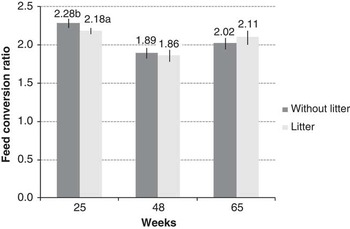
Group size had no influence on feed consumption at the trough or apparent feed conversion ratio. Feed intake tended to be lower when the hens were provided with litter: 111.4 g/hen per day ± 6.8 with litter v. 113.2 g/hen per day ± 5.6 without litter (P = 0.07). Litter provision had no impact on feed conversion ratio over the whole laying period: 2.04 ± 0.02 with litter v. 2.06 ± 0.02 without litter (P = 0.62). However, the effect of the litter × age interaction was significant for this parameter (P = 0.05). Indeed feed efficiency was better for hens provided with litter at 25 weeks of age (Figure 4). This difference was due to a lower feed intake at the trough and a higher laying rate when litter was provided at the beginning of the laying period. Feed conversion ratio was no longer influenced by litter distribution at weeks 48 and 65. Feed consumption and feed conversion ratio changed considerably with time. Feed intake decreased significantly between 25 and 48 weeks of age while the feed conversion ratio improved due to simultaneous increases in laying rate and mean egg weight. However, the feed conversion ratio deteriorated after 48 weeks of age because of a decrease in laying rate during the second part of the laying period. Differences in feed consumption were observed between blocks at weeks 25 and 65 but no clear trend was apparent (data not shown).
Feed conversion ratio (mean ± CI 95%) in relation to litter distribution at 25, 49 and 65 weeks of age. Means with different letters indicate significant differences (P < 0.05).

Discussion
The overall mortality rate observed in this experiment (3.2%) was substantially lower than the threshold of 9% proposed as an accepted maximum level of mortality in a layer flock by the LayWel experts group (LayWel, 2006). The higher mortality rate observed in S40 cages was mostly due to one cage and the mortality rate was similar in all three group sizes when this cage was excluded. In contrast, the experimental results analysed by the LayWel experts showed a clear trend for a higher mortality rate in large furnished cages with 60 hens or more. However, the higher mortality in large furnished cages in the LayWel project was mainly due to pecking. In this study, the hens were beak-trimmed and this could have helped to limit mortality (Guesdon et al., Reference Guesdon, Ahmed, Mallet, Faure and Nys2006): cannibalism was virtually absent in our study (wounds associated with cannibalism observed on eight dead hens). The mortality observed in our study was similar to these recently reported in large furnished cages under experimental conditions (Weitzenburger et al., Reference Weitzenburger, Vits, Hamann and Distl2005) or under commercial conditions in the Netherlands (Rodenburg et al., Reference Rodenburg, Tuyttens, De Reu, Herman, Zoons and Sonck2008).
The egg production parameters were better than the commercial production standards for ISA Brown hens in all treatments, showing that a good level of productivity could be achieved in large furnished cages. The mean bacterial load on shells of eggs laid in the nest was similar to that observed on eggs laid in furnished cages under commercial conditions (5.1 log10 CFU) but slightly higher than that of eggs produced in conventional cages studied in the same conditions (4.4 log10 CFU; Huneau-Salaün et al., Reference Huneau-Salaün, Michel, Huonnic, Balaine and Le Bouquin2010). De Reu et al. (Reference de Reu, Rodenburg, Grijspeerdt, Messens, Heyndrickx, Tuyttens, Sonck, Zoons and Herman2009) also reported that mean bacterial eggshell contamination ranged between 4.2 and 5.2 log CFU/eggshell in commercial furnished cages.
A high proportion of eggs were laid in the nest from the beginning of the laying period. In the first experiments on furnished cages, nesting rates of less than 90% were frequently observed (Abrahamsson and Tauson, Reference Abrahamsson and Tauson1997; Appleby et al., Reference Appleby, Walker, Nicol, Lindberg, Freire, Hughes and Elson2002; Wall and Tauson, Reference Wall and Tauson2002; Guesdon and Faure, Reference Guesdon and Faure2004). Nevertheless, the model of furnished cage used in this study was developed to enhance nesting behaviour by enclosing the nest and lining it with an Astroturf mat (Abrahamsson et al., Reference Abrahamsson, Tauson and Appleby1996; Wall et al., Reference Wall, Tauson and Elwinger2002). In addition, special attention was paid to ensure that the level of light in the nest was low. Our results on nesting rate are consistent with the conclusions of the LayWel experts. In their meta-analysis of experimental data, the estimated proportion of eggs laid in the nest ranged from 92.8% ± 6.0% in small cages (<15 hens) to 95.4% ± 4.3% in large cages (⩾60 hens). In our study, the significant difference in nest box use according to group size may be related to the overall space allowance. As each hen in all three group sizes had 67 cm2 of nest, the overall area of the nest increased with the number of hens per cage. Crowding phenomena and competition for the nest may occur in furnished cages (Appleby, Reference Appleby1998a; Shimmura et al., Reference Shimmura, Eguchi, Uetake and Tanaka2008). Indeed hens exhibit a strong motivation to lay in the nest (Cooper and Appleby, Reference Cooper and Appleby1996) and most of the eggs are laid during the few hours after lights are turned on (Barnett et al., Reference Barnett, Tauson, Downing, Janardhana, Lowenthal, Butler and Cronin2009). These difficulties in nesting could be more frequent in S20 cages with the tiniest nests, leading to a lower rate of nesting in these cages than in the larger ones. Indeed, Appleby (Reference Appleby2004) suggested that the ratio of nest space per bird needed to avoid crowding declines with group size. Similarly, the proportion of hens observed in the pecking and scratching area during a day turned out to be higher in S60 cages with the largest litter area than in S20 cages. However, dust bathing behaviours were not more frequent in S60 cages than in S20 cages.
Encouraging nest box use is relevant for improving egg quality because eggs laid outside the nest are more often broken or soiled and present higher eggshell contamination as demonstrated in this study and previous experiments (Appleby et al., Reference Appleby, Walker, Nicol, Lindberg, Freire, Hughes and Elson2002; Guesdon and Faure, Reference Guesdon and Faure2004; Mallet et al., Reference Mallet, Guesdon, Ahmed and Nys2006). Moreover, eggs laid outside the nest cannot be separated from eggs laid in the nest in furnished cage systems with automatic egg collection. Therefore, a low nest box use in furnished cages may decrease the overall quality of eggs. In our study, the lower rate of nesting in S20 cages was associated with a slight increased proportion of dirty eggs in comparison with S60 cages but not with S40 cages. The other egg quality parameters studied were similar in all three group sizes. Thus, the lower nest laying rate in the S20 cages had little impact on egg quality and eggshell contamination, given that it remained very high (more than 90%). Litter provision could have an effect on nesting rate and egg cleanliness by enhancing the attractiveness of the pecking and scratching area for laying. In our experiment, nesting rate was unaffected by litter provision although the presence of loose material is known to attract hens for laying (Duncan and Kite, Reference Duncan and Kite1989). However, the distribution of litter was begun several hours after putting lighting on, when most of the hens had already laid. The litter was quickly dispersed or pecked by the hens after distribution and did not remain on the mat. Moreover, the pecking and scratching area was more brightly lit than the nest and was thus less attractive for nesting, even when litter was provided. On the contrary, providing litter had a positive effect on hen behaviour by enhancing pecking and scratching (data not shown).
Under experimental conditions, feed intake and feed conversion ratio are generally the same in conventional and furnished cages (Tauson, Reference Tauson2005; Tactacan et al., Reference Tactacan, Guenter, Lewis, Rodriguez-Lecompte and House2009). With an equal floor area per bird, increasing group size was reported to increase feed intake and decrease feed efficiency (Hetland et al., Reference Hetland, Svihus, Lervik and Moe2003). However, the authors stated that the difference in feed conversion could have been due to the poorer plumage of the hens in large furnished cages, resulting in an increased energy requirement. In our experiment, feed intake and the feed conversion ratio were similar for all three group sizes and related to the comparable feather covering in all three types of cages (data not shown). In contrast, the provision of feed as litter was associated, over the whole laying period, with a trend to decreased feed intake at the trough. In addition, a higher laying rate and better feed efficiency were observed in the first part of the laying period when feed was provided in the litter area. The assessment of feed intake and feed conversion ratio may be biased for the treatments with litter provision as some of the feed distributed in the pecking and scratching area was likely to be eaten by the hens but the amount could not be quantified. It is therefore difficult to conclude on the real effect of providing feed as litter on feed efficiency. However, it should be emphasised that this provision enhanced the laying rate at the beginning of the laying period when the energy requirements, to cover growth and egg production needs, are high (North and Bell, Reference North and Bell1993). Nevertheless, distributing feed as a substrate for pecking and scratching increased variable costs by 2% under the pattern of distribution (frequency and quantity) tested in our experiment. As the cost of feeding represents more than 80% of the variable costs in cadged egg production (Mollenhorst et al., Reference Mollenhorst, Berentsen and De Boer2006) increasing this cost may not be economically competitive. Other materials such as wheat bran or sawdust, for instance, would be less expensive than feed. Further research is needed to evaluate the impact on zootechnical performance and technical feasibility of providing hens with other substrates, such as non-feed substrates, in the pecking and scratching area. Automatic systems for litter distribution for coarse substrate such as wood shavings are currently under development (Tauson, Reference Tauson2002) and have to be tested.
Conclusions
The results of this study showed that a high level of productivity and good egg quality could be achieved in large furnished cages with more than 12 hens per cage. Increasing group size did not have adverse effects, from a zootechnical point of view, or increase mortality in beak-trimmed hens kept in furnished cages. Nest use for laying was improved in cages with 40 and 60 hens in contrast with cages with 20 hens, probably due to increased nest size, leading to a sightly lower proportion of dirty eggs in cages with 60 hens. Providing hens with feed as litter slightly modified their feed intake at the trough and enhanced their productivity, but only during the first part of the laying period. Further research is needed to assess the impact on both hens’ welfare and performance of distributing more economically competitive substrates than feed in the pecking and scratching area.
Acknowledgements
The authors are grateful to the Experimental Services for Poultry and Rabbit Husbandry of Anses and to Miss de Tréglodé. This project was made possible by financial support from the CAS DAR, the Region Bretagne, the Conseils Généraux of departments 29, 56 and 35, the CNPO and the UGPVB.