The development of products with low sugar content or without sugar has become a popular strategy for the food industries and is being applied to different products such as chocolates, jams, fruit preserves and dairy products, especially yogurts (Belščak-Cvitanović et al., Reference Belščak-Cvitanović, Komes, Dujmović, Karlović, Biškić, Brnčić and Ježek2015; Moore et al., Reference Moore, Sutton and Hancock2020). The rationale is to improve consumer health, particularly in relation to obesity, through reduced calorific content. Dulce de leche (DL) is a very popular dairy product due to its sweetness. It is produced from milk (fresh or reconstituted) with the addition of sucrose up to 30 g⋅100/mL per volume of milk (Brasil, 1997). However, the current trend is the reduction of this sucrose content in the product for the reasons just given.
Dulce de leche manufacture can be done by two types of evaporators: pan (atmospheric pressure) and vacuum evaporator (below atmospheric pressure). Pans are, in the traditional manufacturing process, the most commonly used. The production of DL starts with the addition of the syrup (milk + sugar) inside the pan with gradual heating under continuous agitation (Perrone et al., Reference Perrone, Stephani, de Carvalho, Netto and Francisquini2019; Stephani et al., Reference Stephani, Francisquini, Perrone, de Carvalho and de Oliveira2019). By decreasing the sugar content in the DL, there may be an increase in fouling, typically found in the heat treatment of milk, that causes problems throughout production (Tanguy et al., Reference Tanguy, Perrone, Dolivet, Santellania, Leduc, Jeantet, Schuck and Gaucheron2019).
The production of DL for research generates an economical expense in relation to energy and raw materials, in addition to longer manufacturing times when compared with industrial scale production lines. To avoid these problems, a process simulator as characterized in the literature was used in the laboratory resulting in quick and economical production of DL within the parameters of legislation (Stephani et al., Reference Stephani, Francisquini, de Paula, de Carvalho, de Oliveira and Perrone2017). The representative results found by Francisquini et al. (Reference Francisquini, Rocha, Martins, Stephani, da Silva, Renhe, Perrone and de Carvalho2019) for hydrolyzed DL were considered the objective of the current work to verify the impact of the reduction of sugar in the production of DL in relation to the formation of incrustations.
Material and methods
Different levels of sucrose (20, 15, 10, 5 and 0% w/w) were added to pasteurized milk, and each syrup went through the process simulator for 1.5 h at approximately 125°C (each concentration was done in triplicate). After the concentration period, the respective resulting deposits were removed for analysis.
The total protein analysis for each deposit was performed in duplicate using the micro Kjeldahl method (Wang et al., Reference Wang, Pampati, McCormick and Bhattacharyya2016). The elemental composition (carbon, hydrogen and nitrogen) of each deposit was also analyzed in triplicate using the Pregl−Dumas method (Patterson, Reference Patterson1973). Further, their anions were quantified to determine calcium and phosphorus with semiquantitative analysis using sem-EDS and quantitative analysis using the AOAC methodology (2012). The morphological analysis was performed in duplicate using scanning electron microscopy with 500 × magnification and Raman spectroscopy following the methodology proposed by Rodrigues Júnior et al. (Reference Rodrigues Júnior, Oliveira, Almeida, de Oliveira, Stephani, Pinto, de Carvalho and Perrone2016).
Regarding statistical analyses, Pearson's correlation coefficient was calculated according to the formula in Microsoft Excel. The data obtained from the analysis of the deposits was analyzed by ANOVA followed by Tukey's post hoc test. If the F value indicated a difference between the means, the normality and homogeneity of the data were analyzed using the Shapiro−Wilk and Bartlett tests, respectively, and both tests at 5% significance. Finally, Tukey's analysis was used to identify group differences. More detailed information about material and methods is described in the online Supplementary File.
Results and discussion
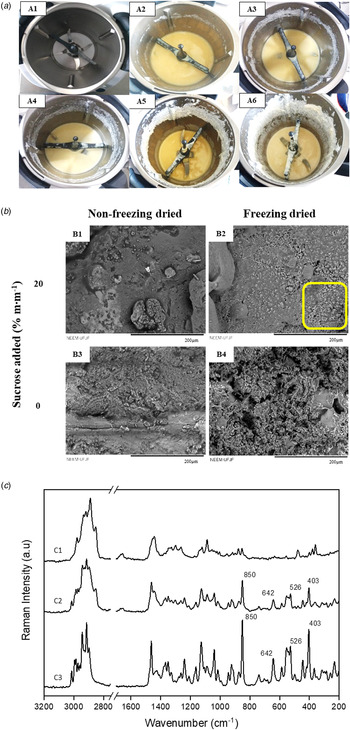
This section will specifically deal with the deposits formed during the production of DL, as these are related to the frequency of use and cleaning of the equipment, which directly impacts production capacity. Thus, the quantitative and morphological observations of the deposits (Fig. 1) and the main results (Table 1) obtained through the analyses described in the previous section will be discussed.
(a) Deposits formed after the manufacture of DL according to the sucrose content added to the milk, where: (A1) Empty, (A2) 20% (m/m) sucrose – DL, (A3) 15% (m/m) sucrose, (A4) 10% (m/m) sucrose, (A5) 5% (m/m) sucrose and (A6) 0% (m/m) sucrose. (b) sem analysis of the samples with 500 × magnification. Where (B1) 20% (m/m) sucrose non-freeze-dried, (B2) 20% (m/m) sucrose freeze-dried, (B3) 0% (m/m) sucrose non-freeze-dried and (B4) 0% (m/m) sucrose freeze-dried. (c) FT-Raman spectroscopy analysis. Being (C1) 0% (m/m) sucrose freeze-dried, (C2) 20% (m/m) sucrose freeze-dried and (C3) commercial sucrose.

Composition and chemical characterization of the deposits formed on the equipment in relation to the sucrose content added to whole milk

* Semiquantitative analysis performed by EDS.
Within a row different superscript letters indicate significant difference by Tukey's test (P < 0.05).
Concentration of milk
After the end of the concentration, the increase in the formation of deposits is visually noticeable with decreased sugar content (Fig. 1a).
Physical−chemical characterization of deposits
By keeping the amount of milk at 1000 g for all samples, it is possible to infer that the amount of milk components is the same for all samples. However, the addition of sucrose causes a dilution effect of these constituents. In the manufacture of traditional DL with 20% (m/m) of sucrose, this dilution factor comes to 16.67. By decreasing the sucrose content, this factor also gradually decreases to 13.04, 9.09, 4.76 and 1.00 for the levels of 15, 10, 5 and 0%, respectively (Table 1).
In addition to this factor, there is also an increase in the evaporative capacity of the samples in line with a decrease in the addition of sugar, from 58.02 ± 1.55% (m/m) of evaporated water for traditional DL to 72.88 ± 0.67% (m/m) for milk without added sugar (Table 1), leading to an increase of evaporation 1.26 times. Therefore, the production requires a shorter evaporation time to achieve the desired characteristics. This fact is corroborated by the concentration factor that increases by 1.67 times. However, despite this benefit, when concentrating the product with low sucrose content, there is an increase in the content of deposits formed that can reach up to approximately 13 times (ratio between the %deposit (w/w) – 20%sucrose:0%sucrose) more than in the traditional product. In addition, the composition of the deposit changes, moving from a deposit with greater dry extract (81.57% m/m) to a deposit with greater moisture content (54.23% m/m) as sugar is decreased. This factor is linked to its composition because when the sucrose content decreases, the deposits start to have a higher protein content. This is responsible for greater water retention, thereby increasing the moisture content of the collected deposits. This factor is corroborated by correlating the levels of total protein and protein in the dry base with the moisture content in which Pearson's correlations of r(3) = 0.987, P = 0.002 and r(3) = 0.997, P < 0.001 are obtained, respectively, clearly showing the relationship between these parameters in the samples.
When analyzing the chemical composition of the deposits (Table 1), once again, a change in the composition of the deposit is observed. The decrease in sugar content from 20 to 0% implies an increasing portion of proteins in the samples, from 12.94 ± 1.79 to 31.31 ± 2.66% (m/m) on dry basis respectively, and a subsequent greater water retention (Table 1). Upon the analysis of minerals (calcium and phosphorus), the semiquantitative analysis by EDS shows a behavior with increasing (3.99 ± 0.01 to 10.61 ± 0.02, for calcium and 2.58 ± 0.01 to 6.61 ± 0.12, for phosphorus – Table 1) statistical significance by the Tukey test (P < 0.05) of the contents of these minerals when reducing sucrose. The same behavior is observed when performing the quantitative analysis by means of atomic absorption spectroscopy obtaining the following values: for calcium 371, 580, 837, 1060, 1117 mg/100/g and for phosphorus 288, 410, 571, 709 and 786 mg/100 g for samples with sucrose addition of 20, 15, 10, 5 and 0% (m/m), respectively. This occurs since the concentration causes a destabilization in the casein micelles and then the high temperature causes calcium phosphate to precipitate, increasing the probability of these salts adhering to the surface wall (Mekmene et al., Reference Mekmene, Le Graët and Gaucheron2009).
Scanning electron microscopy (sem)
Figure 1b shows the surface aspect of the deposits. In the production of traditional DL we observed a deposit. In its non-freeze-dried form (B1) this was compact and smooth and after removing water from it utilizing lyophilization (B2) some crystals were present. With the total removal of sucrose, the concentration of milk forms more rough deposits when observed in its non-lyophilized form (B3) and after lyophilizing it (B4) we can observe a spongy structure characteristic of proteins (Hagsten et al., Reference Hagsten, Altskär, Gustafsson, Lorén, Hamberg, Innings, Paulsson and Nylander2016).
Raman spectroscopy
Deposits formed during the concentration of milks at 0 and 20% (m/m) sucrose were analyzed using Raman spectroscopy. The spectra obtained (respectively C1 and C2 in Fig. 1C) showed they have a similar overall shape, which is due to the same milk-based composition. However, the C2 spectrum shows bands with smaller FWHM values (full width at half maximum) that were not observed in C1; such band forms are characteristic of crystalline structures, as seen in Figure 1b (B2). In the same way, commercial sucrose was also analysed using Raman spectroscopy (spectrum C3 in Fig. 1c) and according to Brizuela et al. (Reference Brizuela, Bichara, Romano, Yurquina, Locatelli and Brandán2012), the specific bands attributed to sucrose characteristic vibrational modes are visible at 850, 642, 526 and 403/cm. These bands are visible on both spectra C3 and C2, which confirms that the crystals observed in Figure 1b (B2) are sucrose. It is interesting to note that due to its lower concentration of proteins and sucrose in its composition, and being highly soluble in water, such deposits tend to be easily removed from the surface, unlike milk protein-rich systems (Hagsten et al., Reference Hagsten, Altskär, Gustafsson, Lorén, Hamberg, Innings, Paulsson and Nylander2016). Further scientific articles corroborating the results are detailed in the online Supplementary File.
In conclusion, with the reduction of the sugar content in the manufacture of DL, attention must be paid to the concentration−time relationship, which will be accelerated due to the increase in the evaporative capacity. As to the cleaning intervals of the equipment, it will require more frequent cleaning cycles due to the possible shorter usage cycle time of the equipment and the need for a more rigorous cleaning regimen to remove proteins adhered to the heat exchange surface (Hagsten et al., Reference Hagsten, Altskär, Gustafsson, Lorén, Hamberg, Innings, Paulsson and Nylander2016).
Supplementary material
The supplementary material for this article can be found at https://doi.org/10.1017/S0022029921000777.
Acknowledgment
This work was supported by Brazilian foundations (FAPEMIG, CNPq and CAPES).