1. Introduction
Standard-setting activities play a key role in the development of economic exchanges and the building of efficient market infrastructure. From a New Institutional Economics (NIE) perspective, standards help economic actors to determine what is exchanged and to reduce the level of measurement and transaction costs (Allen, Reference Allen2011; Barzel, Reference Barzel1982; Reference Barzel1989; North, Reference North1990, Reference North2005). Standards are also acknowledged by the ‘old’ American institutional economics as part of the working rules governing markets and corporations (Commons, Reference Commons1924). Although their economic importance is fully acknowledged by institutional economics scholars, only few prior theoretical and empirical studies have emphasised the organisation of standard-setting activities per se (Foray, Reference Foray, Hawkins, Mansell and Skea1995; Pirrong, Reference Pirrong1995). For example, Barzel (Reference Barzel2004: 1) addressed the role of standards ‘independent[ly] of who set them or whether they are voluntary or mandatory’. This situation sharply contrasts with the current academic dynamics surrounding technological standardisation (Chiao et al., Reference Chiao, Lerner and Tirole2007; Greenstein and Stango, Reference Greenstein and Stango2007; Simcoe, Reference Simcoe2012, Reference Simcoe, Lerner and Stern2014).Footnote 1 Recent topics include the role of standards in carbon emissions monitoring (Bellassen and Cochran, Reference Bellassen and Cochran2015), or on working conditions and social responsibility that intersect/compete with national and international labour regulations (Locke, Reference Locke2013). In the agricultural sector, the globalization of standards received considerable attention in economic sociology (Barham and Sylvander, Reference Barham and Sylvander2011; Busch, Reference Busch2011), agricultural economics (Henson and Humphrey, Reference Henson and Humphrey2009; Rousset et al., Reference Rousset, Deconinck, Jeong and von Lampe2015); economic history (Stanziani, Reference Stanziani2012), legal studies (Marx et al., Reference Marx, Maertens, Swinnen and Wouers2012), and political science (Ponte et al., Reference Ponte, Gibbon and Vestergaard2011), among many others.
To address this gap in the NIE literature, this article explores the possibility of integrating these diverse perspectives by adapting and extending the canonical NIE analytical framework elaborated by Williamson (Reference Williamson1996, Reference Williamson1999) to standard-setting activities. Particular attention focuses here upon the role of collective action and knowledge governance associated with standard selection (Foray, Reference Foray, Hawkins, Mansell and Skea1995, Reference Foray2004; Simcoe, Reference Simcoe, Lerner and Stern2014). To date, the study of economic organisation within NIE has principally explored the questions of ‘make-or-buy’ decisions, contractual coordination, or vertical integration by a single firm (Williamson, Reference Williamson1985). Our analysis follows another research direction suggested by Williamson (Reference Williamson1999) in his work on ‘Public and Private Bureaucracies: a Transaction Cost perspective’ which we believe of particular relevance for the study of standard-setting institutions. Standard-Setting Organisations (SSO) are multifaceted institutions with no unique economic model of governance (Simcoe, Reference Simcoe, Lerner and Stern2014). While a number of standards are established by public authorities through governmental or intergovernmental standard-setting platforms, standardisation also occurs through voluntary industry committees or private consortia (Chiao et al., Reference Chiao, Lerner and Tirole2007; Farell and Simcoe, Reference Simcoe2012; Lerner and Tirole, Reference Lerner and Tirole2015; Simcoe, Reference Simcoe2012, Reference Simcoe, Lerner and Stern2014). The diversity of standard-setting bodies encompasses a broad spectrum of stakeholders and governance rules.
By adopting an NIE perspective, we address several distinctive features underlying the heterogeneity of institutional design and the variety of governance rules supporting standard-setting activities (Williamson, Reference Williamson1999). Recently, Simcoe (Reference Simcoe, Lerner and Stern2014) suggested possible parallels and a natural fit with institutional analysis of collective action and common-pool resources (Libecap, Reference Libecap1989; Ostrom Reference Ostrom1990, Reference Ostrom2005). In both settings, independent actors benefit from shared resources and confront similar problems of institutional design, overcoming free riding in the supply of public goods, monitoring and enforcing access rules, and crafting credible commitments (Simcoe, Reference Simcoe, Lerner and Stern2014). In this article, we propose a generalisation of the argument using the Williamsonian model as a foundation upon which it is possible to construct a still richer set of analytical tools.
To substantiate our analysis, our empirical data address new forms of standard-setting activities in the agricultural sector, as defined by the rise of global standards established by private consortia of large retailers, such as the GlobalGAP standard. Considerable attention previously stressed their impact on North–South international trade and the restructuring of vertical relationships with small farmers in Global Southern countries (Fulponi, Reference Fulponi2006; Henson and Reardon, Reference Henson and Reardon2005), questioning their legitimacy in addressing the general public interest (Fuchs et al., Reference Fuchs, Kalfagianni and Havinga2011; Havinga, Reference Havinga2006; Cheyns, Reference Cheyns2014). A different perspective is provided in this article by focusing on the European context, where there is strong competition with similar pre-farm gate standards established by national farmers’ organisations and/or public authorities. This heterogeneity of standard-setting initiatives offers an opportunity to compare key dimensions in the governance rules supporting various SSOs in the agricultural sector.
The article is organised as follows. Section 2 presents several key junctures in the regulatory transformations and the proliferation of private standards in Europe. Section 3 proposes an extension of the Williamsonian analytical framework to integrate the specific dimensions of standard-setting activities. Section 4 substantiates the analysis with data concerning the governance mechanisms at stake in the GlobalGAP consortium and other related standards in the European context. Section 5 discusses possible institutional failures in developing alternative multilateral governance at supranational and international levels.
2. Background: EU policy and private standards in agriculture
Understanding the complexities of private standard-setting strategies in the European context provides different insights on the current transformations of their regulatory governance in the agricultural sector.
The institutional and regulatory context
The rise of private global standard-setting consortia, established by groups of large international retailers as shared platforms, is a recent trend in the agri-food sector (Fulponi, Reference Fulponi2006; Henson and Reardon, Reference Henson and Reardon2005). Among the most well-known initiatives are the Global Food Safety Initiative (GFSI), established by the British Retail Consortium (BRC) for the food industry, and the GlobalGAP standard, to be operated at the farm level. In the literature, the rise of private global standards was perceived as an institutionalisation of private governance, defining transnational rules without state intervention (Fuchs et al., Reference Fuchs, Kalfagianni and Havinga2011; Pattberg, Reference Pattberg2005). Private global standards also appear to be the most innovative, as they differ from other SSO's,Footnote 2 while their legitimacy in addressing general public interests remains a problematic issue (Fuchs et al., Reference Fuchs, Kalfagianni and Havinga2011; Havinga, Reference Havinga2006; Pattberg, Reference Pattberg2005).
In the academic literature, a number of studies suggested that private global standards established by large retailers were operating more as substitutes than complements to public regulations, especially in Southern countries with weaker regulatory environments (Fulponi, Reference Fulponi2006). In this context, their development was analysed as an outcome of neoliberal public policies promoting the liberalisation and commoditisation of agricultural and food markets (Busch, Reference Busch2011; Ponte et al., Reference Ponte, Gibbon and Vestergaard2011). Analysing their development in Europe brings a radically different perspective, as they are part of the political project of European integration and regulatory harmonisation within Europe (Borraz, Reference Borraz2007). Major food crises and the disastrous impact of the BSE crisis both in the UK and the wider European continent accelerated this political process (Ansell and Vogel, Reference Ansell and Vogel2006).
The two main consequences of the BSE crisis were to highlight both the limits and the regulatory failure of British public authorities in defining proper mandatory standards on meat-and-bone treatment (Ansell and Vogel, Reference Ansell and Vogel2006), as well as the need to accelerate European reform towards stronger self-governance and the credible commitment of private stakeholders in handling food safety and other sustainability issues at every stage of the food chain (Vogel and Kagan, Reference Vogel and Kagan2004). Rather than endorsing public authorities and government through direct supervision, the objective was to introduce more accountability among private actors, with a shift in legal rules and stricter liability regimes positing public action more as a complement to private action and a ‘second-level’ supervision system. This shift in EU regulatory policy representing a new model of responsive co-regulation also stimulated the proliferation of wide-ranging private standards on food safety and sustainability issues in Europe.
The proliferation of private standards in Europe
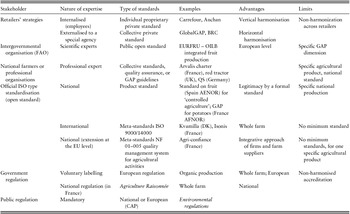
In the academic literature, a large number of studies focused on the emergence of new forms of innovative private standard-setting platforms established by groups of large retailers, such as the GlobalGAP consortium (Fuchs et al., Reference Fuchs, Kalfagianni and Havinga2011; Fulponi, Reference Fulponi2006; Havinga, Reference Havinga2006).Footnote 3 Two other strategies were also adopted by large European retailers through either (i) relying on existing pre-farm gate standards – such as quality assurance schemes and Good Agricultural Practices (hereafter ‘GAP guidelines’) – developed by their agricultural suppliers (Table 1), or (ii) developing their own proprietary standards, as pursued by Carrefour – a leading French retailer (Mazé, Reference Mazé2002) – and, more recently, TESCO in the UK (Rousset et al., Reference Rousset, Deconinck, Jeong and von Lampe2015).
Alternative standard-setting strategies for GAP guidelines and related pre-farm gate standards in the European context

This diversity of standard-setting solutions available to large retailers has clearly been under-evaluated in the literature; surprisingly, very few empirical studies have considered the diversity of adoption patterns of the GlobalGAP standard in the European context, where almost 80% of GlobalGAP farmers are located (Hertzel et al., Reference Herzfeld, Drescher and Grebitus2011; Mazé et al., Reference Mazé, Ait-Aissa, Verjux, Carrotte, Hédouin, Vaucelle, Theuvsen, Spiller, Peupert and Jahn2007). Table 1 provides a general overview of the diversity of private agri-environmental standards in the EU context, including (i) collective GAP guidelines (such as the Red Tractor in the UK, the French Arvalis Charter, QS in Germany, and the GlobalGAP standard); (ii) the formal standardisation processes initiated in Spain through AENOR, the official Spanish SDO, for fruit and vegetable; and (iii) adaptations of ISO 9000/14000 standards on quality and environmental management systems to the agricultural sector (such as the Kvamilla in Denmark, or Isonis and AgriConfiance in France). Private standards established by large retailers, such as GlobalGAP, are merely examples among many others.
All of these initiatives formulated different approaches to other technology-based standards, such as Integrated Pest Management (IPM), issued by the International Organisation for Biological and Integrated Control (IOBC) (Sansavini, Reference Sansavini1997) and the EU regulation on organic standards (Gibbon, Reference Gibbon2008).Footnote 4 Nevertheless, this proliferation of private pre-farm gate standards created some concerns due to the stringency of their requirements, as well as the lack of harmonised and scientifically-based definitions leading to questioning their relevance and effectiveness (Codron et al., Reference Codron, Giraud-Heraud and Soler2005; Manhoult et al., Reference Manhoudt, Van de Ven, Udo de Haes and de Snoo2002).
Standard setting as a make-or-buy decision for large retailers?
In this context, a number of studies have suggested it could be more affordable for European farmers to adopt more targeted standards that provide similar or higher guarantees and at a lower cost than complying with private global standards, such as GlobalGAP; alternatively, large retailers could themselves benefit of having a regulated standard defined by public authorities (Codron et al., Reference Codron, Giraud-Heraud and Soler2005). Over time, GAP guidelines have tended to incorporate more requirements – often dozens of items – covering social, ethical, and environmental issues related to agricultural activities, such as worker safety and training, record keeping, animal welfare, and farm management (Mazé et al., Reference Mazé, Ait-Aissa, Verjux, Carrotte, Hédouin, Vaucelle, Theuvsen, Spiller, Peupert and Jahn2007). The question to consider, then, is why apparently less relevant or ‘inferior’ standards imposing higher operating costs, such as the GlobalGAP standard, have enjoyed relatively large market adhesion among businesses in Europe and worldwide.
In the literature, most studies have questioned the welfare impact on producers and consumers of the rise of private global standards, such as GlobalGAP (Codron et al., Reference Codron, Giraud-Heraud and Soler2005; Fulponi, Reference Fulponi2006). Very few have considered the rationale for large retailers to join the GlobalGAP consortium instead of opting for other existing standards (Hertzel et al., Reference Herzfeld, Drescher and Grebitus2011).Footnote 5 In the agri-food sector, standard-setting activities are still mainly realised through the coordination of professional associations or specialised ad hoc committees, reinforced in some cases by public authorities. The role of formal SDOs, such as the ISO and its national division (such as ANSI in the USA, AFNOR in France, etc.) is more recent. Adopting an NEI perspective, our contention here is that the diffusion of the GlobalGAP standard, despite higher operating costs v2 compared to similar standards, has been enhanced by lower governance costs and its ability to both aggregate diverse demands and realise economies of scale and scope at the international level.
3. Analytical framework
To substantiate our analysis, we begin by re-examining and extending the heuristic and static model developed by Williamson (Reference Williamson1996) to integrate the specific dimensions related to the ex ante and, especially, ex post governance of standard-setting activities.
Beyond public versus private standards: the rules of governance
In their seminal study, Farrell and Saloner (Reference Farrell and Saloner1988) highlighted the trade-offs between market-based and committee coordination, demonstrating how SSOs help to solve coordination problems by providing a forum where interested parties can seek a broad consensus before endorsing a specific standard and promoting it as an industry standard (Chiao et al., Reference Chiao, Lerner and Tirole2007; Simcoe, Reference Simcoe2012). Moreover, David and Greenstein (Reference David and Greenstein1990) suggested that the distinction between de facto and de jure standardisation also influences the level of coordination and transaction costs involved in standard-setting activities. From an NIE perspective, standard-setting activities and their governance differ in their costs and competences in discriminating way (Williamson, Reference Williamson1996, Reference Williamson1999). Discrete governance structures supporting the various SSOs differ in their ability to organise ex ante the standard-setting process and to facilitate the ex post dissemination and adoption of the selected standard (Foray, Reference Foray, Hawkins, Mansell and Skea1995).
Figure 1 presents Williamson's classical heuristic model (Reference Williamson1996) extended here by contrasting the trade-off between public, hybrids, and private bureaus involved in standard- setting activities. It differentiates de facto standards – defined as a unilateral act by private firms (based on internally built expertise and human capital) to formulate and impose their own standards through market competition (left-hand curve) – from de jure standards based on collective coordination through standard-setting committees sponsored by public governments (right-hand curve) or by private or hybrid organisations, such as, for example, ISO, national SDOs, trade or professional producer associations.
Trade-off between governance structures supporting SSOs (adapted from Williamson, Reference Williamson1996, Reference Williamson1999).

One interesting feature of Williamson's simplified heuristic model is to maintain the possibility of multiple equilibria explaining the co-existence of different classes of governance structures for similar transactions (Mazé, Reference Mazé2005; Pagano, Reference Pagano, Bowles, Gintis and Gustaffson1993).Footnote 6 Efficiency connotes that solutions should have comparatively lower governance costs, ceteris paribus, i.e. given consistent technology and production costs and added revenue (Masten, Reference Masten1993; Tadelis and Williamson, Reference Tadelis, Williamson, Gibbons and Roberts2012; Williamson, Reference Williamson1996). In Appendix 1, we provide a detailed analysis of the trade-off faced by large retailers in choosing between the three main pre-identified standard-setting options identified in section The proliferation of private standards in Europe. Standard-setting activity is also a matter of collective action, where knowledge production and ex post dissemination involve specific governance rules (Foray, Reference Foray2004; Simcoe, Reference Simcoe, Lerner and Stern2014), we will analyse more precisely in the next sections.
Economising on transaction and governance costs
When analysing the rules of governance supporting standard-setting activities, Simcoe (Reference Simcoe, Lerner and Stern2014) identified two specific key dimensions. The first is linked to the selection problem: that is in essence, an SSO's effort to identify and endorse the best solution and specific standards for a given problem. The second factor refers to the coordination problem: in essence, the SSOs' impact on the final outcomes of the standard's adoption by the final users. Drawing upon earlier research on collective action in the field of natural resources (Libecap, Reference Libecap1989; Ostrom, Reference Ostrom1990, Reference Ostrom2005), when the number and the heterogeneity of interested parties increase, together with the nature and the size of coalitions, collective action and negotiations within and across groups become more difficult to achieve unless mitigated by specific governance rules.
From a classical NEI perspective, the heuristic model of Williamson (Reference Williamson1996) is applied in the following way. Consider the governance costs Gx of either a public bureau (R), collective hybrid SSO (H), or a private de facto standard established by a single firm (M). Let H = H (s; θ) denote the joint governance costs of alternative collective hybrid forms of SSOs as a function of transaction attributes; the argument is that M(0) < H(0) < R(0), with M representing the governance costs G of an individual firm establishing its own de facto standard through market competition, and R the bureaucratic cost of public regulatory governance. Governance costs can be expressed as a function of the difficulty of defining, implementing, and enforcing chosen standards (d) and a set of exogenous variables (θ). Direct government intervention in highly technical standard-setting processes can pose problems, including lack of expertise, regulatory capture by special interests, and lock-in to government supported standards (Simcoe, Reference Simcoe, Lerner and Stern2014; Williamson, Reference Williamson1999). However, in the case of distributional conflicts, last resort-public intervention usually acts to facilitate adjudicating the various interests involved (Libecap, Reference Libecap1989; Pirrong, Reference Pirrong1995).
Standard setting as knowledge governance
In contrast to technological compatibility standards, which, once adopted, are non-rivalrous and self-enforcing (Simcoe, Reference Simcoe, Lerner and Stern2014), in the case of sustainability standards, ex ante consensus does not preclude their effective ex post adoption by the final users. Knowledge governance potentially involves high exclusion costs, and generating useful knowledge is far from a trivial matter due to issues of appropriateness for final users (Foray, Reference Foray2004). One key issue here is related to the trade-off between consensus-seeking rules and participatory governance within SSOs (Rysman and Simcoe, Reference Rysman and Simcoe2008; Simcoe, Reference Simcoe2012). Footnote 7
Early participation in the standard-setting process presents the advantage of facilitating knowledge spill overs among participants, positively impacting their ex post appropriation and dissemination, in addition to enhancing the participants’ ability to influence the standard design (Foray, Reference Foray2004). However, while consensus-seeking defines a collaborative search for the best solution, it imposes an obligation to adopt procedures different from the one of pure deliberation and voting process, where the objective is to gather a sufficiently large majority (Borraz, Reference Borraz2007; Demortain, Reference Demortain2008; Simcoe, Reference Simcoe2012).
This ‘consensus’ rule requires more than a simple majority, but less than unanimity (Rysman and Simcoe, Reference Rysman and Simcoe2008). It also gives interested parties the power to block or at least delay the adoption of new standards (Farell and Saloner, Reference Farrell and Saloner1988; Simcoe, Reference Simcoe2012). There is then a trade-off between ‘opening’ the platform to grow participation and the potential market and remaining ‘closed’ to reduce competition and maintain control over consensus procedures in pursuit of achieving a good outcome (Chiao et al., Reference Chiao, Lerner and Tirole2007; Simcoe, Reference Simcoe2012). The effectiveness of the standard-setting process relies upon limiting initial participation to a small number of firms whose interests are well aligned, even if, in second step, more active ex post dissemination strategies are needed (Farrell and Simcoe, Reference Simcoe2012; Simcoe, Reference Simcoe, Lerner and Stern2014). A better understanding of the interactions between ex ante participation and ex post dissemination is still needed (Rysman and Simcoe, Reference Rysman and Simcoe2008).
4. Empirical evidence
In this section, we analyse, first, the public debates and controversies that accompanied the definition of GAP guidelines in the French context, and, second, what differentiates the governance rules of a private global standard-setting consortium, such as GlobalGAP, from those of other SSOs in the agricultural sector.
The selection of the standard: local versus global standards?
The fierce public debates in France regarding the scientific and technical relevance of GAP guidelines, including the GlobalGAP standard, offer interesting insights for our field study.Footnote 8 In France, and in contrast to other European countries – such as the Netherlands or Germany, where GlobalGAP originated – agricultural producers have also been the most active in promoting their own standards (Table 1). As well, very few large French large retailers initially joined the GlobalGAP consortium, as most of them rely on standards already developed by their suppliers. Hertzel et al. (Reference Herzfeld, Drescher and Grebitus2011) showed that becoming a member of GlobalGAP was strongly correlated to retailers’ procurement strategies: The greater the amount of imported products (compared to local procurement), the more profitable it is for large European retailers to join a private global consortium (rather than local standards). Among French farmers, especially in Northern France and Brittany specialised in vegetable and potato productions, the arrival of GlobalGAP appears as a possible opportunity to facilitate export market access in Northern European countries.
In France, this proliferation of private standards and GAP guidelines was initially analysed as a lack of coordination among existing private initiatives (Table 1) and a trend towards over-bidding and heterogeneous requirements, potentially creating a risk of confusion and misleading information to consumers, thus necessitating public intervention (Codron et al., Reference Codron, Giraud-Heraud and Soler2005, Mazé et al., Reference Mazé, Ait-Aissa, Verjux, Carrotte, Hédouin, Vaucelle, Theuvsen, Spiller, Peupert and Jahn2007). The main trigger emerged when several large French retailers (such as Auchan) and leading food companies (such as McDonalds and McCain) started to publicise to consumers the more sustainable farming practices employed by their suppliers, generating strong opposition from the national farmer's association (Fédération nationale des syndicats d'exploitants agricoles, FNSEA). Public authorities were asked to find a solution to balance all the relevant interests; consequently, they mandated independent expertise to seek a compromise, led by Guy Paillotin, a former president of the public National Agricultural Research Institute (INRA).
A public regulatory voluntary scheme reinforced by the law, named ‘Agriculture Raisonnée’, was launched based on a set of scientific expert recommendations (Beigbeder and Meynard, Reference Beigbeder and Meynard2001). However, in hindsight, this new regulatory standard did not achieve the expected level of success (fewer than 8,000 farmers involved ten years after its introduction), failing to propose relevant harmonisation across the various existing GAP guidelines that also reflected the diversity of farming systems. Thus, public intervention in standard-setting activities appears here to have its own limitations (Williamson, Reference Williamson1999).
A number of professional GAP guidelines decided to opt out of a formal standardisation process (through the AFNOR), with the aim of defining a ‘base standard’ S0 to be used by agro-food firms to determine their own contractual requirements with their agricultural suppliers. A formal SDO process still necessitates consultative supervision by public authorities (represented by a ‘government commissioner’), in addition to a technical and public enquiry process, before its homologation and official publication.Footnote 9 The expected benefits here for the agro-food firms are to have their own national standard, using a shared industry standard to avoid redesign costs and enhance compatibility, in addition to differing from the strategy adopted by the GlobalGAP consortium.
GlobalGAP as a global standard-setting organisation
The private standard-setting consortium GlobalGAP is rooted in the grouping of a number of North European supermarkets into a formal private association, the Euro-Retailer Produce Working Group (EUREP), whose standard was initially called EurepGAP, then renamed GlobalGAP in 2007. The standard benefited from significant growth, increasing from around 18,000 agricultural suppliers in 2004 to more than 70,000 certified producers in 80 countries nowadays. While the organisational models in formal SDOs maintain a statutory separation between the standard-setting processFootnote 10 and the ex post dissemination and its enforcement through public or private certification schemes, private global standard-setting platforms, such as GlobalGAP, offer a combination of services that facilitate their diffusion worldwide, where language barriers and cognitive distance from the standards’ contents can be important.
Compared to other SDOs, the GlobalGAP consortium delivers a range of marketing and technical services, at a reasonable cost allowed by scale and scope economies. It includes
-
(i) bilateral negotiations and follow-up on the technical content of GAP guidelines;
-
(ii) training delivered to agricultural suppliers (through a list of approved trainers) and an updated follow-up of agricultural suppliers’ membership;
-
(iii) approval and supervision of a pool of independent and accredited third-party certification bodies (based on EN/ISO 17065) operating globally and engaged in a ‘service agreement’, allowing the GlobalGAP Secretariat to remain informed of suspensions; and
-
(iv) lobbying of national administrations and international SSOs.
By outsourcing knowledge acquisition and the technical expertise required for standard design and ex post monitoring, the GlobalGAP consortium allows (i) a reduction in the costs of monitoring food safety standards at the farm level, and (ii) ensuring that they comply with actual European public regulations, especially regarding pesticide residues. With respect to its governance, the GlobalGAP private consortium serves as a private business-to-business (B2B) standard-setting platform, allowing for scale and scope economies.
While standard setting is initiated by the GlobalGAP Board, dedicated technical committees – including representatives of producer organisations and licensed certifying firms – assist in the development of the standard and decide on the technical elements related to their field of expertise.Footnote 11 The final decision rights remain vested in the elected GlobalGAP Board – with a three-year mandate – comprising equal numbers of representative of large retailers and half of producer organisations, with simple majority rules applied in final decision making (Kalfagianni and Fuchs, Reference Kalfagianni, Fuchs, Robinson and Carson2015).
Contrasting with traditional SDOs, the GlobalGAP consortium has been very active in providing ex post support and training programs to facilitate information dissemination and the standard's adoption by potential suppliers worldwide. This technical assistance facilitates the comprehensibility of technical information and of the monitoring system and certification attached to the GlobalGAP standard, which makes a real difference compared to other SSO for the standard adoption in many countries form the Global south.
Joining the GlobalGAP consortium thus allows large retailers to have more influence in the standard-setting process (with half of the Board representatives) compared to traditional SDO's, where they are usually in the minority and responsibility for agenda-setting remains vested in the sectorial strategic committees. Furthermore, membership of GlobalGAP also gives large retailers direct access to the certification and audit reports, which the other standards do not necessarily offer (Mazé, Reference Mazé2002; Mazé et al., Reference Mazé, Ait-Aissa, Verjux, Carrotte, Hédouin, Vaucelle, Theuvsen, Spiller, Peupert and Jahn2007).
The dynamics and the adaptive self-governance of GlobalGAP
Within the GlobalGAP consortium, the ability of large retailers to interact with agri-food firms, farmers, and certification bodies has been interpreted as a form of ‘equal partnership’ (Fuchs et al., Reference Fuchs, Kalfagianni and Havinga2011), and, alternatively, as a new form of forum or arena defining alternative processes of ‘democratic’ governance, or even new instances of discussion, dialogue, and participation among stakeholders (Fuchs et al., Reference Fuchs, Kalfagianni and Havinga2011; Havinga, Reference Havinga2006; Pattberg, Reference Pattberg2005). A detailed analysis of GlobalGAP governance nevertheless shows a much more complex and contradictory picture.
In the literature, the GlobalGAP standard has been described either as a voluntary consensus standard, defined by the joint collaborative action of large retailers and their suppliers (Fuchs et al., Reference Fuchs, Kalfagianni and Havinga2011; Havinga, Reference Havinga2006), or as a typical top-down standard, with large retailers exercising overwhelming powers and evading the scrutiny of public authorities (Henson and Humphrey, Reference Henson and Humphrey2009). Over time, a number of critics emerged, decrying the lack of both transparency and influence of agricultural suppliers in final decision making.Footnote 12 While, in the literature, large retailers are usually endowed with overwhelming powers (Fuchs et al., Reference Fuchs, Kalfagianni and Havinga2011; Havinga, Reference Havinga2006), several changes within the GlobalGAP governance have been introduced indicating a move towards a more balanced representation in the decision-making process and to the adjudication mechanisms solving the various conflicts and divergences of interests among stakeholders during the standard-setting process.
These adjustment outcomes have given more opportunity to suppliers’ representatives and local certifying firms – as practitioners in possession of field knowledge – to discuss the requirements included in GlobalGAP and the standardising work, with an open 60-day public inquiry process to invite comments after the process is completed and its outcome advertised. Three changes within the governance rules supporting the standard-setting process within GlobalGAP are of special interest here.
First, the definition of ‘benchmarking procedures’. These are similar to the generic principles of ‘mutual recognition’ and ‘equivalence’ used within the EU policy for regulatory harmonisation, even if they are far from being easy and automatic, as experienced by a number of initiatives, such as the French Quality Charter Arvalis which failed to be awarded the equivalence after a formal assessment. In 2016, five schemes were acknowledged by GlobalGAP as ‘resembling schemes’, including the UK-based ‘Red Tractor’ scheme and the Dutch IKB scheme, and 16 were acknowledged as ‘benchmarked equivalent schemes’.
Second, the creation of sectorial committees (SC) covering different product groups (e.g. crops, livestock, and aquaculture). These committees are elected for a period of three years by their peers (retailers and suppliers). Each supplier member has a voting right. Each SC works independently from the GlobalGAP Board, but final acceptance of the proposed requirements remains the latter's sole responsibility. In addition, a Certifying Bodies Committee and an Integrity Committee have been created.Footnote 13
Third, the creation of National Technical Working Groups (NTWG) to provide guidance for the interpretation and adaptation of the generic standard (e.g. ChiliGAP, etc.),Footnote 14 thus relaxing the idea of a uniform global standard to be applied worldwide and allowing for national adaptations to general requirements (Henson and Humphrey, Reference Henson and Humphrey2009). Such adaptations highlight several sensitive issues regarding the participation of small stakeholders and the selection of the relevant standards. Standard setting is a dynamic process, and SSOs are not closed-discussion arenas in adjudicating the divergence and convergence of interests among stakeholders.
5. Discussion
In this section, we discuss a number of lessons that can be drawn from our field study contrasting GlobalGAP governance with other private or public standard-setting strategies, in addition to their role towards more sustainable agriculture.
Private global standards: consensus-based versus participative governance?
Understanding the relationship between the public and the private in standard-setting activities has been a recurring theme in the literature due to its legal implications and its impact on international trade (Fulponi, Reference Fulponi2006; Havinga, Reference Havinga2006; Henson and Humphrey, Reference Henson and Humphrey2009). The rise of the GlobalGAP standard has been presented in the literature as a powerful trend in decentralising nation-state governance, in addition to a real shift in the leadership of standard-setting processes in the agricultural sector (Fulponi, Reference Fulponi2006). By highlighting the co-existence of competing standard-setting initiatives, our analysis provides a different angle perspective on the current transformations and institutional dynamics of standardisation at the European and global level.
From a theoretical perspective, the proliferation of private sustainability standards could also be analysed as a classical example of ‘standard wars’ and competition between stakeholders to impose their own technological solution, accompanied by the subsequent sharing of economic value (Shapiro and Varian, Reference Shapiro and Varian1999). It can also reflect a collective learning process through experimentation about the best solutions to be adopted (Choi, Reference Choi1996). The collective production of knowledge in standard-setting activities is also the result of local and temporary solutions to the knowledge dilemma inherent in the conflict between the social goal of efficient use of knowledge, once produced, and its actual use by economic actors (Foray, Reference Foray2004). Beyond guaranteeing the compliance with EU food safety regulations on pesticide residues in agricultural products, the design of GAP guidelines has been sometimes perceived as a blueprint solution and a weak form of agro-ecologization of farming practices raising new issues about current strategies pursuing the reduction of pesticide uses by farmers and more sustainability (Altieri, Reference Altieri1995).
The rules of governance within the GlobalGAP consortium present several key differences with other SSOs in handling the trade-off between consensus seeking and participation in the standard-setting process. In most traditional SDOs, there is a formal separation between the standard-setting process itself and the ex post dissemination of the standard, in addition to its certification by formal certifying firms, which both remain the sole responsibility of the stakeholders. Reducing the costs of ex post implementation is also a means to encourage broader participation in private standard-setting platforms (Simcoe, Reference Simcoe, Lerner and Stern2014). In the case of GlobalGAP, our analysis shows that a more restrictive functioning of standard-setting committees – involving fewer participants and requiring higher levels of knowledge and technical expertise for their agricultural suppliers – is balanced by the broad integration of ex post training programs, in addition to its relative transparency and information disclosure, language, and technical comprehensibility, contributing to a larger knowledge transfer and the dissemination of the GlobalGAP standard.
The design of GAP guidelines and its knowledge dilemma
In the literature, the rise of private global standards, such as GlobalGAP, has been also perceived as the potential driver of harmonisation (Fulponi, Reference Fulponi2006). The economic significance of knowledge codification is a key issue here (Brunsson and Gustafsson, Reference Brunsson and Jacobsson2000; Foray, Reference Foray2004). A detailed analysis of the strategies of knowledge codification applied to the design of GAP guidelines highlights three main technical obstacles to their full harmonisation.
First, the design of most GAP guidelines is an operational translation of the generic principle of risk analysis, as defined by meta-standards such as the HACCP (Hazard Analysis Critical Control Points) methodology.Footnote 15 Being less prescriptive, meta-standards also place primary responsibility with those who possess the most information about risk and potential control methods, the counterpart to which is a more administrative approach and less uniformity in the targeted outcomes (Henson and Humphrey, Reference Henson and Humphrey2009). In this context, the GlobalGAP standard cannot be considered as a meta-standard itself, but rather just as a process standard similar to the other GAP guidelines (Mazé et al. Reference Mazé, Ait-Aissa, Mayer and Verjux2016).
Second, when defining GAP guidelines, there is a trade-off between the setting of uniform standards – as a major driver of harmonisation – and the possible loss of scientific or technical relevance with respect to local farming practices and to possible language leeway in interpreting traceability and standard requirements (Mazé et al., Reference Mazé, Ait-Aissa, Verjux, Carrotte, Hédouin, Vaucelle, Theuvsen, Spiller, Peupert and Jahn2007). National adaptations of the GlobalGAP standard and the rise of Southern standards (Schouten and Bitzer, Reference Schouten and Bitzer2014), for example, reflect the search for greater suitability for local farming practices at the core of the design principles of GAP guidelines. However, a number of large European retailers still prefer the standard version of GlobalGAP rather than its national adaptations.
Finally, a major obstacle to full harmonisation of GAP guidelines is the determination of thresholds and conceptual categories, often defined in authoritative and highly qualitative ways and with large variations across the various GAP guidelines (Mazé et al., Reference Mazé, Ait-Aissa, Verjux, Carrotte, Hédouin, Vaucelle, Theuvsen, Spiller, Peupert and Jahn2007, Reference Mazé, Ait-Aissa, Mayer and Verjux2016).Footnote 16 Differences in ratings can block equivalence and mutual recognition with other standards and limit the role of GAP guidelines as real drivers of harmonisation at the international level, in addition to impeding adjudication between various competing standards and defining the most relevant solutions towards in pursuit of more sustainable farming practices.
Regulatory governance: multilateral cooperation versus institutionalisation?
When operating at the international level, a public authority or government is no longer the sole locus of authority and the ultimate arbitrator in adjudicating between various interests. Outside the multi-layered hierarchical model of accredited SDOs, private global standards use alternative pathways to achieve formal recognition of their specifications as international standards (Simcoe, Reference Simcoe, Lerner and Stern2014). The increasing recognition of private global standards, such as GlobalGAP, seems to challenge the legitimacy of well-established intergovernmental SSOs, such as the Codex Alimentarius or the UN Food and Agriculture Organisation (FAO) (Henson and Humphrey, Reference Henson and Humphrey2009; Rousset et al., Reference Rousset, Deconinck, Jeong and von Lampe2015). Private proprietary standards present the advantage of defining more flexible and prompt ad hoc governance rules than are generated by more formal SSOs (Simcoe, Reference Simcoe2012).Footnote 17 In contrast, being reinforced by the law can allow for stronger coalition stability and a reduction of endless cycling reflecting the costs of forming and reforming coalitions and the political costs of negotiations and coalition enforcement (Johnson and Libecap, Reference Johnson and Libecap2003; Mazé and Ménard, Reference Mazé and Ménard2010). Nevertheless, standard setting remains highly politicised and complex as regards defining compromise and consensus with public authorities and other mainstream stakeholders, with the possible risk of being expropriated, as observed in the organic sector (Gibbon, Reference Gibbon2008; Michelsen, Reference Michelsen2009). In the organic sector, the EU regulation has been sometimes perceived as a ‘mainstreaming’ or ‘conventionalization’ of organic standards leading a number of stakeholders to maintain their own standards and labels.
Rather than opting for institutionalisation, either through a formal SDO or through its endorsement by public authorities, as in the case of organic production, the GlobalGAP consortium recently shifted its orientation decisively towards ‘multilateral cooperation’ through strategic alliances with other leading standard-setting initiatives. In 2014, GlobalGAP's launch – through the ‘Declaration of Abu Dhabi for Global Food Security through Good Agricultural Practices’ – of what they called a ‘Public-Private Partnership’ with the Sustainable Agriculture Initiative (SAI) Platform, representing the leading international food companies (e.g. Unilever, Danone, and Nestlé), provides a strong signal in this direction of moving towards more optionality through multilateral cooperation. However, by adopting a standard under which technology choices remain relatively open and less prescriptive, the question remains about the role of large ‘platform leaders’, such as GlobalGAP, to address the general public interest and act (or not) as potential candidates in orchestrating major agro-ecological transitions and increased sustainability in agriculture.
6. Conclusion
In this article, our aim was to propose an extension of the classical NIE framework to the governance of standard-setting activities, providing a more encompassing view of SSOs that accounts for the various perspectives advanced in economics and contiguous disciplines. This article does not defend a normative view of what (private or public) bureaucracies should do; rather, it investigates the issues raised by the role and the nature of bureaucracies being designed by private actors or policy makers, acting as autonomous organisations, to support standard-setting activities designed to reach their strategic or policy objectives (Williamson, Reference Williamson1999). While our analysis mainly focused on private firms, here large retailers, making choices about standards and participation in SSO, the decisions governments and SDO make to enter in specific standard-setting activities are central for a future NIE research agenda.
The explosion of private standard-setting consortia and the possible conflicts with traditional SDO and international governmental organizations has dramatically changes the political economy of standardization in globalized economies. By focusing on the European context, our study reaffirms that governance does not operate in isolation but rather in interaction with the institutional environment: in essence, the set of rules, laws, policies, and norms that determine the ‘rules of the game’ (North, Reference North1990, Reference North2005). A better understanding of the interdependences between regulatory instruments and the regulatory cycles involving moments in time with (politically neutral) technical evaluation and knowledge expertise at local and global levels is needed. Our theoretical contribution here is twofold.
First, while the literature on technological innovations highlighted the role of path dependencies and lock-in induced by initial learning costs, leading to the adoption of inferior technology or standards (Cowan and Gunby, Reference Cowan and Gunby1996; David, Reference David1985), we show that institutional endowment and capability-building are central to the institutional framing of standard-setting activities. Acting as cognitive artefacts and mental constructs used as reference points (Ostrom, Reference Ostrom2005; North, Reference North2005), standard-setting activities provide a relevant research area on integrating dispersed knowledge throughout society with regards to sustainability issues.
Second, our analysis adds to earlier studies conducted by Rysman and Simcoe (Reference Rysman and Simcoe2008) and Simcoe (Reference Simcoe, Lerner and Stern2014) and the parallel they suggested with the institutional analysis of collective action and natural resources (Libecap, Reference Libecap1989; Ostrom, Reference Ostrom2005). By using the Williamsonian model as a benchmark, our analysis provides a theoretical and analytical background against which to develop quantitative research in the future. Further researches in transaction costs politics and coalition formation may provide interesting insights to address the complex geopolitics attached to the polycentric governance of global standard setting activities.
Appendix 1 – Standard setting: a make-or-buy decision for retailers?
Re-examining and extending the classical model of Williamson (Reference Williamson1996, Reference Williamson1999) provide interesting insights on the trade-off faced by large European retailers when choosing between alternative standard-setting strategies. In the literature on technological standards, one of the key issues identified regarding ‘standard war’ is that it may undermine competition and favour ‘hold-up investment’ (Williamson, Reference Williamson1985), inciting stakeholders to postpone their investments for fear of investing in a losing system. Another approach is suggested here based on Masten (Reference Masten1993), involving assessment of how the differential in governance costs ΔG balances the differential of operating costs ΔC imposed by the different GAP guidelines. Depending of the initial standard design, GAP guidelines differ by their level of operating costs v for suppliers, including traceability systems and technical follow-up of farming practices.
In the first step, large retailers observe the available standard-setting alternatives characterised by their operating costs for the supplier's v, the level of specific investments k required for large retailers, and their governance costs G. The three alternative standard-setting strategies available to the large retailers identified in our study are as follows:
Retailer Strategy 1 – Rely on existing national or local standards, considered as more targeted and relevant to local farming practices, established by a professional supplier association, in which large retailers eventually participate (e.g. Arvalis Quality charter), with k1 > 0 for retailers engaged in bilateral bargaining with their suppliers and operating costs v1.
Retailer Strategy 2 – Outsourcing knowledge acquisition, standard setting, and ex post monitoring of standards by joining a collective B2B platform established by organised groups of retailers, allowing for larger scale and scope economies and less dedicated investments for each individual large retailer (e.g. GlobalGAP), with retailers’ sunk costs k2 linked to membership fees and operating costs v2> v1.
Retailer Strategy 3 – Privatise and develop their own individual private standard, using their internal expertise and human resources (e.g. Carrefour), involving added differentiation revenues R compensating for higher operating costs, with specific investment k3 >> k2 > k1 and operating cost v3.
In the second step, an assessment of Σ(ΔC + ΔG) > 0 is realised for the different standard alternatives, with ΔC the difference in steady-state operating costs between one's own standard and joining a private standard-setting consortium, and ΔG = M(k, s) – H(k, s), the difference governance costs attached to setting their own standard or joining a standard-setting alliance, with d being the difficulty to establish and disseminate the selected standard.
When comparing these options, while the latter strategy S3 requires larger investments in dedicated assets k for the individual retailer, the strategies S1 and S2 differ in their operating costs v1 and v2 (with v2 > v1) and their specific governance rules. The current design of the GlobalGAP standard involves an operating cost v2 > v1; the operating costs of GAP guidelines are defined by representative national or local farmer professional associations. Differences in governance costs, especially through scale economies and access to relevant information, must thus be weighed against potential additional hidden costs passed on to suppliers by way of stricter requirements compared to other similar standards. The last analytical step is dedicated to the comparison of the various governance rules of SSOs for each standard.