Implications
Optimizing milk production efficiency implies diets allowing low methane (CH4) emission and high dairy performance. Maize silage-based diets supplemented with starch or different sources of lipids induced low milk fat content, suggesting milk fat depression (MFD) in dairy cows, which represents economic losses for farmers. All of these diets led to low enteric CH4 emissions, which can limit the dairy cows’ impact on the environment.
Introduction
Dairy producers are interested to improve milk yield and composition of their dairy cows, because economic outputs as payments are based on milk fat and protein contents. However, the genetic selection of high-yielding cows reduces, in the long term, the milk fat content (Le Mezec and Launay, Reference Le Mezec and Launay2017). Moreover, to meet the energy requirements of high-yielding dairy cows and to increase their milk yield (Jenkins and McGuire, Reference Jenkins and McGuire2006), the use of dietary lipid supplementation and/or the distribution of concentrates rich in starch have become common feeding practices for dairy producers. These latter feeding practices could markedly modify milk fat content and composition (Chilliard et al., Reference Chilliard, Glasser, Ferlay, Bernard, Rouel and Doreau2007). More precisely, feeding dairy cows with diets rich in starch (due to a high level of concentrate and/or maize silage-based diets), supplemented or not with unsaturated fatty acids (FA), can induce MFD, also called low milk fat syndrome (Bauman and Griinari, Reference Bauman and Griinari2003). Changes occurring during MFD are characterized by a decrease in milk fat content, ranging from 0.9 to 2.5 g/kg without changes in milk yield (Shingfield et al., Reference Shingfield, Bernard, Leroux and Chilliard2010). Lower milk FA secretion, due to the reduction in de novo mammary FA synthesis (Bauman and Griinari, Reference Bauman and Griinari2003), is also observed in the case of MFD, as are changes in ruminal biohydrogenation (RBH) of polyunsaturated fatty acid (PUFA), with greater production of total trans FA, including trans-10 C18:1 and trans-10,cis-12 CLA, which is known to inhibit de novo mammary FA synthesis (Ferlay et al., Reference Ferlay, Bernard, Meynadier and Malpuech-Brugère2017). Conversely, maize silage-based diets supplemented with saturated fatty acid (SFA) (e.g. C16:0 from palm oil or Ca salts of palm oil) induced higher milk fat content and yield, and a higher C16:0 concentration in milk than no supplemented diets (Lock et al., Reference Lock, Preseault, Rico, De Land and Allen2013). We hypothesize that the different dietary energy substrates would lead to different degrees of MFD as well as changes in RBH pathways and milk FA concentration.
These feeding strategies (starch, lipids) are also known to lower CH4 emissions in dairy cows, though various mitigating mechanisms are involved (Martin et al., Reference Martin, Morgavi and Doreau2010). However, to the best of our knowledge, no direct comparisons of the energy substrate effect (starch v. lipids) on CH4 emissions have been carried out in the past. Nonetheless, it has been reported that the CH4-decreasing effect of lipids appears to be dependent on the dietary FA profile. Indeed, PUFA supplementation is more effective than SFA (Martin et al., Reference Martin, Morgavi and Doreau2010), even though no lipid source effect was reported by Grainger and Beauchemin (Reference Grainger and Beauchemin2011). Furthermore, it is well known that the short-chain FA (acetate, propionate and butyrate) arising from rumen fermentations are precursors of the de novo synthesis of short- and medium-chain FA in the mammary gland and also are related to CH4 production because of these common biochemical pathways in the rumen.
Thus, the main objective of this experiment was to study the effects of starch-rich or different lipid-supplemented diets inducing MFD on milk yield, fat yield and FA profile in dairy cows fed maize silage-based diets in comparison to non-MFD diet. At the same time, the effects on methanogenesis and on other digestive processes (rumen fermentation parameters, total tract digestibility), as well as the links between individual milk FA and CH4 emissions, were investigated.
Material and methods
The experiment was conducted at the animal experimental facilities of Institut National de la Recherche Agronomique (INRA) (UE 1414 Herbipôle, Saint-Genès-Champanelle, France) from February to June 2015.
Cows, experimental design and diets
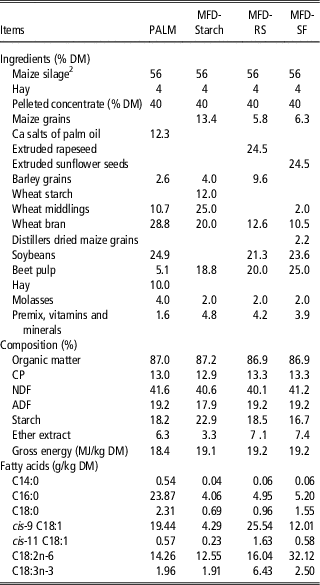
Four multiparous lactating Holstein cows (BW=621±12 kg, days in milk=61±10 days, milk yield=30.7±1.8 kg/day, and milk fat content=3.31±6.20% at the start of the experiment) were used in a 4×4 Latin square design. Each cow was fed four diets based (dry matter (DM) basis) on 60% forage (56% maize silage and 4% natural grassland hay) and 40% of pelleted concentrates (InVivo NSA, Chierry, France). The four concentrates differed in their energy substrate (starch or lipids) likely to modify milk fat content: (1) a diet rich in SFA with Ca salts of palm oil (PALM), likely to increase milk fat content; (2) a diet able to induce a MFD with high dietary starch content (MFD-Starch); (3) a diet able to induce a MFD containing monounsaturated fatty acid (MUFA)-rich lipid supplement as extruded rapeseeds (MFD-RS); and (4) a diet able to induce a MFD containing PUFA-rich lipid supplement as extruded sunflower seeds (MFD-SF) (Table 1). Diets were formulated to be iso-energy and iso-protein and to meet individual energy and protein requirements for lactation and maintenance (INRA, 2007). They were adjusted daily in order to maintain the forage-to-concentrate ratio as close as possible to the 60 : 40 ratio targeted. Ingredients and chemical composition of diets are reported in Table 1.
Ingredients and chemical composition of the four experimental dietsFootnote 1 fed to dairy cows

1 PALM=diet with Ca salts of palm oil; MFD-Starch=diet inducing milk fat depression (MFD) rich in starch; MFD-RS=diet inducing MFD with extruded rapeseed,; MFD-SF=diet inducing MFD with extruded sunflower seeds.
2 Fermentation characteristics of fresh maize silage juice: pH=3.4; lactic acid=98.5 g/kg dry matter (DM); N-NH3=7.5% of total N.
Each experimental period lasted 28 days. From days 1 to 20, cows were housed in a free stall barn and were fed ad libitum with forage (maize silage and hay). From days 21 to 26, cows were placed individually in open-circuit respiratory chambers and fed an amount limited to 95% of individual voluntary feed intake to ensure complete consumption of the diets. From days 27 to 28, cows returned to the free stall barn and were fed the same diet from days 1 to 26. Changes from one diet to another were achieved with a 6-day transition period during week 1 of each experimental period. Hay was given once daily (0830 h) and the maize silage and concentrates were mixed together as a partial mixed ration and given twice a day (66% at 0900 h and 34% at 1600h). Cows had free access to water throughout the experiment.
Measurements
BW, feed intake and diet composition
Cows were weighed at the beginning of the experiment and in week 3 for each period. Dry matter intake (DMI) was determined on 4 consecutive days in weeks 1 to 3, and on 5 consecutive days in week 4 by individually weighing feed offered and refusals. The DM content of the feed offered and refusals was determined (103°C for 24 h) in samples (100 g) taken twice a week for maize silage and once a week for hay and concentrates. In addition, samples of each feedstuff (100 g) were taken twice in week 4, pooled to provide one sample per period and stored at 4°C (concentrates, hay) or at −20°C (maize silage). At the end of the experiment, all feedstuff samples were freeze-dried and ground (1-mm screen; ZM 200 Retch Mill, Haan, Germany) for chemical composition determination of organic matter (OM), CP, NDF, ADF, starch, FA profile, gross energy (GE) and fermentative parameters of fresh maize silage juice (pH, lactate, volatile fatty acid (VFA) and ammonia N (N-NH3)). As refusals were negligible (<1% of total DMI, data not shown), chemical composition of refusals was considered similar to that of the diet offered.
Milk yield and composition
Cows were milked twice daily at 0730 and 1530 h and milk yield was individually recorded at each milking. Milk samples (30 ml) were collected for each cow on days 22 to 24 and stored at +4°C with Bronopol (2-2-nitropropane-1,3-diol) as preservative for milk component analyses. For milk FA composition, another individual milk sample (3 ml) was taken on day 24 and frozen (−20°C) without preservative after each milking. All samples were freeze-dried and then composited per day based on am and pm milk yields, respectively.
Total tract digestibility
Total faeces and urine were collected in individual boxes for 5 consecutive days during week 4. Each morning, after weighing and mixing the faeces and urine, a 1% fresh aliquot was used for DM determination (103°C for 24 h) and another 0.5% fresh aliquot was pooled per week and per animal before being frozen (−20°C). At the end of the experiment, samples were thawed, freeze-dried, and ground (1-mm screen) for chemical determination (OM, NDF, ADF, starch, GE).
Enteric methane emissions and rumen fermentation parameters
Cows were housed in individual open-circuit respiration chambers (16.6 m3 each) from days 21 (0730 h) to 26 (0730 h), during which total CH4 emissions were continuously measured. Open-circuit respiration chambers operated at a slight negative pressure with an airflow of 421±12 m3/h on average (~45 air changes per hour). System design, associated analytical equipment and procedures are detailed in Bougouin et al. (Reference Bougouin, Ferlay, Doreau and Martin2018), as is rumen fluid sampling. Briefly, rumen fluid samples (500 ml) were collected by stomach tubing before the morning feeding on day 18 of each experimental period. Samples were strained through a polyester monofilament fabric (250 µm pore size) and the filtrate was subsampled for determination of VFA concentration and protozoa counting.
Chemical analyses
Chemical composition and rumen fermentation parameters
The OM, NDF, ADF, CP and GE content of feed and excreta (faeces+urine), as well as FA composition of all feedstuffs and fermentative parameters of fresh maize silage juice were determined using procedures as described in Bougouin et al. (Reference Bougouin, Ferlay, Doreau and Martin2018). Concentrations of rumen VFA and N-NH3 were, respectively, analysed by gas chromatography with a flame ionization detector and by colorimetry (Morgavi et al., Reference Morgavi, Jouany and Martin2008). Total protozoa were counted by optical microscopy and categorized as either entodiniomorphs or holotrichs (Williams and Coleman, Reference Williams and Coleman1992). Data for protozoa were log10-transformed for statistical analyses.
Milk composition
Milk fat, protein, lactose and urea nitrogen contents were determined using MilkoScan 4000 (Foss Electric A/S, Hillerod, Denmark; Lial, Aurillac, France). The milk FA composition was determined as described by Ferlay et al. (Reference Ferlay, Martin, Lerch, Gobert, Pradel and Chilliard2010). Lipids were directly methylated using 2 ml of 0.5 M sodium methoxide plus 1 ml of hexane at 50°C for 5 min, followed by cooling with the addition of 75 µl of 12 M HCl at room temperature for 10 min. The FA methyl esters from all the samples were separated on a 100m×0.25mm i.d. fused-silica capillary column (CP-Sil 88; Chrompack, Middelburg, The Netherlands). The composition of methyl esters of CLA isomers in milk fat was analysed according to Bougouin et al. (Reference Bougouin, Ferlay, Doreau and Martin2018). Briefly, the methyl esters of CLA isomers were determined using an HPLC system (Agilent, 1200 series, France) equipped with three silver-impregnated silica columns (ChromSpher 5 Lipids, 250×4.6 mm, 5-μm particle size; Chromoptic, F-91971 Courtaboeuf) coupled in series. Methyl esters of CLA were separated under isocratic conditions at 22°C using 0.1% (vol/vol) acetonitrile in n-heptane at a flow rate of 1 ml/min and monitoring effluent at 233 and 210 nm. CLA isomers were identified based on retention time comparison with a mixture of authentic standards (O5632; Sigma-Aldrich, F-38297 St. Quentin Fallavier, USA). Concentrations of CLA isomers were calculated from the proportional peak area responses determined by HPLC and the sum of concentrations of trans-7,cis-9 CLA, trans-8,cis-10 CLA and cis-9,trans-11 CLA determined by GC analyses (the following minor CLA isomers were also taken into account in the sum: trans-11,cis-13 CLA (coeluted with cis-9,cis-11), trans-11,trans-13 CLA, trans-10,trans-12 CLA, trans-9,trans-11 CLA, and trans-8,trans-10 CLA).
Statistical analyses
Data were analysed by ANOVA using mixed effect models with the lme4 package (version 1.1–10) in R (Version 0.98.1102, R Foundation for Statistical Computing, Vienna, Austria). Fixed effects of period, diets and the random effect of cow were tested with the following model:
 $$Y_{{ijk}} {\equals}\mu {\plus}P_{i} {\plus}A_{j} {\plus}B_{k} {\plus}{\varepsilon}_{{ijk}} $$
where Y ijk is the dependent variable, µ the overall mean, P i the period (i=1 to 4), A j the diet (j=1 to 4), B k the cow (k=1 to 4) and ε ijk the random residual error. Pairwise comparisons were performed using a Tukey test.
Data measured for several days (intake, milk yield and composition, CH4 emissions, total tract digestibility) were averaged for the statistical analyses. Least square means are reported with the pooled standard error of the mean derived from the model. Pearson’s coefficient was used to calculate correlation coefficients between milk fat content, individual milk FA and CH4 emissions. Effects were considered significant at a probability of P<0.05.
Results
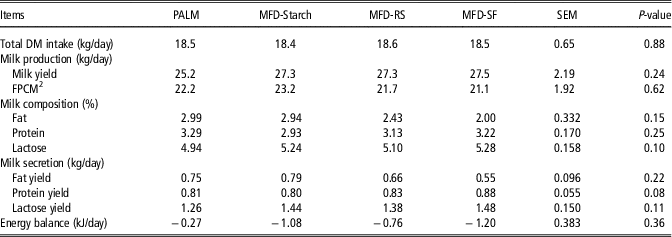
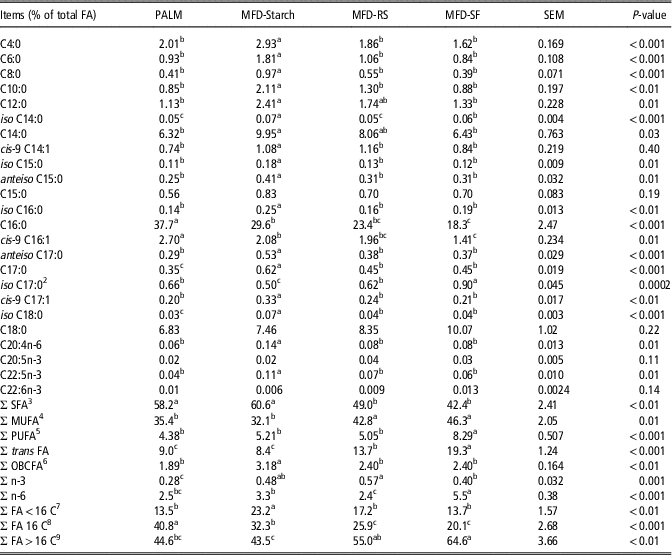
Total DMI did not differ between diets and nor did milk yield and composition or the energy balance of dairy cows (Table 2). The PALM and MFD-Starch diets induced higher milk SFA concentrations than the two other diets (+30%, P<0.01; Table 3). The MFD-Starch diet produced milk with the highest concentrations of individual short even-chain SFA (FA with atoms of carbon ⩽10; P<0.01). Milk from PALM had the highest milk C16:0 concentration, whereas that from MFD-SF had the lowest C16:0 one (P<0.001).
Milk performance in dairy cows fed the four experimental dietsFootnote 1

DM=dry matter.
1 PALM=diet with Ca salts of palm oil; MFD-Starch=diet inducing milk fat depression (MFD) rich in starch; MFD-RS=diet inducing MFD with extruded rapeseed; MFD-SF=diet inducing MFD with extruded sunflower seeds.
2 FPCM: fat- and protein-corrected milk=milk yield (kg/day)×[0.337+0.116×fat (%)+0.06×protein (%)] (Reference Gerber, Vellinga, Opio and SteinfeldGerber et al., 2011).
Concentrations of 4- to 24-carbon (not including 18:1, 18:2 or 18:3 isomers) fatty acids (FA) in milk fat in dairy cows fed the four experimental dietsFootnote 1

a,b,cValues within a row with different superscripts differ significantly at P<0.05.
1 PALM=diet with Ca salts of palm oil; MFD-Starch=diet inducing milk fat depression (MFD) rich in starch; MFD-RS=diet inducing MFD with extruded rapeseed; MFD-SF=diet inducing MFD with extruded sunflower seeds.
2 iso C17:0 coeluted with trans-9 C16:1.
3 SFA=saturated FA (odd FA+branched-chain FA+even FA; from 4 to 26 carbon atoms).
4 MUFA=monounsaturated FA from 10 to 22 carbon atoms.
5 PUFA=polyunsaturated FA from 18 to 26 carbon atoms.
6 OBCFA=odd- and branched-chain FA.
7 Sum of C4:0, C5:0, C6:0, C7:0, C8:0, C9:0, C10:0, cis-9 C10:1, C11:0, C12:0, cis-9 C12:1, C13:0, iso C13:0, anteiso C13:0, C14:0, cis-9 C14:1, trans-9 C14:1, iso C14:0, C15:0, iso C15:0, anteiso C15:0.
8 Sum of C16:0, iso C16:0, trans-6,7,8 C16:1, cis-6,8 C16:1+trans-11 C16:1, cis-9 C16:1, cis-11 C16:1.
9 Sum of FA with more than 16 carbons except iso C17:0 because of coelution with trans-9 C16:1.
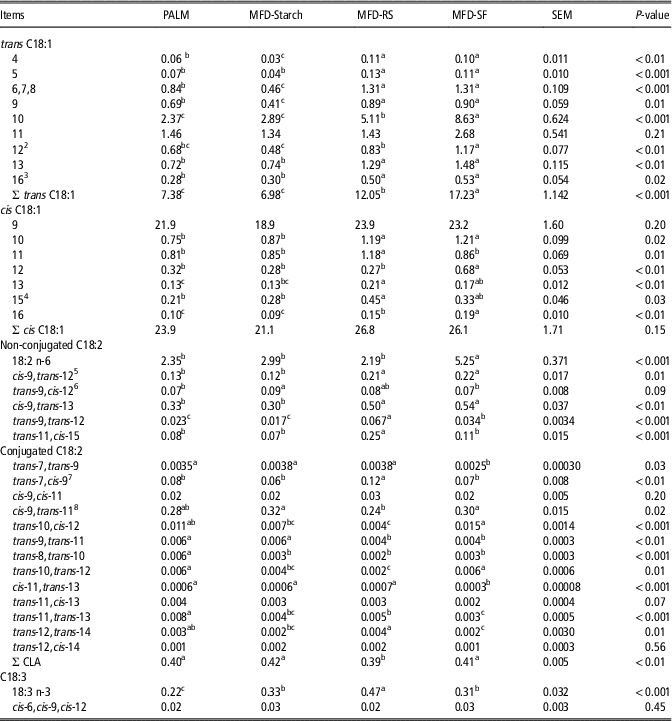
The MFD-Starch diet produced milk with the highest concentrations of several odd- and branched-chain FA (OBCFA), such as C5:0, C7:0, iso C15:0, anteiso C15:0, anteiso C17:0 and greater total OBCFA than other diets (P<0.05; Supplementary Table S1). Milk from both MFD-RS and MFD-SF had significantly higher concentrations of MUFA and several individual trans and cis MUFA (trans-4, trans-5, trans-6,7,8, trans-9, trans-10, trans-13, trans-16 and cis-10 C18:1, P<0.05; Table 4) than MFD-Starch and PALM diets. No significant differences were observed for trans-11 and cis-9 C18:1 between diets. Overall, we observed a higher milk concentration of total trans C18:1 with MFD-SF than with PALM and MFD-Starch, the value with MFD-RS being intermediate (P<0.001, Table 4).
Concentrations of C18:1, C18:2 and C18:3 isomers (% of total fatty acid (FA)) in milk fat in dairy cows fed the four experimental dietsFootnote 1

a,b,cValues within a row with different superscripts differ significantly at P<0.05.
1 PALM=diet with Ca salts of palm oil; MFD-Starch=diet inducing milk fat depression (MFD) rich in starch; MFD-RS=diet inducing MFD with extruded rapeseed; MFD-SF=diet inducing MFD with extruded sunflower seeds.
2 trans-12 C18:1 is coeluted with cis-6,7,8 C18:1.
3 trans-16 C18:1 is coeluted with cis-14 C18:1.
4 cis-15 C18:1 is coeluted with C19:0.
5 cis-9, trans-12 C18:2 is coeluted with cis-9,trans-14 C18:2.
6 trans-9,cis-12 C18:2 is coeluted with trans-10 C19:1.
7 trans-7,cis-9 is coeluted with trans-8,cis-10 CLA.
8 cis-9,trans-11 CLA coeluted with cis-10,trans-12 and trans-9,cis-11 CLA.
The milk C18:2n-6 concentration was higher for MFD-SF (5.3 g/100 g, P<0.05, Table 4) than for PALM and MFD-RS, the value with MFD-Starch being intermediate. The milk C18:3n-3 concentration was higher for MFD-RS (0.47/100 g) and lower for PALM (0.22 g/100 g, P<0.05) than for MFD-Starch and MFD-SF. The milk concentrations of trans-7,cis-9, cis-9,trans-11, trans-10,cis-12 and trans-10,trans-12 CLA were lower for MFD-RS than MFD-SF (P<0.05). In addition, milk cis-9,trans-11 CLA concentration was greater for MFD-starch than for PALM and trans-10,cis-12 CLA concentration in milk was greater with PALM than with MFD-RS. The milk trans-9,trans-11 CLA concentration was higher for PALM and MFD-Starch than for MFD-RS and MFD-SF. Overall, milk concentration of total CLA was lower for MFD-RS than for MFD-SF, PALM and MFD-Starch. Other C18:2 isomer concentrations (cis-9,trans-12 and cis-9,trans-13 C18:2) were greater with MFD-RS and MFD-SF than with PALM and MFD-Starch.
MFD-Starch diet induced the highest milk concentrations of FA<C16 (Table 3). Milk from MFD-SF had higher a concentration of PUFA than other diets and that from MFD-SF had a higher concentration of trans FA (Table 3) than PALM and MFD-starch, the value from MFD-RS being intermediate.
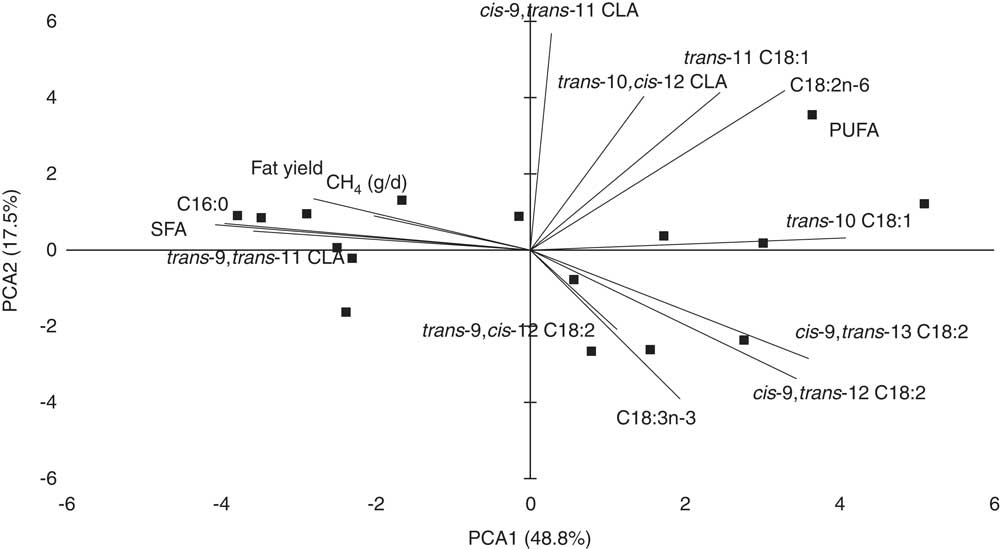
On the one hand, milk SFA, even SFA and C16:0 concentrations were positively correlated with milk fat content (r=0.62, 0.64 and 0.65, respectively, P<0.05; Supplementary Table S2 and Figure 1). On the other hand, several milk FA concentrations were negatively correlated (r>0.60; P<0.05) with milk fat content, such as trans-10 C18:1, cis-16 C18:1, iso C17:0, trans MUFA, cis-9,trans-13 C18:2 and PUFA (Supplementary Table S2 and Figure 1).
Results of a principal components analysis (PCA) based on the contribution of the different milk fatty acids (FA, % of total FA), milk fat yield (g/day) and methane (CH4) production (g/day) from dairy cows with the first (PCA1) and second (PCA2) dimensions, and the individual samples (closed squares) (n=16). SFA=saturated fatty acids; PUFA=Polyunsaturated fatty acids.

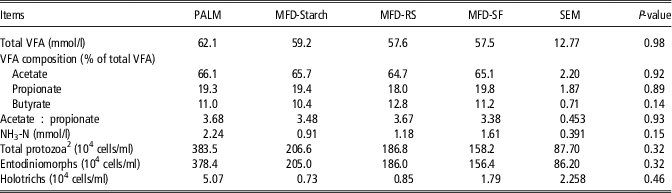
No differences in CH4 emissions were observed between diets, whatever the unit considered (g/day, g/kg DMI, % GE intake and g/kg milk; Table 5). Rumen VFA concentration and composition, N-NH3 concentration as well as protozoal counts were unaffected by diets (Table 6). Total tract apparent digestibility of nutrients (OM, CP, GE) was similar among diets, except for fibre (and more particularly for ADF) and starch. Digestibility of ADF was lower for MFD-Starch and PALM (−4.8% unit on average, P<0.05), and starch digestibility was lower for PALM (−1.3% unit on average, P<0.05) compared to the other diets (Supplementary Table S3).
Enteric methane emissions in dairy cows fed the four experimental dietsFootnote 1

CH4=methane.
1 PALM=diet with Ca salts of palm oil; MFD-Starch=diet inducing milk fat depression (MFD) rich in starch; MFD-RS=diet inducing MFD with extruded rapeseed; MFD-SF=diet inducing MFD with extruded sunflower seeds.
Rumen fermentation parameters and protozoa numbers in dairy cows fed the four experimental dietsFootnote 1

VFA=volatile fatty acids.
1 PALM=diet with Ca salts of palm oil; MFD-Starch=diet inducing milk fat depression (MFD) rich in starch; MFD-RS=diet inducing MFD with extruded rapeseed; MFD-SF=diet inducing MFD with extruded sunflower seeds.
2 For protozoa, statistical analyses have been done with log10 values.
Milk concentrations of C4:0 and trans-9,cis-12 C18:2 (+trans-10 C19:1) were correlated with daily CH4 emissions (g/day) (r=0.52, and −0.62, respectively, P<0.05; Supplementary Table S4 and Figure 1). We observed negative relationships between iso C17:0 (+trans-9 C16:1), cis-11 C18:1 and trans-9,cis-12 C18:2 (+trans-10 C19:1) and CH4 emissions (g/kg of DMI) (r=−0.50, −0.50 and −0.70, respectively). Milk concentration of C16:0 and CH4 emissions (g/kg of milk) were positively related (r=0.55) while negative relationships were observed with total odd-FA, iso C17:0 (+trans-9 C16:1), trans-9,cis-12 C18:2 (+trans-10 C19:1), C18:3n-3 and the total n-3 FA.
Discussion
Effect of milk fat depression-inducing diets on milk fat content and fatty acid composition
In dairy cows, MFD occurs with particular diets such as starch-rich diets supplemented or not with unsaturated lipids (Bauman and Griinari, Reference Bauman and Griinari2003). As expected, the three MFD-inducing diets (MFD-Starch, MFD-RS and MFD-SF) led to low milk fat content, below the French national average (3.93%; France Conseil Elevage (FCEL), 2013). Furthermore, milk fat content decreased with MFD-inducing diets in comparison to the pre-experimental milk fat content values (−26±9.7% on average for three diets), and more particularly with MFD-SF (−40%) and MFD-RS (−27%). In addition, the expected shift from trans-11 to trans-10 C18:1 concentrations in milk fat reported in the case of MFD in dairy cows (Bauman and Griinari, Reference Bauman and Griinari2003) was observed with the three MFD-inducing diets.
Concerning PALM, rich in SFA, we also observed lower milk fat content as compared to the pre-experimental value (−10%) as well as the shift from trans-11 to trans-10 C18:1 concentrations as observed with three MFD diets, which characterized the MFD situation. Rather, we expected a greater milk fat yield with PALM than with the MFD-inducing diets. Mosley et al. (Reference Mosley, Mosley, Hatch, Szasz, Corato, Zacharias, Howes and McGuire2007) reported that high-palmitic acid supplements increased the milk fat yield in dairy cows. The low milk fat content observed with PALM diet could be due to the strongest reduction in the sum of milk FA<16C, because the secretion of de novo synthesized FA is reduced in the case of MFD. The plausible explanation of the low milk fat content observed with the MFD-Starch may be related to a lower rumen pH because of a rapid fermentation of dietary starch (Sauvant et al., Reference Sauvant, Giger-Reverdin and Peyraud2018). The possible low ruminal pH with this type of diets could induce a shift from trans-11 to trans-10 C18:1 in milk fat (Zened et al., Reference Zened, Enjalbert, Nicot and Troegeler-Meynadier2013). In addition, the MFD observed with PALM and MFD-Starch diets could also be explained by the shift from trans-11 to trans-10 C18:1 in milk fat, or by the concentration of other RBH intermediates such as trans-10,cis-12 CLA. These FA with trans 10-double bonds are known to inhibit milk fat secretion (Shingfield et al., Reference Shingfield, Bernard, Leroux and Chilliard2010).
The milk FA profiles were different between MFD-RS and MFD-SF. The higher intake of cis-9 and cis-11 C18:1, and C18:3n-3 from cows fed MFD-RS in comparison to MFD-SF produced milk fat with greater concentrations of these FA. Furthermore, milk FA profile with MFD-RS was characterized by higher concentrations of several RBH intermediates of C18:3n-3 (trans-9,trans-12 and trans-11,cis-15 C18:2, trans-7,trans-9, trans-7,cis-9, cis-11,trans-13, trans-11,trans-13 and trans-12,trans-14 CLA), as reported by Shingfield et al. (Reference Shingfield, Bernard, Leroux and Chilliard2010) and Ferlay et al. (Reference Ferlay, Bernard, Meynadier and Malpuech-Brugère2017). In agreement with our results, Chilliard et al. (Reference Chilliard, Glasser, Ferlay, Bernard, Rouel and Doreau2007) also reported a greater milk concentration of trans-7,cis-9 CLA along with a high level of cis-9 C18:1 intake, and greater milk concentrations of trans-11,cis-15, trans-11,trans-13 and trans-12,trans-14 CLA with a higher level of 18:3n-3 intake.
Cows fed the MFD-SF diet had the greatest milk concentrations of C18:2n-6 and several RBH intermediates of the C18:2n-6 (trans-10 C18:1, trans-12 C18:1, cis-12 C18:1, cis-16 C18:1, cis-9,trans-11 CLA, trans-10,cis-12 CLA, and trans-10,trans-12 CLA), and total PUFA than MFD-RS. Our results are in line with those of Chilliard et al. (Reference Chilliard, Glasser, Ferlay, Bernard, Rouel and Doreau2007), who found greater concentrations of milk trans-10 C18:1, trans-12 C18:1 and trans-10,trans-12 CLA with dairy cows having a high C18:2n-6 intake. Loor et al. (Reference Loor, Ferlay, Ollier, Doreau and Chilliard2005) also reported similar results with dairy cows fed high-concentrate diets based on grass hay (forage : concentrate ratio 35 : 65) and supplemented with 5% of sunflower oil. Indeed, they observed greater milk concentrations of trans-10 C18:1 and C18:2n-6 when compared to the same high-concentrate diet supplemented with C18:3n-3 from linseed oil. Nevertheless, according to an indirect comparison from Glasser et al. (Reference Glasser, Ferlay, Doreau, Schmidely, Sauvant and Chilliard2008), no differences of milk cis-11 C18:1, C18:3n-3 and C18:2n-6 concentrations were observed with diets supplemented with either rapeseeds or sunflower seeds, whatever the nature of forage in the basal diet. The higher milk concentrations of trans FA and PUFA with MFD-SF than MFD-RS suggested a less complete RBH with the former diet.
The different milk FA profiles between MFD-RS and MFD-SF, and especially the greatest concentration of trans-10,cis-12 CLA, as well as the most pronounced shift from trans-11 to trans-10 C18:1 concentrations in milk observed with MFD-SF suggest that the diet supplemented with C18:2n-6 resulted in a more severe MFD than the diet supplemented with cis-9 C18:1 and C18:3n-3, such as the MFD-RS, as shown by He and Armentano (Reference He and Armentano2011). However, the increase in milk trans-10,cis-12 CLA concentration is not observed in all cases of MFD, as shown by Shingfield and Griinari (Reference Shingfield and Griinari2007). This fact could explain the low concentration of this FA in the milk of cows fed the MFD-RS diet, even though this diet led to MFD. The MFD-RS and MFD-SF diets probably modified RBH pathways differently, resulting in different milk FA composition and MFD severity.
Milk concentrations of total PUFA, cis-16 C18:1, trans-10 C18:1 and C18:2n-6 were negatively correlated with milk fat content in our study. This could also explain the low milk fat content observed with all diets, since they produced milk with a great concentration of these FA, and especially the MFD-SF, which showed the more severe MFD. Indeed, when compared to the average 3.93% milk fat content observed in France (FCEL, 2013), the MFD-SF induced the more severe reduction (−1.9%). In addition, we confirm the inhibitory effect of trans-10 C18:1 on milk fat content in cows fed diets supplemented with unsaturated FA (Bauman and Griinari, Reference Bauman and Griinari2003; Shingfield et al., Reference Shingfield, Bernard, Leroux and Chilliard2010), and also in dairy cows fed diets rich in starch. Surprisingly, we observed the same phenomenon with cows fed diets supplemented with SFA from Ca salts of palm oil, but this needs further investigation.
We could also hypothesize that the main forage of the diet, especially the maize silage, was responsible for the low milk fat contents and the MFD observed for all the diets. Indeed, the particle size of the maize silage was fine with more than 30% of particles <0.4 mm (data not shown). In fact, Sauvant and Peyraud (Reference Sauvant and Peyraud2010) reported that feeding diets containing forages for which particle size was <3 to 4 mm was likely to decrease milk fat content.
Milk FA profile from cows fed MFD-RS presented the highest nutritional quality for human consumption because of the lowest C16:0 concentration and greatest n-3 FA and lowest n-6 FA concentrations, with intermediate trans FA concentration. Indeed, it has been shown that SFA consumption in humans increases the risk of cardiovascular diseases (Ferlay et al., Reference Ferlay, Bernard, Meynadier and Malpuech-Brugère2017), whereas n-3 FA consumption has positive health outcomes in the areas of cardiovascular diseases, platelet aggregation, hypertension, hyperlipidaemia, cancer, depression and inflammation (McManus et al., Reference McManus, Merga and Newton2011). Regarding the human consumption of some trans FA of ruminant origin, such as trans-11 C18:1, the negative effect described in the past decade is nowadays questioned since ruminant trans FA intake is not correlated with cardiovascular diseases and may even have beneficial effect in human health (Ganguly and Pierce, Reference Ganguly and Pierce2015; Ferlay et al., Reference Ferlay, Bernard, Meynadier and Malpuech-Brugère2017).
Effect of milk fat depression-inducing diets on methanogenesis
The four diets led to similar CH4 emissions whatever the unit considered (on average 356 (± 36.0) g/day, 19.2 (±1.61) kg/DMI, 5.6 (±0.47) % gross energy intake (GEI) and 13.5 (±1.45) g/kg milk). Our results are in agreement with data (mean and standard deviation) reported in a recent meta-analysis (Niu et al., Reference Niu, Kebreab, Hristov, Oh, Arndt, Bannink, Bayat, Brito, Boland, Casper, Crompton, Dijkstra, Eugene, Garnsworthy, Haque, Hellwing, Huhtanen, Kreuzer, Kuhla, Lund, Madsen, Martin, McClelland, McGee, Moate, Muetzel, Munoz, O’Kiely, Peiren, Reynolds, Schwarm, Shingfield, Storlien, Weisbjerg, Yanez-Ruiz and Yu2018), using a wide range of EU diets and fed to dairy cows with similar DMI and milk yield (on average 18.5 kg and 26.4 kg/day, respectively). Indeed, these authors reported an average CH4 emission of 392 (±88.8) g/day, 21.4 (±3.39) g/kg DMI and 6.4 (±1.04) % of GEI.
To the best of our knowledge, no studies have directly compared starch and lipids as sources of energy in methanogenesis in dairy cows. Our study is the first to report that maize silage-based diets supplemented with starch or lipids have the same CH4 emissions whatever the unit. This is consistent with the absence of variation between diets in rumen fermentation parameters (VFA concentration and composition) and protozoal population, which is known to be a high H2-producer (Williams and Coleman, Reference Williams and Coleman1992).
Moreover, we did not observe any effect of the nature of the lipids with maize silage-based diets (total dietary ether extract content ranging from 3.3% to 7.4%) on methanogenesis, which is in agreement with the meta-analysis of Grainger and Beauchemin (Reference Grainger and Beauchemin2011), who used a large variety of basal diets and total dietary ether extract content ranging from 1.0% to 8.0%. These authors reported no effect of rapeseed-, sunflower- or palm-supplemented diets on CH4 emissions in dairy cows. In contrast, Martin et al. (Reference Martin, Morgavi and Doreau2010) have shown a greater negative effect of unsaturated than SFA supplementation on CH4 emissions, with lipid additions ranging from 1% to 10% of diet DM (3% in our study). These authors explained this difference by a specific and negative effect of unsaturated FA on the microbiota, especially protozoa, which are strongly positively correlated with CH4 yield (Guyader et al., Reference Guyader, Eugène, Nozière, Morgavi, Doreau and Martin2014). In our study, even though the milk FA profile differed between diets, the energy source (starch v. lipids) did not influence CH4 emissions whatever the unit, which is in line with the similar rumen fermentation parameters observed with all diets. This is of interest and raises the question about the accuracy of models based on milk FA profile in predicting CH4 emissions.
Several authors have shown relationships between CH4 emissions and individual milk FA concentrations using various dietary strategies in either individual experiments (Chilliard et al., Reference Chilliard, Martin, Rouel and Doreau2009) or meta-analysis (Dijkstra et al., Reference Dijkstra, Van Zijderveld, Apajalahti, Bannink, Gerrits, Newbold, Perdok and Berends2011; Williams et al., Reference Williams, Moate, Deighton, Hannah and Wales2014). A positive relationship between C16:0 and CH4 emissions (g/kg milk) was observed in our study as well as by Chilliard et al. (Reference Chilliard, Martin, Rouel and Doreau2009) for CH4 emissions (g/day) measured from dairy cows fed maize silage-based diets supplemented or not with lipids from linseed. We also reported a negative relationship between CH4 emissions (g/kg DMI) and cis-11 C18:1, which was highlighted by Dijkstra et al. (Reference Dijkstra, Van Zijderveld, Apajalahti, Bannink, Gerrits, Newbold, Perdok and Berends2011) in a meta-analysis using different CH4 emissions mitigation strategies (linseed, lauric acid, myristic acid, mixture of caprylic and capric acids, yucca plant powder, diallyldisulphide or calcium fumarate) in dairy cows fed a mixture of grass and maize silage. However, we did not observe the same positive relationships between CH4 emissions (g/day) and C8:0 and total C18 FA reported by Williams et al. (Reference Williams, Moate, Deighton, Hannah and Wales2014). This discrepancy between our study and that of Williams et al. (Reference Williams, Moate, Deighton, Hannah and Wales2014) is probably due to the difference in dietary conditions. In Williams et al. (Reference Williams, Moate, Deighton, Hannah and Wales2014) cows were fed pasture (predominantly perennial ryegrass) or lucerne hay-based diets supplemented with different ingredients (linseed, rapeseed, tannin, DHA, grape marc, wheat, almond hulls or citrus hulls). We also observed a negative relationship between trans-9,cis-12 C18:2 and CH4 emissions whatever the unit, which was not reported in the previously quoted studies.
Conclusions
The four maize silage-based diets rich in starch or supplemented with Ca salts of palm oil or rapeseed or sunflower seeds induced MFD in dairy cows leading to low milk fat contents and a shift of trans-11 C18:1 to trans-10 C18:1 in milk fat, but did not change milk production, enteric CH4 emissions or other digestive processes. Neither the energy (starch v. lipids) nor the lipid sources modified methanogenesis, but the milk FA profiles differed greatly among diets. Furthermore, we noted positive or negative correlations between some individual milk FA and CH4 emissions.
Acknowledgements
This experiment is part of a collaborative project led by INRA and funded by 11 institutes and private companies: Adisseo France SAS (Antony, France), Agrial (Caen, France), APIS-GENE (Paris, France), Deltavit (Janzé, France), DSM Nutritional Products AG (Kaiseraugst, Switzerland), Institut de l’Elevage (Paris, France), Lallemand (Blagnac, France), Moy Park Beef Orléans (Fleury-les-Aubrais, France), Neovia (Saint-Nolff, France), Techna France Nutrition (Couëron, France) and Valorex (Combourtillé, France). Animals were managed in the experimental facilities of the Experimental Unit Herbipôle (INRA, UE1414 Herbipôle, Saint-Genès-Champanelle, France). The authors thank L. Mouly, V. Tate, S. Rudel, and D. Roux for animal care and feeding, and E. Tixier, D. Bany, M. Tourret, L. Genestoux, C. Lascoux and D. Graviou for laboratory analyses.
Declaration of interest
No conflicts of interest to declare.
Ethics statement
Procedures involving animals were performed in accordance with the French Ministry of Agriculture guidelines for animal research and with the applicable European Union guidelines and regulations on animal experiments (Directive 2010/63). The Auvergne regional ethics committee on animal experimentation approved the experiment (reference number 821-2015060811534198).
Software and data repository resources
None of the data were deposited in an official repository.
Supplementary material
To view supplementary material for this article, please visit https://doi.org/10.1017/S1751731118003154