Introduction
The introduction of pension ‘auto-enrolment’ in the UK in 2012 requires employers to automatically enrol all eligible employees into private pension arrangements (TPR, 2011). This means that thousands of private sector employers and millions of employees are beginning to make minimum contributions to pension arrangements for the first time (TPR, 2013a). Evidence suggests these arrangements will be mainly defined contribution (DC) (where eventual benefits depend on investment returns and annuity rates at retirement) and often contract-based, established by large financial institutions (ONS, 2012). In the absence of any employee action, the minimum contributions will automatically be invested in a ‘default’ fund, the performance of which will determine the level of pension payments to the employee.
This approach attempts to take advantage of the inertia many individuals exhibit in relation to pension provision (Choi, et al., Reference Choi, Laibson, Madrian and Metric2001; Selnow, Reference Selnow, Mitchell and Utkus2004; Thaler and Sunstein, Reference Thaler and Sunstein2008) since once individuals start saving, that same inertia will mean they continue saving. It has been argued that changing behaviours in this way can subsequently lead to changing attitudes towards saving (Selnow, Reference Selnow, Mitchell and Utkus2004). It also follows similar auto-enrolment reforms in New Zealand (PPI, 2005) and less systematic, but increasingly pervasive, auto-enrolment developments in the USA (Hewitt Associates, 2009; Aon Hewitt, Reference Aon2011).
Given the declared limits of state provision in the UK, and the perceived inadequacy of pensions saving, the policy intention is to increase private pension provision and reduce reliance on state provision (see DWP, 2006 and 2010; Scottish Widows, Reference Scottish2011). These developments reflect similar concerns and reforms across Europe (European Commission, 2012). The position in the UK is also illustrative of the demise of defined benefit (DB) pension provisionFootnote 1 across Anglophone countries (Ashcroft, Reference Ashcroft2009), as well as the increasing international preponderance of DC provision (OECD, 2013; TPR, 2013b).
Importantly, developments in the UK highlight several broader trends. The first concerns the challenges facing employer/employee relationships when employers no longer regard DB pension provision as a useful human relations (HR) tool (Hudson, Reference Hudson2008). The financial costs to businesses of the DB ‘promise’, particularly in the light of the financial crisis, have become all too apparent (Bridgen and Meyer, Reference Bridgen and Meyer2005; Hudson, Reference Hudson2008; Munnell et al., Reference Munnell, Aubry and Muldoon2008). DC provision has enabled a reduction in employer financial contributions and erosion of employer paternalism, though not without causing some strain in the employment relationship (see Byrne et al., Reference Byrne, Harrison and Blake2007; Employer Task Force on Pensions, 2004). Evidence from Gough and Arkani (Reference Gough and Arkani2011) suggests that employers’ connection with their employees may be shifting from being more ‘relational’ to becoming more ‘transactional’ – i.e., a more limited ‘monetary transaction’ basis; and the shift from DB to DC is reflective of this.
Secondly, the shift from DB to DC represents a ‘risk shift’ (Hacker, Reference Hacker2008). Individuals now shoulder the risks and uncertainties associated with longevity, investments and annuity rates, all affecting the level of benefits eventually provided in retirement under a DC arrangement. In turn, it is argued that there has been a ‘financial colonisation’ of everyday life (Langley, Reference Langley2008; Martin, Reference Martin2002). The risks and uncertainties faced by individuals are ‘re-presented’ as a call to action, to achieve positive (pension) outcomes (see Giddens, Reference Giddens1998). This re-making of the individual as a ‘retirement investor’ (Langley and Leaver, Reference Langley and Leaver2012) or ‘responsible saver citizen’ (Ring, Reference Ring2010) infuses UK government policies that attempt to ‘empower’ individuals (see, for example, DWP, 2003 and 2004), or, as the government's own Behavioural Insights Team puts it, to ‘find ways of encouraging, supporting and enabling people to make better choices for themselves’ (BIT, 2012).
Thirdly, these developments highlight the influence of behavioural economics (Elliott et al., Reference Elliott, Dolan, Vlaev, Adriaenssens and Metcalfe2011; Thaler and Sunstein, Reference Thaler and Sunstein2008), which suggests it is possible to create the appropriate ‘choice architecture’ within which individuals can be ‘nudged’ into making the ‘right’, ‘rational’ decisions. Far from empowerment, this strand of policy eschews individuals necessarily having to make any saving decisions. Instead, what becomes key is the pensions apparatus created by the expertise of others, whether that be employers or the financial experts upon whom the employers may rely to fulfil their auto-enrolment requirements. Reliance on these ‘embedded’ pension mechanisms takes on great significance in the context of low levels of literacy and numeracy and low levels of confidence in financial abilities (see Clery et al., Reference Clery, Mckay, Phillips and Robinson2007, Reference Clery, Humphrey and Bourne2010; House of Commons Public Accounts Committee, 2009), and evidence suggests that many individuals are often confused in relation to pensions and their own pension provision (Wicks and Horack, Reference Wicks and Horack2009; Macleod et al., Reference MacLeod, Fitzpatrick, Hamlyn, Jones, Kinver and Page2012).
In these circumstances, where individuals may not be in a position to make a calculated decision based on an understanding of all of the relevant facts but, at the same time, are generally not irrational, making leaps of ‘blind faith’, then trust can be a key ‘in-between’ strategy to manage complex and uncertain futures (Zinn, Reference Zinn2008 and Reference Zinn2011). In the context of auto-enrolment, this is likely to include trust in the scheme chosen by their employer and the competency of the scheme provider (see Ring, Reference Ring2012).
In this article, we therefore begin by examining the importance of trust in the employment relationship when there is pension confusion. The existence of, and reasons for, pension confusion are also discussed. We then utilise data from the Scottish Social Attitudes Data, which, in its 2005 survey, asked respondents specific questions regarding their pension provision (see Laurie and Wright, Reference Laurie and Wright2000, for an introduction to this data set). We start by empirically investigating whether pension confusion can be understood through modelling variables which are designed to control for sources of knowledge deficiency about the nature of pension provision. This analysis utilises a probit model; specifically, a specialised regression methodology which is designed to analyse binary response variables such as our distinction between those who are confused about pensions and those who are not. However, we then turn to a more sophisticated empirical approach which tests the robustness of this basic probit approach. After questioning the extent to which simple knowledge problems can explain why there appears to be pension confusion, the emphasis of this analysis shifts to problems created through genuine uncertainty about pension outcomes. This provides a more complete understanding of pension confusion in Scotland and a means to assess the significance of issues of uncertainty and trust, particularly in the context of current UK pension reforms. We begin by looking at pension confusion and knowledge.
Pension confusion and knowledge
Research suggests that there is significant confusion amongst UK citizens concerning pensions. For example, in a study by McCauley and Sandbrook (Reference McCauley and Sandbrook2006) two thirds of those surveyed agreed that ‘I find all pensions confusing’ and, more recently, 63 per cent of respondents in a Department of Work and Pensions (DWP) National Attitudes survey reported ‘sometimes pensions seem so complicated that I cannot really understand the best thing to do’ (Macleod et al., Reference MacLeod, Fitzpatrick, Hamlyn, Jones, Kinver and Page2012: 59) (see also Dobson and Horsefield, Reference Dobson and Horsfield2009; Wicks and Horack, Reference Wicks and Horack2009).
In the UK, citizens regard pensions as the most complex of all financial products (see Pensions Commission, 2004; FSCP, 2006; MacLeod et al., Reference MacLeod, Fitzpatrick, Hamlyn, Jones, Kinver and Page2012). To save for retirement is to be faced with an array of complexities and risks which many individuals find difficult to navigate, increasing their vulnerability to risk and jeopardising their security in retirement (Clark et al., Reference Clark, Strauss and Knox-Hayes2012; Ring, Reference Ring2010). This complexity is felt particularly acutely by women and those with a lower educational attainment (FSA, 2004).
Another explanation for confusion relates to ‘pensions literacy’. Clery et al. (Reference Clery, Mckay, Phillips and Robinson2007) found that only 5 per cent of respondents in a sample of nearly 2,000 adults believed they had a ‘good’ knowledge of pensions and only 23 per cent agreed that they knew enough to decide with confidence how to save for retirement; findings confirmed in later research (Clery et al., Reference Clery, Humphrey and Bourne2010). They also found age was consistently a factor in pension knowledge – the younger the respondent, the less awareness. Age was, in turn, strongly associated with a number of other factors, such as household income, economic activity and pension savings. Housing tenure was also found to be a strong predictor of levels of pension knowledge, with owner occupiers scoring higher than social tenants.
That said, it is possible to take a more nuanced view of what constitutes relevant knowledge and understanding for pension saving. Atkinson et al. (Reference Atkinson, McKay, Kempson and Collard2006) found that planning ahead, choosing products and staying informed were all important elements, and that pension provision was most problematic for those who were not particularly good at planning ahead. Older people, those educated to degree level, and those actively involved in purchasing financial products, appeared more capable of planning ahead.
As regards competence in choosing products, the most significant factor was experience, and as a result the middle-aged and ‘wealthy achievers’ tended to be better at choosing appropriate financial products. Research elsewhere also supports the importance of experience in making financial judgements in circumstances of risk and uncertainty (Clark et al., Reference Clark, Caerlewy-Smith and Marshall2007). In relation to keeping informed about financial issues, Atkinson et al. note the following regarding socio-demographic factors:
There is a clear relationship between keeping informed and income, qualifications, and age. We found that women scored less than men on average, and local-authority tenants scored considerably lower than home owners. (Atkinson et al., Reference Atkinson, McKay, Kempson and Collard2006: 133)
Pensions and trust
The issue of trust has gained increasing prominence in recent years, and pervades all sectors of society, from business to social work, policing to the media, education to sport (Seldon, Reference Seldon2009; CII, 2010). As already suggested, individuals are generally neither completely rational, in the sense of making a calculated decision based on a full understanding of all relevant facts; nor irrational, simply basing their decisions on blind faith (see Clark et al., Reference Clark, Strauss and Knox-Hayes2012). Zinn distinguishes ‘a third group of strategies which individuals use to manage uncertainty’ within which trust sits (Zinn, Reference Zinn2008: 442).
Research suggest that individuals are less likely to have confidence in employers in general than they are in the government or financial companies (Clery et al., Reference Clery, Mckay, Phillips and Robinson2007 and Reference Clery, Humphrey and Bourne2010). This is not surprising given the en masse shift of employers from DB to DC provision, where employer contributions are significantly below their level in DB schemes (see both ACA, 2009a, 2009b). Interestingly, it has been reported that individuals are likely to have more confidence or trust in their own employer to provide pensions than the government or financial companies (see Gunawardena and O’Neill, Reference Gunawardena and O’Neill2008; Clery et al., Reference Clery, Humphrey and Bourne2010; FSRF, 2010; NAPF, 2010). This suggests that interpersonal relationships developed in the employer/employee context may enhance the potential to place trust in relation to pension provision (Gunawardena and O’Neill, Reference Gunawardena and O’Neill2008). However, views about employers in general may indicate employers can also be regarded as part of the broader pension framework, about which there appears to remain significant mistrust (WRIC, 2011). For example, research has indicated that up to 40 per cent of consumers do not trust those companies providing savings and investments (Mintel International Group, 2005; Kelly, Reference Kelly2007) and the 2012 Edelman Trust Barometer put banks and financial services as the least trusted industries (Edelman, 2012).
In summary, it is argued that, in the face of pension confusion, the relationship of trust between employers and employees is likely to be important in determining the level of success of auto-enrolment. In order to explore this issue, we look at the characteristics of those who express pension confusion which, in turn, may have implications both for the extent to which they are able to act upon the impetus provided by auto-enrolment to become ‘financial subjects’ (Langley and Leaver, Reference Langley and Leaver2012; Selnow, Reference Selnow, Mitchell and Utkus2004) and to place trust in their employer and/or pension provider for any decision they may make regarding schemes chosen by that employer for the purposes of auto-enrolment.
Data and method
The study utilises the Scottish Social Attitudes (SSA) dataset for 2005 (SCSR, 2005), providing us with a sample of 1,363 non-retired respondents. Scotland, with a population of 5.2 million, and a workforce of 2.7 million creating a total Gross Value Added of £102.5 billion, provides an interesting case study and it can be argued may be comparable with other regions within the United Kingdom
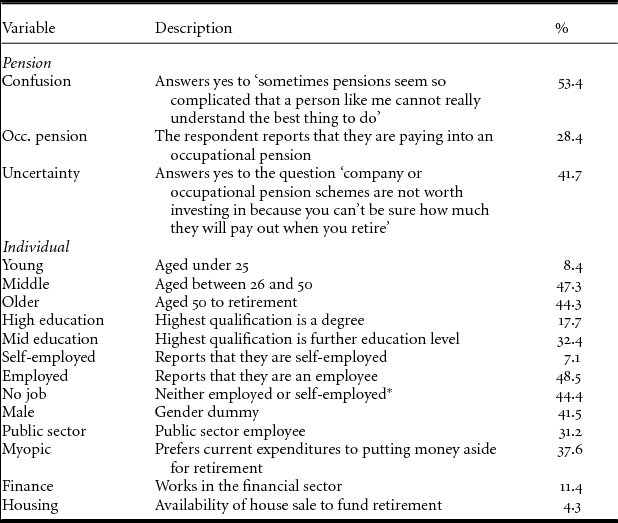
Table 1 provides descriptive statistics and definitions for all variables that are used in our study – which include our three key pension variables. First, we have information concerning the respondent's knowledge and awareness of pensions. This is a dummy variable where the respondent is deemed to show pension confusion if he/she agrees with the remark ‘sometimes pensions seem so complicated that a person like me cannot really understand the best thing to do’. Second, we have objective information over the pension experiences of the respondent. Thus, we can distinguish between those that are currently paying into an occupational pension and those that are not. Third, we have information over the perceived reliability of these schemes. We therefore also construct a dummy variable where those reporting on pension reliability support the remark ‘company or occupational pension schemes are not worth investing in because you can't be sure how much they will pay out when you retire’. This becomes a ‘pension uncertainty’ dummy variable.
Descriptive statistics of the main variables used to model confusion

Note: *This figure may seem relatively high but includes numerous groupings: in full-time education; on government training programmes; waiting to take up paid work already accepted; unemployed and registered at a benefit office; unemployed, not registered, but actively looking for a job (of at least 10 hours a week); unemployed, wanting a job (of at least 10 hours per week) but not actively looking for a job; permanently sick or disabled; and looking after the home.
Our investigation into pension knowledge is split into two parts.
Probit analysis into pension confusion
This part of our empirical analysis involves adopting a probit approach that is designed to estimate the probability that an individual reports that he/she finds pensions difficult to understand. As described in Table 1, our dependent variable is therefore the dummy variable ‘confused’. As described below, we include numerous variables to control for individual and family characteristics of the respondents. A positive (negative) coefficient indicates that an individual with that characteristic is relatively more (less) likely to report that they are confused. In addition, as an estimated coefficient increases, the contribution of that particular attribute to the incidence of confusion also rises.
The focus of the inclusion of the independent variables in our model is on finding mechanisms to control for differences in an individual's pension knowledge levels. The use of education and age is supported by the research discussed in our review of the literature. We also include gender (given that pay inequalities and periods out of the labour market due to family demands may impact on pension experience) and a myopia proxy (defined as preferring current expenditure to investing in retirement). Three occupational effects are also included. First, given the perceived greater generosity of public sector pensions, we use a dummy variable to distinguish between private and public sector employment. Second, as the self-employed may be more likely to need to actively search for pension provision (as opposed to this being provided by an employer), and gain knowledge as a result, we also control for self-employment. Third, we consider the impact of sectoral knowledge through the inclusion of a dummy for those working in the financial sector.
How individuals both attain and utilise knowledge has been rigorously analysed in the literature and it would be intuitive to infer that those working in financial services may well have an advantage when dealing with pensions (see Baumard, Reference Baumard1999; Nonaka and Takeuchi, Reference Nonaka and Takeuchi1995). This may take the form of both explicit and tacit knowledge formation. Poelmans et al. (Reference Poelmans, Stepanova, Masuda, Korabik, Lero and Whitehead2008) discuss the notion of possible positive spill-over effects from work to family, and, it could be argued, knowledge formed in financial services would have a positive effect on an individual's understanding of pensions. The relevance of local environment to financial planning and decision-making may also be important in this regard (see Clark et al., Reference Clark, Caerlewy-Smith and Marshall2007, Reference Clark, Strauss and Knox-Hayes2012).
Joint analysis into pension confusion and pension uncertainty
In the second part of our approach, we consider how perceived uncertainty about occupational pensions may impact on pension confusion. We therefore consider whether, rather than reflecting knowledge deficiencies or lack of ability, confusion reflects genuine uncertainty over the capacity of current pension arrangements to meet retirement needs. That is, when responding to the question ‘sometimes pensions seem so complicated that a person like me cannot really understand the best thing to do’, responses may not suggest confusion as a result of an (in)ability to understand pensions, but may actually indicate an individual's uncertainty about the potential economic outcomes of decisions concerning their financial future in ten, twenty or thirty years’ time. In other words, given the relevance of (ontological) security in retirement (Ring, Reference Ring2005), it may be better to recognise expressions of confusion as acknowledgements of the inherent risks and uncertainty in saving for retirement rather than as a signifier of (lack of) financial education or literacy. To capture this uncertainty effect, we model the dependent variable as respondents’ answer to the question ‘company or occupational pension schemes are not worth investing in because you can't be sure how much they will pay out when you retire’.
We consider whether these two outcomes – pension confusion and pension uncertainty – are perceptions that are formed together. In the econometric literature, this can be tested using what is called a ‘recursive bivariate probit’ approach, first formulated by Maddala (Reference Maddala1983) and further adapted by Greene (Reference Greene2003). We therefore jointly model the two binary dependent variables – pension confusion and pension uncertainty – using a recursive approach which includes a vector of controls for both variables. This enables us to distinguish between the two variables and provide a more accurate interpretation of how individual variables impact upon pension confusion.
As a result we adopt the following format:
 \begin{equation*}
\begin{array}{l}
y^* _C \; = \;x'_1 \beta _1 \; + y_U \gamma + \varepsilon _1,\quad y_C \; = \;1{\rm if}\;\; y^* _C > 0,0\;{\rm otherwise} \\
y^* _U \; = \;x'_2 \beta _2 \; + \varepsilon _{\rm } ,\qquad y_U \; = \;1\;{\rm if}\;\; y^* _U > 0,0\;{\rm otherwise} \\
\end{array}
\end{equation*}
where, as described in Table 1, yC captures pension confusion and yU refers to perceived pension uncertainty. This allows us to gather results on the combined effects of confusion and uncertainty.
By including yU in our first equation, we have variables impacting directly and indirectly on pension confusion. As has been discussed, analysis of these direct and indirect effects can enable a more complete understanding of how perceptions are formed. We could, for example, have an occupational dummy only marginally impacting directly on pension confusion. However, the indirect effect – through the impact on perceived pension uncertainty – could be large. Moreover, direct and indirect effects may also have a different sign. Given the overall effect of the variable is determined by the magnitudes of these conflicting effects, a single equation for pension confusion may lead to overestimation or underestimation of effects. Our joint analysis into pension confusion and pension uncertainty allows us to disaggregate our simple probit approach providing more detailed results. This in turn will help inform the discussion in a more meaningful way – providing policy makers with more information on which to base future decisions. Importantly, it will affect the interpretation of the results and any implication they may have on policy decisions.
This analysis should be seen as a continuation of our initial probit results. We therefore continue with the same control variables. We do, however, include a ‘housing’ measure. This is a dummy variable determined by whether the respondent expects a house sale to be the main means to pay for things in their retirement. Research suggests that those who have property at the core of their retirement planning do so because of lack of investment experience or limited planning options (Clark et al., Reference Clark, Strauss and Knox-Hayes2012). We therefore test to see whether this approach to retirement planning may also, at least partly, be explained by uncertainty about the ability of pension schemes to deliver economic security in retirement.
Results
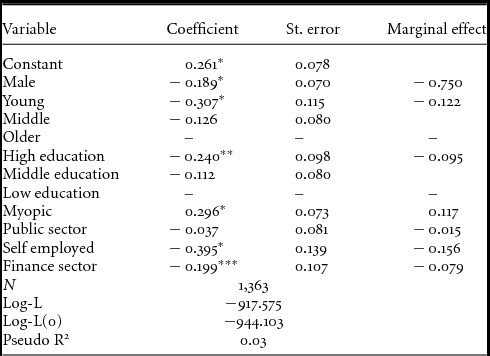
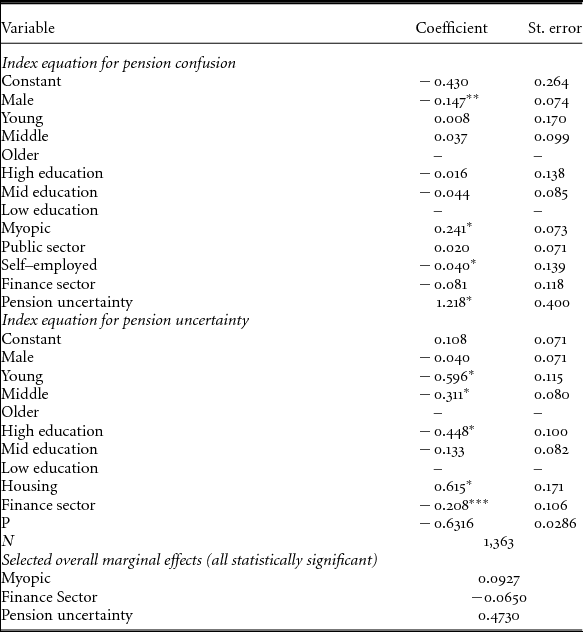
We report utilising a module included in the 2005 Scottish Social Attitudes dataset regarding pensions and the characteristics of those individuals in Scotland that find pensions confusing and/or are uncertain about pension provision. We begin by utilising a probit approach to model ‘confusion’ as the dependent variable and include a number of explanatory variables as outlined in the previous section. We then consider the more sophisticated approach, modelling more pension uncertainty and pension confusion, to gain deeper insight into the nature of the confusion. The analysis starts with our simple probit results, as provided in Table 2, to confirm if we can explain the determinants of pension confusion. Whilst many of our controls do aid understanding of the confusion, the pseudo R2 is relatively low. Nevertheless, our estimates do successfully predict 57.4 per cent of responses. The results from the joint investigation into pension confusion and pension uncertainty are given in Table 3. This offers a deeper understanding of pension confusion in Scotland – one in which pension confusion is determined by myopia and uncertainty of pension outcomes.
Probit results for pension confusion
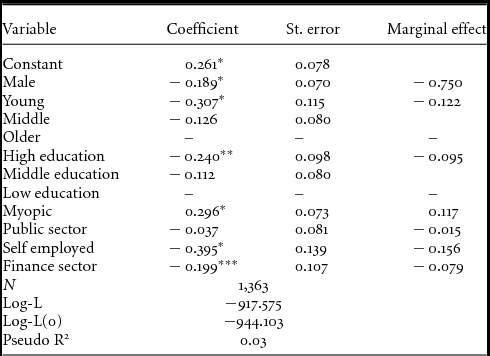
Notes: *p < 0.01, **p < 0.05, ***p < 0.1; dependent variable = Confused; (–) are reference categories.
Joint probit results
Notes: *p < 0.01, **p < 0.05, ***p < 0.1; dependent variables = confused & uncertainty; (–) are reference categories.
Probit analysis
Our initial probit estimates confirm the importance of education, with university graduates significantly less likely to find pensions more difficult to understand, and more likely to answer negatively to the question ‘sometimes pensions seem so complicated that a person like me cannot really understand the best thing to do’. This result is consistent with the literature regarding the wider UK (see FSA, 2004; Clery et al., Reference Clery, Mckay, Phillips and Robinson2007, Reference Clery, Mckay, Phillips and Robinson2010). Our other variables also provide interesting results. For example, with a negative coefficient for our male dummy, we find that women living in Scotland are much more likely to report pension confusion. This result is consistent with UK evidence reported by Clery et al. (Reference Clery, Mckay, Phillips and Robinson2007) and Atkinson et al. (Reference Atkinson, McKay, Kempson and Collard2006) and could be explained by the disparities in pay and differences in career interruptions. In other words, for those with greater assets, the salience of providing for retirement, and therefore the need to have some knowledge and understanding of UK pensions, is greater (Clark et al., Reference Clark, Knox-Hayes and Strauss2009). However, given the limitations of the dataset with regards to variable availability, we are not able to confirm the validity of this hypothesis with any further robustness.
We can, however, confirm the existence of non-linear age effects. Whilst there is no significant difference between the middle- and old-aged ranges in Scotland, those in Scotland aged under 25 years are found to be significantly less likely to report pension confusion. Rather than being evidence of pension knowledge, this finding may be consistent with the premise that the longer the time horizon before retirement, the more likely that pensions (and therefore pension confusion) are not being contemplated by the respondent, and therefore considered unproblematic. Once again, this is supported by the work of Clery et al. (Reference Clery, Mckay, Phillips and Robinson2007), who found that the young were less aware of issues surrounding pensions, and the FSA (2004), who found that the young undertake little long-term planning. It is also in line with past research undertaken by Sykes et al. (Reference Sykes, Hedges and Kelly2008), that younger individuals lack the motivation to engage with pension provision. Nevertheless, this finding is worthy of further investigation.
More generally, we also find that our myopia proxy – defined as someone preferring current consumption to investing for the future – is significant and positive in Scotland, and is consistent with the literature in relation to the UK as a whole. It is therefore consistent with our earlier hypothesis that, ceteris paribus, forward-thinking attitudes do lead to a greater awareness of pensions.
The results are mixed for our occupational variables. We find no difference in levels of confusion between those with public and private sector pensions, which may simply indicate the complexity of both regimes of pension provision. Our self-employment variable indicates that the self-employed are significantly less likely to be confused by pensions, consistent with the belief that many self-employed have to plan ahead financially in all aspect of their business, including for pension issues (even if the result is to make no provision and invest more in their business).
Our financial sector variable is negative and only marginally insignificant at the 5 per cent level, suggesting weak evidence that financial services workers are more able to understand pensions. This may be a function of the skill sets generally required for this occupation. Alternatively, we may be reporting a result which is consistent with heterogeneity in the diffusion of pension knowledge, or of the importance of social environment (Clark et al., Reference Clark, Strauss and Knox-Hayes2012).
The jointly modelled approach
We now move on to the joint analysis of pension confusion and pension uncertainty provided in Table 3. Before discussing our estimates, it should be noted that ρ, the correlation between the error terms in the confusion and uncertainty equations, is found to be non-zero. This is a direct test of endogeneity and suggests that any basic probit approach will show bias and overemphasise the importance of some variables. Importantly, the results from our joint modelling of confusion and uncertainty go some way to correct for this effect. Overall our results indicate a number of key findings. First, pension uncertainty is found to be a significant and a highly substantive determinant of pension confusion. Rather than reflecting overall knowledge deficiencies, this arguably provides evidence that respondents’ perceived confusion is significantly affected by genuine concerns over the reliability of occupational pension schemes – in other words, pension uncertainty.
Our second important result is that a number of the variables, which directly impact on perceived pension confusion, in the first probit equation are found to have statistically insignificant effects when pension uncertainty is included. This indicates that indirect effects (in this case pension uncertainty) may be dominating perceptions of pension confusion. For example, looking at the top half of Table 3 reveals that there are no significant direct effects on pension confusion of age, education, self employment or financial services employment. Table 3 clearly shows that the results are being dominated by the independent variable ‘pension uncertainty’, which is both positive and significant.
By jointly modelling pension confusion and pension uncertainty, our analysis allows us to analyse the magnitude and significance of the variables on the pension uncertainty variable (in this instance as a dependent variable). As one can see in the bottom half of Table 3, the pension uncertainty variable is affected by age, education, housing and the financial services sector employment variable. The young and middle aged respondents show a negative and significant result to the question ‘company or occupational pension schemes are not worth investing in because you can't be sure how much they will pay out when you retire’. This is what appears to be an informed and positive view of occupational pension provision, and is unexpected given the generally poor financial awareness of the young previously discussed.
That said, these results, at least for the younger respondents, could be regarded as consistent with our earlier explanation for the non-linear age effects related to confusion. Certainly, there is evidence to suggest that young people believe saving is ‘a good thing and that people should be making provision for the future’, yet, at the same time, a number of barriers mean that they do not consciously consider pension issues (Pettigrew et al., Reference Pettigrew, Taylor, Simpson, Lancaster and Madden2007). In other words, without the knowledge or experience to offer a considered response, their intuitive response is that it is better to contribute than not to contribute to an occupational pension. The results for the middle aged require further investigation. For some, it may be that they have reached an age where retirement planning is becoming more salient, or that their employment status is such that an occupational pension is more likely to be part of their remuneration package, and the benefits of employer pension provision in retirement planning (but, given their age, perhaps not the uncertainties of such provision) have become apparent.
The results regarding education and pension uncertainty are also intuitive. Given education is a human capital proxy, we would expect to find more highly educated individuals in steady careers and having greater wealth, which increases the salience of pension scheme provision, whilst also being more likely to have access to occupational pension provision.
The direct effect of working in the financial sector is found to be negative and weakly significant (with a predicted probability of 0.053). Whilst the explanation applied to the education variable may also apply here, this result also reinforces the probit results about salience and implicit knowledge gained by working in the financial sector. Of course, as the financial services industry is the main provider of occupational pension schemes, the positive view of occupational provision reported by those working in the financial services sector may also, in part, reflect a need to avoid cognitive dissonance.
In contrast to these results, our housing variable is significant and positive, indicating agreement with the statement that ‘company or occupational pension schemes are not worth investing in because you can't be sure how much they will pay out when you retire’; in terms of our analysis, exhibiting pensions uncertainty. It is trite, given the financial crisis, to note that investing solely in property is not an appropriate retirement planning strategy. Nevertheless, this result suggests that further consideration should be given to the implications of individuals’ certainty-seeking impulses upon on their retirement planning decisions, as well as the continuing dilemma of seeking security or certainty in an uncertain pensions environment.
In turn, this brings us back to the issue of trust. In the face of uncertainty, and specifically the inherent uncertainties in pension provision, and in the context of increasing DC provision where the consequences of that management, good or bad, is borne by individuals, trust becomes a key element in the pervasiveness of any programme of pension provision. Knowledge may be seen as a remedy for confusion, but when a key driver of that confusion is uncertainty, and that uncertainty is inherent in pension provision, the position becomes more complex. Knowledge cannot remove uncertainty, but it may lead many (though not all) to calculate, or at least believe, that the uncertainty is best dealt with (or removed, at least in the sense that confusion about ‘what to do’ is removed) by trusting ‘experts’ (financial services industry) or those with our best interests at heart (employers providing a pension scheme). Our results therefore suggest that trust in employers and pension providers may be as important, if not more important, as diffusion of knowledge or understanding concerning pensions and retirement planning.
Conclusions
We find that, in Scotland, there is significant perceived confusion about pensions amongst the young and the less well educated, and that pension confusion is also related to the myopic nature of human behaviour when considering (or not, in this case) pension provision. We also find that there is less confusion amongst those working in the financial sector and amongst the self-employed.
These results, whilst specific to Scotland, are generally in line with the recent debates that have taken place in the pensions community and discussed in our literature review; specifically, about the need for greater pension education and awareness. However, and much more significantly, as we move to our more sophisticated empirical approach, we show that a substantive determinant of pension confusion is actually pension uncertainty – the uncertainty that company pension schemes are not worth investing in because the investor cannot be sure how much they will pay out in retirement. We find that the better educated, those working in the financial services sector and the young are likely to be less uncertain. We find that the opposite is the case for those relying on house sales for their retirement. In the case of the young, we suggest this does not contradict our findings about confusion and myopia, but is likely to be a response to them. In the case of those relying on housing, we suggest that their behaviour may, at least in part, arise from uncertainty. Overall, we suggest that, where pension knowledge cannot overcome inherent uncertainty, trust becomes a key factor in addressing uncertainty and confusion.
These results, in providing a more complete understanding of pension confusion and uncertainty, have important implications for pension systems. In particular, rather than deriving a more standard supply-side approach focused on knowledge to dispel confusion and enable individuals to become active investors, it is argued that if confusion arises from uncertainty, and savers’ knowledge cannot remove the inherent uncertainty of pension provision, then trust becomes a key issue and an attribute not capable of being ‘supplied’ to savers or prospective savers. This, in turn, has potentially significant implications both for current UK government pension policy and for employer/employee relationships.
The government's auto-enrolment reforms could see employers designate (predominantly DC) pension arrangements for up to eight million new savers. Our discussion suggests that whether those savers take a more active role in the accumulation or decumulation of their investments, or by doing nothing become subject to the automatic ‘choice architecture’ of an employer-designated scheme, trust will be an important issue; specifically, trust in employers (who will be choosing pension providers under auto-enrolment) and in those pension providers themselves. In other words, these reforms may have the effect of reinforcing the relational commitment between employers and employees, contrary to the views of some as to the effect of increasing DC provision; and many employers could find that their employees regard them as having a much greater responsibility for pension outcomes than those employers are willing to recognise or accept. Indeed, the pensions industry is still debating how best to implement and govern contract-based DC pension arrangements, and what the role of employers should be, to ensure the best possible outcomes for savers (OECD, 2013; TPR, 2013b). If auto-enrolment does not deliver what are considered to be satisfactory pension outcomes (and recent evidence suggests savers may significantly overestimate what DC arrangements are likely to deliver in retirement (Crawford and Tetlow, Reference Crawford and Tetlow2012)), it could place significant strain on the relationship of trust between employers and employees, as blame is apportioned for any perceived failure of these pension arrangements to deliver.
In turn, these results draw attention to the significance of reliance being placed by government on the ability of the pensions industry to deliver adequate incomes in retirement through auto-enrolled DC provision. Given the confusion and uncertainty surrounding pension provision, millions are likely to become auto-enrolled savers as a result of anything from conscious trust to unconscious blind faith. If pension outcomes are not regarded as satisfactory by savers (on whatever grounds), this has significant implications for the reputation of a pensions industry whose role in these reforms is to manage, but not to provide guarantees concerning, the risks inherent in pension provision – the corollary of re-making savers into ‘active investors’. The reforms are also part of a re-making of the welfare state that aims to reduce reliance on state provision and increase private provision, which, in turn, binds the performance of the pensions industry into government assertions about delivering good retirement outcomes (DWP, 2007). To the extent that trust in auto-enrolment becomes trust in delivering welfare outcomes, this could present significant challenges for both the pension industry and government if auto-enrolment reforms fail to deliver what savers consider to be adequate retirement incomes (see Curry et al., Reference Curry, Redwood, Adams and James2011).
As regards the narrative underlying these reforms – individual responsibility for pension risks – Selnow (Reference Selnow, Mitchell and Utkus2004) argues that, having established the behaviour of saving for retirement, there will be an attitudinal change as savers take a greater interest in, and develop their knowledge about, their pension savings. Our, and other, findings about the relevance of salience may support this. On the other hand, our findings also suggest that, in the context of uncertainty and the need for trust, myopic individuals may regard the placing of trust in individuals or institutions as a means of obviating the need, or inclination, to develop pension knowledge. This is significant in the context of auto-enrolment, which itself obviates the need for pension knowledge. As one recent exploration of retirement saving behaviour noted:
relying upon another person or institution for future welfare implies a significant degree of trust, such that our respondents willingly give up a sense of responsibility for planning for their retirement. (Clark et al., Reference Clark, Strauss and Knox-Hayes2012: 34)
Finally, it should be noted that these findings extend beyond the UK. They draw attention to the importance of distinguishing between knowledge about pensions and uncertainty concerning pension provision. Knowledge itself does not necessarily dispel confusion and uncertainty, since expressions of the former may actually represent concerns about the latter. This is particularly important in considering DC provision, where risks are borne by individual savers, and highlights the potential limits of pension education in dispelling uncertainty about pension outcomes. The findings draw attention to the dilemmas for pensions industries and governments when there is a shift in the balance between state and private welfare provision in retirement, particularly when that shift is based on behavioural economics.