




No CrossRef data available.
Article contents
Child maltreatment, attention networks, and potential precursors to borderline personality disorder
Published online by Cambridge University Press: 12 December 2005
Abstract
Potential precursors to borderline personality disorder (BPD) were investigated in a sample of 185 maltreated and 175 nonmaltreated school-aged children attending a summer camp research program. Self-report, peer-report, and counselor-report measures were utilized to assess developmental constructs conceptualized to constitute vulnerability for later emerging BPD. These areas, including personality features, representational models of self, parent, and peers, interpersonal relationship difficulties with peers and adults, and suicidal/self-harm behavior, were used to develop a BPD precursors composite. Additionally, the efficiency of three attention networks was assessed with a computerized task. Maltreated children had higher mean scores on the BPD precursors composite, and children classified as having high levels of these precursors were more prevalent in the maltreatment group. No maltreatment group differences were found for the efficiency of the three attention networks; however, children with high levels of BPD precursors evinced less efficient processing of the conflict attention network, comparable to findings observed among adult patients with BPD. Child maltreatment and efficiency of the conflict attention network independently predicted scores on the BPD precursors composite. Experiential and biological contributions to risk for BPD and recommendations for prevention and intervention are discussed.
This research was supported by funding from the National Institute on Drug Abuse (DA11741) and the Spunk Fund, Inc.
Information
- Type
- Research Article
- Information
- Copyright
- © 2005 Cambridge University Press
In the psychiatric literature, personality disorders are conceptualized as relatively enduring, character-based patterns of psychopathology that emerge in adolescence or early adulthood (American Psychiatric Association, 1994; Judd & McGlashan, 2003). Etiological accounts often point to adverse and traumatic childhood experiences as central to the development of personality disorders (Battle et al., 2004; Johnson, Cohen, Brown, Smailes, & Bernstein, 1999; Laporte & Guttman, 1996). Research has established that personality disorders are more prevalent among those who have a history of child maltreatment (Johnson et al., 1999, 2001; Joyce et al., 2003; Pribor & Dinwiddie, 1992; Silverman, Reinherz, & Giaconia, 1996), suggesting that child abuse and neglect may play a role in their etiology. The majority of this research, however, has been retrospective in nature and has consisted of self-reports provided by psychiatric inpatients (Maughan & Rutter, 1997; Paris, 1997). Despite the fact that empirical support has been provided for the validity of retrospective accounts of child maltreatment (Bifulco, Brown, Lillie, & Jarvis, 1997; Brewin, Andrews, & Gotlib, 1993), prospective longitudinal investigations that examine the experience of child maltreatment and the development of personality disorders have been rare.
Among the personality disorders, borderline personality disorder (BPD) has been examined extensively with regard to the role that adverse childhood experiences play in its etiology, course, and pathogenesis (Bradley, Jenei, & Westen, 2005; Dube et al., 2001; Johnson et al., 2002; Zanarini et al., 1997). In general, research with patients with BPD indicates that they report higher rates of abuse and neglect during their childhood (Battle et al., 2004; Herman, Perry, & van der Kolk, 1989; Johnson et al., 2000; Zanarini et al., 1997) than is the case with patients who have other personality disorders or Axis I psychiatric disorders. However, as is the case for investigations of the relation between child abuse and neglect and the development of different personality disorders, the majority of the work examining the contribution of childhood maltreatment to BPD is retrospective in nature and must be interpreted with caution.
The effect of maltreatment subtypes upon the development of BPD is somewhat less clear. Although childhood sexual abuse has been identified as a factor that discriminates patients with BPD from those with other personality disorders, it has been noted that when a history of childhood sexual abuse has been reported by patients with BPD, multiple comorbid subtypes of abuse and neglect also are often present (Battle et al., 2004; Gibb, Wheeler, Alloy, & Abramson, 2001; Johnson et al., 1999; Zanarini et al., 2002).
To address the limitations inherent in retrospective research, prospective longitudinal research has begun to emerge in support of the hypothesis that childhood maltreatment increases the risk of developing personality disorders in adolescence and adulthood (Drake, Adler, & Vaillant, 1988; Johnson et al., 1999; Luntz & Widom, 1994). Such investigations have revealed that child maltreatment is associated with the development of a variety of personality disorders. For example, in a community-based study, individuals who had experienced childhood physical abuse, sexual abuse, and neglect were over four times more likely to be diagnosed with one or more personality disorders during adolescence or early adulthood, even after age, parental education, and parental psychiatric disorders were controlled statistically (Johnson et al., 1999). Included among the Axis II disorders that were associated with documented maltreatment during childhood were antisocial, borderline, dependent, narcissistic, paranoid, and passive–aggressive personality disorders (Johnson et al., 1999).
In a subsequent examination of the same community sample, individuals who experienced verbal abuse during childhood were over three times more likely to develop borderline, narcissistic, obsessive–compulsive, and paranoid personality disorders during adolescence or early adulthood (Johnson et al., 2001). These findings remained statistically significant after age, gender, temperament, childhood physical abuse, sexual abuse, neglect, physical punishment, parental education, parental psychopathology, and co-occurring psychiatric disorders were controlled statistically.
Given that the extant literature on maltreatment and BPD has been predominantly retrospective in nature, it is essential to focus on conducting prospective longitudinal research on the underlying biological and experiential processes and pathways to BPD (Paris, 2000). Because the prevalence of BPD is relatively low in the general population (Lenzenweger, Loranger, Korfine, & Neff, 1997), it would be prudent to examine a population at high risk for developing BPD. Although one such high-risk group would be the children of mothers with BPD, there has been greater evidence for heritability of component personality traits (e.g., impulsivity and affective instability) of BPD than for BPD per se (New & Siever, 2002). Moreover, given the low base rate of BPD in the general population, the feasibility of recruiting a sizable sample of offspring would be limited. In contrast, child maltreatment is prevalent, with 2.8 million cases annually nationwide (Cicchetti & Toth, 2003). Although not all maltreated children will develop a personality disorder, let alone BPD, nonetheless, the association of the experience of childhood maltreatment with BPD in retrospective studies and the relatively high base rate of maltreatment suggest that maltreated children would be an important high-risk population to target for more in-depth study.
We believe that the investigation of maltreated children provides a valuable opportunity to examine the precursors and pathways to BPD. As we discuss below, maltreated children show deficits in functioning in a number of areas that reveal problems associated with BPD (e.g., increased suicidality, relationship disturbances, temperament, personality differences, and self-pathology). To date, there has been a relative paucity of developmental studies. Although diagnostic criteria have been proposed for children with BPD (see, e.g., Bemporad, Smith, Hanson, & Cicchetti, 1982; Cicchetti & Olsen, 1990), many of whom were found to have experienced child maltreatment, in the current investigation we are not striving to identify children with BPD. Rather, we wish to detect individuals who are vulnerable to developing BPD later in life.
Most studies on personality disorders have adhered to the DSM diagnostic criteria and have focused on investigations of individuals 18 years or older. Nonetheless, because personality disorders most likely do not suddenly appear de novo, the adoption of a developmental psychopathology approach would be a promising strategy for tracing the roots, etiology, and nature of maladaptation in BPD so that interventions may be appropriately timed and guided. The identification of precursors that could later coalesce into BPD would contribute to the early identification of BPD and pave the way for earlier interventions into this disorder.
Although not all of the potential contributory areas to BPD will be evident in childhood (e.g., a stable identity, high-risk behaviors such as reckless driving), a developmental psychopathology perspective is useful for uncovering the processes and pathways that may eventuate in the disorder. Rather than identifying children with borderline functioning currently, we sought to focus on developmental processes that could contribute to the consolidation of BPD later in adolescence or early adulthood. Accordingly, we concentrated on currently identifiable aspects of functioning that could presage the later emergence of personality disturbance. The domains we considered included personality features, interpersonal relationship characteristics, representations of self and others, and indications of self-harming behavior and suicidal ideation. Children displaying extremes of functioning across these areas could be regarded as evincing a pattern of significant vulnerability to subsequently emerging BPD.
Personality and temperamental features that can be assessed in the childhood years included high levels of affective negativity, irritability, and lability, consistent with features of BPD (American Psychiatric Association, 1994; Posner et al., 2003). The impulsivity of the disorder also may be presaged by low effortful control, a temperamental characteristic measurable earlier in development (Rothbart & Bates, 1998).
Extreme conflict and struggle in interpersonal relationships are hallmarks of BPD (American Psychiatric Association, 1994; Judd & McGlashan, 2003). Thus, based on current relationships with adults and peers, we sought to identify children who exhibit high levels of interpersonal conflict, volatile emotional reactions, demandingness, and unpredictability in interactions others. Relational aggression in peer relations and being disliked by peers were also considered features that could correspond to the interpersonal distress that individuals with BPD experience in social relationships (Crick, Murray–Close, & Woods, 2005; Werner & Crick, 1999).
Object relations theorists (Kernberg, 1984, 2004; Kernberg & Caligor, 2005) have emphasized the difficulties in internal representational models of self and other that typify the internal relational world of individuals with BPD. Among children, identification of individuals with negative peer expectations and excessive self-doubts about their own social functioning and competence would reflect youth with vulnerability to borderline disturbance. In terms of internal representations of caregivers, concerns over unfulfilled needs, unavailability of the caregiver, fears of abandonment, helplessness, distress over separation, and difficulty reestablishing emotional equilibrium after separation suggest vulnerabilities that may be enacted in future relationships if internal representations are generalized to others. Early indications of self-harm and suicidal ideations also would be consistent with later BPD pathology. Because they are at heightened risk for developing difficulties in emotion regulation, interpersonal relationships, representations of self and other, and suicidal behavior (Cicchetti, 1989, 1991; Cicchetti & Toth, 1995; Cicchetti & Valentino, in press; Rogosch & Cicchetti, 2004; Shields & Cicchetti, 1997; Thompson et al., 2005; Toth, Cicchetti, Macfie, & Emde, 1997), which are areas commonly affected in BPD, maltreated children may represent an especially valuable population for elucidating precursors of BPD.
Moreover, as children develop, features of temperamental systems are elaborated and consolidated into an individual's personality, as the temperamental systems are modified by environmental experiences (Kagan, 1994). Rogosch and Cicchetti (2004) investigated the personality organization of 6-year-old maltreated and nonmaltreated children. Maltreated children were more frequently represented in less adaptive personality clusters. One particularly vulnerable profile, dysphoric, emerged predominantly among maltreated children who had experienced both abuse and neglect; this organization, which represents a newly identified personality cluster, was characterized by low conscientiousness (i.e., low effortful control), low agreeableness, low openness to experience, and high neuroticism (i.e., high negative affectivity). The dysphoric cluster was rarely observed among nonmaltreated children, which may explain why it had not been previously identified in research on child personality organization. Thus, there is a subgroup of maltreated children who possess the personality characteristics of low effortful control and high negative affectivity as identified by Posner and colleagues (2003) in their work with patients with BPD.
In addition to experiential contributors, cognitive/biological processes have been implicated in the development of BPD. Posner and colleagues (2003) have discovered a specific abnormality in patients with BPD that is involved in conflict resolution and cognitive control processes. This attentional abnormality, as measured by the Attention Network Test (ANT), was found to be present only in patients with BPD and not in the comparison groups studied (Posner et al., 2003). In addition to their deficits in the functioning of the attentional control network, patients with BPD were characterized by low effortful control and high negative affect, two temperamental dimensions that tap the negative mood and volatile anger, as well as the relationship instability, impulsivity, and emotion dysregulation, characteristic of individuals with BPD (American Psychiatric Association, 1994; Links, Heslegrave, & van Reekum, 1999). Previous research has demonstrated that attention problems mediate the relations between child maltreatment and lability/negativity, inappropriate affect, and emotion dysregulation (Shields & Cicchetti, 1998).
A key issue is to determine how the experiential and biological contributors to BPD are related. For example, does the experience of child maltreatment alter biological processes (i.e., attention networks) that contribute to the development of BPD? Alternatively, do maltreatment experiences and biological processes independently contribute to BPD? Or does child maltreatment lead to BPD only for individuals with inefficient attention networks? The work presented herein will address these possibilities through examining early potential precursors to BPD that may result in the disorder as development unfolds.
Hypotheses
- When a dimensional perspective is utilized, maltreated, compared to nonmaltreated, children will exhibit higher means levels of features that may prove to be precursors to BPD.
- When a categorical framework is adopted, more maltreated than nonmaltreated children will be classified in a high BPD precursors group.
- Maltreated children relative to nonmaltreated children will evince less efficient functioning of the executive attention network involved in the control of conflict.
- Irrespective of their maltreatment status, children in the high BPD precursors group will display less efficient functioning of the conflict attention network.
- Maltreatment status and efficiency of the conflict attention network will contribute to the prediction of high levels of features that may be precursors to BPD. This statistical model will not apply to other dimensions of child symptomatology.
Method
Participants
The participants in this investigation included 360 children aged 6 to 12, who attended a summer camp research program designed for school-aged low-income children. The sample included both maltreated children (n = 185) and nonmaltreated children (n = 175). Among the participants, 51.4% were boys, and 82.8% were of minority race/ethnicity.
Parents of all maltreated and nonmaltreated children provided informed consent for their child's participation, as well as consent for examination of any Department of Human Services (DHS) records pertaining to the family. Children in the maltreated group had been identified by the county DHS as having experienced child abuse and/or neglect, and the sample was representative of the children in families receiving services from the DHS. Comprehensive searches of DHS records were completed, and maltreatment information was coded utilizing operational criteria contained in the Barnett, Manly, and Cicchetti (1993) nosological system for child maltreatment.
Children in the maltreatment group all had documented histories of abuse and/or neglect occurring in their families according to DHS records. However, DHS record information was not complete enough to code maltreatment subtype information for 23 (12.4%) of the maltreated children. Among the remaining maltreated children, 79.0% had experienced neglect, 61.1% had experienced emotional maltreatment, 26.5% had experienced physical abuse, and 6.2% had experienced sexual abuse. As is typical in maltreated populations (Bolger, Patterson, & Kupersmidt, 1998; Manly, Cicchetti, & Barnett, 1994; Manly, Kim, Rogosch, & Cicchetti, 2001), the majority of children had experienced multiple subtypes of maltreatment. Specifically, 56.8% of the maltreated children had experienced two or more maltreatment subtypes, and 11 of the 15 possible combinations of presence/absence for the four maltreatment subtypes were observed in the sample.
To consolidate subtype groups for comparison purposes, a hierarchical classification system was used based on the degree to which the subtype violates cultural standards and the relative frequency of the different forms of maltreatment, as indicated above. Accordingly, any child who had experienced sexual abuse was categorized as sexually abused (n = 10). Children who had been physically abused, but not sexually abused were included in a physical abuse group (n = 41). Children experiencing neglect but not physical or sexual abuse were classified as neglected (n =94), whereas children who had experienced emotional maltreated alone were included in an emotional maltreatment group (n = 17).
Because maltreated children are predominantly from low socioeconomic status families, demographically comparable nonmaltreated children were recruited from families receiving Temporary Assistance for Needy Families. DHS record searches were completed for these families to verify the absence of any record of child maltreatment. Trained research assistants also interviewed mothers of children recruited for the nonmaltreatment group to confirm a lack of DHS involvement and prior maltreatment experiences. Subsequently, record searches were conducted in the year following camp attendance to verify that all available information had been accessed. Only children from families without any history of documented abuse and/or neglect were retained in the nonmaltreatment group. In addition, families who had received preventive services through DHS due to concerns over risk for maltreatment also were excluded from the nonmaltreated comparison group to reduce the potential for unidentified maltreatment existing within this group.
The maltreatment and nonmaltreatment groups were comparable on a number of demographic variables characterizing the families. The two groups were equivalent in terms of family income, including welfare benefits, t (345) = .89, p = .37, M = $23,665, SD = 14,560, and M = $24,973, SD = 12,619, for the maltreatment and nonmaltreatment groups, respectively. Similarly, most families in the maltreatment group (82.0%) and the nonmaltreatment group (80.0%) were receiving public assistance, χ2 (1, n = 348) = .22, p = .64. Marital status of the families also was comparable, χ2 (1, n = 350) = .91, p = .64. For the maltreatment and nonmaltreatment group families, respectively, 35.1 versus 37.6% of mothers were single, 36.8 versus 38.8% were married or living with a partner, and 28.1 versus 23.6% were no longer married. Thus, for both the maltreated and nonmaltreated children, their families were characterized by low income, a need for public assistance, and a high frequency of single parenting, suggesting that even the nonmaltreated comparison children faced substantial adversity.
Procedure
Children attended a week-long day camp program and participated in research assessments. At the camp, children were assigned to groups of eight same-age and same-gender peers; half of the children assigned to each group were maltreated. Each group was conducted by three trained camp counselors, who were unaware of the maltreatment status of children and the hypotheses of the study. Each day of camp lasted for 7 hr, providing 35 hr of interaction between children and counselors. In addition to the recreational activities, after providing assent, children participated in various research assessments (see Cicchetti & Manly, 1990, for detailed descriptions of camp procedures).
Trained research assistants, who also were unaware of research hypotheses and maltreatment status, conducted individual research sessions with children, in which questionnaires and a computerized attention assessment were administered. Clinical consultation and intervention occurred if any concerns over danger to self or others emerged during research sessions. At the end of the week, children in each group completed sociometric ratings of their peers. The counselors, who had been trained extensively for 2 weeks prior to the camp, also completed assessment measures on individual children, based on their observations and interactions with children in their respective groups. Counselors also were unaware of the research hypotheses and children's maltreatment status.
Measures
The measures described below constitute a subset of assessments conducted during the research camp. In addition to determining features of maltreatment and assessing attention networks, the measures were selected to identify varied aspects of child functioning and relationships that were conceptualized as related to risk for BPD.
Maltreatment Classification System (MCS)
The MCS (Barnett et al., 1993) was used to delineate diverse features of maltreatment experienced by individual children. The MCS utilizes DHS records detailing investigations and findings involving maltreatment in identified families over time. Rather than relying on official designations and case dispositions, the MCS codes all available information from DHS records, making independent determinations of maltreatment experiences. Based on operational criteria, the MCS designates all of the subtypes of maltreatment children have experienced (i.e., neglect, emotional maltreatment, physical abuse, sexual abuse). Coding of the DHS records was conducted by trained research assistants, doctoral students, and clinical psychologists. Adequate reliability has been obtained (weighted κs = .86–.98; Manly et al., 2001). Other investigators have demonstrated that the MCS is reliable and valid in classifying maltreatment (Bolger & Patterson, 2001; Bolger et al., 1998; English et al., 2005; Manly et al., 1994, 2001; Smith & Thornberry, 1995; Stouthamer–Loeber, Loeber, Homish, & Wei, 2001).
In terms of the subtypes of maltreatment, neglect involves failure to provide for the child's basic physical needs for adequate food, clothing, shelter, and medical treatment. In addition to inadequate attention to physical needs, forms of this subtype include lack of supervision, moral–legal neglect, and education neglect. Emotional maltreatment involves extreme thwarting of children's basic emotional needs for psychological safety and security, acceptance and self-esteem, and age-appropriate autonomy. Examples of emotional maltreatment of increasing severity include belittling and ridiculing the child, extreme negativity and hostility, exposure to severe marital violence, abandoning the child, and suicidal or homicidal threats. Physical abuse involves the nonaccidental infliction of physical injury on the child (e.g., bruises, welts, burns, choking, broken bones). Injuries range from minor and temporary to permanently disfiguring. Finally, sexual abuse involves attempted or actual sexual contact between the child and caregiver for purposes of the caregiver's sexual satisfaction or financial benefit. Events range from exposure to pornography or adult sexual activity, sexual touching and fondling, to forced intercourse with the child.
Child measures
ANT for children
The child version of the ANT (Fan, McCandliss, Sommer, Raz, & Posner, 2002) is a computer-administered assessment to measure the alerting, orienting, and conflict attentional networks. In contrast to the arrows used in the adult version, the child version uses drawings of yellow fish as the target stimuli. Either a single yellow fish or a horizontal row of five yellow fish appears above or below the point of central fixation on the screen. The child responds by pressing the left or right key on a mouse, depending on whether the central fish is pointing to the left or the right. On congruent trials, fish on either side of the central fish are pointing in the same direction; for incongruent trials, the flanking fish point in the opposite direction of the central fish. Neutral trials occur when the central fish appears alone.
The target stimuli are preceded by one of four warning cues: a center cue (an asterisk appears at the point of fixation), a double cue (asterisks appear above and below the fixation point), a spatial cue (a single asterisk appears in the position above or below the fixation point where the subsequent stimuli will appear), or no cue.
After 24 practice trials, children are given three experimental blocks of 48 trials each. Each trial represents one of 12 possible conditions in equal proportions: three target types (congruent, incongruent, and neutral) and four cue conditions (no cue, central cue, double cue, and spatial cue). Accuracy and reaction time for each trial are automatically recorded. Correct responses are followed by a single fish blowing bubbles, and a recording of a voice saying “Woohoo” is heard. For incorrect responses, no animation is presented and a tone is heard.
Variations in reaction time across conditions contribute to calculation of the attention network scores, based on difference scores. The alerting score is calculated by subtracting the median reaction time (across target flanker conditions) for trials involving the double cue from trials involving the no cue condition. The orienting score is computed as the subtraction of the median reaction time for spatial cue trials from the median reaction time for central cue trials. Finally, conflict scores are computed from the median reaction times across cue conditions; the median reaction time for congruent trials is subtracted from the median reaction time for incongruent trials. Rueda et al. (2004) report evidence that the child ANT confirms the independence of the three attention networks, consistent with findings for adults.
Perceptions of Peers and Self (POPS)
The POPS (Rudolph, Hammen, & Burge, 1995) is a self-report questionnaire composed of two subscales. The first subscale measures children's perceptions of their peers and friendships, with feelings of problematic relationships resulting in higher scores. Sample items include: “Other kids will try to put you down or tease you if they have a chance,” “Friends often leave you out when there are other kids to play with,” and “Friends may gossip about you when you're not around.” The second subscale measures children's perception of self in the context of relationships. Sample items include “It's a waste of other kids' time to be friends with me,” “When other kids do not want to be around me, it's probably because there is something wrong with me,” and “I am not very good at getting other kids to let me join their games.” In the current sample, the internal consistencies were α = .71 for the peer scale and α = .73 for the self-scale. Rudolph et al. (1995) reported 1- and 5-month test–retest reliabilities ranging from .55 to .69. Negative representations of peers and self have been shown to relate to dysfunctional social behavior and less positive status in the peer group (Rudolph et al., 1995).
Relationship Stance Questionnaire (RSQ)
The RSQ (Finnegan, Hodges, & Perry, 1996) is a 30-item questionnaire designed to measure features of avoidance and preoccupation in relation to attachment figures. In the current study, the preoccupied scale was of particular interest. Brief vignettes are presented to the child, involving stressful situations, and two response options are provided, one suggesting a preoccupied response, and the other a nonpreoccupied response. Children then rate whether their choice is “sort of true” or “really true” for them. The response options describe children who experience a strong need for their mothers in stressful or novel situations, distress over separation, excessive concern over abandonment, emotional distress following reunion, and difficulty functioning adaptively due to strong needs for mother. The internal consistency for the scale in the current study was .75. The preoccupied scale, as an attachment construct, has been found to relate negatively to social functioning in the peer group (Finnegan et al., 1996; Hodges, Finnegan, & Perry, 1999).
Children's Depression Inventory (CDI)
The CDI (Kovacs, 1982, 1992) is a widely used self-report questionnaire to assess depressive symptomatology in school-age children. For each item, children chose from among three option statements, depicting increasing levels of depressive symptoms, to characterize their experiences in the past 2 weeks. Kovacs (1992) reports that internal consistency for the total scale has ranged from .71 to .89, and validity has been well established. In addition to total scores, one critical item involving suicidal ideation was of particular interest in this study.
Counselor measures
Teacher Report Form (TRF)
Behavioral symptomatology was evaluated at the end of each week by counselors' completion of the TRF (Achenbach, 1991). The TRF is a widely used and validated instrument to assess behavioral disturbance from the perspective of teachers, and the measure was used in the present study, because camp counselors are able to observe similar behaviors to that of teachers. The TRF, which contains 118 items rated for frequency, assesses two broadband dimensions of child symptomatology (externalizing and internalizing), as well as total behavior problems. Subscales scores are also computed for the following factors: withdrawn, somatic problems, anxiety/depression, social problems, thought problems, attention problems, delinquent behavior, and aggressive behavior. In the present study, interrater reliability for the internalizing and externalizing scales based on average intraclass correlations among pairs of raters were .67 and .84, respectively. The counselors' scores for each child were averaged to obtain individual child scores for the broadband dimensions, as well as for the TRF subscales. We also were interested in one critical item, “Deliberately harms self or commits suicide,” to assess suicidality and self-harm behavior in children.
California Child Q-Set (CCQ)
At the end of each week of camp after extensive observation and interaction, two counselors independently completed the CCQ (Block & Block, 1969) on children in their group. The CCQ consists of 100 diverse items about children's personality, and cognitive and social characteristics. Raters sort the individual items printed on cards into a fixed distribution of piles depicting nine categories, ranging from most to least characteristic of the individual child. Thus, individual profiles of the 100 items are generated for each child. Interrater agreement assessed by average intraclass correlations among pairs of raters was .82.
John, Caspi, Robins, Moffitt, and Stouthamer–Loeber (1994) utilized the CCQ to develop scales corresponding to the personality dimensions of the five factor model (extraversion, agreeableness, conscientiousness, neuroticism, and openness to experience), based on the placement of specific CCQ items in the overall Q-sort for individual children. In the current study, we were particularly interested in the conscientiousness dimension, which has been linked to effortful control (Posner et al., 2003), and low effortful control has been associated with BPD. Our previous work with similar samples has demonstrated acceptable internal consistency for the conscientiousness dimension, alphas ranging from .73 to .78 (Rogosch & Cicchetti, 2004).
Emotion Regulation Checklist (ERC)
The ERC (Shields & Cicchetti, 1997) is a 24-item rating scale measure completed by adult observers, and camp counselors completed the ERC on children in their group. The ERC contains two-factor analytically derived subscales, including lability/negativity and emotion regulation. We were particularly interested in the lability/negativity subscale as an indicator of intense and impulsive negative affect. This subscale is composed of items representing a lack of flexibility, mood lability, and dysregulated negative affect. Sample items include “exhibits wide mood swings” and “is prone to angry outbursts.” Interrater agreement in terms of the average intraclass correlation among pairs of raters was .84, and counselors' ratings were averaged to obtain scores for individual children. Lability/negativity has been shown to mediate relations between child maltreatment and aggressive behavior (Shields & Cicchetti, 1998).
Student–Teacher Relationship Scale (STRS)
The STRS (Pianta & Steinberg, 1992) is a 30-item measure assessing the quality of the relationship between a child and teacher, as perceived from the teacher's perspective. Given similarity between the camp and school context, counselors used the STRS to report on the relationship quality they experienced with individual children. Items are rated on a 5-point Likert scale. We were particularly interested in the conflicted subscale as an indication of interpersonal antagonism the counselor experienced in trying to relate to the child. Sample items include: “This child and I always seem to be struggling with each other,” “This child easily becomes angry with me,” “This child feels that I treat her/him unfairly,” and “This child's feelings toward me can be unpredictable or can change suddenly.” Although individual counselors may have unique relationships with specific children, the ratings of each of the counselors were averaged to derive scores for each child. Internal consistency of the conflicted scale in this study was α = .96. The STRS scales have been shown to predict subsequent adjustment (Pianta & Nimetz, 1992) and resilience in low income children (Flores, Cicchetti, & Rogosch, 2005).
Peer measure
Peer sociometric ratings
After children had interacted with each other during the week of summer camp, children evaluated the characteristics of their peers in their respective camp groups using a peer rating method on the last day of camp (cf., Coie & Dodge, 1983). The peer rating method, compared to peer nominations, is particularly valuable for assessing peer relations in small groups, and given the combined contributions of multiple raters, peer rating measures provide reliable and valid indicators of children's peer relations (Asher & Dodge, 1986; Bukowski, Sippola, Hoza, & Newcomb, 2000). Counselors conducted the peer rating assessment with individual children. For each peer in the camp group, children were given six brief behavioral descriptors characterizing different types of social behavior and asked to rate each peer on a three-point scale (not true, sort of true, very true). Children also rated how well they liked and disliked each child, using the same scale. Two behavioral descriptors were targeted for this study. These items captured upsetting/demanding behavior (“Child name upsets everyone, wants everyone to do things his/her way.”), and relational aggression (“Child name, when s/he is mad at someone, refuses to play or talk to the person, will try to get others not to like the person, will spread rumors or talk behind the person's back.”). The disliked rating also was used. For each item, all peers' ratings for a specific child were averaged to obtain a mean peer rating for each individual child for each respective item.
Derivation of a BPD precursors composite
Measures derived from self-, peer, and counselor reports were used to derive a composite of features indicative of high vulnerability for later BPD. In terms of personality features, the ERC lability/negativity subscale was chosen as an indicator of intense negative affect and emotional volatility. Similarly, the five factor model Conscientiousness Scale has been linked to the temperamental construct of effortful control, and diminished effortful control has been linked to BPD. Interpersonal relationship difficulties with adults and peers also were included. We selected the conflict subscale from the STRS to reflect interpersonal difficulties as experienced by adults in trying to relate to the child. In terms of difficulties in interpersonal relations with agemates, peer ratings of demandingness, relational aggression, and dislike were incorporated. Representations of self and other were based on the self and peer scales for the POPS, as well as the Preoccupied scale from the RSQ answered in regard to the child's mother. Finally, any endorsement by the child on the CDI item assessing suicidal thoughts and behaviors was targeted. Similarly, the TRF item evaluating self-harming behaviors and suicidal behavior as observed by counselors also was specifically examined.
Results
BPD precursors composite
Collectively, vulnerability to later BPD would be suggested by high scores across the multiple targeted indicators, as discussed above. Coefficient alpha was calculated to evaluate the internal consistency of these multiple features and found to be acceptable, α = .77. Each of the 11 scales/critical items was standardized, and the mean of the standardized scores was computed. This mean score was restandardized and then used as the primary indicator of precursors to BPD.
Maltreatment group differences in BPD precursors
Initially, the maltreated and nonmaltreated groups were contrasted on the components of the BPD precursors index. As shown in Table 1, the majority of indicators differentiated maltreated and nonmaltreated children. In terms of personality features, maltreated children evinced higher lability/negativity and lower conscientiousness than nonmaltreated children. Interpersonal relations with adults, as assessed by the STRS, were marked by higher conflict for the maltreated children. Similarly, peers perceived maltreated children to be more upsetting to others, more relationally aggressive, and more disliked. However, children's report of representations of themselves, peers, and their attachment figure based on the selected measures overall did not differ significantly for maltreated and nonmaltreated children. Although maltreated children did not self-report more suicidal ideation, counselors rated maltreated children as exhibiting more self-harm/suicidal tendencies.
Comparison of maltreated and nonmaltreated groups on standardized scores of components of the BPD precursors composite

Considering these indicators collectively, the groups also were contrasted on the BPD precursors composite scale and found to differ significantly, t (347.85) = 4.10, p = .000. Maltreated children exhibited higher BPD precursors composite scores (M = 0.20, SD = 1.08) than nonmaltreated children (M = −0.22, SD = 0.86).
Children also were classified into a high BPD precursors group if they had scores greater than 1 SD on the BPD precursors scale. Significantly more maltreated children (23.2%) were categorized into the high BPD precursors group than were nonmaltreated children (9.1%), χ2 (1, N = 360) = 13.05, p < .001. Subtype analyses did not indicate that there was marked variability among the subtype groups in terms of the rate of high BPD precursors; 25.5% of the neglected group, 24.4% of the physically abused group, and 30.0% of the sexually abused group had high levels of BPD precursors, whereas the rate in the emotional maltreatment group was 11.8%.
ANT
Consistent with prior research (Fan, Flombaum, McCandliss, Thomas, & Posner, 2004), in the current sample the three attention networks were found to be relatively independent. Nonsignificant correlations were obtained between the alerting and orienting scores (r = .02, p = .75), alerting and conflict scores (r = .02, p = .65), and orienting and conflict scores (r = −.04, p = .49). Age correlated with overall reaction time (r = −.47, p < .001) and overall accuracy (r = .38, p < .001). However, also consistent with Fan et al., age was not correlated with alerting (r = −.09, p = .08) or with orienting (r = .08, p = .14), whereas age was related to conflict scores (r = −.18, p = .001). Accordingly, age was statistically controlled in subsequent analyses.
Maltreatment and attention networks
Maltreated and nonmaltreated children were contrasted on the three attention network scores utilizing t tests. No significant differences emerged for alerting, t (358) = .21, p = .83, orienting, t (358) = .63, p = .53, or conflict, t (368) = 1.08, p = .28. Controlling for age did not alter this lack of group differences. Additionally, maltreatment subtype group analyses were conducted, and all ANOVAs were nonsignificant. Thus, nonmaltreated and maltreated children, regardless of subtype, did not appear to differ systematically in their attention network scores.
High levels of BPD precursors and attention networks
Analogous to Posner et al.'s (2003) contrast of individuals with BPD and nonpatients, the attention network scores of children with high scores on the BPD precursors composite were compared to all other children. A repeated measures ANCOVA was conducted, with the three attention network scores as the within subjects variables, high BPD precursors and maltreatment as independent variables, and age as a covariate. Although the main effect of maltreatment and the interaction of maltreatment and BPD precursors were nonsignificant, the main effect of high BPD precursors was significant, Wilks' F (2, 354) = 3.77, p = .02. Follow-up contrasts controlling for age indicated that the high BPD precursors group did not differ from other children on the alerting, F (1, 359) = .49, p = .49, or orienting network scores, F (1, 359) = .05, p = .83. However, a significant difference was found for the conflict network scores, F (1, 359) = 10.66, p = .001. As illustrated in Figure 1, the children with high levels of BPD precursors had significantly higher conflict network scores than other children, whereas the groups did not differ on the alerting or orienting network scores.

The contrast of children in the high BPD precursors group versus others on the three attention networks.
Relations of the BPD precursors composite to other forms of psychopathology
Given the diversity of symptoms associated with BPD, we evaluated how the BPD precursors composite total score correlated with other forms of psychopathology, as assessed by counselors with the TRF and by child-self report with the CDI. As shown in Table 2, the BPD precursors composite correlated significantly with all of the psychopathology indicators. Although the composite correlated with both internalizing and externalizing problems, the association to externalizing symptoms was stronger. The TRF subscales that evinced the strongest relations with the composite included aggressive behavior, social problems, delinquent behavior, and attention problems. The composite also correlated comparably for child-reported depressive symptoms and counselor-assessed anxiety/depression.
Correlations of the BPD precursors composite with other indices of psychopathology

Prediction of BPD precursors
The joint contributions of maltreatment and conflict network scores were examined in predicting the BPD precursors composite. In a regression analysis, age was controlled on the first step, and in the second step, maltreatment status and the conflict network score were entered to predict the continuous BPD precursors composite score. As shown in Table 3, after controlling for the effects of age, both maltreatment and conflict network scores made significant contributions to predicting the level of BPD precursors. Subsequently, the term for the interaction of maltreatment and conflict network scores was entered, but was not found to be significant. Thus, both maltreatment and the conflict attention network scores independently predicted features of risk for BPD.
Regression analysis with age, maltreatment, and conflict network predicting the BPD precursors composite

Differential prediction of symptomatology
Next, we evaluated whether the predictive relations for maltreatment and the conflict attention network were related specifically to the BPD precursors scale, as opposed to other or more general forms of psychopathology. As shown in Table 4, a series of regression analyses, comparable to the one reported above, was conducted, with different symptomatology scales as the dependent measure. Specifically, from the TRF as completed by counselors, the total behavior problems, internalizing, and externalizing T scores were considered, as well as the eight T scores for each of the narrow band TRF scales. Children's self-report of depressive symptoms on the CDI also was evaluated. Whereas child maltreatment was significantly related to 9 out of 12 of these indicators of symptomatology, the conflict network score contributed significantly to the prediction of only one scale, TRF attention problems. Thus, rather than being related to diverse forms of disturbance, the conflict network scale appeared to have some specificity in its relation to the BPD precursors composite.
After controlling for age, summary of second step regression analyses with maltreatment and conflict network scores predicting different indices of symptomatology

Gender and high levels of BPD precursors
Gender differences for exhibiting high levels of BPD precursors were examined. For the entire sample, 13.1% of girls and 19.5% of boys were classified in the high BPD precursors group, and these rates did not significantly differ, χ2 (1, N = 360) = 2.62, p = .11. Within the maltreated and nonmaltreated groups, the rates also did not differ by gender, with 20.3% of girls and 25.5% of boys in the maltreated group categorized in the high BPD precursors group, χ2 (1, n = 185) = .88, p = .35, contrasting with 7.3% of girls and 11.4% of boys in the nonmaltreated group classified in the high group, χ2 (1, n = 175) = .69, p = .41.
Discussion
The scientific literature on the developmental sequelae of child maltreatment has documented mounting evidence of the deleterious impact that abuse and neglect exert upon child victims (Cicchetti & Manly, 2001; Cicchetti & Toth, 1995; Cicchetti & Valentino, in press). Numerous dysfunctional sequelae have been found in maltreated children across multiple domains of functioning, including affect dysregulation, relationship disturbances with parents and peers, anomalies in self-system processes, negative representations of self, parents, and peers, deviations in cognitive and affective processing, and maladaptive personality organizations (Bolger, Patterson, & Kupersmidt, 1998; Cicchetti & Valentino, in press; Rogosch & Cicchetti, 2004; Rogosch, Cicchetti, & Aber, 1995; Shields & Cicchetti, 1997). Furthermore, maltreatment increases the risks for suicidal ideation and suicidal behavior, as well as the development of psychopathology (Brown, Cohen, Johnson, & Smailes, 1999; Cicchetti & Manly, 2001; Evans, Hawton, & Rodham, 2005; Manly et al., 2001; Thompson et al., 2005). Adolescents and adults with BPD manifest similar disturbances in emotion regulation and emotion processing, self-system processes, representational development, personality organization, suicide and self-harm, and comorbid psychopathology (American Psychiatric Association, 1994; Judd & McGlashan, 2003). The similarities in the dysfunctional developmental processes displayed by maltreated children and adult patients with BPD provide suggestive evidence for a potential prospective pathway from childhood maltreatment to BPD. Indeed, there may be a subgroup of maltreated children who are at heightened risk for the later emergence of BPD.
In the present investigation, when considered collectively, compared to their nonmaltreated counterparts, maltreated children exhibited higher mean levels of the potential precursors to BPD. Moreover, maltreated children displayed elevated rates of the putative BPD precursors than did nonmaltreated comparison children. Although the sexually abused, physically abused, and neglected children evinced comparable rates of the precursors to BPD, children who were emotionally maltreated only were not distinguished from nonmaltreated children in their rates of high-level precursors.
Maltreated and nonmaltreated children did not differ in their performance on the purely cognitive ANT. However, regardless of maltreatment status, children with high levels of precursors to BPD exhibited less efficient processing of the executive attention network. In particular, children with high levels of BPD precursors displayed abnormalities in the ability to exercise control over conflicting cognitions. The parallels found between inefficient processing in the conflict attentional network and high mean levels of precursors to BPD in the present investigation with a school-aged population and the abnormality in functioning of the executive attentional network involved in control of conflict found in adult patients with BPD by Posner and his colleagues (2003) are especially compelling. These findings provide some validation of the high BPD precursors group as indicative of children on a pathway to BPD.
Neuroimaging investigations have shown that an important part of the conflict attention network involves the anterior cingulate gyrus (Beauregard, Levesque, & Bourgouin, 2001; Bush, Luu, & Posner, 2000). DeBellis, Keshavan, Spencer, and Hall (2000), utilizing magnetic resonance spectroscopy to study the in vivo neurochemistry of neurobiological alterations in maltreated children and adolescents with posttraumatic stress disorder (PTSD), examined N-acetylaspartate (NAA), considered to be a marker of neural integrity. Prior research has shown that decreased concentrations of NAA are associated with increased metabolism and neuronal loss (Prichard, 1996). DeBellis and colleagues (2000) found that maltreated children and adolescents with PTSD had lower NAA/creatine ratios that are suggestive of neuronal loss in the anterior cingulate region of the medial prefrontal cortex. The findings of DeBellis et al. (2000) are in agreement with those found in neuroimaging studies that reveal anterior cingulate dysfunction in adults with PTSD (DeBellis, 2001).
Thus, it is conceivable that children, irrespective of maltreatment group membership, who display abnormalities in the executive functioning of the conflict attention network may have neuronal loss in the anterior cingulate that contributes to some of the cognitive and emotion processing deficits displayed by patients with BPD. In a related study, Brendel and Silbersweig (2005) have utilized functional magnetic resonance imaging to examine the neurophysiological activation of patients with BPD and of nonpatient comparisons to the stimulus presentation of positive, negative, and neutral words. Brendel and Silbersweig employed a Go–No Go Task that introduced a degree of conflict through requiring participants to control whether to execute or inhibit their response in accord with experimental instructions. Patients with BPD in Posner et al. (2003) exhibited amygdala overactivity to neutral words in comparison to the nonpatient participants, suggesting that the individuals with BPD may have interpreted a broader range of stimuli as negative. The patients with BPD also showed overactivity in the anterior cingulate, as well as a reduced activity in frontal neural circuits related to inhibitory control (see Posner et al., 2003).
In the present investigation, we found two independent predictors of the total symptom levels of the putative precursors to BPD. The experience of child maltreatment and abnormalities in the functioning of the executive attention network both predicted total mean levels of the precursors to BPD. We did not find any interaction effects between experiential (i.e., maltreatment) and biological contributors to the precursors to BPD. Furthermore, because child maltreatment was not related to differences in the efficiency of the three attention networks, the potential for attentional processes to mediate relations between child maltreatment and BPD precursors was precluded. These findings suggest that there may both experiential (i.e., child maltreatment) and cognitive/biological precursors to BPD.
Moreover, although the anterior cingulate has been implicated in PTSD among maltreated youth, the experiential influence of child maltreatment in generating vulnerability to BPD does not appear to result from the impact of maltreatment on the functioning of the anterior cingulate. The inefficiency of the conflict attentional network may represent a risk factor for BPD that is less affected by experience. In contrast, the findings reported above indicated that patients with BPD evince an overactivity of the amygdala and increased tendencies to interpret a broader range of stimuli as negative. The current study demonstrated that child maltreatment was strongly related to negative affectivity, and lability/negativity was a component of the BPD precursors composite. Future work should examine whether child maltreatment influences the functioning of the amygdala, which in turn, could contribute to the greater negative affectivity of maltreated children vulnerable to BPD. Posner and colleagues (2003) have speculated that similar anatomical relations between the amygdala and negative affectivity and the anterior cingulate and executive attention are characteristic of adult patients with BPD. Future prospective high-risk longitudinal investigations that chart the developmental pathways to BPD, other disorders, or resilience should adopt a multiple levels of analysis approach (Cicchetti & Blender, 2004; Cicchetti & Dawson, 2002). Such a perspective underscores the importance of integrating the measurement of genetic, biological, and psychological processes.
Whereas inefficient processing in the conflict attentional network was related to the precursor features to BPD, there was only a minimal relation between the processing of conflict and other forms of childhood disturbance. Abnormalities in the executive processing of the conflict attentional network only were related to the high counselor-rated levels of attentional problems. The link between inefficient processing of the conflict attention network and attention problems is interesting on two fronts. First, difficulties in attentional processing, not surprisingly, are related to attention problems. Second, attention-deficit/hyperactivity disorder (ADHD) is a common comorbid Axis I disorder found in individuals with BPD. Given the association found between the attentional processing of conflict and attention problems, it may be that some individuals are inadvertently diagnosed with ADHD when a more accurate diagnosis may be BPD.
Despite the relatively large sample of maltreated children in this investigation, there were only 10 children who were sexually abused. It is conceivable that specific maltreatment subtype findings may have emerged if there had been a greater number of sexually abused children. Although we do not know which of the maltreated children who exhibit high levels of the precursor features to BPD will eventually develop the disorder, planned longitudinal follow-up of the current sample will enable us to chart the developmental trajectories of these children to discover differential pathways to BPD and other outcomes. Of course, some children may encounter other negative or positive experiences over the course of their development that deflect them onto more or less deviant developmental pathways.
Given the striking multiple relations found between maltreatment and the symptoms conceived as potential precursors to BPD, it is essential that longitudinal studies be conducted to ascertain whether children with high levels of these precursor features develop BPD in adolescence or adulthood. Furthermore, with such longitudinal investigations, particular attention should be paid to the unfolding of gender differences that have been reported in the scientific literature. We did not find any gender differences in the present study; both males and females were equally likely to have the core precursors to BPD features that we examined in this investigation. It would be extremely informative to follow up these children over time to discover whether more females develop BPD and more males develop antisocial personality disorder.
Finally, because intervention with individuals with BPD is especially challenging, if the present findings are shown to have predictive power for later BPD, then our results possess implications for early identification of and early intervention into BPD. Such an entree into this disorder could result in more efficacious treatment, given that the identification of these precursors prior to the emergence of full-blown BPD should facilitate the treatment process.
Because maltreatment experiences and inefficient executive attention processing independently predicted high mean levels of precursor features to BPD, interventions should not only address the representational and relational problems associated with maltreatment, but also the cognitive/attentional processing deficits of these children. Cognitive control therapy (Santostefano, 1985) is a potentially rich area of intervention for children who manifest early precursors of BPD. The goal of cognitive control therapy is to facilitate the integration among cognition, internal, and external experiences (Santostefano, 1995). Thus, a multilevel approach is likely to hold great promise for successful prevention and intervention with BPD.
References
REFERENCES
Achenbach, T.
(1991).
The derivation of taxonomic constructs: A necessary stage in the
development of developmental psychopathology. In
D. Cicchetti &
S. L. Toth (Eds.),
Rochester Symposium on Developmental Psychopathology: Models and
integrations
(Vol. 3, pp.
43–74).
Rochester, NY:
University of Rochester Press.
American Psychiatric Association.
(1994).
Diagnostic and statistical manual of mental disorders
(4th ed.).
Washington, DC:
Author.
Asher, S. R., &
Dodge, K. A.
(1986).
Identifying children who are rejected by their peers.
Developmental Psychology
22,
444–449.Google Scholar
Barnett, D.,
Manly, J. T., &
Cicchetti, D.
(1993).
Defining child maltreatment: The interface between policy and
research. In
D. Cicchetti &
S. L. Toth (Eds.),
Child abuse, child development, and social policy (pp.
7–73).
Norwood, NJ:
Ablex.
Battle, C. L.,
Shea, M. T.,
Johnson, D. M.,
Yen, S.,
Zlotnick, C.,
Zanarini, M. C.,
et al.
(2004).
Childhood maltreatment associated with adult personality disorders:
Findings from the collaborative longitudinal personality disorders
study.
Journal of Personality Disorders
18,
193–211.Google Scholar
Beauregard, M.,
Levesque, J., &
Bourgouin, P.
(2001).
Neural correlates of conscious self-regulation of emotion.
Journal of Neuroscience
21,
6993–7000.Google Scholar
Bemporad, J.,
Smith, H.,
Hanson, C., &
Cicchetti, D.
(1982).
Borderline syndromes in childhood: Criteria for diagnosis.
American Journal of Psychiatry
139,
596–602.Google Scholar
Bifulco, A.,
Brown, G. W.,
Lillie, A., &
Jarvis, J.
(1997).
Memories of childhood neglect and abuse: Corroboration in a series
of sisters.
Journal of Child Psychology and Psychiatry
38,
365–374.Google Scholar
Block, J., &
Block, J. H.
(1969).
The California Child Q-Set.
Berkeley, CA:
University of California Press.
Bolger, K. E., &
Patterson, C. J.
(2001).
Developmental pathways from child maltreatment to peer
rejection.
Child Development
72,
549–568.Google Scholar
Bolger, K. E.,
Patterson, C. J., &
Kupersmidt, J. B.
(1998).
Peer relationships and self-esteem among children who have been
maltreated.
Child Development
69,
1171–1197.Google Scholar
Bradley, R.,
Jenei, J., &
Westen, D.
(2005).
Etiology of borderline personality disorder: Disentangling the
contributions of intercorrelated antecedents.
Journal of Nervous and Mental Disease
193,
24–31.Google Scholar
Brendel, G. R., &
Silbersweig, D. A.
(2005).
Defining the neurocircuitry of borderline personality disorder:
Functional neuroimaging approaches.
Development and Psychopathology
17,
1197–1206.Google Scholar
Brewin, C.,
Andrews, B., &
Gotlib, I. H.
(1993).
Psychopathology and early experience: A reappraisal of retrospective
reports.
Psychological Bulletin
113,
82–98.Google Scholar
Brown, J.,
Cohen, P.,
Johnson, J. G., &
Smailes, E. M.
(1999).
Childhood abuse and neglect: Specificity of effects on adolescent
and young adult depression and suicidality.
Child and Adolescent Psychiatry
38,
1490–1496.Google Scholar
Bukowski, W. M.,
Sippola, L. K.,
Hoza, B., &
Newcomb, A. F.
(2000).
An analysis of nomination and rating scale measures of acceptance,
rejection, and social preference. In
A. Cillessen &
W. M. Bukowski (Eds.),
Recent advances in the measurement of acceptance and rejection in
the peer system.
New directions for child and adolescent development
(Vol. 22, pp.
11–26).
San Francisco, CA:
Jossey–Bass.
Bush, G.,
Luu, P., &
Posner, M. I.
(2000).
Cognitive and emotional influences in anterior cingulate
cortex.
Trends in Cognitive Sciences
4,
215–222.Google Scholar
Cicchetti, D.
(1989).
How research on child maltreatment has informed the study of child
development: Perspectives from developmental psychopathology. In
D. Cicchetti &
V. Carlson (Eds.).
Child maltreatment: Theory and research on the causes and
consequences of child abuse and neglect (pp.
377–341).
New York:
Cambridge University Press.
Cicchetti, D.
(1991).
Fractures in the crystal: Developmental psychopathology and the
emergence of the self.
Developmental Review
11,
271–287.Google Scholar
Cicchetti, D., &
Blender, J. A.
(2004).
A multiple-levels-of-analysis approach to the study of developmental
processes in maltreated children.
Proceedings of the National Academy of Sciences
101,
17325–17326.Google Scholar
Cicchetti, D., &
Dawson, G. (Eds.).
(2002).
Multiple levels of analysis [Special Issue].
Development and Psychopathology
14,
417–666.Google Scholar
Cicchetti, D., &
Manly, J. T.
(1990).
A personal perspective on conducting research with maltreating
families: Problems and solutions. In
G. Brody &
I. Sigel (Eds.),
Methods of family research: Families at risk
(Vol. 2, pp.
87–133).
Hillsdale, NJ:
Erlbaum.
Cicchetti, D., &
Manly, J. T. (Eds.).
(2001).
Operationalizing child maltreatment: Developmental processes and
outcomes [Special Issue].
Development and Psychopathology
13,
755–1048.Google Scholar
Cicchetti, D., &
Olsen, K.
(1990).
Borderline syndromes in childhood: An organizational developmental
psychopathology perspective. In
M. Lewis &
S. Miller (Eds.),
Handbook of developmental psychopathology (pp.
355–370).
New York:
Plenum Press.
Cicchetti, D., &
Toth, S. L.
(1995).
A developmental psychopathology perspective on child abuse and
neglect.
Journal of the American Academy of Child and Adolescent
Psychiatry
34,
541–565.Google Scholar
Cicchetti, D., &
Toth, S. L.
(2003).
Child maltreatment: A research and policy agenda for the dawn of
the Millennium. In
R. P. Weissberg,
L. H. Weiss,
O. Reyes, &
H. J. Walberg (Eds.),
Trends in the well-being of children and youth
(Vol. 2, pp.
181–206).
Washington, DC:
CWLA Press.
Cicchetti, D., &
Valentino, K.
(in press).
An ecological transactional perspective on child maltreatment:
Failure of the average expectable environment and its influence upon child
development. In
D. Cicchetti &
D. J. Cohen (Eds.),
Developmental psychopathology (2nd ed.): Risk, disorder, and
adaptation
(Vol. 3).
New York:
Wiley.
Coie, J. D., &
Dodge, K. A.
(1983).
Continuities and changes in children's social status: A
five-year longitudinal study.
Merrill–Palmer Quarterly
29,
261–282.Google Scholar
Crick, N. R.,
Murray–Close, D., &
Woods, K.
(2005).
Borderline personality features in childhood: A short-term
longitudinal study.
Development and Psychopathology
17,
1051–1070.Google Scholar
DeBellis, M. D.
(2001).
Developmental traumatology: The psychobiological development of
maltreated children and its implications for research, treatment, and
policy.
Development and Psychopathology
13,
539–564.Google Scholar
DeBellis, M. D.,
Keshavan, M. S.,
Spencer, S., &
Hall, J.
(2000).
N-Acetylaspartate concentration in the anterior cingulated
in maltreated children and adolescents with PTSD.
American Journal of Psychiatry
33,
320–327.Google Scholar
Drake, R. E.,
Adler, D. A., &
Vaillant, G. E.
(1988).
Antecedents of personality disorders in a community sample of
men.
Journal of Personality Disorders
2,
60–68.Google Scholar
Dube, S. R.,
Anda, R. F.,
Felitti, V. J.,
Chapman, D. P.,
Williamson, D. F., &
Giles, W. H.
(2001).
Childhood abuse, household dysfunction, and the risk of attempted
suicide throughout the life span: Findings from the Adverse Childhood
Experiences Study.
Journal of the American Medical Association
286,
3089–3096.Google Scholar
English, D. J.,
Upadhyaya, M. P.,
Litrownik, A. J.,
Marshall, J. M.,
Runyan, D. K.,
Graham, J. C.,
et al.
(2005).
Maltreatment's wake: The relationship of maltreatment
dimensions to child outcomes.
Child Abuse and Neglect
29,
597–619.Google Scholar
Evans, E.,
Hawton, K., &
Rodham, K.
(2005).
Suicidal phenomena and abuse in adolescents: A review of
epidemiological studies.
Child Abuse and Neglect
29,
45–58.Google Scholar
Fan, J.,
Flombaum, J. I.,
McCandliss, B. D.,
Thomas, K. M., &
Posner, M. I.
(2004).
Cognitive and brain consequences of conflict.
NeuroImage
18,
42–57.Google Scholar
Fan, J.,
McCandliss, B. D.,
Sommer, T.,
Raz, M., &
Posner, M. I.
(2002).
Testing the efficiency and independence of attentional
networks.
Journal of Cognitive Neuroscience
14,
340–347.Google Scholar
Finnegan, R. A.,
Hodges, E. V. E., &
Perry, D. G.
(1996).
Preoccupied and avoidant coping during middle childhood.
Child Development
67,
1318–1328.Google Scholar
Flores, E.,
Cicchetti, D., &
Rogosch, F. A.
(2005).
Predictors of resilience in maltreated and nonmaltreated Latino
children.
Developmental Psychology
41,
338–351.Google Scholar
Gibb, B. E.,
Wheeler, R.,
Alloy, L. B., &
Abramson, L. Y.
(2001).
Emotional, physical, and sexual maltreatment in childhood versus
adolescence and personality dysfunction in young adulthood.
Journal of Personality Disorders
15,
505–511.Google Scholar
Herman, J. L.,
Perry, J. C., &
van der Kolk, B. A.
(1989).
Childhood trauma in borderline personality disorder.
American Journal of Psychiatry
146,
490–495.Google Scholar
Hodges, E.,
Finnegan, R. A., &
Perry, D. G.
(1999).
Skewed autonomy-relatedness in preadolescents' conceptions of
their relationships with mother, father, and best friend.
Developmental Psychology
35,
737–748.Google Scholar
John, O. P.,
Caspi, A.,
Robins, R. W.,
Moffitt, T. E., &
Stouthamer–Loeber, M.
(1994).
The “Little Five”: Exploring the nomological network of
the Five-Factor Model of personality in adolescent boys.
Child Development
65,
160–178.Google Scholar
Johnson, J. G.,
Cohen, P.,
Brown, J.,
Smailes, E. M., &
Bernstein, D. P.
(1999).
Childhood maltreatment increases risk for personality disorders
during early adulthood.
Archives of General Psychiatry
56,
600–606.Google Scholar
Johnson, J. G.,
Cohen, P.,
Gould, M. S.,
Kasen, S.,
Brown, J., &
Brook, J. S.
(2002).
Childhood adversities, interpersonal difficulties, and risk for
suicide attempts during late adolescence and early adulthood.
Archives of General Psychiatry
59,
741–749.Google Scholar
Johnson, J. G.,
Cohen, P.,
Smailes, E. M.,
Skodol, A. E.,
Brown, J., &
Oldham, J. M.
(2001).
Childhood verbal abuse and risk for personality disorders during
adolescence and early adulthood.
Comprehensive Psychiatry
42,
16–23.Google Scholar
Johnson, J. G.,
Smailes, E. M.,
Phil, M.,
Cohen, P.,
Brown, J., &
Bernstein, D. P.
(2000).
Associations between four types of childhood neglect and personality
disorder symptoms during adolescence and early adulthood: Findings from a
community-based longitudinal study.
Journal of Personality Disorders
14,
171–187.Google Scholar
Joyce, P. R.,
McKenzie, J. M.,
Luty, S. E.,
Mulder, R. T.,
Carter, J. D.,
Sullivan, P. F.,
et al.
(2003).
Temperament, childhood environment, and psychopathology as risk
factors for avoidant and borderline personality disorders.
Australian and New Zealand Journal of Psychiatry
37,
756–764.Google Scholar
Judd, P. H., &
McGlashan, T. H.
(2003).
A developmental model of borderline personality disorder:
Understanding variations in course and outcome.
Washington, DC:
American Psychiatric Association.
Kagan, J.
(1994).
Galen's prophecy: Temperament in human nature.
New York:
Basic Books.
Kernberg, O.
(1984).
Severe personality disorders: Psychotherapeutic strategies.
New Haven, CT:
Yale University Press.
Kernberg, O.
(2004).
Borderline personality disorder and borderline personality
organization: Psychopathology and psychotherapy. In
J. J. Mangavita (Ed.),
Handbook of personality disorders: Theory and practice (pp.
92–119).
New York:
Wiley.
Kernberg, O., &
Caligor, E.
(2005).
A psychoanalytic theory of personality disorders. In
M. F. Lenzenweger &
J. F. Clarkin (Eds.),
Major theories of personality disorder
(2nd ed, pp.
114–156).
New York:
Guilford Press.
Kovacs, M.
(1982).
The children's depression inventory: A self-rated depression
scale for school-aged youngsters.
Unpublished manuscript,
University of Pittsburgh.
Kovacs, M.
(1992).
Children's depression inventory manual.
North Tonawanda, NY:
Multi-Health Systems.
Laporte, L., &
Guttman, H.
(1996).
Traumatic childhood experiences as risk factors for borderline and
other personality disorders.
Journal of Personality Disorders
10,
247–259.Google Scholar
Lenzenweger, M. F.,
Loranger, A. W.,
Korfine, L., &
Neff, C.
(1997).
Detecting personality disorders in a nonclinical population:
Application of a 2 stage case identification.
Archives of General Psychiatry
54,
345–351.Google Scholar
Links, P. S.,
Heslegrave, R., &
van Reekum, R.
(1999).
Impulsivity: Core aspect of borderline personality disorder.
Journal of Personality Disorders
13,
1–9.Google Scholar
Luntz, B., &
Widom, C. S.
(1994).
Antisocial personality disorder in abused and neglected children
grown up.
American Journal of Psychiatry
151,
670–674.Google Scholar
Manly, J. T.,
Cicchetti, D., &
Barnett, D.
(1994).
The impact of subtype, frequency, chronicity, and severity of child
maltreatment on social competence and behavior problems.
Development and Psychopathology
6,
121–143.Google Scholar
Manly, J. T.,
Kim, J. E.,
Rogosch, F. A., &
Cicchetti, D.
(2001).
Dimensions of child maltreatment and children's adjustment:
Contributions of developmental timing and subtype.
Development and Psychopathology
13,
759–782.Google Scholar
Maughan, B., &
Rutter, M.
(1997).
Retrospective reporting of childhood adversity: Issues in assessing
long-term recall.
Journal of Personality Disorders
11,
19–33.Google Scholar
New, A. S., &
Siever, L. J.
(2002).
Neurobiology and genetics of borderline personality disorder.
Psychiatric Annals
32,
329–336.Google Scholar
Paris, J.
(1997).
Childhood trauma as an etiological factor in the personality
disorders.
Journal of Personality Disorders
11,
34–49.Google Scholar
Paris, J.
(2000).
Childhood precursors of borderline personality disorder.
Psychiatric Clinics of North America
23,
77–88.Google Scholar
Pianta, R. C., &
Nimetz, S. L.
(1992).
Relationships between children and teachers: Associations with
classroom and home behavior.
Journal of Applied Developmental Psychology
12,
379–393.Google Scholar
Pianta, R. C., &
Steinberg, M.
(1992).
Teacher–child relationships and the process of adjusting to
school.
New Directions for Child Development
57,
61–80.Google Scholar
Posner, M. I.,
Rothbart, M. K.,
Vizueta, N.,
Thomas, K. M.,
Levy, K. N.,
Fossella, J.,
et al.
(2003).
An approach to the psychobiology of personality disorders.
Development and Psychopathology
15,
1093–1106.Google Scholar
Pribor, E. F., &
Dinwiddie, S. H.
(1992).
Psychiatric correlates of incest in childhood.
American Journal of Psychiatry
149,
52–56.Google Scholar
Prichard, J. W.
(1996).
MRS of the brain-prospects for clinical application. In
I. R. Young &
H. C. Charles (Eds.),
MR spectroscopy: Clinical applications and techniques
(Vols. 1–25).
London:
Livery House.
Rogosch, F. A., &
Cicchetti, D.
(2004).
Child maltreatment and emergent personality organization:
Perspectives from the five-factor model.
Journal of Abnormal Child Psychology
32,
123–145.Google Scholar
Rogosch, F. A.,
Cicchetti, D., &
Aber, J. L.
(1995).
The role of child maltreatment in early deviations in cognitive and
affective processing abilities and later peer relationship
problems.
Development and Psychopathology
7,
591–609.Google Scholar
Rothbart, M. K., &
Bates, J. E.
(1998).
Temperament. In
W. Damon (Ed.),
Handbook of child psychology: Vol. 3. Social, emotional, and
personality development
(5th ed., pp.
105–176).
New York:
Wiley.
Rudolph, K. D.,
Hammen, C., &
Burge, D.
(1995).
Cognitive representations of self, family, and peers in school-aged
children: Links with social competence and sociometric status.
Child Development
66,
1385–1402.Google Scholar
Rueda, M. R.,
Fan, J.,
McCandliss, B. D.,
Halparin, J. D.,
Gruber, D. B.,
Lercari, L. P.,
et al.
(2004).
Development of attentional networks in childhood.
Neuropsychologia
42,
1029–1040.Google Scholar
Santostefano, S.
(1985).
Cognitive control therapy with children and adolescents.
Elmsford, NY:
Pergamon Press.
Santostefano, S.
(1995).
Embodied meanings, cognition and emotion: Probing how three are
one. In
D. Cicchetti &
S. L. Toth (Eds.),
Emotion, cognition, and representation. Rochester Symposium on
Developmental Psychopathology
(Vol. 6, pp.
59–132).
Rochester, NY:
University of Rochester Press.
Shields, A., &
Cicchetti, D.
(1997).
Emotion regulation among school-age children: The development and
validation of a new criterion Q-sort scale.
Developmental Psychology
33,
906–916.Google Scholar
Shields, A., &
Cicchetti, D.
(1998).
Reactive aggression among maltreated children: The contributions of
attention and emotion dysregulation.
Journal of Clinical Child Psychology
27,
381–395.Google Scholar
Silverman, A. B.,
Reinherz, H. Z., &
Giaconia, R. M.
(1996).
The long-term sequelae of child and adolescent abuse: A longitudinal
community study.
Child Abuse & Neglect
20,
709–723.Google Scholar
Smith, C. A., &
Thornberry, T.
(1995).
The relationship between child maltreatment and adolescent
involvement in delinquency.
Criminology
33,
451–481.Google Scholar
Stouthamer–Loeber, M.,
Loeber, R.,
Homish, D. L., &
Wei, E.
(2001).
Maltreatment of boys and the development of disruptive and
delinquent behavior.
Development and Psychopathology
13,
941–956.Google Scholar
Thompson, R.,
Briggs, E.,
English, D. J.,
Dubowitz, H.,
Lee, L.-C.,
Brody, K.,
et al.
(2005).
Suicidal ideation among 8-year-olds who are maltreated and at risk:
Findings from the LONGSCAN Studies.
Child Maltreatment
10,
26–36.Google Scholar
Toth, S. L.,
Cicchetti, D.,
Macfie, J., &
Emde, R. N.
(1997).
Representations of self and other in the narratives of neglected,
physically abused, and sexually abused preschoolers.
Development and Psychopathology
9,
781–796.Google Scholar
Werner, N. E., &
Crick, N. R.
(1999).
Relational aggression and social–psychological adjustment in a
college sample.
Journal of Abnormal Psychology
108,
615–623.Google Scholar
Zanarini, M. C.,
Williams, A. A.,
Lewis, R. E.,
Reich, R. B.,
Vera, S. C.,
Marino, M. F.,
et al.
(1997).
Reported pathological childhood experiences associated with the
development of Borderline Personality Disorder.
American Journal of Psychiatry
154,
1101–1106.Google Scholar
Zanarini, M. C.,
Yong, L.,
Frankenburg, F. R.,
Hennen, J.,
Reich, D. B.,
Marino, M. F.,
et al.
(2002).
Severity of reported childhood sexual abuse and its relationship to
severity of borderline psychotherapy and psychosocial impairment among
borderline inpatients.
The Journal of Nervous and Mental Disease
190,
381–387.Google Scholar
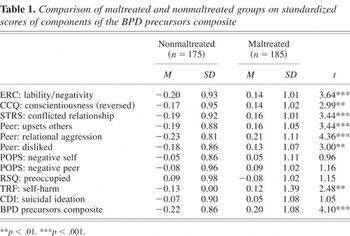
Comparison of maltreated and nonmaltreated groups on standardized scores of components of the BPD precursors composite
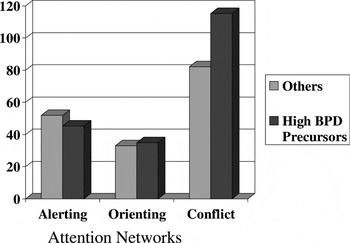
The contrast of children in the high BPD precursors group versus others on the three attention networks.
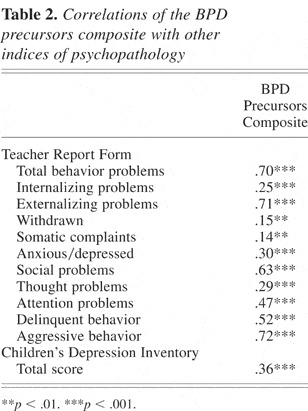
Correlations of the BPD precursors composite with other indices of psychopathology
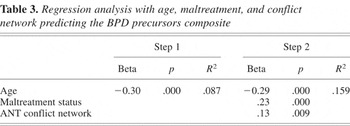
Regression analysis with age, maltreatment, and conflict network predicting the BPD precursors composite
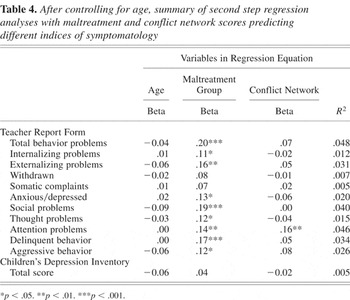
After controlling for age, summary of second step regression analyses with maltreatment and conflict network scores predicting different indices of symptomatology
 You have
Access
- 132
- Cited by