Introduction
Tomato leaf miner, Tuta absoluta (Meyrick) (Lepidoptera: Gelechiidae), is an important pest that causes significant loss in tomato (Lycopersicon esculentum L.) production (Desneux et al., Reference Desneux, Luna, Guillemaud and Urbaneja2011; Luna et al., Reference Luna, Pereyra, Coviella, Nieves, Savino, Salas Gervassio, Luft and Sánchez2015). Injury is caused by the larvae that mine leaves and fruits, mainly on solanaceaeous species, and eventually facilitates plant pathogen invasion. The pest is native to South America, but recently has invaded many countries across Europe, Africa and Asia (Desneux et al., Reference Desneux, Luna, Guillemaud and Urbaneja2011; Han et al., Reference Han, Bayram, Shaltiel-Harpaz, Sohrabi, Saji, Esenali, Jalilov, Ali, Shashank, Ismoilov, Lu, Wang, Zhang, Wan, Biondi and Desneux2018; Mansour et al., Reference Mansour, Brevault, Chailleux, Cherif and Grissa-Lebdi2018). The management of T. absoluta in many countries is primarily based on the chemical control. However, the use of insecticides is not a sustainable method for this pest because their efficacy has gradually decreased and resistance development has been reported in many countries (Lietti et al., Reference Lietti, Botto and Alzogaray2005; Luna et al., Reference Luna, Sánchez, Pereyra, Nieves, Savino, Luft, Virla and Speranza2012; Barati et al., Reference Barati, Hejazi and Mohammadi2018; Grant et al., Reference Grant, Jacobson, Ilias, Berger, Vasakis, Bielza, Zimmer, Williamson, Ffrench-Constant, Vontas, Roditakis and Bass2019).
Host plant resistance to insects is an alternative method to reduce pesticide use and the problems facing in a pest management system (Panda and Khush, Reference Panda and Khush1995; Maluf et al., Reference Maluf, de Silva, das Cardoso, Gomes, Gonçalves Neto, Maciel and Castro Nízio2010). Resistance of different tomato cultivars to T. absoluta in greenhouses and open fields were reported in previous studies (Gilardón et al., Reference Gilardón, Pocovi, Hernández, Collavino and Olsen2001; Leite et al., Reference Leite, Picanço, Guedes and Zanuncio2001; Sobreria et al., Reference Sobreria, Sobreria, Andrade, Almeida and Matta2009; Gharekhani and Salek-Ebrahimi, Reference Gharekhani and Salek-Ebrahimi2014; Sohrabi et al., Reference Sohrabi, Nooryazdan, Gharati and Saeidi2016, Reference Sohrabi, Nooryazdan, Gharati and Saeidi2017). On the contrary, several species of natural enemies have been found to be in association with T. absoluta which among them, Trichogramma parasitoids were considered as one of the most effective biological agents for the management of the pest (Cabello et al., Reference Cabello, Gallego, Vila, Soler, Del Pino, Carnero, Hernández-Suárez and Polaszek2009; Desneux et al., Reference Desneux, Wajnberg, Wyckhuys, Burgio, Arpaia, Narváez-Vasquez, González-Cabrera, Ruescas, Tabone, Frandon, Pizzol, Poncet, Cabello and Urbaneja2010; Cherif and Lebdi-Grissa, Reference Cherif and Lebdi-Grissa2013). Different species of Trichogramma such as Trichogramma achaeae Nagaraja & Nagarkatti (Cabello et al., Reference Cabello, Gallego, Vila, Soler, Del Pino, Carnero, Hernández-Suárez and Polaszek2009, Cherif and Lebdi-Grissa, Reference Cherif and Lebdi-Grissa2017), Trichogramma cacoeciae (Marchal) (Cherif and Lebdi-Grissa, Reference Cherif and Lebdi-Grissa2013), Trichogramma evanescens Westwood (Kececi and Oztop, Reference Kececi and Oztop2017) and Trichogramma brassicae (Ahmadipour et al., Reference Ahmadipour, Shakarami, Farrokhi and Jafari2015) reported as the effective species to reduce the incidence of T. absoluta eggs and larvae under the greenhouse and field conditions. Pilot experiments showed that T. achaeae was highly efficient in lowering T. absoluta infestation levels in experimental and commercial tomato-produced greenhouses in southern Spain (Cabello et al., Reference Cabello, Gallego, Vila, Soler, Del Pino, Carnero, Hernández-Suárez and Polaszek2009). Releasing of T. achaeae at a rate of 750,000 adults ha−1 every 3 or 4 days significantly reduced the number of T. absoluta larvae, leaf mines and damaged fruits, compared to the control plots (Cabello et al., Reference Cabello, Gallego, Vila, Soler, Del Pino, Carnero, Hernández-Suárez and Polaszek2009). In another study, releasing of T. cacoeciae at a rate of 30 adults/plant showed a good efficacy on reducing the number of T. absoluta eggs and larvae under open field conditions in Tunisia (Cherif and Lebdi-Grissa, Reference Cherif and Lebdi-Grissa2013). The potential of six Iranian T. brassicae strains to control T. absoluta was evaluated under laboratory conditions and showed the highest parasitism rate (53.89%) by Baboulsar population (Ahmadipour et al., Reference Ahmadipour, Shakarami, Farrokhi and Jafari2015).
There are no reports on the integration of T. brassicae and resistant varieties to control T. absoluta in the literature, but a few studies conducted on other natural enemies. Kececi and Oztop (Reference Kececi and Oztop2017) examined the effectiveness of individual and combined use of the predatory Mirrid bug, Nesidiocoris tenuis Reuter and T. evanescens and found around 95% reduction in the infested fruit by T. absoluta. In another study, Nderitu et al. (Reference Nderitu, Jonsson, Arunga, Otieno, Muturi and Wafula2020) indicated that combination of moderately resistant variety with the selective insecticide and combination of a susceptible variety with predatory Mirid bug (Macrolophus pygmaeus) significantly improved management of T. absoluta under greenhouse conditions.
In the absence of an appropriate control strategy, the population and damage of tomato leaf miner can be rapidly increased under greenhouse conditions and the larval feeding can be resulted in great crop losses; therefore, implementing effective control tactics are becoming very important (Estay, Reference Estay2000; Cherif and Lebdi-Grissa, Reference Cherif and Lebdi-Grissa2013). Moreover, applying only one control strategy might not be effective enough to keep the pest population below the economically injurious level; therefore, this study was carried out to evaluate integration of two key and environmentally safe and proven methods (host plant resistant and biological control) for sustainable control of the pest under greenhouse conditions.
Materials and methods
Experimental site
The study was conducted under greenhouse conditions (22 ± 3°C, 50 ± 10 RH and a 14 L:10 D photoperiod) in Ardal town, Chaharmahal va Bakhtiari province, Iran (32°14″N; 50°54″E, the greenhouse area was 3000 m2, with 5.30 m height).
Rearing of T. absoluta
The initial population of tomato leaf miner was collected from commercial greenhouses in Ardal, Chaharmahal va Bakhtiari province, Iran. The moths were reared separately on each tested cultivars for six generations. The seeds of studied cultivars were planted in plastic transplanting trays containing sterilized vermin-compost. With the appearance of the first true leaves the seedlings were transplanted into the pots (20 × 20 × 15 cm) filled with equal proportions of soil, sand and vermin-compost. Ten pots of each cultivar were prepared and covered with an insect net under greenhouse conditions (as described above) and irrigated once a day. Newly emerged adults of T. absoluta were transferred to the tomato plants and allowed them to reproduce for at least six generations (Kececi and Oztop, Reference Kececi and Oztop2017). Male and female pupae were collected based on the morphology of genitalia (Shashank et al., Reference Shashank, Chandrashekar, Meshram and Sreedevi2015) and kept separately for the following experiments.
Rearing of T. brassicae
The initial population of T. brassicae was obtained from Department of Biological Control, Iranian Research Institute of Plant Protection, Tehran, Iran. The biological agent was reared on eggs of Ephestia kuehniella Zeller in the growth chamber (25 ± 1°C, 60 ± 10 RH and a 16 L:8 D photoperiod). One-day old E. kuehniella eggs were kept for 30 min at −20°C (Kececi and Oztop, Reference Kececi and Oztop2017). These eggs were scattered on the paper and the egg cards were cut into strip and placed in glass tubes (16 cm × 1.5 cm). T. brassicae was released individually in the glass tubes and fed with honey droplets (Cherif and Lebdi-Grissa, Reference Cherif and Lebdi-Grissa2013; Kececi and Oztop, Reference Kececi and Oztop2017).
Resistance of four commercial tomato varieties to T. absoluta
Four cultivars of tomato including Cherry, Nunhems, Izmir and Matin, which grown widely in greenhouses in Iran, were studied for resistance to T. absoluta under greenhouse conditions (as previously described). The examined cultivars showed a different level of susceptibility to the pest among 16 varieties/genotypes of tomato (Raeesi, Reference Raeesi2015). Tomato seeds were obtained from Golsam Gorgan Chemicals Company, Iran. Seedlings of each cultivar transplanted into the plastic pots (20 × 20 × 15 cm, as previously described). The experiment was conducted using completely randomized design with five replicates. Each replicate contains four plants of each cultivar. Plants were covered by insect proof nets to avoid any contamination. Artificial infestation was performed by introducing one pair of newly emerged adults (one female and one male) per plant at the first-flowering stage. Treatments were evaluated for resistance to T. absoluta at 1, 2, 3 and 4 weeks after releasing of the biological agent. The studied parameters were: ratio of infested leaves/plant, number of larvae/plant, number of mines/leaf and ratio of infested fruits (%)/plant.
Effectiveness of T. brassicae to control T. absoluta on resistant and susceptible varieties
The most resistant (Cherry) and susceptible (Izmir) varieties, identified in the previous experiment, were evaluated in combination with the biological agent, T. brassicae, under greenhouse conditions (22 ± 3°C, 50 ± 10 RH and a 14 L:10 D photoperiod). Experiment was conducted based on the factorial design consisted of two factors (A and B) with ten replicates. Each factor had two levels. Factor A (cultivar) included of resistant (Cherry) and susceptible (Izmir) varieties, whereas factor B (T. brassicae) consisted of released and non-released treatments. Each replicate contained three pots. Infestation of the treatments to T. absoluta was performed when the plants were at the first-flowering stage by introducing a pair of newly emerged adults (one female and one male) per plant. Adult moths were taken from the stock culture and released on the plants covered with an insect net. Ten days later, the biological agent, T. brassicae, was released on the treated plants (Cherif and Lebdi-Grissa, Reference Cherif and Lebdi-Grissa2013). In each replicate, Trichogramma was released by hanging a card contained 50 parasitized eggs with 6–7 days old and considered to be at the pupal stages and about to emerge (Kececi and Oztop, Reference Kececi and Oztop2017). The observations on the damage of tomato leafminer were recorded by weekly sampling started 3 days after release and continued up to 24 days. The studied parameters were: ratio of infested leaves/plant (%), number of larvae/plant, number of mines/leaf and ratio of infested fruits/plant (%).
Statistical analyses
Statistical analysis was performed using SAS (version 9.1) and SPSS (version 22) software. Proc GLM was performed to identify significant differences among the treatments and means were compared using a least significant difference (LSD) test at P = 0.05.
Results
Results indicated significant differences in percentage of the infected leaves (F = 47.21; df = 3, 12; P < 0.0001), number of larvae/plant (F = 160.15; df = 3, 12; P < 0.0001), number of mines/leaf (F = 66.31; df = 3, 12; P < 0.0001) and percentage of infested fruits (F = 27.63; df = 3, 12; P < 0.0001) caused by T. absoluta among the tomato cultivars (tables 1 and 2). The highest ratio of damaged leaves (93 ± 3.80%), number of larvae/plant (67.81 ± 5.57), number of mines/leaf (6.08 ± 0.75) and ratio of infested fruits (15.90 ± 2.80%) were observed in cultivar Izmir followed by Nunhems, whereas the lowest were observed in cultivar Cherry followed by Matin at different sampling times (tables 1 and 2). Therefore, Izmir and Cherry were identified as the most susceptible and resistant varieties, respectively. The efficiency of selected varieties (Izmir and Cherry) in combination with releasing of T. brassicae was evaluated on T. absoluta damage under greenhouse conditions.
Mean (±SE) comparison of number of T. absoluta larvae/plant and number of mines/leaf among four tomato cultivars at different sampling times

Treatments with the same letter in each column are not significantly different at P = 0.01 using the LSD test.
Mean (±SE) comparison of percentage of infested leaves and fruits/plant by T. absoluta among four tomato cultivars at different sampling times

Treatments with the same letter in each column are not significantly different at P = 0.01 using the LSD test.
Effectiveness of T. brassicae to control T. absoluta on resistant and susceptible varieties
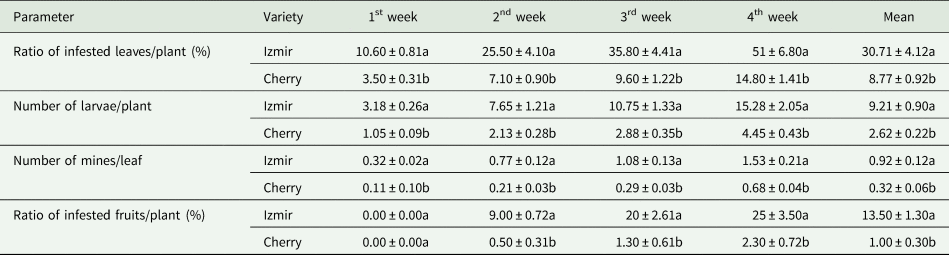
The effectiveness of biological agent, T. brassicae, on resistant and susceptible varieties is presented in tables 3–5. Statistical analysis on average of all sampling dates showed significant differences in the percentage of infested leaves (F = 54.01; df = 7, 12; P < 0.0001), number of larvae/plant (F = 53.72; df = 7, 12; P < 0.0001), number of mines/leaf (F = 55.34; df = 7, 12; P < 0.0001) and percentage of infested fruits (F = 61.22; df = 7, 12; P < 0.0001) among the treatments. Same results were obtained when each sampling date was analyzed separately. Results indicated that the resistant variety (Cherry) significantly influenced on T. absoluta damage. Mean of different sampling dates showed that the susceptible variety (Izmir) supported a more number of infested leaves/plant (30.71 ± 4.12%), larvae/plant (9.21 ± 0.90), mines/leaf (0.92 ± 0.12) and infested fruits/plant (13.50 ± 1.30%) compared to the resistance variety (Cherry) (8.77 ± 0.92%, 2.62 ± 0.22, 0.32 ± 0.06 and 1 ± 0.30%, respectively). The same trend was observed in all sampling dates. Based on the results, the mean number of infested leaves, larvae/plant, mines/leaf and fruits/plant decreased to 3.50, 3.52, 2.87 and 13.50 times on resistant variety (Cherry) compared to the susceptible variety (Izmir), respectively (table 3).
Mean (±SE) comparison of studied parameters between susceptible and resistant varieties to T. absoluta at different sampling times after T. brassicae released

Treatments with the same letter in each column are not significantly different at P = 0.01 in the studied parameters using the LSD test.
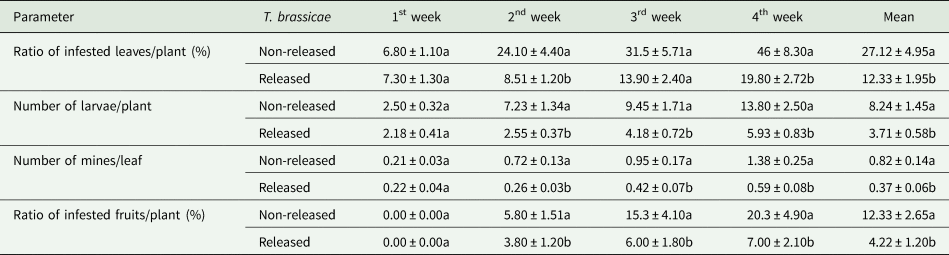
Mean (±SE) comparison of studied parameters between T. brassicae released and non-released treatments at different sampling times

Treatments with the same letter in each column are not significantly different at P = 0.01 in studied traits using the LSD test.
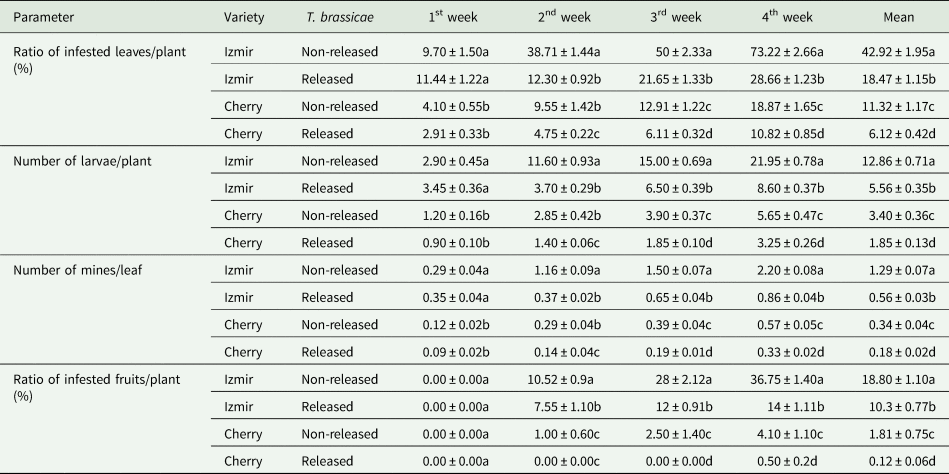
Mean (±SE) comparison of studied parameters among different treatments (susceptible and resistant varieties to T. absoluta × T. brassicae released or non-released) at different sampling times

Treatments with the same letter in each column are not significantly different at P = 0.01 in studied parameters using the LSD test.
Mean comparison of studied traits showed significant differences between released and non-released T. brassicae treatments. Means of different sampling dates indicated that the percentage of infested leaves, number of larvae/plant, number of mines/leaf and percentage of infested fruits/plant in non-released T. brassicae (27.12 ± 4.95%, 8.24 ± 1.45, 0.82 ± 0.14 and 12.33 ± 2.65%, respectively) were significantly higher than T. brassicae-released treatment (12.33 ± 1.95%, 3.71 ± 0.58, 0.37 ± 0.06 and 4.22 ± 1.20%, respectively). The same trend was observed in all the sampling dates. As table 4 shows, ratio of infested leaves, larvae/plant, mines/leaf and fruits/plant were 2.19, 2.22, 2.21 and 2.92 times higher in non-released compared to Trichogramma-released plots, respectively (table 4).
When combined treatments (varieties and biological agent) were considered at different sampling dates, the reduction of insect larvae and plant damage (infected leaves and fruits) were significantly higher in combined resistant variety (Cherry) and biological agent (T. brassicae) treatment (table 5). Mean comparison of all sampling dates indicated that the susceptible variety alone (Izmir) had the highest ratio of infested leaves (42.92 ± 1.95%), number of larvae/plant (12.86 ± 0.71), number of mines/leaf (1.29 ± 0.07) and infested fruits/plant (18.80 ± 1.10%), whereas the lowest (6.12 ± 0.42%, 1.85 ± 0.13, 0.18 ± 0.02 and 0.12 ± 0.06%, respectively) were observed in combined resistant variety (Cherry) and parasitoid-released treatment (table 5). The same was observed in all the sampling times (table 5). Therefore, by integration of biological agent and resistant variety, the ratio of infested leaves, larvae/plant, mines/leaf and infested fruits/plant reduced 7.01, 6.95, 7.16 and 156.67 times compared to the susceptible variety under greenhouse conditions.
Discussion
In this study, the effectiveness of combining resistant variety and biological agent was determined against tomato leafminer under greenhouse conditions. At the first stage, four tomato cultivars were studied for resistance to T. absoluta and the most resistant and susceptible varieties were selected to combine with T. brassicae. As the results showed Cherry and Izmir were the most resistant and susceptible cultivars. The differences in host suitability for tomato leafminer were reported in earlier studies (Gilardón et al., Reference Gilardón, Pocovi, Hernández, Collavino and Olsen2001; Leite et al., Reference Leite, Picanço, Guedes and Zanuncio2001; Gharekhani and Salek-Ebrahimi, Reference Gharekhani and Salek-Ebrahimi2014; Sohrabi et al., Reference Sohrabi, Nooryazdan, Gharati and Saeidi2016, Reference Sohrabi, Nooryazdan, Gharati and Saeidi2017). Genetic variability was reported as the main characteristic which influences higher or lower host susceptibility to pests (Fernandes et al., Reference Fernandes, Fernandes, Silva, Picanco, Jhamc, Carneiro and Queiroz2012). Physical and chemical barriers especially density and composition of type VI glandular trichomes were reported as important factors in cultivated tomato which adversely influence reproduction and development of insects and mites (Saeidi and Mallik, Reference Saeidi and Mallik2012). Our findings were in agreement with Sobreria et al. (Reference Sobreria, Sobreria, Andrade, Almeida and Matta2009) and Sohrabi et al. (Reference Sohrabi, Nooryazdan, Gharati and Saeidi2016, Reference Sohrabi, Nooryazdan, Gharati and Saeidi2017) where they reported adult oviposition, and damage caused by T. absoluta larvae on leaves, stems and fruits were significantly decreased on resistant cultivars.
Biological control has been considered as an important component of integrated management of T. absoluta, to keep the pest population at low density (Desneux et al., Reference Desneux, Wajnberg, Wyckhuys, Burgio, Arpaia, Narváez-Vasquez, González-Cabrera, Ruescas, Tabone, Frandon, Pizzol, Poncet, Cabello and Urbaneja2010). Our results indicated that T. brassicae was able to reduce the damage caused by T. absoluta in both resistant and susceptible varieties under greenhouse conditions. A high efficacy (75.5% of damage reduction) was reported by Zouba and Mahjoubi (Reference Zouba and Mahjoubi2009) by releasing 40 adults of T. cacoeciae/tomato plant under greenhouse conditions in Tunisia. The same results were obtained by Cabello et al. (Reference Cabello, Gallego, Vila, Soler, Del Pino, Carnero, Hernández-Suárez and Polaszek2009) in tomato greenhouses in Spain. In another study, Cherif and Lebdi-Grissa (Reference Cherif and Lebdi-Grissa2013) showed a good efficacy (54.7%) on reducing the number of T. absoluta eggs and larvae after releasing 30 adults/plant in plots covered with insect-proof nets under the field conditions in Tunisia. These reports supported results of the current study which showed about 54, 55, 54 and 66% reduction in number of infested leaves, larvae/plant, mines/leaf and infested fruits/plant in Trichogramma-released plots, respectively. Releasing of parasitoids against T. absoluta led to reduction of pest population densities below economic thresholds and decrease the use of insecticides (Parra and Zucchi, Reference Parra and Zucchi2004; Pratissoli et al., Reference Pratissoli, Thuler, Andrade, Zanotti and Silva2005).
Farmers in many countries apply chemicals weekly to control of T. absoluta under greenhouse or field conditions. According to Luna et al. (Reference Luna, Sánchez, Pereyra, Nieves, Savino, Luft, Virla and Speranza2012), T. absoluta control in Argentina and Italy is mostly based on the use of synthetic insecticides which are applied weekly. This intensive use of insecticides, in addition to producing adverse effects on human health and environment, has led to the development of resistance in the pest populations of South America (Lietti et al., Reference Lietti, Botto and Alzogaray2005; Luna et al., Reference Luna, Sánchez, Pereyra, Nieves, Savino, Luft, Virla and Speranza2012), Europe (Luna et al., Reference Luna, Sánchez, Pereyra, Nieves, Savino, Luft, Virla and Speranza2012; Grant et al., Reference Grant, Jacobson, Ilias, Berger, Vasakis, Bielza, Zimmer, Williamson, Ffrench-Constant, Vontas, Roditakis and Bass2019) and Asia (Barati et al., Reference Barati, Hejazi and Mohammadi2018; Han et al., Reference Han, Bayram, Shaltiel-Harpaz, Sohrabi, Saji, Esenali, Jalilov, Ali, Shashank, Ismoilov, Lu, Wang, Zhang, Wan, Biondi and Desneux2018). Therefore an integrated pest management package based on the economically viable and environmentally safe methods is required to control T. absoluta. Our results showed the importance of the use of both methods (resistant varieties and biological agent, T. brassicae) to control tomato leaf miner under greenhouse conditions.
In fact, resistant varieties can suppress the growth rate of pest population by their effects on reproduction, fertility and survival of a target pest (Price, Reference Price1997). Therefore, they may increase efficacy of natural enemies. Integration of these methods not only keeps the pest population under economically injurious level and decreases damage caused on tomato leaflets and fruits, but also reduces insecticide applications which are adversely impacting human health and environment, especially non-target organisms. These results are quite important and encourage further use of resistant varieties and natural enemies (especially Trichogramma species) in an effective integrated pest management package to control T. absoluta in the invaded areas. Moreover, there may be possibility to integrate these methods with other techniques such as cultural practices, pheromone traps and microbial insecticides (especially Bacillus thuringiensis) in commercial greenhouses.
Further studies are suggested to: (1) identify other native efficient parasitoids and predators of T. absoluta and evaluate their efficacy to decrease T. absoluta infestation when integrated with resistant varieties or other control methods under greenhouse conditions. (2) Evaluate effectiveness of T. brassicae, to control T. absoluta through augmentative release under field conditions and also in combination with economically-sound and environmentally-friendly strategies especially resistant cultivars.
Acknowledgements
Financial support provided by the Agricultural and Natural Resources Research & Education center, Chaharmahal va Bakhtiari, province, Iran and Mehregan Institute of Higher Education, Mahalaat, Iran is gratefully acknowledged.
Author contributions
Z. S. designed the experiments, analyzed data and wrote the manuscript. Material preparation and data collection were performed by M. R. The authors read and approved the manuscript.