Introduction
Candida auris, an urgent antimicrobial threat, 1 is a fungal pathogen capable of causing severe morbidity and mortality in immunocompromised persons and patients who reside in healthcare settings. Initially reported in the United States in 2016, C. auris has now been detected in approximately half of all U.S. states, with most ongoing transmission occurring in healthcare facilities (HCFs). In 2022, a total of 2,377 clinical cases and 5,574 screening cases of C. auris were identified nationwide. 2,3 Outbreaks of C. auris highlight the complex epidemiological linking of cases across large networks of interconnected facilities that often span multiple locations. Reference Adams, Quinn and Tsay4
Typically, patients admitted to ventilator-capable skilled nursing facilities or long-term acute care hospitals are at higher risk for transmission because of extensive HCF exposures and serious underlying medical conditions. Reference Pacilli, Kerins and Clegg5,Reference Tsay, Welsh and Adams6 Additional exposures associated with C. auris colonization and transmission are indwelling medical devices, recent surgery or medical procedures, history of multidrug-resistant organism (MDRO) colonization, and prolonged exposure to broad-spectrum antibiotics or antifungal drugs. Reference Rossow, Ostrowsky and Adams7,Reference Hu, Zhu and Jiang8 These factors increase patient vulnerability to C. auris infections and highlight the importance of continued infection prevention and control (IPC) measures in these healthcare settings.
In Maricopa County, Arizona, suspected and confirmed cases of C. auris must be reported to public health by healthcare providers and clinical laboratories within 24 hours as an emerging or exotic disease agent. 9 The Maricopa County Department of Public Health (MCDPH) serves 4,585,871 residents and has approximately 3,800 HCFs, 10 representing most of the state’s population and healthcare services. Before 2022, no detection of locally acquired healthcare-associated C. auris cases had been reported in Maricopa County residents. However, C. auris detections were noted in neighboring states of California and Nevada. 3
On April 21, 2022, MCDPH received a call from an infection preventionist at HCF A, an acute care hospital (ACH), about C. auris isolated from a bronchoalveolar lavage (BAL) specimen. The clinical specimen was from a male aged 60 years. He was hospitalized with a medical history of nonischemic cardiomyopathy and admitted to HCF A on April 13 for electrophysiology and acute heart failure consultation. On April 21, MCDPH rapidly initiated an outbreak response to determine the patient’s infection source, assess IPC practices, and identify HCFs involved with care for the patient. We describe the first healthcare-associated outbreak of C. auris in Maricopa County and outline MCDPH response activities. This includes initiating screening to identify patients colonized with C. auris, educating HCF staff about C. auris-specific IPC guidance from the Centers for Disease Control and Prevention (CDC), 11 and notifying other HCFs about C. auris-positive patients during HCF transfers.
Methods
When the outbreak occurred, C. auris was classified as a Tier 1 organism based on CDC’s interim guidance. 11 Using this classification and to identify additional cases, MCDPH recommended that the clinical laboratory at HCF A review Candida laboratory isolates from the previous 3 months for species identification. On April 26, 2022, a second C. auris isolate from a BAL specimen was identified through the retrospective laboratory review and species identification. The second patient was a male aged 68 years with end-stage renal disease who was admitted to HCF A for shortness of breath and hemoptysis. This patient was also admitted on April 13 and shared an overlapping stay with the first patient in the same unit for ∼ 7 hours. Both patients identified on April 21 and 26 were considered index patients for the outbreak investigation.
Case definitions and surveillance
Confirmed C. auris cases were defined as C. auris isolated from a culture or positive polymerase chain reaction results in a patient residing at a Maricopa County HCF. A clinical case was defined as C. auris from a specimen that was obtained for the purposes of diagnosing or treating an infection during routine clinical care in a hospitalized patient. Colonized cases were defined as C. auris from a composite axilla and groin swab that was obtained for surveillance purposes from a hospitalized patient. Colonized patients who later displayed symptoms of a clinical C. auris infection and fit the clinical case definition were defined as converted patients. HCFs where known clinical or colonized C. auris patients were residing when specimen collection was completed were defined as exposed HCFs. Point prevalence surveys (PPSs) were conducted every 2 weeks with patients hospitalized in the same units of exposed HCFs to evaluate ongoing transmission. MCDPH recommended sequential PPSs until 2 consecutive rounds of testing yielded no C. auris detection among newly identified or known contacts. MCDPH coordinated all laboratory testing between HCFs and the Antimicrobial Resistance Laboratory Network (ARLN) in Utah.
Contact investigation
MCDPH consulted early with CDC about the initial positive BAL specimens and coordinated with HCF A to provide MDRO-specific IPC guidance. 11 Contacts were initially defined as patients who met either of the following criteria: (1) were located on the same unit or ward as the index patients; or (2) were located on a different unit or ward that shared healthcare personnel, including ancillary staff, or noncritical medical equipment with the index patients for an overlapping stay of ≥4 hours. In the case were staff or equipment was shared, the additional unit was considered exposed and all patients considered contacts. On July 12, 2022, the exposure time frame was modified to an overlapping stay of ≥72 hours after CDC consultation. This modification accommodated the HCF’s limited capacity and resources. Conversations with HCF staff and CDC also indicated that patients with an overlapping stay of <72 hours were less likely to be colonized with C. auris, compared with contacts with longer stays.
Hospitalized contacts at HCF A were offered screening for C. auris colonization by obtaining a composite axilla and groin swab. Contacts were placed on contact precautions until negative test results were confirmed. 11 Contacts that refused screening were kept in contact precautions and had their medical charts flagged for C. auris colonization screening on HCF readmission. For contacts transferred to another HCF in Maricopa County, MCDPH coordinated interfacility notification and screening. MCDPH recommended that all contacts discharged home had their medical charts flagged for C. auris colonization screening on HCF readmission. MCDPH did not offer screening to patients who were discharged home. 11 For patients who were transferred out of Maricopa County jurisdiction, the Arizona Department of Health Services notified the receiving county or state jurisdiction of the patient transfer and potential exposure to C. auris infection.
MCDPH assisted HCFs that identified colonized patients by investigating contacts, conducting virtual infection control assessment and response activities, 12 and supporting PPSs. This outbreak concluded on February 23, 2023, after 2 consecutive PPSs yielded no C. auris detection from the last epidemiologically linked HCF.
During September 20, 2023–January 11, 2024, MCDPH reviewed medical records from all patients with a confirmed C. auris case to document demographic characteristics (age and sex), relevant medical history, patient outcome (alive or deceased), and patient’s healthcare exposures during the 30 days before their initial specimen collection with isolation of C. auris. Exposures of interest included previous HCF admissions and history of MDROs, broad-spectrum antibiotics or antifungal prescriptions, and surgeries or other medical procedures. Death certificates were reviewed for any patients who died during this period to determine whether C. auris was documented as a cause of death.
Statistical analysis
All HCFs identified during the outbreak were expressed as counts and percentage of totals. HCFs were categorized by facility type and included ACHs, long-term ACHs, skilled nursing facilities (SNFs), and other facilities. The other category included hospice care centers, inpatient rehabilitation facilities, behavioral health centers, or assisted living facilities. After contacts were identified, their discharge status from the epidemiologically linked HCF was documented and expressed as counts and percentage of totals. The clinical characteristics from patients with a confirmed C. auris case were categorized based on their case definition and expressed as counts and percentage of totals; age was summarized using median and range. All statistical analyses were completed using SAS Enterprise Guide 8.4 and Microsoft® Excel® (Microsoft Corporation, Redmond, Washington).
This study was reviewed by CDC and was conducted consistent with federal law and CDC policy 45 C.F.R. part 46, 21 C.F.R. part 56; 42 U.S.C. Sect. 241(d); 5 U.S.C. Sect. 552a; 44 U.S.C. Sect. 3501 et seq.
Results
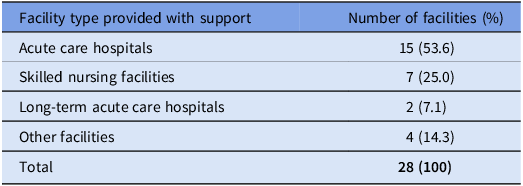
The first healthcare-associated outbreak of C. auris in Maricopa County continued from April 21, 2022, to February 23, 2023. MCDPH provided consultation and outbreak notification to 100 different HCFs and C. auris screening at 28 different facilities (Table 1). The majority of HCFs where C. auris screening occurred were ACHs (n = 15; 53.6%), followed by SNFs (n = 7; 25.0%).
Type of healthcare facilities provided with infection prevention and control education, virtual infection control assessment and response activities, and point prevalence survey support by the Maricopa County Department of Public Health—Maricopa County, Arizona, April 2022–February 2023

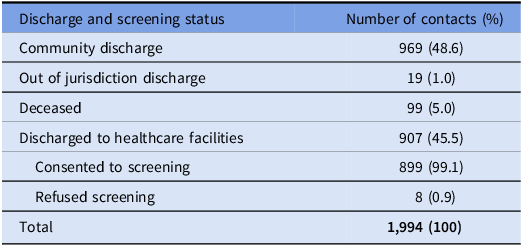
In total, 1,994 contacts were identified throughout this outbreak. A majority of those contacts (n = 969; 48.6%) were discharged to the community and not offered colonization screening (Table 2). However, 907 contacts (45.5%) were still residing in an HCF when outbreak investigations began. Of the 899 contacts screened for C. auris, 158 (17.6%) were colonized. Additionally, 39 patients with clinical cases of C. auris were identified during this outbreak (Table 3).
Discharge status of the contact investigations lead by the Maricopa County Department of Public Health and supported by the healthcare facilities and state health department—Maricopa County, Arizona, April 2022–February 2023

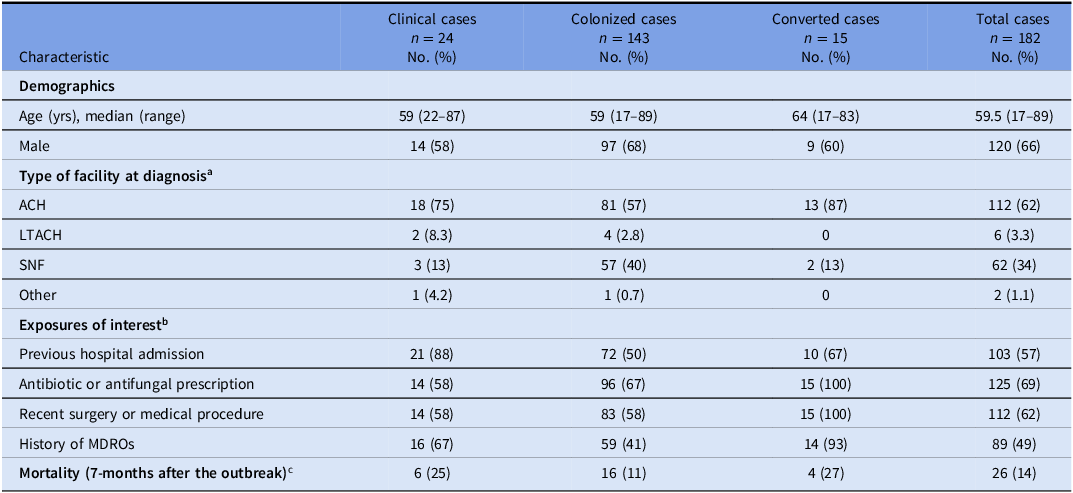
Characteristics for all Candida auris clinical, colonized, and converted patients identified throughout the outbreak—Maricopa County, Arizona, April 2022–February 2023

ACH, acute care hospital; LTACH, long-term acute care hospital; SNF, skilled nursing facility; MDRO, multidrug-resistant organisms.
a For converted patients, the facility in which the patient initially tested positive for colonization is shown.
b Based on review of the patient’s healthcare exposures during the 30 days before the initial positive specimen collection.
c Survival status was determined during the retrospective medical review process, starting on September 20, 2023, ∼7 months after the outbreak concluded.
Among colonized patients, 15 (9.5%) later acquired an active clinical infection of C. auris and were defined as converted patients. All 15 converted patients had a prescription for an antibiotic or antifungal and a surgery or medical procedure within 30 days of positive colonization. The most common medical procedures included bronchoscopy (9/15 [60.0%]) and tracheostomy (5/15 [33.3%]). The median time from initial colonization screening to subsequent clinical testing was 65 days (range: 2–220 days).
Among all patients with a confirmed C. auris case (clinical, colonized, or converted), 112 (61.5%) were screened for C. auris at an ACH. During the retrospective medical review (conducted ∼ 7 months after the outbreak concluded), 26 (14.3%) patients were deceased; 1 patient, with a clinical case of C. auris, had C. auris listed as a cause of death on the death certificate.
Discussion
This outbreak represents the first identified local transmission of C. auris in Maricopa County, Arizona. We describe the comprehensive response actions taken by MCDPH to control this outbreak, including initial case identification, contact tracing methods, and case characteristics. MCDPH’s collaboration with local HCFs, ARLN, and CDC slowed the spread of C. auris and the outbreak was declared over on February 23, 2023. Employing CDC guidance, facilitating communication among HCFs, laboratories, and public health, and focusing resources on high-risk settings contributed to better defining C. auris spread and slowing further spread.
Overall, MCDPH administered virtual infection control assessment responses to 28 Maricopa County HCFs, allowing for IPC gap identification and remediation assistance. MCDPH recommendations focused on implementation of contact precautions, cohorting of colonized patients, and adherence to appropriate environmental cleaning and personal protective equipment practices. Additionally, MCDPH advised HCFs to flag medical charts of colonized patients, allowing for prompt identification during patient transfers and readmittance.
MCDPH and HCFs investigated >40% of all contacts identified in this outbreak and continued communication with HCFs that subsequently admitted these patients. Because of the increased risk healthcare settings pose to the perpetual spread of C. auris, MCDPH focused screening efforts on contacts still residing at an HCF. Almost all investigated contacts agreed to C. auris screening, allowing for continued surveillance within HCFs.
Most patients were screened at ACHs. These hospitals are often the first HCF that persons seek for medical care, especially those persons who require complex care or specialized services. Typically, ACHs are where broader diagnostic testing and evaluation is performed, so more patients were likely to receive a diagnosis of a C. auris infection at these locations. Patients admitted to SNFs will frequently be transferred to ACHs for additional diagnostics and screening. The wide range of patients hospitalized at exposed ACHs results in more identified contacts and PPSs. It is crucial that ACHs continue to exercise the highest level of IPC.
Multiple challenges were noted throughout this response. As the outbreak continued, supporting all Tier 1 recommendations from the CDC guidance became increasingly difficult. 11 First, offering testing to every patient who had any overlapping stay of ≥4 hours with an infected patient created an unsustainable operational burden to the HCFs. Discussions with HCF staff and CDC indicated patients with an overlapping stay of <72 hours were less likely to be colonized compared with patients with longer stays. Concerns regarding laboratory capacity at ARLN because of the continued influx of testing was also a factor. Reference Greco, Smith and Gilbert13 Based on these observations and to accommodate the HCFs’ request, MCDPH modified the exposure time frame. It was increased to overlapping stays of ≥72 hours, which affected testing of patients at 6 HCFs at this time during the outbreak. Secondly, staff at HCFs, dialysis centers, and rehabilitation facilities became hesitant to accept patients, especially those from ACHs, often delaying care for colonized patients. MCDPH provided guidance about IPC practices to these facilities to balance the need for efficient patient placement with adherence to infection control recommendations for C. auris. For dialysis centers specifically, a meeting with regional leadership was convened to discuss and remove a newly established policy requiring a negative C. auris test result for dialysis. Third, standardized communication about C. auris-positive patients between HCFs was often delayed and frequently nonexistent, hindering implementation of appropriate IPC precautions at receiving HCFs on patient admission.
Since this outbreak occurred, guidance from CDC about containment and management of MDROs has been updated. In December 2022, CDC released updated interim guidance for a public health response to MDROs. 14,15 In this updated guidance, MDROs are assigned tiers (1–4) based on the local spread and regional epidemiology of the pathogen. In Maricopa County, C. auris is now classified as a Tier 3 organism, centering public health activities on the integration of prevention measures with containment strategies. This change allowed for public health responses to adapt to the needs of the community and focus efforts on the pathogens of most consequence to the community.
The first C. auris outbreak in Maricopa County, Arizona, underscores the importance of coordinated efforts between HCFs, laboratories, and public health departments. The response facilitated by MCDPH demonstrates the effectiveness of rapid investigation, screening of contacts, and continued IPC education strategies in mitigating the spread of C. auris. Guidance from CDC served as a foundational framework from which MCDPH adapted to address unique local challenges, including resource limitations and interfacility communication gaps. Throughout the outbreak, MCDPH was able to provide feedback to CDC regarding the capacity and limits of local response efforts and how CDC guidance was modified to maintain continued surveillance and communication with HCFs. This C. auris outbreak response highlights the need for ongoing collaboration, tailored response planning based on HCF and public health resources, and continued investment in IPC education to enhance readiness for emerging healthcare-associated outbreaks.
Acknowledgements
We thank all the healthcare facilities involved in this outbreak for the continued support. Additionally, we thank ARLN and CDC for ongoing laboratory capacity support and guidance.
Financial support
None reported.
Competing interests
Drs. Dale and Leahy reported receiving travel accommodations from the Arizona Infectious Diseases Society of America to present on infectious diseases in 2022 and 2024, respectively. Dr. Dale also reported receiving scholarships from National Association of County and City Health Officials (NACCHO) and Council of State and Territorial Epidemiologists (CSTE) to attend the Integrated Foodborne Outbreak Response and Management (InFORM) western regional meeting in 2023 and CSTE annual meeting in 2025, respectively. Drs. Dale and Staab served on the Arizona Department of Health Services Human Subjects Review Board (IRB). No other disclosures were reported.
Disclaimer
The findings and conclusions in this report are those of the authors and do not necessarily represent the official position of the Centers for Disease Control and Prevention.