Anthocoris whitei Reuter (Hemiptera: Heteroptera: Anthocoridae) is a small (2.5–3.5 mm in length), reddish-brown insect that occurs in arid regions of the western United States and Canada (Anderson Reference Anderson1962; Kelton Reference Kelton1978). Several years ago, I began a comparison of mating behaviour among North American species of Anthocoris Fallén (Horton et al. Reference Horton, Hinojosa and Lewis2000, Reference Horton, Lewis and Hinojosa2001, Reference Horton, Lewis and Hinojosa2002, Reference Horton, Bayer and Lewis2005a). Those studies demonstrated large differences among species in copulation duration and dynamics of sperm transfer. Assays with A. whitei led to the observation that some pairings ended only following atypically long copulations. Duration of copulation for this species averages about 90 minutes, which is sufficiently long to bring about insemination in 100% of pairings (Horton et al. Reference Horton, Lewis and Hinojosa2002). However, I have also recorded copulations by this species that extend to over 6 hours.
Factors that prompt atypically long copulations include environmental conditions, interspecific interactions, and sexual selection (Suter and Parkhill Reference Suter and Parkhill1990). For example, temperature affects how rapidly males of A. whitei transfer seminal products, which means that copulation duration increases as temperatures decrease (Horton et al. Reference Horton, Lewis and Hinojosa2002). Males of other species use prolonged copulation to reduce susceptibility of the female partner to predation, thus protecting his investment in future progeny (Suter and Parkhill Reference Suter and Parkhill1990). Finally, long-duration copulations may be a consequence of sexual interactions, including as a means to increase certainty of paternity, to reduce receptivity of the female to additional males, or to hasten oviposition by the female (Suter and Parkhill Reference Suter and Parkhill1990; Alcock Reference Alcock1994; Eberhard Reference Eberhard1996).
One proximate factor that affects copulation duration for many insect taxa is sex ratio. Male-biased sex ratios have been shown to lead to atypically long copulations in a number of insect species (Clark Reference Clark1988; Alcock Reference Alcock1994; García-González and Gomendio Reference García-González and Gomendio2004; Flay et al. Reference Flay, He and Wang2009). Here, I tested whether exposure to other males, preceding access to females, leads to prolonged copulation by A. whitei. I hypothesised that male-biased sex ratios would lead to copulations of longer duration than those in which males had not been exposed to such conditions.
Cultures of A. whitei were begun from insects collected from antelope bitterbrush, Purshia tridentata (Pursh) (Rosaceae), growing west of Yakima, Washington, United States of America. First and second generation offspring of field-collected insects were used in the assays. Insects were reared on pear seedlings infested with nymphs of pear psylla, Cacopsylla pyricola (Förster) (Hemiptera: Psyllidae), in ventilated Tupperware© containers (Orlando, Florida, United States of America) at 22°C and a photoperiod of 16 light:8 dark hours. To produce virgin adults for the mating assays, late-instar nymphs were removed from cultures and reared individually in petri dishes (90 mm diameter) to which psyllid-infested leaves were added. Petri dishes were checked daily for new adults. Virgin female and male A. whitei of 2–6 days in age were used in the assays.
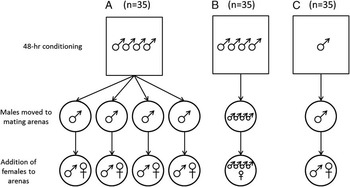
Mating trials were done under fluorescent lighting at room temperature (22–25°C), which are the conditions used in previous studies of mating behaviour of this species (Horton et al. Reference Horton, Lewis and Hinojosa2001, Reference Horton, Lewis and Hinojosa2002). Three treatments were defined, in which male density was varied preceding access to females or accompanying access to females (Fig. 1). Insects were randomly assigned to treatments. A 48-hour conditioning period that preceded access to females was created by placing males on pear seedlings in ventilated 145 mL plastic cages (Fig. 1: boxes). Densities of males were either four per cage (Figs. 1A, 1B) or one per cage (Fig. 1C). Conditioning arenas were kept in an environmental chamber free of female and nymphal A. whitei. After 48 hours, males were transferred to mating arenas (plastic petri dishes, 55 mm in diameter) by use of a small paintbrush. Densities were either four males (Fig. 1B) or one male per mating arena (Figs. 1A, 1C).
Experimental design used in testing effects of male density preceding access to females on duration of copulation by Anthocoris whitei.

Males were allowed five minutes to settle. A single virgin female was then added to each mating arena (Fig. 1), and copulation duration was recorded. The experimental design allowed me to assess whether male density preceding contact with females affected copulation duration (A versus C in Fig. 1), and whether male density during access to females affected duration (A versus B in Fig. 1). Copulation was defined to have begun when the pair entered the typical “V” position shown by this species. The end of a copulation occurred as insects disengaged physically. For treatment B, in which multiple males were present in each arena, copulation duration was recorded for the initial copulation. For each treatment, I also made records of other behaviours, including attempts by secondary males to separate copulating pairs, resistance by copulating males to advances of other males, or resistance by females to advances by males. Sample sizes were 35 conditioning arenas for each treatment (which led to 4 × 35 = 140 mating arenas for treatment A).
Sperm are transferred by the male into a membranous sperm pouch located in the female at the end of a specialised copulatory tube (Carayon Reference Carayon1977). The sperm pouch expands as it fills (Horton et al. Reference Horton, Lewis and Hinojosa2002). Females require 3–5 days following mating to begin oviposition (Horton et al. Reference Horton, Lewis and Neven2005b). The initial stages of copulation by A. whitei were similar to those described for other species of Anthocoris (Hill Reference Hill1957, Reference Hill1961; Shimizu Reference Shimizu1967; Péricart Reference Péricart1972; Horton et al. Reference Horton, Bayer and Lewis2005a). The male mounted the female and moved his body to her right side, keeping his left legs hooked over the left edges of the female's pronotum and forewing. No obvious resistance by the female was noted, unlike behaviour of females of other Anthocoris (Horton et al. Reference Horton, Bayer and Lewis2005a). He then curled his abdomen beneath the female's abdomen to insert his genitalia into her copulatory tube. In other species of Anthocoris, the male remains in this position for duration of the copulation (Hill Reference Hill1957, Reference Hill1961; Shimizu Reference Shimizu1967; Péricart Reference Péricart1972; Horton et al. Reference Horton, Bayer and Lewis2005a). In contrast, once a male of A. whitei had achieved intromission, the male dismounted the female but remained coupled to her in the “V” position known for some other Anthocoridae (fig. 31 in Péricart Reference Péricart1972).
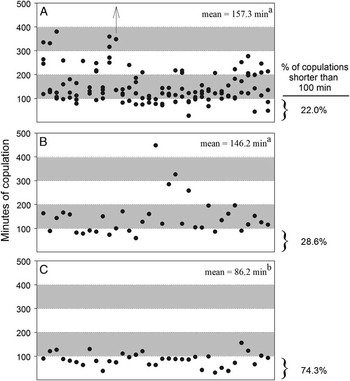
Copulation duration was compared among treatments using one-way analysis of variance (PROC MIXED; SAS Institute 2008). For treatment A (Fig. 1), data from the four mating arenas for a conditioning arena were averaged, producing 35 observations for treatment A. Copulation duration was significantly affected by treatment (Fig. 2; F 2,102 = 13.2, P < 0.0001). Treatments in which males were conditioned in groups of four (A and B in Figs. 1, 2) led to copulations that were on average a full hour longer than the average copulation of males not exposed to other males (treatment C in Figs. 1, 2). Over 70% of pairings by treatment C males (no exposure to other males) led to copulations shorter than 100 minutes (Fig. 2C); when males were previously exposed to other males, over 70% of copulations exceeded 100 minutes (Figs. 2A, 2B). Long-duration copulations included pairings that exceeded five hours (Fig. 2), and two copulations that exceeded nine hours in duration (arrow in Fig. 2A). Durations were statistically the same in pairings in which preexposed males were individually presented with females (Fig. 2A) or in groups of four males (Fig. 2B), suggesting that presence of other males during copulation did not affect duration of copulation.
Copulation duration (in minutes) for Anthocoris whitei in each of the three treatments shown in Figure 1. Each filled circle is result for a separate mating arena. For treatment A (Fig. 1), each column of four circles depicts the results for the four mating arenas that had originated from a single conditioning chamber; some columns may have fewer than four symbols due to overlap of points or because some pairings failed to result in copulation. Arrow in panel A marks one group of four in which two of the copulations exceeded 500 minutes (data not shown; 640 minutes and 590 minutes). Means (upper right corner of each panel) followed by the same letter not significantly different by least significant difference test (P > 0.05).

In arenas having multiple males (Fig. 1B), unpaired males often attempted to mount the copulating pair. Copulating males resisted this interference by using the front legs to kick at the secondary males. No instances of physical displacement by secondary males were observed, although in two pairings both the initial male and a secondary male had simultaneously inserted their genitalia into the female. Females regularly mated again with a second male soon following copulation with the original male. I randomly chose 10 of the 35 arenas in treatment B to monitor behaviour beyond the first copulation. In all 10 of these arenas, the females copulated with a second male within 40 minutes of having ended copulation with the first male. The majority of second copulations appeared to be with a male other than the original male; however, because the four males in an arena had not been marked in any manner, I could be certain of this only when the second copulation began very soon following the first copulation.
In previous studies, copulation duration by A. whitei was found to average 89 minutes (Horton et al. Reference Horton, Lewis and Hinojosa2002), virtually identical to results obtained here for the treatment in which males were not exposed to other males (Fig. 2C). Sperm transfer in this species can be detected within 10 minutes following the onset of copulation, with 100% of females being inseminated within 40 minutes of the onset of copulation (Horton et al. Reference Horton, Lewis and Hinojosa2001, Reference Horton, Lewis and Hinojosa2002). Males of A. whitei that were interrupted at 40–60 minutes into copulation were found to have deposited seminal products similar in volume to that transferred by uninterrupted males (Horton et al. Reference Horton, Lewis and Hinojosa2002). This result may indicate that copulation by this species, even in the absence of male competition, is of longer duration than needed to fully transfer seminal products.
In sum, copulation of A. whitei increased substantially in duration if males were exposed to other males preceding access to females, similar to what has been found for other Heteroptera (Sillén-Tullberg Reference Sillén-Tullberg1981; Clark Reference Clark1988; McLain Reference McLain1989; García-González and Gomendio Reference García-González and Gomendio2004; Wang et al. Reference Wang, Yang and Hedderley2008). It should be noted that my study design did not allow me to determine whether it was exposure specifically to other males that prompted the change in copulation behaviour, or whether exposure to groups of any conspecifics would lead to the response. I also did not determine whether physical contact between males is needed to prompt behavioural change, or whether other cues (visual, chemical) were responsible.
Prolonged copulations under conditions of male-biased sex ratios may often be a strategy to ensure paternity of offspring. Longer copulations could serve to increase female resistance to additional copulations, or as stimulatory cues that prompt increased use of that male's sperm by the copulating female (Eberhard Reference Eberhard1996). Prolonged copulations may also be a form of postinsemination mate guarding to prevent mating of guarded females by other males (Alcock Reference Alcock1994). It is not possible from this study to choose among hypotheses, although there is evidence consistent with a mate-guarding explanation. That evidence includes observations that previously mated females readily copulated with other males following the first copulation, as well as observations that copulating males successfully prevented rival males from interrupting copulations. To more definitively accept a mate-guarding hypothesis will require information on the relationship between copulation duration, re-mating frequency, and sperm use by multiply mated females (Alcock Reference Alcock1994).
Acknowledgements
I thank Erik Wenninger and Wee Yee for reviewing a previous version of this manuscript. I also thank Merilee Bayer, Toni Hinojosa, and Tamera Lewis for assistance in rearing insects and in conducting behavioural assays.