The problem: Indian independence and the ‘moment of labour’
In hindsight, the historical significance of the late 1940s in India—the years when Jawaharlal Nehru described the country as ‘a volcano of 400 million human beings’Footnote 1—seems to be self-evident: the terminal crisis of the British colonial regime; bitter negotiations between the imperial authorities, the Indian National Congress, the Muslim League, and the princes over India's future political organization; genocide and mass displacement along lines of religious community; and, at long last, the consolidation of a centralizing, Congress-controlled post-colonial Indian state and of its politically less robust Pakistani counterpart. The storyline appears to be indisputable and unalterable. It does justice, after all, to historical tendencies that transformed the lives of many South Asians, namely the tendency towards both the politics of religious identitarianism and the formation of nation-states. This narrative, moving seamlessly from the abyss of partition to the attainment of nationhood, has been compelling far beyond the sphere of professional historiography: it has been the hegemonic pattern of historical remembrance with regard to these years. It has suggested, even to those who lived through that time, what was important or legitimate to remember and what was not. The hegemonic narrative thereby reduced the complexity of the historical moment of the late 1940s and streamlined the plurality of historical experience. In particular, it pushed into the shadows those historical tendencies that were extinguished, submerged, or reigned in, but implied, as Sumit Sarkar puts it, ‘alternative possibilities that have been almost forgotten today’.Footnote 2
It is not as if all of these, presumably minor, tendencies, such as rural insurrections, industrial confrontation, or Dalit self-assertion, melted into air without leaving material traces. My specific contention in this article is that the late 1940s in India were, among other things, a catalytic moment in the definition of ‘labour’ as a political and social category because long-term processes of piecemeal change were condensed under the pressure of a profound and comprehensive political crisis. This crisis unsettled, for a brief period, the structures of social and economic power, not just intercommunity relations and the constitution of the state. ‘Subaltern groups’, as Douglas Haynes argues, ‘regarded the end of the Raj as a moment of “breakdown”, when the old social order had clearly ended and a new one had arisen whose content could be imagined in a variety of liberating ways’.Footnote 3 Since such emancipatory imaginations clashed with equally vigorous and more powerfully entrenched authoritarian conceptions of the post-colonial social order, the impact of the political crisis on India's late colonial regime of labour regulation was contingent upon the constellation of social forces. When the crisis receded, this constellation lost much of its fluidity and congealed into the remarkably durable social foundation of a new regulatory regime.
No linear, mechanical causality can be assumed between political crisis and social change, therefore, nor did the crisis of the late 1940s ‘bring about’ a transformation of India's world of labour out of the blue. Rather, the crisis served as a catalyst, which, in a conflictual and hence, to some extent, open-ended process, intensified two tendencies that had gathered strength over several decades. The first of these, dating back to the 1920s at least, leaned towards a transformation of the organization of production in Indian industry and, more specifically, towards the ‘formalization’ of the employment relations of a ‘core workforce’ in large industries and the public sector. The second tendency, even older perhaps, but certainly fuelled by the two world wars and the Great Depression, implied an expansion and intensification of the state's role in regulating economic processes. This included, with regard to work relations, the legal regulation of ‘labour’ not only at the level of the individual work contract but also increasingly as a collective entity. The crisis of the late 1940s released the social energy required to coagulate these two tendencies into a new regime of labour regulation—a regulatory regime that has proved, in its key elements, resilient to change for almost seven decades. The crisis of the late 1940s was thus, I argue, a catalytic moment in the history of Indian labour and, with regard to the visibility of workers in the wider political arena, even the climactic moment of India's urban labour force in the twentieth century.
Interestingly, however, no legitimate place has been conceded so far to this moment in mainstream historiography. One searches in vain for any reference to it, for instance, in Ramchandra Guha's elegantly written and widely sold liberal resurrection of the conventional historical narrative India after Gandhi.Footnote 4 That hegemonic remembrance elides this catalytic moment of Indian labour has not prevented it, however, from impacting on everyday lives in very material ways ever since. It was preserved mainly in the form of legal texts, in the form of laws, ordinances, and, crucially, in a flood of court and labour tribunal judgments—a form of abstract normative prescription that suggests a timeless and socially sterile universality and conceals its rootedness in concrete historical constellations.
‘Labour’ was a subject of legislation both at the central and the provincial levels according to the Government of India Act of 1935, a categorization confirmed by the Indian Constitution of 1950. Most of the key issues of labour legislation were included in the so-called ‘concurrent list’, which defined subjects that legislation could deal with at either level.Footnote 5 An analysis of the monthly reports from the Delhi office of the International Labour Organisation (ILO) on India's labour situation reveals a very unusual density of provincial and central labour legislation between 1946 and the early 1950s, concerted efforts to coordinate and homogenize labour legislation across India, as well as a substantial expansion of the administrative and judicial apparatus required for the implementation of the new laws.Footnote 6 A ‘five year programme for labour’ was announced in 1946,Footnote 7 and the following selection of all-India level legislative initiatives shows that most of the key laws that have regulated India's world of labour up to the present were enacted or consolidated during these years: in 1946, even before the establishment of the interim government, an Industrial Employment (Standing Orders) Act was passed that regulated, among other things, the establishment of legally binding rules of employment and procedures of dismissal within larger enterprises. In March 1947, in the shadows of expanding communal rioting and accelerating preparations for the ‘transfer of power’, the crucial Industrial Disputes Act was enacted which included provisions for compulsory arbitration. The year 1948 saw the ratification of a new Factories Act, and also of two of post-colonial India's major pieces of protective social legislation, the Minimum Wages Act and the Employees State Insurance Act, followed in 1952 by the Employees Provident Funds Act.
This list is highly selective even at the all-India level, nor does it include several important amendments to central Acts nor pieces of legislation that were confined to particular industries but had a landmark status, such as the laws regulating welfare provisions for the mining industry (1946, 1947, and again in 1948), the decasualization of dock labour (1948), or the employment conditions of plantation workers (1951).Footnote 8 The changes wrought on the legal repertoire during these years also included legislation that did not qualify as ‘labour law’ in the narrow sense, but was aimed primarily at industrial workforces nevertheless: the Bombay Rents, Hotel and Lodging Houses Rates Control Act, for instance, passed in late 1947 under popular pressure by a reluctant Congress government and emulated before long in other provinces, was meant to provide affordable housing to western India's urban and often working-class tenants.Footnote 9
This heavy legislative paper trail requires explanation. The late 1940s were a period of economic recession that followed the ‘war boom’ and preceded the rising growth rates of the early Five-Year Plans: 400,000 out of 2.6 million or about 15 per cent of all factory workers were made redundant between 1945 and 1947,Footnote 10 while the press reported in December 1945 that the government was contemplating the retrenchment of up to 250,000 railway workers.Footnote 11 Sir Ardeshir Dalal, member for planning and development of the last colonial dispensation and leading spokesman of Indian big business, had announced two months earlier that 850,000 demobilized soldiers would be flooding the labour market within eight months, a situation aggravated by the fact that one million ‘unskilled workers’, presently employed on defence works, were no longer required.Footnote 12 To make matters worse, an official survey among a large sample of ‘servicemen’ conducted in July 1945 brought out clearly that only 35 per cent of the interviewees expected to return to agricultural occupations, while almost as many (31 per cent) hoped to find employment in industry after demobilization.Footnote 13 Clearly, labour market conditions did not strengthen the economic bargaining position of industrial labour to an extent that would have forced the state into legislative hyperactivity.
Moreover, the intensity of the state's efforts to circumscribe a new labour regime also seems counter-intuitive in terms of the country's political history. As distinguished a labour historian as Sabyasachi Bhattacharya thus claimed only recently that ‘labour’ appears to have been a rather marginal political field that was low on the prime minister's agenda in the dramatic years of partition and nation-building.Footnote 14 How, then, do we explain the very considerable level of political and bureaucratic attention and energy dedicated to this ‘marginal field’ as well as, as we shall see, the repeated direct interventions in labour issues of leading politicians, including Nehru himself? Moreover, the dominant discourse on early post-colonial history, coloured by neoclassical assumptions, suggests that either a fallacious ‘march to socialism’,Footnote 15 a populist turn to welfarism by Indian nationalists,Footnote 16 or the dogmatic implementation of ILO normsFootnote 17 are to blame for labour-pampering policies imposed on the country in spite of its economic conditions. All of these narratives assume that the labour reforms of the 1940s and 1950s resulted from one or the other ideological preoccupation of policy-makers, which induced them to err from the presumably unideological path of neoclassical reason. All of them, like other neoclassical theorems, run into difficulties, however, as soon as we care to look for historical evidence.
For the protagonists of this spate of labour legislation were neither associated with the left, including the majority of Congress socialists who felt compelled to part ways with mainstream nationalism in this very period, nor with ‘Liblab’ social reformers like N. M. Joshi who used their close links with the ILO to play the ‘Geneva card’, with some success, in the 1920s and 1930s, but found themselves politically marginalized under the newly emerging post-colonial dispensation.Footnote 18 Rather, we encounter a curious and contradictory alliance that included Jawaharlal Nehru, the democrat with socialistic leanings, as much as right-wing authoritarians like Vallabhbhai Patel and Shyamaprasad Mookerjee; the champion of Dalit autonomy B. R. Ambedkar as much as his Congress antagonist Jagjivan Ram; Gandhian trade unionists like Gulzarilal Nanda as much as the business-friendly and deeply conservative Congress bosses in Madras, Bombay, United Provinces (UP), and West Bengal. In addition, the sheer resilience of the regulatory apparatus created during these years casts further doubt on the belief that India's post-colonial labour regime emerged from a fit of delusion: how could the ideological capriciousness of even the most powerful historical figures have made a lasting impact if they had been fully out of sync with the wider constellation of social power? In this article, I attempt to reconstruct this constellation of social power—one that opened up a space for the creation of a remarkably durable regime of labour regulation.
The plan of the article reflects the author's present position on a longer route of research: what lies at the beginning is already accessible for a close-up analysis, which is what the second, third and fourth sections aim at: a detailed examination of the strike movement in the years 1946 to 1948 as an articulation of India's comprehensive political crisis. Further along that route, in the medium distance, the main features of the landscape are clearly discernible, while an analysis of microstructures will only be possible after moving closer. The fifth and sixth sections thus reconstruct how a new regime of labour regulation emerged from the interplay of medium-term tendencies in labour legislation, and in the organization of industrial production with the political dynamics of the post-war crisis. In the far distance, where the route reaches the horizon, the landscape's outline is still perceptible, if blurred: this is an area of speculation where the discernible is sufficiently distinct to render conventional explanations implausible, while our own arguments can, until further research is undertaken, only take the form of tentative hypotheses—both on the crucial decade of the 1940s and on the as-yet largely unexplored labour history of subsequent decades. This is the task of the seventh and final section, which hypothesizes about the long-term consequences of the crisis of the late 1940s for India's post-colonial regime of labour regulation and, specifically, for the structure of industrial relations.
India's political crisis and the moral economy of the post-war strike movement
The prevalence of a comprehensive political crisis in the late 1940s, irreducible to the twin phenomena of intercommunity conflict and constitutional transformation, may be an unusual idea for most present-day historians—for contemporary political protagonists and observers it was certainly no surprise when it began to unfold in 1946. The memory of a global systemic crisis after the end of the First World War was still fresh. The crisis of 1919–1921 had seriously challenged the legitimacy of British rule in India and swept a variety of new, plebeian actors onto the political stage. As elsewhere, a broad-based strike movement had contributed in a highly visible way to the popular upsurge, and India's small, but geographically concentrated industrial workforce had emerged as a force to be reckoned with in Indian politics.Footnote 19 The colonial government was thus fully aware that the end of the Second World War would prompt serious social and political dislocation, especially since India had been made to contribute much more substantially and in the face of far greater opposition than during the previous clash of empires.
Hence, as early as in 1941, the Government of India initiated a programme of post-war reconstruction, a central element of which was the generation of alternative employment opportunities in the period when mass demobilization would predictably coincide with a slump in the demand for war-relevant goods and services.Footnote 20 This was even before the Quit India Movement clarified that, although the crisis could be postponed by means of repression, it would have very serious proportions when it eventually unfolded. In late 1945, B. R. Ambedkar, then labour member of the Viceroy's Council, and Sir Ardeshir Dalal, member for planning and development, were prepared to counter the emerging employment crisis with a legal reduction of working hours in factories and railways to 48 hours and with a public works investment programme.Footnote 21 Even so, retrenchment would not disappear as a major issue of the strike movement in the following years: between 1946 and 1950 almost a quarter of the officially registered industrial disputes were reported as having had ‘personnel’ (that is, retrenchment) issues as their main cause.Footnote 22
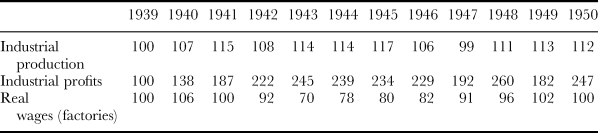
Most prominent among the economic demands made by striking workers were, however, those for wage increases, bonus payments, and the continuation of dearness allowances. In an important article, Indivar Kamtekar argues that the economic impact of the Second World War was more unevenly distributed among India's social classes than was the case, for instance, in Britain. Industrialists were quick to avail themselves of the opportunities offered by the war's quasi-protectionist side effects and by the state's ravenous and insatiable hunger for war-relevant industrial goods. For Indian capital (as well as for more prosperous parts of the peasantry) the war was thus a period of unmitigated bliss, unhindered expansion, and unprecedented profits. It was also a time when only a fraction of the windfall gains were entered into the books or submitted to taxation.Footnote 23 Wage earners, however, suffered a significant decline in real wages: in the case of factory workers this was 30 per cent, on national average, between 1939 and 1943. The wage levels of the pre-war period only recovered, according to official figures, by 1949. The economist S. A. Parlekar summed up his findings rather timidly (see Table 1) as follows: ‘between 1939 and 1950, industrial prosperity and an improvement in the economic conditions of the workers in India did not probably quite go hand in hand’.Footnote 24
Industrial production, profits, and real wages, 1939–1950.Footnote 25

While firm statistical evidence for this discrepancy was only provided after the post-war crisis had subsided, it was common and accepted knowledge in the late 1940s across the political spectrum. Ultra-left communists like B. T. Ranadive, leading nationalist economists like D. R. Gadgil, and official British analysts all agreed that the growing disparity between profits and wages was an indisputable, popularly known fact and one of the main factors contributing to the upsurge of labour unrest.Footnote 26 In India, the Second World War was thus far from being perceived as a ‘people's war’ not only in terms of sovereignty and constitutional politics, but also with regard to social policy: with cloth prices surpassing the pre-war level by more than 500 per cent,Footnote 27 it had been an Eldorado for the rich and a period of exacerbated economic precariousness for urban as well as rural wage earners, including the salaried middle classes. Furthermore, the forces that had widened the gap between prices and wages, and, accordingly, between profit-gainers and wage-earners, were more easily identifiable as political forces in a period when redistributive regulation by state agencies was the undisputed order of the day. A contemporary economist thus observed that even though India had, by the end of the war, ‘almost the same apparatus of controls’ with regard to the pricing and distribution of consumer goods as other countries,
the price level in India stood much higher […]; the standard of living of the people had also suffered to a larger extent[;] the profiteering gains of industrialists, traders and speculators made as a result of the war were enormously greater.
‘All prices,’ he explained, ‘were negotiated prices, that is, prices which industrialists were not reluctant to accept.’ The mechanisms of this negotiation were also clearly discernible: ‘Cloth prices were, for example, put under the control of a sub-committee of the Textile Control Board which had an overwhelming majority of manufacturers in its membership.’Footnote 28 At the same time, the Defence of India Rules made sure that a lid was kept on the resulting social tensions and that labour's bargaining power remained checked for the time being.
Despite this prehistory of a highly visible political regulation of consumer prices and wages, official observers interpreted the prominence of the wage issue (registered officially as the main cause of about 40 per cent of industrial disputes in 1947–48)Footnote 29 as proof of the essentially apolitical mentality of the Indian working class.Footnote 30 However, this official reading of labour protests being in themselves apolitical (or, ‘economistic'), if not interfered with by ‘outsiders’, should not be accepted at face value. E. P. Thompson's scorching criticism of the ‘spasmodic view of popular history’ comes to mind.Footnote 31 For wage conflicts, as much as food riots and other forms of conflict over social distribution, cannot be reduced to unconscious, spasmodic reflexes in response to hardship. Rather, they result from collective reflection, from a social process in which the immediate grievances they address are charged with cultural and political meaning. Thus a mood of moral outrage and bitterness appears to have given the strike movement of the late 1940s a peculiar colour.
This is indicated by the determined, and often violent, resistance against the employment of strike-breakers, against arrests and victimization tactics targeting union leaders, or against baton charges and police firings.Footnote 32 Reports of police firing at striking workers abound for these years, which usually resulted in several fatalities and numerous injuries. As early as in February 1947, the All-India Trade Union Congress (AITUC) reported that 59 people had been killed by police fire in Golden Rock, Gwalior, Dacca, Ratlam, Amalner, Coimbatore, Kolar Gold Fields, and Kanpur.Footnote 33 Confrontations between workers and the police appear to have turned violent with particular frequency when the former were mainly Dalits.Footnote 34 Such incidents created a public scandal only in rare cases like that of the Kanpur incident of January 1947.Footnote 35 If judicial enquiries into such shootings were unlikely to happen, effecting the reinstatement of victimized workers by legal means was a remote possibility,Footnote 36 which may explain the tendency towards escalating forms of conflict. Similarly, arrests were often followed up by harsh punishments: in March 1947, scores of striking ‘sweepers’ were arrested in Jabalpur, of whom 18 were sentenced to six months of rigorous imprisonment in a summary trial. When further arrests were being attempted a ‘crowd of women scavengers’ was reported to have pelted stones at the police, injuring the deputy superintendent and 12 others.Footnote 37 While clashes between police and striking workers were the most frequent form of industrial violence, there are also instances when machines and other employer property were damaged or destroyedFootnote 38 as well as of violent clashes between striking workers and strike-breakers.Footnote 39 Spokesmen for employers like Ardeshir Dalal and B. Mehta also condemned workers for their ‘tendency to use personal violence against superior staff’,Footnote 40 a tendency that could be directed against European supervisors, as Sekhar Bandyopadhyay has shown for Kolkata,Footnote 41 but was also experienced by their Indian counterparts.Footnote 42 British officials likewise observed in early 1948 ‘a growing tendency in recent months for strikes to be accompanied by acts of violence’ that could also target labour officers of the post-colonial state at a time when the forces of the state were employed more frequently against strikers.Footnote 43 Even after the suppression of the strike movement, in May 1949 they reported frequent and increasing ‘physical assaults and threats of assault on managing and technical personnel’, which they believed, after inquiries, had ‘no specifically anti-British bias about them’.Footnote 44 Notions of morality, justice, and workers’ rights could give conflicts over labour relations a violent turn in this tense situation, even in the absence of larger industrial disputes. A case in point is that of the Madura Mills, a substantial British-run enterprise in southern India, where the death of a worker at his workplace, having been denied sick leave by the mill dispensary, led to ‘disturbances’ and police firing at the factory premises in January 1947.Footnote 45
Yet violence was not the only form of militancy indicating a morally charged sense of grievance and injustice: towards the tail end of the movement, in May 1949, the labour adviser to the British High Commissioner in India reported that the adoption of the ‘weapon’ of hunger strikes ‘on a fairly wide scale by industrial workers in recent months has caused embarrassment to some Provincial Governments, particularly the United Provinces Government’—a calculated embarrassment no doubt as Gandhi himself had introduced this form of protest into Indian labour struggles.Footnote 46 Hence in May 1946 five workers of the Dharamsey Mill in Bombay commenced a ‘fast unto death’ in the compound of Congress House in Bombay to protest against the victimization of 30 workers several months previously.Footnote 47 Between 1946 and 1949 the Times of India reported on employees and trade union leaders conducting hunger strikes in various, but particularly lower middle-class, occupations, including air force men in Bombay, Karachi, and Lahore; policemen in Delhi and Patna; railway workers in Hubli, Hyderabad, and Dohad; textile mill employees in Bombay and Lucknow; postal clerks and government staff in Jhansi and Calcutta; and dockers as well as teachers in Bombay.Footnote 48 In April 1949, 5,000 textile workers in Rajnandgaon were reported to have gone on a one-day fast in solidarity with 31 workers who had been victimized after a strike the previous year.Footnote 49 At the same time, a Provincial Tripartite Labour Conference in Kanpur decided to ‘issue a statement, signed by labour leaders belonging to different parties, appealing to workers not to resort to hunger strikes […]’.Footnote 50
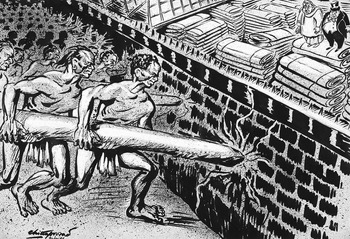
The Government of independent India's short-lived policy of ‘decontrolling’ food and cloth prices, announced in late 1947 (to which we shall return later), was perceived, even at the level of everyday discourse in working-class neighbourhoods, as an explicitly political issue and proof of the partiality of the Congress and, sadly, of Gandhi himself towards business interests.Footnote 51 Demands for higher wages, dearness allowances, and price controls were thus more than ‘purely economic’ utterances: they were charged with political and moral meaning. They implied an indictment of accumulated injustice that needed to be rectified, if not by the Government, then by the people themselves, now that the war was over and British rule on its way out. After August 1947, this expectation was reported to have grown even more intense, with a widespread ‘feeling among all classes of workers that some immediate and tangible benefits would follow the inauguration of an independent Indian Government’.Footnote 52 ‘India has become politically free;’ a British official wrote, ‘labour has naturally caught the same infection in the economic field.’Footnote 53 Congress politicians were aware of this ‘infectiousness’ of ‘freedom’ and of popular high expectations: when the Bombay government published a document on its future labour policy in preparation for the 1945–46 elections, the nationalist Bombay Chronicle chose the caption ‘Ram Rajya for Working Classes’.Footnote 54 As late as 1949, when the strike movement was being suppressed, the Gandhian Harijan remarked that the ‘current popular slogan […] Kisan-Mazdoor Raj […] is common to the Congress, the Socialists and Communists’.Footnote 55 Intellectuals and artists were often drawn to the left during these years and, in their own way, sought to make sense of the atmosphere of post-war India when social tensions ran high and could be expressed in radical political terms. Consider, for instance, Chittaprosad Bhattacharya's July 1946 caricature (see Figure 1). Taking up one of the most urgent and politically controversial popular grievances of the post-war years, it depicts a crowd of men attacking the spiked wall separating them from the stores of British and Indian cloth hoarders.
Chittaprosad, ‘Untitled’, water colour and ink on paper, 1946. Source: Collection and image courtesy of DAG Modern, New Delhi.Footnote 56

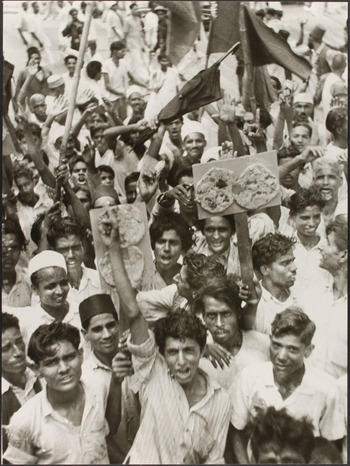
The near-nakedness of the muscular attackers expresses deprivation as much as an aggressive proletarian virility. Chittaprosad fell back on a masculinist imagery that emphasized the strength of the dispossessed and presumably ‘weak’—quite possibly a loan from the international labour movement's iconographic repertoire. It is significant, however, that he did so only during these years of the post-war crisis, in clear distinction, for instance, to his 1943 and 1944 drawings, in which he depicted starved Bengali villagers as struggling, and eventually succumbing, famine victims.Footnote 57 Moreover, the motif of the barely clad male body may also have been inspired by forms of protest that caught public attention at the time. In October 1945, the government of Bihar was perturbed by a report in Amrita Bazar Patrika that ‘some 3,000 semi-naked workmen had staged a demonstration’ at the Tata's Jamadoba colliery in the Jharia-Dhanbad coalfields to demand a larger supply of cloth—a report they found exaggerated only with regard to the numbers of demonstrators.Footnote 58 Consider also Sunil Janah's photograph of a Bombay rally from the late 1940s, where demonstrators themselves chose the ambiguous imagery of sticking rotis to otherwise blank placards—referring, perhaps consciously, to the famous rumour of the circulating chapatis at the time of the great Indian insurgence of 1857 (see Figure 2).
Workers' demonstration in Bombay. Source: © Sunil Janah, courtesy Arjun Janah, suniljanah.org.Footnote 60

Artists like Chittaprosad and Janah thus were able to capture aspects of the ‘moral economies’ that gave seemingly mundane, apolitical, ‘economistic’ demands for food and clothing a deeper, politically subversive meaning. This may have induced them, like many leftists at the time, to read as a prelude to social revolution what was, as Javed Alam argues, a more limited political radicalization of popular movements that went ‘far beyond the limits set by the nationalist leadership’ (both with regard, one might add, to social content and to the modalities of protest). These occurred, however, without revoking altogether their political allegiance with nationalism, the Indian National Congress, and the state the latter assumed control of.Footnote 59 This would become clearer as the crisis unfolded: a profoundly political crisis of social and state power was resolved through the consolidation of a highly bureaucratized post-colonial state.
The ‘strike fever’ of 1946–48: making sense of proportions
At the time, however, Indian business, too, braced itself for a round of intensified labour conflicts. The strike of 12,000 Calcutta engineering workers was among the first indications of an increase of industrial disputes in India. Capital, a mouthpiece of the Birla group, offered a rather unexcited economistic or, indeed, ‘spasmodic’ explanation for the spread of strike movements in Britain, France, and Australia:
‘Strike Fever’ is one of the inevitable consequences of the economic retrenchment which must follow the ending of the war. As such it is world-wide. The desire for security which comes with peace too often takes the form of a sort of nervous collapse.Footnote 61
The first nine months of the year 1946, then, saw a sharp rise of strike movements in India, and government officials registered a ‘phenomenal increase’ in industrial disputes.Footnote 62 Just as in Birla's journal, the situation was routinely analysed in pathological terms in official reports. An internal report on the Central Provinces for July 1946 thus stated:
An epidemic strike fever seems to be spreading throughout the province from which no class of employee appears to be exempt; sweepers, school boys, school masters, mill hands, bidi workers, lac workers, clerks, even Government chaprasis are all thinking of striking […].Footnote 63
M. K. Gandhi saw deeper causes for what he, too, considered to be a ‘disease’ afflicting the nation: if strikes had turned into ‘a universal plague’ the world over, the fundamental reason for this ‘spreading strike fever’ and, specifically, for its violence was to be found in the replacement of the ‘cash nexus’ for religious bonds in contemporary life. In addition, the ‘unnatural condition’ of a retreating colonial regime in post-war India gave the strike movement a ‘special significance’, in Gandhi's view: ‘As soon as the lid is removed and there is a crevice letting in the fresh air of freedom, there will be an increasing number of strikes.’Footnote 64
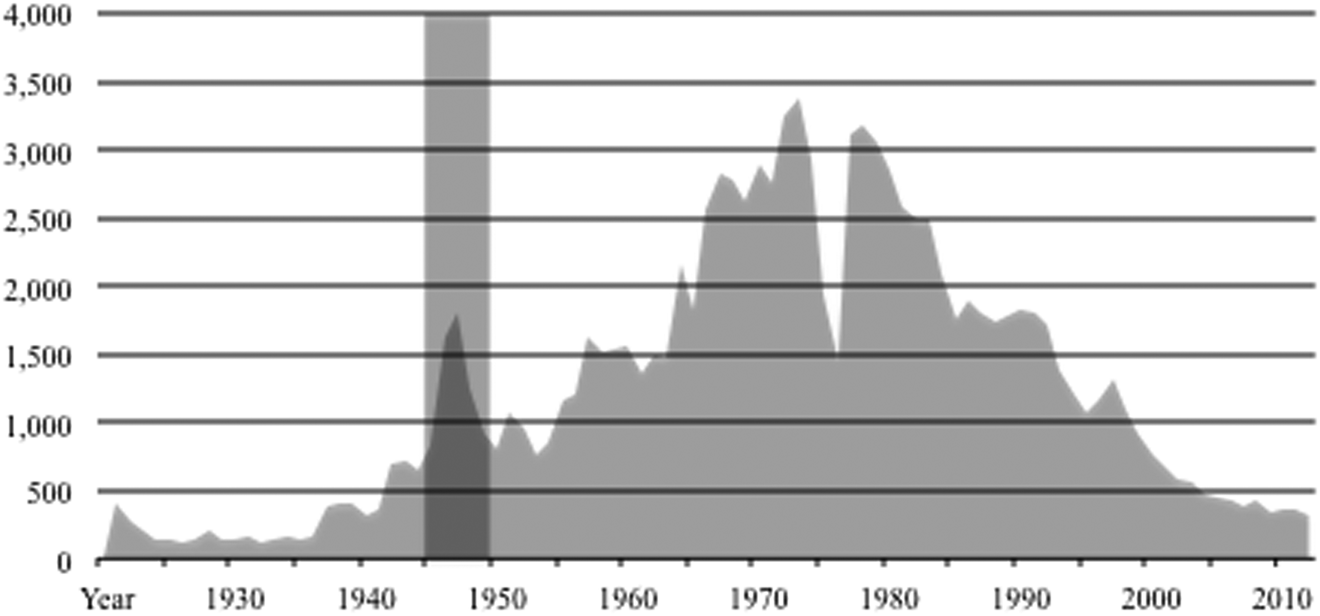
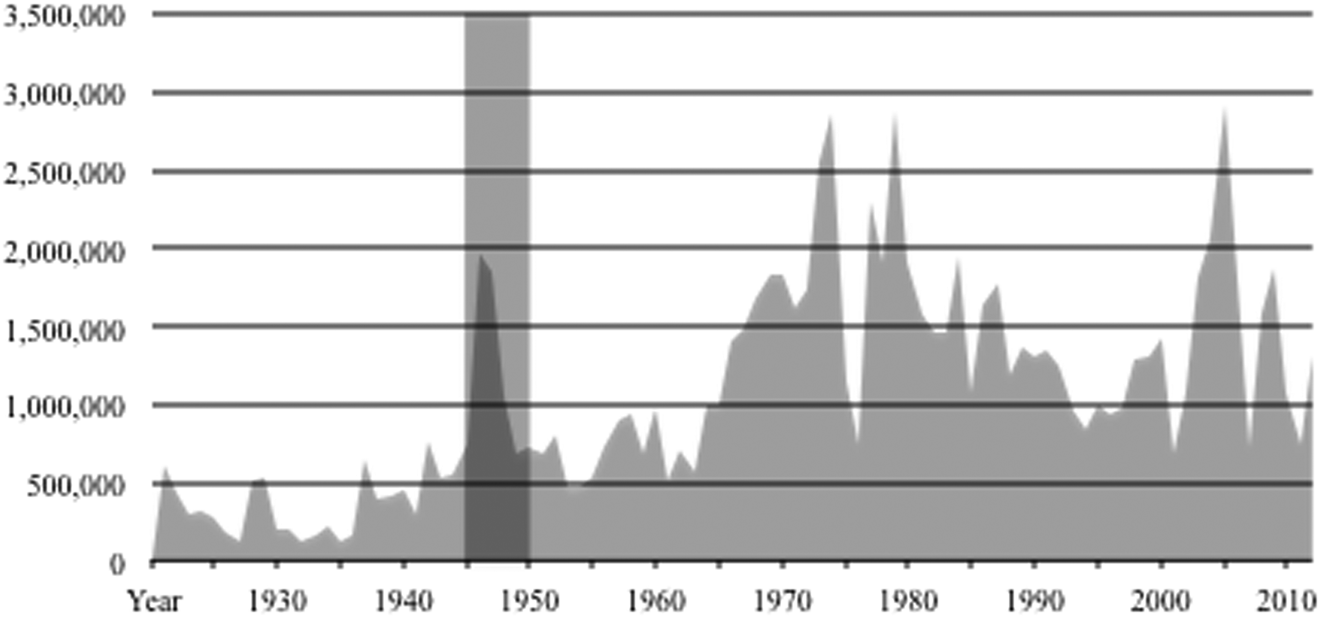
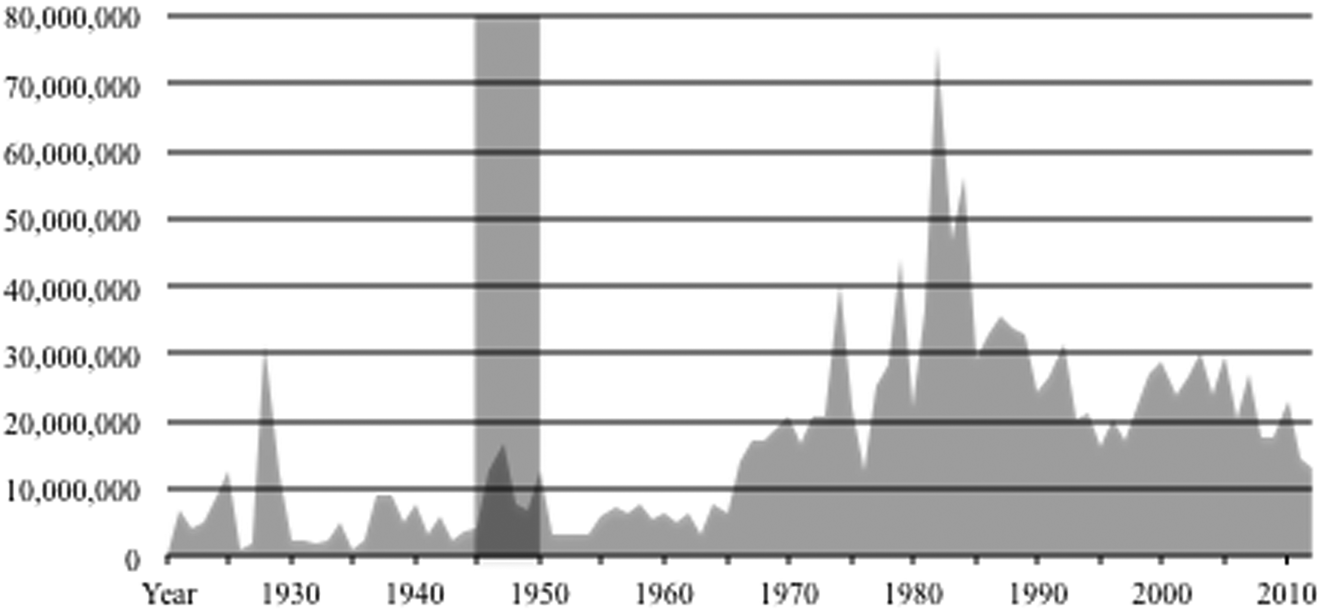
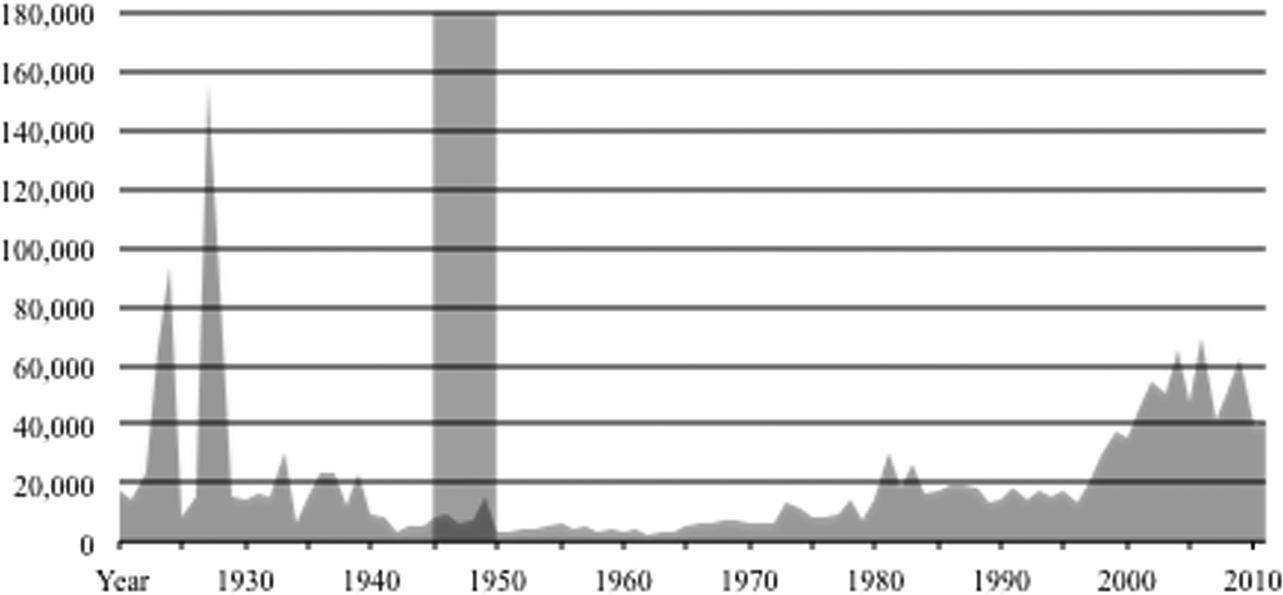
Even so, the labour upsurge had ebbed considerably by September, perhaps, as Sumit Sarkar speculates, due to the massive increase in communal riots that ‘disrupted labour unity in the big cities’.Footnote 65 But this was not the end of the movement: the year 1947, marked by communal violence on a vastly greater scale, saw strike movements as expansive as—and even somewhat more intensive than—those of the previous year. The movement took half a decade to recede to the level of 1945. Its range and significance for the formation of the post-colonial order has rarely been acknowledged by scholars,Footnote 67 even though aspects of this strike movement have been studied from regional and local perspectives or for certain occupational groups.Footnote 68 However, the former trade-union leader and Congress politician V. V. Giri, one of the best-informed contemporary observers, considered the post-war years in hindsight as a period of ‘industrial strife unprecedented in the history of India’.Footnote 69 This claim is largely supported by the following diagrams.
That these statistics are heavily distorted has been well known for decades: reporting is voluntary and a large proportion of actually observable strikes have not been recognized as ‘industrial disputes’ according to the criteria applied.Footnote 70 The sharp decrease of industrial disputes figures since the ‘liberalization’ drive of the 1990s can be understood, for instance, as K. R. Shyam Sundar argues convincingly, only in part as indicative of a real decline of industrial conflict, and this may be caused, to a large extent, by systemic underreporting due to the decay of the labour administration and to a diminishing political interest in keeping adequate labour statistics. In addition, an informalization process has pushed many labour conflicts outside the remit of the Industrial Disputes Act, which defines in legal terms whether a labour conflict is an ‘industrial dispute’ or not.Footnote 71 Similarly, the figures for the decades preceding the Second World War may also reflect, to a great extent, a political context that did not recognize the legitimacy of labour conflicts and a labour administration that recorded statistics that were still confined to a few industrial centres. A statistical analysis of industrial disputes since 1921, published in 1948, states, for instance, that the official figures ‘do not cover all disputes because they represent the figures submitted by the Registered Unions which send returns to the Labour Commissioner's Office under the Trade Union Act’.Footnote 72 If the available statistics show a markedly higher ratio of lost work days per industrial dispute (that is, a much higher intensity of such disputes) for the period between 1920 and 1940 as well as for the period since the late 1990s (see Figure 6 below), this may indicate, to some extent, that smaller, shorter, and less centrally located conflicts were less likely to be reported in these decades. During the 1950s to 1980s, by contrast, a regime of industrial planning put a greater premium (and spent more resources) on the generation of comprehensive labour statistics. In other words, the dual transformation suggested by the official statistics for industrial disputes for the mid-1940s and again for the 1990s may be more reflective of changes in the regime of labour regulation than of a sudden shift in the nature and extent of labour conflicts as such.
Hence these statistics may tell us even more about those counting or discounting industrial disputes than about the strikes and lock-outs they claim to quantify. However, simply disregarding the available quantitative material comes at a cost, even though historians increasingly choose to do so.Footnote 73 Statistics for Indian industrial disputes will not provide us with ‘hard data’ or precise proportions, and they clearly exaggerate trends by piling up bizarre mountains and by carving out implausibly deep valleys, but they still point us towards tendencies that need to be corroborated with qualitative evidence. This is what the following discussion undertakes.
At its peak in 1946 and 1947, the strike movement appears to have been far less intensive than the spectacular and well-studied textile strikes of the late 1920s (with 16.5 million ‘work days lost’ in 1947, about half of the 1928 figure; see Figure 5), but it was reported to have involved nearly four times as many workers (almost two million in 1946 and again in 1947; see Figure 4). The number of recorded industrial disputes (including both strikes and lock-outs) reached an annual maximum of around 400 during the interwar period and amounted to no more than 203 in 1928, when strike movements assumed the greatest intensity for many decades. During the years 1946 and 1947, however, the annual number of recorded strikes and lock-outs shot up to an unprecedented average of almost 1,900 (see Figure 3). In sum, the available data for both industrial disputes and worker participation in such disputes suggest that the strike movement of the late 1940s was more extensive than any previous movement in India. The average duration of strikes, as indicated by the figures for ‘work days lost’ in relation to the number of disputes, appears to have been lower than in other periods, however.
Strikes and lock-outs, 1921–2012.Footnote 66

Workers participating in strikes or affected by lock-outs, 1921–2012.

Work days lost, 1921–2012.

Lost work days per industrial dispute, 1921–2012.

The significance of the strike movement of the late 1940s, the official figures suggest, thus lay in its increased range, rather than in its intensity. That shorter strikes were increasingly accounted for, is likely to have been due to changing counting practices to some extent, but not entirely. Conversely, the greater frequency of ‘little strikes’ may have precipitated more systematic reporting. Beyond statistical fiction, one socio-economic precondition for the greater reach of the strike movement can be found in the transformation of the industrial workforce itself: the war had functioned as a catalyst of industrialization that resulted, according to official estimates, in a 30 per cent growth in the workforce employed in factories between 1939 and 1945Footnote 74 or, according to the Government's Reconstruction Committee, even in a 50 per cent growth of employment in ‘organised industry’ between 1938 and 1944.Footnote 75 This went along with industrial diversification—for instance, with regard to engineering where employment was reported to have doubled between 1939 and 1943.Footnote 76 Moreover, industrial growth was not confined to the ‘old’ industrial provinces of Bengal and Bombay, even though their combined share of India's factory employment declined only slightly from 59.3 per cent in 1939 to 57.7 per cent in 1943.Footnote 77 About 300,000 factory jobs had been created outside these provinces in the course of these four war years.Footnote 78 This resulted in, as an official report put it in 1944, ‘notable changes in the geographical distribution of [the] industrial population’:Footnote 79 the relative increase of factory employment was most pronounced in Bihar, the Central Provinces and Berar, Punjab, and the United Provinces, where growth rates of between 70 and 100 per cent were recorded for the years 1939–1945.Footnote 80 Consequently, strike movements were transformed from incidents of highly visible, intense, but localized unrest into national events that affected larger sections of the subcontinent. Even though 57 per cent of all registered industrial disputes in 1947 were still located in the provinces of Bengal and Bombay,Footnote 81 strikes were also experienced in the lesser urban centres of Bihar or Central India or, given the importance of strikes in the communication sector (see below), along supralocal networks.
The post-war strike movement and the rise of ‘labour’ as a political category
A second, perhaps even more important, precondition for the unprecedented range of the 1946–47 movement was a political process that had been observable from the 1930s: ‘labour’ as a useable category of political self-identification and trade unions as a useable form of social organization were no longer found solely in highly concentrated large-scale industries. Between 1937–38 and 1942–43, the membership of registered trade unions in India increased by 75 per cent, from 390,000 to 685,000.Footnote 82 Crucially, and as recent studies show, the 1930s to 1950s saw a growing presence of (largely unregistered) trade unions in what today would be called the ‘informal sector’. Bashir Ahmed Bakhtiar, in his memoirs, thus recalled having contributed in the 1930s to establishing unions in Amritsar among the most diverse occupational groups, including cow-herders, cloth hawkers, lorry drivers, ‘tandoor’ workers, zari thread embroiderers, sesame grinders, Garhwali domestic servants, and, indeed, also factory workers of several kinds.Footnote 83 Douglas Haynes has traced intensive trade union mobilization among handloom and powerloom workers in mid-twentieth-century western India: in response to this mobilization, owners subdivided karkhanas (workshops), thereby circumventing labour laws and effectively beating back the challenge of increasing unionization.Footnote 84 Shahana Bhattacharya has explored the forms of union organization and struggles of Dalit workers in the tannery workshop clusters of Chennai and Calcutta during the 1940s.Footnote 85 Among the 59 Madras Labour Tribunal awards reproduced in the Labour Law Journal for the period from April to December 1949, the large majority pertain to disputes in small-scale factories, workshops, or service establishments: nine cases involving beedi and other tobacco manufacturers, and six concerning road transport companies are documented. Moreover, handloom weavers and ‘bazaar coolies’ took their grievances before the tribunal and claimed, often unsuccessfully, the legal status of ‘worker’ and consequently protection by labour law.Footnote 86 Even in the princely state of Sambalpur a secret government report expressed concern that communists ‘are busying themselves with meetings of confectioners, Biri-leave workers, rickshaw pullers, sweepers and tailors and have also formed three unions in the Orient Paper Mill’.Footnote 87 To the labour adviser of the UK High Commission, the Minimum Wages Act of 1948 appeared to be the result of increasing mobilization in the small-scale industries or, as he put it, to reflect that the government had recognized,
the need to ensure reasonable minimum wages for workers in industries which are not well organized by trade unions and in which agitation can easily be stirred up by bogus trade union officials more interested in political ideologies than in the improvement of conditions for the workers.Footnote 88
If the generalization of ‘labour’ as a useable category of social and political mobilization was the result of a long-drawn-out, gradual process, it reached its climax and emerged as a focus of public reflection during the post-war strike movement.Footnote 89 British fortnightly reports on the Indian provinces for the years 1945 to 1947, the AITUC's ‘strike diary’ for 1947 to 1949, as well as extensive newspaper coverage provide rich evidence of a widespread appropriation of established forms of trade union organization and industrial conflict by diverse groups of workers employed even in decentralized worksites and a wide range of artisanal and service occupations. Hotel workers went on strike in several cities—in Madras, they created their own union and in September 1945 struck for an eight-hour day in the larger hotels, and pushed for a broadening of their organization into the smaller or mufassil towns of the province.Footnote 90 ‘Municipal sweepers’, a localized workforce by definition, participated in the strike movement not only in large cities with long histories of worker and Dalit mobilization but also in numerous middle towns in all the Indian provinces and in some princely states. An AITUC report listed, for the first six months of the year 1947, strikes of ‘sweepers’ and ‘scavengers’ in 28 locations;Footnote 91 the Times of India carried 34 news items on strikes of non-clerical municipal staff, with a regional emphasis on western India, during the same period.Footnote 92 Pyarelal, editor of Gandhi's mouthpiece Harijan, commented that ‘[s]weepers strikes are becoming the order of the day’.Footnote 93 The 1947 struggles of municipal workers were spread out geographically over the North Indian Doab, western and Central India, with some extension to Bengal, Assam, and Punjab; by 1948, the Tamil region had emerged as a new hotbed of ‘sweeper’ protests. The wide geographical scope is all-the-more remarkable since this occupational group had long since been subjected to peculiar and severe restrictions on their right to strike—by way of various municipal regulations since the late nineteenth century and at the all-India level by the Trade Disputes Act of 1929, which banned unannounced strikes in ‘public utilities’.Footnote 94 Legal prohibitions were backed up by severe moral injunctions; Gandhi was not alone in considering ‘sweepers’ strikes as inadmissible: ‘A bhangi,’ he wrote, ‘may not give up his work even for a day.’Footnote 95 Trade unions were involved in these labour conflicts as much as Dalit organizations: a thorough analysis of individual strikes is beyond the scope of this article, but is required to recover the specific political undertones of this wing of the labour movement and its relation to Ambedkarite mobilizations of the time.Footnote 96
Strikes of workers employed in artisanal workshops, homework arrangements, or small-scale factories were less likely to leave traces in official documents but strikes are reported for occupations such as tanners, beedi workers, butchers, halwais (sweetmeat makers), rickshaw pullers, printing press employees, and jari/zari (embroidery) workers.Footnote 97 An analysis of the list of 105 trade unions that were newly registered in the province of Madras between February and October 1949 (bringing the total number of registered trade unions up to 651) yields the following composition:
List of trade unions registered in the province of Madras, February to October 1949.Footnote 98

Strikes involving larger employers and more centralized workforces were no longer confined to older labour movement strongholds like the textile industries—they now spread to engineering firms, tea plantations, oil companies, as well as to tobacco, cement, match, sugar, shoe, shellac, and other factories.Footnote 99 The increased acceptance among a wider range of social groups of both the trade union and the strike as suitable devices for staking social claims became most visible, however, in the growth of ‘white-collar’ strikes: clerical staff such as bank and insurance employees involved themselves in protracted and sometimes bitter industrial confrontations as much as school teachers.Footnote 100 The press often commented on this new development with consternation.Footnote 101 However, the fact that price hikes in essential commodities also affected the middle-class readership of newspapers was reflected, at times, in a less hostile, softened—even sympathetic—attitude towards certain strikes. Badly paid teachers, for instance, were described in one newspaper as the ‘worst victims of war's human misery’.Footnote 102 When in May 1946 teachers in Bhopal posed as hawkers selling fruit and vegetable in the market in order ‘to demonstrate and at the same time earn a few rupees’ the Bombay Chronicle commented that ‘[t]he sight of these “builders of the nation” going about with their “Thelas” incites a sense of shame in the people’.Footnote 103
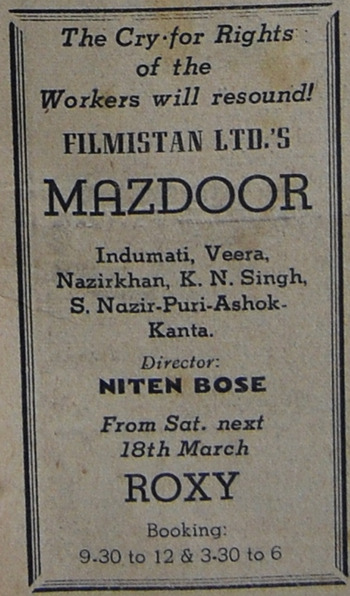
The arrival of ‘labour’ as a legitimate and useable political category (or, as Arvind Rajagopal puts it, as a ‘sanctioned political field’Footnote 104) in a public sphere that was more responsive to the Indian middle classes than to more subordinated social groups is also indicated by the following newspaper advertisement published in 1946:
Film advertisement, 1946.Footnote 105

Producers of commercial films and cinema owners could hope, at this time, to earn money with a film taking up the contemporary issue of labour struggles.
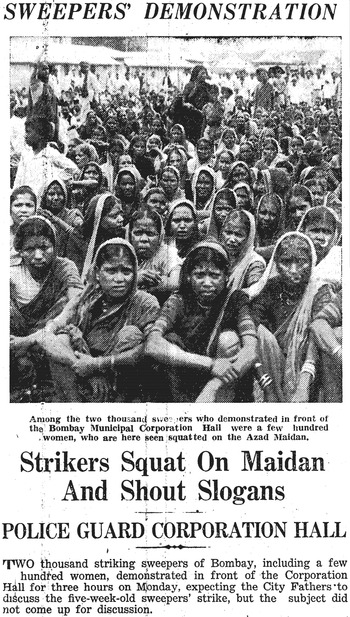
Furthermore, the spread of strikes to occupations involving large female workforces (such as beedi workers or municipal ‘sweepers’) resulted in the more visible presence of women in labour movements. The increase in female employment during the war in mines and the temporary suspension of the defeminization process that had been observable in factories during the interwar period certainly contributed to this greater visibility. This was also remarkable since workers' struggles had been (and were to be) strongly coloured by a culture of hypermasculinity that thrived in proletarian urban neighbourhoods inhabited by many more men than women. As early as in 1940, a hectographed two-part ‘diary’ of the mahangai (anti-dearness) strike in Bombay, published by the Communist Party of India (CPI), was unusual for its consistent emphasis on female participation. It vacillates between being a celebration of female violence and militancy (‘all women together womanhandled [a police officer] so vigorously’; ‘[t]hey are of steel and wrought iron’), the praise of women as the ‘vanguard of the strike’ whose hunger strike kept up the flagging morale of their husbands, and less refracted paternalistic clichés (‘so charming even in their militancy’).Footnote 106 Reports on violent encounters between women workers and the police reappeared during the post-war crisisFootnote 107 and towards the end of the movement. In June 1949, the Times of India illustrated one of its hostile reports on the strike of Bombay municipal workers with a photograph of a demonstration of stern-faced women (see Figure 8).
Image from the Times of India, 21 June 1949.

Apart from its greater geographic, occupational, and demographic spread, the strike movement of the late 1940s stood out against its predecessors for yet another reason. The growth of 30 per cent in factory employment during the war years was unevenly distributed between the public and private sectors. In 1939, no more than 8 per cent of India's factory workers were employed by the state; by 1945, this proportion had increased to 17 per cent.Footnote 108 With the simultaneous massive growth of the administrative apparatus as well as of state-administered communications and transport infrastructure, the state's importance as an employer had increased even more in the service sector than in the manufacturing field.Footnote 109 Railway employment alone rose by almost 50 per cent between 1938/39 and 1946/47 from 701,000 to over a million.Footnote 110 In addition, through the Defence of India Rules, by closely monitoring the labour situation and various legislative initiatives, the state had assumed a more direct role in the regulation of wages, labour relations, and prices of consumer goods during the war (see below). Both these spin-offs of the war economy had implicated the state more directly in labour conflicts, which, at the same time, turned it into a more visible target of industrial action. This was clearly recognized by contemporaries: for example, the employer organ Capital's regular columnist even believed that in 1946 he could discern greater public sympathy for public sector strikes:
A strike in a public service is always a good deal more spectacular than an ordinary industrial dispute—and usually more inconvenient to the community at large. The striker can usually rely on a residuum of not very precisely expressed sympathy from a public that has its own grouses against Authority in its various manifestations. In a country such as India, there is the added kudos that comes from striking a blow against an administration which, even though it be ninety per cent Indian, is none the less regarded as alien. None of this reflected glory comes the way of the striker in an ordinary industrial dispute, who usually gets a very poor press.Footnote 111
The legitimacy of strikes as a form of protest was thus increasing and strike activities came from unexpected quarters that worried both the outgoing British administration and their aspiring nationalist successors. The postal strike of July 1946 involved 50,000 postal employees according to government sources and affected large parts of the country for 23 days.Footnote 112 Repeated threats of a national railway strike were averted and reduced to the regional level only after considerable effort and, as we shall see, with the help of emergency powers and fierce repression. Postal and railway strikes together had the potential to paralyse the communication system on which both the state and businesses depended—a threat further enhanced by the repeated industrial action of dockers, tram and motor transport workers, as well as in India's newly founded first airline.Footnote 113 But the movement also spread to the no-less-essential coercive functions of the state: policemen took industrial action in more than one province, their forms of protest ranging from hunger strikes to armed confrontations.Footnote 114 By May 1946 the governor of Bihar believed that ‘the rank and file of the police cannot be relied on in any future emergency’.Footnote 115 The governor wrote from the perspective of a region that supplied police labour to much of northern and eastern India and which was now becoming a hotbed of police strikes.Footnote 116 At the other end of the subcontinent, half of the colonial crack troops of the South—the Malabar Special Police Companies aka ‘Madras Cossacs'—refused to go on duty in April 1946, inducing the government to immediately disband one of the companies.Footnote 117
This was particularly worrying against the backdrop of armed forces that faced a major demobilization drive and were considered politically unreliable by both colonial and nationalist office bearers. After all, the Royal Indian Navy's uprising in Bombay in February 1946 was conceived of by the ratings themselves and also discussed in public as a ‘strike’ thereby contradicting its criminalizing categorization as a ‘mutiny’ by the British commander-in-chief.Footnote 118 Nor were soldiers' strikes confined to the Navy or to Bombay and Karachi.Footnote 119 The connection between unrest among the armed forces and the unfolding wider strike movement was clearly visible at the time. As the government's railway member Edward Benthall noted in his diary, ‘We have been dealing with unrest in many cities, a mutiny in the R.I.N., strikes in the R.I.A.F. and a general state of indiscipline throughout the country, induced by a weakening of Govt's authority and power as the transfer draws nearer.’Footnote 120 This view is corroborated by an analysis of the Times of India’s coverage of strikes in the first half of 1946, which indicates that state employees, including members of the armed forces, spearheaded the strike movement: strikes appear to have been more prevalent in the state apparatus in the early months of the year, with the emphasis shifting to industrial enterprises only towards the summer.
In sum, the strike movement of 1946–48 contributed to a wider crisis of social authority that questioned, in particular, the stability and legitimacy of the institutions of the state. The British authorities felt increasingly ill-equipped to deal with this challenge. As the director of the government's Intelligence Bureau put it in August 1946:
[…] the labour situation is becoming increasingly dangerous […] Until a responsible Indian government is introduced at the centre, there is little that can be done […] I am satisfied that a responsible government, if one can be achieved, will deal more decisively with Labour than is at present possible.Footnote 121
He was not going to be disappointed.
State capitalism, minoritarian formalization, and the labour reforms of the 1940s
As has already been pointed out, the post-war crisis was far from unexpected and the interim government that took over in early September 1946, at the first climax of the strike movement, could draw upon a number of legal and administrative devices that had been developed or prepared by its predecessors. B. R. Ambedkar, the towering Dalit leader who had served as labour minister since 1942, was replaced by the Congress's ‘Harijan’ spokesman Jagjivan Ram, who would hold the office until 1952. Much of the programme for labour legislation—the ‘five year labour programme’ announced by the interim government a few weeks after its assumption of officeFootnote 122—had already been initiated during Ambedkar's ministerial term. This was partly in response to the recommendations of the 1931 report of the Royal Commission on Labour in India, partly a continuation of the labour policies developed by the Congress-led provincial governments in the years 1937–39 (crucially in Bombay under Labour Minister Gulzarilal Nanda), and partly as an offshoot of the exigencies of the war economy and of war-time etatism.Footnote 123 By 1942, Ambedkar had left behind, as Gail Omvedt argues, his years of radicalism to function for the next 15 years ‘within a statist-capitalist democratic structure’.Footnote 124 During his time as labour member of the war government, one might argue that, while state capitalism clearly provided the framework for social policies under the conditions of a war economy, it was exactly the weakening of the (no doubt severely restricted and socially distorted) structures of democratic participation in late colonial India and the enhanced autonomy of the Executive under the Defence of India Rules that opened the possibility for generating a more homogeneous and state-centred labour policy. Like Beveridge in England, who considered the war a ‘revolutionary moment in history’ that allowed for a comprehensive transformation of social policy,Footnote 125 Ambedkar perceived the war as an opportunity to push through a reform agenda that would have faced fierce opposition from entrenched interests at other times. He thus pointed out in 1943 that it was doubtful whether labour welfare, and particularly the establishment of tripartism as a principle of industrial relations, ‘would have taken concrete shape so quickly if the war had not made the maintenance of labour morale an urgent and immediate necessity’. He added that tripartism was ‘to last beyond the war. It is going to be an institution which will have a permanent place in the economic structure of the country.’Footnote 126 In December 1945, addressing a conference on the creation of an ‘industrial relations machinery’, Ambedkar explained his strategy as follows:
Industrial peace based on social justice is a hopeful proposition. This involves [a] triangular approach which must start by recognising (1) on the part of the workers, the duty to work which is the same as elimination of shirking; (2) on the part of the employers to pay reasonable wage—which is the same as elimination of exploitation and to provide comfortable conditions of work—which is another name for labour welfare; (3) the duty on the part of the State and Society to realize that the maintenance of proper industrial relations is a public affair and is not a mere matter of contract between the employer and the employee.Footnote 127
The labourer's obligation to work, the employer's obligation to pay ‘reasonable wages’ and provide labour welfare, and the state's obligation to regulate industrial relations—these three general principles were articulated, through the conflicts of the post-war crisis, in a specific corporatist form that emphasized the powers of the state. They were translated into policies that sought to reduce ‘shirking’, fluctuation, and ‘absenteeism’ (a buzzword of the 1940s and 1950s) among a core of the industrial workforce. These policies also sought to restrict the workers' right to withhold their labour power (as in strikes), claimed to regulate standards of compensation (for instance, by fixing a minimum wage), and created the legal scaffold for a peculiar, potentially authoritarian, form of tripartism, in which the state possessed far-reaching powers to enforce ‘proper industrial relations'. The third of Ambedkar's principles, in particular—that relations between labour and capital were to be considered a ‘public affair’ and not ‘a mere matter of contract’—was, and continued to be, at variance with the views held not only by British capital interests in India, but also by segments of their increasingly influential Indian counterparts (see below). Yet the breach of their defences, effected under the strain of war conditions and compensated for generously by war gains, could not be closed in the years of the post-war crisis: an enlarged and invigorated strata of higher-level bureaucrats and judicial functionaries in control of the resources of state power had achieved a certain degree of autonomy from the dominant forces of Indian society.Footnote 128
Accordingly, the major pieces of labour legislation in 1947 and 1948, which had been prepared under Ambedkar's supervision, all reflected this approach. They were enacted under the interim government, but mostly under the first government of independent India.Footnote 129 The Industrial Disputes Act of 1947 was based on the Trade Disputes Act of 1929 and also included provisions from the Defence of India Rule 81A that committed strikes in so-called ‘public utility’ industries to compulsory arbitration by a state tribunal, which put severe limits on the right to strike.Footnote 130 During the strike movement of the late 1940s, the ‘elastic provisions’ of this law were interpreted most generously and a wide range of industries, ranging from steel and cotton via sugar and salt to hosiery, inland shipping, motor transport, and tramways were declared ‘public utility industries’ at one point or the other.Footnote 131 The commanding role of the state in this regime of industrial relations bore the traces of its war origins, but was put on a permanent footing during the crisis of the late 1940s. The consolidation of the state's war-time emergency powers went along with a militaristic imagination of labour: Asaf Ali, railway member of the interim government, demanded, for instance, in October 1946 that ‘[a]ll workers should regard themselves as a national army in the economic trenches of the country’.Footnote 132 The resulting labour policy, with its heavy emphasis on state regulation, was criticized not only from the socialist and communist left, but also by liberal circles within the Congress itself. V. V. Giri, Jagjivan Ram's successor as labour minister in 1952, attempted to reduce compulsory state arbitration in order to allow for what he considered to be proper ‘industrial bargaining’, and he stepped down as minister when these measures were stonewalled at the level of government with the support of all trade union federations, barring the AITUC.Footnote 133 As a result, an extraordinarily state-centric industrial disputes law has remained in force ever since—a highly visible long-term consequence of the crisis of the late 1940s.
The other major pieces of legislation that had been prepared during Ambedkar's tenure at the Labour Ministry, and which were finally enacted in 1948, represented the welfarist component of a labour policy driven by wartime exigencies first and then by the pressures of unprecedented labour unrest. While the Factories Act sought to counter post-war unemployment by reducing the working week from 60 to 48 hours, the Minimum Wages Act aimed at preventing a further drop of wages in a flooded labour market.Footnote 134 The Employees State Insurance Act followed the recommendation of the Royal Commission on Labour to set up health insurance for industrial workers and was based on a 1944 report by B. P. Adarkar, in turn inspired by the famous ‘Beveridge Plan’ for Britain.Footnote 135 It is easy to perceive these pieces of legislation as part of a virtually global drive towards welfarism in the mid-twentieth century and to miss, at the same time, their specificity. The key issue in the preparatory debates for such legislative initiatives, ever since the Workmen's Compensation Act of 1923, was always the question of scope. It was here that employer and worker representatives clashed at tripartite labour conferences and it was here that state officials trod with particular caution and emphasized the ‘importance of going slow’.Footnote 136
The remit of these laws was thus, more often than not, narrowly circumscribed and their actual implementation even more constricted. The Employment State Insurance Act of 1948, for instance, applied only to perennial factories (or to about two million workers), although, in practice, only 1,095 million employees were covered by the scheme in 1957.Footnote 137 The 1946 Industrial Employment (Standing Orders) Act, a seemingly innocuous piece of legislation that applied to all industrial establishments employing 100 workers or more, was instrumental in defining differences in the employment status of employees within ‘organised sector’ industries—differences that translated into differential entitlements with regard to legal protection and social benefits.Footnote 138 A Government of India draft of ‘Model Standing Orders' provided, for instance, the following finely graded ‘classification of workmen’: permanent, probationers, badli (substitute), temporary, casual, and apprentice. Each category enjoyed differential rights and only permanent workers were entitled to a notice period if their contracts were terminated.Footnote 139 A 1956 amendment to the Standing Orders Act explicitly excluded from its ambit workers hired by a contractor.Footnote 140 The Railway Servants (Hours of Employment) Rules of 1951 made analogous distinctions between different categories of workers: weekly working hours of ‘intensive workers’ were limited to 45 hours, of ‘continuous workers’ to 54 hours, and of ‘essentially intermittent workers’ to 75 hours.Footnote 141
A pattern emerges from the multiple, contradictory, and overlapping debates on the scope of social and labour laws in that period. I contend that the late 1940s were a catalytic moment in the history of India's politics of labour, not only because it was then that its state-centric industrial relations regime took definite shape. It was also a moment when the divide between what would later be called the ‘informal’ and ‘formal’ economies was deepened and held up by way of legislation and jurisdiction. This was a complex process, which requires a detailed examination that is beyond the scope of this article. Here we confine ourselves to outlining some of its key aspects. Prabhu Mohapatra argues convincingly that the formal–informal divide must not be understood as a division between a ‘modern’ and ‘traditional’ employment sector, but as a historically produced distinction, with law functioning as one of the crucial regulatory devices for the separation of the two spheres.Footnote 142 A historical reconstruction of this process of separation and a chronology of the emergence of the formal–informal divide is lacking as yet, however. Raj Chandavarkar, in his 1994 monograph on business strategies and the working classes in Bombay, hinted at a possible (and in my view, plausible) chronology of (in)formalization, without further developing the point: ‘the divide between the formal and informal sectors was entrenched and formalized only by changes effected in the legal framework and conditions of employment beginning in the late 1930s and gathering momentum after the Second World War,’ he writes.Footnote 143 Ten years later, he returned to the issue, observing for the Bombay textile industry that the reorganization of labour recruitment and labour processes since the 1930s had resulted in a more clear-cut division between a ‘permanent’ and directly employed workforce, on the one hand, and a ‘badli’ and contracted workforce, on the other. By the 1950s this sharper differentiation of labour relations generated, in turn, a new polarization of social experiences in Bombay's industrial workforce which began to undermine the foundations of the labour movement.Footnote 144 Anna Sailer's recent path-breaking study of the transformation of the labour process in the Bengal jute industry in the interwar period renders such processes visible at the level of the shop floor in a very different industrial and political setting.Footnote 145 The reforms of the late 1940s, I hypothesize, may be understood as the legal ratification of an ongoing process, which affected not just the Bombay cotton mills, but also a wider range of Indian industries. This process was reflected in debates on the implications of poor living conditions on the ‘efficiency’ of Indian factory workers that had never disappeared after the Indian Industrial Commission first raised the issue in 1918.Footnote 146 In the 1940s and 1950s this debate came to focus on the issue of labour ‘absenteeism’ as ‘an important problem of labour welfare and one of the root causes of labour unrest and reduced national output’Footnote 147 and—a view later severely critiqued by Morris D. MorrisFootnote 148—as a ‘manifestation of partial commitment to industrial employment by Indian labor’.Footnote 149 The enactment of almost every piece of protective social legislation of the post-war years was accompanied by the assertion that its scope would be expanded successively: ‘I am sure,’ said Labour Minister Jagjivan Ram, ‘amidst cheers’ when the Employees’ State Insurance Act was passed in the Legislative Assembly, ‘that the Corporation [sic], the Provincial Governments and the Central Government will take the earliest opportunity to extend the scope of the Bill as soon as conditions permit.’Footnote 150 In fact, protective legislation remained largely confined to factory labour and sealed off, accordingly, a small section of India's labour force from the vast majority.
This process of ‘sealing off’ the formally from the informally employed was facilitated by the large-scale retrenchments that were implemented at that time: the war-time labour scarcity, which had opened doors for new or formerly casual workers to more continuous and direct employment, was clearly over. Many of the new entrants were turned out before the doors were shut again, in part with legal sanction. Accelerated defeminization was part of this process. If the process of defeminizing India's formally employed workforce, which had set in during the interwar period, slowed down, and was partly reversed in the war years, it now gained momentum again.Footnote 151 Protective legislation served to exclude women from formal employment both directly (as in the case of underground mining, where the legal ban on female employment was reimposed in 1946)Footnote 152 and indirectly (as per employers' efforts to avoid the costs of maternity benefits and other new, or more strictly implemented, protective legislation). Accordingly, we find leads—to be followed up by further research—that measures aimed at the separation of a ‘core’ and a ‘peripheral’ workforce by way of casualizing the employment relationships of the latter tended to target women first.Footnote 153
Disciplining labour: ‘industrial truce’, state-led tripartism, emergency powers
The exigencies of the war economy and the emergency powers of the war government secured the acquiescence even of business circles to a state-capitalist agenda and engendered its quick institutionalization. In the post-war years the counter-forces to this development attempted to regain lost ground. D. C. Driver, president of the Indian Chamber of Commerce, expressed, perhaps most bluntly, the position of those who wished to roll back state capitalism altogether in a speech in early 1948. He was reported to have asked the government to ‘“keep in cold storage the ideological excellence of their theories” and to give the present system 20 years to work its own way, unfettered as before the war, with pre-war tax levels’. This, and not ‘socialistic experiments on one-sixth of humanity’, was the way forward for India's industrialization, he declared, and ‘suggested that Government should try out their ideological theories on a laboratory scale in a limited area like the island of Andamans'. The impediments to an increase of production were, according to him, ‘the proposed limitation of dividend, “diverse threats of nationalisation, suffocating taxation and increasing financial burden of existing and proposed labour laws”’.Footnote 154
The dominant and most politically influential group of big business leaders continued, however, to support certain aspects of state capitalism (such as coordinated state investment in infrastructure and capital-intensive industries, protection of Indian capital from foreign competition, or state subsidies), while opposing all measures to infringe on their property rights—the latter included not only nationalization and the establishment of state monopolies in certain industries, but also all regulatory measures that reduced the proprietor's discretionary powers such as caps on prices and profits or ‘interference’ with any aspect of managing capital.Footnote 155 Such issues of ‘interference’ generally included, with regard to labour, policies based on Ambedkar's third principle—‘maintenance of proper industrial relations is a public affair and is not a mere matter of contract between the employer and the employee’—as well as all social policy schemes requiring redistributive measures.
While socialistic pronouncements on the part of Congress leaders reflected, more than anything else, the horizon of expectations that the prospect of ‘swaraj’ had raised among sizeable parts of the future electorate, the actual conflict within the new Congress government concerned the form of state capitalism that was to be promoted by the post-colonial Indian state. Consequently, the competing wings of the Indian National Congress differed on how to deal with the labour crisis of the late 1940s. The conservatives around Patel, in control of many of the provincial Congress organizations, supported the stance of big business. Accordingly, they were averse to redistributive social policies, including the continuation of war-time controls on business, and favoured instead a strongly disciplinarian approach to labour. In December 1947 and January 1948 they accomplished, with Gandhi's support and in accordance with the recommendations of a Foodgrains Committee dominated by business leaders, the ‘decontrol’ of food and cloth prices. The assumption was that actual scarcity was limited, that hoarded commodities would be released onto the market, and that prices would eventually decline after the abolition of distorting controls. In reality, however, food grain prices soared in the following ten months (by about 150 per cent in three major regions: Bombay, the Central Provinces and Berar, and the United Provinces). To fend off a politically destabilizing famine, and despite its objective of disengaging with commodity markets, the government eventually had to step up costly grain imports to 2.1 million tons (above even wartime levels) in order to supply its cheap grain shops. The rise of textile prices within the first seven months of the year ranged between 50 and 200 per cent, as Industries Minister S. P. Mookerjee had to admit in August 1948 to the Constituent Assembly. As a result, the wage increases achieved in 1947 were largely cancelled out and a resurgence of labour unrest was anticipated. Between July and December 1948, the policy of ‘decontrol’ had to be reversed step by step after turning out to be, in the words of a contemporary economic analyst, ‘the most disastrous and costly experiment by the Government’.Footnote 156
D. R. Gadgil, the eminent economist who would subsequently assume key offices in the Reserve Bank of India and in the Planning Commission, located these developments in the context of a political shift he discerned for the year of 1947. The interim government of 1946–47 was, according to him, ‘a composite one in which two opposing forces were represented; one in favour of private enterprise and of giving Indian capitalists full opportunities and the other with a bias against Indian capitalists and, therefore, tending towards a programme of socialization and high taxation of business and industry’. After the partition of India, the forces ‘capable of withstanding [the] pressure of Indian capitalists’ had been weakened or had even, according to Gadgil's assessment in 1949, ‘vanished from the scene’.Footnote 157
This assessment of the government's political shift to the right was shared by the Congress socialists who could not translate the esteem they had gained during the Quit India Movement of 1942 into an ability to substantially influence the policies of the first post-colonial dispensation. As a result, they were increasingly alienated from the party and in March 1948 parted ways with the Congress, denouncing its business-friendly and authoritarian approach.Footnote 158 Jaya Prakash Narayan, their most respected spokesmen, accused the Congress-led government as early as late 1947 of not representing ‘real swaraj’,Footnote 159 believing that he discerned ‘a nascent Indian fascism over which strangely enough a democrat like Pandit Nehru presides’.Footnote 160 The socialist leader thus chose, despite otherwise unbridgeable political differences, a vocabulary virtually identical with that employed at that time by the ultra-left CPI leadership under B. T. Ranadive.Footnote 161 Such verbal radicalism may well have reflected the inability of all sections of the Indian left to connect the dynamism of powerful social movements to a socially and politically broad-based minimum programme and, consequently, their helplessness in countering their increasing political marginalization.
At the same time, the disaster of the ‘decontrol’ episode brought home to the Congress conservatives the fact that a simple return to a pre-war economic policy, specifically a complete rollback of the increased regulatory power that state institutions had gained over capital owners in the course of the war years, was not a feasible political option. With regard to labour, the diverging currents within the Congress leadership eventually settled for a combination of redistributive (or ‘welfarist’) and disciplinarian policies. This was already reflected in the ‘Industrial Truce Resolution’ adopted by the Industries Conference in December 1947Footnote 162 and in the measures towards its implementation, which were approved by the tripartite Indian Labour Conference and Labour Standing Committee in April 1948.Footnote 163 This resolution was jointly passed by representatives of the government, of employer organizations, as well as by delegates of the recently founded and Congress-affiliated Indian National Trade Union Congress (INTUC) and the Indian Federation of Labour (IFL), while the more radical AITUC remained excluded. The resolution proceeded from the assumption that increasing production was the primary need of the nation and that wage increases would merely fuel inflation if they were not preceded by an upturn in economic growth. Labour was reminded of its ‘duty in contributing to the increase of the national income without which a permanent rise in the general standard of living cannot be achieved’.Footnote 164 While other factors for the post-war drop in industrial production (namely, the lack of transport infrastructure and the insufficient availability of raw materials and capital goods) were mentioned and the lack of both foreign and domestic capital investment, persisting well into the 1950s, was somewhat glossed over, industrial relations were given prominence in the analysis. Industries Minister S. P. Mookerjee opened the conference by asserting that ‘[o]f the many causes responsible for the fall in production, the most important was the unsatisfactory relations between labour and industry’.Footnote 165 He was promptly seconded by his predecessor Sir Ardeshir Dalal who claimed, on behalf of the employers, that ‘more than anything else, labour difficulties were retarding the increase in production’.Footnote 166 The argument was summed up most succinctly in the phrase ‘produce or perish’—the crisp title of an All-India Radio broadcast series, to which Prime Minister Nehru himself contributed on 18 January 1948.Footnote 167 This refrain was to be heard perpetually in the following years, presented by Nehru and his followers as an appeal to reason, in a social-democratic tone,Footnote 168 and, simultaneously, in the language of conservative authoritarianism, as an open threat. Vallabhbhai Patel, in a controversial speech given in Kamgar Maidan in Bombay two days later, warned his audience that ‘if workers want more wages they must produce more, failing which they will perish’.Footnote 169
The key provisions of the ‘Industrial Truce Resolution’ of December 1947 consisted of a commitment on the part of employers and workers to abstain from strikes and lock-outs for a period of three years—a commitment to be implemented by a ‘machinery’ of tripartite committees extending from the level of the factory to that of the nation. In return, a scheme for the ‘fair’ distribution of the gains of industrial production would be devised:
The system of remuneration to capital as well as labour must be so devised that while in the interests of the consumers and the primary producers excessive profits should be prevented by suitable measures of taxation and otherwise, both will share the product of their common effort after making provision for the payment of fair wages to labour, a fair return on capital employed in the industry and reasonable reserves for the maintenance and expansion of the undertaking.Footnote 170
In April 1948, in the context of the government's industrial policy statement, it was decided that the details of this system of ‘fair wages’ and ‘profit-sharing’ were to be worked out by a tripartite Central Advisory Council with the support of an Expert Committee at the national level that was to include employer, trade union, and government representatives.Footnote 171 In a slow and cumbersome process, two legislative initiatives were prepared on this basis. The first was a law that would regulate the determination and payment of ‘fair wages’ to—‘in the first instance’—factory workers and miners. Such wages were to provide a family of four with food, shelter, clothing, medical expenses, and education ‘appropriate to his [the worker's] station in life’. Such wages, obviously modelled on the notion of a male breadwinner, were to be fixed by tripartite bodies and linked to the cost of living index.Footnote 172 The initiative was persistently critiqued by employers and their press organs. The Eastern Economist argued, for instance, that ‘fair’ wages could only come at the expense of employment and thus implied ‘grave political dangers’ that would eventually benefit only the communists.Footnote 173 Consequently, it took 32 months from the ‘Industrial Truce Resolution’ until the Bill was introduced in parliament,Footnote 174 with Prime Minister Nehru apologizing for the delay a few months earlier.Footnote 175 The Bill lapsed, however, with the dissolution of the provisional parliament, was not reintroduced, eventually coming to nothing.Footnote 176
The second, even more controversial, initiative was that for ‘profit-sharing’—essentially a scheme for establishing parameters and a tripartite institutional structure for the redistribution of profit shares to the workforces of businesses in key industries like textiles or steel. The AITUC, by now increasingly on the political margins, opposed the scheme since it considered it a ruse to ‘side-track the workers’ struggle for a living wage’ and because they were ‘opposed to production for profit’.Footnote 177 Representatives of the nationalist INTUC and the socialist Hind Mazdoor Sabha (HMS) trade union federations, founded in competition to AITUC in 1947 and 1948 respectively, participated in the negotiations, but were somewhat reluctant: shares of a fluctuating profit determined at the level of individual businesses appeared less secure and less legally enforceable than bonuses based on production figures.Footnote 178 Employers were opposed to any scheme implying a rise in labour costs, but particularly to one that undertook to cap dividends and interfered, from their perspective, with property rights by involving worker and state representatives in management decisions.Footnote 179 In June 1949, the conservative Indian Social Reformer brought out the crux of the matter with admirable clarity:
The opposition of Capital to profit-sharing is not due to cupidity, nor can it be ascribed to a feeling that, since the burden of loss is wholly borne by it, it is entitled to all the profits. It is much more fundamental in that it opposes a step which must entitle workers to inspect profits, to be told the exact financial position of the concern in which they are working, and ultimately to suggest more efficient and economic ways of working the business. However well disguised these matters might be, profit-sharing does involve all of them and there is no use trying to get away from the fact. If any plan of profit-sharing is to work, trade unions will have to engage auditors and to secure the right to inspect the books of the company. As matters stand today, there will be serious danger of the real management shifting from the hands of business to the workers, and with it will arise political labour disputes intensified far beyond the present state of affairs. The only form of profit-sharing which does not involve a direct interest in management, is the bonus.Footnote 180
Indian business magnates were more diplomatic in their statements, but had come to the same conclusion—a year earlier, G. D. Birla had declared ‘I have no doubt that profit-sharing is impracticable’ and had proposed instead ‘a production bonus on a sliding scale’.Footnote 181 In September 1948, the Advisory Council could not agree on a report agreeable to the labour delegates and its attempts to concretize the profit-sharing scheme resembled, as the Bombay-edited paper Commerce jeered, a ‘wild-goose chase’.Footnote 182 A British official reported to his London superiors that the joint secretary in industry and supply,
who was principally concerned in steering the Committee's deliberations […] pointed out that the Committee—as far as he was concerned—had done the two necessary things: (1) produced a report which could easily be rejected at the administrative stage; (2) frightened Labour by revelations of some of the possible consequences of profit-sharing.Footnote 183
After almost another year, negotiations ground to a halt when the employer representatives insisted that the economic situation of the country did not permit the plan to be pursued further for the time being.Footnote 184 Looking back a decade later, V. V. Giri could only confirm the analysis of the Indian Social Reformer: ‘Requests for facilities for looking into the balance sheets of the companies were resented as unwarranted interference in the sphere of management. Such an attitude defeated the very object and purpose of the profit-sharing scheme’, which eventually ‘failed’.Footnote 185
As a first step to raise the living standards of workers, the ‘Industrial Truce Resolution’ had also declared that ‘immediate attention’ was to be given to a scheme of industrial housing, the costs of which were to ‘be shared in suitable proportions between the Government, employers and labour, the share of labour being given in the shape of reasonable rent’.Footnote 186 Labour Minister Jagjivan Ram announced the proportions of this scheme in the Constituent Assembly early in April 1948: one million worker tenements were to be built within ten years.Footnote 187 A year later, however, an enquiry uncovered ‘that no plans have been drawn up as yet for this scheme’.Footnote 188 The impressive housing programme was reformulated, restructured, and downsized several times, but the requisite funds could never be found.Footnote 189 The elephant, eventually, gave birth to a mouse.
What remained, then, for all practical purposes was a government-sanctioned ‘Industrial Truce Resolution’ which declared that for three years any strike would be directed against the vital interests of the nation and consequently considered an unpatriotic act. Ostensibly this was aimed at the CPI, the communist-dominated AITUC, and those other leftists who were considered potential ‘fellow-travellers’: since early 1947, Indian government circles (as much as British analysts) had held the communists were responsible for the continuation of the strike movement—not for inventing the workers’ real enough grievances, but for abusing their dissatisfaction for ulterior political, most likely Soviet-directed, purposes by fomenting strikes in order to destabilize the country. In response to strikes that defied the ‘Industrial Truce Resolution’ in early 1948, Home Minister Patel passed, according to the British high commissioner, ‘invariably […] the strongest possible strictures on what he called the disruptive tactics of the Communists who, by discouraging production and fomenting unrest, were doing the greatest possible disservice to the country in the early days of its independence’.Footnote 190 After its insurrectionist turn in March 1948, the CPI saw itself, too, as the actual leader of what it perceived as a renewed and invigorated upsurge of the strike (and peasant) movement under conditions of increasing state repression—a role it would fail to perform only if and when internal ‘opportunism’ and ‘treachery’ held it back.Footnote 191 Scholars have tended to accept such leadership claims, confirmed, after all, by both antagonists, even though a variety of contemporary voices indicate a more complex picture.Footnote 192
In the early phase of the strike movement even AITUC president M. K. Bose was quoted as having stated that most of the strikes of the recent ‘wave’ ‘were neither co-ordinated nor regulated and instead of helping would retard the progress labour was making’.Footnote 193 The limited and uncertain hold of national-level trade unions, regardless of their political affiliation, over the strike movement was also stressed by British observers: ‘In general it appears true,’ concluded a 1949 secret report on the Bombay Province, ‘that no man, or Union organisation or political party could command support of anything like the majority of labour in any one industry at any one time, let alone the majority of industrial labour as a whole.’Footnote 194 At the all-India level, they believed, ‘labour tends to follow the organisation which promises most and this results in unstable union membership with frequent transfers of allegiance from one organisation to another’.Footnote 195 For the engineering industry in Calcutta, which had seen some of the most militant strikes in eastern India, it was stated that even though the strength of unions was considerable, there were ‘signs of a tendency among the workers to repudiate unions completely and to rely on direct negotiations with employers through such bodies as the Works Committees under the Industrial Disputes Act’.Footnote 196
Recent case studies, for instance Ahmad Azhar's on the railway workshops of Lahore or Anna Sailer's on the Calcutta jute industry,Footnote 197 point out that local levels of militancy, leadership, and organization need to be taken more seriously; these shaped labour movements more deeply than the often-temporary choice of English-educated frontmen (and occasionally -women) associated with one or the other political current. So while a strong communist presence in the late 1940s strike movement is clearly evident, no political party was able to organize strikes involving almost two million workers (even according to official figures) against their will.Footnote 198 The communist conspiracy argument thus had multiple political uses in early Cold War India, but it does not explain the labour upsurge of the late 1940s. The communists, for their part, alienated most of their allies in the AITUC and embarked on an insurrectionist party line, thus providing their adversaries with the ammunition they had lacked and facilitating their efforts to undercut popular support for the labour movement. The ‘Industrial Truce Resolution’ was used as an instrument to undermine the position of the now communist-led AITUC, and the combined powers of Congress and government were applied to install their own union, the INTUC, in its place. Heavy-handed repression, always justified with an assumed Moscow-engineered plot to destabilize India, targeted not only AITUC-connected labour organizations or strikes, but also other labour activists, among them those associated with the newly founded HMS trade union which united former Congress socialists and ‘Royists’ from the now defunct Indian Federation of Labour.Footnote 199 The political polarization between communists and socialists ruled out, at the same time, the possibility of joint action.
Against a background of soaring prices for food and cloth, the ‘Industrial Truce Resolution’ did not immediately rupture the dynamism of the strike movement, however. Employers complained about its failureFootnote 200 and the British deputy high commissioner wrote, with unconcealed Schadenfreude, that the worker ‘could hardly be expected to show enthusiasm when he found that while he was treated with sermons and threats, the profiteers were getting on merrily with their loot’.Footnote 201 From the second half of 1948, delayed perhaps by the political fallout of Gandhi's assassination on 30 January, levels of repression rose and thousands of trade unionists and militant workers were arrested across the country.Footnote 202 On May Day 1949, at the height of the wave of repression, Vallabhbhai Patel addressed an INTUC rally in Ahmedabad with characteristic bluntness: ‘Nothing is more shameful to us than to fire upon our own brothers and there will be no necessity of resorting to fire if labour follows the leadership of INTUC.’Footnote 203 At this time, the provincial and central governments embarked on a policy of breaking strikes at any cost. The Bombay municipal sweepers’ strike of 1949, the fourth since the end of the war and which lasted for five months, is a particularly interesting case, as the municipal and provincial governments made a point of crushing the protest of a predominantly Dalit workforce in the most deterrent way possible.Footnote 204 However, the key event epitomizing the end of the post-war strike movement was the suppression of a planned national strike of railway workers, which a British official report to London appreciated as ‘a signal success over subversive activity’.Footnote 205 Responding in great detail to a question in the Constituent Assembly on 28 February 1949, Prime Minister Jawaharlal Nehru confirmed that 870 people had been arrested within 10 days in connection with the planned railway strike, justifying this measure as preventive action against communist insurgency.Footnote 206 The Times of India reported approvingly on 11 March 1949 that another 800 railway workers had been arrested within the previous 48 hours, 300 alone in South India.Footnote 207
The suppression of the strike movement of the late 1940s did not rely exclusively on the state apparatus and its coercive potential, however. Its erasure from historical memory in subsequent decades resulted from the successful spread of the seemingly commonsensical idea that all that mattered during the explosive post-war years could be reduced to the twin processes of independence and partition. This hegemonic notion was achieved by a distinction between legitimate and illegitimate social demands. In April 1948, Prime Minister Jawaharlal Nehru thus argued in a lengthy statement before the Lok Sabha that ‘[t]hose who undoubtedly suffer because of retrenchment should remember the fate of the vast numbers of our countrymen whom a cruel destiny has hit so hard’. Partition, here endowed with a quasi-metaphysical status as a ‘cruel destiny’, was juxtaposed with the concern of losing one's subsistence, which was implicitly assigned a lesser, merely material status. Here, then, the needs of partition refugees were used to justify strong disciplinary action against striking employees of the ‘public services’.Footnote 208
A ‘demobilization’ of labour? Contradictory results of India's post-war crisis
I conclude this article by highlighting the two structural changes that emerged from the crisis of the late 1940s and turned it, with regard to class formation and labour policy, into a catalytic moment in the social history of twentieth-century India. The first I will merely repeat and point at, leaving an in-depth discussion to a future study:Footnote 209 the hiatus between the ‘formally’ and the ‘informally’ employed, already emerging in the changing organization of labour processes in several industries, was deepened by means of legislation and juridification, that is, by new and more far-reaching labour laws and intensified jurisdiction with regard to labour issues. This created not only greater tensions and more diverse structures of self-identification within India's working classes, but also implied that trade unions were driven to narrow down their activities to the ‘organized’, formally regulated workforces, with a heavy emphasis on their legal representation. Consequently, the development of a single strategy addressing, uniting, and immediately benefiting all sections of the working classes became increasingly problematic: gains were much harder to achieve in the enormous realm of informally regulated labour, where recourse to the newly established labour tribunals and courts was more difficult or even ruled out.
The second structural change is clearly the emergence of a strongly state-centred industrial relations regime that limited the rights of trade unions to an extent that is unusual in many other parliamentary democracies. That said, we still need to specify these limitations and their extent. Vivek Chibber argues that the long-term political ‘demobilization’ of Indian labour was the main outcome of the crisis of the late 1940s. This, he believes, effectively destroyed the ability of Nehru and the Congress left to achieve a ‘disciplinary’ form of planning, that is, a type of developmentalist planning premised on the preservation of a measure of state autonomy against the hegemonic power of Indian big business.Footnote 210 While I agree with Chibber's refutation of the hypothesis that the economy of Nehruvian India was shaped by ‘socialist planning’ in its substance, I do not think the demobilization thesis holds much water. The diagrams of industrial disputes in India, which were discussed earlier in this article (see Figures 3–5), indicate a return to a high level of strike activity as early as in the mid-1950s, not to mention later, even more extensive, and intensive movements. As pointed out before, the data are likely to exaggerate long-term trends in industrial conflict, but still cast doubt on the validity of the ‘demobilization’ argument.
Even more importantly, the ‘depoliticization’ of the labour movement had been one of the publicly declared objectives of the two-pronged strategy of legislation/suppression. Congress spokesmen,Footnote 211 employers,Footnote 212 as well as BritishFootnote 213 and AmericanFootnote 214 observers all agreed that uneducated and essentially apolitical workers were regularly misled into supporting political projects unrelated to their ‘true’ interests. They also concurred that an ‘irresponsible’ trade union movement politically opposed to the new post-colonial dispensation constituted a national and even international danger. Congress's response was to withdraw its members from the AITUC, to create a new, presumably apolitical, trade union federation (INTUC), and use the combined powers of capital and state to marginalize its competitors.Footnote 215 If a ‘fascist’ peril was proclaimed by leading protagonists of the Indian left at that time, this was—even according to contemporary internal critics—a case of severe political misjudgement and hysterical oratory,Footnote 216 but it also reflected political resonances that were hard to ignore. For Italian fascism, much more than its German counterpart, had gained a certain popularity among sections of India's nationalist intelligentsia and policy circles in the 1930s, not least because of its policy of authoritarian corporatism which seemed to guarantee the containment of class conflict and the creation of national discipline.Footnote 217 These voices had not been fully silenced after Mussolini's inglorious exit from the historical stage. The deeply authoritarian current within India's post-colonial bourgeoisie that has resurfaced, once again, in recent years was discernible even then. If Mussolini had successfully crushed the ‘biennio rosso’—Italy's two ‘red years’ after the First World War—was there not a lesson to be learned for India's post-war crisis? The issue was repeatedly raised, for instance, in the pages of the influential conservative-nationalist weekly Indian Social Reformer. In July 1946, when the strike movement approached its first climax, an editorial denounced the detrimental effects of frequent strike threats on ‘public morale’ and called for a ‘more rational substitute’ for strikes. It ended by conjuring up the ghost of the only recently disembodied ‘Duce’: ‘Mussolini, it may be recalled, found in the social and economic dislocation of frequent strikes, his chief argument for State control of factories. The workers, he argued, were entitled to protection from exploitation, but were not entitled themselves to exploit the public.’Footnote 218 Early in January 1948, now under the new post-colonial dispensation and shortly after the adoption of the ‘Industrial Truce Resolution’, another editorial brought the same message out with even greater clarity:
Mussolini and Hitler clearly realised that uncontrolled private enterprise in industry was a danger to the state. They did not abolish it but brought it under strict state control. They also realised that labour too had to be controlled in its own interests as well as that of the nation as a whole. They took upon themselves to see that fair wages and treatment were given to labour and forbade strikes as they were unnecessary. This worked well in Fascists States and Nazi Germany where unemployment practically ceased.Footnote 219
Given the weekly's otherwise critical distance from the defeated dictatorships of the European right, the point appears to have been not to propagate a full-scale resurrection of European fascism on Indian soil, but rather to salvage and normalize the power technologies of authoritarian corporatism from the debris of that deeply discredited regime. As K. Natajaran, the weekly's editor, had argued a few months earlier, the
[…] technique of Fascism is largely entering into the democratic machinery. Mussolini was inspired to invent Fascism by the recurrence of industrial strikes impeding production and endangering the economic basis of society. The democracies are adopting to deal with strikes nearly the same methods. Gandhiji has recently declared that ‘Strikes’ for increase of wages or reduction of working hours, even though not violent, are not entitled to the dignity of ‘Satyagraha’.Footnote 220
Gandhi's communitarianism was here, curiously enough, invoked to give legitimacy to an authoritarian organicism that prioritized the requirements of the state (or of a nationally defined ‘community’) over the needs of both the individual and of social ‘groups’ (or classes), much along the lines that had marked out the corporatist ideology of Italian fascism.Footnote 221 This brand of anti-liberal and, simultaneously, anti-socialist corporatism did not require an explicit reference to Mussolini and could, instead, appeal to an authoritarian ‘common sense’ prevalent among sections of the Indian middle classes. Another author in the same journal used this way of thinking to deny public sector employees in particular the freedom to strike:
Now the fact that the worker's right to strike evolved at a time when the laissez-faire attitude was at its height, and the fact that the laissez-faire system today stands discredited, should make one pause and revise one's ideas of the rights of the individual. It is thoroughly illogical to want the state to plan the community's economic life whilst denying it the right to see that the various sections that participate in its work, are not sabotaging the very plans that the requirements of the community have induced it to frame. Seen in this perspective there are small chances of the right to strike against the state being accepted now.Footnote 222
These were voices from the conservative end of India's political spectrum, no doubt, but a much wider range of political actors subscribed to the objective of suppressing strikes altogether, if possible. Take Naval Tata, for instance, who would represent Indian business at ILO conferences for decades as the incarnation of the ‘progressive’ businessman advocating labour reforms, tripartism, and a new ‘partnership’ between capital and labour. In a 1947 essay on the ‘labour problem in India’ he conceded that ‘strikes and lockouts are, to a certain extent, probably inevitable in a free democratic society’, only to proceed to outline a ‘utopian’ scheme that might enable the abolition of strikes. He mused over
[…] a covenant between the union and the employer to the effect that, in the event of a dispute which cannot be settled by mutual negotiations, a state of strike is declared without a strike taking place. At that stage, an arbitrator adjucates the dispute and the offending party, if an employer, is made to pay a special compensatory bonus, and, if the verdict of guilty is against the labour, the workers are penalised in the form of forfeiture of a portion of their wages.Footnote 223
The scheme thus not only stipulated a contractual obligation on the part of workers to abstain from strikes and submit to arbitration, but also implied a financial risk for them when choosing the route of ‘peaceful’ arbitration—a financial risk that was obviously more difficult to bear for precariously remunerated workers. Naval Tata deplored that such proposals had to remain ‘wishful thinking’ in ‘this imperfect world’. Relevant for our discussion, however, is that his notion of abolishing strikes by means of contract (guaranteed, like all contracts, by the state) resonated strongly with the idea of abolishing strikes by direct means of applying state power that were circulating and, to some extent, practised at the same time: one differed with regard to the instruments to be used, but the desirability and urgency of the goal remained uncontested. Statist-developmental, authoritarian-conservative, and communitarian-Gandhian discourses converged in the goal of curing the nation from the ‘disease’ or ‘ulcer’ of strikes.Footnote 224
Whether explicitly referring to the historical precedent of authoritarian corporatism or not, the project of establishing a trade union monopoly under the direct control of a dominant party, and setting up labour courts as institutions of compulsory arbitration, while severely restricting the right to strike through industrial disputes and emergency legislation, had an eerily familiar ring to contemporary political observers.Footnote 225 This project created some unease even among the ex-colonial bureaucrats of the British High Commission in IndiaFootnote 226 and American trade union envoys whose brief was to contain communist trade union influence in Asia.Footnote 227 After all, forms of corporatism inspired more openly by the Italian model had been established elsewhere in the world and continued to shape industrial relations for decades after the downfall of European fascism—the Brazilian labour law system, monitored by American trade unionists and officials with continuing concern, being the best-studied example so far.Footnote 228
The point, however, is that the tendency towards an authoritarian brand of corporatism failed to fully materialize in the Indian context, even though the legal preconditions for it were created in the late 1940s. While emergency laws and industrial disputes legislation created devices for the state to enforce arbitration and to make legal strikes almost impossible, strike movements reached higher levels both in terms of extensiveness and intensity up until the 1980s (see Figures 3–5). While state governments and employers used all means at their disposal, whether legal or not, to promote the INTUC and marginalize its competitors,Footnote 229 the pluralistic ‘politicization’ of the Indian trade union movement has proved its resilience ever since. The notion that ‘political influences’, ‘disruptive political leanings’, and the consequent absence of a ‘genuine trade union leadership’ have been a ‘great obstacle to the growth of a healthy trade unionism in India’ cuts little ice, even though it was as much part of an officially sanctioned discourse then, as it is now.Footnote 230 That authoritarian corporatism (as well as other forms of ‘depoliticization’) failed can be explained only in part by the fact that the authoritarian right (associated with Patel and the old guard of regional bosses) did not have free rein even within the Congress, and that universal franchise was one of the most immediate, wide-ranging, and irreversible benefits of political independence, which considerably increased the political weight of workers.Footnote 231 For this failure also indicates that the strike movement of the late 1940s, despite the wave of state repression that marked its end, did not result in labour's overall ‘demobilization’ or an unqualified defeat. Most immediately, it contributed to reversing the massive decline of real wages in a situation—marked by shrinking industrial employment, decreasing productivity, and declining rates of profitFootnote 232—when the economic (as opposed to the political) bargaining position of labour was particularly weak. The experience of those participating in the strike movement was thus certainly a mixed one: the dangers, such as victimization, the loss of livelihood, or imprisonment, were forcefully demonstrated, but so was its potential to improve the basic conditions of working lives. Workers’ memories of these years are still largely unexplored by historians. However, the older textile workers Enid Perlin interviewed in Coimbatore in 1976 did, for instance, remember the new labour laws of the late 1940s as a significant intervention in their working lives, which they associated with the ban of physical punishment from the shopfloor.Footnote 233
From the perspective of capital, the political fallout of the post-war crisis was also commented upon with mixed feelings. The growing autonomy of the state, which resulted in intensified ‘interference’ from politicians, bureaucrats, and judges in the spheres of industrial relations and economic policy was observed with apprehension or even hostility. Certainly, as K. A. M. Chenoy demonstrates, both the evolving structure of the constitution and the government's ‘Industrial Policy Statement’ of April 1948 complied with the demand by big business to guarantee the ‘sanctity’ of property and chalked out the perspectives of state capitalism that followed, in its main features, the famous ‘Bombay Plan’, which India's most powerful industrial captains had drafted in 1944.Footnote 234 Even so, employer spokesmen like Tata manager Ardeshir DalalFootnote 235 or bodies such as the Bombay Millowners’ Association (BMOA) continued to warn against the dangers of a government policy ‘interfering and unduly controlling the economic life of the country’.Footnote 236 The government's industrial relations policy as well as the new labour tribunals and courts were among the main targets of employer complaints: BMOA chairman B. C. Mehta complained in April 1948 that the administrative ‘machinery’ installed to adjudicate industrial disputes was generally biased against employers as the arbitrators tended to take the view that ‘labour must be appeased at all costs’. He demanded that the ‘scope of arbitrators and adjudicators must be restricted’ and that workers needed to be compelled to abide by the awards of tribunals and labour courts: ‘if we are to have compulsory adjudication, then the awards have to be enforced, and Government cannot and must not appease and placate one section at the expense of the other’.Footnote 237
Reports by British High Commission officials confirmed that similar complaints were raised both by British and Indian employers across the provinces.Footnote 238 A landmark ruling by the Federal Court in 1949, affirming that industrial tribunals had the right to reinstate workers who had been dismissed in the course of an industrial conflict,Footnote 239 was ‘regarded as a serious interference with the right of an employer to determine a contract of service and to discharge or dismiss employees’, which would ‘lead to a serious decline of factory discipline’.Footnote 240 Other consequential judgments concerned the payment of bonuses: while employers had successfully blocked, as we have seen, the ‘profit-sharing’ scheme, production bonuses were now defined as a right inherent in the employment relationship.Footnote 241 Bonus payment thus turned into one of the largest issues of labour litigation and strengthened, ironically, the role of the state in regulating conditions of employment.Footnote 242 Together with the fact, deplored as we have seen already in early 1948 by B. C. Mehta, that workers availed themselves of the new institutions of adjudication without necessarily abiding by the awards, without remaining with the trade union that had represented them in court, or without relinquishing the tool of the strike, the contradictory consequences of the strike movement of the late 1940s are once again emphasized: the new institutions of labour arbitration and jurisdiction emerged as sites of conflict.
Maya John, in an important recent study, argues that labour legislation produced a clear juxtaposition between ‘legalistic’ (or ‘constitutional’) and ‘militant’ (or ‘political’) trade unionismFootnote 243—a binary that fails to take account of the political polyvalence (or the ‘Janus face’) of the process of juridification. The establishment of a state-centric industrial relations structure; the bureaucratization of trade unions whose energies were redirected, to a considerable extent, from mobilization to litigation; and the increasing confinement of labour movements to ‘organized sector’ industries were certainly key aspects of this juridification process. However, it is equally evident that labour law as a site of conflict could never be fully subordinated to the needs of capital and that the relative autonomy of state institutions provided trade unions with some room for manoeuvre. Historians of Brazilian labour have explored the appropriations of corporatist labour law by workers under changing political conditions, including ‘populist’-democratic and authoritarian regimes, with remarkable results—historians of India have not even begun to do so. In the Brazilian case, it has been argued that corporatist structures could be appropriated, under conditions of liberal democracy, to invigorate and politicize labour movements, while the opposite effects could ensue under conditions of authoritarian dictatorship.Footnote 244 A similar argument can perhaps be developed for the Indian case. The Indian labour regime that emerged from the post-war crisis was characterized by the concurrence of high levels of litigation with a high incidence of strikes: the same has been observed for Brazil during the democratic phase of the early 1960s.Footnote 245 In India this tendency extended over several decades, interrupted only during the ‘National Emergency’ of 1975–77 (see Figures 3–5). The corporatist legal structure that had been consolidated during the post-war crisis aimed at preventing strikes altogether, but failed to do so. In fact, industrial disputes appear to have proliferated as much as labour litigation, a phenomenon facilitated by the existence of a competitive and politically pluralistic trade union landscape.Footnote 246 This was the contradictory and most durable consequence of a labour movement that ended, I argue, with a stalemate rather than with outright defeat.
In the decades that followed, a potentially authoritarian legal regime was kept in check, to some extent, by a politically pluralistic trade union movement. To hint, at least, at some concrete articulations of this stalemate I conclude this article with a brief account of a strike that occurred a few months after the post-war labour upsurge had been successfully suppressed: a strike, lasting a week, of about 20,000 non-clerical workers of the Calcutta Corporation. The labour adviser to the UK high commissioner in Delhi, wrote a detailed and insightful analysis of the politics of this industrial dispute, suspecting that ‘it may well have considerable effect on the future of the Indian trade union movement’.Footnote 247
Apparently, the communist-led AITUC and Congress's INTUC were competing fiercely to gain the trust of the ‘sweepers’ and other workers employed by the Calcutta Municipal Corporation at that time. When employees demanded an increase in wages and the dearness allowance, AITUC called for an immediate, unannounced strike in September, while INTUC insisted on complying with the legally proscribed notice period of one month before resorting to strike action. Few workers followed AITUC's strike call and INTUC seemed to have gained an edge over their competitors. The Calcutta Municipal Corporation, however, likewise controlled by the Congress, did not enter into negotiations with INTUC during the one-month notice period and then requested the West Bengal government, again Congress-led, to refer the dispute for arbitration. INTUC's West Bengal branch refused to accept the procedure since the workers’ grievances had not been dealt with adequately and the referral to arbitration was thus one-sided. The West Bengal government pointed out, however, that INTUC's national president Khandubhai Desai had approved it. Interestingly, the West Bengal branch of INTUC then decided to call for a strike in open defiance not only of the Calcutta and West Bengal Congress authorities, but also of its own national leadership and the Industrial Disputes Act. After a week, the striking municipal employees succeeded in securing several of their key demands and returned to work.
Since the prevention of illegal strikes and strict adherence to the new industrial disputes legislation were among the defining elements of INTUC's policy or, in their own words, of their ‘creed’, an internal clash seemed unavoidable. The West Bengal branch received unexpected support, however, at INTUC's Working Committee meeting in early November. While the resolution adopted on the Calcutta strike reiterated the Working Committee's ‘firm faith in the method of peaceful negotiations and arbitration as the most effective means for settlement of industrial disputes’, the West Bengal unit was only mildly critiqued and the ‘unsatisfactory working of the machinery for the settlement of industrial disputes’ was identified as the root of the problem. INTUC's leadership clearly understood that a strict adherence to their policy of abstaining from illegal strikes would have meant forfeiting their political advantage over their AITUC competitors in the Calcutta Municipal Corporation.
Room for manoeuvre was thus upheld for workers by a politicized and pluralistic trade unionism and, conversely, the limits of Congress's brand of corporatism came into sight at the very time when it was established by law and force. The political fragmentation of India's trade union infrastructure in the late 1940s, which would have been an indicator solely of its weakness in other historical circumstances, should be understood, therefore, as a defensive response to the potentially authoritarian post-colonial corporatism that took shape during these years. Under the circumstances, it could serve as a trench system that labour movements could fall back on during a protracted war of position. The multiplicity of trade unions undermined the ‘monopoly of recognition’ state and employers sought to impose;Footnote 248 it was a—no doubt double-edged—precondition for maintaining a degree of trade union autonomy. This limited, relative autonomy was likely to be interpreted, in hegemonic discourse, as a defect of the ‘industrial relations machinery’, as it was by the long-standing spokesman of British industrial interests in India a decade later. In 1959, Sir Percival Griffiths thus expressed concern over ‘the inability or unwillingness of the various governments to take seriously the provision in the law against illegal strikes’ and over an ‘unhealthy inter-union rivalry’ that was ‘encouraged by the tendency of Government labour officers and conciliators to deal with unrecognised unions even when a recognised union exists’.Footnote 249
The political demobilization of ‘labour’ certainly continued to be a policy aim of the ‘historic bloc’ that took shape in early post-colonial India. In the language of the First Five Year Plan, ‘the worker’ was conceived of as ‘the principal instrument [my emphasis] in the fulfilment of the targets of the Plan and in the achievement of economic progress, generally’.Footnote 250 ‘Labour’ was thus assigned, in technocratic discourse, the place of an object of economic allocation and denied that of a subject of political processes: ‘labour’ was reified in the precise sense of the word. In practice, however, in the conflictual field of force that constituted India's early post-colonial society, the social category of the ‘worker’ could not be stripped entirely of political subjectivity. Throughout the crisis of the late 1940s, ‘labour’ was circumscribed more narrowly by way of legal regulation but asserted itself, nevertheless, as a usable category of political self-identification.