I. INTRODUCTION
Friedrich von Wieser was a law student when he first read Carl Menger’s Grundsätze der Volkswirthschaftslehre (Principles of Economics) (Menger [Reference Menger1871] 2004); it is this book that captivated young Wieser’s interest in economics. In Grundsätze, Menger ([Reference Menger1871] 2004) repeatedly uses the phrase “experience teaches us” (die Erfahrung lehrt uns), and makes the following claim in the preface:
In what follows I have endeavoured to reduce the complex phenomena of human economic activity to the simplest elements that can still be subjected to accurate observation, to apply to these elements the measure corresponding to their nature, and constantly adhering to this measure, to investigate the manner in which the more complex economic phenomena evolve from their elements according to definite principles. (Menger [Reference Menger1871] 2004, preface, pp. 46–47; emphasis added)
According to Menger ([Reference Menger1871] 2004, p. 47), this method––mistakenly considered to be a special method that is limited to the natural sciences alone––is the “empirical method,” which is common to all fields of empirical knowledge, including social sciences.
Menger did not doubt that his main epistemological ideas on social sciences were empirical. Even his concepts of Grenznutzen (marginal utility) and equimarginal principle were formulated to enable observation by the introduction of loss principle, as has been highlighted (Milford Reference Milford, Hagemann, Nishizawa and Ikeda2010, p. 173). However, post-publication, Menger faced harsh criticism from German historicists, who regarded the Grundsätze as an unempirical work. Menger published a book on the methodology of the social sciences twelve years later (Menger [1883] Reference Menger1985), which included a critique of the German historical school. This methodological confrontation between Menger and German historicists eventually developed into what is known as the Methodenstreit.
While Menger was engaged in methodological work and discussions in the early 1880s, Wieser obtained his habilitation with the treatise Über den Ursprung und die Hauptgesetze des wirthschaftlichen Werthes (On the Origin and the Main Laws of Economic Value) (Wieser Reference Wieser1884), in which he extended Menger’s theory of value and introduced the term Grenznutzen. He published Der natürliche Werth (Natural Value) (Wieser [Reference Wieser and Malloch1889] 1956) five years later, which extended Menger’s idea of marginality to production theory.Footnote 1 His economic research seems to have been completed with his Theorie der gesellschaftlichen Wirtschaft (Social Economics) (Wieser [Reference Wieser and Ford Hinrichs1914] 2003), which Friedrich Hayek ([1929] 1992, p. 20) describes in glowing terms as “not only the sole consistent treatment of economic theory produced by the modern subjectivist school, but it also constitutes, above all, what may well be the greatest synthesis achieved by economic theory in our time.” These works by Wieser partly supported the stance of the Austrian camp in the Methodenstreit.
In his attempts to improve Menger’s economic theories——the value and production theories—Wieser frequently discussed methodological and epistemological issues. These discussions were characterized as a justification of Menger’s empiricism. In the Epilogue of Der natürliche Werth he states:
If now, in closing, there is one thing which, more than another, I wish to repeat with special emphasis, it is the intention which has dominated me throughout the whole work, and in every part of it——the intention to be, in the best sense of the word, empirical. I may perhaps hope that the attainment of this object has not been disturbed by the fiction undoubtedly unempirical of a natural value and of the Utopian state of communism. So far as I can judge of my own work, I have nowhere pointed to any foreign non-empirical power in the actuality of economic life. (Wieser [1889] Reference Wieser and Malloch1956, p. 242; emphasis added)
Although Wieser did not leave behind systematic methodological books, he developed his own position,Footnote 2 which contributed to the development of the Austrian school. However, extensive literature indicates that interest in his methodological position as well as his economic theories was low. This could be attributed to his peculiar habit of referring to Menger, but not to other authors, and not specifying the original sources of the ideas that he discusses and develops (Streissler Reference Streissler and Leser1986, p. 85).Footnote 3
In this paper, I propose that Wieser’s position is the result of his reformulation of the empirical position that Menger develops in his Grundsätze.Footnote 4 Wieser maintains that economics is an empirical science, and supports this claim by discussing marginal utility—the focus of subjective value theory. According to Wieser, the theories of the Austrian school are superior to those of the classical school because they are based on ‘experience,’ and provide better explanations of the social world. He states that Menger’s value theory is related more to experience than those of William Stanley Jevons or Léon Walras, who introduces a mathematical method to explain the concept of marginality (Wieser [Reference Wieser and Malloch1889] 1956, preface, pp. xxiii–xxxiv). However, if the social sciences are justified by experiences, as claimed by Wieser, the following questions arise. What exactly did Wieser mean by “experience” in social sciences? What are his epistemological and methodological positions? Is his empiricism consistent with that of Menger? This paper attempts to answer these questions.
Moreover, this paper resolves other problems, which perhaps originated because of the unique historical circumstances of the time. Why did Wieser change his field of research to sociology, and publish a book, Das Gesetz der Macht (The Law of Power) (Wieser [Reference Wieser and Kuhn1926] 1983), that emphasizes the role of elite leadership, which may have led to the downgrading of his work? These research issues are regarded as a type of riddle in research related to the history of economic thought. Erich Streissler (1986, p. 83) describes it as “a dichotomy which he [Wieser] was not able to bridge, different strains of thought that he could not blend into a unified whole.” Richard Arena (Reference Arena, Hagemann, Nishizawa and Ikeda2010) emphasizes Wieser’s importance for his effective integration of economics and economic sociology; moreover, he developed the understanding of the emergence of rules. However, such a leap that he appears to have made, from early economics to authoritarian sociology, is still not satisfactorily explained from a methodological perspective.
To address these methodological problems, I first explain the structure of Menger’s empiricism, followed by a discussion of Wieser’s distinct use of the concept of Erfahrung (experience) in social sciences, and propose four possible interpretations of the concept: i) “experience” stored in language, ii) “experience” as introspection, iii) “experience” as a mental experiment, and iv) “experience” as observation. Finally, I examine the structure of Wieser’s empiricism.
II. MENGER’S EMPIRICISM
To understand Wieser’s epistemological position as a reformulation of Menger’s empiricism, an explanation of that empiricism is necessary. In Menger’s ([1883] 1985) methodological book Untersuchungen über die Methode der Sozialwissenschaften, und der politischen Ökonomie insbesondere (hereafter Untersuchungen; Investigations into the Method of the Social Sciences with Special Reference to Economics), he explains his epistemological position, which can be regarded as an empiricism.
In Untersuchungen, Menger states that the purpose of social sciences is the application of strict general laws (types and typical relationships) in social phenomena. Menger ([1883] 1985, p. 36) states that social regularities to some extent can be sought by direct observations of society: “Experience teaches us, rather, that definite phenomena are repeated … in the variation of things.” However, he states that one cannot derive strict general laws by directly observing social phenomena in the social sciences because in social phenomena, elements interact with each other; thus, direct observation only derives the complex results of such interactions. Menger ([1883] 1985, pp. 56–57) states, “There are no strict types in ‘empirical reality’, i.e., when the phenomena are under consideration in the totality and the whole complexity of their nature.” On the basis of those considerations, Menger ([1883] 1985, p. 45) states that prior to observation, social scientists should establish strict general laws by the method he calls “exact orientation of research,” and that social phenomena should be understood as special cases of those strict general laws in the process of the “empirical-realistic orientation of research.” In that sense, the “exact orientation of research” is a prerequisite of the empirical-realistic orientation of research. Even though Menger emphasized that the exact orientation of research brings strict general laws of actual social facts, he presents few concrete methodological explanations of this method; that is, the derivation of such laws. This may partly be because he intended to raise an objection against the German historicists, who believed that the primary goal of social sciences is to derive historical laws from the direct observation of society.
Without clarifying the detailed method, Menger ([1883] 1985, p. 61) only states that exact science “examines, rather, how more complicated phenomena develop from the simplest, in part even unempirical elements of the real world in their (likewise unempirical) isolation from all other influences, with constant consideration of exact (likewise ideal!) measure.” Grundsätze seems to be an application of what Menger calls the “exact orientation of research,” but we scarcely find his methodological explanation in the book, which leads to the following questions. What exactly is the “exact orientation of research”? Moreover, how can one derive strict general laws that describe actuality? And how one can justify this method as an empirical one?
III. WIESER’S MEANING OF “EXPERIENCE”?
Following Menger’s scientific program, Wieser seems to have intended to give an epistemological justification for the derivation of strict general laws based on experiences. Like Menger, Wieser ([1914] 2003, p. 5) states that economics should be characterized as an empirical science: “The method of economic theory is empirical. It is supported by observation and has but one aim, which is to describe actuality.” However, natürliche Werth, the fundamental concept of his economic theory, which according to him “would be recognised by a completely organic and most highly rational community” (Wieser [Reference Wieser and Malloch1889] 1956, p. 61), does not seem to be compatible with our experiences. Some authors (Hutchison Reference Hutchison1953; Kauder Reference Kauder1957) regard Wieser’s method not as an empirical one, but rather as an essentialist one, which explains “nature” or the “essence” of things such as value or cost. Ludwig von Mises ([1933] 1960, p. 24) considers his concept of “common experience” to belong to the aprioristic, and hence, non-empirical, sphere. Thus, it is necessary to examine what exactly Wieser meant by ‘experience’ in social sciences.
To clarify Wieser’s use of the term “experience” in his economic theory, I must first explain the logical relationship between experience and theory in empirical sciences by introducing Karl Popper’s discussions. According to Popper ([1934] 1959), statements reporting experience can be logically represented in the form of singular statements such as “at time t and location k, there is a white swan” (Sa∧Wa). In contrast, theories of empirical sciences are presented in the form of universal statements such as “all swans are white” (∀x)(Sx→Wx). Inductive inferences, such as are suggested by John Stuart Mill, derive strictly universal statements from singular statements that describe individual observations by truth-preserving and content-enlarging inferences: “at time t 1 and location k 1 there is a swan and it is white”; “at time t 2 and location k 2 there is a swan and it is white”; therefore, “all swans are white” (∃x)(Sx∧Wx)→(∀x)(Sx→Wx). However, these inferences are logically false. Instead of deriving universal statements from singular statements, Popper suggests regarding singular statements reporting experiences as testing empirical theories. Singular statements such as “at time t and location k there is a swan and it is not white” can falsify universal statements, such as “all swans are white,” without logical inconsistency (∃x)( Sx∧﹁Wx)⇔﹁(∀x)(Sx→Wx). In that sense, experiences are regarded as critical standards of these theories, by which the theories may fall short (Popper [1934] 1959, pp. 25–30).
Given the notion of experience in empirical sciences, it must be analyzed whether “experience” for Wieser was the empirical basis by which he derived strictly universal statements by generalization, or the critical standards for universal theories. Since Wieser introduced “experience” in various forms, I propose that his concept of experience can be interpreted in four ways.
i. “Experience” as stored in language. Wieser argued that people’s historical experiences are stored in common, pre-scientific language, and that language analysis is an important source of empirical (social) knowledge. This may have resulted from his intention to justify Menger’s method in Grundsätze, which seems to have involved language analysis.
ii. “Experience” as a result of introspection or inner observations of the “motive power” of society. Wieser regards introspection as a special source of empirical knowledge. In his view, introspection provides knowledge on motive power, which internally motivates social activities.
iii. “Experience” as a mental experiment. Wieser believed that mental experiments can help examine causal relationships that exist in complex social situations. He proposed the concept of Grenznutzen (marginal utility) as a general condition for economic causalities, and constructed the theory of Einfache Wirtschaft (simple economy) as a result of mental experiments. This view may be regarded as a result of Wieser’s attempt to clarify Menger’s concept of causality.
iv. “Experience” as observation or as the result of methodological motivationalism. Wieser was aware that observations of social phenomena are part of the empirical basis of economics. However, according to him, observable social phenomena are the result of interactions of different causalities triggered by different motive powers. In his view, motive powers are triggered not only by humans but also by social organizations or nations. Because he applied the concept of motive power to explain observable social phenomena, I call this position “methodological motivationalism.” It appears that this particular position can aid in the understanding of his shift to sociology.
Below, I discuss these possible interpretations in greater detail.
Experience as Stored in Common Language
First, I propose that Wieser’s concept of “experience” can be interpreted as something that is stored in common language.
In Grundsätze, Menger introduces linguistic analysis, which contains the process of comparing an economic concept with a more general concept, and identifying the strict meanings and properties that the economic concept possesses. At the start of the book, Menger ([1871] 2004) defines “good” by comparing it with the concept of a “thing,” which cannot be defined as a “good.” According to Menger, a thing can become a good only when four prerequisites are simultaneously present: “1) a human need; 2) such properties that render the thing capable of being brought into a causal connection with the satisfaction of this need; 3) human knowledge of this causal connection; and 4) command of the thing sufficient to direct it to the satisfaction” (p. 52). Furthermore, Menger analyzes the identification of “economic goods” by comparing the concept of a “good,” to which he had given conceptual identification. Thus, the pressing question is, how can one justify the laws derived from a process that contains conceptual analysis as empirical?
By stating that experience is stored in language, Wieser justifies Menger’s method, which comprises linguistic analysis, as an empirical one. According to Wieser, social sciences, unlike natural sciences, deal with special knowledge about humans; that is, knowledge about ourselves. This characteristic of social sciences requires a special empirical method. Humans are compelled to provide linguistic explanations to others in their social lives regarding what they are doing or what they want to do, and common language evolved through this kind of communicative process (Wieser Reference Wieser1884, preface, pp. 3–4). Thus, he maintained that social experiences—knowledge about ourselves—are historically accumulated into the common language that we use daily. Such experience that is stored in language is what he calls gemeine Erfahrung (common experience).
Much of the store of common experience that is shared by the economic community is deposited in the national language, especially in the basic designations relating to economics and the law of economic relations.… economic theory, like other practical sciences, has for its subject the content of common experience, long familiar and already named. (Wieser [Reference Wieser and Ford Hinrichs1914] 2003, p. 8)
From these considerations, Wieser concluded that social sciences should not begin with direct observations of the social world, but with people’s common experience accumulated in language, and that language analysis is important to derive social theories. For Wieser, language analysis is not an unempirical or aprioristic method, as is usually believed, but an empirical method that is necessary to clarify common experience.
By stating that experience is stored in common pre-scientific language, and that language analysis is an important source of social knowledge, Wieser may have been trying to justify Menger’s method, which was itself based on experiences.
Experience as a Result of Introspection or Inner Observation
I now analyze the second interpretation of “experience” that Wieser developed, possibly to prove that economics is an empirical science; namely, his interpretation of experience as being a result of introspection. Wieser believed that introspection—the inner observations of individuals—functioned as a special source of empirical knowledge in economics.
In Grundsätze, human needs constitute a core element of Menger’s explanation of society. As previously stated, Menger’s fundamental concept of a “good” is based on human need, and he seems to have believed that human need is a general prerequisite for all economic phenomena. According to Menger ([1871] 2004, p. 192), “the force that drives them to the surface is the ultimate and general cause of all economic activity, the endeavour of men to satisfy their needs as completely as possible.” As Uskali Mäki (1990a, p. 229) observes, the notion of “causal power” is important for Menger’s view, as Menger seems to have regarded human needs as the internal causal power in economics. However, in merely stating that “needs arise from our drives and the drives are imbedded in our nature” (Menger [Reference Menger1871] 2004, p. 77), Menger does not clarify how he reached such conclusions.
By emphasizing the role of introspection as the internal causal power in economics, Wieser justifies Menger’s theory, which is based on human need, as an empirical one. According to Wieser, introspections suggest that individuals consciously evaluate personal situations, such as their preferences, needs, and budgets, and they judge whether certain goods have Werth (value) or not, and, if so, how much is the value.Footnote 5 Moreover, these subjective estimations made by individuals are the fundamental source of all values in an economy. He stated that an economy is a system motivated by values, which stem from a person’s subjective estimation. According to him, value is “the most effective motive of economy” (Wieser Reference Wieser1884, p. 214; translated from the German original) and “is the essence of things in economics. Its laws are to political economy what the law of gravity is to mechanics” (Wieser [Reference Wieser and Malloch1889] 1956, preface, p. 30). In this sense, he called his economics the “philosophy of value” (Wieser Reference Wieser1891). Thus, Wieser regarded introspections as those experiences that lead to knowledge on the fundamental motive power of an economy.
Experience as Mental Experiments in the Social Sciences
Because Wieser stated that social sciences require experiments, his notion of “experience” can be interpreted as equivalent to mental experiments. According to him, “we Austrians, while we have certainly no wish to be disciples of naturalism, are wholly set on being experimentalists” (Wieser Reference Wieser1891, p. 108). “Like the naturalist performing an experiment, the theoretical economist is bound to isolate, when making observations” (Wieser [Reference Wieser and Ford Hinrichs1914] 2003, p. 5).
In the introduction to Grundsätze, Menger stated that the book clarified social causalities invoked by the human desire to obtain goods and certain conditions under which the causalities occur (Menger [Reference Menger1871] 2004, preface). Like Menger, Wieser believed that economics should provide causal explanations to humans’ economic activities. Wieser believed that mental experiments can aid in deriving causal laws from complex, observable, social phenomena in social sciences.
To specify the causalities of economics in mental experiments, Wieser proposed Grenznutzen (marginal utility) as a general condition, under which economic causalities occur. According to Wieser, humans are by nature already satisfied with being human, and are naturally indifferent to the things around them; thus, there is at the start no causal relationship between humans and things.
According to Wieser ([1889] 1956), causal relationships between humans and things occur only if the possession of things contributes toward human desires or welfare; if a good provides them with Nutzen (utilities) (p. 19). However, the possession of goods also offers them “negative utilities” because they are originally satisfied with being human. Therefore, the possession of goods simultaneously offers humans contradictory utilities—negative and positive utilities at the same time. Goods simultaneously offer the opposite utilities to humans; therefore, Wieser explained, marginal utility—the utility obtained by one additional unit of good—decreases gradually until it reaches 0, as indicated in Table 1. As the positive utility triggered by possessing goods increases, the negative utility does as well; the total of positive (+) and negative (−) utilities increases if the number of goods is under 5, and then decreases to 0 when the number of goods reaches 11.
Marginal utility and causality

Source: Wieser ([1889] 1956, p. 30).
Note: The underline, arrows, and italicization have been added to the original values.
When the number of goods is 11, an additional unit of good brings no utility, and the causal relationship between humans and goods stops at this point (indicated by the underlined numbers in Table 1). Thus, in Wieser’s view, economic causalities between a human x and goods g occur as long as the marginal utility of x for g is positive (i.e., if 10 ≥ g in Table 1), and it ends when the marginal utility reaches 0 (i.e. if g > 11 in Table 1). In this sense, Grenznutzen helps to distinguish causalities in economics.
Economic selection of need-values is most accurately made by determining the limit to which the satisfaction of needs may be pushed. Through this delimitation all values are included that are economically required, all improper ones are excluded.… The marginal value is strictly adhered to. (Wieser [Reference Wieser and Ford Hinrichs1914] 2003, p. 125; emphasis added)
Using the concept of Grenznutzen, Wieser performs mental experiments: he constructs ideal situations (Einfache Wirtschaft) in which economic causalities can be specified. He proposes the concept of Natürliche Werth: a value that is decided only by the marginal utilities of individuals. Natürliche Werth is a value that can be realized only in an ideal society; that is, a “completely organic and most highly rational community” (Wieser [Reference Wieser and Malloch1889] 1956, p. 61). On the basis of the concept of Natürliche Werth and other assumptions, he constructed the theory of Einfache Wirtschaft, which is characterized as an ideal economy determined only by economic causes and free from other social influences. Thus, the theories of Einfache Wirtschaft derived from mental experiments are causalities that are specified only in economic activities or areas embedded in society, and possibilities of the effects of other social causalities are ruled out. Wieser ([1914] 2003, p. 151) stated that “the theory of the simple economy only explains the condition of the isolated and idealised individual economy that follows its laws of motion without restraint.”
Wieser stated that the assumptions of der natürlich Werth as well as Einfache Wirtschaft cannot be observed in the actual social world and might seem to contradict experiences; nevertheless, he states that they are empirical and constitute parts of the social world (Wieser [Reference Wieser and Malloch1889] 1956, p. 62). As discussed below, Wieser believed that observable social phenomena are triggered by various types of causalities. Thus, the theory of Einfache Wirtschaft as a result of mental experiments is a prerequisite for specifying economic causalities in observable society.
Experience as Observation or as the Result of Methodological Motivationalism
It appears that the last possible interpretation of Wieser’s “experience” is observation, or the result of methodological motivationalism. Unlike Menger and other representatives of the Austrian school, Wieser did not regard observable phenomena as being implied by methodological individualism. This comes from his ontological position characterized by the concept of “power.”
Following Menger’s distinction between the “exact orientation of research” and the “empirical and realistic orientation of research,” Wieser distinguishes observable social phenomena from pure social theories. Wieser derives economic causalities from mental experiments; however, he believes that such causalities are not compatible with actual observations of society. Since observable social facts are always affected by other social, political, and cultural causalities, and are the result of cooperation among them, economic causalities cannot be directly observed in real society: “Complex experiences cannot possibly be interpreted as wholes” (Wieser [Reference Wieser and Ford Hinrichs1914] 2003, p. 5). For instance, Wieser states that the experimental concept of natürliche Werth does not strictly correspond to the actual price observed in the real market, because market price is not only decided by marginal utility but is also affected by other social factors such as social class, contracts, and customs. He suggests that the price of general goods, such as bread, is decided by the marginal utility of the wealthy buyer (Wieser [Reference Wieser and Ford Hinrichs1914] 2003, pp. 186–187).
In Menger’s ([1883] 1985) view, observable social phenomena are explained theoretically as a result of the interaction of the simplest social elements, as already stated: “how more complicated phenomena develop from the simplest, in part even unempirical elements of the real world” (p. 61). As the simplest element, Menger presupposes human actions that satisfy human needs, and social facts and processes are in his view the results of these actions. Menger ([1871] 2004, p. 63) states that “by economy we understand the precautionary activity of humans directed toward covering their material needs.” As Mäki (Reference Mäki1990b) explains, this view, which is usually called “methodological individualism,” also contains the ontological position that can be summarized as follows: “Social entities are unintended consequences of actions by human individuals” (p. 324).
To explain observable phenomena, Wieser seems to have partly developed his position beyond the Austrian theory of methodological individualism by introducing the concept of “power.” He states that power is the motivating force of society and that social phenomena should be explained as the consequences of such power: “No economic progress is possible unless a force becomes kinetic” (Wieser [Reference Wieser and Ford Hinrichs1914] 2003, p. 19). In Theorie der gesellschaftlichen Wirtschaft, he uses the word “power” more than 400 times and states: “It seems to me that the highest task of theory was to show in what relations this consciousness and power were in harmony and in opposition in the creation of the social, state, and world economy” (Wieser [Reference Wieser and Ford Hinrichs1914] 2003, p. 17).
For Wieser, individuals are not a fundamental factor in explaining observable society, but whether a social unit has power is considered as important. Thus, he distinguishes people who possess power from those who do not: “Only a strong people can apply the powers of the multitude to social ends with the utmost efficiency and without appreciable waste” (Wieser [Reference Wieser and Ford Hinrichs1914] 2003, p. 19). He regards social organizations, such as the state, not as mere collective entities of individuals, but as important factors that possess the power to influence society: “it will be possible to acknowledge social unity only if more effective unifying forces than self-interest are observed, forces that are strong enough to bend even the most powerful” (Wieser [Reference Wieser and Ford Hinrichs1914] 2003, p. 11). In that sense, Wieser does not support methodological individualism. However, if Wieser denies the theoretical structure that methodological individualism employs to describe observable social facts, how can we interpret his position? Because he defines the unit of a social agent from the perspective of whether it has the power to motivate society, I assume that his position was one of methodological motivationalism. This is not only a methodological but also an ontological deviation from Menger’s position.
Treating Wieser’s position as methodological motivationalism can partly explain his shift from economics to sociology. In Das Gesetz der Macht (Wieser [Reference Wieser and Kuhn1926] 1983), published just a year before his death, he inquires about social power, emphasizing the role of leadership. If one interprets his position as methodological motivationalism, the notion of explaining society as a result of power was already found in Theorie der gesellschaftlichen Wirtschaft and may represent a natural shift in his subject of study.
IV. STRUCTURE OF WIESER’S EMPIRICISM AND CONCLUDING REMARKS
I conclude this paper by clarifying the structure of Wieser’s empiricism by relating the following four interpretations of his concept of “experience” that I described earlier.
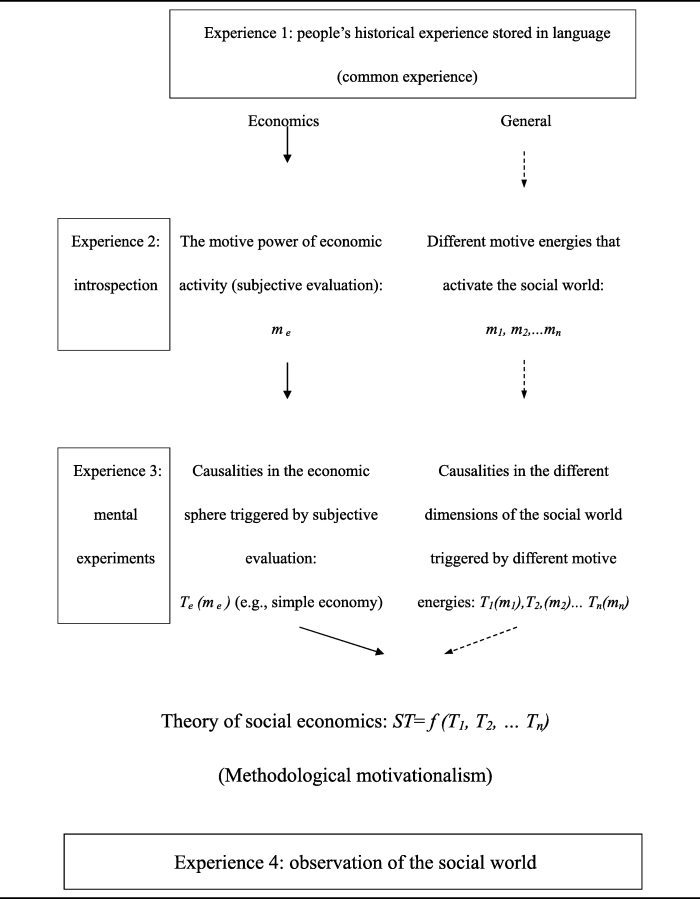
As Wesley Mitchell highlighted in his review of Wieser’s Theorie der gesellschaftlichen Wirtschaft, Wieser’s economic theory has a type of hierarchical feature (Mitchell Reference Mitchell1917). As indicated by Arena (Reference Arena, Hagemann, Nishizawa and Ikeda2010), Einfache Wirtschaft (simple economy) is the preliminarily logical step established for social economy (p. 111). In Theorie der gesellschaftlichen Wirtschaft, one finds that each chapter presupposes what is analyzed in the previous chapter: Einfache Wirtschaft followed by Volkswirtschaft (social economy), Staatswirtschaft (state economy), and Weltwirtschaft (world economy). Wieser seemed consistent in this hierarchical approach to his research, not only in this particular book but also in his other works, each of which is grounded in the results that he obtained from his previous works. In his habilitation, he discussed the philosophy of value (Wieser Reference Wieser1884); in Der natürliche Werth, he applied his value theory to production and distribution in the economic sphere (Wieser [Reference Wieser and Malloch1889] 1956); and he extended his theory to the economy, including social situations, in Theorie der gesellschaftlichen Wirtschaft (Wieser [Reference Wieser and Ford Hinrichs1914] 2003). After completing his economic inquiries, he extended his field of research to sociological or political considerations (Wieser [Reference Wieser and Kuhn1926] 1983). This hierarchical character of his work parallels the structure of his empiricism; each dimension of empirical knowledge, as described above, constitutes the hierarchy of a complete empirical theory of social sciences. By distinguishing among these different dimensions of experiences, Wieser reformulated and systematized Menger’s empiricism. The structure of Wieser’s empiricism can be reconstructed from these discussions, as shown in Table 2.
Structure of Wieser’s Empiricism
First, the social sciences begin with a common language that constitutes people’s historical experiences, which Wieser called “common experiences” (experience as stored in language; Experience 1 in Table 2). Then, introspections show “motive powers,” such as the subjective evaluation of humans, by which economic causalities are triggered (experience as introspection; Experience 2 in Table 2). Next, by performing mental experiments, causalities triggered by the motive powers in specific areas (such as economy) are derived: T 1(m 1), T 2(m 2), T 3(m 3),… T n(m n) (experience as mental experiments; Experience 3 in Table 2). Finally, social phenomena are observed as a result of the interactions of the different motive powers. This position may be characterized as “methodological motivationalism,” which indicates that the social processes are satisfactorily explained as the result of the interactions of different motive energies: ST = f (T 1, T 2, … T n) (experience as observations; Experience 4 in Table 2).
As we have seen, Wieser’s epistemological stance can be understood as a systematic justification of Menger’s economic theory as a form of empiricism. In most ways, Wieser was in line with Menger’s scientific program, but, regarding an ontological view of society, Wieser diverged from Menger, who tried to explain social facts as a consequence of an individual’s actions. Wieser’s special ontological position, which explains social facts as interactions of motivating powers, leads him to the latest sociological studies that go beyond mere economics. Wieser believed that social facts could be satisfactorily explained as the result of the interactions of different motive energies, and that social laws could be derived psychologically; that is, by performing mental experiments. For Wieser, statements describing introspection and mental experiments are the source of certain knowledge, from which universal statements are inductively derived. In this sense, he holds a position that can be regarded as “psychological inductivism,” in which experiences are no longer the critical standard of theories, but psychological inferences alone justify social theories. Thus, he states, “we, each of us, hear the law pronounced by an unmistakable inner voice” (Wieser [Reference Wieser and Ford Hinrichs1914] 2003, p. 8; emphasis added). According to Wieser, contradictions between a social theory and an observation do not falsify a theory, but can lead to other psychological inquiries.
Wieser’s particular position of psychological individualism can partly explain his shift to sociological and political studies. In the preface of Das Gesetz der Macht, he stated that, after completing his research on economic theories, he confronted World War I and found that it was a subject that could not be explained by an individual’s subjective evaluation (such as that in an economy), and was motivated by (political) “power” (Wieser [Reference Wieser and Kuhn1926] 1983, p. 39). One may therefore say that his later shift to sociological and political research is not a leap from economics, but is rather an outcome that necessarily emerged from his epistemological position.