


INTRODUCTION
In almost all dictatorships the leader is supported by a group of elites. These elites provide essential political services to the dictator, and the breakdown of elite coalitions is one of the main threats to authoritarian rule. But the consequences of elite defection are better understood than the causes. In this paper, we examine the determinants of elite defection in one prominent electoral authoritarian regime, Russia.
Focusing on electoral defections in Russia’s regions, we develop a simple cost-benefit framework to explain defections from Russia’s ruling party, United Russia (UR). Aligning with the regime offers significant advantages for politicians, including state backing during elections and access to rents. At the same time affiliation can come at considerable cost. Regimes can force politicians to forgo their own political beliefs and constituency demands in order to toe the party line. Politicians also run the risk of being tainted by their association with an autocratic regime should the regime falter and rivals seek retribution.
How the regime manages the distribution of spoils and other political benefits is key to understanding why individual elites defect. First, we argue defections should be more likely when the ability of the regime to help candidates win elections decreases. Candidates are hesitant to affiliate with an unpopular regime that cannot ensure their electoral prospects. Second, accessing rents, spoils, and privileges is one of the main goals for politicians under autocracy. We argue that defections should increase when the regime places limits on access to these benefits. We also argue that defections will increase when the regime diverts spoils from allies and shares them with the opposition. Third, we argue that defections should increase in settings where cadres face greater uncertainty about the future provision of spoils. Such uncertainty may be driven by weak formal institutions that fail to constrain the arbitrary behavior of the autocrat. Finally, we argue that the individual characteristics of elites matter. Those who have already achieved office should be less likely to defect since they have less uncertainty about future career advancement opportunities. In addition, those with significant autonomous political resources should be more likely to defect. Such resources increase the chances that elites will be able to achieve their political goals independently of the regime.
Our theoretical framework points out some inherent contradictions in previous work on authoritarian durability. Autocrats face tradeoffs in dealing with different types of threats. They may try to co-opt opposition leaders in order to stave off challenges, but by diverting spoils from regime insiders to the opposition, they leave insiders disgruntled. Thus, dictators may find it difficult to co-opt their way out of a rising opposition, because opposition co-optation simultaneously threatens the integrity of ruling coalitions. The regime may also seek an electoral advantage by recruiting strong candidates (e.g., those with personal followings or business resources), but candidates with autonomous resources are exactly the type that are more likely to betray the regime. Finally, regimes may seek to exert greater personal control over politics, but this makes it harder to commit to power-sharing with elites and risks defection.
Using a unique dataset that covers the universe of United Russia candidates in all Russian regional legislative elections between 1999 and 2016, we find evidence consistent with these claims. First, we find some evidence that United Russia cadres are more likely to abandon the party when the regional vote share of the party decreases or when regional economic performance declines. We take both as indicators of the regime’s electoral strength: elites defect from regimes whose popularity is on the wane.
We next find that defections increase in settings where rent-seeking opportunities for businessperson deputies are limited and in legislatures where the regime shares more legislative leadership positions with the opposition. United Russia holds majorities in all of Russia’s regional legislatures, but it often shares important posts with the opposition in order to co-opt its leaders. Our analysis reveals that this co-optation comes with a cost: By sharing more spoils with the opposition, the regime limits the spoils that are available to its own cadres. This leads to defections from UR.
Our analysis also reveals there are more defections in the most personalist regions of Russia (using several different measures). As a number of authors have argued, dictators in personalist regimes (i.e., regimes where leaders are relatively unconstrained by institutions) have difficulty committing to sharing spoils with elites in a dependable manner (e.g., Svolik Reference Svolik2012). This increases uncertainty for cadres and increases their incentives to defect.
Finally, we find evidence that elites take their own relationship with the regime into consideration when deciding whether to defect. Candidates who already hold elected office are more likely to remain loyal. These candidates have more to risk by defecting. Moreover, we find that ownership of various autonomous political resources matters greatly. Businesspeople—especially those in the private sector—are more likely to defect than bureaucrats and other professional deputies such as lawyers and administrators. Businessperson candidates can draw on their firms to help fund an independent political machine and their employees to help drive their own personal vote. This makes them less dependent on the ruling party. Likewise, deputies who have previously won election as independents (before joining United Russia) are more inclined to defect. Being elected as an independent indicates that the deputy has (or was once able to build) a personal following in their constituency. Ruling party affiliation matters less if a politician can win office on his or her own.
We believe this is first study to use micro-level, quantitative data to test hypotheses about the cohesion of elite coalitions under autocracy. It offers a direct test of several competing perspectives on authoritarian stability. Some argue that authoritarian coalitions are held together by spoil-sharing among elites (Bueno de Mesquita et al. Reference Bueno de Mesquita, Smith, Siverson and Morrow2003). Others share this focus on elite spoil sharing but add that institutions must exist to make dictators’ commitments credible (Magaloni Reference Magaloni2008; Svolik Reference Svolik2012). Still others focus on the regime’s ability to co-opt or repress threats from the opposition (Gandhi Reference Gandhi2008). We do not resolve this debate, though we do find evidence for a number of the propositions put forth by the neo-institutional literature on authoritarianism. For example, regimes with institutional constraints on the leader have an easier time keeping elites united than those run by personalist leaders. In addition, restricting the overall volume of spoils available to elites, or choosing to distribute spoils to the opposition, can spur defection. We find that regime elites respond negatively to opposition co-optation by voting with their feet.
Our results also suggest that theorists of autocracy should think not just about the characteristics and strength of the “regime” and opposition, but also about the composition, orientation, and resources of individual elites. The resources of elites vary both across and within countries, and the specific types they hold affect their loyalty to the regime. We add to previous work showing how business resources can empower opposition coalitions (Arriola Reference Arriola2013; Greene Reference Greene2010), while also identifying other assets that politicians can capitalize on to remain autonomous.
AUTHORITARIAN STABILITY AND ELITE COHESION
Dictators do not rule alone. In all autocracies, the ruler is surrounded by a coalition of elites who support the regime and render various political services.Footnote 1 Elite allies—legislators, governors, administrators, mayors, military officers, chiefs, oligarchs, employers, clan leaders, and the like—are important to the survival of the regime because they exercise influence over citizens and other important political actors. They are opinion leaders and power brokers. They help the regime mobilize the masses, win elections, administer territory, collect taxes, battle insurgencies, and so on.
Political scientists have long recognized that cohesion among ruling elites is central to autocratic regime stability. For example, this assumption undergirded the transitology school of democratization studies (e.g., Przeworski Reference Przeworski1991). O’Donnell and Schmitter (Reference O’Donnell and Schmitter1986) put it starkly when they wrote: “There is no transition whose beginning is not the consequence—direct or indirect—of important divisions within the authoritarian regime itself” (19). Decades later, the neo-institutional literature on authoritarianism has largely been organized around the presumption that schisms in the ruling elite imperil authoritarian regimes. For Geddes (Reference Geddes1999), the most important distinction between various regime types is the extent to which they are able to contain elite schisms. Similarly, Svolik (Reference Svolik2012) argues that conflict among ruling elites is one of the two main threats to authoritarian rule (the other being mass uprising). Indeed, elite defection plays a central role in many of the most prominent recent studies of authoritarian longevity (Brownlee Reference Brownlee2007; Hale Reference Hale2014; Levitsky and Way Reference Levitsky and Way2010; Magaloni Reference Magaloni2006).
Defections—which we define as instances in which regime-affiliated elites voluntarily abandon the ruling coalition in order to challenge the regimeFootnote 2—undermine regime stability. When powerful elites defect, the regime is deprived of access to the skills, followers, and resources that those elites command. This can undermine the ability of the regime to mobilize elite and mass support. Such defectors can help rally the masses against the regime. And when they run in elections, they can divide the regime’s vote share and make it easier for the opposition to win. Finally, defections may signal the vulnerability of the regime, which, in turn, may embolden potential challengers.
It is not surprising, then, that elite defections have led to the breakdown of many prominent electoral authoritarian regimes over the past several decades. Examples include Ukraine in 2004 (Way Reference Way2005, 138), Mexico in the late 1990s (Langston Reference Langston2002, 82–3), Serbia in 2000 (Levitsky and Way Reference Levitsky and Way2010, 110), Nigeria in 2015 (Animashaun Reference Animashaun2015, 196), Georgia in 2003 (Mitchell Reference Mitchell2009, 35–7), and Kenya in 2002 (Anderson Reference Anderson2003, 331–33).
While defections by national elites tend to grab most of the headlines, defections by regional elites have also played a key role in the destabilization of prominent electoral autocracies. Garrido de Sierra (Reference Garrido de Sierra2012) calculates that 36 PRI gubernatorial candidates defected to the opposition in Mexico between 1989 and 2006. The rate of defections increased dramatically after 1996 and has been linked to the unraveling of the PRI’s local political machine (Garrido de Sierra Reference Garrido de Sierra2012; Gibson Reference Gibson2005). In Nigeria, the ruling People’s Democratic Party suffered a string of regional defections between 2013 and 2015, including the governors of seven states and a number of vice governors (Thurston Reference Thurston2015, 9). The loss of these local patrons (and their vote mobilizing ability) was seen as instrumental to the PDP’s historic defeat in March 2015.
Given the far-reaching consequences of elite defections, it is important to know what causes them. Much of the research on this question has been concentrated in one of two areas. First, there is a large literature on the determinants of coups (Belkin and Schofer Reference Belkin and Schofer2003; Londregan and Poole Reference Londregan and Poole1990). We know much about when the military intervenes in authoritarian politics, a very extreme and specific type of elite conflict. In this paper, we focus on electoral defections by civilian elites, a much more common occurrence, especially in the post–Cold War era.Footnote 3
Another approach to studying elite defection comes from the recent literature on authoritarian institutions. A key insight from this literature is that dictators are often stymied in their efforts to maintain elite loyalty by a commitment problem (Magaloni Reference Magaloni2008; Svolik Reference Svolik2012). Leaders may promise to share power and spoils, but they have difficulty making those promises credible. Such distrust of the dictator can lead elites to abandon the regime. Dictators who solve this commitment problem—usually by relinquishing some of their arbitrary authority to a political party or a legislature—are said to survive longer. In support of such arguments, scholars have demonstrated that autocracies with power-sharing institutions are more durable (e.g., Gandhi Reference Gandhi2008; Svolik Reference Svolik2012).
Such studies are persuasive and influential, but it is clear that institutions are not the only explanation for elite defection. If they were, we would never observe defections in dominant party regimes and personalist regimes would never survive past day two. Empirically, these studies approach the question of elite defection only indirectly. Elite cohesion is assumed to be the mechanism that links institutions to regime longevity, but it is not shown directly that institutions reduce elite discord.
Other studies have examined elite defection more directly. Cross-national quantitative studies have argued that defections are caused by economic crisis (Haggard and Kaufman Reference Haggard and Kaufman1995; Reuter and Gandhi Reference Reuter and Gandhi2011). Qualitative case studies, meanwhile, have focused either on the role of electoral competition (Langston Reference Langston and Schedler2006), economic liberalization (Balmaceda Reference Balmaceda2013; Junisbai Reference Junisbai2012; Radnitz Reference Radnitz2010), or the contextual strategies used by autocrats (Khisa Reference Khisa2016; Schedler and Hoffmann Reference Schedler and Hoffmann2016).
In sum, the empirical literature on defections is sparse. There are a number of qualitative studies that examine the institutional causes of elite defection indirectly, and we have two quantitative studies that focus on the effects of economic growth. Case study research focuses on a broader range of factors, but those studies have not developed a general theory of defections that encompasses structural, institutional, and individual-level explanations. We discuss such a theory below and test its implications with a micro-level, large-N dataset.
THEORETICAL FRAMEWORK
In this section, we provide a simple theoretical framework for analyzing electoral defections from authoritarian ruling parties. By electoral defection, we mean instances in which a regime-affiliated candidate not only leaves the ruling party, but challenges it by running for office with a different political affiliation. In order to keep our theory tractable, we focus on this specific, historically important type of defection. Our focus on electoral defections is also useful, as discussed below, because it facilitates the accurate measurement of defection.
We theorize the process from the perspective of a regime-affiliated candidate who is deciding whether to remain with the regime or to defect and run for office against the regime. We assume that when a candidate leaves the ruling party, they forfeit some or all of their standing and influence as members of the ruling group.Footnote 4 How might such a candidate approach this decision? We begin by assuming that ruling party candidates are self-interested actors and that their decisions are based on a rational evaluation of the costs and benefits of continued affiliation. These payoffs are evaluated with respect to the candidate’s goals.
What are the goals of regime candidates? Following a long tradition in political science, we assume that politicians, whether in democracies or autocracies, are politically ambitious; they want to advance their political careers and expand their political power (Aldrich and Bianco Reference Aldrich and Bianco1992; Laver and Benoit Reference Laver and Benoit2003). In the given context, this means that candidates first value getting elected. Getting elected means gaining the support of voters, but since elections under authoritarianism are not free and fair, it also means gaining access to political resources (e.g., media, administrative levers, and patronage networks) that can help skew the electoral playing field in their favor. For brevity, we term this goal votes.
Beyond votes, regime candidates value the benefits of office. As in democracies, regime candidates want to achieve “power and prestige” within the chamber (Fenno Reference Fenno1973). In addition, they also seek to maximize control over the private goods that legislative office provides. Collectively, we call these private benefits—prestige, corruption rents, and leadership positions—spoils.
While rent-seeking occurs in democracies, opportunities for private gain are usually greater in authoritarian legislatures. In autocracies, the rule of law is usually weak and autocratic regimes often use the legislature specifically as a forum for sharing rents with allies (e.g., Lust Reference Lust2009). The greater prevalence and acceptance of corruption increases the salience of rent-seeking as a motivation for candidates. Unlike in democracies, any theory of defection under autocracy should pay special attention to spoil sharing.
We further assume that candidates value votes and spoils both now and in the future. It is especially important to consider the time horizons of candidates in authoritarian regimes, because elite politics under autocracy is permeated by distrust and uncertainty. Institutional constraints on dictators are often weak, undermining their ability to make credible commitments to share power and spoils. Regime leaders may promise to promote a specific cadre or share some corruption rent in the future, but because dictators are unconstrained in their decision-making, elites may have little reason to believe these promises (Magaloni Reference Magaloni2008; Svolik Reference Svolik2012).
Finally, in addition to votes and spoils, we assume that candidates have ideological motivations (Wittman Reference Wittman1983; Cox Reference Cox1984). For example, they may feel strongly about redistribution or protecting human rights. Compared to their democratic counterparts, autocratic legislatures have less influence over general policy direction,Footnote 5 but as an increasing number of studies now show, their influence is often more than de minimis (Gandhi Reference Gandhi2008; Noble Reference Noble2017). But even if the policy influence of legislatures were minimal, the ideological motivations of cadres still matters. After all, pro-regime candidates do more than pass laws. They make speeches, adopt public positions, and defend the regime in mass media. Outside of lawmaking, there is ample scope for asserting one’s ideological preferences and shaping the policy debate.
For many candidates in authoritarian regimes, affiliating with the regime maximizes their ability to achieve this set of political goals. If the regime is popular, candidates can ride those coattails in their own races. The regime also controls access to state resources and most political offices, helping its allies both win election and further their careers inside the chamber. Affiliation with the regime may also bring access to government largesse and rents, and offers the best chance for influencing policymaking. These are significant benefits and, from this list alone, it is clear why most cadres stick with the ruling party.
And yet, elites often do defect. We argue that aligning with the regime can come with important costs, which for certain types of candidates, and in certain settings, can outweigh the benefits of continued affiliation. After all, what is good for the ruling party is not always good for an individual politician. If a candidate is forced to support a measure (or a leader) that is unpopular in her district, she may suffer at the polls for it. Ruling parties also often force candidates to “buy” their seats by contributing financial resources to the ruling party (Blaydes Reference Blaydes2011). Bowing to these demands may not make sense if the regime is not providing sufficient spoils in return. Defecting to the opposition may also lead to a status improvement for the candidate. A low-level regime official may be a small fish in the pool of regime candidates, but a big fish in a smaller opposition party. Such a move may actually improve access to spoils if the opposition is being co-opted by the regime.
Finally, regime affiliation can be costly if the candidate’s ideological position differs from that of the regime. Politicians whose policy preferences do not align with the regime may be forced to contravene their own beliefs, support policies they do not actually believe in, and help perpetuate a regime they detest. As Kuran (Reference Kuran1991) and others have argued, this type of preference falsification is psychologically costly.
We expect that candidates will quit their affiliation with the regime when they perceive that these costs outweigh the benefits. Defections are more likely to occur when candidates believe that opportunities for achieving their political goals within the party are diminished. This framework thus provides a roadmap for identifying the conditions that will, ceteris paribus, make defections from the ruling party more likely to occur. And while this general approach could produce a number of possible hypotheses, we focus below on those that are testable,Footnote 6 non-trivial, and have the most relevance for current debates on authoritarian politics. For instance, our hypotheses speak directly to debates about personalism, opposition co-optation, the role of institutions under autocracy, and elite power-sharing.
Beginning with votes, we should expect more defections as the ability of the regime to provide votes—i.e., help candidates win elections—decreases. If the regime is on the brink of collapse, then defections will, of course, be widespread. But even when the regime is still in power, candidates should be more likely to defect if they do not view affiliation as an electoral asset. This might happen if the administrative capacity of the state weakens, its ability to commit fraud wanes, or the popularity of the ruling party fades.Footnote 7
H1: Defections should increase as the regime’s electoral vulnerability increases.
Turning to spoils, our framework also predicts that defections should increase as access to spoils declines. This could happen because of an external shock. An economic downturn might reduce the amount of corruption rents available. Alternatively, access to spoils might decline because of some political choice taken by the regime. Some prominent accounts hold that autocratic coalitions are bound together by direct transfers of spoils (e.g., Bueno de Mesquita et al. Reference Bueno de Mesquita, Smith, Siverson and Morrow2003). When the regime limits opportunities to access spoils—perhaps by decreasing institutional points of access or constraining legislators’ ability to abuse their office for personal gain—elites will have less incentive to stay with the regime.
H2: Defections should increase as opportunities for accessing spoils decrease.
The availability of spoils also depends on the regime’s spoil distribution strategy. In autocracies, most spoils are reserved for pro-regime elites, but recent literature has shown that the regime often shares some benefits with the opposition as well (Gandhi Reference Gandhi2008; Reuter and Robertson Reference Reuter and Robertson2015). Autocrats do this in order to buy off their leadership and reduce the threat of mass unrest. This leads to a tradeoff. The size of the pie is limited, so by distributing spoils to the opposition, the regime is depriving some insiders of those benefits. If ambitious regime cadres are snubbed in favor of outsiders, they may calculate that their future chances of receiving spoils from the regime are diminished. Furthermore, they may also conclude that joining the opposition will not result not in oppression, but rather in the chance to acquire the same patronage they did as members of the ruling party.
H3: Defections should increase as the regime shares more spoils with regime outsiders.
Broadly speaking, the discussion above suggests that defections should increase when the regime fails to offer sufficient opportunities for accessing spoils. But elites also care about the credibility of those offers. Can they trust the regime to follow through on its promises to reward them for loyalty and service? One of the main contentions of the neo-institutional literature on authoritarianism is that dictators who solve their credible commitment problems will find it easier to keep elites loyal. One way that commitments can be made credible is if there are formal institutions with some modicum of independence—e.g., legislatures or ruling parties—that can regularize spoil distribution in a predictable way (e.g., Magaloni Reference Magaloni2008; Reuter Reference Reuter2017). Such institutions may also facilitate spoil-sharing by improving the monitoring ability of elites (Svolik Reference Svolik2012) and enabling them to solve collective action problems vis-à-vis the dictator (Gehlbach and Keefer Reference Gehlbach and Keefer2011). When such institutions are weak, as they usually are in so-called personalist regimes, the leader is more unconstrained and elites are more likely to fear that the dictator will act capriciously in the spoil distribution process. This should make defections more likely.
H4: There will be more defections where institutional constraints on the leader are fewer (i.e., in more personalist regimes).
The characteristics of candidates will also affect their propensity to defect. For one thing, candidates vary in the extent to which they are uncertain about future access to spoils. Those who have already secured access to office and spoils have less reason to start fresh outside the ruling party. Moreover, they can leverage their privileged position to help maintain their stature. On the other hand, candidates without established footholds in the legislature might be concerned about the regime’s commitment to their own ambitions. Such candidates also have less to lose by casting their lot with the opposition.
H5: Candidates who have already achieved office will be less likely to defect.
Finally, individual candidates vary in the extent to which they can achieve important political goals—e.g., winning elections and securing spoils—without regime affiliation. Those with their own political resources which do not derive from their affiliation with the ruling party (e.g., personal followings, independent political machines, and hard-to-tax economic assets) are better positioned to do this.Footnote 8 For example, a candidate who can generate votes independently has less need for regime electoral support. Candidates with autonomous resources can also leverage their resources in order to extract spoils from the regime, even as independents. Moreover, such candidates have more to offer the opposition and therefore can demand higher standing if they choose to defect. In sum, candidates with independent resources are better able to withdraw from the regime and achieve their political ambitions.
H6: Candidates with more autonomous political resources will be more likely to defect.
Expulsion versus Defection
We have defined defections as instances in which a member of the ruling coalition voluntarily departs from the ruling coalition in order to challenge the regime. Our conception of defection does not encompass instances in which the regime purges or expels elites against their will. Ruling parties may have good reasons to show some members the door. For example, candidates with criminal pasts can create electoral liabilities. As we outline in the Research Design section below, we remove any such expulsions from our data, ensuring that the remaining defectors left the party on their own accord.
Still, even if our empirical approach miscodes some expulsions as defections, we would not expect the hypotheses we derive above to predict both defections and expulsions. For one, there is little reason to expect a positive relationship between the electoral vulnerability of the regime and expulsions. Forcing out regime affiliates during times of political uncertainty is a risky strategy. The literature on coup-proofing, for instance, argues that dictators are more likely to move against their rivals when the risk of coups is low (Sudduth Reference Sudduth2017). It is also doubtful that the regime would be more likely to expel elites when rent-seeking opportunities are greater. The same goes for spoil-sharing with the opposition. We see no reason to think that the regime would feel compelled to expel cadres when it is sharing resources with the opposition. In contexts where elections are used to select leaders, the regime should also be keen to retain those cadres that have resources that can help it win votes and govern cost-effectively. Recent studies of United Russia’s electoral strategy have shown that the party focuses on co-opting prominent politicians with well-developed political machines (Golosov Reference Golosov2011; Reuter Reference Reuter2017). Therefore, we should not expect to see politicians with more autonomous resources being expelled. And, if our dataset is contaminated with hidden expulsions, it should be harder to find significant results on these variables.
RESEARCH DESIGN
The Russian Case
We test our hypotheses using data on candidacies to regional legislative office in Russia during the period 1999–2016. Russia is a federal state containing 85 subnational units, colloquially called regions, each of which contains a directly elected legislature. Why should an analysis of elite defections look at Russian regional legislators? First, these legislatures contain a vivid cross section of the most important elites in a region. The most prominent regional figures—directors of large enterprises, representatives of state corporations, and the heads of major hospitals and research institutes—are all likely to be members of (or have representatives in) their region’s legislature. Regional legislatures are key fora of rent-seeking and spoil-sharing among the Russian regional elite.
Next, the large number of regions in Russia provides a greater sample size than could be obtained by studying a national legislature. Since Russian regions vary on important political dimensions—including institutional configurations, levels of political competition, and the strength of United Russia’s regional branches—we are able to examine hypotheses about how regime-level factors affect defection. A number of scholars have made the convincing case that Russian regions can be treated as subnational political regimes (Lankina, Libman, and Obydenkova Reference Lankina, Libman and Obydenkova2016; Petrov and Titkov Reference Petrov and Titkov2013), a conceptual convention that is common in the study of other federations as well (Gibson Reference Gibson2005). At the same time, by looking at variation in defection rates within a single dominant party, we are able to hold constant some important factors, such as ideology and national political conditions.
A final reason for examining Russian regional legislatures is practical. Given that our hypotheses make predictions about when elites leave the ruling party, we require an arena where data on partisan affiliations are available. While many bureaucrats carry partisan memberships, information on those affiliations is not public and is difficult to gather. For legislative candidates, the matter is simplified by the fact that candidates register their affiliation when they run for office.
Our period of analysis begins at a time when United Russia was emerging as the dominant party in Russia. From 1999 to early 2003, central authorities had little involvement in regional legislative politics. Between 2001 and 2003, only 1.7% of candidates were affiliated with United Russia, which received backing from President Putin but was only starting to expand its position outside of Moscow. Beginning in 2003, the federal center—and United Russia—significantly increased its role in regional politics. By the late 2000s, all of Russia’s regional legislatures had United Russia majorities and the vast majority had super majorities. Between 2010 and 2016, 72% of all regional deputies held a UR affiliation.
Data on Defections
Examining candidate defections from the ruling party first requires establishing the proper sample for analysis. This section provides a condensed description of the sample construction procedures; a more detailed explanation can be found in the appendix. First, we collected basic data on all candidates to regional legislative office registered with the Russian Central Election Commission at any point from 1999 to 2016. We refer to the act of running for office as a “candidacy” and the specific person behind that candidacy as an “individual.”
Over this period, there are 117,834 candidacies to 336 regional legislative convocations. The total number of individuals (as uniquely defined by name and date of birth) who ran is 96,962, resulting in roughly 1.2 candidacies per individual. 14,757 individuals ran for office more than once over the period. These individuals with multiple candidacies are over five times more likely to win elections compared to individuals that only ran once (32% compared to 6%).
We begin by narrowing down our sample of candidacies according to the following criteria. First, to be included in the analysis, a candidate must have been affiliated with the ruling party (UR) during any regional election. Candidates indicate their party affiliation upon registration. From 1999 to 2016, there were 19,131 candidacies affiliated with UR, or 16.2% of the total. We exclude all other candidacies, such as those run by members of opposition parties or independents, since these individuals never publicly established an association with the regime and could not have defected from it.
The second criteria to enter the sample is that regime-affiliated candidates face a choice about whether to remain with the ruling party or drop their affiliation and challenge the regime. We operationalize this decision by requiring that each candidate that enters our sample run in two consecutive regional elections. In the first election of each sequence, all candidates must have affiliated with United Russia. In the second election, a candidate decides which party affiliation to adopt. Each electoral sequence is a unique observation, and individuals can be members of multiple electoral sequences.Footnote 9 As indicated in Appendix Figure A.2, 4,291 electoral sequences run by 3,398 individuals fall into this UR “Repeat Runner” category. In other words, these are candidates who (a) have run for office in two consecutive elections and (b) ran with a UR affiliation in their first balloting.
The vast majority retained their UR affiliation in the second election of the sequence but some choose to drop the UR affiliation and run against the ruling party. These are our defectors.Footnote 10 We code an individual as having defected from the ruling party if he or she ran on a different party ticket or as an independent in the second election in each sequence.Footnote 11
As an illustration, consider the case of Aleksei Vereshagin. Vereshagin is a long-time deputy in the Arkhangelsk Region Council of Deputies. In our data, he has run for a seat four times: in 2000 as an independent; in 2004 from United Russia; in 2008 again from United Russia; and in 2013 as an independent. This career path contains two electoral sequences that are included in our analysis: the 2004–08 sequence and the 2008–13 sequence. The 2000–04 sequence is not included because Vereshagin ran as independent in 2000, so he could not, logically, defect from United Russia before the 2004 election. For the 2004–08 sequence, Vereshagin affiliated with United Russia in the first election and remained with the party in the second. We code such a candidate as not having defected in 2008, since his affiliation did not change. For the 2008–13 sequence, Vereshagin affiliated with UR in 2008, but then ran as an independent five years later. We code this as a defection from the regime in 2013.
Summary Statistics
Our data indicate that defections are neither common nor rare. Of the 4,291 eligible electoral sequences in our empirical sample, we find that 320 candidates defected from United Russia in the second election. This translates to roughly 1 in 13 United Russia candidates defecting, or a rate of 7.5%. Defections occurred in 76 of the 87 regions in our sample. Smolensk Region and Republic of Buryatia saw the highest number at roughly 25%, while regions such as Saratov, Rostov, and Kemerovo did not experience any defections over the period.
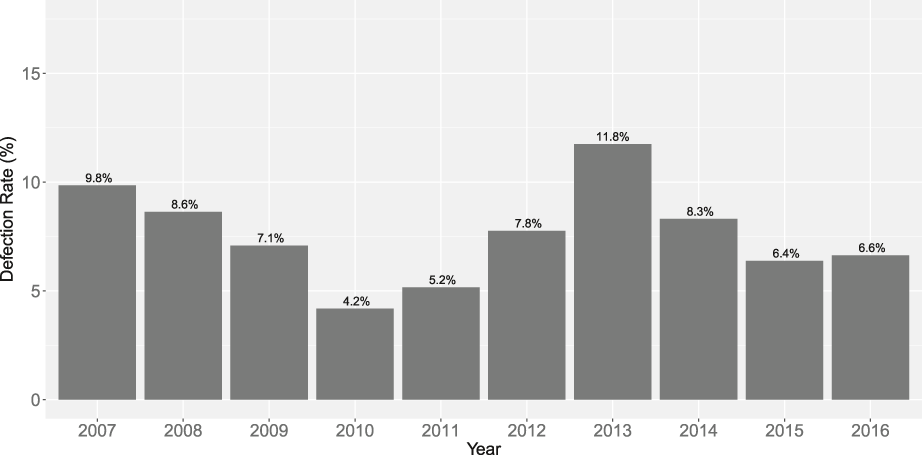
Figure 1 plots the nationwide defection rate over time. From 2007–2011, the rate decreased by roughly 45%. This corresponds to a period when United Russia was consolidating its control over regional politics and when Putin’s popularity was consistently high. Meanwhile, the marked increase in defections in 2012–13 corresponds to the period when United Russia’s popularity fell after the 2011–12 protest wave. Political observers in Russia noticed an uptick in defections during this period, and some even questioned whether the party would survive the crisis.Footnote 12 The regime’s popularity was buoyed again in 2014 by the surge of patriotism that followed the annexation of Crimea, and we observe that defections decreased during this period. In sum, our micro-level data track with national trends and are consistent with anecdotal accounts of elite defection in Russia.
Defection Rate by Year
This figure plots defection from United Russia by year. The x-axis shows the year of the second election in the sequence. We exclude the small number (52) of candidates from 2004–06.

Seventy-four percent of our candidates are incumbents (those who won in the first election in the sequence). Incumbents are much less likely to defect than non-incumbents (5% versus 13%). However, of the 320 defectors, 173 (54%) were incumbents, indicating that many defections happen among incumbents.Footnote 13 Defecting from the ruling party by no means spells the end of one’s political career. Whether running with the opposition or as an independent, UR defectors win their second election roughly 25% of the time. This means that defectors are over three times more successful than the average opposition candidate, who wins office only 7.8% of the time. And yet, affiliating with the ruling party still carries clear electoral advantages; otherwise, the regime would have collapsed under the weight of mass defections. UR candidates who stayed with the ruling party in the second election of the sequence won roughly 70% of those races.
Handling Potential Expulsions
This scheme for identifying defectors is quantitative and, as such, it cannot easily distinguish between cases when legislators left the ruling party voluntarily and cases when they were expelled. To address this, we collected press reports on all the 341 “defections” we identified in the data and coded them to determine whether the candidate was expelled or defected voluntarily. We uncovered 21 such expulsions, and we exclude these observations from all analyses below.
As discussed above, one might still object that our sample could be contaminated by expulsions. Yet, several pieces of evidence indicate that our sample is composed primarily of “real defections.” For one thing, the fact that we only uncovered 21 expulsions in our sample of mechanically coded “defections” indicates that defections are much more common than expulsions. In addition, the temporal distribution of defections shown in Figure 1 is inconsistent with an expulsion story. As noted above, there is considerable anecdotal evidence pointing to an increase in defections during 2012–13, but there is no evidence that a party purge was underway.
Finally, our data indicate that defectors perform considerably better than the average opposition candidate. This fact is hard to reconcile with an expulsion story: After all, why would the ruling party drive out candidates who will help the opposition win more votes? As noted below, defections appear to undermine United Russia vote totals. This increases our confidence that our data are not significantly contaminated by expulsions. Even with all this, it is still possible that a few expulsions go unnoticed and that our dependent variable is measured with error. Such contamination should reduce the efficiency of our estimates and make it harder to find statistically significant results.
Political Costs of Defection
We are not aware of other studies of elite defections in Russia, but work on Russian regional politics argues that elite conflict weakens the regime, in particular by damaging United Russia’s vote share (Golosov Reference Golosov2011; Lapina and Chirikova Reference Lapina and Chirikova2002).Footnote 14 There is considerable anecdotal evidence showing that defections undermine UR’s ability to mobilize votes. One high profile instance occurred in 2012 in Yaroslavl, where former UR legislator Evgenii Urlashov won election to mayor, defeating the governor’s favored candidate. In other instances, defections can peel away UR voters and prevent the ruling party from securing the large vote margins that signal regime invincibility. In Irkutsk in 2013, Alexandr Bitarov, a former UR regional party secretary and vice chairman of the regional legislature, led a group of prominent UR members away from the party and became chairman of the local branch of the right-leaning party, Civic Platform.Footnote 15 Leaning on Bitarov’s name recognition and financial resources—he was head of the region’s largest construction firm—Civic Platform drew votes from United Russia and won 9% of the party list vote, an impressive showing for a new opposition party. United Russia ended up with only 42% of the party list vote, the second worst showing for the party among the 16 regions holding elections that year.
Our quantitative data are consistent with these examples. In Appendix Section E, we show that a single defection is associated with a 1–3% decrease in UR’s party list vote share in the subsequent election. In SMD races, UR is often unable to find a replacement candidate after it suffers defection. And when it does find a replacement, that candidate receives fewer votes and is 10% less likely to win. Defections make it harder for UR to dominate elections.
Defections also complicate lawmaking. The Kremlin has long had difficulty controlling non-partisan deputies, even if those deputies are ideologically aligned (Hale Reference Hale2007; Remington Reference Remington2006). At the very least, the transaction costs of passing legislation increase significantly when pro-regime deputies are not subordinated to party discipline. Finally, the simple fact that UR party leaders worry about defections demonstrates that they are problematic. In 2012–13, UR party congresses were marked by regional party leaders requesting more tools from Moscow to help them shore up party discipline in the locales.Footnote 16
Independent Variables
To test Hypothesis 1, we use two related indicators of the regime’s electoral vulnerability in the region. First, we measure United Russia’s vote share on the PR ballot during the year of the first regional election in each candidate sequence. Low UR vote share could indicate that the political machine of the regional administration is weak, or it could indicate that the opposition is strong.Footnote 17 Whatever the cause, the electoral benefits of remaining with UR are lower in regions where the party is performing poorly at the polls. This should lead to an increase in defections.
Second, we treat economic performance as a measure of the regime’s electoral vulnerability. Poor economic performance is an issue around which challengers might mobilize support, and the electoral viability of the opposition usually increases during economic crisis. We use the rate of economic growth in the region for the year immediately preceding the second election in each sequence (the year the candidate decides whether to remain with the ruling party).
To test Hypothesis 2 on access to spoils, we develop a measure of the financial payoffs that UR legislators reap from office. Recent research has shown that businessperson deputies in Russia can earn sizable increases in revenue and profitability for their firms (Szakonyi Reference Szakonyi2018). Using firm-level financial data, we compute the average change in profitability for firms connected to UR deputies over the course of each regional legislative convocation.Footnote 18 We expect that UR candidates will be more likely to defect when it becomes apparent that the amount of spoils being channeled to UR-connected businesspeople goes down. This measure is available for convocations starting between 2004 and 2011, covering 91% of our observations.
To test Hypothesis 3 on spoil distribution to the opposition, we use data on the allocation of legislative leadership positions during the convocation preceding the second election in the sequence. Legislative leadership offers special opportunities for deputies to push for desired legislation, secure perks, such as offices and staff, and direct pork to their constituencies. We calculate the percentage of speakerships, vice-speakerships, and committee chairmanships given to United Russia deputies in each regional convocation.
United Russia held a majority in almost all convocations during this period and has the right to keep all leadership positions for itself. However, the regime sometimes distributes leadership positions to opposition leaders in order to co-opt them and keep them from mobilizing their supporters in the streets (Reuter and Robertson Reference Reuter and Robertson2015). The logic of our hypothesis suggests that there should be more defections when United Russia shares more leadership positions with the opposition. This signals to United Russia candidates that their chances of receiving future spoils through the party have decreased while their chances of receiving spoils as a member of the opposition have increased.
Hypothesis 4 suggests that defections should be more likely in personalist regimes. We use two proxies to measure personalism, which, following Geddes, Wright, and Frantz (Reference Geddes, Wright and Frantz2017, 1), we define as the extent to which “the dictator has personal discretion and control over the key levers of power in his political system.” Our first measure is an indicator for whether the region is an ethnic republic that is headed by a member of the republic’s titular ethnic group.Footnote 19 In the 1990s, leaders in many ethnic republics used strong identity-based social networks to build powerful regional machines (Hale Reference Hale2003). This was especially common in republics where the titular ethnic group constituted a majority of the population, in which case a member of that group usually became leader. These leaders then used machines to concentrate power in the executive branch (most of them created “Presidencies” for themselves) and sideline formal institutions, such as legislatures and ruling party cells, that could place constraints on leaders.
Scholars note high degrees of personalism in Russia’s ethnic republics (Sharafutdinova Reference Sharafutdinova2013). Some of Russia’s most well-known regional strongmen (e.g., Mintimer Shaimiev and Murtaza Rakhimov) have been heads of ethnic republics. Chechnya is an illustrative, though admittedly extreme, case. One recent study found that 30% of 158 top officials were Ramzan Kadyrov’s relatives.Footnote 20 A further 23% were from his village. In the 1990s, leaders of ethnic republics were more likely to create their own personalized regional parties than join federal parties (Makarenko Reference Makarenko1998). And traditionally, United Russia has found itself more dependent on the machines of these leaders than these leaders have been on the party (Golosov Reference Golosov2011).
Given the overweening power of leaders in these regions, the institutional independence of United Russia is usually weaker. Spoil distribution is less likely to be governed by rules and norms embedded within the ruling party and more likely to depend on the arbitrary will of the regional leader. Since these dynamics are most common where the leader is from a non-Russian ethnic majority, we use a dummy variable for this condition as our first indicator for personalism.Footnote 21
We also employ a secondary indicator of personalism that is not limited to ethnic republics. We bring to bear new data from the “Expert Survey on the Quality of Government (QoG) in Russia’s Regions” conducted by the Quality of Government Institute at the University of Gothenburg. In 2014, the QoG Expert Survey polled 311 experts on the organizational design of bureaucracy in 65 Russian regions (Nistotskaya, Khakhunova, and Dahlström Reference Nistotskaya, Khakhunova and Dahlström2016). We draw on a question that asked about the degree to which new chief executives upon entering office, dismissed bureaucratic administrators and replaced them with their own sympathizers.Footnote 22 Respondents then named the percentage of three types of positions that were apportioned in this manner (low to mid-level specialists, top-level managers, and directors of state-funded organizations). We calculated the average across all three categories (values range from 0 to 100), with higher values indicating a greater degree of personalism in determining the allocation of spoils. Unfortunately, this measure is not available for all regions.
At the individual level, we include a dummy for whether the candidate already holds legislative office (H5). Incumbents have already achieved one of their major political goals—being elected—so should be less likely to defect. We measure autonomous resources in three ways. First, we include an indicator for whether the candidate has won election previously (prior to the first election in a sequence) as an independent. This would indicate that the candidate has the personal following and/or resources necessary to achieve elected office on his/her own. Such candidates have more to offer the opposition and find it easier to get elected without regime support.
Second, we create a series of indicators that tap a candidate’s occupational autonomy from the regime. Candidates who work for the state owe their careers to regime leaders and therefore should be less willing to risk defection. By contrast, those who work in the private sector should be more willing to defect from the regime.
Finally, we also include indicators for whether a candidate is a firm director and whether their firm operated in the private sector. Private firm directors have a degree of independence from the state that gives them leeway to defect. Recent work has shown that businesspeople possess the organizational and economic resources necessary to win office, making them less reliant on political parties (Hale Reference Hale2007; Smyth Reference Smyth2006; Szakonyi Reference Szakonyi2019). For example, many businesses in Russia operate as political machines, with their managers mobilizing their employees to vote (Frye, Reuter, and Szakonyi Reference Frye, Reuter and Szakonyi2014). Recent work in Africa comes to a similar conclusion. Arriola (Reference Arriola2013) argues that private firms are better able to cultivate political autonomy and are therefore more likely to support opposition coalitions. The ability to bankroll one’s own campaign provides an escape from party dictates.
Party leaders in Russia assiduously court businesspeople for financial contributions, while government officials rely on employers to ensure high turnout (Hutcheson Reference Hutcheson2012). And party leaders encourage private firm directors to become members of the party, so as to improve the party’s image in society (Fremke Reference Fremke2008). Political parties must curry favor with business leaders, given that they are among the only actors in society with substantial economic resources. On the other hand, SOE directors are much more reliant on maintaining good relations with the government, most notably to save their own jobs. State officials appoint SOE directors (Sprenger Reference Sprenger2010), and these decisions may be based on how well these enterprises serve political functions, such as mobilizing votes.Footnote 23
To create these variables, we first classify candidates by the occupation listed on their registration form. Our binary, mutually exclusive categories include Firm Director (upper-level company management), Government Employee (working in the bureaucracy or a budgetary institution), Private Sector Employee (skilled or unskilled workers), Social Organization Employee (working in NGOs, academia, the media, or trade associations), Political Party Employee (employed full time within United Russia), Professional Regional Legislator (legislative incumbent without outside employment), and Unemployed (pensioner, student, etc.).
We also draw on recent work on businessperson candidates that matches regional legislators in Russia to firm registries to uncover business ties (Szakonyi Reference Szakonyi2018).Footnote 24 We code two indicators based on the ownership of the firms that candidates were affiliated with: private versus state-owned. Firm registry data are only available for candidates running from 2004 to 2011; for the remaining years, we manually code the sector of the firms listed on candidate registration forms.
Several controls are also included. First, we include an indicator of the region’s level of democracy. Defections may be less likely in more closed regimes, those that are more repressive, and/or in those where elections are less free.Footnote 25 These data come from Petrov and Titkov (Reference Petrov and Titkov2013) and are commonly used in studies of Russian subnational politics. Defections may also increase when the regional government changes; we include a variable equal to one for elections in which the governor has changed from being an insider (i.e., from the region) to an outsider (or vice versa) in any of the years since the starting election. Finally, we control for candidate age, ballot structure (i.e., PR or SMD), gender, the share of the vote received in the first election of the sequence (if they ran in a SMD), and the candidate’s position on the party list (for PR candidates).Footnote 26
MODEL AND RESULTS
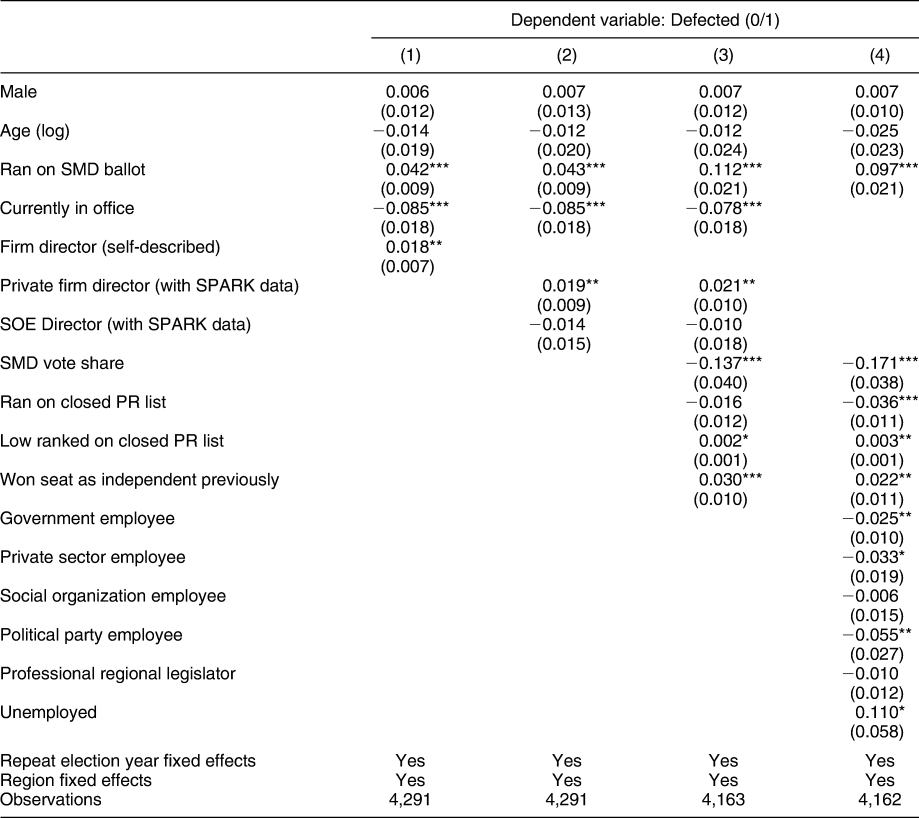
To assess the determinants of defection, we use linear probability models (OLS).Footnote 27 The main outcome variable, defection, takes a value of 1 if a United Russia candidate defected in the second election of a given sequence, and 0 if they ran in the second election under the UR banner. Each observation is an electoral sequence, as described above. Before adding region-level covariates to the models, we first present models focusing on the individual (candidate)-level determinants of defection (Table 1). These models include both fixed effects for region and for the year of the second election in the sequence.
Individual Determinants of Defection

***p < 0.01, ** p < 0.05, * p < 0.1. This table examines individual-level covariates. Firm Director (self-described) is a dummy for whether the candidates indicated they were part of a private firm’s upper management; Private Firm Director and SOE Director add further information from the SPARK database. The reference category for the three firm-related variables is all other non-businessperson candidates. Likewise, the reference category for the occupation dummies is all businesspeople. All models use OLS with repeat election year and region fixed effects and cluster standard errors on region and year.
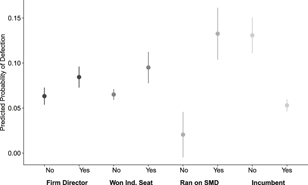
The results reveal support for several of our candidate-level hypotheses. First, we find that incumbency is negatively correlated with defection. Candidates who held seats at the time of the second election in the sequence are less likely to defect. These incumbents found success affiliating with United Russia and are hesitant to break ranks for fear of jeopardizing their position in the legislature.Footnote 28 As Figure 2 shows, this effect is substantial. While holding all other covariates at their means, an incumbent has a predicted probability of defection of 5%, while the predicted probability for non-incumbents is over 2.5 times as high (13%).
Individual-Level Substantive Effects
Figure presents the predicted probability of defection based on different values of the predictors shown in bold. The model used to generate the probabilities comes from column 3, Table 1. All other predictors are held at their means.

Next, we find that candidates with autonomous resources are more likely to defect from United Russia. Candidates that had previously won election as an independent in a single-member district are significantly more likely to leave the ruling party. The electoral resources they employed to win election in the past may be transferrable to future contests.
The situation is similar with firm directors, who have financial and organizational resources that can aid their electoral independence. We see that the point estimates on both measures of firm director are positive and statistically significant.Footnote 29 What is interesting is that the point estimate for state-owned enterprises directors is not statistically different from the reference category (all non-businesspeople). SOE directors have less autonomy from the state than do private businesspeople.
We also find that the importance of occupational autonomy extends to other types of employment. Government employees are far less likely to defect than private businesspeople (the reference category in column 4, Table 1). Defecting from the party could put a candidate’s employment at risk. Likewise, candidates that were formally employed in the ruling party prior to the first election of the sequence are more likely to remain loyal. Finally, results on some of the individual-level control variables are also noteworthy, but we discuss them in Appendix Section C.
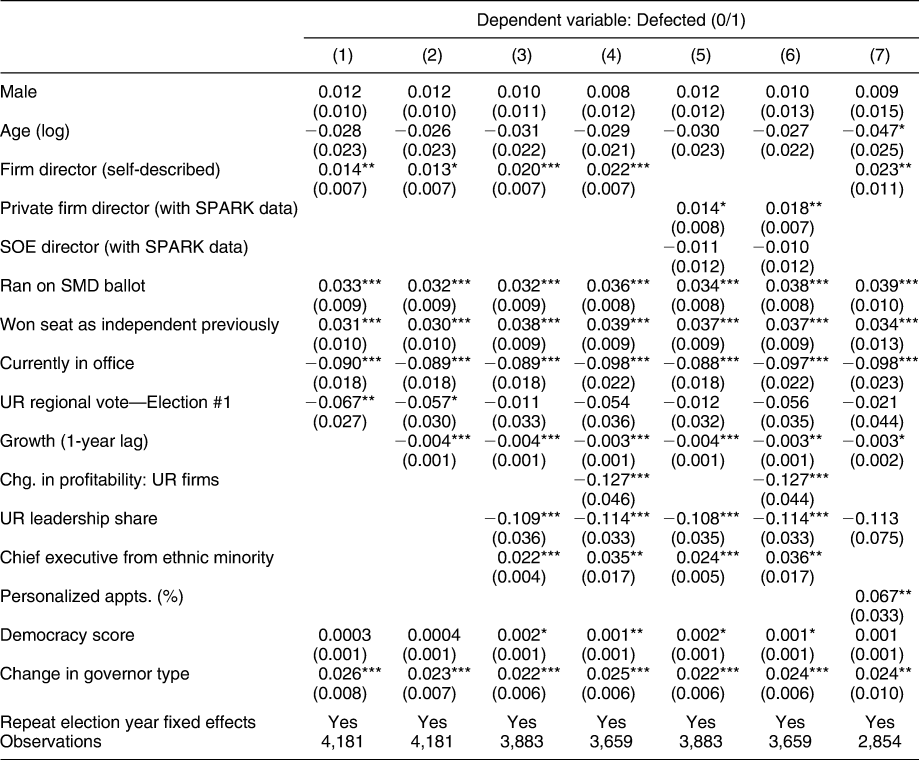
In Table 2, we add region-level predictors to test Hypotheses 1–4.Footnote 30 The results indicate support for our hypotheses about votes and spoil access. We begin with a simple model that includes only individual level characteristics and several regional covariates, before varying the inclusion of predictors moving left to right. First, in column 1, we see evidence that defections are more likely when UR’s vote share in the region is lower. The higher the ruling party’s vote share, the lower the chance of defections. But this effect falls short of statistical significance once we include economic growth in the model (starting in column 2). This makes sense given that the two variables are correlated and both are proxies for electoral benefits. Higher growth in the year prior to the second election in the sequence significantly and consistently decreases the likelihood of a defection.
Regional Determinants of Defection

***p < 0.01, ** p < 0.05, * p < 0.1. This table examines both individual- and region-level covariates. The reference category for the three firm director variables is all non-businessperson candidates. All models use OLS with repeat election year fixed effects and cluster standard errors on region and year.
We also find support for our hypotheses about spoil access (Hypotheses 2 and 3). The negative coefficient on Chg. In Profitability: UR Firms indicates that defections are less likely when firms connected to UR deputies are overperforming. In settings where UR deputies are able to secure significant benefits for their firms, candidates are less likely to defect. Defections then become more frequent when fewer rents are available to UR members.
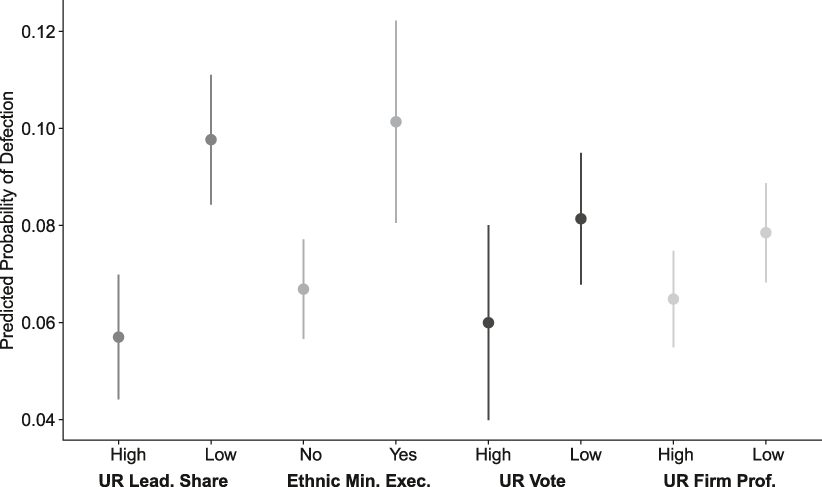
The choice of spoil distribution strategy also figures prominently in the decision about whether to defect. We find that in regions where key leadership posts are shared with opposition parties, United Russia candidates are more likely to defect (Hypothesis 3). When the regime takes spoils away from its own affiliates and gives them to the opposition, UR members understand their chances of receiving spoils through the ruling party have decreased, while the possibility of receiving spoils as members of the opposition have increased. The effect of this variable is quite large. As Figure 3 shows, the probability of a candidate defecting is 5.7% when United Russia keeps all leadership positions for itself. When United Russia shares 35% of leadership positions with the opposition, the predicted probability of defection jumps by three-fourths to nearly 10%.Footnote 31
Regional-Level Substantive Effects
Figure presents the predicted probability of defection based on different values of the predictors shown in bold. The model used to generate the probabilities comes from column 4, Table 2. A High level for the UR Leadership Share variable indicates that no positions were shared with the opposition (90th percentile), while the Low level indicates that 64% of positions were given to UR deputies (10th percentile). The Ethnic Minority Executive categories take a yes/no, while the low and high categories for UR vote share and UR firm profitability are set at the 10th and 90th percentiles. All other predictors are held at their means.

One might object that this correlation is spurious because the opposition’s share of leadership positions is just a proxy for its political strength, and a strengthening opposition should lead to more defections. There are several reasons to be skeptical of this interpretation. First, there is no mechanical relationship between the opposition’s share of leadership positions and their vote share. UR controls majorities in all regions and decides whether/when to distribute leadership posts to the opposition. Second, regime change is not possible in the subnational context we study. So a strengthening opposition should only make defections more likely because it signals the electoral softening of the regime. And yet, we include a control for UR’s regional vote share in all models. This estimate is also robust to including a measure of economic growth, another proxy for the opposition’s latent popularity. Finally, in Appendix Table D.3, we show these results are robust to controlling for the number of protests staged by the opposition—in particular the Communist Party and non-system opposition groups—which is a non-electoral measure of the opposition’s level of regional mobilization. In sum, we feel reasonably confident that the partial effect of UR Leadership Share is tapping spoil distribution and not the underlying strength of the opposition.
More personalist regimes, first defined as ethnic republics with a president from the ethnic minority, see greater rates of defections from the ruling party. The lack of institutional constraints on leaders in these regions exacerbates commitment problems and makes the promise of future spoil-sharing more uncertain. The other measure of personalism we employ, the percentage of bureaucratic posts given to loyalists of the chief executive, is positively signed and statistically significant. We include this variable in a separate model (Model 7) because its limited availability results in substantial loss of data. Robustness checks testing other dimensions of personalism return similar results and can be found in Appendix Section F.1.
Above, we treat defection as a binary choice: Stay with UR or leave and run with another affiliation. But defecting candidates actually face multiple choices: They may choose to run as an independent or they may choose to join the opposition. In Appendix Table H.1, we estimate a multinomial logit model, in which the categorical outcome is equal to 0 for non-defections, 1 for defections to the opposition, and 2 for defections to run as an independent. The results are mostly consistent across the two types of defections, but some differences are worth highlighting. For one, UR Leadership Share does a much better job predicting defections to the opposition than it does predicting defections to run as an independent. When the regime shares more spoils with the opposition, cadres calculate that they can do better by defecting to those parties. Independents are less able to demand these spoils because they are not affiliated with social groupings that can credibly threaten unrest. It is also noteworthy that firm directors are more likely to become independents. Such candidates can draw on their economic resources to maintain autonomy, even from opposition parties.
CONCLUSION
This paper was motivated by a central question: When do elite coalitions organized under the aegis of a dominant party breakdown? And while we cannot analyze an (unobserved) instance of regime breakdown in Russia, we believe our findings shed light on this question. Like seismologists who study not just earthquakes but also the vibrations that constantly reverberate through the Earth’s crust, we study the strains and disruptions that occur beneath the surface in Russia’s ruling party. And just as seismologists cannot predict the exact location of an earthquake, we cannot predict the exact date of regime breakdown in Russia or any other autocracy. Seismologists do, however, predict seismic hazard and can tell us where and when earthquakes are more likely to occur. Ours is a similar task. By studying trends and tendencies at the regional level in Russia, we hope to gain insight into the conditions that make autocratic elite coalitions more likely to collapse.
We developed a simple cost-benefit framework to explain electoral defections in Russia’s regions. Defections were more likely when opportunities for accessing spoils and securing votes were jeopardized in some way. For instance, we found that defections increase when opportunities for rent-seeking diminished, particularly when United Russia shared more spoils with the opposition in order to co-opt them. But it is not just the raw amount of spoils that matters. Defections were more likely to occur in more personalist regions where the lack of institutional constraints on leaders increases uncertainty about how those spoils will be distributed in the future. Finally, the individual characteristics of candidates matter. More interestingly, those candidates with political resources of their own, such as personal followings and business assets, were more likely to defect.
Our findings suggest several amendments to the current literature on authoritarianism. For one, more attention should be paid to the tradeoffs between various authoritarian survival strategies. The tradeoff between personal control and elite dissension is well-understood, but others are less appreciated. The literature almost unanimously argues that rational autocrats should co-opt the opposition and take measures to keep elites loyal. But spoils are not infinite, and by co-opting the opposition, the regime risks depriving insiders of spoils and leaving them disgruntled. A rising opposition leads not just to external pressure on the regime, but also to the collapse of elite coalitions from within. Conversely, leaders may not be able to satisfy all regime insiders without limiting the spoils available to co-opt the opposition. Thus, maintaining strong regime institutions can actually undermine the ability of the regime to fend off threats from the opposition. We have exposed this tension in this paper, but we have not provided a solution to it. Future research might profit in this area.
A similar tradeoff confronts the regime in the area of elite recruitment. As Egorov and Sonin (Reference Egorov and Sonin2011) and Zakharov (Reference Zakharov2016) have argued, dictators face competing appointment incentives. Competent viziers are desired for their ability to help govern, but they are also more likely than loyal cronies to betray the dictator. We have identified a similar tradeoff in electoral politics. The regime would like to draw on the resources of strong elites to help them win elections, but resourceful elites are the most likely to abandon the regime when the chips are down. The exit of prominent elites may signal regime weakness and trigger a wider cascade. Regimes may be better off undermining and/or expropriating powerful elites within society, lest they betray the coalition later.
These findings also have implications for Russian politics. While we have documented that regional defections have real costs in Russia, the regime has not witnessed the type of large scale defections seen in some other autocracies and there have been few defections at the national level. Our analysis of regional defections points to some of the reasons why elite cohesion is higher in Russia than it has been in many other autocracies. For example, Putin’s consistently high popularity ratings give UR candidates an electoral advantage, and hydrocarbon revenues ensure that the regime has ample spoils to share. Russia also has a comparatively large public sector and even much of the private business elite is rooted in asset-immobile sectors that are dependent on the state. Institutional reforms—such as the switch to an all PR electoral formula for the 2007 and 2011 State Duma elections and the cancellation of direct gubernatorial elections between 2005 and 2012—undermined the independent power bases of regional elites. And finally, the regime has been careful about sharing too many spoils with the opposition at the national level. In contrast to many other autocracies, especially in Africa, the regime has not destabilized its own coalition by giving high-profile cabinet positions to the opposition. Our analysis suggests that a significant change in one or more of these factors could spur defections at the national level as well.
SUPPLEMENTARY MATERIAL
To view supplementary material for this article, please visit https://doi.org/10.1017/S0003055419000030.
Replication materials can be found on Dataverse at: https://doi.org/10.7910/DVN/B1HHGV.




Comments
No Comments have been published for this article.