Introduction
The intergenerational clustering of specific mental illnesses has long been observed (Rutter, Reference Rutter1966) and has provided support for the pursuit of diagnosis-specific causal mechanisms. Intergenerational risk of mental illness extending beyond concordant diagnoses to the risk of diagnostically-related illnesses is now well established, with offspring of parents diagnosed with schizophrenia having an elevated risk of developing bipolar disorder, for example Van Snellenberg & de Candia (Reference Van Snellenberg and de Candia2009). Whether such overlap extends even further to include apparently diagnostically unrelated disorders is less clear but a number of recent studies suggest the inherited risk for mental disorders may well span a broad spectrum of diagnoses (Dean et al. Reference Dean, Stevens, Mortensen, Murray, Walsh and Pedersen2010; Rasic et al. Reference Rasic, Hajek, Alda and Uher2013). Such findings have important implications, not only for understanding the extent to which current diagnostic approaches have utility when applied to the identification of the causes of mental illness, but also for informing early identification and intervention strategies. Accumulating evidence of a lack of concordance in parent-offspring psychiatric diagnoses is also consistent with the notion of a general factor of psychopathology (the p factor) underlying the apparent overlap in symptoms across diagnoses (Caspi et al. Reference Caspi, Houts, Belsky, Goldman-Mellor, Harrington and Israel2014; Murray et al. Reference Murray, Eisner and Ribeaud2016), and thought likely to have a strong genetic basis (Pettersson et al. Reference Pettersson, Larsson and Lichtenstein2016). It may be that this general factor of psychopathology is shared between parents and offspring, giving rise to a lack of diagnosis-specific intergenerational associations. Further, while mental disorders in adult offspring of affected parents have been well studied, it is increasingly understood that manifestations of intergenerational risk, including sub-clinical signs of emerging psychopathology, may appear much earlier in the lives of offspring, bolstering the potential for early identification of those at risk. The evidence to support early life antecedents of mental illness in those at elevated familial risk arises predominantly from studies focused on specific diagnostic groups, such as the high-risk longitudinal studies of offspring born to parents, usually mothers, with severe mental illnesses (Welham et al. Reference Welham, Isohanni, Jones and McGrath2009; Mesman et al. Reference Mesman, Nolen, Reichart, Wals and Hillegers2013). Fewer studies have examined antecedents in offspring born to parents affected by other disorders, with the exception of perinatal depression (Luoma et al. Reference Luoma, Tamminen, Kaukonen, Laippala, Puura and Salmelin2001), while studies that have simultaneously included the full spectra of diagnoses in parents and domains of vulnerability in children are lacking. In addition, few studies have examined the impact of affected fathers and thus the potentially important role of assortative mating on the developmental trajectory of mental disorders (Plomin et al. Reference Plomin, Krapohl and O'Reilly2016), at least partly on the basis that mothers with mental illness are often assumed to have a greater impact on offspring development.
The current study aimed to examine the nature of vulnerabilities emerging in early childhood across the externalising and internalising spectrum emerging in relation to parental mental illness across the full range of diagnoses, in a large population-based intergenerational cohort. We hypothesised that offspring externalising and internalising vulnerabilities would be associated with all types of parental mental health diagnoses, that associations would be present for offspring with affected mothers or affected fathers, and that these associations would be relatively greater where both parents were mentally ill.
Methods
Design and sample
The New South Wales Child Development Study (NSW-CDS) is a longitudinal population-based cohort study utilising multi-agency, inter-generational record linkage methodology (Carr et al. Reference Carr, Harris, Raudino, Luo, Kariuki and Liu2016). The child cohort includes all those children who entered their first year of full-time schooling in the state of New South Wales in Australia in 2009 (aged approximately 5 years) and who were assessed by their teachers using the Australian Early Development Census (AEDC) (Brinkman et al. Reference Brinkman, Gregory, Goldfeld, Lynch and Hardy2014). The AEDC was completed for the vast majority of children entering school across the state (approximately 99%, N = 87 026), providing the basis for a whole-of-population cohort (full sample and study details are provided in a published cohort profile paper (Carr et al. Reference Carr, Harris, Raudino, Luo, Kariuki and Liu2016)).
Cohort children were linked to a variety of population-based administrative databases. Linkage to parental information was possible for those children with NSW birth registration records (N = 72 245). Parental records for this subsample were also linked to a variety of administrative databases including the NSW Ministry of Health's Mental Health Ambulatory (detailing community mental health contacts but not emergency department or primary care contacts) and Admitted Patients Data Collections (detailing all hospital admissions). The sample for the current study was further restricted by excluding those children identified as having special needs by teachers completing the AEDC (i.e. those children with chronic medical, physical, or intellectually disabling conditions, for whom limited AEDC data are available). The socio-demographic profile of the subsample of the NSW-CDS cohort used for the current study (n = 69 116) has been compared with the full cohort and to the general population at the state and national level with no major group differences identified (Carr et al. Reference Carr, Harris, Raudino, Luo, Kariuki and Liu2016).
All data linkage for child and parent cohort members was undertaken by an independent government agency, the Centre for Health Record Linkage (CHeReL: www.cherel.org.au/), which obtained data directly from data custodians in order that the researchers would not have access to any identifying information. The CHeReL employed probabilistic linkage methods to match individuals across different datasets relying on the identifying information provided on individuals by each data custodian. Matching variables, including name, date of birth, residential address and sex, were obtained for each dataset, where available. Definite and possible matches between datasets were identified on the basis of matching probabilities (0.75 was set as the upper probability threshold for assigning ‘true matches’ and 0.25 the lower threshold for assigning ‘false matches’). Clerical reviews were conducted on all pairs with probabilities between the thresholds. Optimal linkage rates were achieved using this process [see details provided in the published cohort description for more information (Carr et al. Reference Carr, Harris, Raudino, Luo, Kariuki and Liu2016)]. Data provided to researchers for analysis was in de-identified form only. Ethical approval for the research was obtained from the NSW Population and Health Services Research Ethics Committee (HREC/11/CIPHS/14) and the University of New South Wales Human Research Ethics Committee (HC11409), with data custodian approvals granted by the relevant Government Departments.
Assessment of mental illness in parents
Data on the mental health of parents, including ICD-10 diagnoses, were obtained from the NSW Ministry of Health's Mental Health Ambulatory (for the years 2001–2009) and Admitted Patients (years 2000–2009) Data Collections. Details on each admission to hospital with a psychiatric diagnosis (ICD 10 Chapter V, F00-99 codes) listed as either a primary or additional diagnosis and each episode of ambulatory (i.e. community or outpatient) mental health service contact (episodes defined within 3-month calendar periods) (Sara et al. Reference Sara, Luo, Carr, Raudino, Green and Laurens2014) were obtained up to the 31 December 2008 (the year prior to AEDC assessment) for all mothers and fathers of children in the cohort. Any psychiatric diagnosis assigned to a hospital admission episode and the primary diagnosis occurring latest in a 3-month calendar period for ambulatory contact were considered the relevant diagnoses for an episode of care. After exclusion of specific ICD-10 diagnostic code categories included in the raw data (those relating to physical health diagnoses only, those coded as health contact for contextual reasons, and those where a psychiatric diagnosis was coded as not applicable), the following broad psychiatric diagnostic categories were developed (see online Supplementary Table S1 for ICD-10 codes included in each broad group):
1. Severe mental illness;
2. Common mental disorder;
3. Personality disorder;
4. Substance abuse;
5. All other adulthood-onset illness (e.g. organic disorders, eating disorders, sleep disorders, disorders not otherwise classified or not yet all located);
6. All other childhood-onset illness (e.g. hyperkinetic disorders, conduct disorders, mental retardation, pervasive developmental disorders);
Whilst these six broad groupings comprised mutually exclusive sets of ICD-10 codes (i.e. codes for schizophrenia appeared only in Group 1, and codes for anxiety disorders appeared only in Group 2), the groups created for analysis were not mutually exclusive. That is, offspring could appear in more than one broad parental diagnosis group if a parent was diagnosed with more than one psychiatric diagnosis belonging to more than one broad group throughout the course of available data collections. Sensitivity analyses were undertaken with mutually exclusive versions of the same categories created on the basis of the last episode of parental mental health contact occurring prior to the end of 2008 (Sara et al. Reference Sara, Luo, Carr, Raudino, Green and Laurens2014).
Assessment of early childhood outcomes
The AEDC is a modified version of a validated Canadian instrument (Janus & Offord, Reference Janus and Offord2007) which is completed by teachers on the basis of at least 1 month's knowledge of the child (typically, teachers have at least 5 months’ knowledge of the child). The AEDC is an instrument designed to measure development in five key domains: physical health and wellbeing, social competence, emotional maturity, language and cognitive development, and communication skills and general knowledge. Sub-domains within each of the five domains have also been identified. Three specific subdomains covering both externalising and internalising features were selected from the AEDC emotional maturity domain: aggressive problems, hyperactive and inattentive behaviour and, anxious and fearful behaviour (Janus, Reference Janus2010). For each subdomain, children were classified as vulnerable (in the lowest 10th centile) or not (remaining 90th centile) of the national 2009 AEDC sample. Online Supplementary Table 2 lists the individual teacher-rated items included in each of the three subdomains of interest. Between 437 and 469 children had invalid data on one of the three AEDC subdomain classifications due to inadequate completion of relevant AEDC items; these children were excluded from analyses involving the relevant subdomain data.
Consideration of covariates
The following socio-demographic factors were considered potential confounders of relationships between history of parental mental illness and externalising/internalising vulnerabilities: mother's age at birth of the child cohort member (three levels: ⩽26.0, >26.0, and ⩽36.9, >36.9 years), child age at AEDC assessment (three levels: <5, 5, and >5 years), having English as a Second Language, and SEIFA (Socio-Economic Index for Area), a five-level (quintile) area-based index of socio-economic disadvantage (Pink, Reference Pink2013). The latter three variables were obtained from the AEDC dataset, and the mother's age from birth registration data.
Statistical analyses
Logistic regression models were used in all analyses of the hypothesised associations between offspring history of parental mental illness and externalising/internalising vulnerabilities. These analyses provided odds ratios (ORs) and their 95% confidence intervals (CIs); results were statistically significant if the 95% CI did not cross 1.00. The unexposed reference group for all analyses comprised the group of children without any history of parental mental illness. The impact of the parental diagnostic group on children born to at least one parent with any mental disorder was considered and then results were stratified first by sex of the affected parent and then by offspring sex. Offspring of two affected parents were also considered where numbers allowed. The main effect of parental diagnoses (in either parent) was adjusted for the selected covariates. Departure from the multiplicative logistic regression models was used to formally test the potential interaction of parental diagnosis with the sex of the offspring (by adding an interaction term to the multivariate model) and sex of the affected parent (by formally comparing the stratified models for affected fathers and mothers). Finally, a series of sensitivity analyses were undertaken to determine the impact of restricting parental diagnostic classification to mutually exclusive categories of parental mental illness.
Results
Of the 69 116 children in the sample, 15.3% (n = 10 563) had at least one parent with a psychiatric diagnosis; 4127 (5.97%) had an affected father, 7498 (10.85%) an affected mother, and 1184 (1.71%) had both parents with a psychiatric diagnosis.
Broad diagnostic categories of parental mental illness and early childhood psychopathology
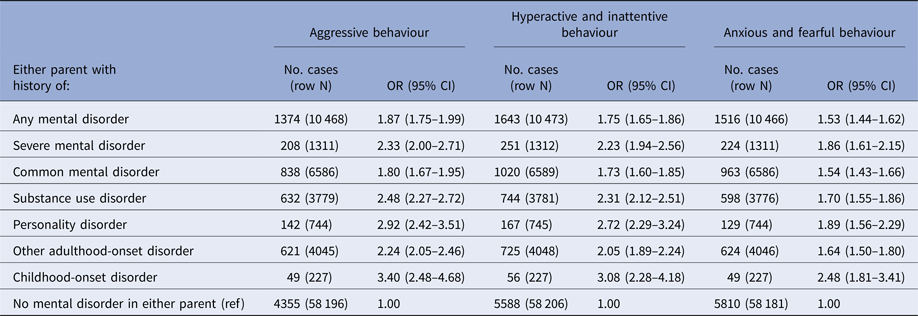
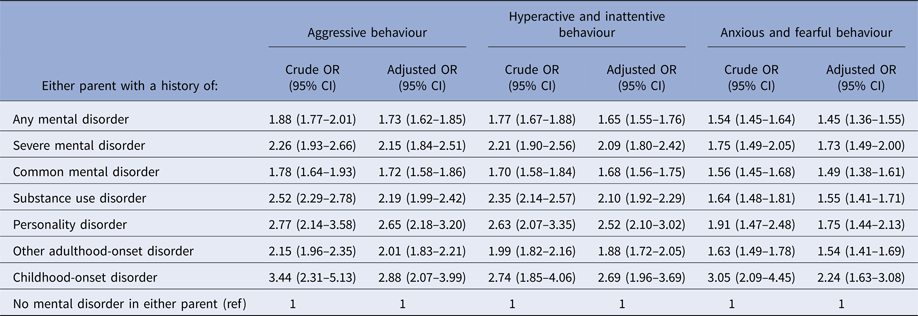
Compared with children with no mental disorder in either parent, those with at least one parent with any mental disorder had elevated risks of vulnerability across all three subdomains of interest: OR 1.87 (95% CI 1.75–1.99) for aggressive behaviour, OR 1.75 (95% CI 1.65–1.86) for hyperactive and inattentive behaviour, and OR 1.53 (95% CI 1.44–1.62) for anxious and fearful behaviour. When each of the six broad diagnostic categories was considered, significant associations were found for all categories in relation to all three subdomains (Table 1). The strongest effect appeared to be for children born to at least one parent with a childhood-onset disorder although the cell sizes in this diagnostic category were the smallest. Effect sizes were generally stronger for the two externalising domains. Adjustment for covariates reduced the strength of associations but all associations remained statistically significant (Table 2).
Offspring with history of parental mental disorder (in either parent) and subdomain vulnerability (unadjusted associations)

No., number; OR, odds ratio; CI, confidence interval; ref, reference category.
Offspring with history of parental mental disorder (in either parent) and subdomain vulnerability (adjusted for child sex, maternal age at birth, child English as a Second Language, and Socio-Economic Index for Areas)

No., number; OR, odds ratio; CI, confidence interval; ref, reference category; adjusted analyses are undertaken on a reduced sample due to missing data for maternal age at birth (n = 617 missing).
Impact of having two affected parents, sex of the affected parent, and sex of offspring
The presence of mental disorder in a parent was positively associated with the mental disorder in the other parent (p < 0.001). Children born to two parents with any mental disorder (n = 1184; 1.71%) had almost three times the odds (unadjusted) of being vulnerable in terms of aggressive behaviour than children without parental mental disorder (OR 2.85, 95% CI 2.45–3.31), with elevated risk also seen for the other two subdomains (online Supplementary Table S3).
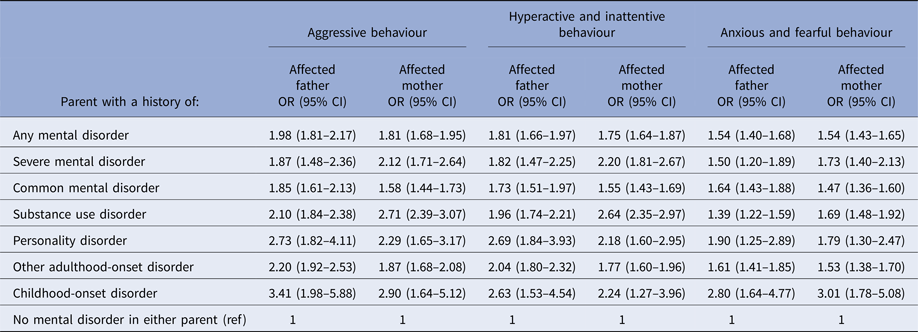
Repeated analyses stratified by parental sex indicated that significant associations between all categories of parental mental disorder and all subdomains were present for both offspring with affected mothers and offspring with affected fathers (Table 3; raw numbers in online Supplementary Table S4). Interaction by parental sex was formally tested (by comparing the models stratified by parental sex) and a statistically significant interaction was identified in the specific case of the parental history of substance use disorder with the effect of the maternal disorder being greater than paternal for each of the two externalising subdomains. A sensitivity analysis using parental diagnosis based on the most recent mental health contact, with results stratified by sex of the affected parent, was also conducted and these results were similar to those initially produced (tables available from authors on request).
Offspring with paternal and maternal history of mental disorder and subdomain vulnerability (unadjusted associations)

No., number; OR, odds ratio; CI, confidence interval; ref, reference category; the raw numbers for each cell can be found in online Supplementary Table S4.
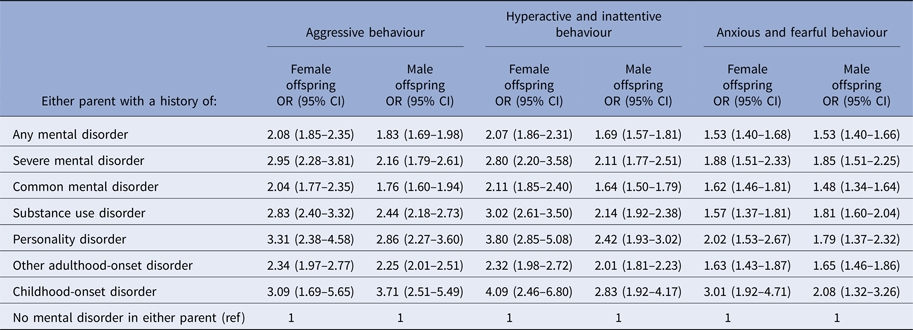
The main analysis was repeated with stratification by offspring sex. Having at least one parent with a history of any mental disorder was associated with offspring vulnerability across the three subdomains for both male and female offspring (Table 4; raw numbers in online Supplementary Table S5). For most associations, the size of effect appeared to be greater for female compared with male offspring, particularly in the case of vulnerability in the two externalising subdomains. When interaction by offspring sex was formally tested in the fully adjusted model (by adding an interaction term to the unstratified model), statistically significant interaction was identified for three specific associations – the effect on hyperactive/inattentive vulnerability was greater for female than male offspring with at least one parent having a common mental disorder, substance use disorder or personality disorder.
Female and male offspring with parental history of mental disorder (in either parent) and offspring subdomain vulnerability (unadjusted associations)

No., number; OR, odds ratio; CI, confidence interval; ref, reference category; the raw numbers for each cell can be found in online Supplementary Table 5.
Discussion
In this population-based intergenerational record linkage study, we have demonstrated that emerging psychopathology in early childhood, of both externalising and internalising type, is associated with a history of parental mental illness spanning the entire psychiatric diagnostic spectrum. Both mothers and fathers with mental illness had an impact on a vulnerability in their children; those born to two parents affected by mental illness were at even greater risk. The impact of a history of parental mental illness on male and female offspring was comparable for most associations, with some limited evidence of increased vulnerability for a girl, with a parental history of the common mental disorder, substance use disorder, and personality disorder.
Main findings
Overall, our findings support the notion that intergenerational risk of psychopathological vulnerability in offspring is not specific to any particular type of parental mental disorder. This may reflect a degree of commonality among causes of mental illnesses, undermining diagnostic specificity (Dean, Reference Dean2012), although it remains possible that different underlying mechanisms give rise to common overt signs of vulnerability, particularly early in development. This will be an important issue to examine in future when the children in this cohort reach critical ages for onset of particular mental disorders in adolescence and adulthood. While most previous studies of emerging psychopathology and antecedents of mental illness in high-risk offspring have focused on particular diagnoses in parents (Fergusson & Lynskey, Reference Fergusson and Lynskey1993; Hameed & Lewis, Reference Hameed and Lewis2016), a lack of specificity has been noted in the few studies where different diagnoses of parents are compared and in a recent systematic review found evidence to support a range of shared risk factors and antecedents for non-affective and affective psychoses (Laurens et al. Reference Laurens, Luo, Matheson, Carr, Raudino and Harris2015). Our findings also accord with studies focused on older offspring during later stages of development, where evidence of risk for psychiatric disorders spanning traditional diagnostic categories comes from intergenerational studies of discordant but diagnostically-related mental illnesses, including from a number of the high-risk follow-up studies of offspring born to parents with certain severe mental illnesses (Rasic et al. Reference Rasic, Hajek, Alda and Uher2013). While few studies have considered the full diagnostic spectrum in both parents and offspring (Dean et al. Reference Dean, Stevens, Mortensen, Murray, Walsh and Pedersen2010), evidence for commonality in offspring diagnostic outcomes across parental diagnostic groups does come from systematic reviews of studies focused on a range of parental diagnoses (van Santvoort et al. Reference van Santvoort, Hosman, Janssens, van Doesum, Reupert and van Loon2015).
The lack of interaction by parental sex in the current study is of particular interest given that the impact of mental illness on offspring is often assumed to be greater for those with affected mothers than fathers. While the literature to date has been dominated by studies focused on mothers (Phares & Compas, Reference Phares and Compas1992), a recent meta-analysis of maternal v. paternal psychopathology in relation to child outcomes has reported stronger associations for affected mothers on child internalising, but not externalising, problems and the former identified difference for internalising problems was small (Connell & Goodman, Reference Connell and Goodman2002). In our study, the one circumstance in which parental sex had a significant interaction effect was in the case of mothers with substance use disorders, where a stronger impact on all types of offspring psychopathology was found. This finding has not been highlighted in previous studies and requires further replication and exploration, including the potential for an explanation to be found in maternal substance use during pregnancy. We also found evidence for an impact of assortative mating such that children born to two affected parents had a particularly high risk of vulnerability, although we were unable to look in further detail at whether particular combinations of parental diagnoses influenced offspring vulnerability. Overall, our findings highlight the importance of considering the impact of both mothers’ and fathers'mental illness on child development.
While we found evidence of associations between all parental diagnostic groups and all three subdomains of externalising and internalising vulnerabilities, there were a number of apparent variations in the strength of associations. For example, across all parental diagnostic groups, the strength of associations appeared higher for externalising than internalising vulnerability in offspring, consistent with an early classic study of children of mentally ill parents (Rutter & Quinton, Reference Rutter and Quinton1984). It may be, however, that externalising behaviours are simply a more conspicuous response to stress or vulnerability in childhood and are thus more easily detected by teachers (who provided the AEDC ratings). The lack of multiple raters of child vulnerability is also an issue here, particularly given the evidence that correlations between teacher and parent reports is less robust for internalising problems (Grietens et al. Reference Grietens, Onghena, Prinzie, Gadeyne, Van Assche and Ghesquière2004). We also found some evidence, albeit on the basis of relatively small numbers, that parents with childhood-onset disorders (ADHD, conduct disorder, pervasive developmental disorders) had the greatest impact on offspring vulnerability across subdomains. This finding may reflect a degree of emerging concordance between parent and offspring psychopathology. Alternatively, the finding may reflect the impact of timing of onset (or duration) of parental mental disorder on vulnerabilities in offspring, such that parents with mental disorder beginning in childhood may have experienced particular challenges in developing effective parenting skills, for example (Rutter & Quinton, Reference Rutter and Quinton1984; Connell & Goodman, Reference Connell and Goodman2002). In support of the latter hypothesis, the associations between personality disorder in parents and offspring vulnerabilities were also strong.
Potential mechanisms underlying shared risks across diagnoses
While our study cannot separate genetic from environmental mechanisms underlying the associations between parental diagnoses and offspring vulnerabilities, the findings do have important implications for exploring potential mechanisms of the intergenerational transmission of mental disorders. In particular, our findings are consistent with the general factor of psychopathology or p factor literature (Caspi et al. Reference Caspi, Houts, Belsky, Goldman-Mellor, Harrington and Israel2014; Murray et al. Reference Murray, Eisner and Ribeaud2016), for which there is evidence to indicate a likely genetic basis (Pettersson et al. Reference Pettersson, Larsson and Lichtenstein2016).
In our study, we were able to include a range of socio-demographic variables in adjusted analyses and found that shared socio-demographic risk was evident across parental diagnostic groups but was not sufficient to explain individual associations. We were not able to consider a range of other potential mechanisms including marital or other family discord, prenatal factors, exposure to maladaptive parental affect, behaviour and cognitions, and contextual (or indirect) stressors (Rutter & Quinton, Reference Rutter and Quinton1984; Goodman & Gotlib, Reference Goodman and Gotlib1999). Parenting itself has been a focus of investigation in studies attempting to understand the mechanisms underlying intergenerational patterns of mental health risk (Johnson et al. Reference Johnson, Cohen, Kasen, Smailes and Brook2001; Fudge et al. Reference Fudge, Falkov, Kowalenko and Robinson2004; Smith, Reference Smith2004; Vostanis et al. Reference Vostanis, Graves, Meltzer, Goodman, Jenkins and Brugha2006). Whilst apparently environmental in nature, these latter mechanisms may themselves have underlying genetic contributions.
Strengths and limitations
The current study benefits from the advantages of population-based sampling and record-linkage methodology, in which selection biases (both sampling and attrition) and information biases are minimised, and generalisability enhanced. The sample is large and enables investigation of associations between relatively uncommon exposures and outcomes as well as subgroup analyses and formal tests for interaction. The findings presented here were limited to those children in the NSW-CDS cohort with birth registration in NSW and for whom AEDC subdomain information was available but we found no differences in socio-demographic profile between the subsample used and either the wider cohort or the general population (Carr et al. Reference Carr, Harris, Raudino, Luo, Kariuki and Liu2016). It should be noted that our measure of emerging childhood psychopathology relied on assessment by class teachers and did not benefit from other sources of information on the child. Misclassification of individuals as unexposed (i.e. without parental history of mental illness) is also possible for those parents where incorrect or inadequate identifying information was available in the birth registration dataset resulting in apparently failed linkage, where contact with health services occurred only prior to the period of reliable data collection or, importantly, where contact for mental illness treatment occurred only in primary care, emergency departments or with private mental health care providers. Such misclassification is likely to underestimate any association between parental mental illness and offspring psychopathology and is more likely to impact older parents and those with less severe mental illnesses or those otherwise excluded by services. We were also limited by a lack of information on potential mechanisms, including an inability to separate genetic from environmental effects, and on detailed information relating to parental psychopathology beyond diagnosis (Nordahl et al. Reference Nordahl, Ingul, Nordvik and Wells2007).
Implications
Parental mental illnesses across the diagnostic spectrum are associated with externalising and internalising vulnerabilities in early childhood, among offspring born to affected mothers and affected fathers. These findings have important implications for developing effective strategies for identifying and intervening with young people at risk of later development of mental illness. Such strategies should not be focused on particular psychiatric diagnoses in the parent(s), should not ignore the impact of paternal mental illness or assortative mating, and should not expect emerging psychopathology in offspring to necessarily concord with parental diagnoses. It may be that intervening early in children presenting with evidence of developmental vulnerabilities will have an impact on a wider range of diagnostic and other outcomes, rather than demonstrating specificity for prevention of particular mental illnesses. Our findings provide support for the notion that different psychiatric diagnoses likely share causal mechanisms adding further weight to the argument that future research may benefit by focusing less on diagnostic categories in the search for the causes of mental illness. Nonetheless, common patterns of vulnerability may still reflect a number of different and possibly specific underlying mechanisms, especially early in development. This complexity needs to be considered if causal mechanisms and potential targets for prevention and intervention are to be successfully delineated.
Supplementary material
The supplementary material for this article can be found at https://doi.org/10.1017/S0033291717003786
Acknowledgements
This research was conducted by the University of New South Wales with financial support from the Australian Research Council (ARC Linkage Project LP110100150, with the NSW Ministry of Health, NSW Department of Education and Communities, and the NSW Department of Family and Community Services representing the Linkage Project Partners); the National Health and Medical Research Council (NHMRC Project Grant APP1058652); the Australian Rotary Health (Mental Health Research Grant 104090), and the Australian Institute of Criminology (Research Grant CRG 19/14–15). KD was supported by Justice Health & Forensic Mental Health Network, NSW; KRL, FH, and VJC were supported by funding from the Schizophrenia Research Institute (Australia) using infrastructure funding from the NSW Ministry of Health; KRL was also supported by an ARC Future Felowship (FT170100294); MJG was supported by a NHMRC R.D. Wright Biomedical Career Development Fellowship (1061875). The New South Wales Child Development Study was conducted using population data owned by the NSW Department of Education; the Board of Studies, Teaching and Educational Standards NSW; the NSW Department of Family and Community Services; the NSW Ministry of Health; the NSW Registry of Births, Deaths and Marriages; the Australian Bureau of Statistics, and; the Bureau of Crime Statistics and Research. However the information and views contained in this study do not necessarily, or at all, reflect the views or information held by these Departments.
Declaration of interest
There are no conflicts of interest to declare for any author.